Old tires have a naturally heavy, industrial appearance, but a thoughtful coat of color can completely change the way they feel in a garden. The most successful Painted Tire Planter Ideas are not simply about making black rubber brighter. They use color as part of the overall garden design, coordinating the planter with flowers, foliage, surrounding materials, and the atmosphere of the outdoor space.
That difference matters.
A randomly painted tire can easily look like a quick recycling project. A carefully designed painted tire planter, however, can become a genuine decorative feature. The right palette can make an old tire feel playful and cheerful, soft and romantic, or surprisingly sophisticated.
The secret is restraint and coordination.
Instead of using every available color, choose a visual direction. Instead of covering the planter with too many decorative details, allow the flowers and foliage to remain important. And instead of treating each tire as an isolated object, connect it to the colors already present in the garden.
For this guide, we are focusing on three distinctly different approaches. The first uses a sophisticated muted palette for an elevated look. The second celebrates cheerful coordinated color without becoming chaotic. The third uses subtle botanical details to turn the planter itself into a piece of garden art.
Here are the 3 best Painted Tire Planter Ideas for giving old tires a colorful and surprisingly beautiful second life.
| Rank | Painted Tire Planter Idea | Main Visual Effect | Best For |
|---|---|---|---|
| 🥇 | Muted Botanical Color Tire Planter | Sophisticated and garden-friendly | Elegant patios and flower beds |
| 🥈 | Coordinated Color Block Tire Planter | Bright, cheerful and modern | Backyards and playful gardens |
| 🥉 | Hand Painted Botanical Tire Planter | Artistic and decorative | Garden focal points and entrances |
Important Note: Painted tires are best treated as decorative outdoor planters for ornamental plants. If the previous use and material history of an old tire are unknown, purpose-made food-safe containers are the more straightforward option for growing edible plants. Always follow the paint manufacturer’s preparation, compatibility, drying, and outdoor-use instructions.
🥇 Platz 1 Muted Botanical Color Tire Planter
The easiest way to make a painted tire look more sophisticated is surprisingly simple:
Do not make the color too loud.
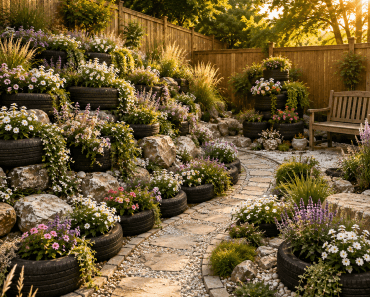
A Muted Botanical Color Tire Planter uses soft colors inspired by nature—sage green, dusty blue, warm terracotta, muted olive, clay, mushroom beige, charcoal, or creamy stone—to visually connect the tire with the garden around it.
Instead of screaming for attention, the planter becomes a supporting element for the flowers.
This subtle relationship between container and planting is what makes the concept our number one choice.
Start With Colors Already Found in Nature
Gardens contain enormous amounts of color, but much of it is naturally softened.
Leaves are rarely one flat green.
Soil contains browns, charcoal tones, and warm grays.
Stone introduces beige, cream, and muted mineral colors.
Weathered timber adds warm brown and silver-gray.
Borrowing from these colors helps an artificial painted surface feel more comfortable outdoors.
Consider shades such as:
- sage green,
- eucalyptus green,
- muted olive,
- warm clay,
- dusty terracotta,
- mushroom beige,
- stone gray,
- soft charcoal,
- muted blue-gray.
These colors are strong enough to transform the tire without overpowering the planting.
Sage Green Is Particularly Effective
Among all the possible colors, muted sage is especially versatile.
Why?
Because it sits naturally beside foliage.
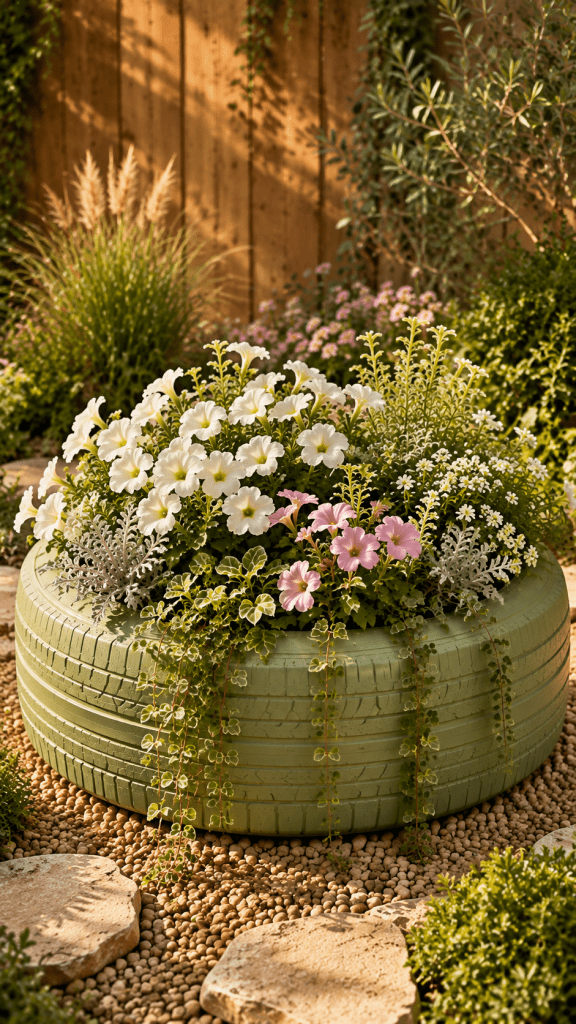
Imagine an old tire painted a soft gray-green shade and planted with creamy white flowers, pale pink blooms, and abundant trailing greenery.
From a distance, the tire almost merges with the foliage.
The flowers become the visual highlight.
This is very different from painting the same planter bright green. A saturated artificial green can compete with natural leaves, while sage provides a softer transition.
Sage also works beautifully with natural timber, gravel, stone, terracotta pots, and cream-colored walls.
That makes it suitable for many garden styles.
Terracotta Creates Warmth
Another beautiful option is muted terracotta.
This color visually references traditional clay pots, which means the tire begins to borrow some of the familiarity of conventional garden containers.
Pair a dusty terracotta tire with:
white flowers + soft yellow accents + green foliage
for a warm Mediterranean-inspired combination.
Or use:
terracotta + pale pink flowers + burgundy foliage
for something richer.
Place the planter near weathered wood, natural stone, or gravel and the industrial origin of the tire becomes much less obvious.
Dusty Blue Creates a Softer Romantic Look
Dusty blue works especially well in cottage-inspired gardens.
It pairs beautifully with:
- white,
- lavender,
- pale pink,
- silver foliage,
- soft green.
A dusty blue tire filled with cascading white flowers and lavender-toned blooms can look surprisingly delicate.
The contrast is interesting because the original material is anything but delicate.
That transformation is part of the appeal.
Match the Flower Intensity to the Paint
One useful design rule is:
The stronger the container color, the simpler the flower palette should be.
If your painted tire is subtle sage, you have room for stronger flowers.
If the tire is deep terracotta or blue, slightly calmer flowers may create better balance.
You do not want the container and flowers competing for the same level of attention.
One should lead.
The other should support.
Use One Color Across Several Tires
If you have multiple tire planters, painting every one a different color is not your only option.
Try repeating the same color.
Three sage tire planters positioned in different parts of the garden immediately create visual continuity.
You could also use a tonal palette:
deep sage → medium sage → pale sage
The containers remain related without being identical.
This is an excellent strategy for making recycled planters feel more like part of a designed landscape.
Pair Muted Paint With Natural Materials
The surrounding surface matters.
A beautifully painted tire placed on neglected ground may still look unfinished.
Instead, position it among materials such as:
- pea gravel,
- mulch,
- natural stone,
- brick,
- weathered timber,
- low groundcover.
These textures make the planter feel anchored.
A sage tire on pale gravel beside weathered timber, for example, creates a much more cohesive composition than the same planter sitting alone on concrete.
Why This Idea Takes First Place
The Muted Botanical Color Tire Planter is our 🥇 winner because it offers perhaps the best balance between creativity and sophistication.
It still clearly transforms an old tire.
It still introduces color.
But it does not rely on novelty alone.
With the right planting, it can genuinely complement a beautiful garden.
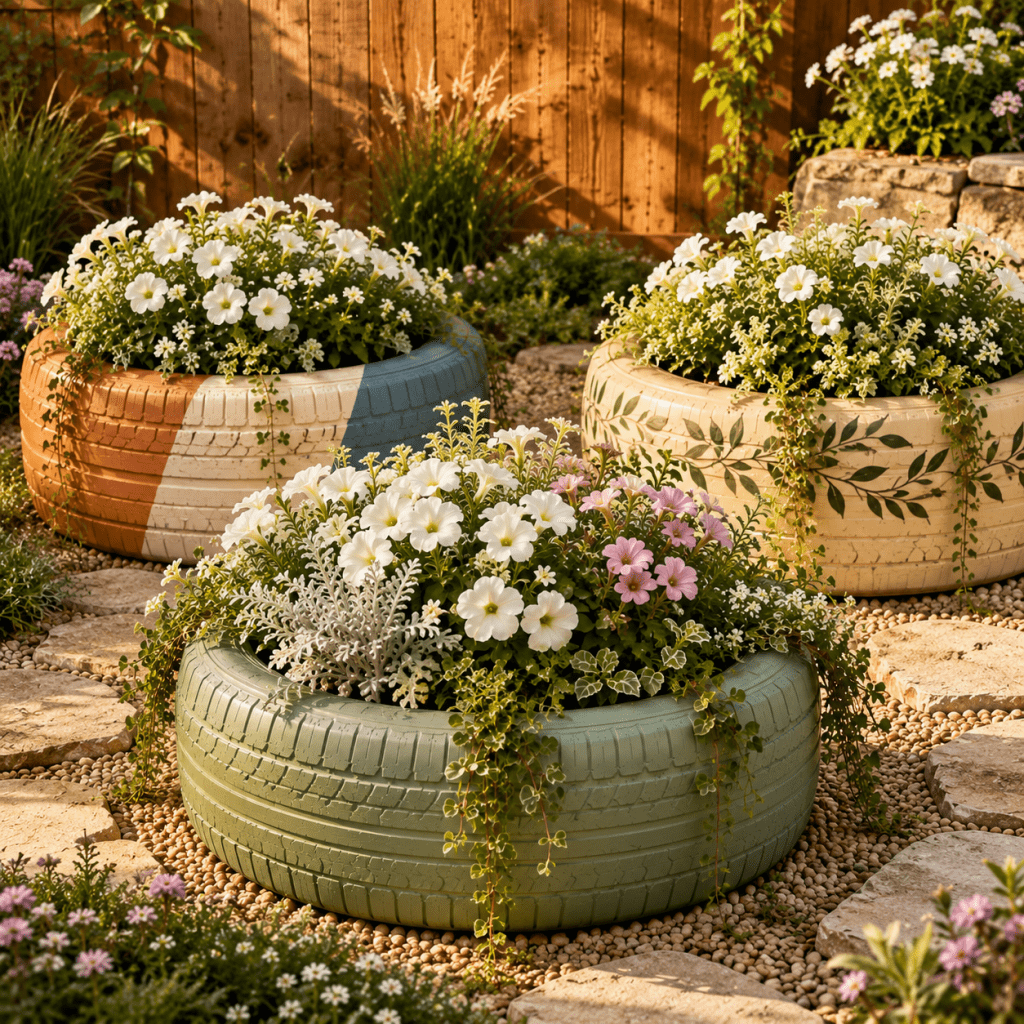
🥈 Platz 2 Coordinated Color Block Tire Planter
Sometimes subtle is not the goal.
Perhaps your garden needs energy.
Perhaps you want something playful beside a patio or shed.
Perhaps the outdoor space is used by children, or you simply love strong cheerful color.
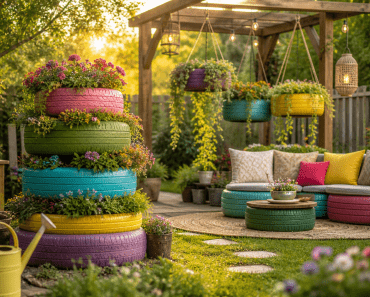
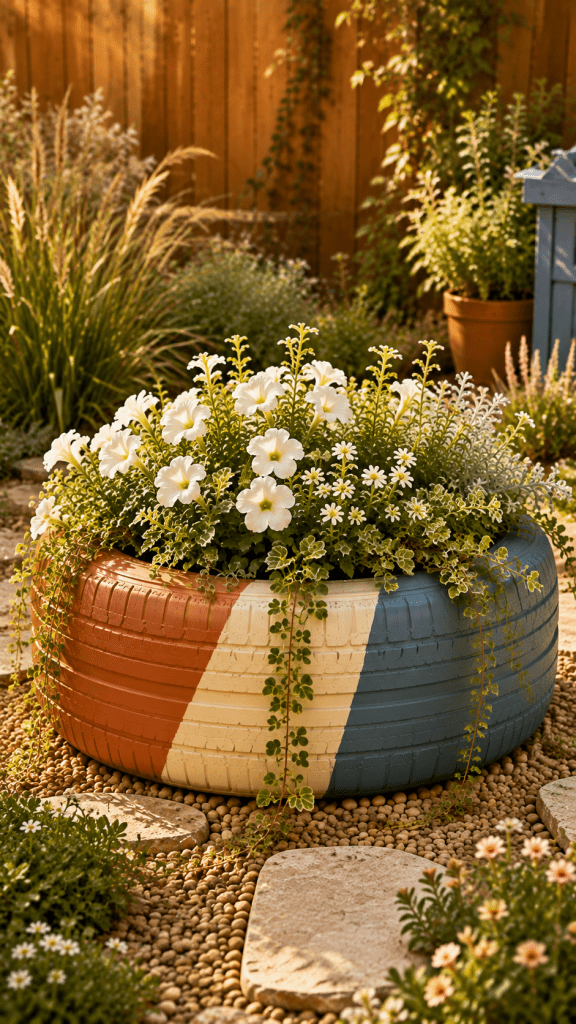
In that case, the Coordinated Color Block Tire Planter offers a much more expressive approach.
The important word is coordinated.
Bright does not have to mean random.
Use Two or Three Colors Instead of Ten
The easiest way to keep colorful tire planters visually controlled is to limit the palette.
Choose two or three colors that work together.
For example:
Mustard + dusty blue + cream
feels cheerful but relatively sophisticated.
Coral + pale pink + warm white
creates a softer summer palette.
Teal + terracotta + cream
offers stronger contrast.
Blue + yellow + white
feels fresh and energetic.
The colors can appear on separate tires or within individual color-blocked designs.
The important thing is repetition.
Once a color appears, let it appear again somewhere else.
Try Simple Geometric Divisions
You do not need complicated patterns to create an interesting painted tire.
Simple color blocking can be much more effective.
One half of the tire could be one color and the other half another.
A broad painted band can run around the center.
The sidewall can be one shade while selected raised details receive another.
You might also create two or three large sections around the tire.
The geometry of the tire already provides plenty of visual texture.
Simple paint divisions often work better than intricate decoration.
Create a Family of Colorful Planters
This concept becomes especially effective when several planters work together.
Imagine three tires positioned near a garden seating area.
One is dusty blue.
One is muted mustard.
One is warm coral.
All three contain the same white trailing flower.
The repetition of the flower visually unifies the different containers.
Another approach is to paint all three tires using the same two colors but in different proportions.
The result feels playful without appearing accidental.
Use White Flowers to Calm Strong Paint
White flowers are exceptionally useful with colorful containers.
They create a visual pause.
A bright blue tire filled with red, yellow, purple, pink, and orange flowers may become overwhelming.
The same blue tire filled predominantly with white flowers and green foliage feels completely different.
The planter remains colorful, but the overall composition has balance.
Soft cream can perform a similar role.
Or Use One Matching Flower Color
Another strategy is deliberately repeating the tire color in the flowers.
A dusty coral planter might contain flowers with smaller coral accents.
A blue planter might feature pale blue or lavender blooms.
The match does not need to be exact.
A subtle relationship is enough.
This makes the composition feel carefully selected.
Give Bright Tire Planters Space
Strong color requires breathing room.
If ten colorful tires are packed into a small corner, individual shapes and colors can become visually noisy.
Instead, allow some empty space.
Separate the containers with greenery.
Place one beside a neutral fence.
Use lawn, gravel, or mulch as a visual background.
This gives each color enough room to make an impact.
Best Locations for This Style
The Coordinated Color Block Tire Planter works especially well:
- beside a garden shed,
- near a casual patio,
- along a playful backyard,
- around a family garden,
- against a plain fence,
- near an outdoor craft area,
- or beside a colorful cottage garden.
It is less restrained than our first-place idea, but that is precisely its strength.
For gardeners who want old tires to become joyful decorative features rather than disappear into the landscape, this earns 🥈 second place.
🥉 Platz 3 Hand Painted Botanical Tire Planter
The third idea takes painting beyond color and turns the tire itself into a decorative object.
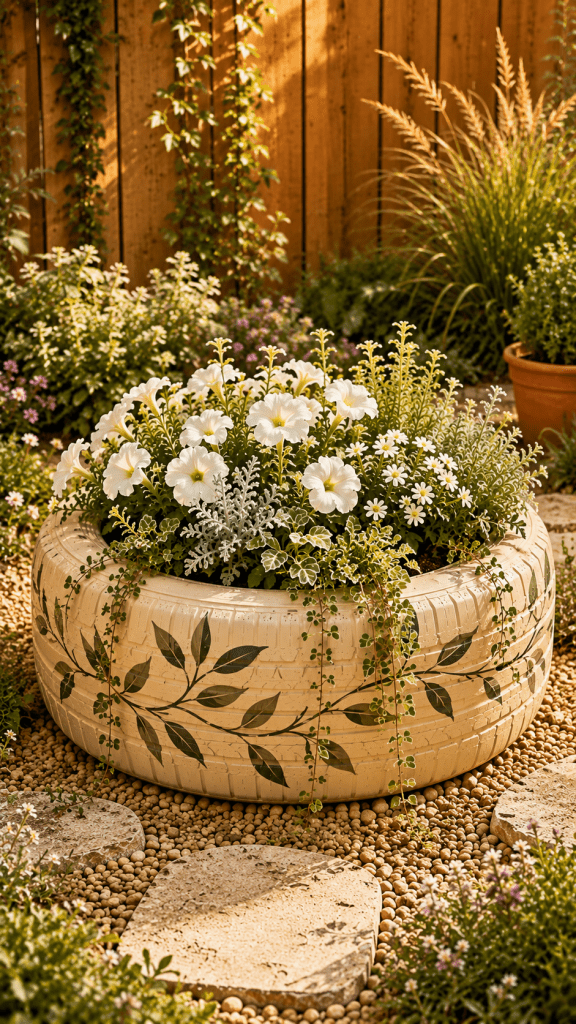
A Hand Painted Botanical Tire Planter uses simple leaves, vines, flowers, branches, or other nature-inspired motifs to decorate the sidewall.
This approach can be beautiful, but it requires restraint.
Too many details can make the planter compete with the real plants growing inside it.
The best botanical tire designs therefore feel more like subtle illustration than a heavily decorated craft project.
Begin With a Simple Base Color
Start with a calm background.
Warm cream, dusty sage, muted charcoal, pale terracotta, soft blue, or warm beige can all work.
This base creates the visual foundation.
Then add botanical details using one or two complementary colors.
For example:
Warm cream base + olive leaf pattern
creates a soft natural look.
Dusty blue base + white botanical linework
feels delicate and fresh.
Charcoal base + muted beige leaves
creates stronger contrast.
Terracotta base + cream botanical pattern
feels warm and earthy.
Keeping the base simple prevents the artwork from becoming too busy.
Think Line Art Rather Than Murals
The tire already has a complex surface.
Detailed multicolored paintings can become difficult to read.
Simple botanical line art often works better.
A delicate vine can follow the curve of the sidewall.
Small leaves can repeat around part of the tire.
A few stylized flowers can create a focal point on the front.
You do not necessarily need to decorate the entire circumference.
Leaving portions plain can actually make the artwork more visible.
Follow the Circular Shape
One of the most interesting aspects of a tire is its geometry.
Use it.
Instead of painting a rectangular-looking picture onto a circular object, let the botanical motif follow the tire.
A vine can wrap around the circumference.
Leaves can radiate around the circle.
Small floral motifs can repeat rhythmically around the edge.
This makes the artwork feel connected to the object rather than simply placed on top of it.
Coordinate Painted Flowers With Real Flowers
This is where the concept becomes especially charming.
Suppose the tire has a subtle painted white floral pattern.
Plant it with mostly green foliage and a few real white flowers.
The painted and living elements begin to interact.
Or imagine a terracotta tire decorated with pale botanical linework and filled with creamy flowers.
The visual relationship creates a cohesive design.
Avoid making the painted flowers drastically more colorful than the actual planting.
The real garden should still be the hero.
Use Botanical Patterns as an Accent
If you have several tire planters, not every tire needs artwork.
In fact, a better composition might include:
two solid-color tires + one botanical painted tire
The illustrated planter becomes the accent.
This is similar to using a patterned cushion among solid cushions indoors.
A little pattern has more impact when surrounded by simpler elements.
Position It Where the Artwork Can Be Seen
Unlike a tire covered almost completely by trailing foliage, this planter needs some visible sidewall.
Place it where people can see the painted design.
A garden entrance is ideal.
So is a patio.
It can work beside steps or along a frequently used walkway.
If the planter sits deep inside a flower bed and becomes hidden behind foliage, much of the painting effort is lost.
Why It Takes Third Place
The Hand Painted Botanical Tire Planter earns 🥉 third place because it offers enormous personality and artistic potential.
It can become a genuinely unique garden feature.
However, it is also easier to overdo than the other two concepts.
The strongest versions use limited colors, simple botanical motifs, and restrained planting combinations.
How to Prepare a Tire for Painting
Beautiful color begins with preparation.
An outdoor tire is exposed to dirt, road residue, weather, moisture, and years of wear. Paint applied over a poorly prepared surface may not give the finish you expect.
Start by selecting a tire that is structurally suitable for the intended decorative project.
Clean it thoroughly.
Remove loose dirt and debris from the surface, including the tread and sidewall areas that will remain visible.
Allow it to dry completely.
Then follow the surface-preparation instructions provided by the manufacturer of the coating you intend to use. Different products may require different preparation or compatible primers, so the product instructions should take priority over generic advice.
Also remember that tires flex.
A coating system intended for a rigid masonry surface is not automatically appropriate for rubber.
Choose products specifically described by their manufacturer as compatible with the intended material and exterior conditions.
Matte or Glossy Paint for Tire Planters
Finish can change the entire character of a painted tire.
A glossy surface tends to emphasize the tire.
It reflects light and makes color appear stronger.
A matte or lower-sheen finish usually feels quieter and can help the container integrate with natural garden materials.
For sophisticated Painted Tire Planter Ideas, softer finishes are often particularly attractive.
Imagine:
matte sage + white flowers + weathered timber
versus:
high-gloss bright green + multicolored flowers
Both are colorful, but they communicate completely different aesthetics.
Choose the finish based on the effect you want rather than assuming one is universally better.
Product durability and suitability for exterior rubber should remain the first practical consideration.
How to Choose the Right Painted Tire Color
When unsure about color, do not begin with the tire.
Look around the garden.
Find three existing colors.
Perhaps you see:
cream house walls + natural timber fence + green foliage
A muted olive or warm beige tire could connect beautifully.
Perhaps you have:
gray paving + charcoal furniture + lavender flowers
Dusty blue-gray could work.
Or perhaps your garden contains:
terracotta pots + warm brick + white flowers
A muted clay-colored tire would immediately belong.
The easiest color choices often already exist around you.
Painted Tire Planter Color Combinations Worth Trying
Different palettes create very different moods.
| Paint Color | Flower Combination | Overall Style |
|---|---|---|
| Sage green | White + pale pink | Soft botanical |
| Dusty terracotta | Cream + apricot | Warm natural |
| Muted blue | White + lavender | Cottage inspired |
| Charcoal | White + burgundy foliage | Modern dramatic |
| Warm cream | Pink + green foliage | Romantic |
| Olive | Yellow + white | Natural cheerful |
| Dusty coral | White + soft pink | Playful summer |
| Stone gray | Lavender + silver foliage | Calm contemporary |
These combinations are starting points rather than strict rules.
Local plant availability, climate, sunlight, and personal preference should always influence the final selection.
How to Avoid the Craft Project Look
There is nothing wrong with a playful DIY aesthetic if that is what you want.
But if the goal is to make painted tire planters look more polished, a few principles help enormously.
Limit the Palette
Two or three colors usually create more cohesion than many unrelated colors.
Repeat Colors
If one tire is sage, repeat sage elsewhere.
It could appear on another planter, garden furniture, a small decorative object, or nearby foliage.
Simplify the Planting
A colorful container does not always need equally colorful flowers.
Green foliage and white blooms can provide balance.
Use Natural Surroundings
Gravel, stone, timber, mulch, and plants help soften the synthetic appearance of painted rubber.
Leave Some Empty Space
Do not fill every available garden corner with painted tires.
A few carefully placed containers usually make a stronger statement.
Let Plants Mature
Freshly planted containers can look sparse.
As foliage fills the center and begins cascading over the rim, the tire becomes less visually dominant and the overall composition becomes softer.
Planting a Painted Tire Without Hiding the Color
One challenge is deciding how much of the painted surface should remain visible.
For a Muted Botanical Color Tire Planter, allowing greenery to cover part of the edge creates a beautiful natural effect.
For a Coordinated Color Block Tire Planter, keep enough of the sidewall visible so the color composition remains readable.
For a Hand Painted Botanical Tire Planter, avoid completely covering the painted motif.
This means plant choice should respond to the decorative treatment.
Not every painted tire needs an enormous waterfall of trailing plants.
Sometimes a compact mounding arrangement is more appropriate.
One Painted Tire or a Group
A single painted tire creates a focal point.
A group creates a theme.
Both approaches work.
If using one planter, make it special through location and planting.
If using several, create consistency.
You might use the same color on every tire but vary the flowers.
Or use three related paint colors and repeat the same plant.
Another possibility is using two simple solid-color planters with one patterned planter between them.
Think of the group as one composition rather than several unrelated projects.
Where Painted Tire Planters Look Best
Placement should reinforce the design.
Muted botanical tires can blend beautifully into flower beds and sophisticated patio gardens.
Color-blocked planters are excellent against neutral backgrounds such as plain timber fences or simple walls.
Botanical painted planters deserve close-view locations where the artwork can be appreciated.
Garden entrances are especially effective because the planter becomes part of the first impression.
Patio corners are another good option.
A carefully painted tire filled with abundant flowers can soften hard paving while adding a controlled burst of color.
Which Painted Tire Planter Idea Should You Choose
Choose the 🥇 Muted Botanical Color Tire Planter if you want the most sophisticated and versatile result.
It works with many garden styles, allows the flowers to remain dominant, and can make recycled rubber feel surprisingly at home beside natural materials.
Choose the 🥈 Coordinated Color Block Tire Planter if your garden needs energy and personality.
This is the strongest choice for cheerful backyards, colorful patios, and spaces where the tire itself is intended to become part of the visual attraction.
Choose the 🥉 Hand Painted Botanical Tire Planter if you want something unique and artistic.
It requires more decorative work, but the result can become a beautiful one-of-a-kind garden feature.
Final Thoughts on Painted Tire Planter Ideas
The best Painted Tire Planter Ideas prove that color can do much more than disguise an old tire.
It can redefine it.
The 🥇 Muted Botanical Color Tire Planter uses sophisticated nature-inspired shades to help recycled rubber blend beautifully with plants and landscape materials.
The 🥈 Coordinated Color Block Tire Planter embraces stronger color while using repetition and a limited palette to keep the result intentional.
And the 🥉 Hand Painted Botanical Tire Planter turns the sidewall itself into a decorative canvas with restrained nature-inspired artwork.
Whichever direction you choose, start with the garden rather than the paint can.
Look at the colors already around you.
Consider the flowers you want to grow.
Think about where the planter will sit and what will surround it.
Then choose a palette that connects those elements.
Because the goal is not simply to make an old tire colorful.
The goal is to make it look like it was always meant to be part of the garden.