A garden does not need an explosion of bright colors to feel dramatic. Some of the most memorable outdoor spaces are created by doing exactly the opposite. Black Flower Garden Ideas use flowers and foliage in shades of deep burgundy, smoky purple, near-black violet, chocolate, and midnight red to create gardens that feel sophisticated, mysterious, and unexpectedly luxurious.
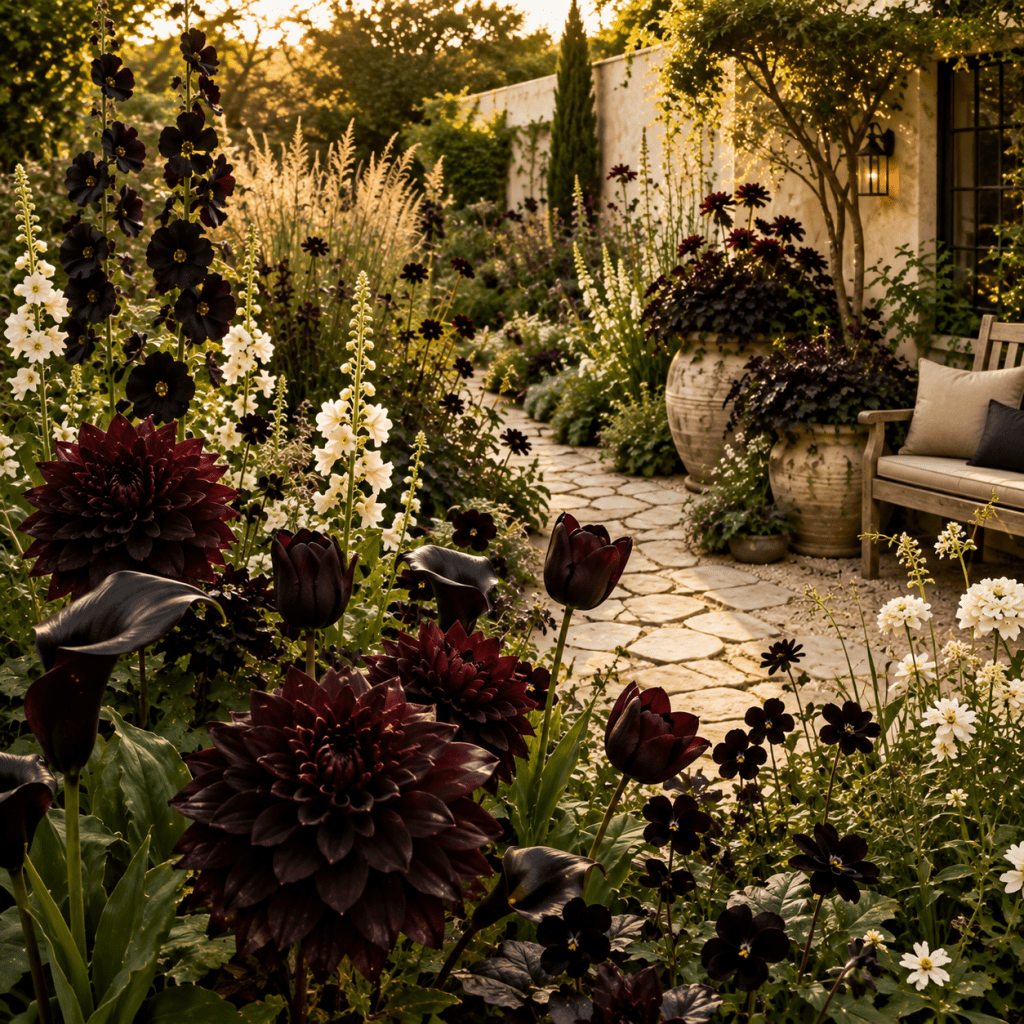
True jet-black flowers are extremely rare in nature. Most plants described as black actually reveal subtle undertones when sunlight touches their petals. A bloom that appears almost black from a distance might become dark wine, plum, mahogany, or purple when viewed closely. Far from being a limitation, this complexity is exactly what makes a black flower garden so visually interesting. 🌑🌿
The secret is not simply planting as many dark flowers as possible. A beautiful black garden depends on contrast, layering, texture, repetition, and strategic placement. Dark flowers need surrounding elements that allow their unusual colors to remain visible rather than disappearing into the landscape.
Among the many possible approaches, three concepts stand out because they transform dark plants into intentional garden features rather than isolated curiosities. These are the 3 best Black Flower Garden Ideas for creating an outdoor space that feels elegant, atmospheric, and professionally designed.
Why Black Flowers Can Completely Change the Character of a Garden
Black flowers have an unusual visual presence. Bright flowers naturally project themselves forward. Yellow, white, pink, and orange blooms immediately catch the eye, even when planted relatively far away.
Near-black flowers behave differently.
Their darker pigmentation visually recedes, creating a sense of depth and mystery. Instead of revealing themselves immediately, they encourage the viewer to look closer. This makes them particularly effective around pathways, patios, entrances, seating areas, and other places where people can experience the garden at close range.
🌑 Black flowers can create visual depth.
🌿 Green foliage prevents the composition from becoming flat.
🤍 Pale flowers provide dramatic contrast.
🪨 Stone and gravel help dark petals remain visible.
✨ Strategic lighting reveals hidden burgundy and purple undertones.
Dark flowers also have an architectural quality. Their strong silhouettes can function almost like sculptural elements, especially when combined with carefully clipped greenery, ornamental grasses, stone paving, or contemporary planters.
That versatility means a black flower garden does not automatically need to look gothic. It can be romantic, minimalist, cottage-inspired, modern, luxurious, or even naturalistic depending on the plants and materials surrounding the dark blooms.
Quick Comparison of the 3 Best Black Flower Garden Ideas
Before exploring each concept in detail, it helps to understand how differently the three approaches can affect a landscape.
| Black Flower Garden Idea | Overall Character | Best Location | Key Design Element | Difficulty |
|---|---|---|---|---|
| 🥇 Layered Black and White Flower Border | Elegant and dramatic | Pathways and large borders | High contrast | Moderate |
| 🥈 Moody Black Flower Courtyard Garden | Intimate and luxurious | Patio or courtyard | Dark blooms with architectural materials | Easy to Moderate |
| 🥉 Naturalistic Midnight Meadow Garden | Romantic and mysterious | Backyard or informal garden | Dark flowers mixed with grasses | Moderate |
All three concepts use dark flowers, but the experience is completely different. The first relies on sophisticated contrast, the second creates an immersive intimate environment, and the third integrates near-black flowers into a softer natural landscape.
🥇 Best 1 Layered Black and White Flower Border
Of all Black Flower Garden Ideas, few are as visually powerful as combining near-black flowers with carefully controlled white blooms.
This concept works because black and white create one of the strongest contrasts possible in garden design. Instead of filling the border randomly with flowers of many colors, the palette remains intentionally restrained.
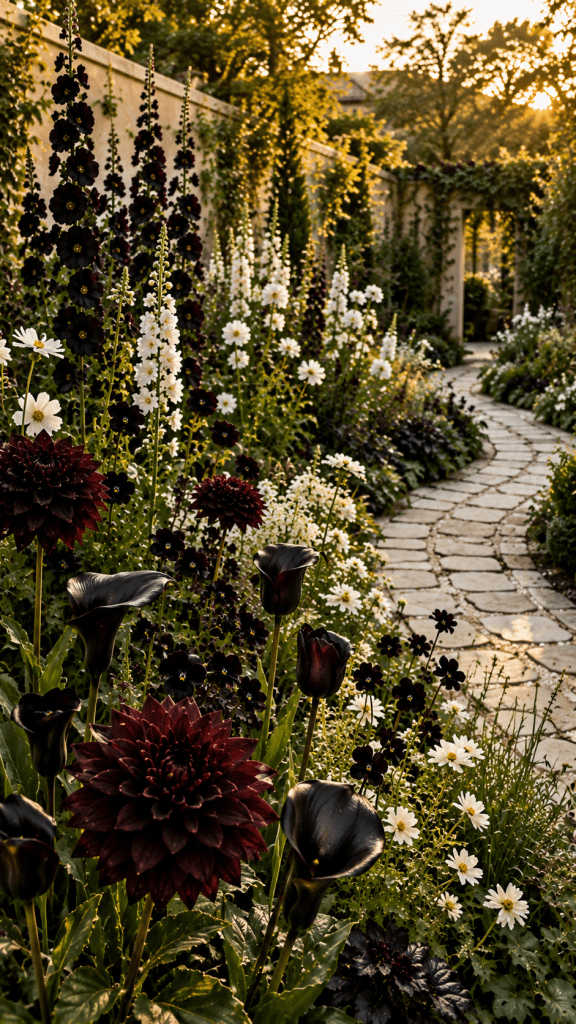
Imagine a long garden pathway bordered by deep green foliage. Near-black tulips, dark dahlias, black hollyhocks, burgundy cosmos, or deep purple petunias rise from the planting. Between them are carefully positioned white foxgloves, white cosmos, pale hydrangeas, or small clouds of white flowering plants.
The dark flowers immediately become more visible because the pale flowers provide visual separation.
Rather than creating a harsh checkerboard pattern, however, the colors should flow naturally through the garden.
Create Layers Instead of Mixing Everything Together
The strongest version of this garden uses different planting heights.
At the front of the border, low-growing dark flowers and foliage can create a defined edge. Small black violas, dark-leaved heuchera, compact petunias, or similar plants work beautifully here.
The middle layer can contain medium-height flowers with larger blooms. Dark dahlias, deep burgundy cosmos, near-black lilies, and ornamental foliage create more visual weight.
The back layer should provide vertical structure. Tall hollyhocks, foxgloves, ornamental grasses, dark-leaved shrubs, or climbing plants can form the architectural backdrop.
This layered arrangement prevents the garden from looking like a flat collection of flowers.
Instead, the eye moves gradually from foreground to background.
Use White Flowers as Strategic Highlights
White should not necessarily dominate the planting.
Its purpose is to illuminate the dark flowers.
A few carefully positioned groups of white flowers can create more visual impact than an equal mixture of black and white plants. When white blooms are positioned behind or beside near-black flowers, the silhouettes of the darker petals become significantly easier to appreciate.
At dusk, this contrast becomes particularly beautiful.
White flowers remain visible as daylight fades, while black flowers become deeper and more mysterious. The garden can transition from elegant during the day to atmospheric in the evening.
🤍 Think of white flowers as natural garden lighting.
They create visual highlights without requiring additional colors.
Add Green to Prevent the Garden From Becoming Too Graphic
A black-and-white garden still needs green.
Without enough foliage, the combination can become overly formal or artificial. Rich green leaves soften the contrast and connect the different flowering plants.
Plants with large leaves are particularly useful because they create calm visual spaces between complicated flower forms.
Deep green hostas, ferns, boxwood, climbing foliage, or other structural plants can provide this visual breathing room.
The result should feel botanical first and monochromatic second.
Introduce Stone and Natural Materials
The surrounding hardscape can significantly influence the success of this design.
Warm limestone pathways, weathered stone walls, pale gravel, aged terracotta, and natural oak can soften the black-and-white palette.
A pale gravel path running through the center of the garden is particularly effective because the dark flowers become clearly outlined against the lighter ground.
Natural materials also prevent the garden from becoming too theatrical.
The flowers remain dramatic, but the overall environment still feels sophisticated and believable.
Important Note: Plants marketed as “black” are usually extremely dark shades of purple, burgundy, brown, or red rather than genuinely black. Always check how a variety appears in natural sunlight before planning an entire color scheme around it.
Why This Black Flower Garden Idea Takes First Place
🥇 The Layered Black and White Flower Border takes first place because it provides the strongest combination of drama and timelessness.
It can work in contemporary gardens, traditional European landscapes, cottage gardens, and even relatively small residential yards.
More importantly, it makes black flowers genuinely visible.
Instead of disappearing into surrounding greenery, every dark bloom receives enough contrast to reveal its unusual shape and color.
🥈 Best 2 Moody Black Flower Courtyard Garden
The second of the 3 Best Black Flower Garden Ideas takes a completely different approach.
Rather than creating a long flower border, the Moody Black Flower Courtyard Garden concentrates dark flowers inside an intimate architectural space.
This concept is particularly effective for smaller gardens.
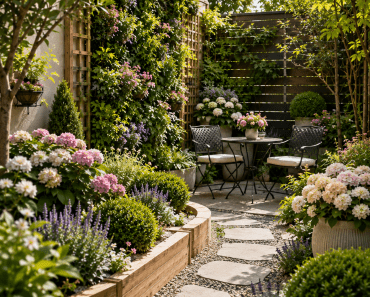
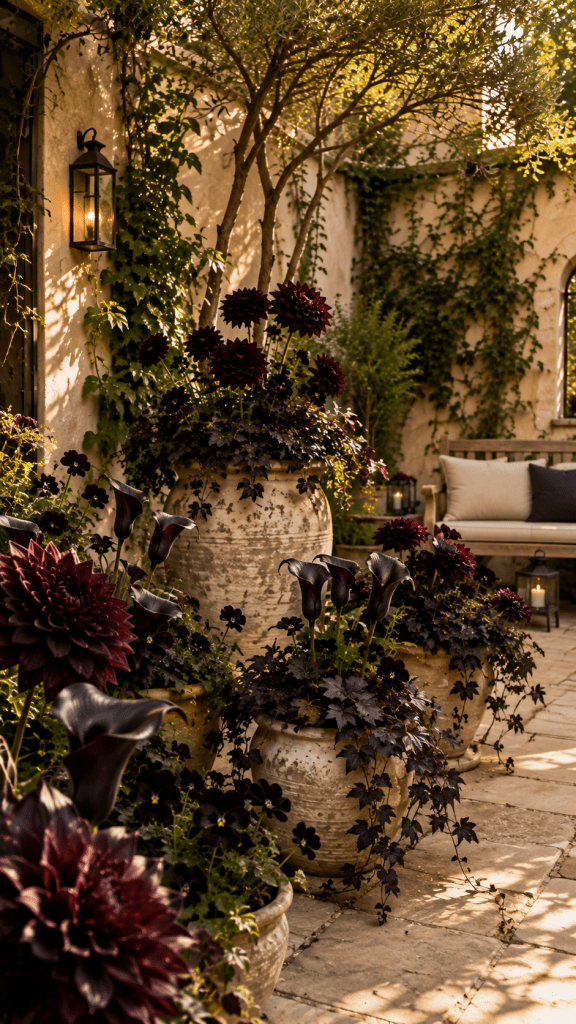
A courtyard, enclosed patio, side garden, or compact backyard can become an immersive botanical retreat when near-black flowers are combined with beautiful paving, oversized containers, climbing greenery, and carefully positioned seating.
The goal is not to create a garden that feels gloomy.
The goal is to create depth and intimacy.
Make Black Flowers the Main Decorative Element
In a traditional courtyard, decorative interest might come from brightly colored cushions, painted furniture, ceramic accessories, or numerous ornamental objects.
In this concept, the plants provide most of the decoration.
Large containers can hold dramatic dark flowers such as near-black dahlias, deep burgundy petunias, chocolate cosmos, dark calla lilies, or purple-black foliage plants.
Several containers can be grouped together at different heights.
One oversized planter might contain a tall architectural plant surrounded by cascading dark foliage. Smaller pots can repeat the same color family nearby.
Repetition makes the arrangement feel intentional.
Instead of appearing like a collection of unrelated plants, the courtyard becomes a complete visual composition.
Combine Dark Flowers With Warm Stone
One of the easiest mistakes with a black garden is surrounding dark flowers with too many equally dark surfaces.
A black wall, black paving, black furniture, and black flowers can cause individual elements to disappear.
A better approach is to contrast the flowers with warm natural materials.
Pale limestone is particularly effective.
Its creamy neutral surface reflects sunlight and provides a beautiful background for burgundy and purple-black petals. Travertine, warm concrete, pale brick, gravel, and weathered stone can produce similar effects.
Imagine an intimate courtyard with warm ivory plaster walls, aged limestone paving, a natural oak bench, and several large planters filled with near-black flowers.
The flowers immediately become the darkest visual element.
That is exactly what makes them powerful.
Introduce Deep Green Foliage
Dark flowers should be surrounded by foliage with several different shades of green.
Climbing ivy or jasmine can soften walls. Ferns can occupy shaded corners. Small evergreen shrubs can provide year-round structure.
This mixture gives the courtyard depth even when some flowers are not blooming.
🌿 Green becomes the transition between black flowers and pale architecture.
The darkest leaves can sit close to the flowers, while lighter green foliage can appear farther away.
This creates subtle visual layering without introducing additional flower colors.
Create a Beautiful Seating Destination
A courtyard garden becomes more successful when there is a reason to enter and remain inside it.
A small bench, café table, outdoor lounge chair, or built-in seating area can transform the space from something purely decorative into a destination.
Position seating where the dark flowers can be viewed at close range.
This matters because many near-black flowers reveal their most beautiful colors only when viewed nearby. A chocolate cosmos bloom, for example, may appear almost black from several meters away but reveal deep reddish-brown tones when illuminated by sunlight.
The garden becomes an experience rather than simply a view.
Use Evening Lighting Carefully
Black flowers can almost disappear after sunset, so lighting becomes particularly important in courtyard gardens.
Instead of using bright overhead lighting, consider subtle illumination.
Small architectural wall lights can provide gentle ambient light. Low garden lights can illuminate foliage from below. Lanterns positioned near seating can introduce warm pools of light.
The objective is not to illuminate every flower equally.
A little darkness is part of the atmosphere.
Allow some flowers to remain in shadow while others catch the warm light. This creates a sophisticated layered effect that works especially well with deep burgundy petals.
Keep Decorative Objects Restrained
Because black flowers already create significant visual drama, too many decorative objects can quickly overwhelm the courtyard.
Choose a few substantial pieces instead.
One sculptural planter is better than ten unrelated pots. One beautiful stone bowl may be more effective than numerous garden ornaments. A single wooden bench can provide enough furniture.
This restrained approach makes the courtyard feel more luxurious.
It also ensures that the flowers remain the primary focal point.
Why This Black Flower Garden Idea Takes Second Place
🥈 The Moody Black Flower Courtyard Garden is one of the strongest choices for anyone working with limited outdoor space.
It does not require a huge flower bed or expansive landscape.
Even a compact patio can achieve the effect because the design relies on concentration rather than scale.
Dark flowers, warm stone, rich greenery, natural wood, and atmospheric lighting can transform a small courtyard into something remarkably sophisticated.
🥉 Best 3 Naturalistic Midnight Meadow Black Flower Garden
The third concept proves that Black Flower Garden Ideas do not need to look formal.
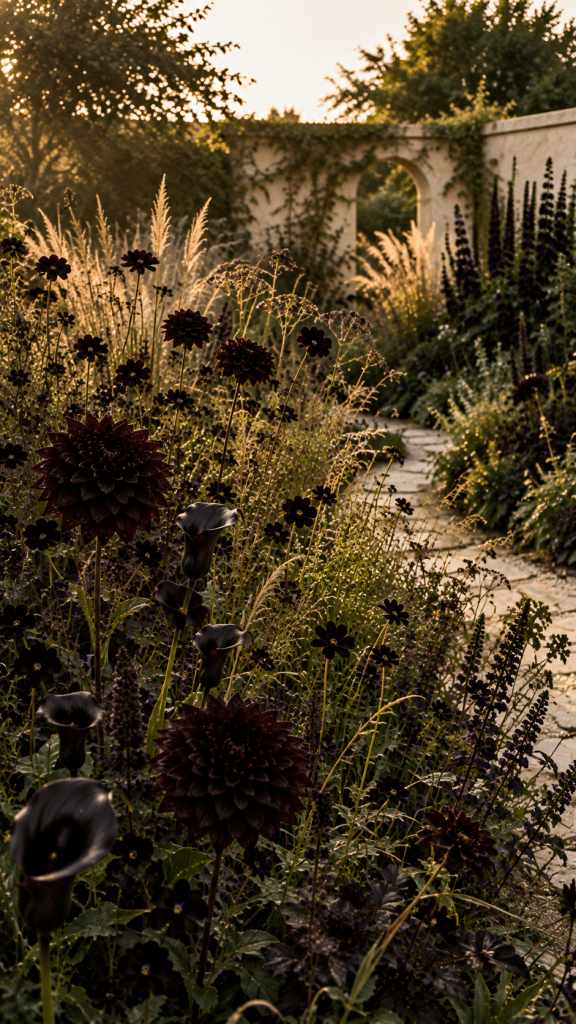
The Naturalistic Midnight Meadow Garden mixes dark flowers with airy ornamental grasses, delicate seed heads, soft green foliage, and restrained touches of pale flowers.
Instead of arranging plants in obvious rows, the garden appears loose and spontaneous.
The final effect can feel mysterious, romantic, and slightly wild. 🌾🌑
This approach works particularly well in larger backyards, cottage landscapes, countryside gardens, and spaces where a softer natural style is preferred.
Scatter Dark Flowers Through a Naturalistic Planting
The key to this garden is repetition without obvious symmetry.
Imagine tall ornamental grasses moving gently in the wind. Between them, dark burgundy flowers appear at irregular intervals.
A group of near-black hollyhocks might rise in the background.
Several dark dahlias could occupy the middle layer.
Smaller chocolate cosmos, dark scabiosa, or deep purple flowers can appear throughout the foreground.
The plants should look as though they naturally emerged within the meadow rather than being arranged into rigid decorative blocks.
However, the apparent randomness still requires planning.
Dark flowers need to be repeated across the landscape so the eye can visually connect one area with another.
Let Ornamental Grasses Provide Movement
Flowers attract attention through color.
Grasses attract attention through movement.
Combining the two produces a landscape that changes constantly throughout the day.
Fine grass blades create soft backgrounds behind dark flowers, making their heavier silhouettes more noticeable. Seed heads catch sunlight and introduce delicate golden highlights.
During late afternoon, the contrast can become spectacular.
Warm sunlight passing through pale grasses can create a glowing backdrop while near-black flowers remain dark and sculptural in the foreground.
This is one of the best ways to prevent a black flower garden from feeling heavy.
Add Small Amounts of Smoky Color
Unlike the first garden, this concept does not require pure black-and-white contrast.
Muted transitional colors can make the meadow feel more natural.
Smoky mauve, dusty pink, faded cream, muted burgundy, bronze, and soft green can all work beautifully.
The important thing is avoiding excessive saturation.
Bright tropical colors would compete with the dark flowers and change the character of the garden.
Instead, every secondary color should feel slightly weathered or softened.
Think of the palette as an old botanical painting rather than a rainbow flower bed.
Create a Meandering Path Through the Planting
A pathway can dramatically improve this design.
Instead of placing the meadow at the edge of the property where it is viewed only from a distance, create a narrow path that allows people to move through it.
Fine gravel, irregular stepping stones, weathered brick, or compacted natural material can all work.
The path does not need to be perfectly straight.
A gentle curve creates curiosity because the destination is not immediately visible.
Dark flowers positioned close to the path can then be appreciated in detail.
This is particularly valuable because near-black petals often contain subtle patterns and undertones that disappear from a distance.
Allow Seasonal Change to Become Part of the Design
A naturalistic black flower garden should not necessarily look identical throughout the year.
Spring may begin with dark tulips and emerging foliage.
Summer can introduce cosmos, hollyhocks, lilies, and other dark flowering varieties.
Late summer and early autumn can become richer as dahlias, ornamental grasses, and seed heads reach maturity.
Even faded flowers can contribute to the composition.
Seed heads and dried grasses often develop beautiful brown, bronze, and charcoal tones that complement the black garden palette.
Rather than immediately removing every faded plant, some can remain as structural elements.
This extends the visual character of the garden beyond the flowering season.
Why This Black Flower Garden Idea Takes Third Place
🥉 The Naturalistic Midnight Meadow Garden earns third place because it provides the most romantic interpretation of the theme.
It is less controlled than the black-and-white border and less architectural than the courtyard garden.
Instead, it celebrates movement, seasonal change, texture, and atmosphere.
For gardeners who prefer landscapes that feel relaxed rather than perfectly manicured, this can be the most beautiful choice of all.
Best Flowers to Consider for Black Flower Garden Ideas
Creating a convincing black garden becomes easier when several plant types are combined rather than depending on a single flower.
Near-black tulips can provide dramatic spring color. Their smooth petals and upright form work particularly well beside pale stone or lighter spring flowers.
Dark dahlias become powerful focal points later in the growing season. Large varieties can provide substantial visual weight, while smaller varieties can be repeated throughout borders.
Chocolate cosmos can introduce a softer and more delicate appearance. Their dark reddish-brown flowers work especially well in naturalistic gardens.
Near-black hollyhocks can provide height and old-fashioned romance.
Dark calla lilies offer a cleaner, more sculptural silhouette and can be particularly effective in contemporary courtyard arrangements.
Black or deep purple violas can create smaller accents near pathways and containers.
Dark foliage plants are equally important. Deep burgundy heuchera, purple-black ornamental foliage, and dark-leaved shrubs can maintain the color theme even when flowers are temporarily absent.
The most effective black garden therefore combines flowers and foliage rather than relying exclusively on blooms.
How to Choose the Right Background for Black Flowers
Background color is one of the most overlooked aspects of dark garden design.
Place a near-black flower directly in front of a dark green hedge and its silhouette may become difficult to see.
Place the same flower in front of a warm limestone wall and suddenly every petal becomes visible.
This means the background should be considered almost as carefully as the flower itself.
Pale stone, ivory plaster, weathered timber, light gravel, silver-green foliage, and white flowers can all provide useful contrast.
This does not mean every background needs to be bright.
Medium green foliage can also work when enough tonal separation exists.
The objective is simply to prevent dark plants from visually merging into one large shadow.
How to Make a Black Flower Garden Feel Luxurious Instead of Gloomy
A sophisticated black garden relies on balance.
Dark colors should create focal points rather than completely dominate every visible surface.
One useful approach is the dark light green formula.
Use near-black flowers as the dramatic accents.
Use pale stone, white flowers, or lighter foliage to create highlights.
Then use natural green plants to connect everything.
This creates a composition with several levels of brightness.
Texture is equally important.
Velvety flowers, delicate grasses, glossy foliage, rough stone, natural wood, and fine gravel all interact differently with light. Even when the color palette is limited, these material differences prevent the landscape from becoming visually monotonous.
✨ Luxury often comes from restraint rather than abundance.
A carefully positioned group of five spectacular dark dahlias can have more impact than dozens of unrelated black plants scattered around the garden.
The Best Lighting for Black Flower Garden Ideas
Lighting can completely transform near-black flowers.
Strong midday sunlight may reveal more of their purple or burgundy undertones. Overcast conditions can make them appear significantly darker.
But perhaps the most beautiful moment is late afternoon.
Golden-hour sunlight creates warm highlights along petal edges while leaving deeper sections in shadow.
This combination emphasizes the sculptural structure of the flower.
Backlighting can be particularly beautiful with thinner petals and ornamental grasses. When the sun is positioned behind the planting, translucent foliage begins to glow while the black flowers appear almost like silhouettes.
For this reason, garden orientation can influence planting decisions.
If possible, position some of the most dramatic dark flowers where they receive angled morning or late-afternoon light rather than only harsh midday illumination.
Using Containers to Experiment With a Black Garden
Not everyone needs to redesign an entire flower bed immediately.
Containers provide an excellent way to experiment with black garden aesthetics.
Start with one large planter.
Choose a near-black flowering plant as the focal point, then surround it with deep green foliage and one contrasting trailing plant.
Place the container against a pale wall or beside a light-colored pathway.
A second planter can repeat the same dark color elsewhere.
If the combination works, additional plants can gradually be introduced into permanent beds.
Containers also make it easier to reposition plants when the contrast is not strong enough.
A dark flower that disappears against one background may look spectacular only a few meters away against another.
Common Mistakes to Avoid With Black Flower Garden Ideas
The biggest mistake is assuming that more black automatically creates more drama.
It often does the opposite.
When too many dark plants are placed together without contrast, individual flowers lose definition.
Another common mistake is ignoring foliage.
Flowers may last only part of the growing season. If the entire garden concept depends on a few weeks of dark blooms, the design can lose its identity once flowering ends.
Structural foliage solves this problem.
Another issue is using too many competing colors.
Black can work with numerous colors, but a sophisticated garden usually benefits from a controlled palette. White, cream, dusty pink, burgundy, silver-green, and muted purple are easier companions than a random mixture of saturated colors.
Finally, avoid positioning every dark flower at the back of the garden.
Near-black blooms often need close viewing.
Bring some of them toward pathways, patios, entrances, and seating areas where their subtle colors can actually be appreciated.
Which of the 3 Best Black Flower Garden Ideas Should You Choose
The right concept depends largely on the architecture and size of the outdoor space.
Choose 🥇 Best 1 Layered Black and White Flower Border when the goal is maximum visual contrast. This is especially effective beside pathways, lawns, traditional borders, and structured residential landscapes.
Choose 🥈 Best 2 Moody Black Flower Courtyard Garden when space is limited or when the garden needs to feel intimate and luxurious. This concept is particularly effective around patios, terraces, enclosed courtyards, and small urban gardens.
Choose 🥉 Best 3 Naturalistic Midnight Meadow Garden when a softer and more romantic landscape is preferred. It works beautifully in backyards where ornamental grasses and loosely arranged perennial planting can develop naturally.
It is also possible to borrow elements from each concept.
A black-and-white border could lead toward a courtyard filled with dark container plants. A naturalistic meadow could incorporate a few white flowers for contrast. A courtyard could use ornamental grasses to soften its architectural edges.
The strongest garden is ultimately the one that responds naturally to its surroundings.
Final Thoughts on Creating an Unforgettable Black Flower Garden
The most beautiful Black Flower Garden Ideas are not simply about finding the darkest flowers available.
They are about understanding contrast.
Near-black blooms become extraordinary when surrounded by materials and plants that allow their colors to be seen. Pale stone can sharpen their silhouettes. White flowers can illuminate them. Green foliage can soften them. Ornamental grasses can introduce movement. Warm sunlight can reveal hidden shades of burgundy, plum, chocolate, and violet.
That is why the 🥇 Layered Black and White Flower Border stands out as the best overall concept. Its dramatic contrast makes dark flowers unmistakable while remaining elegant enough to work with many garden styles.
The 🥈 Moody Black Flower Courtyard Garden offers a more intimate alternative, transforming even a compact outdoor space into a sophisticated botanical retreat.
Meanwhile, the 🥉 Naturalistic Midnight Meadow Garden creates something softer and more atmospheric, allowing mysterious dark flowers to emerge naturally among grasses and textured foliage.
A black flower garden does not have to feel dark in spirit.
With the right composition, it can feel refined, romantic, contemporary, and remarkably alive. 🌑🌿
The darkness of the flowers simply provides the contrast.
Everything around them makes that darkness beautiful.