Old tires and beautiful flowers may seem like an unlikely combination, but that contrast is exactly what makes Tire Flower Garden Ideas so visually interesting. A material associated with roads, garages, and industrial spaces can become almost unrecognizable once it is surrounded by lush foliage, overflowing blooms, and thoughtful garden styling.
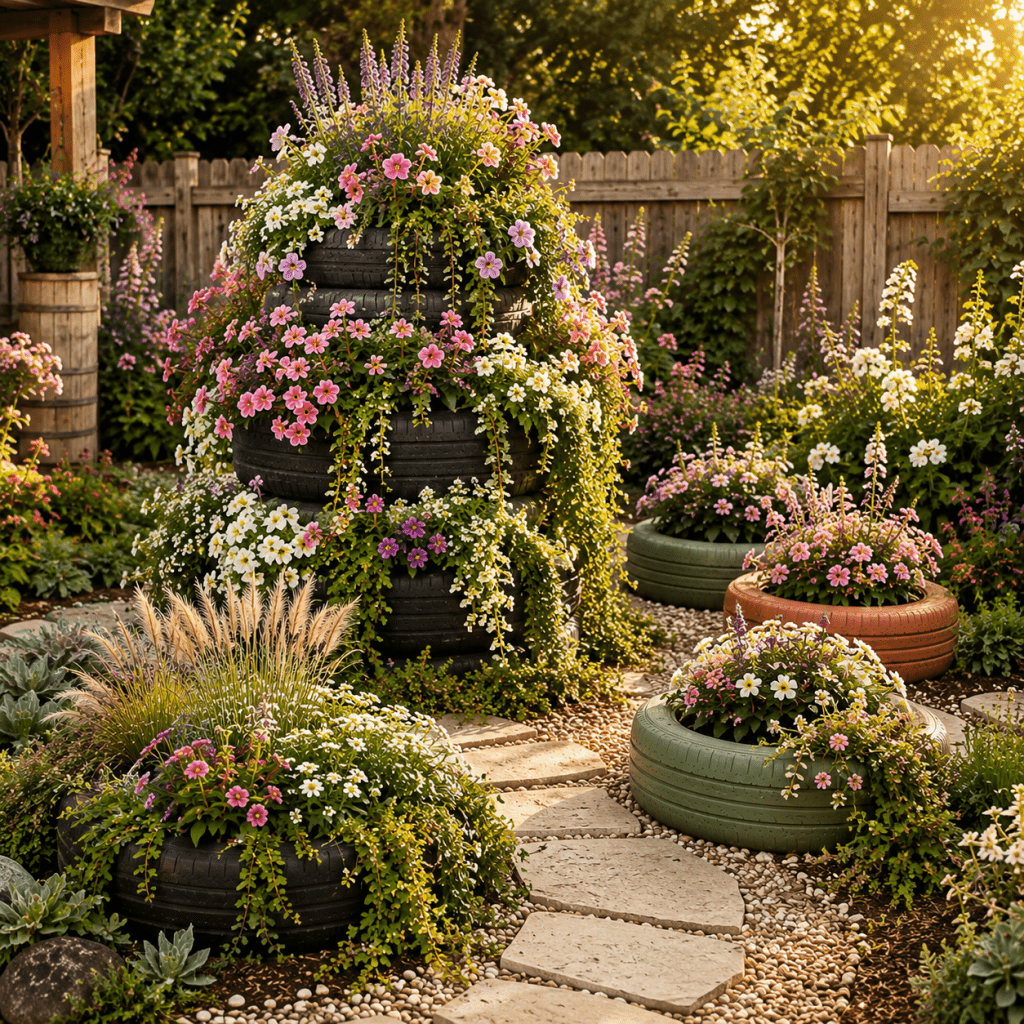
The difference between a basic tire filled with flowers and a genuinely beautiful tire flower garden comes down to composition.
Flowers should not simply occupy the empty center of the tire. They should transform it.
Cascading plants can soften the hard circular edge. Tall flowers can create height. Dense foliage can hide portions of the rubber. Repeated colors can connect multiple planters into one coherent garden feature. Even the surrounding gravel, lawn, stone, timber, or flower beds can determine whether the tires feel integrated or simply placed there.
For this guide, the three ideas use flowers in completely different ways.
The first creates a spectacular overflowing floral focal point. The second uses coordinated tire planters to form a colorful flower garden composition. The third takes a softer approach, allowing flowers and foliage to gradually conceal the tires and merge them into the surrounding landscape.
Here are the 3 best Tire Flower Garden Ideas for turning old tires into a stunning backyard display.
| Rank | Tire Flower Garden Idea | Main Visual Effect | Best For |
|---|---|---|---|
| 🥇 | Cascading Flower Tower Tire Garden | Dramatic vertical abundance | Backyard focal points |
| 🥈 | Color Harmonized Tire Flower Garden | Coordinated waves of color | Patios and flower garden displays |
| 🥉 | Naturalized Cottage Tire Flower Bed | Soft landscape integration | Cottage and informal gardens |
Important Note: Tire flower gardens are most straightforward when used for ornamental plants. For edible gardening, purpose-made food-safe containers avoid uncertainty about the tire’s age, previous exposure, and material history. Whatever container you use, provide appropriate drainage and choose plants suited to your local light and climate.
🥇 Platz 1 Cascading Flower Tower Tire Garden
If the goal is to create a tire flower garden that immediately attracts attention, height changes everything.
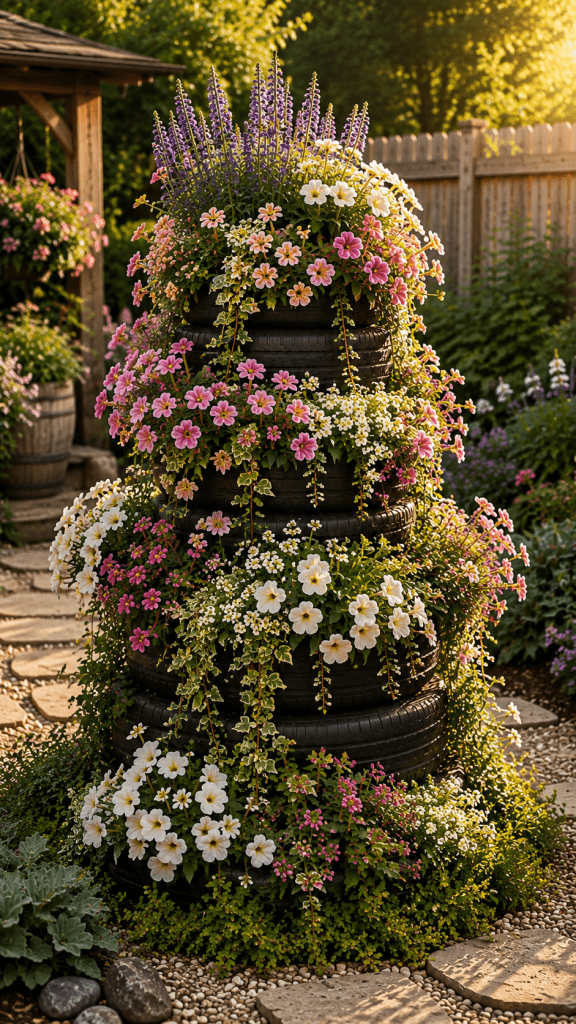
The Cascading Flower Tower Tire Garden transforms several ordinary tires into a layered vertical structure covered with flowers and trailing foliage.
Instead of looking like individual recycled containers, the tires begin to function as the hidden framework behind a spectacular floral composition.
This is what makes the concept so powerful.
The flowers gradually become more visually important than the tires themselves.
Build a Silhouette Before Choosing Flowers
Before thinking about flower colors, consider the overall shape of the garden.
A straight tower can work, but a staggered structure often looks more natural.
Imagine three levels.
The bottom level is broad and substantial.
The middle level becomes slightly narrower.
The upper level creates a final burst of height.
You might achieve this with several tires arranged in a loose pyramid or with stacks positioned at slightly different heights.
Perfect symmetry is not required.
In fact, an arrangement where one side rises higher than the other can create more visual movement.
The goal is to create a recognizable silhouette even before the flowers are added.
Use Three Different Planting Behaviors
A spectacular flower tower should not contain plants that all grow in exactly the same way.
Instead, combine three behaviors:
upright + mounding + trailing
Upright plants establish height.
Mounding flowers provide fullness.
Trailing plants create movement and soften the tire edges.
This is one of the most useful formulas for Tire Flower Garden Ideas because it allows plants to visually reshape the industrial container.
The tire begins as a strong circle.
Trailing plants break that circle.
Mounding flowers fill the interior.
Upright flowers draw the eye upward.
Together, they create a much more organic form.
Let the Upper Level Create the Crown
The highest planter deserves special attention.
It becomes the visual crown of the entire arrangement.
Rather than filling it exclusively with trailing plants, introduce one or several taller flowering or foliage plants.
Around those, add medium-height blooms.
Finally, allow a few plants to cascade over the edges.
From a distance, the upper tire may become almost invisible beneath the planting.
This is exactly what you want.
The viewer should first notice flowers, shape, and color.
The recycled structure becomes the surprising discovery underneath.
Make the Middle Layer Dense
The middle section connects the top and bottom of the composition.
If it is sparsely planted, the structure can look disconnected.
Use dense mounding flowers and foliage here.
Depending on your growing conditions, petunias, calibrachoa, verbena, begonias, lobelia, coleus, bacopa, and other suitable ornamentals can create the necessary fullness.
Do not choose plants simply because they are colorful.
Look at their shape.
A mixture of flower sizes and leaf textures usually creates a richer display.
Let the Lowest Level Spread Outward
The bottom should visually anchor the tower.
Allow trailing plants to spread over the tires and toward the surrounding ground.
Low-growing flowers can also be planted nearby to create a gradual transition.
This is especially effective if the tower stands within an existing flower bed.
The flowers inside the tires can begin to overlap visually with flowers growing directly in the soil.
Suddenly, the boundary between recycled planter and conventional garden becomes less obvious.
Choose One Dominant Flower Palette
Because the structure itself is already complex, a controlled flower palette helps maintain cohesion.
Consider:
white + lavender + green
for a soft romantic display.
Or:
pale pink + burgundy + green
for a richer composition.
For a warmer look:
apricot + cream + deep green
can be beautiful.
A cheerful summer display might use:
yellow + white + soft blue
The exact combination is flexible.
What matters is repetition.
If pale pink appears at the top, repeat it somewhere in the middle or bottom.
If white flowers cascade from one tire, introduce white flowers elsewhere.
Repetition visually binds the separate levels together.
Consider Keeping the Tires Neutral
A flower tower already contains enormous visual interest.
Brightly painting every tire can sometimes compete with the flowers.
For a sophisticated look, consider leaving the tires dark or painting them in one restrained shade such as charcoal, muted olive, warm gray, or earthy brown.
As the plants mature, much of the surface will disappear behind foliage anyway.
This allows the floral composition to dominate.
Create a Proper Setting Around It
Do not stop designing at the edge of the lowest tire.
The immediate surroundings matter.
A small gravel area can define the feature.
Natural stones can visually connect it to a landscape bed.
Groundcovers can creep toward the base.
Mulch can create a clean transition.
Or the entire tower can sit inside a larger flower bed.
Avoid surrounding it with too many additional decorative objects.
The flowers already provide the decoration.
Best Place for a Flower Tower
This idea needs enough space to be appreciated from a distance.
Strong locations include:
- the end of a garden path,
- a large backyard corner,
- beside a patio,
- against a plain fence,
- near a garden shed,
- or within a large ornamental flower bed.
Try viewing the proposed location from the house.
If the tower creates an attractive focal point through a window, you may have found the ideal position.
Why This Idea Takes First Place
The Cascading Flower Tower Tire Garden earns 🥇 first place because it produces the strongest transformation.
Individual tires become secondary.
What you see instead is a vertical mass of flowers, foliage, texture, and cascading movement.
For anyone who wants a tire flower garden to become a genuine backyard centerpiece, this is difficult to beat.
🥈 Platz 2 Color Harmonized Tire Flower Garden
Not every tire flower garden needs to rise upward.
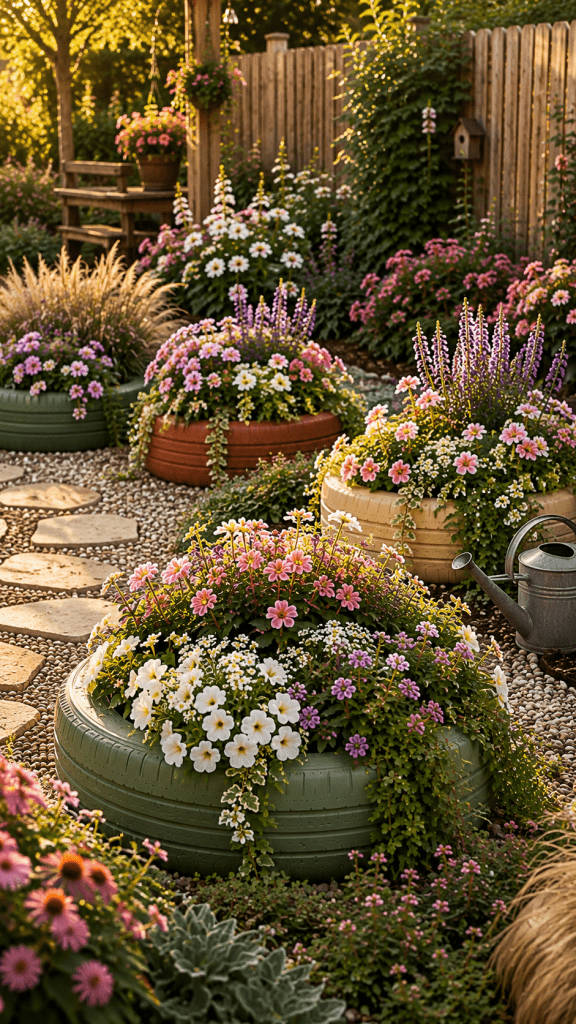
The Color Harmonized Tire Flower Garden spreads the visual interest horizontally, using several individual tire planters and carefully repeated flower colors to create a unified composition.
The secret is coordination.
Instead of planting each tire independently, think of all the planters as one garden.
Choose the Flower Palette First
Start with two or three dominant flower colors.
This is much easier than buying random plants and attempting to coordinate them afterward.
For example:
pink + white + green
creates a romantic garden.
purple + lavender + white
feels cool and elegant.
yellow + cream + green
creates a bright sunny display.
coral + apricot + white
produces a warm summer look.
You can include variations within these families, but the dominant colors should remain recognizable.
Repeat Flowers Between Planters
Imagine four tire planters.
If each contains completely different plants and colors, the eye reads them as four separate projects.
Now imagine that all four contain the same white trailing flower.
Suddenly, they belong together.
You do not need to make the planting identical.
One planter might combine white with lavender.
Another might combine white with soft pink.
A third could contain white flowers with ornamental foliage.
The repeated white element creates continuity.
Use Different Heights Without Stacking
This concept does not require a tire tower.
Instead, use the surrounding landscape to introduce subtle changes in elevation.
One tire might sit slightly higher within a flower bed.
Another could be positioned beside low groundcover.
A third might sit near taller ornamental grasses.
The tire planters remain individual objects, but their surroundings create layers.
This is particularly useful when you want a softer appearance than stacked tires provide.
Coordinate the Tire Color Too
The tires themselves can support the floral palette.
For a restrained garden, paint all the tires one color.
Sage green works beautifully with pink and white flowers.
Charcoal provides dramatic contrast with white and lavender.
Warm cream can soften stronger flower colors.
Terracotta pairs naturally with apricot, yellow, and cream.
Another possibility is a tonal series.
You might use three related shades of muted green or dusty blue.
The garden remains colorful without becoming chaotic.
Create a Visual Rhythm
Spacing matters.
Do not necessarily line the tires up at identical intervals.
A more natural composition might use groups.
For example:
two planters close together → open space → one planter → another pair
This creates rhythm.
The eye moves through the garden rather than reading it as a rigid row.
You can reinforce that movement with flowers planted directly in the ground between the tire planters.
Connect the Tires With Conventional Planting
This is where the design can become especially beautiful.
Imagine several tire planters positioned within a larger flower border.
The tires contain pink, white, and lavender blooms.
The surrounding bed repeats some of those same plants.
Flowers appear to flow in and out of the tire containers.
The recycled planters no longer look isolated.
They become elevated pockets within a larger floral landscape.
Use Foliage as a Resting Point
If every plant is covered with intensely colored flowers, the composition can become exhausting.
Green foliage provides visual rest.
Include plants valued primarily for their leaves.
Silver foliage can also work beautifully with pastel flowers.
Dark burgundy leaves can introduce contrast.
Ornamental grasses can add fine texture.
A balanced flower garden is not made exclusively from flowers.
Best Places for This Concept
The Color Harmonized Tire Flower Garden works beautifully:
- along patios,
- beside fences,
- around garden seating areas,
- within larger flower beds,
- beside pathways,
- and in sunny backyard corners.
It is particularly effective when the garden is frequently viewed from several directions because the planters can be distributed across the space.
Why It Takes Second Place
This idea earns 🥈 because it offers tremendous flexibility while remaining visually coherent.
It can use two tires or ten.
It can be subtle or colorful.
It can fit a cottage garden or a more contemporary backyard.
The essential ingredient is repetition.
Once the same flowers and colors begin appearing across multiple tire planters, they stop looking like unrelated recycled objects and start functioning as one designed flower garden.
🥉 Platz 3 Naturalized Cottage Tire Flower Bed
The third idea takes the quietest approach.
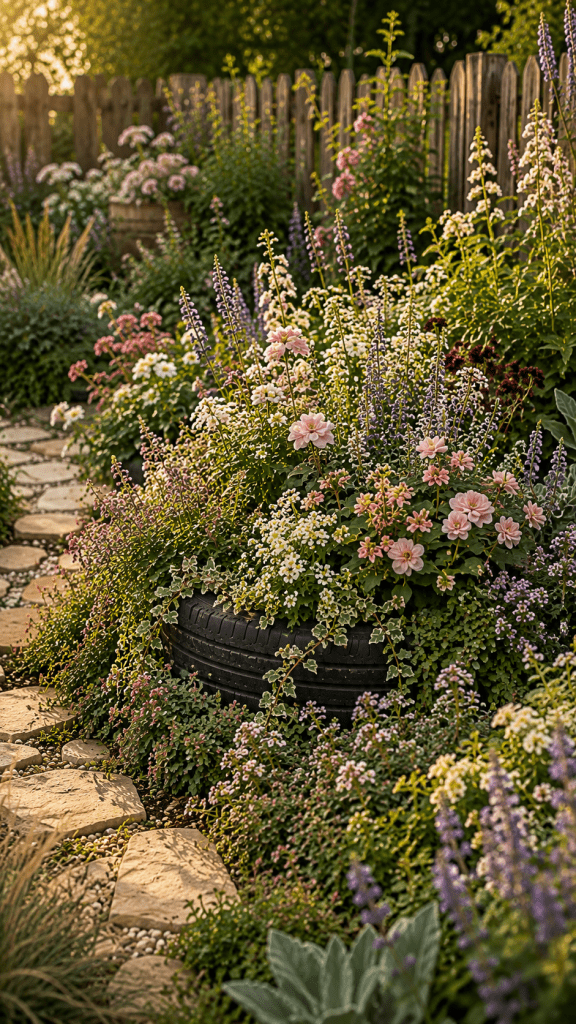
Instead of emphasizing the tires, the Naturalized Cottage Tire Flower Bed deliberately allows them to disappear beneath loose flowers, trailing foliage, groundcovers, and surrounding plants.
The tire becomes almost like a hidden raised planting pocket.
This is one of the best options for gardeners who love recycling but do not necessarily want the garden to look like a collection of recycled objects.
Begin With the Existing Flower Bed
Unlike the previous concepts, do not design the tire first.
Design the flower bed.
Look at the plants already growing there.
What colors dominate?
What heights?
What foliage textures?
Which flowers repeat?
Then introduce the tire planter as an extension of that existing planting.
If white flowers and soft ornamental grasses dominate the bed, repeat them inside the tire.
If the garden contains lavender and pale pink, continue those colors.
The tire should inherit the visual language of its surroundings.
Partially Hide the Tire
There is no requirement that the entire tire remains visible.
Its lower section can be softened with mulch, gravel, groundcover, or surrounding plants.
The upper edge can gradually disappear beneath trailing foliage.
As the plants mature, only small portions of the rubber may remain visible.
This is desirable.
The tire provides elevation without becoming the focal point.
Choose Loose Romantic Flowers
Cottage-style planting works particularly well because it naturally overlaps.
Flowers do not need to remain neatly inside individual boundaries.
Plants can lean.
Foliage can spill.
Blooms can intermingle.
A tire planter surrounded by this kind of planting begins to lose its obvious circular outline.
Depending on local growing conditions, you can explore combinations of soft flowering ornamentals, fine grasses, trailing plants, and foliage varieties that produce this relaxed character.
The principle matters more than any particular species.
Avoid Perfect Symmetry
Formal symmetry draws attention to the container.
Naturalized planting does the opposite.
Place a taller plant slightly off-center.
Allow one side to cascade more heavily.
Let surrounding flowers partially obscure one portion of the tire.
The result should look as though the plants have gradually colonized the planter.
Controlled imperfection is the goal.
Keep the Tire Dark or Earthy
Bright paint usually works against this concept.
Original dark rubber can recede surprisingly well once covered with foliage.
Alternatively, use a matte earthy shade:
- charcoal,
- deep brown,
- muted olive,
- warm gray,
- dark forest green.
Avoid making the container more visually important than the flowers.
Create Several Hidden Levels
One tire can subtly raise part of a flower bed.
Several carefully positioned tires can create multiple hidden levels.
One might sit near the back.
Another could be partly concealed in the middle.
A third might appear closer to the front.
As plants fill in, the garden develops more vertical complexity without obvious conventional raised beds.
This can be especially effective in an otherwise flat backyard.
Allow Groundcovers to Connect Everything
Groundcovers are valuable because they erase boundaries.
A plant spreading across the soil and toward the tire visually connects both surfaces.
Trailing plants growing from the tire can meet groundcovers growing below.
Eventually, it becomes difficult to see where one planting zone ends and another begins.
That is exactly the effect this concept needs.
Best Places for a Naturalized Tire Flower Bed
This approach works particularly well in:
- cottage gardens,
- informal backyard borders,
- rustic gardens,
- naturalistic flower beds,
- woodland-edge gardens,
- and areas already filled with abundant planting.
It is less suitable if you want the tire itself to be a decorative feature.
Here, the tire is infrastructure.
The flowers are the attraction.
Why It Takes Third Place
The Naturalized Cottage Tire Flower Bed earns 🥉 because it demonstrates that a tire flower garden does not need to look obviously recycled.
With enough foliage and thoughtful integration, the tire can almost disappear.
What remains is an additional layer of flowers and texture.
How to Choose Flowers for a Tire Garden
Choosing plants based only on flower color is one of the easiest ways to create a disappointing container.
Consider several characteristics simultaneously.
Height
You need plants at different levels.
If every plant reaches approximately the same height, the arrangement can appear flat.
Use taller plants selectively, medium-height plants for body, and lower plants near the edges.
Growth Habit
Ask whether a plant grows upright, outward, in a mound, or downward.
Combining these habits creates movement.
Trailing plants are particularly valuable because they soften the tire.
Foliage
A plant should not become visually useless when it temporarily has fewer flowers.
Interesting leaves help maintain the composition.
Look for variation in leaf size, shape, and tone.
Light Requirements
A beautiful combination is useless if half the plants need full sun and the other half prefer substantially different conditions.
Choose plants compatible with the actual location.
Mature Size
Do not judge plants only by their size at the nursery.
A small young plant can become surprisingly large.
Give each plant enough room to mature without immediately overwhelming its neighbors.
Climate
Plant recommendations vary enormously by location.
A combination that thrives in one climate may struggle in another.
Use locally appropriate ornamentals and adapt the visual formulas in this guide to the plants that perform well in your area.
The Best Flower Formula for Tire Planters
When unsure where to begin, use this simple formula:
1 structural plant + 2–3 mounding plants + 1–2 trailing plants
The structural plant creates height.
Mounding plants fill the center.
Trailing plants soften the edges.
The exact number depends on the tire size and mature plant dimensions, so avoid treating the formula as a rigid planting quantity.
Think of it as a design principle.
For an especially natural look, add one foliage-focused plant with a contrasting leaf color.
Should You Paint Tires in a Flower Garden
You can, but you do not have to.
For a Cascading Flower Tower, neutral tires often allow the flowers to dominate.
For a Color Harmonized Tire Flower Garden, coordinated paint can become an important part of the composition.
For a Naturalized Cottage Tire Flower Bed, darker or earthy tires are usually easier to conceal.
Ask one question:
Do I want people to notice the tire or the flowers first?
If the answer is flowers, keep the tire understated.
If the tire is part of the decorative concept, color can be much more expressive.
How to Make Tire Flower Gardens Look Fuller
Young plants need time to mature.
Do not compensate by packing too many plants into a limited space.
Instead, design for growth.
Position plants according to their expected mature dimensions.
Use foliage plants to provide early visual structure.
Apply an appropriate mulch where suitable.
Allow trailing plants time to extend beyond the edge.
Within the growing season, a carefully spaced arrangement can become dramatically fuller.
Patience usually produces a healthier and more attractive display than immediate overcrowding.
Drainage Matters More Than Decoration
Flowers cannot compensate for poor growing conditions.
A tire planter should be configured so excess water can escape rather than remaining trapped around roots.
Use an appropriate growing medium for the selected plants and container setup.
Monitor moisture because containerized plants can behave differently from plants growing directly in garden soil.
Also consider the planter’s exposure.
Dark rubber positioned in intense direct sunlight can absorb considerable heat, so local climate, location, and plant tolerance should influence your design.
Beautiful Tire Flower Garden Ideas still need to function as healthy growing environments.
How to Integrate Tire Flowers Into the Backyard
The easiest way is repetition.
If white flowers grow inside the tire, repeat white flowers somewhere nearby.
If ornamental grasses surround the planter, use similar grasses elsewhere.
If the tire sits on gravel, repeat the same gravel along a path or seating area.
These connections make the planter belong.
Another powerful technique is overlap.
Allow surrounding plants to grow toward the tire.
Let trailing plants extend outward.
Avoid creating a perfectly empty ring around every container.
The more naturally planting zones interact, the less isolated the recycled material feels.
Common Tire Flower Garden Mistakes
Even creative ideas can lose their impact when too many elements compete.
One common mistake is combining brightly painted tires with too many flower colors.
Another is using identical plants at identical heights in every tire.
A third is scattering individual tires randomly without creating visual relationships between them.
Poor placement is another issue.
A beautifully planted tire can still look awkward if it blocks a walkway or appears disconnected from everything around it.
And perhaps the biggest mistake is forgetting the surrounding garden entirely.
A tire flower garden should not end at the rubber edge.
The landscape around it is part of the composition.
Which Tire Flower Garden Idea Is Best
Choose the 🥇 Cascading Flower Tower Tire Garden if you want a dramatic focal point.
Its height, layered planting, and cascading flowers create the biggest visual transformation.
Choose the 🥈 Color Harmonized Tire Flower Garden if you want to spread flowers across a larger area while maintaining a coordinated palette.
It is flexible, colorful, and particularly suitable for backyard displays.
Choose the 🥉 Naturalized Cottage Tire Flower Bed if you want the tires to become almost invisible.
This is the strongest choice for a soft, informal landscape where plants rather than recycled materials should dominate.
Final Thoughts on Tire Flower Garden Ideas
The most beautiful Tire Flower Garden Ideas use flowers to change how we perceive the tire itself.
The 🥇 Cascading Flower Tower Tire Garden turns stacked recycled forms into a spectacular vertical mass of blooms.
The 🥈 Color Harmonized Tire Flower Garden uses repetition and coordinated color to connect multiple tire planters into one unified backyard display.
And the 🥉 Naturalized Cottage Tire Flower Bed goes in the opposite direction, allowing foliage and flowers to gradually conceal the tires until they become almost invisible within the landscape.
None of these concepts depends on filling every available tire with as many colorful flowers as possible.
They depend on composition.
Choose a limited palette.
Combine different plant forms.
Repeat colors.
Create layers.
Allow foliage to soften hard edges.
And pay attention to the garden surrounding the planter.
When those elements work together, an old tire stops looking like something that was simply reused.
It becomes the framework for something genuinely beautiful.