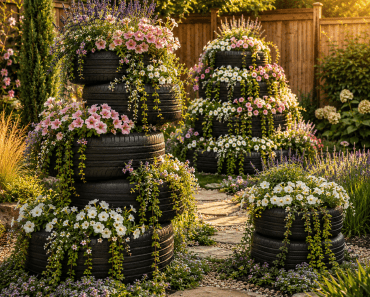
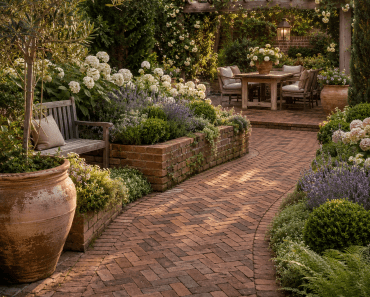
Old tires may look like one of the least promising materials for a beautiful garden, but with thoughtful planting and styling, they can become surprisingly attractive outdoor features. The best Tire Planter Ideas do much more than simply fill a tire with soil. They use the tire’s bold circular shape, deep planting cavity, and substantial proportions as part of the overall garden design.
The key is to make the planter feel intentional.
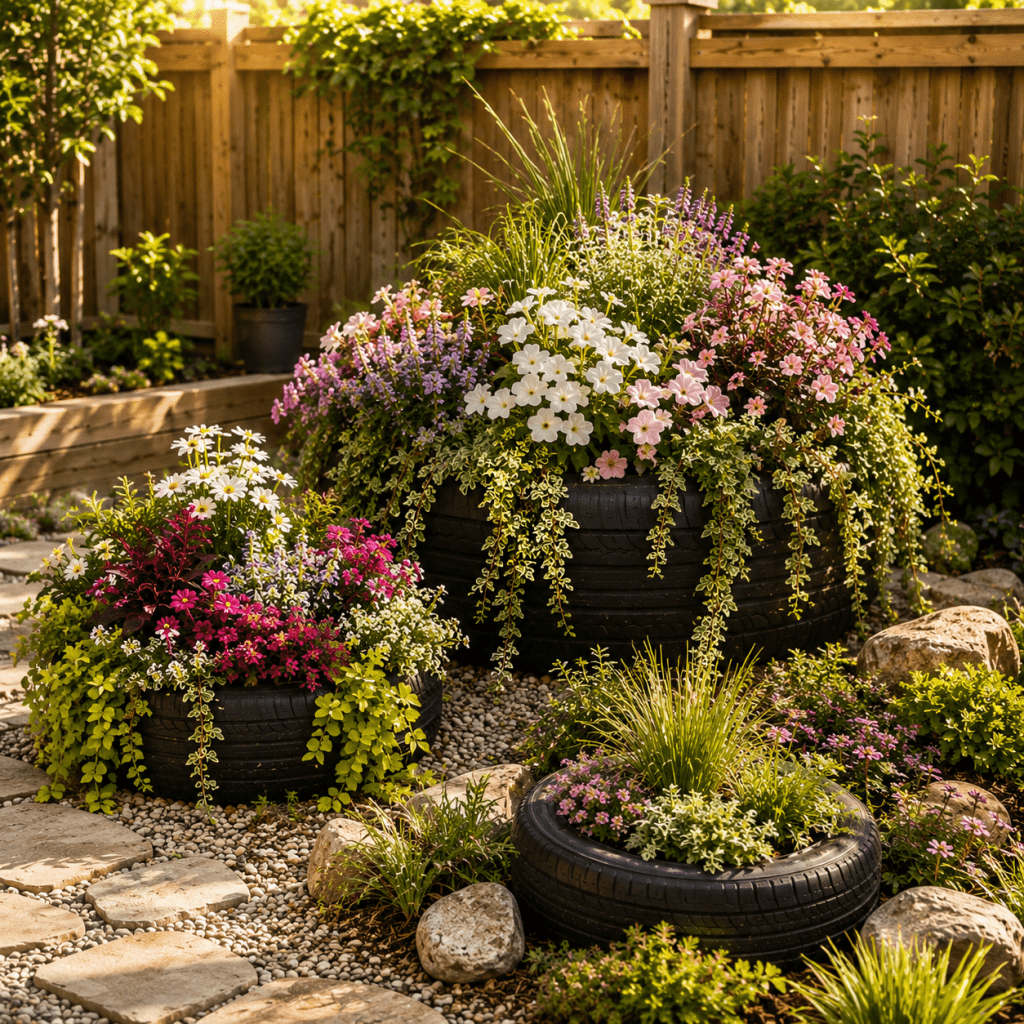
Instead of treating an old tire as something that needs to be hidden, a well-designed tire planter gives it a clear visual purpose. It can become an oversized statement container overflowing with flowers, a layered miniature planting composition filled with contrasting textures, or a subtle low-profile planter that almost disappears into the surrounding landscape.
That distinction is what separates this guide from broader tire garden concepts. Here, the focus is specifically on the individual tire as a planter—how it is positioned, planted, styled, and integrated into the garden.
These three approaches offer very different possibilities, from dramatic and decorative to natural and understated.
| Rank | Tire Planter Idea | Main Effect | Best Location |
|---|---|---|---|
| 🥇 | Oversized Statement Tire Planter | Bold garden focal point | Patio, entrance, backyard |
| 🥈 | Layered Mixed Flower Tire Planter | Abundant texture and color | Flower gardens and sunny corners |
| 🥉 | Low Profile Natural Tire Planter | Subtle landscape integration | Informal and natural gardens |
Important Note: Reused tires are particularly suited to ornamental planting projects. If you are considering growing edible plants, think carefully about the container material and its history; purpose-made food-safe growing containers are a more straightforward choice when material exposure is uncertain.
🥇 Platz 1 Oversized Statement Tire Planter
The strongest tire planter does not apologize for being a tire.
It makes the circular form part of the design.
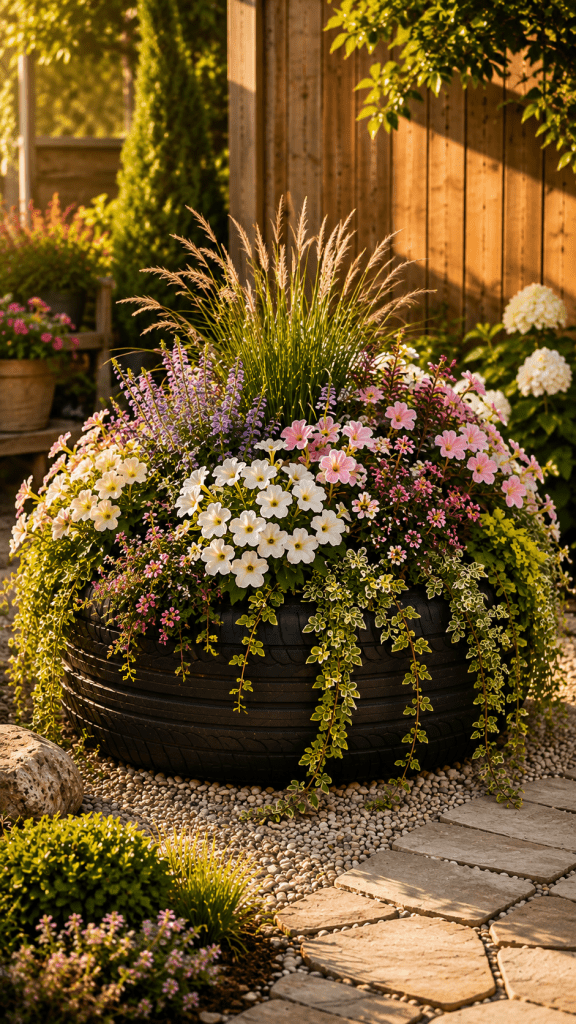
The Oversized Statement Tire Planter takes one substantial tire and transforms it into a visually dominant container filled with lush ornamental planting. Rather than scattering multiple tires around the garden, this approach concentrates attention on one carefully styled feature.
The result can look surprisingly sophisticated.
Give One Tire Enough Visual Importance
One of the easiest mistakes when decorating with recycled materials is using too many pieces.
If ten tires are scattered throughout a small garden, the material itself can overwhelm the plants.
A statement planter takes the opposite approach.
Choose one tire with good proportions and place it somewhere where it can function almost like a conventional oversized garden pot.
This could be beside a patio.
It could anchor the end of a garden path.
It could sit beside a shed or beneath an otherwise empty section of fence.
The surrounding area should give the planter enough breathing room to be appreciated as a single composition.
Create a Three-Level Planting Structure
The planting itself determines whether the tire feels like a basic DIY container or a genuine garden feature.
One of the most reliable arrangements follows the classic container formula:
Height + fullness + cascading movement
Start with one taller ornamental plant near the center or slightly toward the back.
Around it, add medium-height flowering or foliage plants that create volume.
Finally, introduce trailing plants around the perimeter.
These plants soften the hard circular edge and create the impression that the garden is spilling naturally over the container.
Depending on your local growing conditions, ornamental grasses, coleus, begonias, petunias, calibrachoa, lobelia, sweet potato vine, trailing verbena, and other suitable ornamentals can provide these different forms.
The exact plants matter less than their roles.
You want contrast between upright, rounded, and cascading growth.
Use Foliage to Make the Planter Look Fuller
Flowers usually receive the most attention, but foliage is what gives a planter structure.
Imagine a tire containing only several flowering plants with bare soil visible between them. The container may look unfinished until the plants mature.
Now imagine the same planter with dense green, burgundy, silver, or variegated foliage filling the gaps.
Immediately, the arrangement feels richer.
A particularly effective combination might include deep burgundy foliage toward the center, soft green mounding plants around it, and white flowers cascading over the tire.
The color contrast creates depth without requiring many different flower varieties.
Consider Leaving the Tire Dark
Painting is not mandatory.
In fact, one of the most interesting Tire Planter Ideas is allowing the original dark rubber to function almost like a matte black garden container.
This works particularly well in contemporary or natural gardens.
Dark tires visually recede behind green foliage. Once trailing plants begin covering portions of the sidewall, the rubber becomes less dominant.
Pair it with gravel, weathered timber, stone, or abundant greenery and the result can feel surprisingly restrained.
If the original tire has distracting markings or an uneven appearance, painting it in a single muted shade is another option.
Charcoal, warm gray, muted olive, deep brown, and soft terracotta can all be easier to integrate than very bright colors.
Elevate It Slightly With the Surrounding Landscape
A statement planter should not appear abandoned on an empty lawn.
Create a small visual zone around it.
Gravel can form a simple base.
Low groundcover plants can surround the tire.
A few natural stones can connect it to a nearby flower bed.
Even a small patch of mulch extending beyond the tire can help.
The idea is not to decorate the tire with more objects. It is to connect the planter to the landscape.
Make the Flowers the Hero
When styling a statement planter, decide what people should notice first.
Ideally, the answer is the planting.
The tire provides structure.
It should not compete with the flowers through excessive decoration, multiple patterns, lettering, ornaments, and unrelated colors.
This restraint is precisely what makes the concept powerful.
From a distance, the viewer first notices a spectacular mass of plants. Only afterward does it become apparent that the container is an old tire.
That little moment of surprise is what makes this our 🥇 best tire planter idea.
🥈 Platz 2 Layered Mixed Flower Tire Planter
The second concept celebrates abundance.
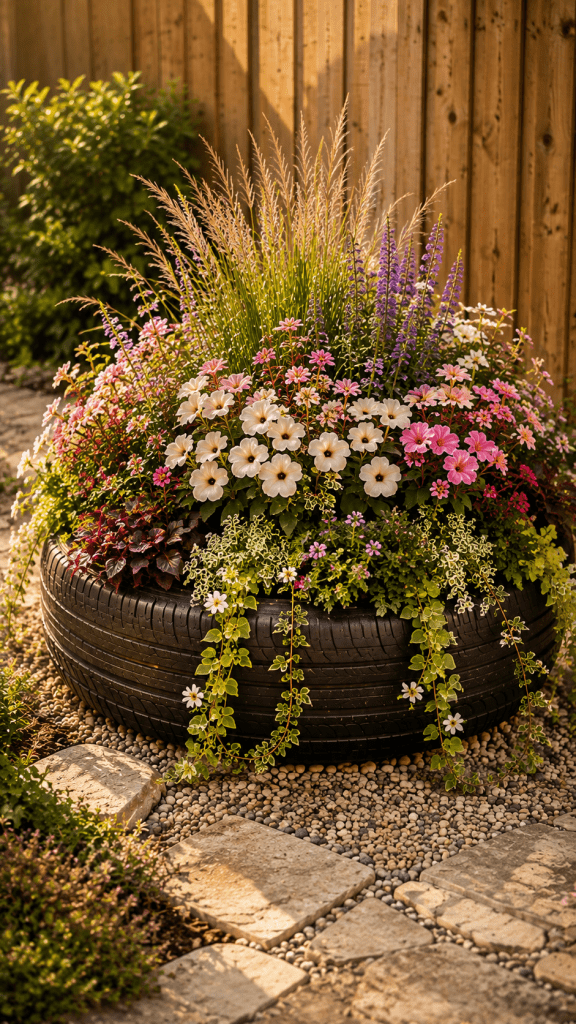
A Layered Mixed Flower Tire Planter uses a single tire as a miniature flower garden, combining different plant heights, flower forms, foliage textures, and cascading edges within one compact container.
Unlike the statement planter, which relies heavily on overall silhouette and location, this design is about what happens inside the tire.
Every planting layer contributes something different.
Think of the Tire as a Tiny Flower Bed
A tire provides a relatively broad circular planting surface.
Use that shape to your advantage.
Instead of planting one flower variety evenly across the entire space, divide the composition into subtle layers.
The tallest plants can occupy the center.
Medium-height flowers can surround them.
Lower mounding plants can fill the outer area.
Trailing plants can finally spill over the edge.
This creates a garden-in-miniature effect.
From almost every viewing angle, something different is visible.
Combine Flower Shapes Not Just Colors
Color is only one source of contrast.
Flower shape is equally important.
Large rounded blooms can be paired with clusters of tiny flowers. Upright flower spikes can rise behind softer mounding plants. Delicate trailing blooms can spill underneath stronger foliage.
This diversity prevents the planting from becoming visually flat.
The same principle applies to leaves.
Combine larger leaves with finer foliage.
Pair glossy surfaces with softer textures.
Introduce one darker foliage plant among predominantly green leaves.
Small contrasts accumulate to produce a planter that feels abundant.
Use a Limited Flower Palette
A mixed planter does not require every color in the garden.
In fact, selecting two dominant flower colors plus plenty of green usually creates a more sophisticated result.
For example:
White + lavender + green
creates a calm romantic composition.
Soft pink + burgundy + green
feels richer and more dramatic.
Yellow + white + green
produces a bright cheerful planter.
Coral + pale pink + deep foliage
creates a warmer summer look.
You can introduce minor variations, but the dominant palette should remain easy to understand.
This is especially important because the tire itself already adds another visual element.
Let Some Plants Escape the Circle
A perfectly circular planting arrangement can feel overly rigid.
Allowing flowers and foliage to spill outside the tire changes that.
One trailing plant might extend significantly farther than the others.
A tall stem might lean gently toward one side.
Foliage might partially cover the tire at the front while leaving more rubber visible at the back.
These irregularities make the arrangement feel alive.
Nature rarely grows in perfect symmetry.
A little controlled imperfection helps the tire planter blend into the garden.
Think About the Entire Growing Season
A planter can look spectacular when every flower is simultaneously blooming, but good design should also consider what happens before and after peak flowering.
Foliage becomes especially important here.
Choose plants with attractive leaves so that the arrangement maintains structure even when fewer flowers are present.
Different flowering periods can also help extend visual interest.
One plant may dominate early, another later, while foliage provides continuity between them.
The exact selection will depend on your climate, light conditions, and season.
Place It Where the Details Can Be Seen
Because this planter relies on smaller contrasts and layered planting, it deserves a relatively close viewing position.
Place it beside:
- a seating area,
- garden steps,
- a patio,
- a walkway,
- an entrance,
- or a frequently used garden path.
Visitors can then appreciate the different flower forms and textures.
From a great distance, some of that complexity disappears.
Up close, however, the Layered Mixed Flower Tire Planter becomes a small landscape of its own.
That earns it 🥈 second place.
🥉 Platz 3 Low Profile Natural Tire Planter
Not every tire planter needs to look like a colorful recycled craft.
Sometimes the most beautiful approach is making the tire almost disappear.
The Low Profile Natural Tire Planter integrates a single tire into an existing flower bed or informal landscape, using abundant planting and surrounding materials to soften its industrial appearance.
The result is understated.
Instead of shouting, “Look at this tire,” the design quietly adds another planting level to the garden.
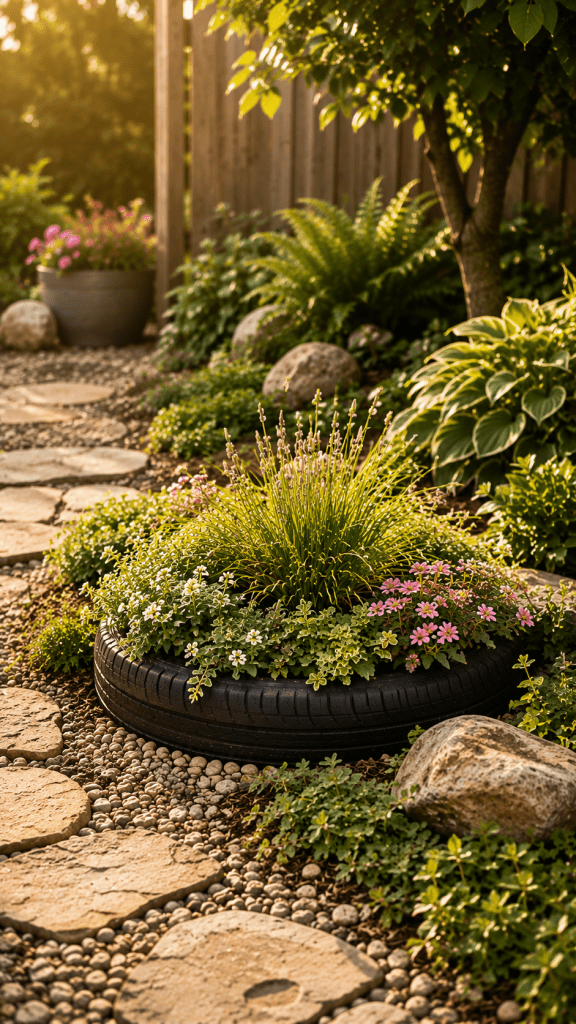
Partially Conceal the Tire
The tire does not need to remain completely visible.
Surround its lower portion with gravel, mulch, low groundcover, or adjacent planting so the strong circular form becomes less obvious.
From certain angles, only the upper rim may remain visible.
As plants mature and spill over the sides, even more of the tire disappears.
This creates an interesting illusion.
The tire still provides the structure of a container, but visually it begins to behave more like a compact raised flower bed.
Choose Natural Colors
This is not the place for neon paint.
If the tire needs painting, choose a color that connects it to the surrounding landscape.
Good possibilities include:
- charcoal,
- earthy brown,
- muted olive,
- stone gray,
- warm taupe,
- deep forest green.
Original dark rubber can also work when enough foliage surrounds it.
The goal is visual recession.
The plants should attract attention before the container.
Use Relaxed Planting
Formal rows are usually less effective for this concept.
Instead, choose plants with loose natural forms.
Soft ornamental grasses can move in the breeze.
Low flowers can spread toward the edges.
Trailing foliage can cross the tire rim.
Nearby groundcovers can visually connect the planter with the rest of the bed.
This approach is especially attractive in cottage gardens and naturalistic landscapes where plants already overlap.
Repeat Plants From the Existing Garden
One of the easiest ways to make a recycled planter feel integrated is to repeat plants that already grow nearby.
Suppose your flower bed contains white flowers, ornamental grass, and dark-leaved foliage.
Use one or two of those same plants inside the tire.
The eye immediately connects the two spaces.
Instead of appearing like a separate DIY project, the tire becomes an extension of the flower bed.
This principle is incredibly useful.
Repetition creates belonging.
Use the Tire to Create Subtle Elevation
Even one tire introduces height.
Take advantage of it.
Place the planter behind lower groundcover so its flowers rise slightly above the surrounding plants.
Or position it near the back of a flower bed to create another planting tier.
This allows a relatively flat garden to gain depth without building a large raised bed.
The effect should remain subtle.
You are not creating a tower.
You are simply lifting one planting area enough to establish another layer.
Where This Idea Works Best
The Low Profile Natural Tire Planter works beautifully in:
- cottage gardens,
- informal flower beds,
- woodland-inspired gardens,
- rustic backyards,
- naturalistic landscapes,
- and garden corners where a large decorative object would feel intrusive.
It is also a strong choice for gardeners who like the recycling aspect of tire planters but do not necessarily want their garden to look like a recycled-material project.
For its subtlety and ability to blend into the landscape, it earns 🥉 third place.
How to Make Tire Planter Ideas Look Intentional
Whether you choose a dramatic statement planter or something much more natural, several design principles can improve almost any tire planter.
1. Decide What the Focal Point Is
Every successful planter needs hierarchy.
Ask yourself:
Should people notice the flowers first?
The unusual container?
The color?
The foliage?
The shape?
Trying to emphasize everything simultaneously usually creates visual clutter.
For most gardens, making the plants the primary attraction is the safest approach.
Let the tire provide support.
2. Cover Bare Soil
Large visible patches of soil can make a planter look unfinished.
As plants mature, this problem may disappear naturally.
At the beginning of the season, however, mulch or appropriately spaced low-growing plants can create a more finished appearance while helping the planting look intentional.
Avoid overcrowding simply to eliminate every visible gap. Plants need room to reach their mature size.
3. Pay Attention to Drainage
A tire planter still needs the same basic growing conditions as other containers.
Water should not remain trapped around roots.
The planting setup should therefore allow excess water to drain appropriately while keeping the growing medium contained.
This becomes particularly important during heavy rain.
Good drainage protects the plants and prevents unnecessary water accumulation.
4. Choose the Location Before Planting
A tire filled with growing medium can become extremely heavy.
Decide where it belongs before filling it.
Consider sunlight, drainage, nearby plants, walking routes, and the view from important areas such as patios or windows.
Moving the planter afterward can be unnecessarily difficult.
5. Give Plants Enough Root Space
Not every plant is suitable for every container.
Select ornamentals whose mature root systems and growing requirements are compatible with the available planting depth and width.
Also remember that dark containers exposed to strong sun can become warm.
Local climate should influence both placement and plant choice.
6. Repeat Something
Repetition is one of the easiest ways to create professional-looking garden design.
Repeat a flower color.
Repeat a foliage texture.
Repeat a nearby material.
Repeat the color of another container.
You only need one connection.
That small detail can make the tire planter feel as though it belongs in the garden rather than being added afterward.
Painted or Unpainted Tire Planters
Both can work.
Painting creates a stronger decorative feature and allows the tire to coordinate with your garden palette.
Leaving the tire unpainted produces a more industrial or understated look.
The decision should depend on the surrounding space.
A colorful cottage-style garden may welcome a soft painted container.
A contemporary garden with charcoal accents may look better with a dark tire.
A naturalistic flower bed may benefit from a tire that is mostly concealed by plants.
Rather than asking whether tires should be painted, ask which treatment makes the container fit its environment.
If painting is chosen, clean and prepare the surface carefully and use a coating intended for suitable exterior applications according to the product manufacturer’s directions.
Where to Place a Tire Planter
Location can change the entire effect.
Beside a patio, a tire planter functions like a decorative container.
Within a flower bed, it functions more like a small raised planting area.
Against a fence, it can become a focal point.
At the end of a pathway, it can visually terminate the view.
Near a garden entrance, it can create a welcoming burst of flowers.
Try looking at your garden from inside the house as well.
Sometimes the best location is not where the planter looks most attractive while standing beside it, but where it creates the strongest composition when viewed through a frequently used window.
Which Tire Planter Idea Is Best for Your Garden
For the biggest transformation, choose the 🥇 Oversized Statement Tire Planter.
It is bold enough to become a genuine focal point while remaining simple enough to avoid the clutter sometimes associated with recycled garden projects.
For gardeners who love abundant flowers, the 🥈 Layered Mixed Flower Tire Planter offers the most planting possibilities. Different heights, foliage textures, and cascading blooms can turn one tire into a compact flower garden.
If your preference is more natural and understated, the 🥉 Low Profile Natural Tire Planter is the strongest choice. By partially concealing the tire and repeating plants from the surrounding landscape, the recycled container can blend almost seamlessly into an existing flower bed.
The three approaches demonstrate an important principle:
A tire planter does not have to have one particular aesthetic.
It can be bold.
It can be romantic.
It can be natural.
What matters is that the container and planting tell the same visual story.
Final Thoughts on Tire Planter Ideas
The most successful Tire Planter Ideas are not really about the tire.
They are about what the tire allows you to create.
The 🥇 Oversized Statement Tire Planter transforms one old tire into a dramatic garden container. The 🥈 Layered Mixed Flower Tire Planter uses abundant flowers and contrasting textures to create a miniature garden. And the 🥉 Low Profile Natural Tire Planter proves that recycled materials can also be quiet and understated.
Whichever approach you choose, resist the temptation to add decoration simply because the material is recycled.
Start with the garden.
Consider its colors, plants, materials, and overall atmosphere. Then design the tire planter to belong within that environment.
Once lush foliage begins covering the edges and flowers start spilling over the circular form, the original object becomes less important.
What remains is a beautiful planting composition—and the surprising realization that something once destined to be discarded can become one of the most distinctive features in the garden.