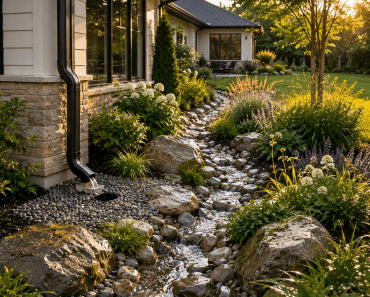
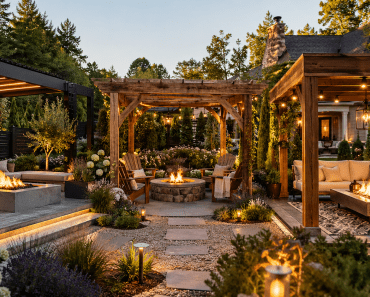
Creating a beautiful outdoor space is not only about choosing stylish furniture, planting colorful flowers, or building the perfect patio. A truly comfortable backyard also needs a sense of separation from neighboring properties, nearby streets, and surrounding activity. The right Outdoor Privacy Solutions can transform an exposed garden, patio, deck, or courtyard into a peaceful retreat where relaxing, dining, entertaining, and spending time with family feel much more natural.
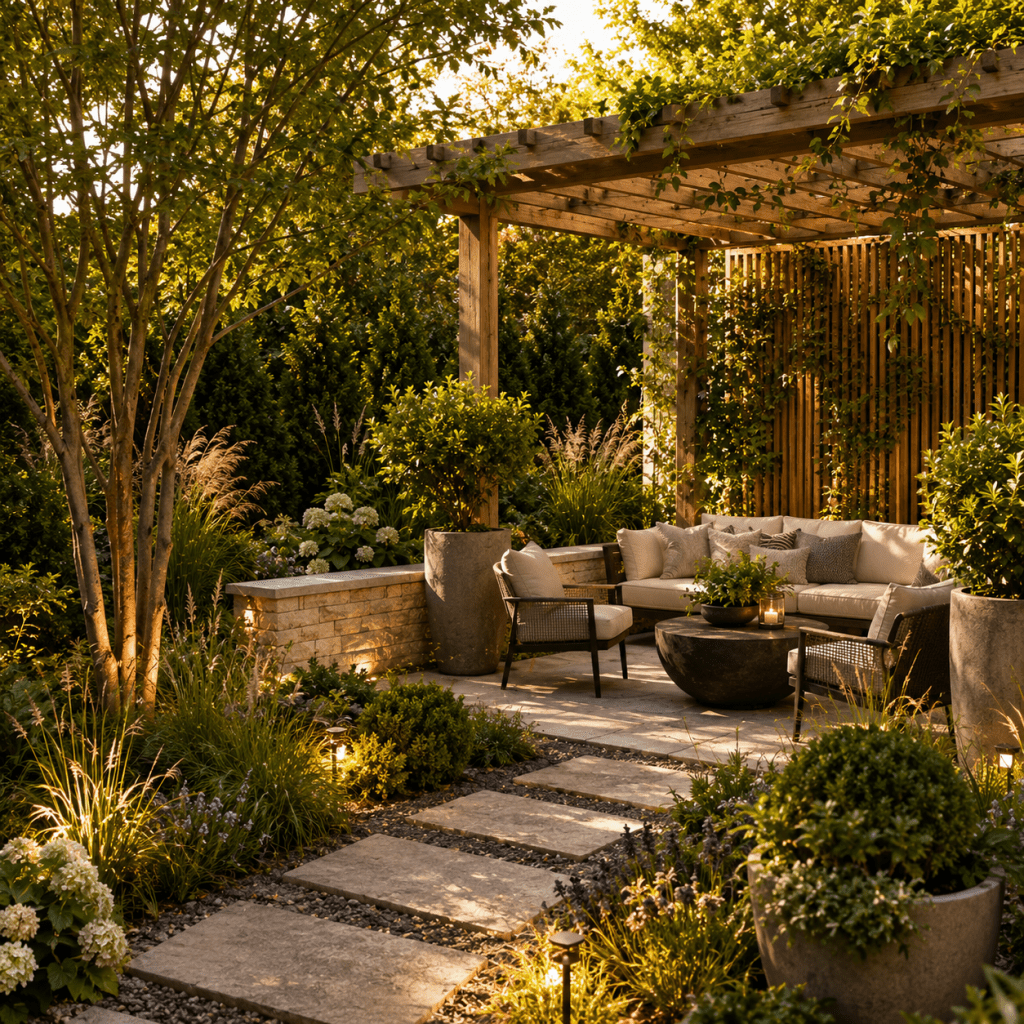
Modern privacy design has also moved far beyond simply installing a tall fence around the property. Today, some of the most attractive solutions combine architecture and landscaping through layered planting, elegant privacy screens, pergolas, climbing plants, ornamental grasses, hedges, and carefully positioned garden structures. 🌿 Instead of making the backyard feel enclosed, these elements can actually make it feel more sophisticated and thoughtfully designed.
The strongest approach is usually one that considers privacy from several directions. Neighboring windows may create privacy concerns from above, while an open fence line may expose a seating area from the side. A swimming pool might require a completely different solution from a small patio. Understanding where the unwanted sightlines originate makes it much easier to create privacy without unnecessarily blocking sunlight, airflow, or attractive views.
Among the many possibilities, three approaches stand out because they balance privacy, beauty, flexibility, and long-term landscape value exceptionally well.
🥇 Best 1 Layered Living Privacy Garden With Trees Hedges and Ornamental Grasses
🥈 Best 2 Architectural Privacy Screens With Pergolas and Climbing Plants
🥉 Best 3 Private Outdoor Room With Strategic Walls Curtains and Greenery
Each creates privacy differently, making it possible to choose a solution that fits the size, style, and exposure of almost any outdoor space.
Why Outdoor Privacy Solutions Can Completely Transform a Backyard
Privacy changes the way an outdoor space feels.
An exposed patio may technically have everything needed for relaxation—a comfortable sofa, attractive paving, beautiful plants, perhaps even an outdoor fireplace—but it can still feel strangely uncomfortable when neighboring windows overlook the area. Once those sightlines are softened or blocked, the same patio suddenly feels like a genuine extension of the home.
Good Outdoor Privacy Solutions should therefore be treated as part of the overall landscape architecture rather than something added at the very end.
🌿 Planting can establish soft boundaries.
🪵 Timber screens can provide immediate separation.
🌸 Climbing plants can turn structures into living walls.
🏡 Pergolas can address overhead sightlines.
🌾 Ornamental grasses can provide seasonal screening without creating heavy visual barriers.
Another major advantage is atmosphere. Privacy elements create layers, and layers make landscapes visually interesting. A garden where everything can be seen immediately from one position often feels smaller than it actually is. Screens, planting, and partial walls create hidden areas and encourage visual discovery.
This means privacy can paradoxically make a small backyard feel larger.
Instead of seeing the entire boundary at once, the eye moves through foreground plants, intermediate screens, and background greenery. The landscape develops depth.
The Best 3 Outdoor Privacy Solutions at a Glance
Choosing the right approach depends on how quickly privacy is required, how much maintenance is acceptable, and whether the goal is natural screening, architectural structure, or complete outdoor-room intimacy.
| Outdoor Privacy Solution | Privacy Level | Best For | Maintenance | Visual Character |
|---|---|---|---|---|
| 🥇 Layered Living Privacy Garden | High | Backyards, pools, garden borders | Medium | Lush, natural, luxurious |
| 🥈 Architectural Screens and Pergolas | High and immediate | Patios, decks, urban gardens | Low to medium | Modern, structured, elegant |
| 🥉 Private Outdoor Room | Very high | Dining and lounge areas | Medium | Intimate, resort-inspired, cozy |
The most sophisticated gardens often combine elements from all three rather than relying on only one technique.
🥇 Best 1 Layered Living Privacy Garden With Trees Hedges and Ornamental Grasses
Why This Is One of the Most Beautiful Outdoor Privacy Solutions
A layered living screen is arguably the most natural way to create privacy because the screening itself becomes part of the garden.
Instead of constructing one continuous barrier, different plant heights are arranged strategically. Taller trees establish the upper layer, evergreen shrubs or hedges form the middle layer, and ornamental grasses, flowering shrubs, or perennials soften the lower portion.
The result resembles a carefully composed woodland edge rather than a privacy barrier.
🌳 Taller planting can interrupt views from neighboring upper-story windows.
🌿 Evergreen shrubs provide dependable screening closer to eye level.
🌾 Grasses soften rigid boundaries while introducing movement.
🌸 Flowering plants add seasonal color and make the privacy planting feel decorative rather than purely functional.
This layering technique is especially successful in medium and large gardens because it creates depth while disguising the actual property boundary.
A simple fence tells the eye exactly where the garden ends. Layered planting makes the edge less obvious.
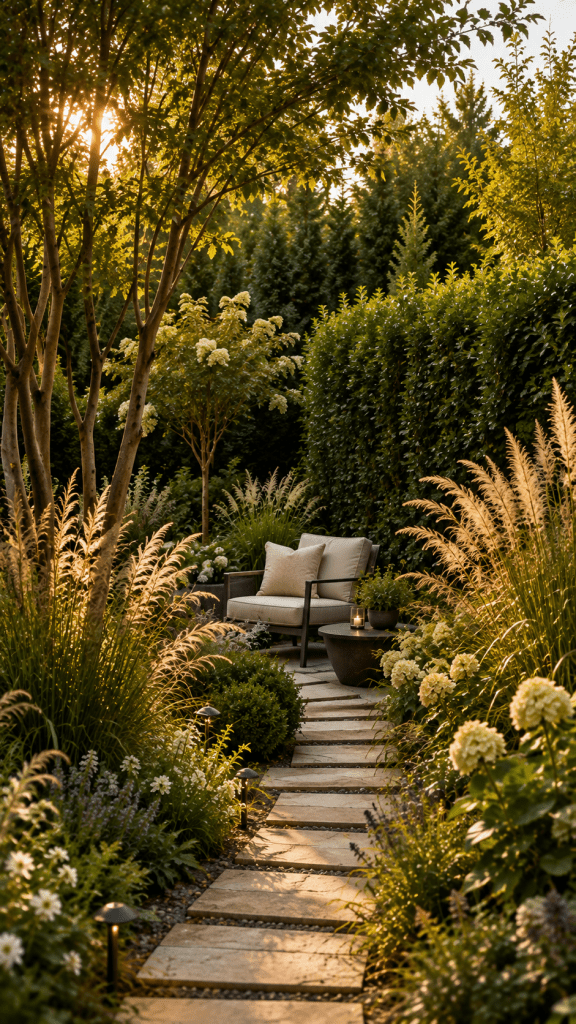
Build Outdoor Privacy Solutions With Multiple Plant Heights
The secret to successful living privacy is avoiding a single uniform line.
Imagine a backyard boundary with a six-foot hedge running perfectly straight from one corner to another. It provides screening, but visually it can become a green wall.
Now imagine the same boundary with several taller multi-stem trees behind the hedge. Ornamental grasses overlap sections of the foreground, while flowering shrubs create irregular shapes between them.
Suddenly the landscape feels deeper and much more natural.
A useful planting hierarchy might include:
Upper layer: small ornamental trees or narrow upright trees.
Middle layer: evergreen shrubs, clipped hedging, bamboo alternatives, or large flowering shrubs.
Lower layer: ornamental grasses, perennials, groundcover, and smaller architectural plants.
The exact species should always suit the local climate, soil conditions, available sunlight, and mature dimensions of the garden.
Use Trees to Block Elevated Neighboring Views
One of the most difficult privacy problems comes from second-story windows.
A conventional fence may block people walking next door, but it often does nothing about windows positioned several meters above ground level.
Strategically placed trees can solve this problem without requiring an excessively tall solid structure.
The key word is strategically.
It is rarely necessary to plant trees across the entire boundary. Instead, identify the precise sightline between the neighboring window and the area where privacy is most important.
A carefully positioned tree canopy can interrupt that line of sight while allowing the rest of the garden to remain open.
Multi-stem trees can be particularly attractive because their branching structure feels lighter than a dense hedge. They can also cast beautiful patterned shade across patios and garden paths. 🌳
Create Soft Privacy With Ornamental Grasses
Ornamental grasses offer a completely different type of screening.
Rather than creating absolute visual separation, they filter views.
This makes them particularly effective around seating areas, garden paths, swimming pools, and contemporary patios where a heavy wall would feel too restrictive.
Tall grasses also move beautifully in the wind. Their fine foliage catches sunlight, creating a soft shimmering effect that can make an ordinary boundary feel remarkably atmospheric.
During late summer and autumn, many varieties develop elegant seed heads that add another layer of texture.
For a premium landscape appearance, grasses look especially beautiful when planted in generous groups instead of isolated individual plants.
Add Evergreen Structure for Year Round Privacy
Seasonal planting can be spectacular, but privacy needs do not necessarily disappear when leaves fall.
Evergreen shrubs help maintain structure throughout the year.
Instead of planting a continuous hedge everywhere, evergreen masses can be positioned around important sightlines. This produces a more relaxed landscape while maintaining functional screening.
A combination of evergreen structure and deciduous seasonal planting is often more visually interesting than relying entirely on one category.
During summer, the garden becomes lush and layered. During winter, the evergreen framework remains visible and preserves essential privacy.
Create a Hidden Seating Area Inside the Planting
One particularly beautiful variation is to place the seating area slightly inside the landscape rather than directly against the house.
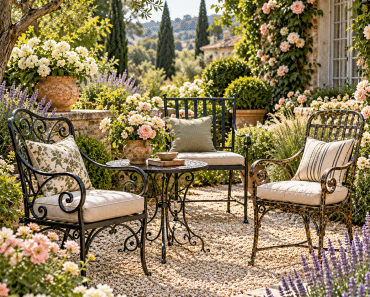
Imagine a small gravel terrace surrounded on three sides by layered planting.
A pair of comfortable outdoor chairs sits beneath a small tree. Tall grasses move along one side while evergreen shrubs form the background. A narrow stone path leads toward the seating area but does not reveal everything immediately.
This creates the feeling of discovering a secret garden room. ✨
It works particularly well for reading corners, morning coffee areas, meditation spaces, or quiet conversation zones.
🥈 Best 2 Architectural Privacy Screens With Pergolas and Climbing Plants
Why Architectural Outdoor Privacy Solutions Work So Quickly
Plants can create extraordinary privacy, but they often require time to mature.
Architectural screens provide an immediate alternative.
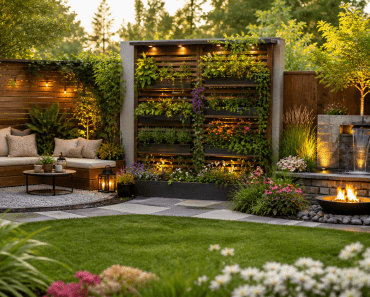
A beautifully designed timber, metal, masonry, or composite screen can establish privacy from the moment it is installed. When combined with plants, the structure becomes part of the landscape rather than appearing like a purely functional barrier.
This solution is especially effective for:
🏡 Small urban gardens
🪴 Courtyards
🔥 Outdoor kitchens
🛋️ Patio lounges
🍽️ Outdoor dining spaces
🌊 Poolside areas
Architectural screens are also useful when privacy is required only in one specific location.
Instead of enclosing the entire property, a screen can protect the exact area that needs it.
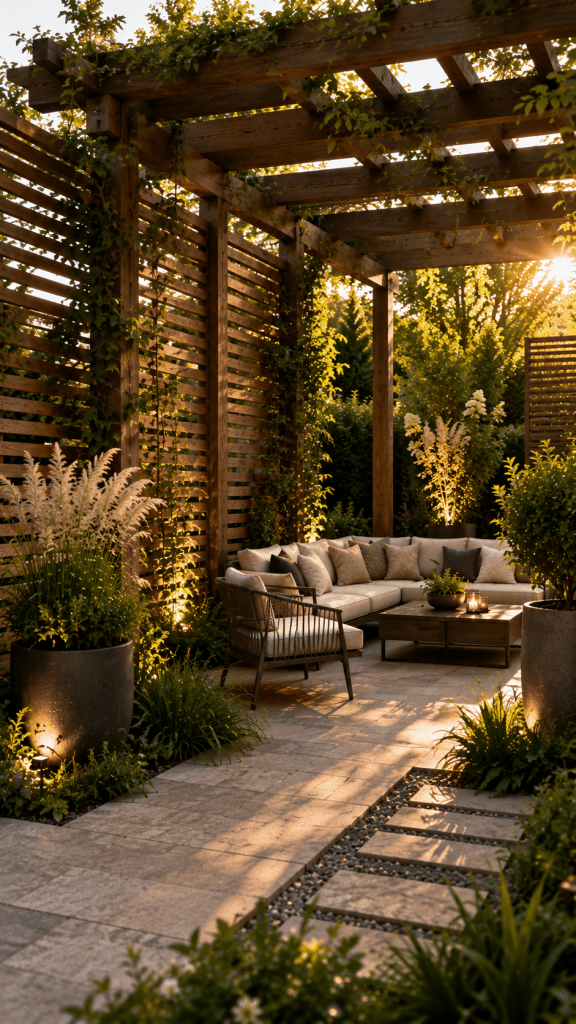
Use Slatted Screens Instead of Heavy Solid Walls
Solid walls offer excellent privacy, but they can sometimes make compact spaces feel smaller.
Slatted screens provide an elegant compromise.
Vertical timber slats are particularly effective because they create a strong architectural rhythm while still allowing limited airflow and light to move through the structure.
The spacing between the slats can be adjusted according to the desired privacy level.
Narrow spacing produces stronger screening. Wider spacing creates a lighter visual effect.
Natural timber works beautifully in gardens dominated by greenery, limestone, gravel, or neutral outdoor furniture. Dark stained timber or black metal can create a more contemporary aesthetic.
Vertical orientation can also make the screen appear taller and more refined.
Turn a Pergola Into a Privacy Structure
Pergolas are usually associated with shade, but they can also become powerful privacy tools.
A standard open pergola defines an outdoor room. Add a slatted side panel, climbing plants, or strategically positioned screens and it begins protecting the space from neighboring views.
Overhead structures are particularly useful when the privacy problem originates from above.
For example, a neighboring second-story balcony might overlook a dining terrace. Adding carefully spaced overhead slats or a climbing vine canopy can reduce that exposure without completely covering the patio.
The effect is much softer than building a permanent roof.
A pergola also gives the garden vertical architecture, helping an ordinary patio feel like a destination rather than simply an area of paving.
Combine Climbing Plants With Privacy Screens
Architecture and planting are especially powerful when used together.
A privacy screen offers immediate coverage while climbing plants gradually soften the structure.
Over time, vines can weave through trellises or climb cables installed against a wall. 🌿
The result becomes increasingly organic as the garden matures.
Flowering climbers can introduce seasonal color, while evergreen climbers may provide longer-lasting coverage in suitable climates.
The support system should be designed according to the mature weight and growth pattern of the selected plant. Some vigorous climbers become surprisingly heavy and need substantial structural support.
Frame Views Instead of Blocking Everything
Privacy does not always mean eliminating every view.
Sometimes the most elegant solution is selective screening.
Suppose one side of the backyard faces an unattractive neighboring structure while another side looks toward mature trees or distant landscape.
Blocking everything would remove both the undesirable and desirable views.
Instead, position privacy screens where they are specifically needed and leave attractive sightlines open.
This technique is often called view framing.
The garden becomes visually edited.
Screens hide distractions while carefully positioned openings direct attention toward attractive plants, sculptures, water features, or distant scenery.
It is the landscape equivalent of choosing what appears inside a picture frame. 🖼️
Use Decorative Screens as Garden Art
Privacy structures can also function as focal points.
Laser-cut metal panels, sculptural timber screens, geometric latticework, and textured masonry can transform functional screening into decorative architecture.
Lighting makes these elements even more interesting.
A warm landscape light positioned near a patterned screen can cast dramatic shadows across paving or adjacent walls after sunset.
During the daytime, climbing plants and surrounding greenery soften the architecture. At night, the same structure becomes an illuminated garden feature.
This dual function makes decorative screens particularly valuable in compact gardens where every element needs to contribute visually.
Important Note: Before installing tall privacy fences, screens, walls, pergolas, or large trees, check local property-boundary rules, building regulations, utility locations, drainage requirements, and any applicable neighborhood restrictions. Mature plant dimensions should also be considered so today’s elegant privacy solution does not become an overcrowded or structurally problematic feature later.
🥉 Best 3 Private Outdoor Room With Strategic Walls Curtains and Greenery
Turn Outdoor Privacy Solutions Into a Complete Garden Room
The third approach goes beyond screening the property boundary.
Instead, it creates privacy around a specific activity zone.
Think of it as designing a room without conventional interior walls.
A patio can become an outdoor living room. A dining terrace can feel like an intimate restaurant courtyard. A poolside lounge can resemble a private resort cabana.
The key is creating several subtle boundaries around the space.
A pergola might define the ceiling.
A low masonry wall establishes one side.
Tall planting protects another.
Outdoor curtains provide flexible screening.
Large containers filled with greenery soften the remaining edges.
Together, these elements create enclosure without completely separating the space from the garden.
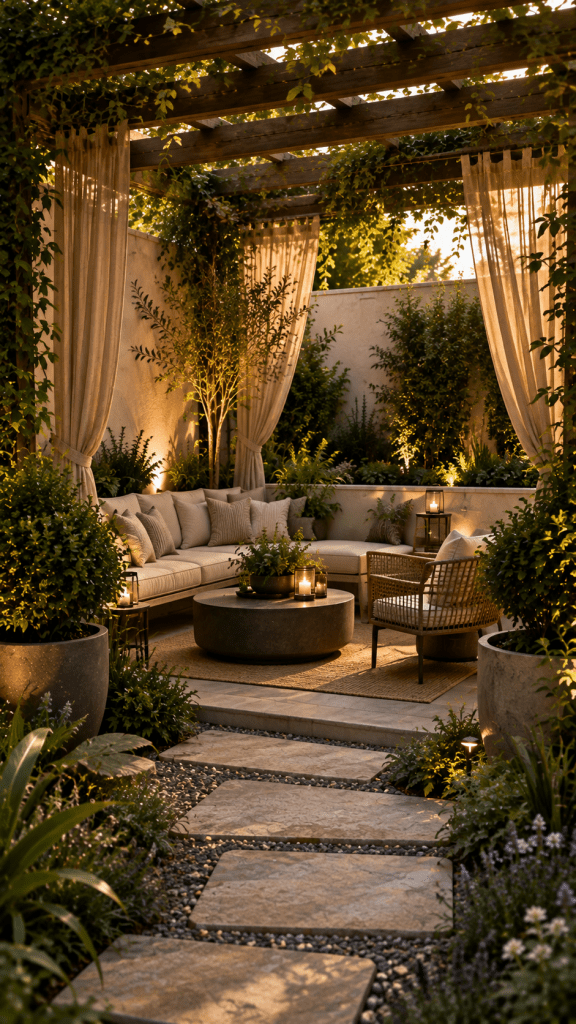
Create a Luxury Outdoor Lounge With Curtains
Outdoor curtains can dramatically change the atmosphere of a pergola or covered patio.
When open, they frame the surrounding garden.
When partially closed, they soften unwanted views.
When fully drawn, they can create a remarkably intimate environment.
Light neutral fabrics are particularly effective because they maintain an airy appearance while moving gently in the breeze. 🤍
The fabric should, of course, be suitable for outdoor exposure and the local climate.
Curtains are most successful when combined with permanent landscape elements rather than used as the only privacy solution.
For example, a backdrop of evergreen planting behind a linen-look curtain creates much greater visual depth than fabric alone.
Use Low Walls Without Making the Space Feel Enclosed
Not every privacy wall needs to be extremely tall.
A low wall can create psychological separation even when it does not completely block the view.
This is especially useful around sunken lounges, fire-pit areas, and outdoor dining terraces.
Natural stone, lime-finished masonry, brick, or textured concrete can establish architectural boundaries while providing seating edges or surfaces for decorative objects.
Planting immediately behind the wall can extend its perceived height.
For example, a four-foot architectural wall backed by tall grasses may visually behave like a much taller barrier while remaining softer and more dynamic.
This combination is particularly effective in modern gardens.
Surround Seating With Large Container Plants
Containers offer one major advantage: flexibility.
Large planters filled with upright shrubs, grasses, small trees, or architectural foliage can create instant screening without permanently changing the entire landscape.
This makes them ideal for decks and paved courtyards where planting directly into the ground may not be possible.
Instead of using many small pots, consider fewer oversized containers.
Large-scale planters generally create a stronger architectural statement and provide enough soil volume for substantial plants.
Repeating the same planter material also helps the arrangement feel intentional.
For example, several oversized textured stone containers planted with tall greenery can establish a sophisticated visual rhythm along the edge of a terrace.
Create Privacy Around an Outdoor Dining Area
Dining areas often benefit from a stronger sense of enclosure than general garden spaces.
A dining table placed in the middle of an exposed patio may feel temporary.
Place the same table beneath a pergola, surround one side with a timber screen, add layered greenery behind it, and hang a pendant light overhead.
The space suddenly feels like an outdoor dining room.
This demonstrates an important principle:
Privacy and spatial definition often work together.
People tend to feel more comfortable when a seating or dining area has identifiable edges.
Those edges do not need to be solid walls. They simply need to visually communicate that the area is its own destination.
Design a Private Fire Pit Retreat
Fire-pit areas naturally encourage gathering, making them perfect candidates for privacy landscaping.
A circular gravel or stone terrace can be partially surrounded by tall ornamental grasses and multi-stem shrubs.
Instead of creating a continuous wall, leave one intentional opening toward the garden.
The entrance becomes part of the experience.
Guests walk through the landscape before arriving at the fire area, which makes the destination feel more secluded.
🔥 At night, firelight illuminates the grasses from below, creating dramatic silhouettes and making the privacy planting part of the atmosphere.
This approach works particularly well toward the far end of a larger backyard.
How to Choose the Right Outdoor Privacy Solutions for Your Space
The best solution begins with understanding the actual privacy problem.
Stand in the area where privacy matters most.
Then look outward.
Where can neighboring properties see the space?
A street-level view requires a different solution from an elevated window. A narrow gap between buildings requires something different from an open suburban property line.
Mark the critical sightlines mentally or physically.
Once these are understood, screening can be placed strategically rather than surrounding the entire property unnecessarily.
This saves space, preserves light, and often reduces cost.
Outdoor Privacy Solutions for Small Backyards
Small gardens require careful balance.
Too much screening can make them feel boxed in.
Instead of installing tall solid barriers everywhere, combine vertical elements with greenery.
A narrow slatted timber screen can occupy very little ground space. Climbing plants can cover vertical surfaces without requiring wide planting beds. Small multi-stem trees can provide overhead foliage without creating enormous dense canopies.
Mirrors, carefully framed openings, and changes in planting depth can also help prevent the garden from feeling claustrophobic.
The objective is not simply maximum enclosure.
It is maximum useful privacy with minimum visual heaviness.
Outdoor Privacy Solutions for Large Backyards
Large properties offer more opportunities for layered landscapes.
Rather than placing all privacy planting directly against the property line, bring some of it forward into the garden.
Create overlapping planting islands.
One group of trees might screen a neighboring building. Another cluster of shrubs can protect the patio. Tall grasses might surround a secondary seating area.
This breaks the garden into several interconnected spaces.
A person walking through the landscape experiences changing views rather than one enormous open lawn surrounded by a hedge.
The result feels much more immersive.
Outdoor Privacy Solutions for Patios and Decks
Patios and decks usually require targeted screening because people spend significant amounts of time sitting in one location.
Start by evaluating eye-level views when seated rather than standing.
This small change in perspective can dramatically reduce the amount of screening required.
A strategically positioned planter or four-foot screen may be enough to block a neighboring patio when viewed from a seated position.
Pergolas are particularly effective for decks because they establish vertical structure without requiring enormous planting beds.
Add climbing greenery or adjustable screens and the deck begins to feel like an outdoor room.
Outdoor Privacy Solutions Around Swimming Pools
Pool privacy should balance screening with openness.
Dense planting can create a resort-like atmosphere, but the landscape should remain practical and compatible with pool maintenance.
Layering is especially effective.
Architectural screens can protect key sightlines, while selected greenery softens the structure.
Repeating plants around the pool perimeter creates visual cohesion.
Instead of surrounding the entire pool with a tall wall, screening can be concentrated around lounge areas where people spend the most time.
This preserves an open feeling while improving comfort.
Materials That Make Privacy Features Look More Luxurious
Materials strongly influence whether a privacy structure feels like a temporary barrier or an intentional part of the landscape.
Natural timber introduces warmth.
Stone creates permanence.
Black or bronze metal adds contemporary refinement.
Textured masonry can connect outdoor structures with the architecture of the house.
The best material usually relates to something already present on the property.
If the home has natural oak details, repeating warm timber outside can create continuity.
If limestone is used around the patio, incorporating the same stone into privacy walls or planters makes the entire landscape feel cohesive.
Avoid introducing too many unrelated materials.
A limited palette generally creates a calmer and more sophisticated result.
Add Lighting to Outdoor Privacy Solutions
Privacy landscaping should not disappear after sunset.
Lighting can transform screens, trees, and planting into some of the most dramatic elements in the nighttime garden. ✨
Uplighting a multi-stem tree reveals its branching structure.
Soft illumination behind ornamental grasses creates glowing silhouettes.
Warm lighting grazing across a timber screen emphasizes its texture.
Integrated lights beneath a pergola turn the structure into an inviting evening destination.
The goal should usually be subtle illumination rather than making the garden excessively bright.
Pools of warm light separated by darker areas create depth and intimacy.
Privacy features then become part of the nighttime composition.
Common Outdoor Privacy Mistakes to Avoid
One common mistake is attempting to block every possible view with the tallest available barrier.
This may create privacy, but it can also eliminate sunlight, airflow, and visual depth.
Another problem is planting fast-growing species without considering mature size.
A plant that looks perfectly proportioned when purchased may eventually overwhelm a narrow garden or require constant pruning.
Spacing is therefore crucial.
The same applies to trees. Roots, canopy width, proximity to structures, and long-term maintenance should all influence placement.
Another mistake is focusing only on the boundary.
Sometimes the easiest solution is much closer to the seating area.
A small screen positioned six feet from a patio may block the same sightline that would otherwise require a much larger structure at the property boundary.
Strategic placement is usually more effective than simply increasing height.
Combine the Best 3 Outdoor Privacy Solutions for Maximum Impact
The most compelling outdoor spaces rarely rely on a single technique.
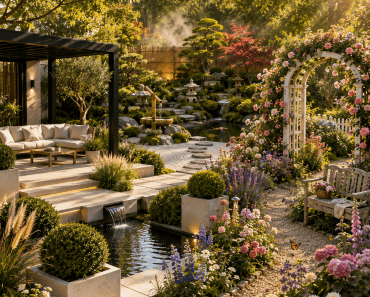
Imagine a sophisticated backyard where a natural timber pergola shelters the main seating area. One side contains a vertical slatted screen covered partially with climbing greenery.
Behind the patio, several multi-stem trees filter views from neighboring upper windows.
A loose hedge creates evergreen structure along the property line.
Tall ornamental grasses soften the lower boundary.
Near the back of the garden, a second secluded seating area is surrounded by layered shrubs and warm landscape lighting.
Every privacy element performs a specific function.
Yet nothing looks like it was installed merely to hide the neighbors.
That is the ultimate objective.
Privacy should become part of the beauty of the landscape.
Final Thoughts on the Best Outdoor Privacy Solutions
The best Outdoor Privacy Solutions do much more than prevent unwanted views. They create atmosphere, define outdoor rooms, introduce depth, frame attractive scenery, support planting design, and make a backyard genuinely comfortable to use.
For homeowners who love lush natural landscapes, 🥇 Best 1 Layered Living Privacy Garden With Trees Hedges and Ornamental Grasses offers exceptional long-term beauty. Trees handle elevated views, evergreen planting creates dependable structure, and grasses soften the entire composition.
For patios, decks, courtyards, and contemporary gardens requiring faster results, 🥈 Best 2 Architectural Privacy Screens With Pergolas and Climbing Plants combines immediate screening with strong visual architecture. It is particularly useful when only specific sightlines need to be blocked.
For those wanting the strongest feeling of intimacy, 🥉 Best 3 Private Outdoor Room With Strategic Walls Curtains and Greenery transforms ordinary seating and dining areas into sophisticated garden destinations reminiscent of boutique hotels and private resorts.
🌿 The most successful design may ultimately borrow ideas from all three.
A tree canopy can provide upper-level privacy. A slatted screen can protect the side of a patio. A pergola can define the ceiling. Tall grasses can soften the boundary. Curtains can provide adjustable enclosure. Carefully positioned lighting can bring the entire composition to life after sunset.
Instead of thinking of privacy as building a barrier, think of it as designing layers between private and public space.
That change in perspective opens far more creative possibilities.
With thoughtful placement, beautiful materials, appropriately selected plants, and attention to important sightlines, an exposed backyard can become a secluded landscape that feels larger, calmer, and considerably more luxurious. 🏡🌿