A beautiful garden is more than colorful flowers, lush greenery, and perfectly arranged plants. Hidden among the leaves, branches, and delicate morning dew, a fascinating little creature may be working quietly to protect your outdoor paradise. The European garden spider is one of nature’s most overlooked garden helpers, offering remarkable benefits that many homeowners never realize.
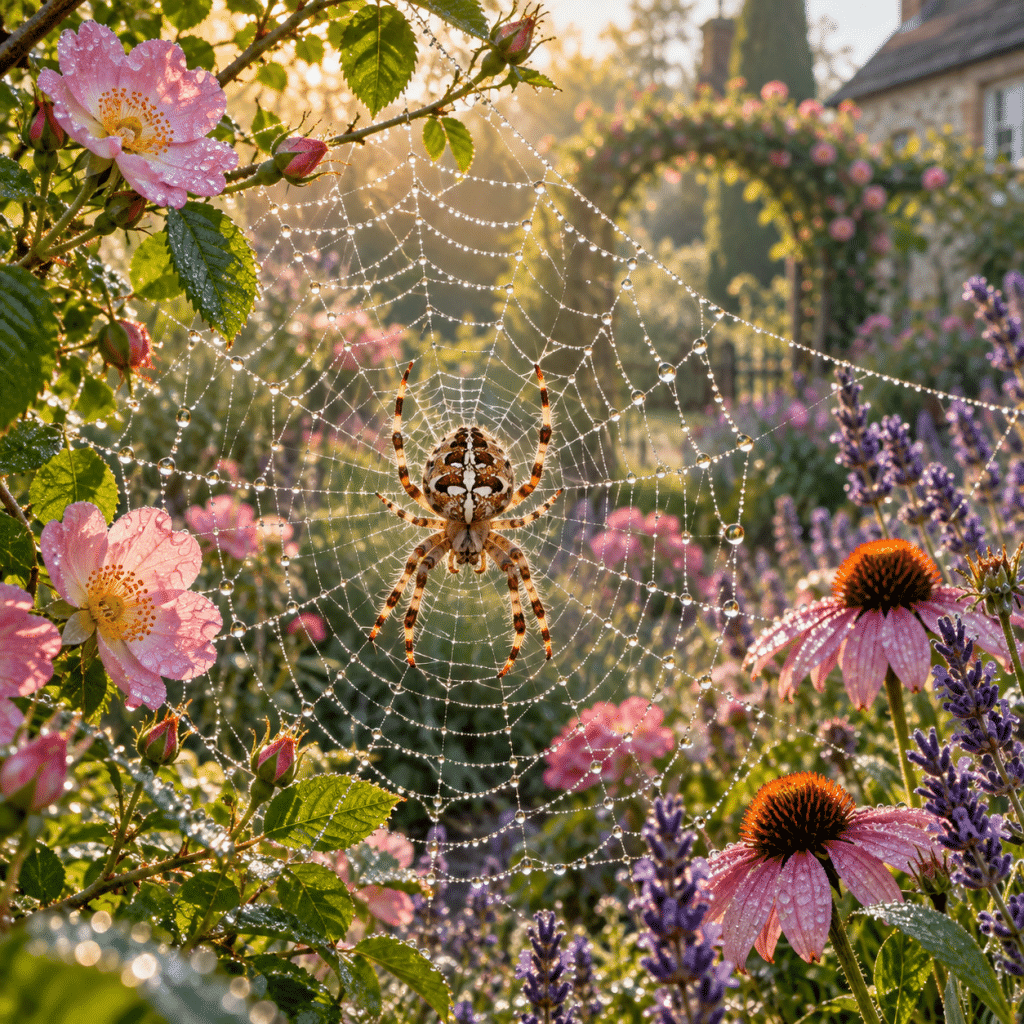
🌿 Imagine stepping into your garden on a peaceful autumn morning and discovering an intricate spiderweb glistening between two flowering shrubs. Tiny droplets of dew sparkle across its delicate threads, transforming an ordinary corner into something extraordinary. While some gardeners instinctively remove these webs, they may unknowingly be disturbing one of their garden’s most useful natural predators.
Also known as the cross orb-weaver or cross spider, the European garden spider (Araneus diadematus) plays an important role in outdoor ecosystems. From capturing flying insects to contributing to healthy garden biodiversity, this remarkable arachnid deserves far more appreciation than fear.
Unlike many garden maintenance methods that require constant effort, these spiders naturally hunt insects, build their own webs, and adapt to suitable surroundings without any assistance from homeowners.
Even better, welcoming European garden spiders can fit beautifully into modern wildlife-friendly gardening. Whether your outdoor space features romantic cottage flowers, a thriving vegetable patch, elegant climbing roses, or a small backyard retreat, allowing these creatures to live undisturbed can contribute to a healthier garden environment.
But what makes them so valuable?
Discover the best 3 reasons European garden spiders are good for your garden, along with practical advice for recognizing them, protecting their habitat, and creating an outdoor space where beneficial wildlife can thrive.
Understanding European Garden Spiders and Their Hidden Role in Your Garden
Before exploring their surprising benefits, it helps to understand what makes European garden spiders different from other common garden visitors.
The European garden spider belongs to the orb-weaver family, a group famous for constructing beautiful circular webs. Its scientific name, Araneus diadematus, refers to a species widely encountered across Europe and also established in parts of North America.
One of its most recognizable characteristics is the pale cross-shaped pattern on its rounded abdomen. This distinctive marking gives the species its familiar alternative name, the cross spider.
Its coloring varies considerably. Some individuals feature golden-brown bodies, while others display darker shades of reddish brown, gray, or orange. This natural variation allows the spiders to blend into different garden environments.
Female European garden spiders are usually noticeably larger than males, especially toward the end of summer and during autumn. A mature female may sit prominently in the center of a beautifully constructed web, waiting patiently for vibrations that signal trapped prey.
🕸️ The most fascinating detail is that these spiders do not need to chase insects around the garden. Their remarkable webs function as passive hunting structures, allowing them to capture suitable flying insects that encounter the sticky silk.
European garden spiders frequently establish webs between shrubs, tree branches, fences, garden structures, and tall herbaceous plants. Their presence becomes especially noticeable in late summer and early autumn, when adults are larger and mature females construct conspicuous webs.
According to the European Society of Arachnology, this species regularly renews its orb web and can recycle silk proteins by consuming older web material. This remarkable behavior highlights the efficiency of its natural hunting system.
For gardeners, the real value of these spiders extends well beyond their beautiful web patterns.
They are active participants in the living ecological network that surrounds every healthy garden.
European Garden Spider Facts Every Gardener Should Know
| Characteristic | European garden spider facts |
|---|---|
| Scientific name | Araneus diadematus |
| Common names | European garden spider, cross spider, cross orb-weaver |
| Spider family | Araneidae |
| Identifying feature | Pale cross-shaped markings on the abdomen |
| Typical habitat | Gardens, hedgerows, woodland edges, shrubs, and vegetation |
| Main food sources | Flying insects and other small arthropods |
| Hunting technique | Circular sticky orb webs |
| Most noticeable season | Late summer and autumn in temperate regions |
| Garden value | Natural insect predation and contribution to biodiversity |
| Human safety | Generally low risk when left undisturbed |
These characteristics make the European garden spider a fascinating example of how wildlife naturally integrates into human-designed landscapes.
A carefully maintained flower garden may appear completely different from a wild meadow, yet both can provide valuable hunting opportunities when suitable vegetation and insect populations are available.
Understanding these spiders encourages a more thoughtful approach to garden maintenance, where preserving beneficial creatures becomes part of creating a genuinely beautiful outdoor environment.
🥇 Reason 1 European Garden Spiders Provide Natural Pest Control Without Harmful Chemicals
One of the strongest reasons to welcome European garden spiders is their ability to capture insects naturally.
Every garden attracts a wide variety of flying insects. Some are harmless visitors, others are beneficial pollinators, and certain species can become annoying or troublesome when their populations increase.
European garden spiders contribute to natural insect regulation by capturing small flying creatures that accidentally encounter their webs.
Unlike chemical pest-control treatments, this activity requires no purchased products, repeated applications, or specialized equipment.
The spider simply uses its natural hunting behavior to obtain food.
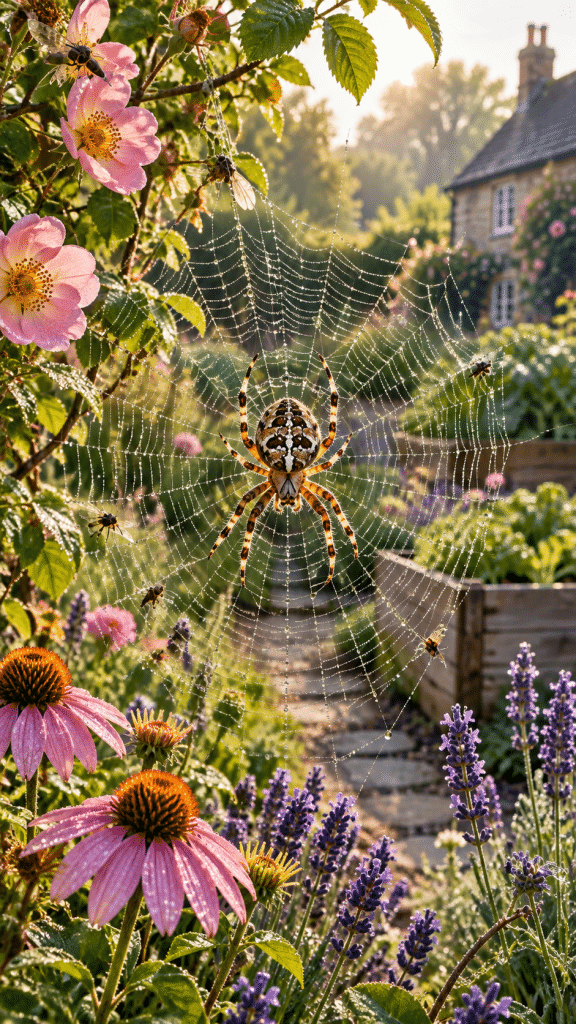
How European Garden Spiders Catch Flying Insects Naturally
European garden spiders construct circular webs supported by stronger structural silk threads.
The familiar wheel-shaped design combines radial threads with a capture spiral that contains sticky material. Together, these elements form an efficient structure capable of intercepting flying prey.
When an insect becomes trapped, movement sends vibrations through the web. The spider detects these signals using sensitive structures on its legs and responds by approaching the prey.
Depending on the insect and circumstances, the spider may immobilize its catch, wrap it in silk, and consume it.
🕷️ This entire process occurs without any intervention from the gardener.
The spider’s presence can help reduce some of the flying insects moving through a particular garden area.
Research summarized by Animal Diversity Web describes Araneus diadematus as an insect-eating predator that can contribute to controlling pest populations.
However, it is important to recognize that these spiders are generalist predators rather than specialized pest-control agents.
They cannot distinguish between an insect considered harmful by gardeners and one that provides benefits to flowers or crops.
Their ecological value comes from participating in the broader natural predator community, not from selectively eliminating unwanted species.
Why Natural Insect Predators Matter in Flower Gardens
Flower gardens often attract abundant insect life because flowering plants provide pollen, nectar, shelter, and breeding opportunities.
This activity is essential for a thriving landscape, but it can also bring insects that gardeners would prefer to keep under control.
European garden spiders may build their webs near flowering borders where flying insects frequently travel.
For example, a web suspended between tall asters and an ornamental shrub can intercept insects moving through that part of the garden.
A similar web positioned between climbing plants and a fence may capture occasional flies, moths, or other flying insects.
These individual hunting events contribute to the larger network of natural predation occurring throughout the garden.
🌸 A garden filled with beneficial predators does not need to be completely free of insects to remain healthy.
In fact, total insect elimination would be undesirable because many insects are essential for pollination, decomposition, and supporting birds and other wildlife.
The goal is ecological balance rather than a perfectly insect-free environment.
European garden spiders play one small but meaningful part in maintaining that balance.
Can European Garden Spiders Help Protect Vegetable Gardens
Vegetable gardens also benefit from a diverse community of insect predators.
Tomatoes, beans, peppers, leafy greens, and other crops attract numerous arthropods throughout the growing season.
Some insects feed on plants, while others pollinate flowers or prey on pests themselves.
European garden spiders may capture winged insects moving between vegetable beds, particularly when suitable web-supporting structures are present.
A spiderweb stretched between tall garden stakes or shrubs near a vegetable plot might intercept a flying insect before it reaches another plant.
Nevertheless, orb-weaving spiders are not a complete solution for problems such as aphid colonies, caterpillar infestations, or soil-dwelling pests.
They primarily capture prey that encounters their webs, which means their impact depends on web placement, local insect activity, and the species of insects present.
The most effective approach combines habitat conservation with regular plant inspections, appropriate plant care, and other integrated pest-management practices.
This allows gardeners to benefit from natural predators without expecting them to perform tasks beyond their ecological role.
Why European Garden Spiders Support Chemical Free Gardening
Gardening without unnecessary pesticide applications has become an important priority for homeowners interested in biodiversity and environmental stewardship.
While pesticides may sometimes be necessary for specific problems, indiscriminate use can affect beneficial organisms alongside target pests.
Spiders can be exposed directly to sprays or indirectly through contaminated prey and changes in the insects available for food.
By protecting existing predator populations, gardeners support the natural processes that already occur in their outdoor spaces.
A wildlife-friendly approach may involve monitoring pests before deciding on treatment, tolerating small amounts of cosmetic plant damage, and choosing targeted interventions when action is necessary.
This does not mean European garden spiders eliminate the need for every form of pest management.
Instead, they form one component of a diverse biological system that can help moderate certain insect populations.
For gardeners who appreciate sustainable landscaping, that contribution makes these spiders particularly welcome.
Best Garden Locations Where European Garden Spiders Can Hunt
Certain parts of a garden are especially suitable for orb-weaving spiders because they provide stable attachment points and frequent insect movement.
| Garden location | Why spiders may use it | Recommended gardening approach |
|---|---|---|
| Flower borders | Tall stems provide support and insects pass between plants | Leave some structural stems standing |
| Shrub gardens | Branches create multiple web attachment points | Avoid unnecessary disturbance |
| Climbing plant areas | Vines and supports offer web-building opportunities | Inspect before pruning |
| Vegetable garden edges | Flying insects travel around crop beds | Preserve webs outside work areas |
| Hedges | Dense vegetation offers shelter and supports prey | Maintain varied vegetation |
| Garden fences | Stable structures can support webs | Leave harmless webs in quiet corners |
| Woodland-style borders | Layered vegetation creates diverse microhabitats | Retain natural plant structure |
A well-planned garden does not require spiders in every corner.
Instead, preserving a few sheltered areas can help maintain opportunities for these useful hunters while keeping walkways and seating spaces comfortable.
The result is an outdoor environment where careful garden design and natural pest regulation can coexist.
🥈 Reason 2 European Garden Spiders Help Create a Healthier and More Balanced Garden Ecosystem
The second major benefit of European garden spiders is their contribution to garden biodiversity.
A successful garden is not simply a collection of attractive plants. It is a living community of organisms interacting through feeding relationships, shelter, reproduction, and seasonal changes.
Insects visit flowers.
Birds search for small animals among branches.
Decomposers break down organic material.
Predators, including spiders, feed on other organisms.
Together, these interactions create the ecological complexity that helps garden habitats function.
European garden spiders occupy an important place within this natural network.
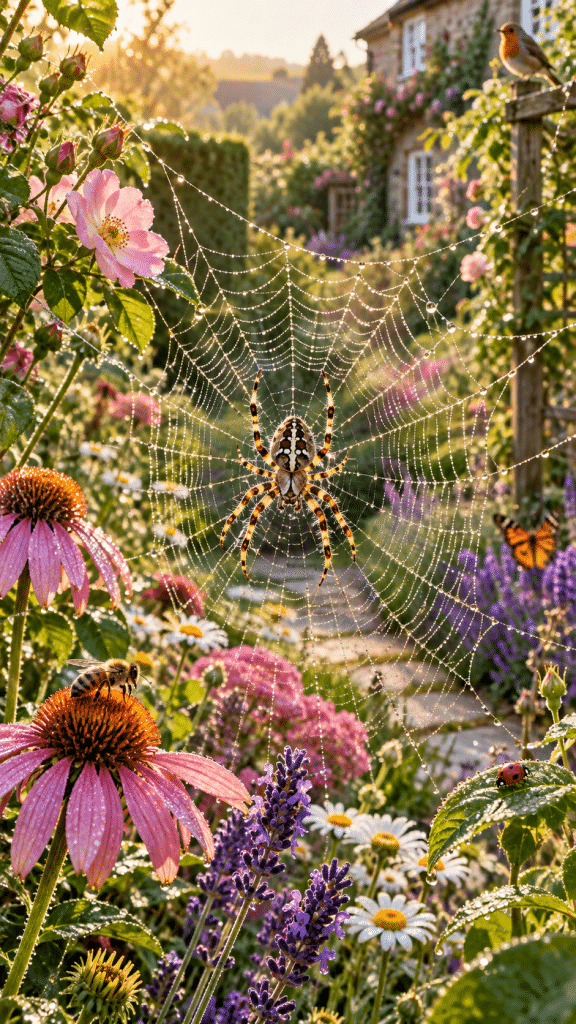
European Garden Spiders Are Part of the Garden Food Web
Every garden contains interconnected food relationships.
Plants capture energy from sunlight and support numerous herbivores and nectar-feeding insects.
Predatory creatures feed on smaller animals, transferring energy through the ecological system.
European garden spiders participate by consuming insects and other suitable arthropods.
At the same time, spiders themselves may become prey for birds, wasps, and other predators.
This dual role makes them contributors to the movement of energy through garden food webs.
🌱 The value of European garden spiders is therefore not limited to the insects they capture.
Their presence also represents one component of a wider community that includes predators, prey, and the habitats supporting both.
A garden that accommodates different animal species may provide more varied ecological functions than a highly simplified landscape.
For example, a mixed planting of flowering perennials, shrubs, and small trees offers a wider variety of physical spaces than a garden consisting only of closely mown lawn.
Different plants provide different resources, including nectar, foliage, seeds, shelter, and structural surfaces for web construction.
This diversity creates opportunities for many forms of wildlife to coexist.
How European Garden Spiders Fit Into Biodiversity Friendly Landscaping
Biodiversity-friendly gardening focuses on creating suitable conditions for a broad range of organisms.
Rather than treating every unfamiliar creature as a potential problem, this approach considers how different species contribute to the garden environment.
European garden spiders are particularly interesting because their needs often overlap with attractive landscaping features.
Climbing roses, natural hedges, ornamental grasses, and mixed shrub borders can provide structures suitable for web building.
A romantic cottage garden filled with layered planting may therefore offer ideal locations for these spiders.
Likewise, a modern garden with carefully positioned shrubs, trellises, and flowering borders can support wildlife without sacrificing a clean architectural appearance.
The Royal Horticultural Society notes that hedges and woodland-edge habitats support spiders alongside many other invertebrates and provide important shelter for garden wildlife.
This suggests an appealing design principle.
Rather than creating separate spaces for beauty and biodiversity, gardeners can combine them through thoughtful plant selection and structural variety.
A flowering hedge can serve as a privacy screen, a seasonal display, and a refuge for beneficial animals.
A climbing plant can soften an unattractive wall while simultaneously providing surfaces for spiderwebs.
A layered perennial border can create visual depth while supporting different insects and their predators.
These combinations make wildlife-friendly gardening practical even in relatively small outdoor spaces.
Why Every Garden Needs a Variety of Natural Predators
No single predator can regulate every type of garden pest.
Ladybirds and their larvae may consume aphids.
Hoverfly larvae can also feed on certain soft-bodied pests.
Ground beetles hunt a variety of small animals, depending on the species.
Predatory mites attack particular tiny arthropods.
Orb-weaving spiders capture flying prey that reaches their webs.
Each predator has different hunting strategies, preferred habitats, and prey relationships.
When a garden supports several kinds of predators, natural predation is distributed across different areas and insect groups.
This diversity does not guarantee that damaging pest outbreaks will never occur.
Weather, plant health, seasonal conditions, and pest reproduction can still cause substantial problems.
However, preserving a diverse predator community is a sensible component of integrated garden management.
🦋 The healthiest-looking garden is not necessarily the one with the fewest insects.
Instead, a biologically active garden contains many species interacting without constant human intervention.
European garden spiders help illustrate this principle because their webs make an otherwise hidden ecological process visible.
European Garden Spiders and Their Relationship With Pollinators
One important consideration is that European garden spiders sometimes catch beneficial insects.
Bees, butterflies, hoverflies, and other pollinators may become trapped in orb webs if they encounter the sticky threads.
This is a normal consequence of generalist predation.
It would therefore be inaccurate to describe European garden spiders as creatures that exclusively protect pollinators or selectively hunt harmful insects.
Nevertheless, the existence of predation does not mean that spiders should be removed from flower gardens.
Predators and pollinators have coexisted in natural ecosystems for millions of years.
The more useful gardening objective is to maintain sufficient floral resources, appropriate habitat, and a diverse range of species.
For example, gardeners can plant flowers with overlapping bloom periods so nectar and pollen remain available across much of the growing season.
They can also preserve sheltered habitats and avoid unnecessary pesticide applications.
These practices benefit many invertebrates, including pollinators and spiders, while allowing normal ecological interactions to continue.
What European Garden Spiders Reveal About Garden Biodiversity
Finding a European garden spider in a garden can be a rewarding observation.
Its presence indicates that the immediate location offers at least some of the conditions the spider needs, such as web attachment points and access to prey.
However, a single spider is not proof that the entire garden ecosystem is healthy.
Even disturbed or simplified habitats may support some adaptable spider species.
A more informative picture emerges by observing the diversity of wildlife across seasons.
Are bees visiting flowers?
Do butterflies appear during suitable weather?
Are birds using the shrubs?
Can different insects be found among leaves and stems?
Are spiders occupying several parts of the garden?
Together, observations like these can help gardeners understand how different habitat features are being used.
A growing appreciation for such details can transform garden maintenance from a purely decorative activity into a rewarding relationship with nature.
🥉 Reason 3 European Garden Spiders Add Natural Beauty and Encourage Sustainable Garden Design
The third reason European garden spiders deserve a place in the garden is perhaps the most unexpected.
Their webs can become extraordinary natural decorations.
A well-positioned orb web combines geometry, delicate silk, changing light, and surrounding vegetation to create something that no manufactured garden ornament can perfectly reproduce.
This visual appeal becomes especially remarkable during early autumn mornings.
When mist settles over a garden, tiny droplets may cling to spider silk, revealing intricate patterns that are otherwise almost invisible.
As sunlight passes through the web, individual threads can sparkle against a background of deep green foliage.
For gardeners who appreciate natural beauty, these moments create an atmosphere that feels peaceful, mysterious, and deeply connected to the seasons.
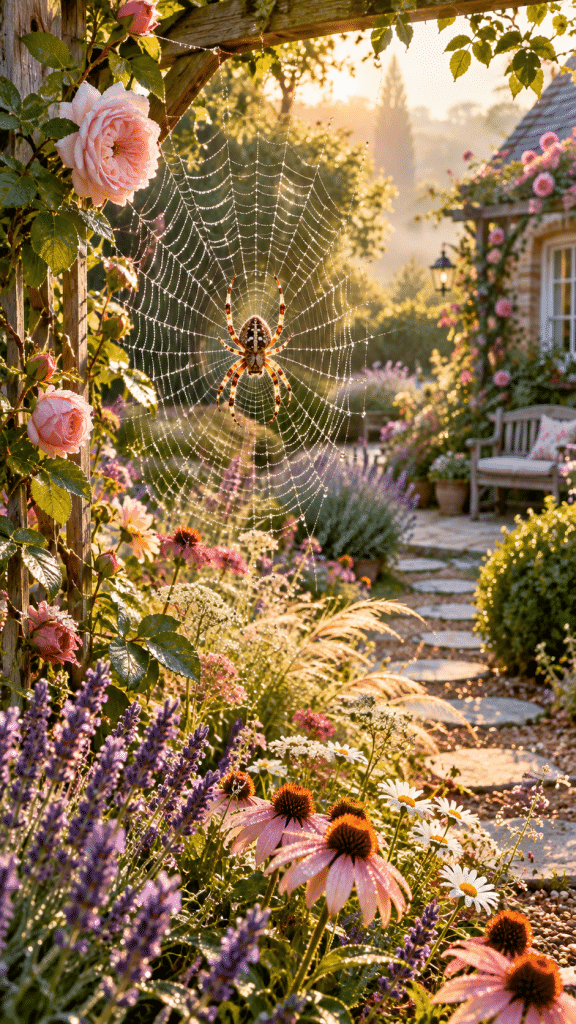
Why European Garden Spider Webs Look So Beautiful
European garden spiders are known for constructing orb-shaped webs with a recognizable radial design.
The framework consists of multiple silk threads that connect to surrounding vegetation or other stable supports.
Within this structure, the spider creates a spiral-shaped capture area.
The resulting arrangement combines efficiency with remarkable visual symmetry.
Although the geometry is functional rather than decorative, its appearance can be striking.
A web stretched between two lavender stems may resemble an intricate piece of lace.
Another suspended between climbing roses can add a delicate pattern to the surrounding foliage.
When viewed against dark evergreen leaves, the fine silk may become especially visible.
✨ Morning dew often creates the most dramatic effect.
Water droplets collect along the threads, reflecting available light and outlining the entire web.
In a quiet cottage garden, this can produce one of the most memorable scenes of the season.
Rather than viewing these webs as untidy objects, gardeners can appreciate them as temporary works of natural architecture.
How European Garden Spiders Enhance Cottage Garden Charm
Cottage gardens are celebrated for their relaxed planting arrangements, abundant flowers, romantic atmosphere, and close relationship with nature.
Unlike formal landscapes where every plant is carefully clipped into strict geometric shapes, cottage-style spaces often embrace softness and seasonal variation.
This makes them especially compatible with wildlife-friendly practices.
Tall foxgloves, climbing roses, asters, ornamental grasses, and flowering shrubs can create the complex vegetation structures where spiders may establish webs.
A spiderweb glistening beside a weathered wooden fence can complement the nostalgic beauty of such a garden.
Likewise, a delicate orb web between tall autumn flowers can become a fascinating detail within a layered planting scheme.
The goal is not to deliberately cover the garden with webs.
Instead, it is to allow suitable webs to remain in places where they create no inconvenience.
A sheltered border near a climbing rose arch or a quiet corner beside an ornamental shrub can be particularly appropriate.
Over time, these small decisions help a garden feel less like a controlled display and more like a living landscape.
Why Spider Friendly Gardening Can Reduce Unnecessary Maintenance
Gardeners sometimes spend considerable time removing webs from areas where they cause no practical problems.
However, European garden spiders may rebuild damaged or removed webs as part of their normal hunting behavior.
Repeatedly destroying webs in quiet garden corners can therefore create unnecessary disturbance without providing any meaningful gardening benefit.
A more sustainable approach distinguishes between webs that interfere with everyday activities and those that can safely remain.
For example, a web stretched across a frequently used pathway may need to be moved or cleared.
In contrast, a web positioned between shrubs away from walking routes can usually be left undisturbed.
This simple distinction reduces unnecessary maintenance while preserving habitat for a beneficial predator.
It also encourages gardeners to pay closer attention to how outdoor spaces are actually used.
Not every corner needs the same level of grooming.
Some areas can remain carefully designed and highly accessible, while others are allowed to develop a more natural character.
European Garden Spiders Make Gardens More Interesting for Families and Nature Lovers
Observing a European garden spider can also create valuable opportunities for learning about wildlife.
Its web offers a visible example of animal engineering, while its hunting behavior demonstrates how predators obtain food.
Watching a spider rebuild an orb web can reveal the patience and precision involved in constructing a complex silk structure.
Children and adults alike may enjoy observing these animals from a comfortable distance.
A magnifying glass or camera can reveal additional details without requiring physical contact.
Gardeners can also compare how web locations change throughout the season or how spiders respond to different weather conditions.
These observations can inspire questions about biodiversity, animal behavior, and the relationship between plants and wildlife.
A small garden can therefore become a fascinating outdoor learning environment.
The greatest benefit is often a change in perspective.
Instead of seeing wildlife as something that interrupts a perfect landscape, gardeners begin recognizing living creatures as part of what makes an outdoor space remarkable.
How to Identify European Garden Spiders Before Removing Any Web
Recognizing the European garden spider correctly is important because many spider species live in gardens.
Not every spider constructing an orb web is Araneus diadematus.
Several related species have similar body shapes, web structures, and patterns.
One of the most helpful identifying characteristics is the pale cross-shaped marking on the upper surface of the abdomen.
However, coloration varies considerably, and markings may be less obvious on certain individuals.
A combination of body features, web appearance, and geographic location is more useful than relying on one characteristic alone.
Look for the Distinctive White Cross Marking
The classic European garden spider often displays pale spots forming a cross-like pattern across its rounded abdomen.
Its body may be light brown, reddish, orange, or dark brown.
Mature females usually possess relatively large, rounded abdomens, particularly toward autumn.
Males are generally smaller and less conspicuous.
The European Society of Arachnology describes the distinctive cross pattern as one of the species’ principal identifying features.
Nevertheless, not every spider showing pale abdominal spots belongs to this species.
When identification is uncertain, it is better to observe the animal without handling it.
Observe the Circular Web Structure
European garden spiders typically construct recognizable orb webs.
These consist of radial silk threads connected by a spiral capture structure.
The spider may remain near the central hub, monitoring vibrations transmitted through the silk.
The web can be suspended between shrubs, garden supports, tree branches, or other suitable structures.
Some individual spiders rebuild substantial portions of their webs regularly, depending on conditions.
Watching the web from a distance may reveal how the spider responds when a small insect becomes trapped.
This behavior is one of the most accessible ways to observe predation in a home garden.
Understand When European Garden Spiders Become Most Visible
In many temperate areas, European garden spiders become particularly noticeable during late summer and autumn.
Adult females grow larger, and their webs may be easier to detect among seasonal vegetation.
Autumn dew also makes the silk more visible.
Later in the season, females produce silk egg sacs containing the next generation.
These protected eggs generally overwinter, and young spiders emerge during the following spring.
Seasonal timing varies with local conditions.
The spiders may be present well before their webs become obvious to gardeners.
How to Create a Garden That Welcomes European Garden Spiders Naturally
Supporting European garden spiders does not require expensive landscaping or complicated equipment.
In most cases, a few thoughtful changes to garden maintenance can make outdoor spaces more suitable for these beneficial creatures.
The most effective approach combines varied vegetation, stable web-building locations, reduced disturbance, and responsible pest management.
Grow Layered Plants and Natural Hedges
Gardens with several levels of vegetation provide a variety of physical structures.
Low perennials, medium-height shrubs, climbing plants, and small trees each contribute different spaces where spiders may hunt or shelter.
A mixed border featuring flowering plants in front of shrubs can create attractive opportunities for web construction.
Natural hedges are particularly useful because their branching structures provide many potential attachment points.
They also support insects and other wildlife.
🌿 For a beautiful garden design, combine flowering perennials with evergreen structure and seasonal grasses.
The result can remain visually attractive while offering more habitat variety than a simple lawn.
Leave Some Quiet Garden Corners Undisturbed
Not every area needs frequent pruning or cleaning.
A sheltered corner beside a hedge, fence, or flowering shrub can become a valuable refuge for wildlife.
Leaving some stems standing through autumn may preserve existing web attachments and provide habitat for various invertebrates.
Avoid clearing every area of fallen leaves or removing all seasonal plant growth at once.
Instead, use selective maintenance to keep the garden functional while allowing quieter sections to remain relatively undisturbed.
This creates a balance between a well-maintained appearance and ecological value.
Avoid Unnecessary Pesticide Applications
Chemical treatments can affect more than the species they are intended to control.
Predatory spiders and other beneficial organisms may also be exposed.
A thoughtful approach begins by identifying the actual problem.
Not every insect requires treatment, and minor feeding damage does not always justify intervention.
When action is necessary, choose methods appropriate to the identified pest and follow product instructions carefully.
Protecting existing predator populations supports a broader garden management strategy rather than relying exclusively on repeated chemical applications.
Protect Existing Webs During Routine Garden Work
Before pruning shrubs or trimming climbing plants, inspect the surrounding branches for spiderwebs.
If a web occupies a quiet location, consider leaving it intact.
When maintenance cannot be avoided, work carefully and avoid handling the spider directly.
Webs across heavily used walkways may need to be cleared for comfort and accessibility, but there is generally no reason to remove every web in an outdoor space.
⚠️ Important Note: European garden spiders are generally not aggressive toward people, and bites are uncommon when they are left undisturbed. However, they are venomous predators capable of biting if trapped or handled. Avoid picking them up with bare hands, supervise young children around unfamiliar wildlife, and seek medical advice if a bite causes significant or worsening symptoms. Never assume an unidentified spider is harmless solely because it is found in a garden.
Create a Simple Spider Friendly Garden Plan
| Garden feature | What to provide | Benefit for spiders and other wildlife |
|---|---|---|
| Layered flower borders | Plants at several heights | Varied structure and shelter |
| Natural hedges | Mixed shrubs and branching growth | Web attachment points and habitat |
| Climbing plants | Trellises with vines or climbing flowers | Stable web-building opportunities |
| Quiet garden corners | Less frequent disturbance | Protection for wildlife |
| Seasonal plant stems | Selective autumn cleanup | Structural habitat and shelter |
| Responsible pest management | Targeted treatment only when necessary | Reduced unnecessary exposure |
| Native and regionally suitable plants | Diverse flowering and structural plants | Support for a wider invertebrate community |
A beautiful wildlife-friendly garden does not need to look abandoned.
Careful planting combinations, defined pathways, and intentional focal points can preserve an elegant appearance while allowing beneficial organisms to flourish.
Common Mistakes Gardeners Make With European Garden Spiders
Even gardeners who enjoy wildlife may unintentionally disrupt beneficial spider populations.
Most problems arise from treating all insects and spiders as unwanted visitors rather than considering their ecological roles.
Learning to recognize common mistakes can help preserve spiders while maintaining a comfortable outdoor space.
Removing Every Spiderweb Immediately
The instinct to remove every web is understandable, especially near doors and seating areas.
However, many webs located within vegetation cause no inconvenience.
Destroying them removes a hunting structure that the spider has invested energy in building.
A better approach is to remove webs only when they interfere with access, maintenance, or daily activities.
Allowing webs to remain in garden borders can provide an opportunity to observe natural insect predation.
Assuming All Garden Spiders Are Dangerous
A large spider sitting in the middle of an intricate web may look intimidating.
Its appearance alone does not indicate that it presents a serious threat.
European garden spiders are generally reluctant to bite unless physically disturbed or trapped.
Nevertheless, spider identification matters because gardens around the world contain different species.
Homeowners should avoid handling unfamiliar spiders and use appropriate caution when working among dense plants or moving outdoor objects.
Respectful distance is usually sufficient for enjoying these animals safely.
Expecting Spiders to Eliminate Every Garden Pest
European garden spiders are useful predators, but they cannot control all pests.
They mainly capture prey that encounters their webs.
They are not specialized hunters of slugs, plant roots, or every insect that damages leaves.
Even flying pests may avoid or pass around webs.
For reliable plant protection, gardeners should combine natural predator conservation with healthy growing conditions, appropriate plant selection, routine observation, and targeted intervention when necessary.
This balanced approach recognizes the strengths and limitations of biological pest regulation.
Making the Entire Garden Too Bare and Uniform
A heavily simplified landscape may provide fewer suitable web attachment points.
Large areas of short lawn, isolated plants, and frequently disturbed borders often offer less structural variety than mixed vegetation.
European garden spiders benefit from opportunities to stretch webs between stable supports.
Providing shrubs, climbing plants, and layered borders can therefore make a garden more suitable.
Importantly, garden design should still reflect the available space, climate, and maintenance needs.
Even a small garden can incorporate a few strategically planted shrubs or climbing plants without becoming overcrowded.
European Garden Spiders Through the Seasons
Understanding the life cycle of European garden spiders can help gardeners make better seasonal maintenance decisions.
Their activity and visibility change throughout the year in temperate climates.
Spring, summer, autumn, and winter each play a different role in the species’ development.
Spring Brings a New Generation of Garden Spiders
In spring, young European garden spiders typically emerge from egg sacs that have survived the winter.
The spiderlings are tiny compared with mature adults.
They may initially remain close together before dispersing into the surrounding environment.
Some young spiders use silk to assist dispersal when weather conditions are suitable.
As they spread through vegetation, they begin establishing themselves in suitable habitats.
Because of their small size, they are easily overlooked.
Gardeners may not realize that the next generation is already present among spring flowers and emerging foliage.
Summer Supports Growth and Web Building
As temperatures rise and insect activity increases, young spiders continue growing.
They undergo molts, shedding their external skeletons as their bodies develop.
Their hunting structures become more noticeable as individuals mature.
Summer flower borders, hedges, and climbing plants can offer numerous web-building opportunities.
During this period, maintaining diverse vegetation and avoiding unnecessary disturbance can help preserve suitable habitats.
By late summer, many spiders have developed into conspicuous adults.
Autumn Reveals the Most Spectacular Spiderwebs
Autumn is often the season when European garden spiders attract the greatest attention.
Large females become highly visible in their orb webs.
Cool mornings and seasonal moisture can outline the silk with sparkling droplets.
These conditions create the familiar image of a spiderweb suspended among golden leaves and fading flowers.
🍂 This seasonal display can be especially beautiful in cottage gardens, woodland-style borders, and natural hedgerows.
Autumn is also an important reproductive period.
Following mating, females produce egg sacs that protect developing offspring.
In areas where the species follows its typical annual cycle, mature adults usually die toward the end of the season, while the next generation survives within protected egg sacs.
Winter Protects the Next Generation
During winter, European garden spiders are generally much less visible.
Egg sacs are usually the principal overwintering stage in temperate regions.
Protected locations among vegetation, bark, or other sheltered structures can help eggs survive until conditions become suitable for emergence.
For this reason, gardeners may wish to avoid completely stripping every sheltered corner during autumn cleanup.
Leaving some natural structure can benefit a variety of overwintering invertebrates.
The following spring, a new generation begins the cycle again.
Frequently Asked Questions About European Garden Spiders
Are European Garden Spiders Good for Vegetable Gardens
Yes, European garden spiders can contribute to natural insect predation around vegetable gardens.
Their webs may capture flying insects moving between plants or along the edges of growing areas.
However, they are generalist predators, and their presence does not guarantee protection against particular vegetable pests.
They work best as one part of a broader integrated pest-management approach.
Should European Garden Spiders Be Removed From the Garden
In most situations, removal is unnecessary.
If a spiderweb occupies a quiet shrub border or garden corner, it can usually remain without causing any practical problem.
Webs that obstruct paths, doorways, or frequently used spaces may need to be cleared.
It is generally better to avoid direct handling when moving around spiders.
Do European Garden Spiders Eat Mosquitoes
European garden spiders can capture mosquitoes when those insects encounter their webs.
However, mosquitoes represent only part of the potential prey available to orb-weaving spiders.
Their presence should not be considered a dependable mosquito-control method.
Reducing standing water where mosquitoes breed is generally more directly useful for managing mosquito populations around a home.
Are European Garden Spiders Aggressive Toward Humans
No, European garden spiders are not generally aggressive toward humans.
They are primarily concerned with building webs, capturing prey, and reproducing.
They may bite defensively if squeezed, trapped, or handled, but they do not normally pursue people.
Observing them without touching them is the safest approach.
Do European Garden Spiders Eat Bees and Butterflies
Yes, European garden spiders may occasionally capture bees, butterflies, and other beneficial insects.
Their webs do not selectively trap only harmful species.
This is a normal part of natural food-web interactions.
Maintaining a diverse garden with abundant flowering resources and varied habitat supports the broader wildlife community.
How Long Do European Garden Spiders Live
In many temperate regions, European garden spiders typically complete their life cycle over approximately one year.
Eggs overwinter, young spiders emerge during spring, and adults become most noticeable in late summer and autumn.
The exact timing can vary with environmental conditions.
Can European Garden Spiders Live in Small Gardens
Yes, a small garden can provide suitable habitat when it contains enough vegetation, insect activity, and stable attachment points.
Even compact spaces with climbing plants, shrubs, or sheltered borders may support orb-weaving spiders.
A large property is not essential.
What matters is whether the local environment provides the resources the species needs.
Are European Garden Spiders Native to North America
European garden spiders are native to Europe and parts of the broader Palearctic region.
They have also become established in parts of North America.
Penn State Extension describes the cross orb-weaver as a species believed to have been introduced from Europe.
Gardeners should avoid deliberately transporting spiders or egg sacs into new regions.
Supporting existing local wildlife is preferable to intentionally introducing non-native animals.
Final Thoughts on the Best 3 Reasons European Garden Spiders Deserve a Place in Your Garden
A thriving garden is not created by beautiful flowers alone.
Its character comes from the interactions between plants, insects, birds, soil organisms, and countless other living creatures that share the same outdoor space.
European garden spiders demonstrate how even small animals can make meaningful contributions to this complex environment.
The three most compelling reasons to appreciate them are their role in natural insect predation, their participation in garden biodiversity, and the remarkable natural beauty of their intricate webs.
🥇 Natural pest regulation: European garden spiders capture a variety of flying insects, contributing to biological control as part of a diverse predator community.
🥈 Garden biodiversity: Their presence supports the broader ecological network of predators and prey that helps make outdoor habitats dynamic and biologically interesting.
🥉 Natural garden beauty: Their delicate orb webs add seasonal character, particularly when autumn dew transforms silk threads into sparkling patterns among flowers and shrubs.
The most valuable lesson is that a beautiful garden does not need to exclude wildlife.
A carefully designed landscape can include elegant flower borders, peaceful seating areas, productive vegetable beds, and quiet natural corners where beneficial creatures live undisturbed.
By preserving suitable vegetation, avoiding unnecessary chemical treatments, and respecting the spiders already present, gardeners can create spaces that are both visually appealing and ecologically thoughtful.
🌿 The next time a European garden spider appears between your favorite flowers, consider leaving its web in place. That delicate structure is more than a fascinating natural decoration. It is the home and hunting tool of a remarkable animal contributing to the living world around your garden.
Sometimes, one of the simplest ways to improve a garden is to recognize the value of the wildlife that is already there.