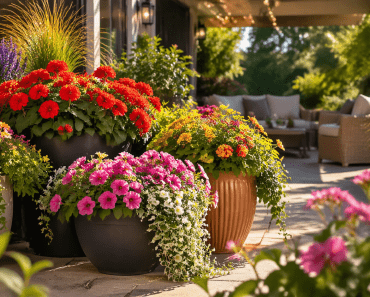
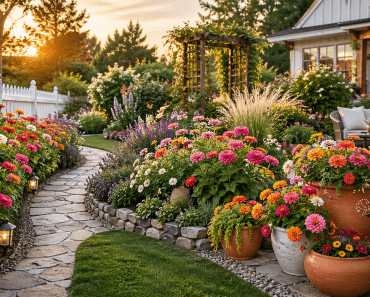
A small garden does not need to feel limited. In fact, compact outdoor spaces often benefit the most from creative planting because every corner, wall, and vertical surface can be used more intentionally. That is exactly where Small Tire Garden Ideas can become surprisingly useful.
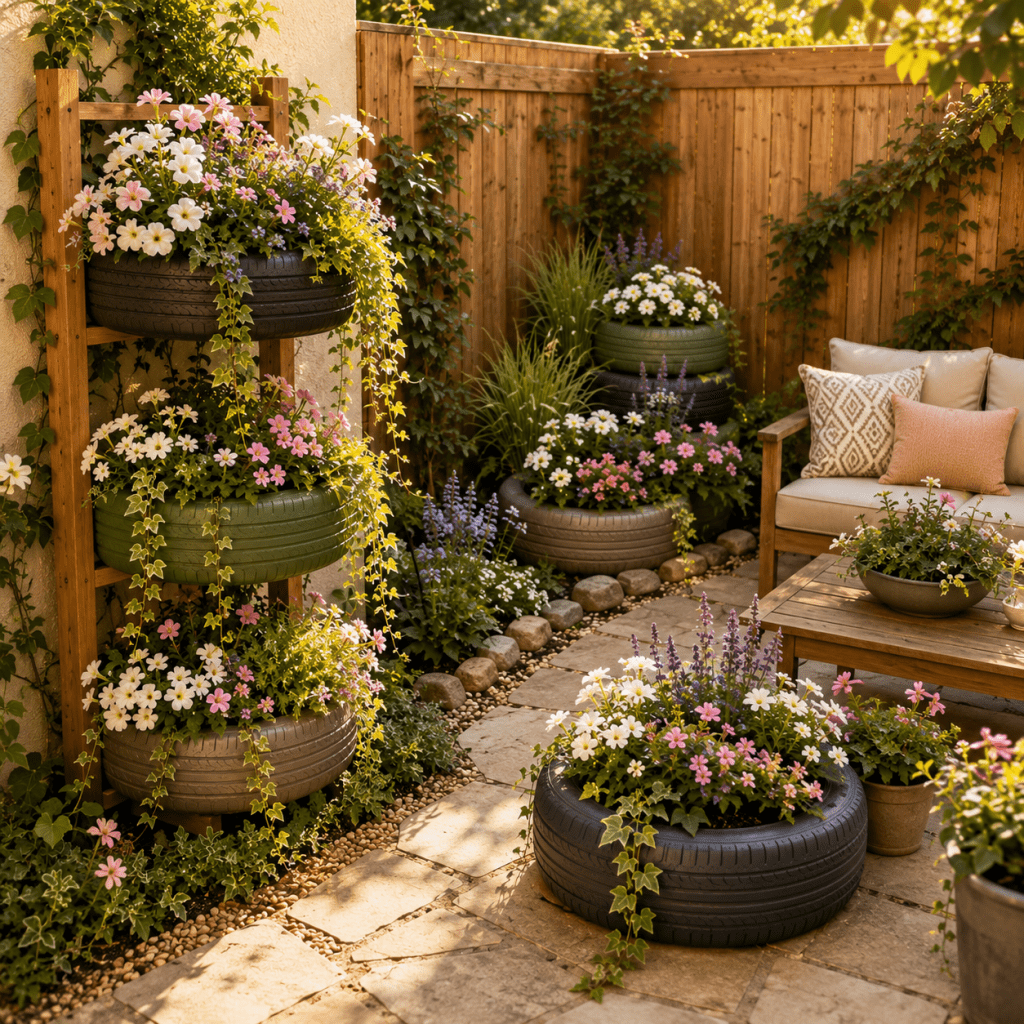
Old tires are naturally compact containers, and when they are positioned carefully, they can introduce flowers, foliage, and structure without taking over the entire yard. The key is to avoid treating them like bulky recycled objects.
Instead, think of each tire as a space-saving planting tool.
One tire can transform an empty corner. A narrow vertical arrangement can add multiple planting levels without sacrificing valuable ground. A small patio can gain color and depth from just two or three coordinated planters. Even a tiny backyard can support a surprisingly lush garden if the design uses height, layering, and visual restraint.
For this guide, the three ideas are intentionally different.
The first creates a compact vertical tower that concentrates planting into one narrow footprint. The second uses a corner arrangement to turn neglected space into a small but rich garden zone. The third integrates tire planters into a tiny patio or courtyard without making the area feel crowded.
Here are the 3 best Small Tire Garden Ideas for making tiny outdoor spaces feel greener, more creative, and much more complete.
| Rank | Small Tire Garden Idea | Main Visual Effect | Best For |
|---|---|---|---|
| 🥇 | Compact Vertical Tire Garden Tower | Maximum planting in minimal footprint | Tiny backyards and narrow spaces |
| 🥈 | Layered Corner Tire Garden | Turns an unused corner into a garden feature | Small yards and courtyard corners |
| 🥉 | Mini Tire Garden Patio Arrangement | Adds greenery without crowding seating areas | Patios and compact outdoor living spaces |
Important Note: Small spaces require especially careful placement. Keep tire planters clear of walkways, doors, steps, and circulation zones, and make sure stacked or elevated installations are structurally secure. Reused tires are most straightforward for ornamental plants; purpose-made food-safe containers are preferable for edible growing when the tire’s material history is uncertain.
🥇 Platz 1 Compact Vertical Tire Garden Tower
When floor space is extremely limited, the best direction is upward.
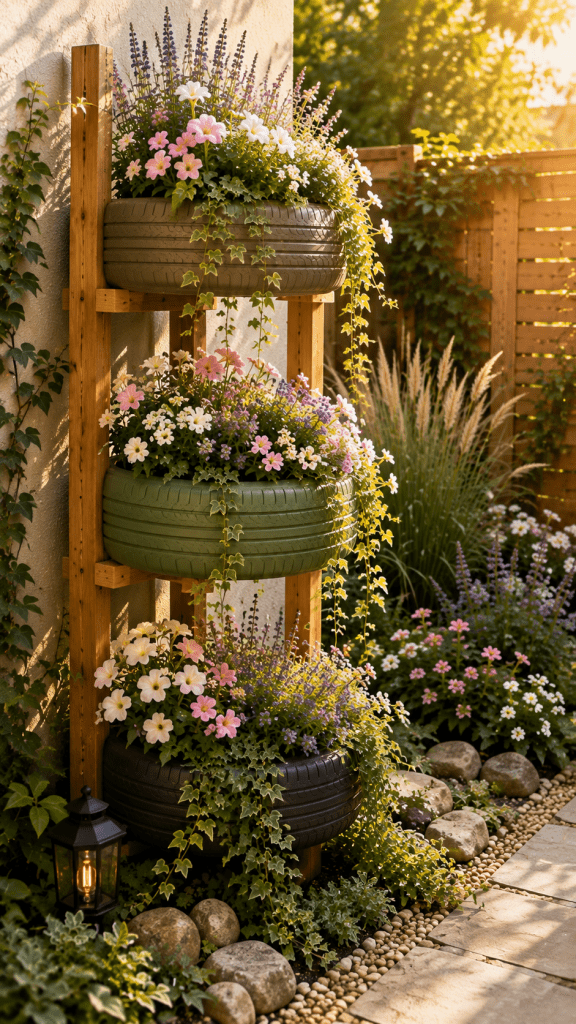
A Compact Vertical Tire Garden Tower uses two or three tires arranged vertically on a stable structure, creating multiple planting levels within a very small footprint.
This idea is ideal for narrow side yards, tiny courtyards, compact patios, or backyard corners where a conventional flower bed would consume too much room.
Use Height Instead of Width
In a small garden, every square meter matters.
A broad tire arrangement can quickly dominate the space.
A vertical tower solves this problem by concentrating the planting.
Instead of placing three tires side by side, use them at different heights.
This gives you more flowers while keeping the ground area relatively open.
Keep the Structure Narrow
The tower should feel tall and light rather than bulky.
Use only enough tires to create visual impact.
Two may be enough in an extremely tight area.
Three can create a stronger composition.
Avoid adding extra tires simply because more are available.
A compact garden benefits from editing.
Stagger the Tires Slightly
A perfectly straight stack can appear rigid.
Shifting the tires slightly from one level to another creates movement.
The upper tire might sit a little to the left.
The middle one can shift right.
The base remains visually stable.
This arrangement creates a more sculptural silhouette without requiring additional width.
Use Trailing Plants on the Upper Levels
Higher planters are perfect for cascading foliage and flowers.
Plants can spill downward and visually connect one tire to the next.
This helps soften the structure.
It also makes the tower appear fuller without increasing the physical size.
Use the upper level for the longest trailing plants.
The middle tier can combine mounding flowers with shorter cascading growth.
The lower tire can contain fuller foliage and compact flowers.
Use One Strong Plant Palette
Tiny gardens can become visually chaotic very quickly.
Choose a simple palette.
For example:
white + green + charcoal
creates a clean modern look.
soft pink + sage + cream
feels romantic.
lavender + white + muted gray
works beautifully in cottage-inspired spaces.
The fewer colors you use, the more intentional the tower tends to feel.
Keep Tire Colors Quiet
Strong paint can make a small feature feel larger and heavier.
Dark charcoal is often effective because it recedes visually.
Muted sage can blend into foliage.
Warm gray or dusty terracotta can also work.
If the space already contains many colors, keep the tires neutral.
If the surroundings are very simple, one muted color can add enough personality.
Add a Small Ground Layer
Even a vertical tower benefits from a little planting at the base.
A narrow patch of groundcover can soften the lowest tire.
A few stones can create a transition.
A small gravel zone can define the feature.
This helps the tower feel rooted rather than simply placed in the corner.
Use the Wall or Fence as a Backdrop
A compact tower often looks strongest against a simple vertical surface.
Natural timber can provide warmth.
A pale masonry wall can create contrast.
A dark fence can make white flowers stand out.
The background should remain relatively calm.
In a small space, too much competing pattern can make the arrangement feel cluttered.
Make Maintenance Easy
Do not position the highest planter beyond safe reach.
You should be able to water and maintain the plants comfortably.
Also remember that trailing foliage can eventually extend much farther than it does on planting day.
Design for mature growth.
Why This Idea Takes First Place
The Compact Vertical Tire Garden Tower earns 🥇 because it solves the biggest challenge of a small garden:
lack of floor space.
It creates several planting levels while occupying only one narrow zone.
The result can be lush without being crowded.
🥈 Platz 2 Layered Corner Tire Garden
Corners are often wasted.
They are too small for furniture, too awkward for a conventional garden bed, and frequently become empty spaces with little visual purpose.
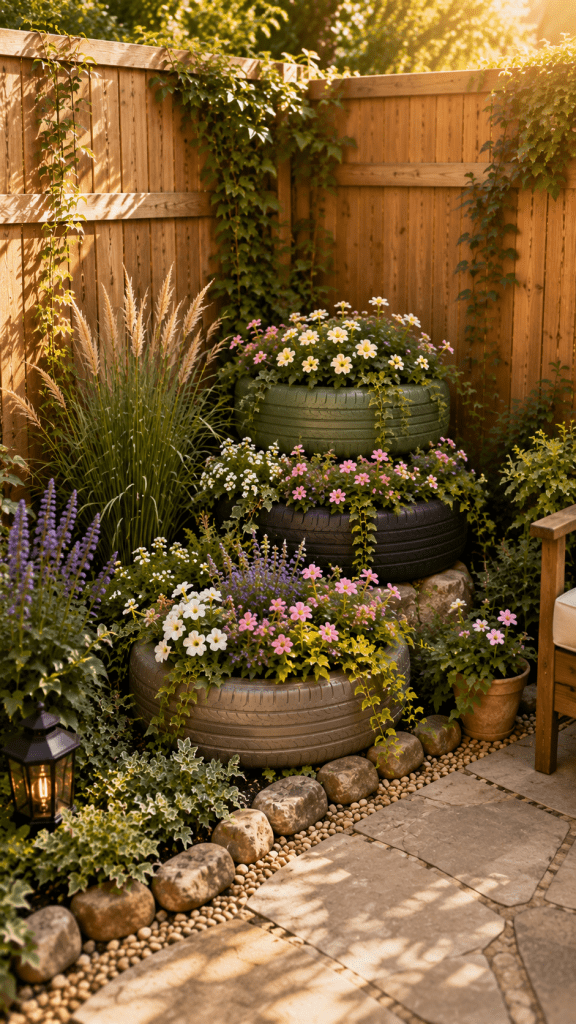
A Layered Corner Tire Garden turns that neglected area into a compact planting composition.
The tires remain low enough to avoid overwhelming the space but are arranged at different heights to create depth.
Use the Corner as Natural Framing
Two walls or fences already create a visual frame.
Take advantage of it.
Position the tallest planting toward the back of the corner.
Use a medium tire planter slightly forward.
Place the lowest planter closest to the open space.
This creates a natural progression.
The corner begins to feel deeper than it actually is.
Use Only Two or Three Tires
Small garden design is not about fitting as much as possible into every space.
It is about choosing enough.
Two tires can create a beautiful corner.
Three can add more layering.
More than that may begin to feel crowded depending on the size of the area.
Ask whether every planter contributes a different level or plant texture.
If not, remove one.
Combine Tire Planters With Conventional Plants
Do not make the corner exclusively about tires.
A few conventional plants around them can help soften the recycled containers.
Groundcover can spread between the planters.
One ornamental grass can add vertical movement.
A climbing plant can use the background fence.
The result becomes a small garden rather than a display of recycled objects.
Create Three Planting Heights
Use the tallest plants toward the rear.
Medium flowers belong in the center.
Trailing or low-growing plants can occupy the front.
This simple layering formula creates depth:
tall → medium → low
It is especially useful in corners because the eye naturally reads the space from front to back.
Choose Light-Colored Flowers for Dark Corners
If the corner appears visually gloomy, pale flowers can help.
White, cream, light pink, and lavender can make the area feel brighter.
Combine them with different foliage textures so the planting does not appear flat.
If the location receives limited sunlight, plant selection should of course match the actual growing conditions rather than color alone.
Repeat Plants Across the Tires
One plant should appear more than once.
For example, white trailing flowers could grow from both the highest and lowest planter.
Or one compact green foliage plant could repeat in all three tires.
This repetition creates unity.
Without it, a small composition can look surprisingly busy.
Use Gravel to Define the Corner
A small gravel pad is extremely effective.
It separates the tire garden from the surrounding lawn or patio.
It also creates a tidy visual foundation.
Pale gravel can brighten the corner.
Darker gravel creates a stronger, more dramatic look.
A few natural stones can introduce additional texture.
Introduce One Vertical Element
Even though the tire planters remain relatively low, one taller element can help.
This might be:
- a narrow ornamental grass,
- one upright flowering plant,
- a climbing vine,
- or a slim timber support.
That vertical accent prevents the entire corner from feeling flat.
Keep the Tire Treatment Consistent
Do not paint every tire differently.
In a tiny corner, unrelated colors can create visual noise.
Use:
one shared color,
one tonal family,
or natural dark rubber.
This allows the plants to provide most of the variation.
Why This Idea Takes Second Place
The Layered Corner Tire Garden earns 🥈 because it turns one of the most commonly wasted areas in a small backyard into a deliberate garden feature.
It does not require much floor space.
It does not need a large structure.
And it can create surprising depth with only a few planters.
🥉 Platz 3 Mini Tire Garden Patio Arrangement
Small patios require even more restraint because the area must remain functional.
People still need room to sit, walk, open doors, move chairs, and use the space comfortably.
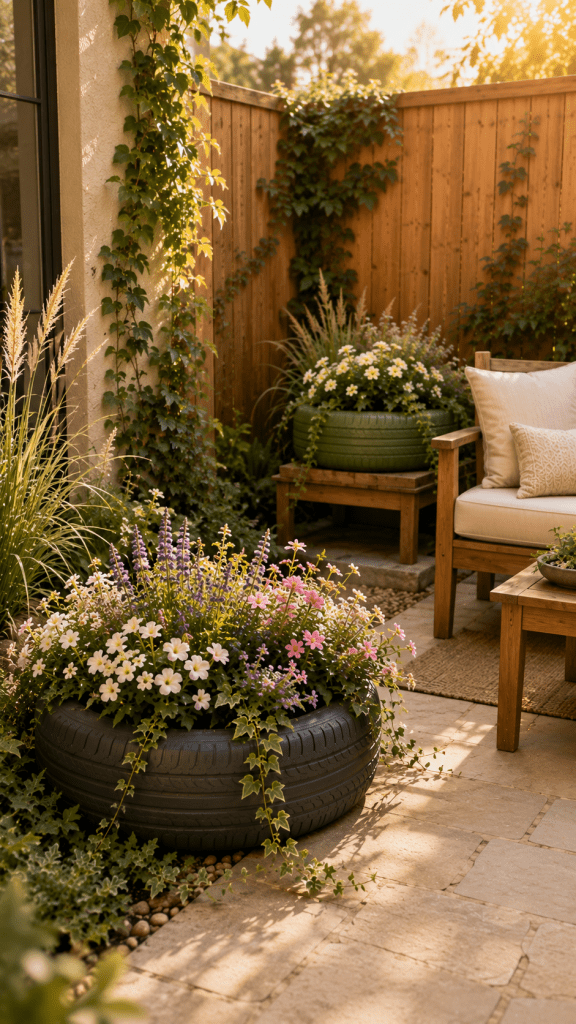
The Mini Tire Garden Patio Arrangement uses only a few tire planters as carefully placed accents around an outdoor living area.
The goal is not to turn the entire patio into a tire garden.
The goal is to make the patio feel greener.
Start With Circulation
Before placing any planter, identify the routes people actually use.
Where does the door open?
Where do chairs pull back?
Where do people walk toward the garden?
Where are the steps?
Keep these zones clear.
Then use the leftover spaces.
A patio corner may fit one planter.
The edge between paving and lawn may fit another.
A fence behind the seating area can support a small vertical feature if structurally appropriate.
Use One Statement Planter
In a very small patio, one well-designed planter can be enough.
Choose one tire.
Fill it with abundant flowers and foliage.
Place it where it softens a hard corner.
This is often more effective than trying to fit several planters around the furniture.
Add One Supporting Planter
If space allows, introduce a second tire at a different height.
For example:
one low planter near the edge of the patio,
plus one elevated or vertical planter nearby.
The height difference creates more visual interest without requiring many containers.
Coordinate With Patio Furniture
Look at the colors already present.
If the seating is natural oak or teak, muted sage or terracotta can work beautifully.
If the furniture is charcoal metal, a dark tire can blend easily.
If cushions are cream or beige, repeating these soft colors in the flower palette helps connect the planting to the seating area.
This makes the recycled planter feel intentional.
Use Soft Flowers and Fine Foliage
Patio planters are viewed closely.
Small details matter.
Fine trailing foliage can look especially attractive.
Compact flowers provide color without becoming visually heavy.
Ornamental grasses can introduce gentle movement.
Avoid choosing every plant for maximum drama.
A seating area usually benefits from softness.
Keep the Flower Palette Relaxed
Good small-space combinations include:
white + sage + pale pink
cream + lavender + green
soft apricot + olive + white
white + burgundy foliage + charcoal
A restrained palette makes the patio feel calmer.
Use a Vertical Tire Behind the Seating Area
If the patio is extremely compact, move one planter off the floor.
A securely supported tire planter on an appropriate wall or purpose-built frame can introduce flowers without occupying the walking area.
This is especially useful behind a bench or at the far end of a patio, provided placement and support are safe.
Use Natural Materials to Soften the Rubber
A tire looks more integrated when surrounded by materials such as:
- timber,
- gravel,
- stone,
- terracotta,
- woven outdoor fabrics,
- and abundant foliage.
You do not need all of them.
Even one or two can help.
Leave Empty Space
This may be the most important principle.
A beautiful small patio still needs visual emptiness.
Do not fill every edge with a planter.
Do not hang something on every wall.
Do not cover every corner.
Empty space makes the few garden features you do use feel more important.
Why This Idea Takes Third Place
The Mini Tire Garden Patio Arrangement earns 🥉 because it proves that tire garden ideas can work even where outdoor space must remain highly functional.
The key is restraint.
One or two excellent planters can provide plenty of character.
Why Small Tire Gardens Need a Different Design Approach
Large yards can absorb visual clutter more easily.
Small yards cannot.
Every object has more impact.
That means Small Tire Garden Ideas should generally use:
fewer tires,
fewer colors,
stronger vertical organization,
more negative space,
and clearer visual hierarchy.
The purpose is not to fit the maximum number of planters into the minimum amount of space.
The purpose is to create the maximum garden effect with the fewest well-chosen elements.
Use Vertical Space First
Before placing another tire on the ground, look upward.
Could a wall support a purpose-designed planter system?
Could a freestanding frame create more planting levels?
Could a fence become part of the garden?
Vertical design leaves the floor available for movement.
This is particularly important in:
- narrow side yards,
- tiny patios,
- courtyards,
- compact rental gardens,
- and small urban backyards.
Keep the Ground Visually Simple
Busy paving, multiple planter styles, bright tires, decorative signs, many flowers, and garden furniture can overwhelm a small space.
Use a calmer ground surface.
Gravel is effective.
Simple paving works well.
Mulch can create a natural look.
Then let a few plants provide the complexity.
This makes the garden appear more spacious.
How to Make a Small Tire Garden Look Bigger
Several design tricks can help.
Use Height
Vertical planting draws the eye upward.
Use Repetition
Repeating one flower or color makes the space feel organized.
Limit Materials
Too many different surfaces can visually divide a tiny garden.
Introduce Curves Carefully
A subtle curved border can make the eye travel farther.
Keep Foreground Planting Low
This maintains longer sightlines.
Use Lighter Flowers Strategically
Pale flowers can brighten visually enclosed areas.
The Best Tire Colors for Small Gardens
Dark charcoal is one of the easiest choices.
It can recede behind plants.
Sage is also excellent because it connects naturally with foliage.
Warm gray works with paving and stone.
Muted terracotta introduces warmth.
Dusty blue can suit cottage gardens.
The important thing is avoiding too many unrelated colors.
One small garden usually needs one tire palette.
A Simple Small Tire Garden Color Formula
Try using:
1 tire color + 2 flower colors + green foliage
For example:
sage + white + pink + green
or:
charcoal + white + lavender + green
or:
terracotta + cream + apricot + green
This is usually enough variation.
Use Trailing Plants to Soften Small Tire Planters
Trailing plants are especially valuable in compact spaces because they visually blur the hard tire edge.
A single planter can appear much more lush once foliage starts spilling over the side.
But do not let trailing plants invade walkways.
Remember how long they may become at maturity.
Position them so their growth remains within the intended garden zone.
Use Mirrors With Caution
Mirrors are sometimes used to make tiny gardens appear larger, but outdoor mirror placement requires care because reflected sunlight, wildlife interactions, visibility, and breakage can create problems.
A safer design strategy is often to create depth through:
- planting layers,
- repeated materials,
- vertical greenery,
- and longer visual lines.
You can make a small garden feel richer without relying on reflective surfaces.
How to Arrange Three Tire Planters in a Small Space
Avoid placing them in a straight row unless the layout demands it.
A triangular composition usually creates more depth.
For example:
one taller planter at the back,
one medium planter slightly forward,
one low planter toward the opposite side.
This creates hierarchy.
The three planters become one composition.
How to Arrange Two Tire Planters
Use contrast.
One can be slightly elevated.
One can remain low.
One may contain trailing flowers.
The other can have a more upright form.
Repeat one plant or color between them.
This creates connection without exact duplication.
Can One Tire Be Enough
Absolutely.
In a very small garden, one beautifully planted tire may be better than several.
Choose a strong location.
Use an abundant planting composition.
Connect it to the surrounding materials.
Give it enough empty space.
One deliberate feature can make a larger visual impact than five crowded ones.
Small Tire Gardens Against Fences
Fences are extremely valuable in compact spaces.
A small vertical arrangement can move flowers off the ground.
Natural timber works especially well as a background.
Keep plenty of fence visible between planters.
This maintains visual breathing room.
And make sure the structure is actually capable of supporting the loaded weight.
Small Tire Gardens Beside Paths
Keep planters outside the circulation zone.
A low tire can work beside a pathway, but trailing foliage should not extend into the walking route.
Use planting to soften the path, not obstruct it.
In narrow spaces, every centimeter of clearance matters.
Small Tire Garden Ideas for Courtyards
Courtyards often have hard surfaces and strong walls.
A tire garden can introduce softness.
Use:
one vertical feature,
one low planter,
and perhaps one conventional container with ornamental grass.
That combination may be enough to transform the space.
Because courtyards often feel enclosed, avoid excessive visual clutter.
Small Tire Gardens for Rental Spaces
Freestanding features may be particularly useful where permanent alterations are not desired.
A compact timber or metal frame can support several planters without depending on a wall, provided it is properly designed for the weight and outdoor conditions.
This can also allow the garden layout to remain more flexible.
How to Keep Small Tire Gardens Easy to Maintain
Compact does not always mean easy.
Vertical gardens can still require careful watering.
Tight corners can become hard to access.
Trailing plants can grow into pathways.
Design maintenance into the layout.
Keep plants within comfortable reach.
Allow enough room to move around them.
Choose species appropriate for the actual light.
Avoid overcrowding.
A small garden should simplify outdoor life, not create constant obstacles.
Drainage in Tiny Spaces
Poor drainage is particularly noticeable on patios and courtyards.
Water should not run toward doorways or create persistent wet areas on walking surfaces.
Make sure each tire planter can drain appropriately.
Think about where the drained water will go.
A beautiful container should not create a slippery patio or water problem.
Be Careful With Heat
Small patios often contain masonry walls, paving, and other surfaces that reflect heat.
Dark tires can become even warmer in these locations.
Observe the microclimate before selecting plants.
A location that appears suitable in the morning may become extremely hot in late afternoon.
Choose plants and tire placement accordingly.
Common Small Tire Garden Mistakes
The first mistake is using too many tires.
The second is using too many colors.
Another is trying to make every planter a separate focal point.
Blocking walkways is a serious practical issue.
Overly tall or unstable stacks are another.
And failing to consider mature plant growth can make a tidy garden become crowded surprisingly quickly.
Small spaces reward restraint.
Which Small Tire Garden Idea Is Best
Choose the 🥇 Compact Vertical Tire Garden Tower if the available ground area is extremely limited.
It creates the highest planting impact within the smallest footprint.
Choose the 🥈 Layered Corner Tire Garden if you have an unused corner that needs depth and character.
It creates a complete little garden using only a few planters.
Choose the 🥉 Mini Tire Garden Patio Arrangement if the outdoor area is primarily used for seating and relaxation.
It introduces greenery without sacrificing functionality.
Final Thoughts on Small Tire Garden Ideas
The best Small Tire Garden Ideas prove that limited outdoor space does not require limited creativity.
The 🥇 Compact Vertical Tire Garden Tower uses height to create several planting levels while preserving valuable floor space.
The 🥈 Layered Corner Tire Garden transforms an awkward unused corner into a small but richly layered garden feature.
And the 🥉 Mini Tire Garden Patio Arrangement shows how just one or two carefully positioned tire planters can soften a compact outdoor living area without creating clutter.
The most important rule is simple:
do less, but make every element matter.
Use fewer tires.
Choose a restrained palette.
Plant vertically.
Repeat flowers and materials.
Keep circulation clear.
Leave breathing room.
And design for the mature garden rather than the newly planted one.
When space is limited, thoughtful placement becomes more important than quantity.
That is exactly why a tiny tire garden can sometimes look more polished than a much larger one.