Old tires are often treated as useless waste, but with a little imagination, they can become some of the most practical and eye-catching features around a home. Tire Upcycling Projects offer an affordable way to transform worn-out tires into planters, outdoor furniture, garden decorations, and functional pieces while giving materials that might otherwise be discarded a completely new purpose.
The best part is that tire upcycling does not necessarily require advanced woodworking skills or expensive equipment. Many projects can be completed with basic tools, outdoor paint, strong fasteners, rope, wood, and a free afternoon. A single tire can become a colorful planter, while several tires can be combined into a surprisingly sophisticated garden seating area.
♻️ Instead of looking at an old tire as waste, think of its strongest characteristics: it is durable, weather resistant, flexible, heavy enough to remain stable outdoors, and naturally circular. Those qualities create countless opportunities for creative DIY projects.
Among all the possibilities, three ideas stand out because they combine visual appeal, usefulness, and realistic DIY construction. These Best 3 Tire Upcycling Projects range from easy garden improvements to larger outdoor transformations that can become genuine focal points.
Why Tire Upcycling Projects Are Becoming Such a Creative Garden Trend
Upcycling is different from simply recycling something. Recycling normally involves breaking a material down so that it can be processed into something new. Upcycling keeps much of the original object intact and creatively transforms it into something with another purpose.
Old tires are particularly interesting materials for this approach.
Their rugged construction allows them to survive conditions that would quickly damage many ordinary household materials. Rain, soil, changing temperatures, and regular outdoor use are exactly the types of conditions tires were originally designed to withstand.
This durability makes Tire Upcycling Projects particularly suitable for gardens, patios, backyards, workshops, play spaces, and casual outdoor entertainment areas.
🌿 Garden design also provides enough visual freedom to make recycled materials look intentional rather than misplaced. A tire painted in a sophisticated color and surrounded by ornamental grasses can look dramatically different from the same tire sitting beside a garage.
The secret is not simply reusing the tire.
It is integrating it into the overall design.
Colors, surrounding plants, placement, materials, and finishing details determine whether the finished project feels like a random DIY experiment or a carefully planned garden feature.
What Can You Make From Old Tires
There are considerably more possibilities than the traditional tire swing.
Old tires can become raised planters, vertical gardens, ottomans, outdoor coffee tables, pet beds, playground features, garden borders, decorative wells, storage pieces, and even small ponds.
Some transformations preserve the recognizable tire shape, while more elaborate projects partially conceal it using rope, timber, plants, or other decorative materials.
The ideal project depends on three main factors: how many tires are available, where the finished piece will be placed, and how much construction work is realistic.
For beginners, planters are generally the easiest starting point. Outdoor furniture requires more careful construction, while larger garden installations provide the greatest visual transformation.
Here is a quick comparison of the three featured ideas.
| Tire Upcycling Project | Difficulty | Approximate Tires Needed | Best Location | Main Benefit |
|---|---|---|---|---|
| 🥇 Tire Garden Planters | Easy | 1–5 | Garden, patio, entrance | Maximum visual impact with simple construction |
| 🥈 Tire Outdoor Furniture | Medium | 2–6 | Patio, backyard, covered terrace | Combines recycling with practical seating |
| 🥉 Tire Garden Features | Medium | 3+ | Backyard or larger garden | Creates a unique landscape focal point |
These projects can also be combined. For example, an outdoor tire seating area can be surrounded by matching tire planters, creating a unified upcycled garden zone rather than several unrelated objects.
🥇 Best 1 Tire Upcycling Projects With Creative Garden Planters
Transforming tires into planters is arguably the most versatile tire upcycling idea.
A planter requires relatively little structural modification, making it accessible even for people who have limited DIY experience. At the same time, the final appearance can range from playful and colorful to surprisingly modern.
One tire can create a simple low planter. Several can be stacked to create height. Tires can also be mounted vertically against a sturdy structure to produce an unusual living wall.
The circular form naturally frames flowers and foliage, turning plants into the visual center of the project.
Create Modern Painted Tire Planters
Brightly painted tires are among the easiest ways to completely change the appearance of old rubber.
The key is choosing colors intentionally.
Rather than automatically painting every tire a different bright color, consider the surrounding garden palette. Soft sage green, warm terracotta, charcoal, cream, muted blue, or earthy beige can make recycled tire planters feel much more integrated into a contemporary landscape.
🌸 For cottage-style gardens, softer colors paired with abundant flowering plants can create a charming effect.
🌿 For modern landscapes, monochromatic colors combined with ornamental grasses and architectural plants generally produce a cleaner appearance.
A grouping of three planters at different heights is often more visually interesting than a single isolated tire. The variation creates layers while still maintaining repetition through the circular shape.
Position the tallest arrangement toward the back and smaller containers toward the front. Plants can then cascade naturally between levels.
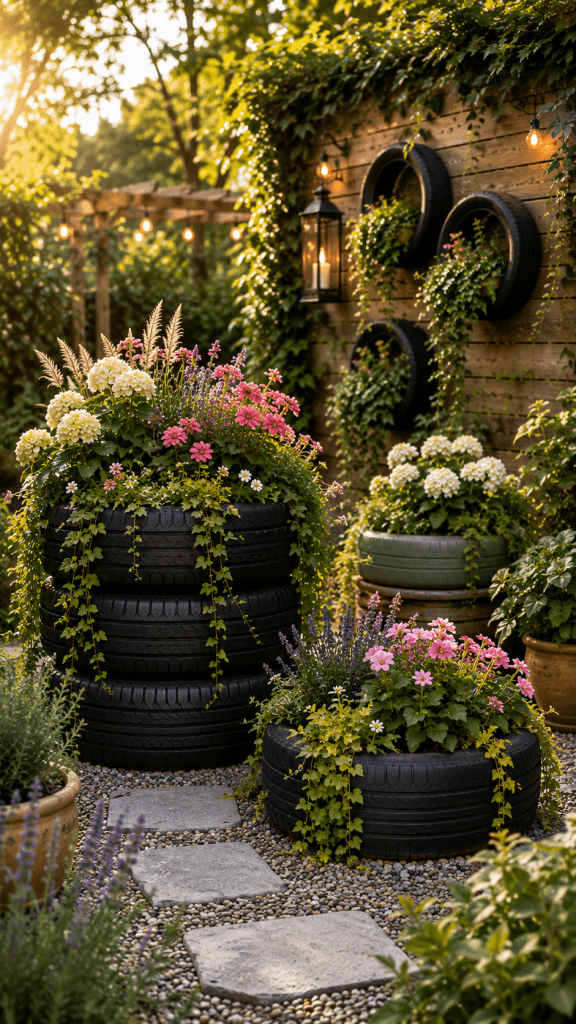
Build Stacked Tire Planters for Extra Height
Stacking tires creates instant vertical structure.
Two or three tires placed securely on top of each other can form a substantial raised planter that works especially well in larger gardens.
The increased height also provides opportunities for planting combinations.
Tall ornamental grasses or structural plants can occupy the center, while trailing flowers and foliage spill over the sides. This creates a layered arrangement that gradually disguises much of the original tire structure.
Consider using combinations such as ornamental grasses with trailing greenery, herbs with edible flowers, or seasonal flowers with compact evergreen foliage.
🌱 Repetition can make the design even stronger.
Three stacked planters positioned along a garden path can create rhythm and guide the eye toward another feature such as a bench, pergola, or patio.
Turn Tires Into Hanging Garden Planters
Not every tire has to sit horizontally.
A tire securely mounted vertically can become an unusual hanging planter. Plants grow inside the lower section while trailing foliage gradually spills over the edge.
This works particularly well against garden fences, masonry walls, sheds, and sturdy timber structures.
Trailing plants are especially effective because they soften the tire’s industrial appearance. Over time, cascading foliage can partially conceal the rubber and make the planter appear integrated with the surrounding greenery.
Petunias, trailing herbs, creeping foliage, and other suitable container plants can provide attractive results depending on local climate and growing conditions.
The mounting system must be strong enough to handle significantly more than the empty tire’s weight because soil and retained moisture add considerable mass.
Design an Entire Tire Planter Garden
One planter is a project.
A coordinated group of planters can become landscaping.
This distinction is important when trying to create a polished garden.
Instead of placing recycled tires randomly around the property, select one area and intentionally develop it as a small feature garden.
Use gravel, stepping stones, mulch, natural rocks, timber edging, or surrounding groundcover to connect the planters visually.
The result can become an attractive miniature garden that happens to use recycled tires rather than a collection of tires that happens to contain plants.
That small change in design philosophy makes an enormous difference.
Important Note: ⚠️ When using old tires in garden projects, consider their intended use carefully. For edible gardening, research appropriate local guidance regarding tire materials and soil contact before growing food crops. For decorative projects, flowers and ornamental plants are a straightforward choice. Always clean tires thoroughly, provide suitable drainage, and make sure stacked, hanging, or elevated tires are securely supported.
🥈 Best 2 Tire Upcycling Projects for Stylish Outdoor Furniture
Furniture is where tire upcycling becomes significantly more ambitious.
A tire already has several useful furniture characteristics. It is strong, stable, relatively wide, and naturally suited to circular seats and tables.
However, raw rubber rarely fits naturally into a carefully designed patio.
The solution is to combine the tire with more refined materials.
🪵 Wood can create solid tabletops.
🧵 Rope can conceal rubber surfaces.
🛋️ Outdoor cushions provide comfort.
Together, these materials can transform an ordinary tire into a piece that looks deliberately designed.
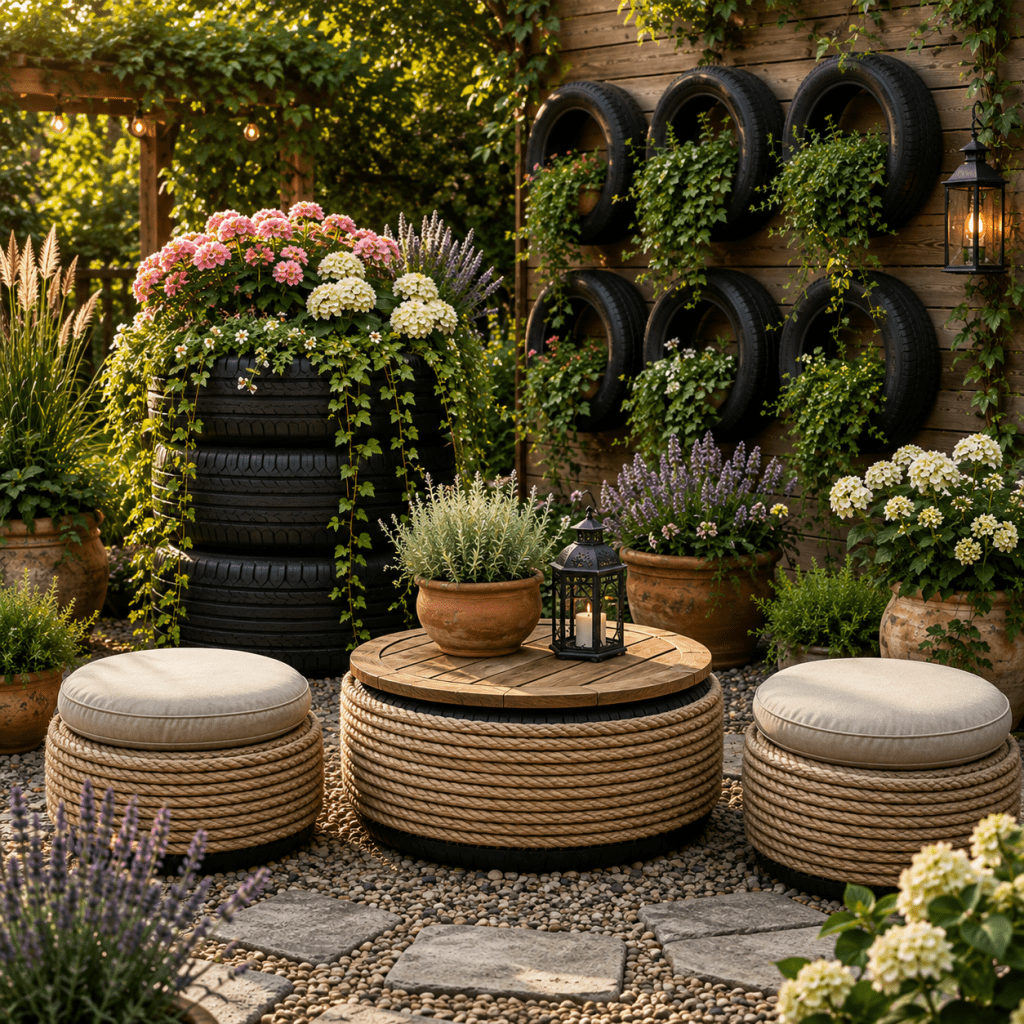
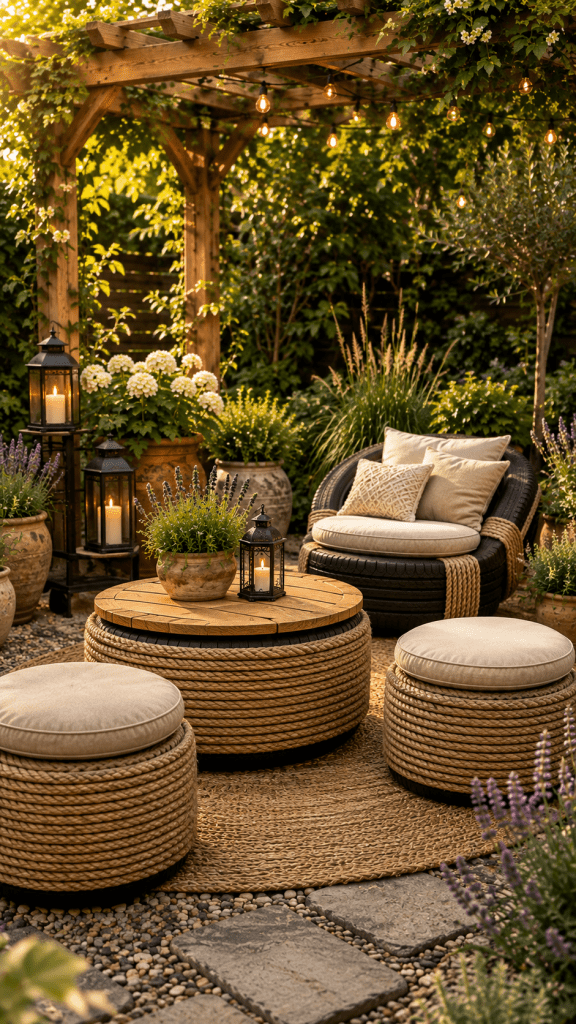
Make a Rope Wrapped Tire Ottoman
A rope-covered ottoman is one of the most dramatic tire transformations because very little of the original material remains visible.
The basic design begins with a cleaned tire. Strong circular panels can be fitted appropriately to the top and bottom before decorative rope is carefully wrapped around the exterior.
Natural rope introduces texture and warmth, immediately moving the object away from its automotive origin.
The finished piece can function as a footrest, low stool, or decorative outdoor accent depending on how it is constructed.
For a covered terrace, neutral rope combined with cream or beige outdoor cushions can complement natural wood furniture particularly well.
For exposed outdoor environments, material selection becomes more important because not every rope, adhesive, or panel material is suitable for continuous moisture exposure.
Create a Tire Coffee Table
The same principle can be adapted into a small outdoor coffee table.
A tire provides the base while a properly secured circular wooden top creates the usable surface.
The wooden component offers plenty of opportunities for customization.
Natural timber creates a rustic appearance, while a smoother minimalist top can produce a contemporary look. Decorative rope around the tire helps visually connect the rubber base with the wooden surface.
Several matching pieces can form a complete arrangement.
Imagine two low tire seats positioned beside a central tire coffee table, all finished with the same rope and timber combination.
Suddenly, discarded tires become an intentionally coordinated patio set.
Build Comfortable Tire Seats
Tires can also form the structural base for casual outdoor seats.
A properly constructed base combined with a fitted cushion can create a low lounge seat. Stacking tires may provide additional height, although the pieces need to be securely joined rather than simply balanced.
Comfort becomes particularly important here.
A visually attractive recycled chair will rarely be used if the seating position is awkward.
Consider seat height, cushion thickness, stability, and the intended user before construction.
For relaxed garden spaces, low seating can work beautifully around a fire pit or casual coffee table. For conventional dining areas, however, standard furniture dimensions will usually be more appropriate.
Create a Cozy Upcycled Garden Lounge
The strongest furniture projects often work as groups rather than individual objects.
Instead of making one tire ottoman and placing it beside unrelated furniture, create a small dedicated lounge zone.
Start with two or three coordinated seats.
Add a central table.
Place the arrangement on gravel, pavers, decking, or another clearly defined surface.
Then soften the area with large planters, ornamental grasses, lanterns, and outdoor textiles.
✨ Warm string lights positioned overhead can dramatically improve the atmosphere in the evening.
The tire furniture becomes part of a larger composition rather than the only thing visitors notice.
That is usually the difference between a DIY object and a successful outdoor design.
Choosing Colors for Upcycled Tire Furniture
Color has an enormous influence on whether recycled furniture feels playful, rustic, modern, or luxurious.
Black tires can actually work well in industrial-style outdoor spaces when paired with natural wood and black metal details.
For softer spaces, covering the rubber with rope or using appropriately selected finishes can reduce the industrial appearance.
Neutral combinations are particularly versatile:
Cream and natural wood create warmth.
Charcoal and timber produce a modern aesthetic.
Beige rope with ivory textiles creates a relaxed resort-inspired atmosphere.
Terracotta accents work beautifully with Mediterranean-style landscaping.
Olive and muted green tones blend easily into gardens.
The goal does not need to be hiding the recycled origins completely. Instead, the materials should feel visually connected.
🥉 Best 3 Tire Upcycling Projects That Become Garden Features
The third category moves beyond individual planters or furniture and uses tires as part of the landscape itself.
This is where larger quantities of tires become useful.
A collection of old tires can form decorative boundaries, vertical garden installations, play features, or even small water-inspired landscape elements when carefully designed.
These projects require more planning because their scale makes them visually dominant.
A poorly positioned tire feature can overwhelm a small garden, while a thoughtfully designed installation can become a memorable centerpiece.
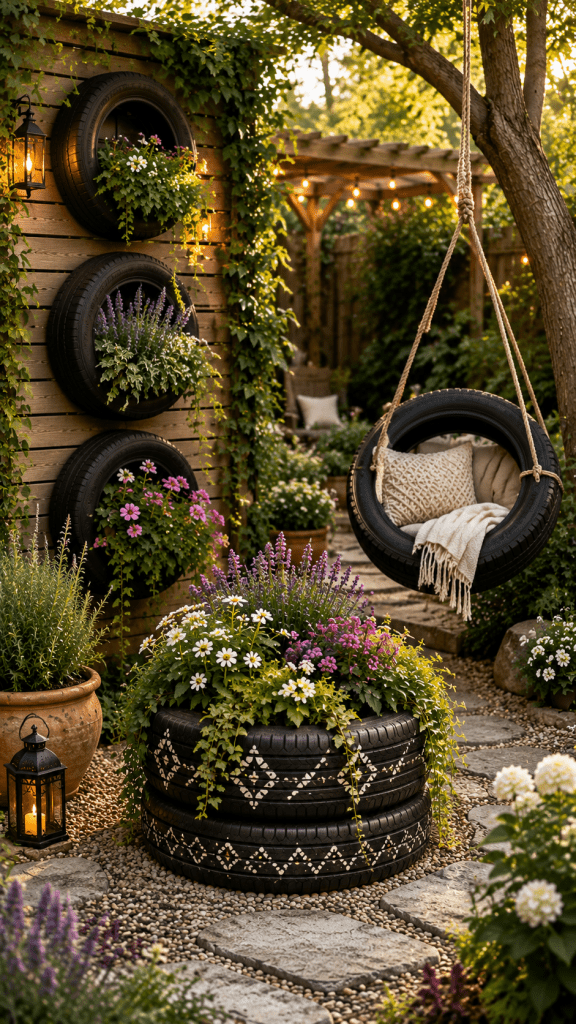
Build a Vertical Tire Garden
Vertical gardening is particularly valuable when ground space is limited.
Instead of spreading several planters across the lawn, tires can be arranged securely on a sufficiently strong supporting structure to create layers of vegetation.
The most successful designs allow plants to become more visually dominant than the tires.
Choose cascading plants and abundant foliage that gradually spread across the structure.
🌿 Mix different leaf textures rather than relying exclusively on flowers.
For example, fine trailing foliage can contrast beautifully against larger leaves. Seasonal flowers can then provide smaller bursts of color.
A vertical tire garden can also help disguise an unattractive garden wall or add interest to a plain boundary.
The key is ensuring that every tire is independently and safely supported.
Wet soil is heavy, and a large vertical arrangement can place substantial loads on a structure.
Create Decorative Tire Garden Borders
Garden edging provides another practical opportunity.
Tires can be partially incorporated into certain informal landscape designs to help define areas, although the finished appearance depends heavily on placement and styling.
This approach is best suited to playful, eclectic, rustic, or highly creative gardens rather than formal minimalist landscapes.
Repeating the same finish across every tire helps create consistency.
Surrounding the feature with dense planting can also soften the geometric repetition and prevent the border from dominating the garden.
Consider using the edging to separate a flower garden from a recreational area or to frame a dedicated children’s garden.
Make a Classic Tire Swing With a Modern Garden Setting
The tire swing remains one of the most recognizable ways to reuse an old tire.
Its simplicity is exactly why it continues to appeal.
But the surrounding environment can completely change the experience.
Instead of treating the swing as an isolated object hanging in an empty yard, integrate it into a landscaped area.
A mature shade tree, soft lawn, flowering borders, natural stepping stones, and nearby seating can turn the classic tire swing into part of an inviting family garden.
🌳 The supporting tree and attachment system must be structurally appropriate for the intended load. Safety is considerably more important than appearance for any suspended project.
When properly planned, the tire’s recycled character adds nostalgic charm.
Create a Tire Garden Play Zone
Families with sufficient outdoor space can expand the concept beyond a single swing.
Tires have historically been used in playground environments because their form encourages climbing, stepping, balancing, and imaginative play.
A modern home version should prioritize secure installation, suitable spacing, drainage, smooth finishes, and age-appropriate design.
The visual treatment can then follow the overall garden.
Bright colors create a cheerful children’s area, while muted earthy shades allow the play space to blend more subtly into the landscape.
Surrounding greenery can make the area feel adventurous without requiring elaborate equipment.
How to Make Tire Upcycling Projects Look Expensive
The difference between an attractive upcycled project and something that simply looks discarded usually comes down to finishing.
Preparation matters.
Clean the tire thoroughly before beginning. Remove dirt, debris, and contaminants appropriate to the planned use. Allow everything to dry completely before applying suitable coatings or decorative materials.
Next, limit the color palette.
Using six unrelated bright colors can work in a children’s play area, but the same approach may feel chaotic in a sophisticated garden.
For contemporary spaces, choose two or three coordinated tones.
For example:
🌿 Olive green + warm beige + natural wood
🤍 Cream + taupe + weathered oak
🖤 Charcoal + natural timber + ivory
🌸 Terracotta + muted sage + warm stone
Repeating materials elsewhere in the garden creates additional visual consistency.
If the tire planter contains natural stone, use similar stones along the path. If the tire table uses timber, repeat that timber tone in nearby benches or planters.
These small connections make the project feel intentional.
Combine Tire Upcycling Projects With Natural Materials
Natural materials are especially effective at balancing the industrial character of rubber.
Wood is perhaps the easiest companion material.
It adds warmth and can be used for tabletops, planter surrounds, seating surfaces, and decorative details.
Rope provides another strong contrast because its fibrous texture disguises the smooth rubber surface.
Stone and gravel work particularly well around tire planters. They establish a landscape context and help the project visually connect with the ground.
Plants are even more important.
Abundant foliage can soften hard edges and transform the overall appearance of recycled objects.
🌱 Ornamental grasses are particularly useful because their fine leaves create movement and texture.
Trailing plants can cover edges.
Flowering plants introduce seasonal color.
Evergreen foliage maintains structure during less colorful periods.
The more thoughtfully these materials interact, the less the project feels like a standalone recycled object.
Where to Place Tire Upcycling Projects in the Garden
Placement should be considered before construction begins.
A large tire planter may look perfectly proportioned beside a garden shed but oversized beside a narrow entrance.
Similarly, a small tire ottoman may disappear visually in a large lawn.
Think about scale.
For compact patios, one or two sophisticated pieces are usually enough.
For larger backyards, grouped installations create stronger visual impact.
Garden corners are particularly suitable for tire planter arrangements because they can fill otherwise unused space.
Fences and blank walls work well for vertical designs.
Covered patios provide protection for furniture projects incorporating rope, fabric, or wood.
Children’s projects require significantly more attention to safe clearances, ground conditions, structural support, and supervision.
Tire Upcycling Projects for Small Gardens
Small gardens actually provide some of the best opportunities for tire upcycling.
The trick is building vertically instead of horizontally.
A hanging tire planter uses wall space without occupying much floor area.
A stacked planter creates several planting levels within the footprint of a single tire.
A compact tire ottoman can potentially serve more than one function, depending on its construction.
It can provide occasional seating, act as a footrest, or become a low side table when paired with an appropriate solid surface.
Multipurpose design is extremely valuable when every square meter matters.
Avoid filling the entire space with recycled projects. One carefully executed feature generally creates more impact than several competing ideas.
Tire Upcycling Projects for Large Backyards
Larger landscapes provide room for more ambitious combinations.
Instead of creating one feature, establish a complete upcycling zone.
Imagine a gravel courtyard surrounded by ornamental grasses.
At the center sits a rope-covered tire coffee table with coordinated low seating. Nearby, three stacked tire planters overflow with greenery and flowers.
A vertical tire garden provides a lush backdrop.
Warm garden lights illuminate the plants after sunset.
✨ Individually, each object is simple.
Together, they create an environment.
This approach is especially effective because repeating materials connects the individual projects. The same timber, rope, planter colors, and plants can appear throughout the entire area.
Easy Styling Ideas for a More Professional Result
Professional-looking DIY projects rarely require expensive decoration. They require restraint and repetition.
Choose one dominant material and one supporting material.
For example, natural rope might become the primary finish while timber appears as the secondary element.
Then choose a small color palette.
Add greenery.
Finally, allow enough empty space around each feature.
One common mistake in DIY garden design is adding too many decorative elements because every empty surface feels like an opportunity.
Negative space is valuable.
A beautiful tire planter surrounded by simple gravel can sometimes look more impressive than the same planter surrounded by numerous signs, ornaments, pots, and accessories.
🌿 Let the plants provide much of the decoration.
Seasonal Tire Upcycling Projects
Another advantage of tire planters is that their appearance can change throughout the year.
Spring can introduce fresh flowers and delicate foliage.
Summer allows lush trailing plants to dominate.
Autumn can bring ornamental grasses, seasonal foliage, and warm-toned arrangements.
In climates where outdoor planting slows significantly during winter, the structural planter itself can remain part of the landscape while appropriate seasonal materials provide interest.
This flexibility makes the same basic project reusable across multiple garden styles and seasons.
Rather than rebuilding the feature, simply change what surrounds and fills it.
Budget Friendly Ways to Upgrade the Finished Look
Upcycling is most appealing when the transformation remains economical.
There is little reason to reuse a free tire if the decorative transformation costs more than purchasing a comparable finished planter or table.
Prioritize materials that create the largest visual improvement.
Cleaning is inexpensive but essential.
A coordinated finish can create a major transformation.
Plants provide natural decoration.
Leftover timber from another project may become a tabletop or structural detail if it is appropriate for the application.
Existing gravel, stones, or bricks can help define the surrounding area.
Before buying new decorative accessories, look at what is already available.
Old baskets, unused outdoor cushions, leftover rope, spare timber, and excess landscaping materials may all contribute to the final project.
♻️ Upcycling works best when the philosophy extends beyond the tire itself.
Which of the Best 3 Tire Upcycling Projects Should You Try
The best option depends on the desired result.
For a simple weekend project with immediate visual impact, 🥇 tire garden planters are difficult to beat. They require relatively little construction and offer enormous flexibility in color, planting, and placement.
For something functional and more unexpected, 🥈 tire outdoor furniture provides the biggest transformation. Rope, timber, and outdoor textiles can make the original tire surprisingly difficult to recognize.
For homeowners who have multiple tires and enough outdoor space, 🥉 larger tire garden features provide the greatest creative freedom. Vertical gardens, play areas, decorative installations, and coordinated landscape features can transform an ordinary corner of the yard.
There is also no need to choose only one.
The strongest garden design could combine elements from all three categories.
Final Thoughts on Tire Upcycling Projects
Old tires do not have to remain forgotten in a garage or immediately become waste. Their strength, shape, and weather-resistant construction give them unusual potential for creative outdoor reuse when the project is appropriate and safely constructed.
The most successful Tire Upcycling Projects go beyond simply painting an old tire and placing it somewhere in the backyard. They treat the tire as one material within a larger design.
🥇 Creative tire planters offer the easiest and most versatile transformation.
🥈 Upcycled tire furniture turns discarded materials into functional outdoor features.
🥉 Large tire garden installations provide opportunities to create vertical gardens, recreational features, and memorable landscape focal points.
Whatever project is selected, thoughtful styling makes the biggest difference. Natural materials, restrained colors, abundant plants, secure construction, and intentional placement can transform a recognizable piece of automotive waste into something genuinely useful.
Start with one tire and one carefully planned idea.
A simple planter can become the beginning of a colorful garden corner. A rope-covered tire can become part of a comfortable outdoor lounge. Several old tires can become an entirely new landscape feature.
♻️🌿 With creativity and careful planning, Tire Upcycling Projects can give forgotten materials a second life while making a home or garden more distinctive, practical, and personal.