Garden borders do much more than separate one area from another. A well-designed border can guide the eye, define pathways, frame flower beds, and make an outdoor space feel more organized. That is exactly why Tire Garden Border Ideas can be surprisingly effective when old tires are used with intention.
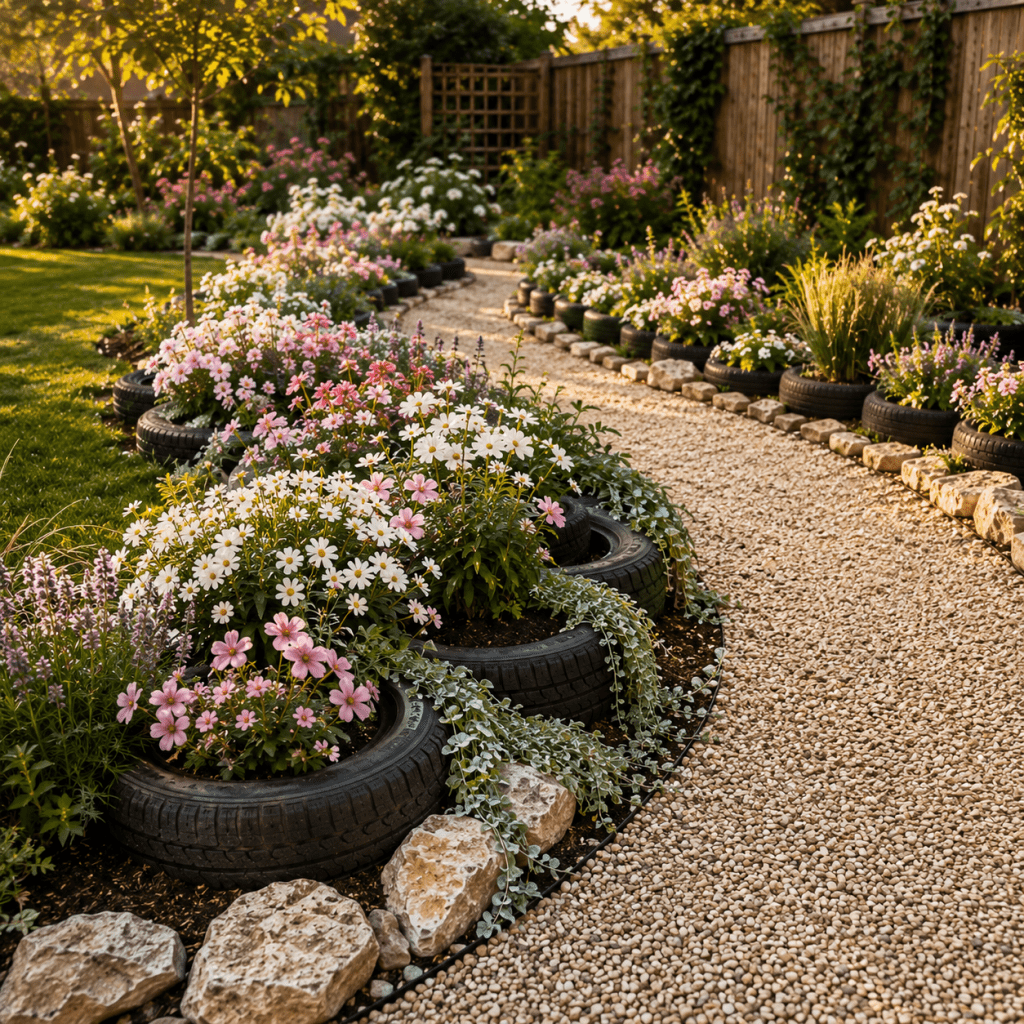
The challenge is avoiding the look of a random row of discarded rubber.
The strongest tire borders feel integrated with the surrounding landscape. They use repetition, partial burial, coordinated planting, and consistent spacing to create rhythm rather than clutter. In some designs, the tires remain visible as decorative elements. In others, plants and groundcover soften the rubber so much that the border almost disappears.
For this guide, the three concepts use tires in very different ways.
The first creates a flowing partially buried border that follows the shape of a flower bed. The second uses low planted tires to frame a garden pathway. The third creates a softer naturalized border where flowers and foliage gradually conceal most of the tire structure.
Here are the 3 best Tire Garden Border Ideas for creating more character around flower beds and pathways.
| Rank | Tire Garden Border Idea | Main Visual Effect | Best For |
|---|---|---|---|
| 🥇 | Curved Partially Buried Tire Flower Border | Soft flowing garden edge | Flower beds and lawn borders |
| 🥈 | Low Tire Planter Pathway Border | Rhythmic planted path definition | Garden paths and walkways |
| 🥉 | Naturalized Tire Garden Edge | Almost-hidden organic border | Cottage and informal gardens |
Important Note: Tire borders should never create trip hazards or unstable edges near walkways. Keep the installation secure, maintain clear circulation, and provide appropriate drainage around planted tires. Reused tires are most straightforward for ornamental planting rather than edible crops when material history is uncertain.
🥇 Platz 1 Curved Partially Buried Tire Flower Border
The most attractive tire border is often the one that does not show too much tire.
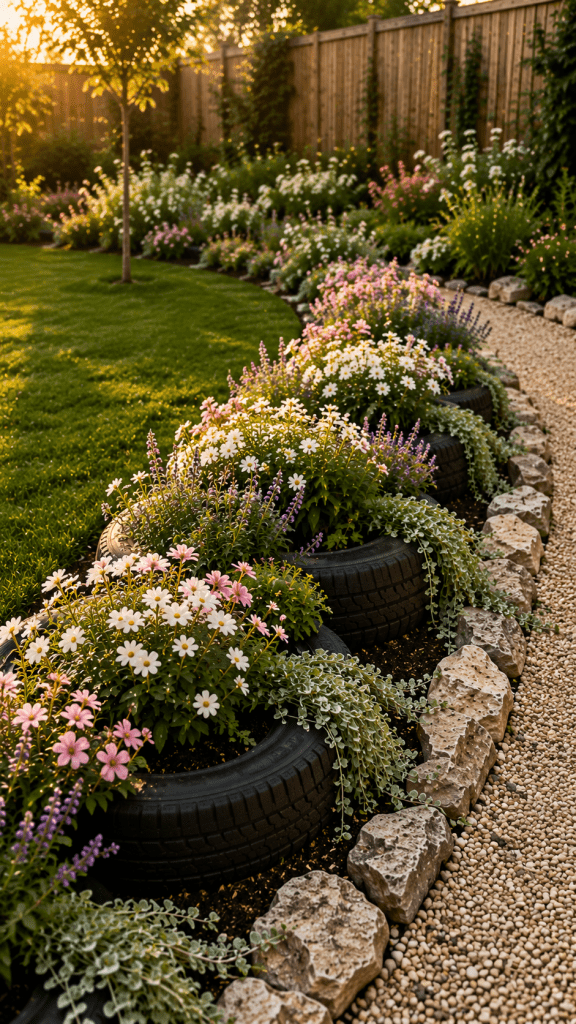
A Curved Partially Buried Tire Flower Border uses old tires placed along the edge of a flower bed, with part of each tire set below the surrounding grade so the visible forms feel lower, softer, and more integrated.
The curve is what gives this idea its strength.
Instead of creating a rigid straight line, the border follows the natural movement of the garden.
Use a Gentle Curve
A border should guide the eye.
A gentle curve can make the garden feel larger because the line continues gradually rather than stopping abruptly.
This works especially well around:
- cottage flower beds,
- lawn edges,
- curved planting islands,
- and informal backyard borders.
The tires can follow the shape of the bed rather than forcing the landscape into a straight geometry.
Partially Bury the Tires
Leaving the entire tire exposed can make the border feel heavy.
By setting part of the tire below the soil or landscape surface, the visible circular form becomes much more subtle.
The tire begins to behave more like a low raised planting pocket.
This also allows surrounding groundcover and mulch to soften the lower edge.
The exact installation should remain stable and allow water to drain appropriately.
Do Not Use Identical Spacing Everywhere
Perfect repetition can feel mechanical.
A slightly more natural rhythm may work better.
You can place some tires closer together and others with small planting gaps between them.
Those gaps can contain:
- low flowers,
- ornamental grass,
- groundcover,
- or simple mulch.
This creates variation without losing cohesion.
Use One Dominant Flower Color
A border needs visual unity.
One repeated flower color can create that.
White is especially effective because it works with almost any garden palette.
Soft pink can create a romantic edge.
Lavender gives a calmer look.
Yellow adds energy.
The key is repetition.
If every tire contains completely unrelated flowers, the border can lose its rhythm.
Let Plants Spill Over the Tire Edge
Trailing plants are one of the best ways to soften the rubber.
Allow foliage to cross the visible rim.
Flowers can spread slightly toward the lawn or flower bed.
The tire shape should still be recognizable, but it should not dominate.
This gives the border a more established garden feel.
Keep the Tire Color Restrained
For this concept, bright paint is usually unnecessary.
Good choices include:
- charcoal,
- warm gray,
- muted olive,
- earthy brown,
- stone,
- or natural dark rubber.
These tones recede visually and allow the planting to become more important.
Connect the Border to the Flower Bed
Repeat some of the same plants inside and outside the tires.
If white flowers grow in the border, use them elsewhere in the bed.
If ornamental grasses appear between the tires, repeat them toward the back of the planting.
This makes the tire edge feel like part of the whole garden rather than a separate decoration.
Why This Idea Takes First Place
The Curved Partially Buried Tire Flower Border earns 🥇 because it offers the best balance between function and appearance.
It defines the planting area, adds color, and creates rhythm without making the tires overwhelmingly obvious.
🥈 Platz 2 Low Tire Planter Pathway Border
The second concept uses tires to frame movement through the garden.
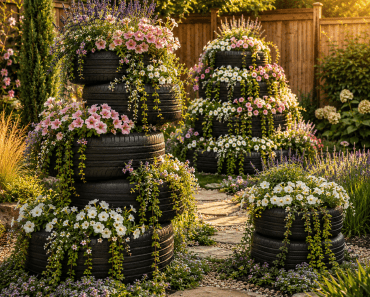
A Low Tire Planter Pathway Border positions planted tires alongside a path, creating repeated pockets of flowers and foliage that visually guide people toward another part of the yard.
This works especially well along gravel paths, stepping-stone routes, or informal garden walkways.

Keep the Tires Outside the Walking Zone
Safety comes first.
The tire border should sit clearly beside the path rather than reducing the usable width.
Plants should also be positioned so mature growth does not spill excessively into circulation areas.
A border is most successful when it enhances the pathway without becoming an obstacle.
Use Repetition to Lead the Eye
Repeated circular forms naturally create rhythm.
Place low tire planters at intervals along one side of the path or both sides where space allows.
The eye recognizes the repeating pattern and follows it.
This can make even a simple garden path feel more deliberate.
Avoid a Perfect Parade of Identical Tires
Exact duplication can make the garden feel too formal for the material.
Instead, keep the tire treatment consistent while varying the planting slightly.
For example:
Tire 1: white flowers + green foliage
Tire 2: lavender + white
Tire 3: mostly trailing green foliage
Tire 4: white + soft pink
Tire 5: lavender + foliage
The same palette repeats, but each planter remains slightly different.
Use the Path Material as Part of the Design
A pale gravel path creates strong contrast with dark tires.
Warm stone paving pairs beautifully with muted terracotta or charcoal.
Weathered brick works well with earthy tire colors.
The path and border should feel related.
Do not think of them as separate projects.
Keep the Planters Low
A pathway border should preserve visibility.
Most of the visual height should come from plants rather than tall tire stacks.
Low planters keep the route open and welcoming.
If you want occasional taller accents, use ornamental grasses or upright flowers.
Create a Destination
A pathway is more interesting when it leads somewhere.
Use the tire border to guide the eye toward:
- a seating area,
- garden gate,
- flower garden,
- patio,
- shed,
- or focal planter.
This gives the repeated border a purpose beyond decoration.
Use Groundcover Between Tires
You do not have to leave empty gaps.
Low groundcover can connect the individual planters.
This creates the impression of one continuous planted edge rather than isolated circles.
Just ensure plants do not spread aggressively into the walkway.
Why This Idea Takes Second Place
The Low Tire Planter Pathway Border earns 🥈 because it combines garden decoration with directional design.
The tires help organize movement while adding flowers and texture to an otherwise ordinary path.
🥉 Platz 3 Naturalized Tire Garden Edge
The third idea is the softest and least obviously recycled.
A Naturalized Tire Garden Edge uses low tires within an informal border and allows surrounding flowers, grasses, and groundcover to gradually conceal much of the rubber.
The tire provides structure.
The plants create the visual experience.
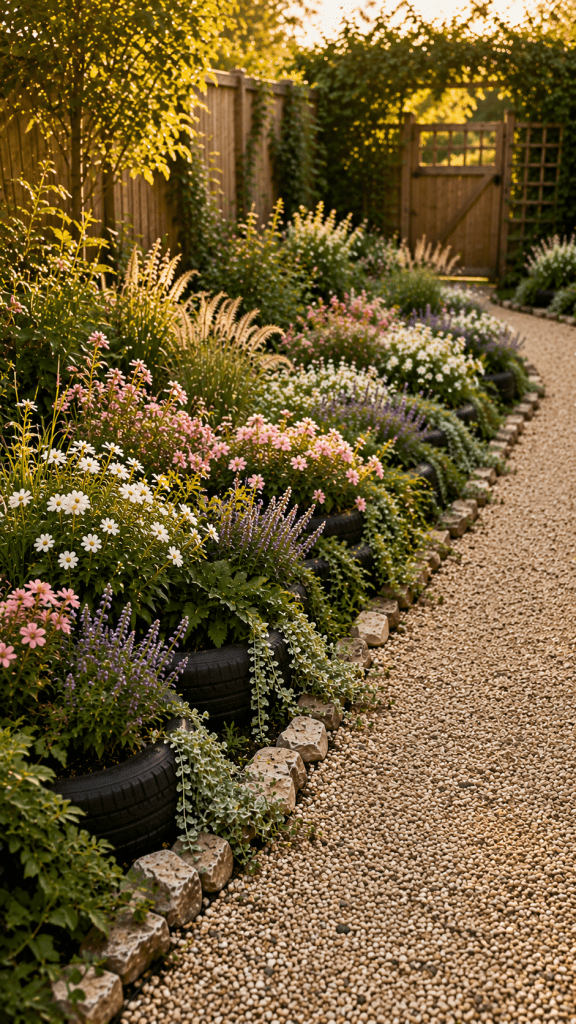
Treat Tires Like Hidden Planting Pockets
Rather than displaying every tire, position them so only part of the rim remains visible.
Surround them with dense planting.
The effect should be subtle.
From a distance, the viewer may simply notice slightly raised groups of flowers.
Only up close does the tire structure become apparent.
Use Loose Natural Planting
This idea works best with plants that overlap and move naturally.
Formal rows are less suitable.
Use:
- soft mounding flowers,
- fine ornamental grasses,
- trailing foliage,
- low groundcovers,
- and irregular flower clusters.
The planting should cross boundaries.
That is what helps the tire disappear.
Avoid Strong Paint
Brightly colored tires work against the purpose of a naturalized border.
Keep them dark or earthy.
Charcoal, deep brown, olive, and warm gray are easier to conceal.
In some settings, original dark rubber may work best.
Repeat Plants From the Existing Garden
This is one of the most effective techniques.
If your border already contains pale pink flowers and ornamental grasses, use the same combination inside some tires.
The eye sees continuity.
The container becomes less important.
Allow Some Tires to Be More Hidden Than Others
Naturalized landscapes benefit from irregularity.
One tire may remain partly visible.
Another may be almost completely covered with foliage.
A third could sit slightly higher.
This variation prevents the border from feeling artificial.
Use the Tire to Add Subtle Height
Even one low tire raises the planting slightly.
This can create another layer within a flat flower bed.
Position a tire behind lower groundcover and fill it with medium-height plants.
The elevation gives the border more depth without building a conventional raised bed.
Why This Idea Takes Third Place
The Naturalized Tire Garden Edge earns 🥉 because it proves that tire borders do not need to look like tire borders.
For gardeners who prefer a soft cottage or naturalistic style, this is the easiest way to use recycled tires without making them the visual focus.
Why Tire Garden Borders Work
Borders are naturally repetitive.
Tires are naturally repetitive too.
That makes them surprisingly compatible.
The circular forms can create rhythm along an edge while the planting adds softness and seasonal color.
The challenge is controlling visual weight.
Too much exposed rubber can dominate the landscape.
Too many bright colors can make the border feel busy.
The best designs balance repetition with planting.
Straight or Curved Tire Garden Border
Both can work, but they create different effects.
A straight border feels more structured.
It can suit:
- modern gardens,
- rectangular beds,
- narrow side yards,
- and formal pathways.
A curved border feels softer.
It works especially well in:
- cottage gardens,
- informal yards,
- lawn edges,
- and larger flower beds.
Curves also create visual movement and can make a compact garden feel more expansive.
Should Tires Be Fully Visible
Not necessarily.
For a decorative playful garden, exposed painted tires can be part of the look.
For a more sophisticated border, partial concealment usually works better.
You can soften visible rubber with:
- mulch,
- gravel,
- groundcover,
- flowers,
- and surrounding soil.
The border becomes more landscape-like and less object-like.
Tire Border Color Ideas
A controlled palette can make the entire edge feel more polished.
| Tire Color | Flower Palette | Best Style |
|---|---|---|
| Charcoal | White + green | Modern natural |
| Sage | Pale pink + white | Soft botanical |
| Warm gray | Lavender + silver foliage | Calm cottage |
| Terracotta | Cream + apricot | Warm Mediterranean |
| Deep brown | White + ornamental grass | Rustic |
| Dusty blue | White + pale pink | Romantic |
The existing materials in the garden should guide the choice.
How to Make a Tire Border Look More Expensive
The trick is not more decoration.
It is restraint.
Use One Tire Color
Or one tonal family.
Repeat One Flower
This creates cohesion.
Use Natural Materials Nearby
Stone, timber, gravel, and foliage help soften rubber.
Leave Some Space
Do not fill every centimeter with tires.
Keep Soil Edges Tidy
Messy planting surfaces make the border look unfinished.
Avoid Too Many Accessories
The tires and flowers already provide enough visual interest.
Tire Garden Borders Around Flower Beds
A flower bed border works best when it reinforces the planting inside.
Repeat flowers from the bed in the tire planters.
Use the same mulch.
Connect the border with surrounding groundcover.
Avoid making the tire edge more colorful than the garden it frames.
The bed should remain the hero.
Tire Garden Borders Along Lawn
A tire edge can clearly separate lawn from flower planting.
Keep the visible tire height relatively low.
This preserves the open feeling of the lawn.
A curved border is especially effective because it creates a softer transition.
Remember that mowing and maintenance access should remain practical.
Tire Garden Border for Small Gardens
Small gardens need fewer tires.
A short border of three to five planters may be enough to define a zone.
Use a simple palette.
Keep the tires low.
Repeat one flower.
And avoid using a border around every part of the yard.
One strong edge is more effective than multiple competing borders.
Tire Garden Border for Large Backyards
Larger spaces allow a longer repeated pattern.
But repetition still needs variation.
Break a long tire border with:
- groundcover sections,
- ornamental grass,
- natural stones,
- or small planting gaps.
This prevents the border from feeling endless and mechanical.
How to Space Tire Border Planters
There is no universal spacing rule.
The right distance depends on:
- tire diameter,
- plant spread,
- border length,
- garden style,
- and whether tires are intended to touch.
A formal border may use more consistent spacing.
A cottage border can vary.
Always plan for mature plant size rather than nursery size.
Use Tires as Planting Pockets Not Structural Retaining Walls
Tires can help create decorative planting edges, but they should not automatically be treated as engineered retaining structures.
If a slope requires real soil retention or load-bearing support, use an appropriate landscape solution designed for that purpose.
Decorative border design and structural retaining design are not the same thing.
Drainage Around Tire Borders
Water should not collect in ways that damage plants or nearby paths.
Provide appropriate drainage in the planting setup.
Observe how rainwater moves through the border.
If the tires sit beside paving, ensure water does not create persistent wet or slippery areas.
Good drainage is part of both plant health and garden usability.
Avoid Creating Mosquito-Prone Water Pockets
Any outdoor object that traps standing water can become problematic.
Design the tire border so water drains rather than remaining in unused cavities or low areas.
Inspect the border periodically, especially after heavy rain.
The planting feature should not create persistent stagnant water.
Plants for Tire Garden Borders
Choose ornamentals based on climate, light, and mature size.
Useful plant behaviors include:
mounding for fullness,
trailing for edge softness,
upright for occasional height,
and groundcover for visual connection.
You do not need many plant species.
A small repeated selection often looks better.
Use Foliage Not Just Flowers
Borders need structure beyond peak bloom.
Include plants with attractive leaves.
Silver foliage can lighten the border.
Burgundy leaves can create contrast.
Fine grasses introduce movement.
Different green tones make the planting richer.
This helps the border remain interesting across more of the season.
How to Connect a Tire Border With a Pathway
Repeat one material.
If the path uses pale gravel, introduce a small amount of the same gravel around the tire bases.
If the walkway is brick, consider an earthy tire palette.
If timber edging appears elsewhere, repeat wood nearby.
This creates continuity.
Common Tire Garden Border Mistakes
One common mistake is using too many exposed tires.
Another is painting each one a different bright color without a clear palette.
Placing them too close to walking routes can create hazards.
Overcrowding the plants can cause maintenance problems.
Poor drainage can create standing water.
And using the border without considering the shape of the existing garden can make the design feel forced.
The best border should reinforce the landscape rather than fight it.
Which Tire Garden Border Idea Is Best
Choose the 🥇 Curved Partially Buried Tire Flower Border if you want the most natural balance between visible structure and soft planting.
It is especially effective around flower beds and lawn edges.
Choose the 🥈 Low Tire Planter Pathway Border if you want the tires to help guide movement through the garden.
This approach creates rhythm and makes pathways feel more designed.
Choose the 🥉 Naturalized Tire Garden Edge if you prefer the plants to dominate and the recycled material to remain subtle.
It is particularly well suited to cottage-style and informal landscapes.
Final Thoughts on Tire Garden Border Ideas
The best Tire Garden Border Ideas use old tires to define space without letting the material dominate the garden.
The 🥇 Curved Partially Buried Tire Flower Border creates a flowing planted edge that can make flower beds feel more intentional.
The 🥈 Low Tire Planter Pathway Border uses repeated low planters to guide the eye and frame movement through the yard.
And the 🥉 Naturalized Tire Garden Edge allows flowers, groundcover, and foliage to gradually conceal the tires until they become almost invisible within the landscape.
The most important principle is integration.
Follow the shape of the garden.
Keep the border low.
Repeat a limited palette.
Use plants to soften the rubber.
Maintain clear walking space.
And make sure every section of the border contributes to the overall composition.
When those details are handled carefully, old tires can do something surprisingly useful:
they can turn an ordinary garden edge into a deliberate landscape feature.