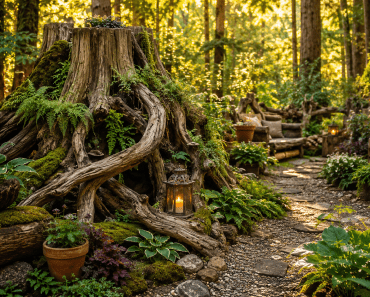
Pumpkin Fairy House Garden Ideas bring a delightful combination of autumn charm, miniature architecture, and imaginative gardening into ordinary outdoor spaces. 🎃✨ Instead of using pumpkins only as seasonal decorations, these enchanting designs transform them into tiny fairy homes surrounded by miniature gardens, winding pathways, delicate plants, and handcrafted architectural details.
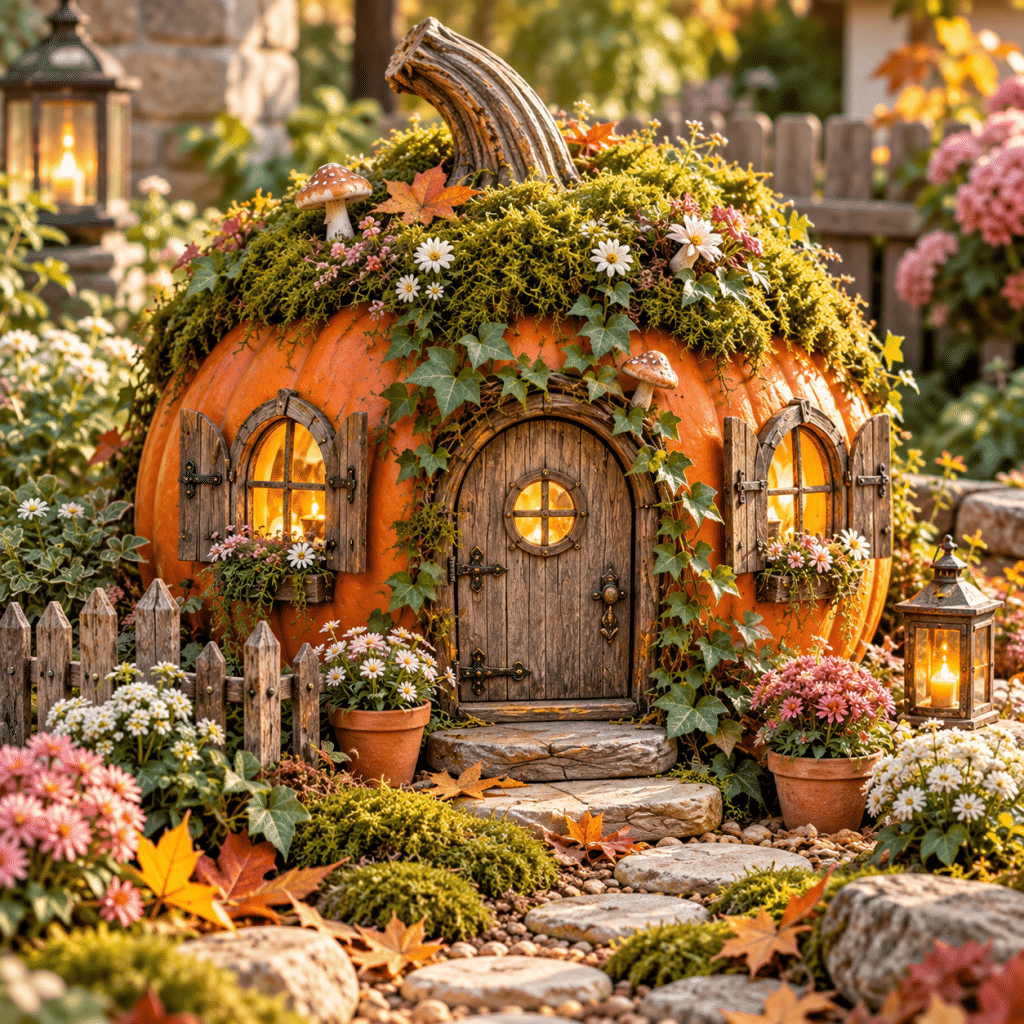
Imagine discovering a little pumpkin cottage beneath the leaves of a flowering shrub, complete with a curved wooden door, miniature windows, and a tiny garden filled with moss and colorful flowers. Nearby, a second pumpkin might resemble an elegant botanical greenhouse, while another glows gently beneath the evening sky as though magical creatures have just returned home.
These miniature landscapes can turn forgotten garden corners into captivating destinations. A shaded flower bed, an unused container, a small courtyard, or even a narrow space beside a garden pathway can become the perfect setting for a whimsical pumpkin fairy house.
What makes these projects particularly appealing is their flexibility. Natural pumpkins provide authentic autumn texture and a temporary seasonal display, while artificial craft pumpkins offer the opportunity to create more durable decorations that can be enjoyed across multiple seasons.
The most beautiful results also go beyond decorating a pumpkin. They create an entire miniature environment in which every element feels connected, from the doorway and roof to the surrounding plants, stepping stones, and landscape features.
🌿 The following Top 3 Pumpkin Fairy House Garden Ideas explore three distinctive designs that combine creative pumpkin transformations with beautiful garden landscaping. Each concept offers a different personality, allowing the finished display to become a charming botanical retreat, an imaginative miniature architectural feature, or a glowing fairy village.
Why Pumpkin Fairy House Garden Ideas Are Perfect for Creative Autumn Gardening
Pumpkins have a naturally charming shape that makes them ideal for miniature houses. Their rounded surfaces resemble small cottages, their curved ridges create architectural texture, and their warm colors blend beautifully with autumn flowers, ornamental grasses, and fallen leaves.
Unlike conventional garden decorations, pumpkin fairy houses invite visitors to examine details closely. A miniature doorstep might lead to a winding pebble path. A tiny window could reveal a handmade curtain. A small wooden bench might sit beneath a branch that resembles an enormous tree when viewed from the fairy house’s perspective.
These details encourage storytelling and discovery.
The appeal is not limited to Halloween. A pumpkin cottage without frightening faces or spooky decorations can work beautifully as a harvest garden ornament, a Thanksgiving centerpiece, or a whimsical outdoor feature that celebrates the changing seasons.
🍂 Another advantage is that fairy houses can be designed around existing plants rather than requiring a completely new garden.
A mature fern can become a miniature forest canopy. Low-growing thyme can resemble a lawn. Small sedum plants create miniature succulent gardens, while carefully arranged stones provide the appearance of walls, cliffs, and winding trails.
The visual relationship between the pumpkin and the surrounding landscape is what makes the completed design convincing.
Choosing the Right Pumpkin for a Fairy Garden House
The choice of pumpkin affects both the appearance and longevity of the project.
Fresh pumpkins offer an authentic natural surface and beautiful seasonal colors. However, they gradually soften and decompose, particularly when exposed to moisture, direct soil contact, or warm weather.
Artificial pumpkins made from hollow craft materials are better suited to projects requiring detailed construction, internal lighting, attached windows, and repeated seasonal use.
White, pale orange, sage green, and traditional orange pumpkins can all look beautiful, depending on the desired atmosphere.
A wide, squat pumpkin creates the impression of a cozy cottage, while a tall pumpkin works well for more unusual structures such as miniature towers or botanical houses.
For a balanced garden composition, select a pumpkin large enough to accommodate visible architectural details without overwhelming the surrounding plants.
Top 3 Pumpkin Fairy House Garden Ideas at a Glance
Before beginning the project, comparing the three designs makes it easier to select the right combination of materials, planting conditions, and decorative details.
| Fairy House Garden Design | Main Visual Feature | Recommended Setting | Signature Materials | Overall Atmosphere |
|---|---|---|---|---|
| 🥇 Moss Roof Woodland Nursery | Pumpkin cottage with a living-looking botanical roof | Shaded garden corner or woodland bed | Pumpkin, preserved moss, bark, ferns, pebbles | Romantic and naturally enchanted |
| 🥈 Terraced Succulent Pumpkin Tower | Elevated pumpkin house surrounded by miniature stone terraces | Sunny patio or well-drained container garden | Craft pumpkin, gravel, succulents, stacked stones | Sculptural and architectural |
| 🥉 Twilight Pollinator Lantern Village | Illuminated pumpkin houses nestled among miniature flowering gardens | Flower border or sheltered evening display | Artificial pumpkins, LED lights, flowers, natural twigs | Dreamy and magical |
Each design can be adapted to different budgets and garden sizes.
The essential principle is to treat the pumpkin as a miniature architectural structure rather than simply a decorated seasonal object.
🥇 Top 1 Pumpkin Fairy House Garden Ideas With a Moss Roof Woodland Nursery
One of the most enchanting Pumpkin Fairy House Garden Ideas is a moss-roofed woodland nursery nestled among miniature greenery, weathered tree branches, and natural stone.
This design imagines a tiny fairy gardener living inside a pumpkin cottage and tending an equally tiny collection of forest plants.
Instead of creating a bright, artificial-looking decoration, the entire composition appears to have grown naturally within the garden.
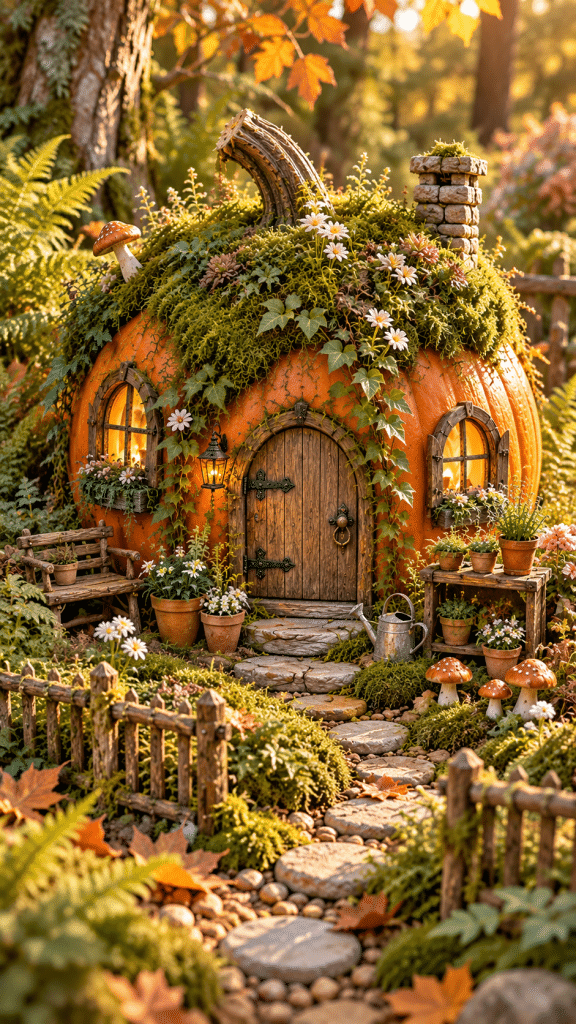
The pumpkin becomes an organic woodland dwelling with a weathered wooden door, delicately framed windows, a soft moss-covered roof, and a miniature planting area filled with forest-inspired textures.
🌿 The finished scene resembles a hidden cottage discovered beneath the canopy of an ancient tree.
Create a Pumpkin Cottage With Natural Woodland Architecture
Begin with a medium-sized pumpkin that has a broad lower section and an attractive rounded silhouette.
A pale orange, muted green, or creamy white pumpkin works particularly well because these colors coordinate naturally with moss, bark, and woodland foliage.
Place the pumpkin on a stable, slightly elevated base made from a flat stone, sealed wooden disk, or shallow garden container.
The base creates a visible foundation and helps keep the pumpkin away from persistently wet soil.
For a reusable display, choose a hollow artificial pumpkin. Its surface can be painted with thin layers of warm beige, weathered sage, and soft brown to introduce subtle variation.
The most important architectural feature is the doorway.
Create a small arched door using thin pieces of craft wood or lightweight bark. Narrow vertical wooden strips can imitate old cottage planks, while a tiny bead or decorative metal stud makes an attractive door handle.
Position the door slightly off-center for a more organic appearance.
A miniature stone doorstep completes the entrance and visually connects the house to the garden floor.
Build an Enchanting Moss Roof With Tiny Woodland Details
The moss roof is the defining feature of this design.
Rather than covering the entire pumpkin in one uniform layer, create an irregular roofline that looks as though it has developed naturally over time.
Use preserved decorative moss for a reusable craft pumpkin, attaching it with an adhesive suitable for the pumpkin material.
Arrange the moss in soft patches around the upper curves of the pumpkin, allowing selected areas of the original pumpkin surface to remain visible.
Small pieces of bark can form roof edges, while slender twigs create the appearance of old wooden beams.
🍄 A few handmade miniature mushrooms positioned near the roofline introduce additional woodland character.
Small artificial fungi in muted ivory, warm brown, or dusty red can create a charming forest atmosphere without making the scene excessively colorful.
For an especially imaginative detail, construct a tiny chimney from a short piece of hollow wood or miniature stacked stones.
The chimney should be proportionally small so the pumpkin maintains its cottage-like appearance.
The roof can also incorporate dried seed pods, tiny pinecones, and miniature leaf ornaments.
These elements make the house look naturally aged and comfortably integrated into the surrounding landscape.
Design a Miniature Woodland Nursery Around the Pumpkin
The surrounding planting is what transforms the cottage into a complete fairy garden.
Start by defining a small planting area around the pumpkin with smooth stones, low branches, or a shallow edging of bark.
Avoid covering the entire ground with decorative materials. Leaving selected areas of natural soil or living groundcover helps the miniature landscape feel authentic.
For a sheltered woodland-inspired setting, suitable plants may include miniature ferns, low-growing shade-tolerant groundcovers, and small foliage plants selected for the site’s climate.
Living moss may also work in consistently moist, suitable conditions, although preserved craft moss should not be treated as a living planting material.
Arrange the plants according to their perceived scale.
A small fern placed behind the pumpkin can resemble a tall tree, while a compact groundcover near the doorway creates the appearance of a miniature cottage lawn.
Create a tiny plant nursery beside the house using several miniature terracotta pots.
Fill the pots with small rooted plants or realistic miniature botanical decorations.
Position the pots on a low shelf made from twigs or a miniature wooden crate.
This detail introduces the idea that the fairy living inside the pumpkin is actively caring for the surrounding forest.
Add a Winding Pebble Path and a Secret Garden Gate
A miniature pathway gives the design visual direction.
Begin at the cottage doorway and extend a gently curving path toward the front of the display.
Use small, relatively flat pebbles or miniature stepping stones that suit the scale of the house.
A straight path may look too formal for this woodland concept, while a slightly irregular curve creates a more natural impression.
Allow tiny patches of groundcover or moss-like decoration to soften the path edges.
At the far end of the pathway, construct a miniature gate from thin twigs.
Two upright twigs can form the posts, with shorter branches creating a rustic gate between them.
The gate does not need to function. Its presence alone suggests the entrance to a hidden fairy property.
✨ For an additional storytelling detail, place a tiny watering can beside the door or hang a miniature basket from the gate.
These small objects make the design feel inhabited rather than merely decorative.
Make the Woodland Fairy House Look Beautiful From Every Angle
A frequent problem with miniature displays is that all the interesting features appear on the front.
For a garden installation that can be viewed from several directions, develop the sides and rear of the cottage as well.
One side might feature a miniature woodpile stacked beneath a small window.
The other could contain a tiny herb garden bordered with pebbles.
Behind the pumpkin, create a miniature compost basket using dried leaves and small twigs.
These details strengthen the woodland nursery theme while providing visual interest throughout the composition.
The overall arrangement should remain natural and slightly irregular.
Rather than positioning every accessory in perfect symmetry, imagine how a real little gardener might organize a comfortable home in the forest.
The result is a pumpkin fairy house that feels quietly magical, realistic, and full of personality.
🥈 Top 2 Pumpkin Fairy House Garden Ideas With a Terraced Succulent Tower and Miniature Stone Courtyard
The second of the Top 3 Pumpkin Fairy House Garden Ideas introduces a completely different aesthetic.
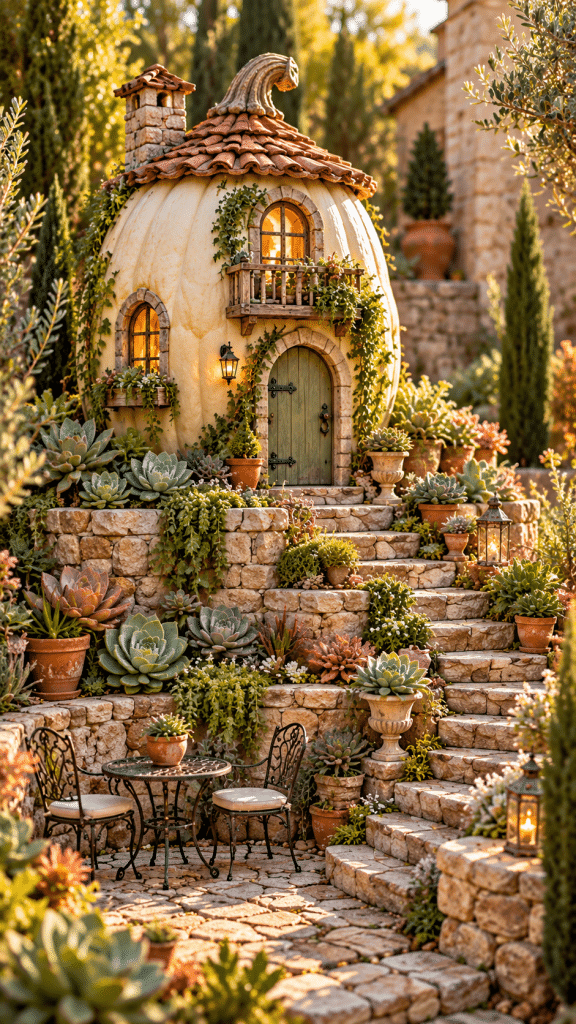
Instead of a woodland cottage hidden among moss and ferns, this concept transforms a pumpkin into an elevated miniature tower surrounded by sculptural succulents, carefully stacked stones, and a charming terraced courtyard.
The design takes inspiration from hillside architecture and Mediterranean-style gardens, combining warm natural materials with elegant miniature landscaping.
🏡 The finished composition resembles a tiny fairy residence built on a sunlit rocky hillside.
Its vertical structure makes it particularly suitable for patios, raised garden beds, broad outdoor planters, and compact courtyards.
Construct an Elevated Pumpkin Fairy Tower
Choose a tall artificial craft pumpkin with pronounced vertical ridges.
An elongated shape naturally creates the appearance of a miniature tower, particularly when the pumpkin is positioned on a raised stone foundation.
Cream, terracotta, and muted sandstone colors work especially well with the architectural direction of this design.
Begin by constructing a sturdy, level base using a shallow planter or stable stone-effect platform.
Lightweight imitation stones are useful when creating a portable arrangement, while real stones can work in a permanent garden location if the supporting structure is stable.
Elevate the pumpkin slightly above the surrounding garden floor.
This creates room for a miniature staircase leading toward the doorway.
The door should be narrower and taller than the door used in the woodland design, giving the tower a more architectural appearance.
Paint the door in faded olive green, weathered brown, or antique blue.
A small arched window above the entrance introduces vertical rhythm and makes the pumpkin feel like a two-story dwelling.
Create a Distinctive Balcony With Miniature Railings
A balcony provides one of the most memorable details in this design.
Attach a lightweight miniature balcony beneath the upper window of an artificial pumpkin.
A small wooden platform supported by decorative brackets can create the illusion of a projecting terrace.
Construct railings from thin wooden dowels or miniature craft balusters.
For a Mediterranean-inspired finish, paint the balcony in weathered ivory or soft charcoal.
A tiny planter attached to the balcony can hold artificial trailing greenery or a miniature botanical arrangement.
Avoid filling the balcony with too many accessories.
One hanging planter and a small decorative lantern are enough to establish a believable architectural feature.
🌸 A few delicate flowers spilling over the railing create a romantic contrast with the structured stone courtyard below.
For greater depth, include a tiny window shutter or a decorative arch above the balcony.
These details make the pumpkin look less like a seasonal ornament and more like a miniature house designed with architectural intention.
Build Layered Stone Terraces Around the Fairy House
The terraced landscape is the defining characteristic of this concept.
Instead of placing the pumpkin directly in a flat garden bed, surround it with several small planting levels.
Use suitable stones, miniature retaining-wall blocks, or lightweight stone-effect pieces to create shallow terraces.
The levels should step gradually downward from the pumpkin tower.
A higher terrace might contain a compact succulent collection, while the middle terrace supports a miniature bench and the lowest terrace forms a decorative gravel courtyard.
The arrangement creates the impression of a much larger hillside property.
However, the construction should remain stable and practical.
Actual retaining features must be secure, and any planting container must allow excess water to drain appropriately.
Choose plants based on the growing conditions rather than appearance alone.
Small rosette-forming succulents and low-growing drought-tolerant plants can be effective in sunny, well-drained locations.
In climates where heavy rain is common, a sheltered display or plants adapted to local wet conditions may be more reliable.
Introduce a Miniature Succulent Courtyard
The succulent courtyard introduces a beautiful contrast between organic plant forms and structured miniature architecture.
Select several small plants with different growth habits.
A compact rosette succulent can resemble a sculptural garden centerpiece.
A low, spreading succulent may create the impression of a miniature hedge or groundcover.
A small upright succulent introduces architectural height.
The key is restraint.
Rather than surrounding the pumpkin with a dense collection of unrelated plants, use a few carefully selected varieties with complementary colors and textures.
Soft sage green, powdery blue-green, silvery gray, and warm terracotta make a particularly harmonious palette.
Cover exposed planting surfaces with a thin layer of appropriate mineral mulch where suitable.
Fine gravel visually connects the plants to the stone terraces and helps reinforce the miniature hillside appearance.
Create a tiny circular courtyard directly in front of the pumpkin.
A miniature mosaic made from small colored stones can become the center of the courtyard.
🌿 Add a miniature café table, a tiny chair, or a small potted plant to suggest a peaceful fairy residence overlooking the garden.
Design a Curving Staircase Between the Terraces
The staircase gives the elevated design its architectural identity.
Starting from the lowest courtyard level, build a sequence of miniature steps leading upward toward the pumpkin doorway.
Small flat stones work particularly well because they resemble traditional garden steps at a reduced scale.
Each step should be stable and proportionate to the miniature house.
Allow the staircase to curve gently rather than following a perfectly straight line.
This introduces movement and makes the scene appear more sophisticated.
Decorative retaining walls can flank selected sections of the staircase.
A few miniature plants placed between the stones soften the architecture.
For additional charm, position one tiny lantern near the lower steps and another beside the front door.
The repeated details visually connect the different levels.
Finish the Pumpkin Tower With an Elegant Roof and Garden Details
A simple roof can dramatically change the pumpkin’s silhouette.
For a Mediterranean-inspired design, use a lightweight conical or shallow domed roof made from weather-resistant craft material.
A warm terracotta finish complements the stone courtyard, while an aged ivory roof produces a softer romantic appearance.
Small overlapping roof pieces can imitate traditional tiles.
Position the roof securely so it does not become detached during wind or rain.
Add subtle finishing touches such as a miniature wall fountain that does not require flowing water, decorative urns, or tiny climbing vines attached to the artificial pumpkin.
These accessories should support the architectural story rather than compete with it.
The finished display should feel like a tiny hillside villa, with the pumpkin tower occupying the highest point and miniature gardens unfolding naturally beneath it.
This concept is especially attractive because it combines the playful nature of fairy gardening with the structured beauty of miniature landscape design.
🥉 Top 3 Pumpkin Fairy House Garden Ideas With a Twilight Pollinator Lantern Village
The third design introduces illumination, seasonal flowers, and the atmosphere of a magical miniature village.
Rather than featuring a single cottage, this concept brings together a small collection of pumpkin fairy houses arranged among low-growing flowering plants.
Each pumpkin becomes a tiny lantern dwelling, with miniature windows glowing softly as evening approaches.
The surrounding garden resembles a fairy-sized flowering meadow, complete with tiny pathways, miniature fences, and delicate natural decorations.
🧚♀️ The result is especially beautiful at dusk, when the warm windows begin to shine among the flowers.
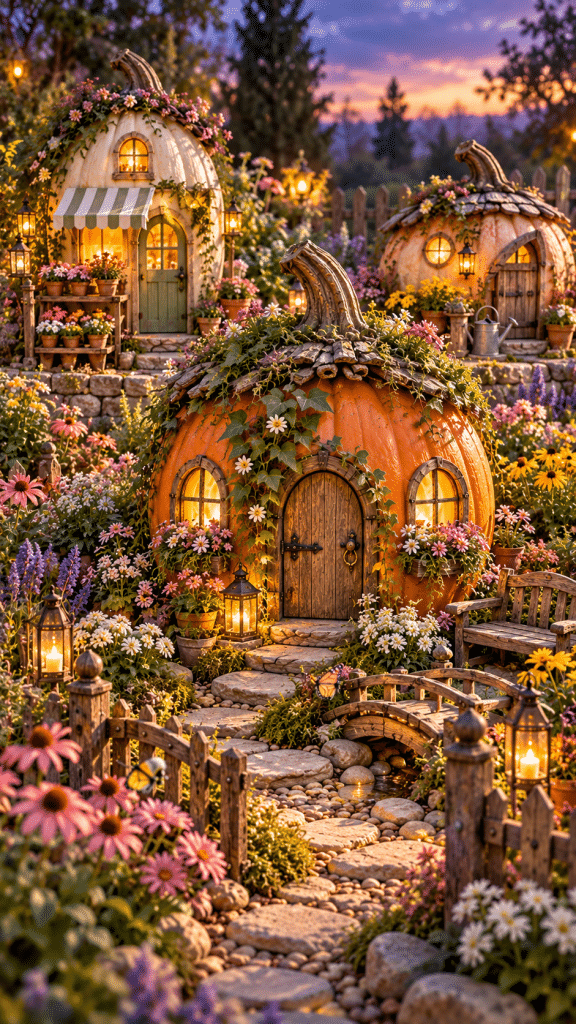
Create a Village of Three Pumpkin Lantern Houses
Begin with three hollow artificial pumpkins of different sizes.
Using an odd-numbered group naturally creates a more relaxed and appealing composition.
The largest pumpkin becomes the main village house.
A medium pumpkin can serve as a miniature flower shop, while the smallest might resemble a tiny seed cottage or garden workshop.
Although the houses should share a similar visual language, each should have a distinct character.
For example, the main cottage could feature a round wooden door and several arched windows.
The flower shop might have a tiny awning made from weather-resistant fabric and miniature flower displays beside its entrance.
The garden workshop could feature a simple rustic door, a small tool rack, and several tiny pots.
The overall village becomes more engaging when the houses suggest different activities.
🎃 The pumpkins themselves can remain in natural shades of orange, cream, and pale green to create a warm seasonal palette.
Avoid painting all three in identical colors.
Subtle variation makes the arrangement feel like a collection of individual homes.
Create Glowing Windows With Battery Powered LED Lighting
Lighting is the most distinctive element in the twilight village.
Carefully cut small window openings into hollow artificial pumpkins using tools appropriate for the material.
Rounded windows, narrow arches, and tiny circular openings work beautifully.
Translucent craft material placed behind the windows can diffuse the light and prevent the interior from appearing overly bright.
Small warm-white battery-powered LED lights can be positioned inside the pumpkins.
Choose lighting designed for the intended setting, especially if the decorations may be exposed to outdoor moisture.
The warm light creates the impression of occupied miniature houses without requiring real candles.
Different window shapes help distinguish the three cottages.
The largest house might feature two glowing windows beside the entrance.
The flower shop could have one broad display window.
The smallest house might feature a single tiny illuminated opening near the roof.
✨ The scene becomes particularly atmospheric when the lights remain subtle enough to complement the surrounding plants rather than overpower them.
Surround the Fairy Village With a Miniature Flower Meadow
The planting design should make the fairy village look integrated into a living garden.
A miniature meadow works particularly well because flowering plants introduce color, texture, and seasonal movement.
Choose compact flowers adapted to the local climate, available sunlight, and planting conditions.
Low-growing alyssum, where suitable, can create delicate clusters of tiny flowers.
Dwarf marigolds provide warm golden and orange tones, while selected small-flowered native plants can contribute additional color and ecological value.
Compact flowering groundcovers may also work, provided their mature size remains appropriate for the display.
For the most convincing miniature effect, avoid plants with extremely large flowers immediately beside the pumpkin doors.
Large blooms can overwhelm the house.
Instead, place taller plants behind the village and use smaller flowers toward the foreground.
This creates depth and maintains the illusion of scale.
Where locally appropriate, flowering plants with accessible nectar and pollen can also attract visiting pollinators.
However, decorative lighting should remain restrained, and flowering areas intended for nocturnal insects should not be unnecessarily illuminated.
Add Tiny Bridges and a Miniature Village Path
A village needs visible connections between its houses.
Create a main pathway that winds through the flower planting, linking each pumpkin cottage.
The path can be constructed from fine gravel, small flat stones, or a series of miniature stepping stones.
Instead of placing all three pumpkins in one straight line, arrange them at different depths.
Position the largest pumpkin toward the rear center, the flower shop slightly forward on one side, and the smallest cottage near the opposite foreground.
This arrangement creates the impression of an actual village.
A tiny bridge can introduce an especially charming architectural detail.
Construct it from thin craft wood with gently curved railings.
Place the bridge over a narrow strip of dark decorative pebbles or blue-gray stone that suggests a miniature stream without needing standing water.
A dry-stream design is easier to maintain and avoids introducing a small water feature that could collect debris.
🌸 A tiny signpost near the bridge can point toward the flower shop, garden workshop, and main cottage.
Miniature signs create a sense of destination while keeping the display playful and imaginative.
Make a Fairy Flower Shop With Seasonal Garden Accessories
The flower shop can become the most detailed structure in the village.
Begin with a medium-sized pumpkin featuring a broad doorway.
Create a small exterior counter using lightweight wooden craft pieces.
Place tiny flowerpots, miniature baskets, and handmade floral arrangements on the counter.
A small wooden crate can hold miniature bundles of dried flowers.
Another can contain tiny seed packets made from folded paper protected from moisture.
For an additional decorative touch, create a miniature flower cart using a small wooden platform and decorative wheels.
The cart can stand beside the shop entrance.
A tiny sign above the doorway completes the impression of a charming village business.
The combination of architecture and accessories gives the entire installation a gentle narrative.
Instead of seeing three unrelated pumpkin decorations, visitors discover a miniature community with its own buildings and gardens.
Transform the Fairy Village After Sunset
The twilight transformation is what makes this design especially memorable.
During the day, the miniature village appears cheerful, botanical, and full of seasonal character.
After sunset, the illuminated windows create a completely different atmosphere.
Use warm light inside the pumpkins while allowing the surrounding flowers to retain their natural evening appearance.
A very small outdoor-rated accent light can illuminate a focal detail, but excessive brightness should be avoided.
The goal is not to light the entire garden.
It is to suggest that a tiny village is quietly glowing among the plants.
Position the arrangement where it can be viewed easily from a patio, nearby window, or garden seating area.
The design can be particularly effective in a sheltered container garden, allowing the pumpkin houses to be repositioned when necessary.
With a few carefully arranged lights and believable miniature details, the display becomes a charming garden feature that feels magical without relying on elaborate electronic effects.
How to Choose Materials for Long Lasting Pumpkin Fairy House Garden Ideas
The visual appeal of a fairy house matters, but material selection determines how successfully the decoration performs outdoors.
Pumpkins, miniature woodwork, stones, plants, adhesives, and lighting all respond differently to weather conditions.
For a temporary seasonal installation, fresh pumpkins may offer the most natural appearance.
They can be decorated with removable accessories and displayed for a limited period before being composted where appropriate.
However, carving and prolonged exposure to moisture can accelerate deterioration.
For a reusable project, hollow artificial pumpkins provide more flexibility.
They can be cut, painted, decorated, and illuminated while maintaining their basic structure from year to year.
A reusable artificial pumpkin also makes it easier to construct detailed roofs, balconies, and miniature windows.
| Material | Best Application | Main Advantage | Care Consideration |
|---|---|---|---|
| Fresh pumpkin | Temporary woodland cottage | Natural seasonal texture | Decomposes and needs monitoring |
| Hollow craft pumpkin | Illuminated fairy house | Reusable and easy to customize | Material should suit outdoor exposure |
| Preserved moss | Decorative roofing | Soft natural-looking texture | Keep protected from prolonged moisture |
| Natural bark and twigs | Doors, fences, rustic roofs | Authentic woodland appearance | May weather or deteriorate |
| Terracotta mini pots | Fairy nursery and courtyard | Realistic garden detail | Can crack or tip over |
| Natural stones | Paths, terraces, foundations | Durable visual structure | Must be stable and safely positioned |
| Battery-powered LEDs | Glowing miniature windows | No open flame | Use suitable outdoor-rated components |
A well-designed project uses each material where its strengths are most valuable.
Natural elements provide texture and authenticity, while artificial structural materials improve durability for detailed architectural features.
Protect Miniature Architectural Details From Outdoor Weather
Tiny doors, balconies, roofs, and fences are often the most delicate components.
Before installing the fairy house outdoors, examine how each piece is connected to the pumpkin.
Lightweight decorative elements should be secured with adhesives or mechanical connections compatible with their materials.
Choose weather-resistant finishes when the project will be exposed to outdoor conditions.
Painted wood may benefit from an appropriate exterior protective coating.
However, a coating should never be assumed to make absorbent natural materials permanently waterproof.
Avoid positioning delicate paper decorations where they will be exposed directly to rain.
For gardens with strong seasonal storms, a sheltered porch, covered patio, or portable container arrangement may be more practical.
A removable display also allows maintenance without disturbing nearby plants.
⚠️ Important Note: Never place an open flame inside or near a pumpkin fairy house, particularly one decorated with dried moss, bark, paper, or wooden accessories. Use suitable battery-powered LED lighting instead. Keep electrical components protected from moisture, secure miniature structures against wind, and remove fresh pumpkins when they begin to soften, mold, or attract unwanted pests.
Selecting the Best Plants for Pumpkin Fairy House Garden Ideas
Plants are essential because they connect the miniature architecture to the surrounding landscape.
Without greenery, a pumpkin fairy house may resemble a tabletop craft.
With carefully chosen plants, it becomes part of a believable miniature garden.
The most effective planting designs consider scale, growth habit, light requirements, and mature plant size.
A plant that looks miniature at purchase may grow rapidly and eventually obscure the entire cottage.
For this reason, compact and relatively slow-growing plants are often more manageable.
Use Low Growing Plants to Create Miniature Lawns
A miniature lawn helps establish the scale of a fairy house.
Creeping thyme can create a fine-textured groundcover in suitable sunny, well-drained conditions.
Some low-growing mosses may work in shaded, consistently moist environments.
Small-leaved groundcovers adapted to local growing conditions can also create the appearance of miniature lawns.
The important consideration is compatibility with the site.
A shade-loving groundcover may struggle in a sunny succulent display, while drought-tolerant plants can decline in persistently wet soil.
Avoid selecting plants purely for visual appearance without considering their needs.
🌱 A healthy miniature landscape will remain attractive longer than one built around plants that require conflicting conditions.
Introduce Vertical Planting Without Hiding the Pumpkin
Vertical elements make miniature gardens feel deeper and more realistic.
A small upright plant behind the pumpkin can resemble a tree.
A compact ornamental grass may suggest a tall meadow plant.
A tiny fern can imitate a woodland canopy.
However, the plant should support the fairy house rather than overwhelm it.
Position taller vegetation toward the back or sides of the display.
Keep the doorway and primary windows visible from the main viewing angle.
When viewed from a low perspective, the surrounding vegetation should create the illusion of a natural environment surrounding a miniature dwelling.
Combine Seasonal Flowers With Permanent Garden Structure
Seasonal flowers can introduce vibrant autumn color, but a miniature garden also benefits from lasting structure.
Small evergreen plants, suitable compact groundcovers, and permanent stones can establish the basic composition.
Seasonal flowers can then be replaced or refreshed as the garden changes.
For example, a miniature stone courtyard can remain in place while surrounding flowering containers are exchanged.
A woodland cottage might feature permanent bark edging and miniature stones, with small seasonal plants adding color.
This flexible arrangement allows the miniature scene to evolve without rebuilding the entire fairy house.
Where to Display Pumpkin Fairy House Garden Ideas for Maximum Visual Impact
The location of a pumpkin fairy house affects how easily visitors can appreciate its details.
Because these decorations are small, they often perform better in places where people naturally look closely.
A huge open lawn may cause even a beautiful miniature house to disappear visually.
An intimate garden setting creates a stronger experience.
Place a Fairy Cottage Near a Garden Path
A garden path is an ideal location because visitors naturally move through the area.
Position the fairy house slightly off the path, nestled among planting.
Avoid placing it where people may accidentally step on the decoration or where it obstructs walking.
A low stone edging or small planted border can help define the miniature setting.
The cottage becomes a delightful discovery rather than an obvious centerpiece.
Use a Raised Planter for Small Spaces
A raised planter allows miniature details to be viewed more comfortably.
It also provides greater control over the planting medium and arrangement.
A broad shallow container can accommodate a pumpkin house, small plants, and miniature pathways.
Choose a container with suitable drainage and enough room for plant roots.
The raised position makes the design particularly suitable for balconies, compact patios, and small courtyards.
A container display also makes seasonal changes easier because the entire arrangement can be managed in one location.
Create a Fairy Garden Under a Shrub or Small Tree
Established shrubs create a natural sense of shelter.
Their branches can resemble a miniature forest canopy when the pumpkin house is positioned beneath them.
A shaded corner with ferns, stones, and natural leaf litter is especially effective for the woodland nursery concept.
However, avoid damaging roots or piling materials against living trunks and stems.
The fairy garden should complement established plants without interfering with their health.
A carefully positioned cottage beneath a shrub can look as though it has always belonged in the garden.
Budget Friendly Ways to Make Pumpkin Fairy House Garden Ideas Look More Expensive
An elaborate-looking miniature garden does not require expensive accessories.
The most convincing details often come from ordinary materials used creatively.
Fallen twigs can become fences, railings, and rustic beams.
Small stones can become miniature pathways or architectural foundations.
Leftover craft wood can create doors, windows, balconies, and benches.
Even an old shallow planter can become the base of a complete miniature fairy landscape.
The key is consistent scale and a limited material palette.
Repurpose Natural Garden Materials Creatively
Natural materials often provide more realistic texture than mass-produced miniature decorations.
A small piece of bark can resemble an ancient cottage roof.
A curved twig may become a decorative archway.
Tiny seed pods can imitate baskets, pots, or sculptural ornaments.
Smooth pebbles can form a miniature courtyard.
Collect materials responsibly and avoid taking living moss, plants, or natural habitat features from protected areas.
Clean and inspect collected materials before bringing them into a craft project.
🍃 The best results often come from choosing a few beautiful materials and repeating them throughout the miniature scene.
Focus on One Remarkable Architectural Detail
Instead of buying dozens of miniature accessories, create one distinctive feature.
For the woodland cottage, that feature might be a richly textured moss roof.
For the terraced tower, it could be the tiny balcony and curved staircase.
For the twilight village, glowing miniature windows create the strongest impression.
Once the defining feature is complete, simpler decorations can support it.
This approach prevents the fairy garden from becoming overcrowded.
Keep the Color Palette Coordinated
Color coordination creates a polished appearance even when inexpensive materials are used.
The woodland nursery works beautifully with moss green, weathered brown, cream, and muted orange.
The succulent tower benefits from terracotta, sandstone, dusty sage, and warm ivory.
The twilight village can combine pumpkin orange, soft cream, flower pink, natural green, and warm amber illumination.
Avoid introducing too many unrelated bright colors.
A restrained palette allows the natural shape of the pumpkin and the miniature architectural features to remain the focus.
Common Mistakes to Avoid When Designing Pumpkin Fairy Houses
Even imaginative projects benefit from a few practical design principles.
One common mistake is using too many miniature accessories.
Tiny benches, chairs, signs, buckets, bridges, fences, figurines, mushrooms, lanterns, and flowerpots can all be attractive individually.
However, combining everything in a compact space can make the garden difficult to interpret.
Leave some open ground around the house.
Another frequent mistake is ignoring the scale of the decorations.
A miniature bench that is taller than the front door immediately weakens the illusion.
Try to maintain a consistent relationship between the cottage and its surrounding features.
Plant selection can also create problems.
Fast-growing plants may cover the house, while plants with incompatible watering requirements can make maintenance unnecessarily difficult.
Finally, avoid placing elaborate pumpkin decorations directly in areas exposed to persistent waterlogging.
Stable foundations, suitable drainage, and protected electrical components are essential for a display that remains attractive and practical.
How to Make Pumpkin Fairy House Garden Ideas More Magical Through Storytelling
The most memorable miniature gardens suggest that something is happening beyond what visitors can see.
A tiny watering can beside a cottage door implies that a fairy has been tending the plants.
A miniature basket filled with flowers suggests that someone has just returned from the garden.
A glowing window creates the impression of a warm interior.
A narrow pathway disappearing behind a shrub invites curiosity about where it might lead.
These details transform an arrangement of decorative objects into a scene with personality.
For the woodland nursery, imagine a fairy who grows unusual forest plants and spends quiet mornings watering miniature ferns.
For the terraced tower, imagine a fairy architect who enjoys cultivating succulents on a sunlit hillside.
For the twilight village, imagine several fairy families living among the flowers and visiting a tiny flower shop each evening.
🧚 These imaginary stories do not need to be explained through elaborate signs.
The architecture, planting, and accessories can communicate them naturally.
This is what makes pumpkin fairy houses so engaging for both children and adults.
They allow creativity to extend beyond the original decoration and into an entire imaginary world.
Caring for Your Pumpkin Fairy Garden Throughout Autumn
A miniature garden requires occasional attention to maintain its appearance.
Check the plants regularly and adjust watering according to their individual requirements and the condition of the growing medium.
Remove fallen debris that obscures pathways or blocks miniature doorways.
Inspect wooden accessories for signs of deterioration, particularly after periods of heavy rain.
If using fresh pumpkins, monitor their condition frequently.
Softening, leaking, unpleasant odors, or significant mold growth indicate that the pumpkin should be removed.
Do not expect a fresh carved pumpkin to function as a permanent outdoor structure.
For artificial pumpkins, gently clean the exterior when needed and check that attached architectural features remain secure.
Battery-operated lights should be inspected for moisture exposure and maintained according to the manufacturer’s instructions.
At the end of the season, removable houses can be cleaned, dried, and stored.
Keeping delicate roofs, balconies, and miniature accessories in protective containers helps prevent damage before the next display.
The planted landscape can continue growing even after the pumpkin houses are removed.
This allows a fairy garden to become a reusable miniature gardening project rather than a single-season decoration.
Final Thoughts on the Top 3 Pumpkin Fairy House Garden Ideas
Beautiful Pumpkin Fairy House Garden Ideas combine miniature architecture, thoughtful planting, and playful imagination to turn ordinary garden corners into something extraordinary.
The three featured designs provide very different ways to achieve that transformation.
🥇 The Moss Roof Woodland Nursery creates a romantic hidden cottage surrounded by ferns, tiny garden pots, bark, moss-like textures, and winding pebble paths. Its natural appearance makes it especially effective in sheltered garden beds and shaded woodland-inspired settings.
🥈 The Terraced Succulent Tower offers a more architectural interpretation. Elevated pumpkin structures, miniature balconies, stone terraces, and sculptural planting create the illusion of a tiny hillside residence with elegant outdoor courtyards.
🥉 The Twilight Pollinator Lantern Village brings together glowing pumpkin cottages, delicate flowering plants, miniature pathways, and imaginative village details. Its greatest appeal is the transition from a charming daytime display into a softly illuminated fairy settlement after sunset.
Whichever design fits the garden best, the secret lies in creating a complete miniature environment.
A beautiful pumpkin alone may attract attention, but a pumpkin surrounded by convincing landscaping, carefully proportioned accessories, and thoughtful architectural details inspires curiosity.
A small door suggests a hidden home. A curved path invites exploration. A tiny flowerpot introduces personality. A glowing window transforms an ordinary seasonal decoration into something magical.
With creative use of natural materials, appropriate plants, and carefully designed miniature features, even the smallest garden space can become an enchanting storybook world filled with autumn beauty and whimsical charm. 🎃🌿✨