Dry riverbed landscaping is one of the most beautiful ways to transform an ordinary yard into a landscape that feels natural, intentional, and surprisingly dynamic. Instead of relying on a conventional lawn, plain gravel area, or rigid drainage channel, a dry riverbed creates the illusion that water has naturally traveled through the property over many years. Curving lines, weathered stones, layered planting, and carefully positioned boulders can turn even an awkward section of the garden into an impressive focal point.
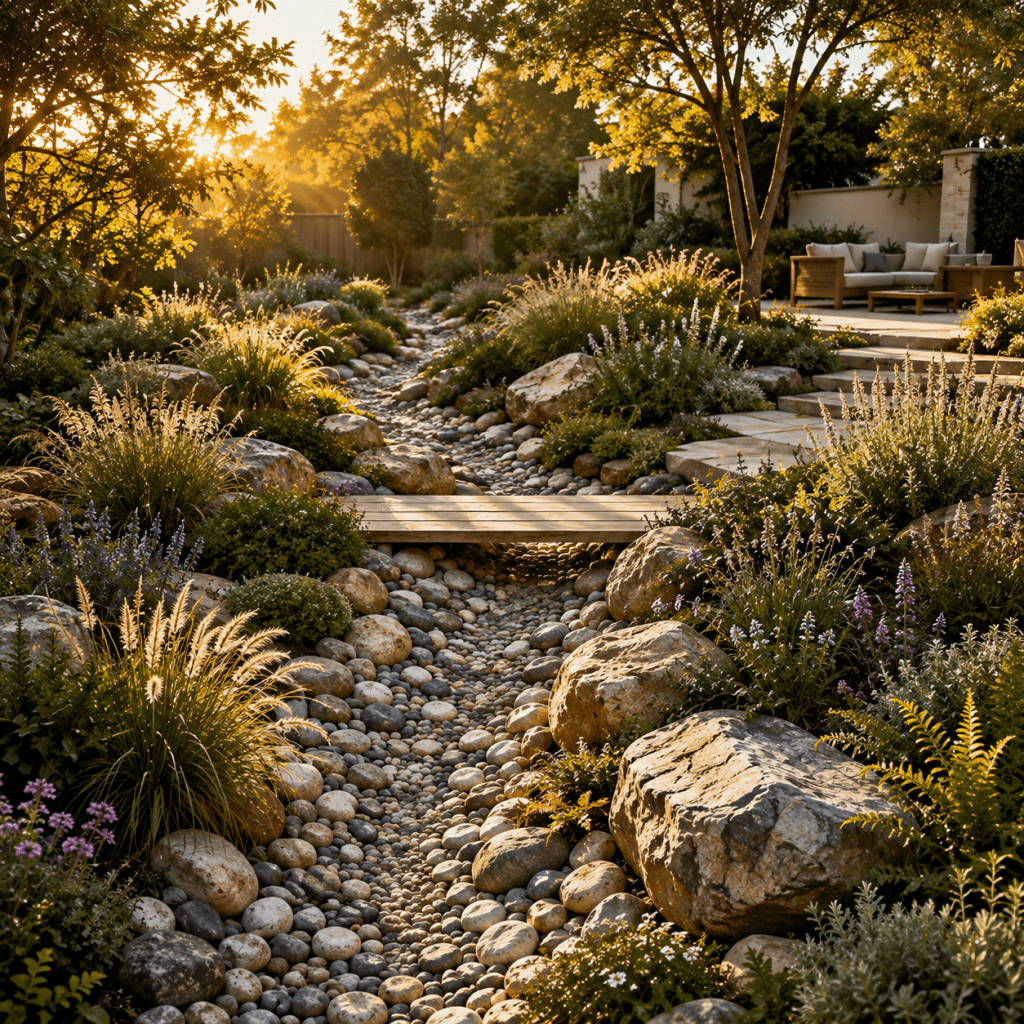
The appeal goes far beyond appearance. 🌿 A thoughtfully designed dry creek can visually connect different parts of a landscape, introduce texture, reduce the monotony of large planted areas, and potentially help guide stormwater when designed for the site’s actual drainage conditions. It works beautifully in rustic gardens, contemporary landscapes, woodland-inspired yards, Mediterranean spaces, drought-conscious gardens, and modern suburban properties.
However, the most convincing designs rarely look like someone simply poured gravel into a trench. Successful dry riverbeds imitate the irregularity of nature. Stones change size, the channel changes width, plants occasionally soften its edges, and larger rocks create visual interruptions that make the entire feature feel established rather than newly installed.
Among the many possibilities, three approaches stand out for their visual impact and versatility. These Best 3 dry riverbed landscaping ideas range from lush naturalistic streams to sophisticated modern stone channels and dramatic boulder-filled creek beds.
Why Dry Riverbed Landscaping Can Completely Change a Yard 🌿
A garden is often dominated by horizontal surfaces. There may be a lawn, patio, planting beds, pathways, and fences, but without a strong visual line connecting these elements, the landscape can feel fragmented.
A dry riverbed introduces movement.
Its curved shape naturally encourages the eye to travel through the garden. Instead of seeing the entire yard immediately, the viewer follows the stone channel toward another area. This can make a relatively modest backyard appear deeper and more interesting.
The effect becomes particularly powerful when the beginning or end of the riverbed is partially hidden. For example, the stones might disappear behind ornamental grasses, curve around a mature tree, or continue beneath a small wooden bridge. 🌾 The viewer intuitively imagines that the creek extends beyond what is immediately visible.
Texture is another major advantage.
Smooth river pebbles contrast beautifully with feathery grasses, broad leaves, rough boulders, timber, mulch, and soft groundcover plants. When several stone sizes are combined, the riverbed itself becomes a detailed landscape feature rather than merely an empty strip of gravel.
A carefully planned dry riverbed can also make difficult garden spaces feel intentional. A natural low point, narrow side yard, slope, or awkward transition between different elevations may become the perfect location for a creek-inspired feature.
Quick Comparison of the Best 3 Dry Riverbed Landscaping Ideas
Before choosing a design, consider how formal or natural the surrounding landscape already feels.
| Dry Riverbed Landscaping Idea | Overall Style | Best Feature | Ideal Setting | Maintenance |
|---|---|---|---|---|
| 🥇 Naturalistic Planted Dry Creek | Organic and lush | Plants blend beautifully with stone | Backyards and garden borders | Moderate |
| 🥈 Modern Minimalist Stone Riverbed | Clean and architectural | Strong contrast and simplicity | Contemporary homes | Low to moderate |
| 🥉 Boulder and Gravel Dry Creek | Rugged and dramatic | Exceptional natural texture | Slopes and larger landscapes | Moderate |
The best choice does not necessarily depend on garden size. Even a small yard can accommodate a narrow dry creek if its proportions are carefully controlled.
What matters most is visual integration. The riverbed should appear to belong to the surrounding landscape rather than looking like a separate decorative object.
🥇 Best 1 Naturalistic Dry Riverbed Landscaping with Lush Planting
For homeowners who want a garden that feels mature, peaceful, and almost untouched, a naturalistic planted dry riverbed is difficult to beat.
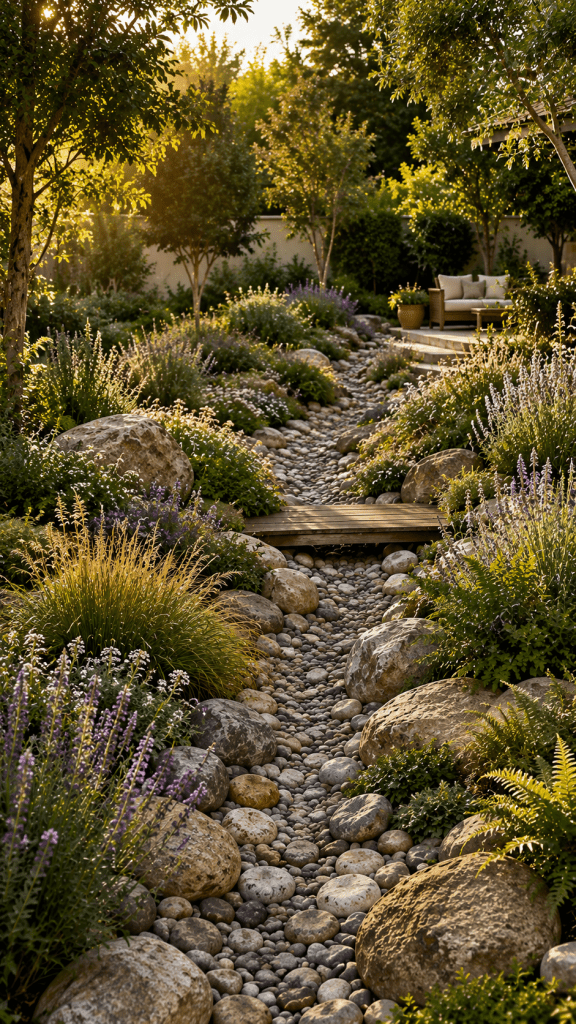
This approach recreates the appearance of a seasonal woodland stream that has temporarily dried after the rainy season. Instead of exposing every edge of the stone channel, plants overlap selected sections. Leaves arch above the rocks, grasses emerge between larger stones, and groundcovers gradually soften the transition between riverbed and garden.
The result can feel remarkably authentic.
Rather than becoming an isolated hardscape element, the riverbed becomes part of the planting composition.
Create a Naturally Curving Dry Riverbed Landscaping Layout
Straight lines are uncommon in natural streams.
A more convincing dry riverbed should therefore gently meander through the landscape. The curves do not need to be extreme. In fact, overly dramatic S-shaped curves can sometimes look artificial.
Instead, imagine how water would naturally move around obstacles.
Place a large boulder near one section and allow the channel to curve around it. Let another section narrow between dense planting before gradually becoming wider again.
This changing width is important. 🌿
A natural creek rarely maintains exactly the same dimensions from beginning to end. Wider pockets create visual resting areas, while narrower passages increase movement.
If the yard is long and narrow, a diagonal or gently curving riverbed can also help reduce the corridor effect.
Mix Different Stone Sizes for Natural Texture
One of the easiest ways to make dry riverbed landscaping look artificial is to use only one stone size.
Nature rarely sorts an entire creek into identical decorative pebbles.
Instead, combine several scales of stone.
Small gravel can fill spaces between medium river rocks. Larger rounded stones can define portions of the bank, while occasional substantial boulders create anchors.
The largest stones deserve particularly careful placement.
Rather than placing them evenly every few feet, create irregular clusters. One section might contain three substantial rocks positioned close together, while another stretch remains relatively open.
Partially burying large stones can also make them appear more established.
A boulder sitting completely on top of the ground may look as though it was delivered yesterday. A stone with part of its mass disappearing beneath gravel and planting feels much more permanent.
Important Note: If the dry riverbed is intended to manage real stormwater rather than serving only as decoration, its slope, depth, outlet, soil conditions, erosion protection, and relationship to the house foundation should be planned around actual site drainage. Decorative layouts should never redirect runoff toward buildings or neighboring properties.
Surround the Creek with Layered Greenery 🌾
Planting is what gives this first design its signature character.
The goal is not to hide the stones completely. Instead, vegetation should frame the riverbed and occasionally interrupt its edges.
Ornamental grasses are especially effective because their narrow leaves introduce movement without visually overwhelming the rocks. Their arching forms can mimic vegetation growing beside a natural stream.
Ferns can create a cooler woodland feeling in shaded areas.
In sunnier landscapes, lavender, rosemary, sedges, low shrubs, and drought-tolerant perennials can create a completely different interpretation.
Groundcover plants are useful around selected boulders. They soften the hard boundary between stone and soil, creating the impression that vegetation has gradually colonized the creek bank.
🌿 Try thinking in layers:
- Low groundcovers immediately beside selected stones
- Medium perennials and grasses along the banks
- Structural shrubs slightly farther away
- Small ornamental trees or multi-stem specimens in the background
Avoid creating an uninterrupted wall of plants on both sides. Leaving occasional open sections of gravel makes the composition easier to appreciate.
Add a Small Bridge for Storybook Character
A simple bridge can dramatically increase the visual impact of a planted dry creek.
It does not need to be large.
A narrow timber bridge crossing a particularly attractive section can create a destination while connecting two garden areas. Natural wood works beautifully in woodland, cottage, Japanese-inspired, and rustic landscapes.
For contemporary gardens, a flat stone slab or minimalist concrete crossing can produce a cleaner effect.
The important detail is positioning.
Rather than automatically installing the bridge in the exact center of the yard, consider placing it slightly off-center where the riverbed naturally narrows.
Surrounding it with grasses or low planting helps integrate the crossing into the landscape.
Create the Illusion That the Creek Continues Beyond the Garden
One of the most effective landscape-design techniques involves leaving part of the feature unseen.
Instead of making both ends of the dry creek clearly visible, allow one end to disappear behind shrubs, boulders, or tall ornamental grasses.
This creates mystery. 🌿
The viewer cannot immediately determine exactly where the creek begins.
In smaller gardens, this simple trick can create an impressive sense of depth.
A riverbed could emerge from beneath dense planting near the back fence, curve through the garden, pass beneath a bridge, and gradually disappear into another planted area.
The garden suddenly feels much larger than its physical dimensions suggest.
🥈 Best 2 Modern Dry Riverbed Landscaping with Minimalist Stone
Not every dry creek needs to imitate a wild woodland stream.
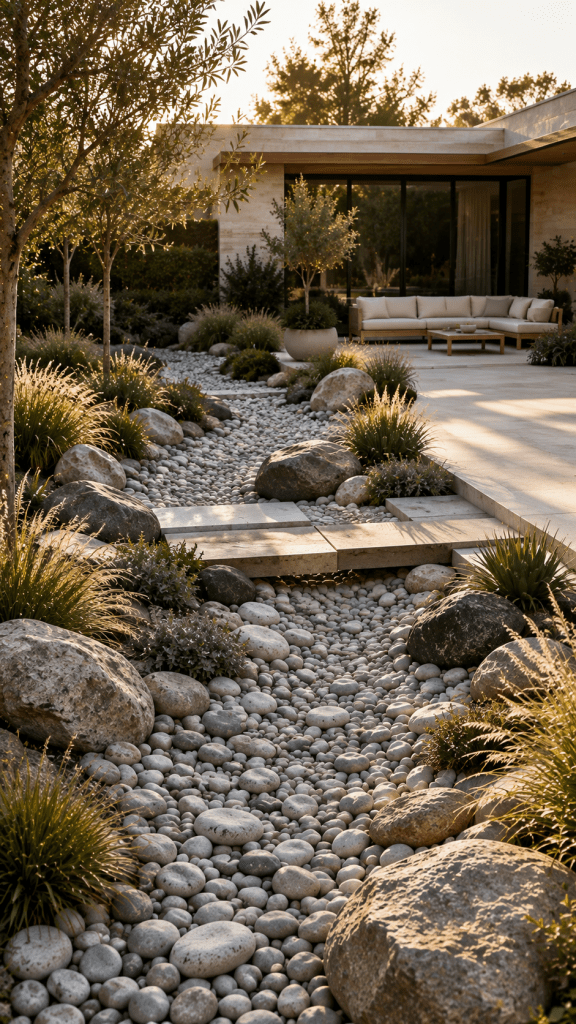
A contemporary home may benefit from a more restrained interpretation using carefully selected stone, architectural planting, and simplified geometry.
The modern dry riverbed landscaping approach maintains the concept of flowing stone while reducing visual clutter.
Instead of abundant planting spilling across the channel, every material has more breathing room.
The result can feel luxurious, calm, and sophisticated.
Choose a Restrained Stone Palette
Color consistency becomes especially important in contemporary landscapes.
Rather than combining numerous stone colors, choose a restrained family of tones.
Soft gray river stones can complement concrete architecture. Warm beige and cream stones work beautifully beside limestone, travertine, pale render, and natural oak.
Dark charcoal stones can create dramatic contrast beside light walls.
The riverbed does not have to contain perfectly identical rocks. Variation in size and shape is still desirable, but keeping the color palette controlled helps preserve the modern character.
✨ A sophisticated combination might include:
- Pale gray river pebbles
- Medium gray rounded cobbles
- Several larger charcoal boulders
- Light concrete paving
- Black architectural accents
- Soft green planting
The overall appearance remains natural without becoming visually chaotic.
Pair Dry Riverbed Landscaping with Architectural Plants
Plant selection should reflect the cleaner design language.
Instead of filling every gap with vegetation, use sculptural plants strategically.
Ornamental grasses are excellent candidates because their flowing foliage creates contrast against the hard stone.
A few large grasses positioned beside substantial boulders can be more powerful than dozens of small plants.
Depending on climate, architectural succulents, compact evergreen shrubs, olive trees, yucca-like forms, or carefully shaped multi-stem trees may also work beautifully.
🌿 Repetition is useful in modern gardens.
For example, the same ornamental grass can appear at three irregular intervals along the creek. This provides rhythm while preserving simplicity.
Connect the Riverbed to Modern Paving
The relationship between stone and paving can make a contemporary dry creek particularly impressive.
Imagine large rectangular stepping stones crossing a bed of smooth gray pebbles.
The contrast between precise geometric slabs and naturally rounded river stones immediately creates visual interest.
Alternatively, the creek might run beside a modern terrace before curving into the planted garden.
Large-format concrete, limestone, or porcelain paving can provide a clean architectural counterpoint.
Keep transitions deliberate.
A poorly defined border between paving and river stone can look unfinished. Depending on the design, concealed edging may help maintain crisp boundaries where a contemporary appearance is desired.
Use Negative Space as Part of the Design
Modern landscapes benefit from restraint.
Not every section needs another plant, boulder, lantern, sculpture, or decorative accessory.
Open gravel and exposed stone can be beautiful.
Negative space gives the eye somewhere to rest and allows the strongest materials to receive more attention.
For example, one large sculptural boulder beside a cluster of soft grasses may be considerably more impressive than ten small decorative rocks scattered across the same space.
This principle applies to the riverbed itself.
Allow some stretches to remain predominantly stone. Then create concentrated planting around key bends.
The contrast creates rhythm.
Introduce Subtle Landscape Lighting 💡
Lighting can completely transform a dry riverbed after sunset.
Rather than flooding the entire channel with bright light, illuminate only selected elements.
A concealed fixture can graze the textured surface of a large boulder. Another can softly illuminate an ornamental grass from below.
Warm architectural lighting can create subtle shadows across the pebbles.
The riverbed then becomes a nighttime landscape feature rather than disappearing into darkness.
For an especially sophisticated effect, position lights where they are visually concealed during daylight.
The viewer should notice the illuminated landscape, not a collection of fixtures.
🥉 Best 3 Boulder Dry Riverbed Landscaping for Dramatic Natural Texture
The third approach is ideal for anyone who wants the dry riverbed to become a major landscape statement.
Instead of relying primarily on small river pebbles, this design uses large boulders, mixed gravel, irregular banks, and dramatic changes in scale to recreate a rugged natural creek.
It can look spectacular in larger yards, sloped landscapes, and gardens where a stronger naturalistic feature is needed.
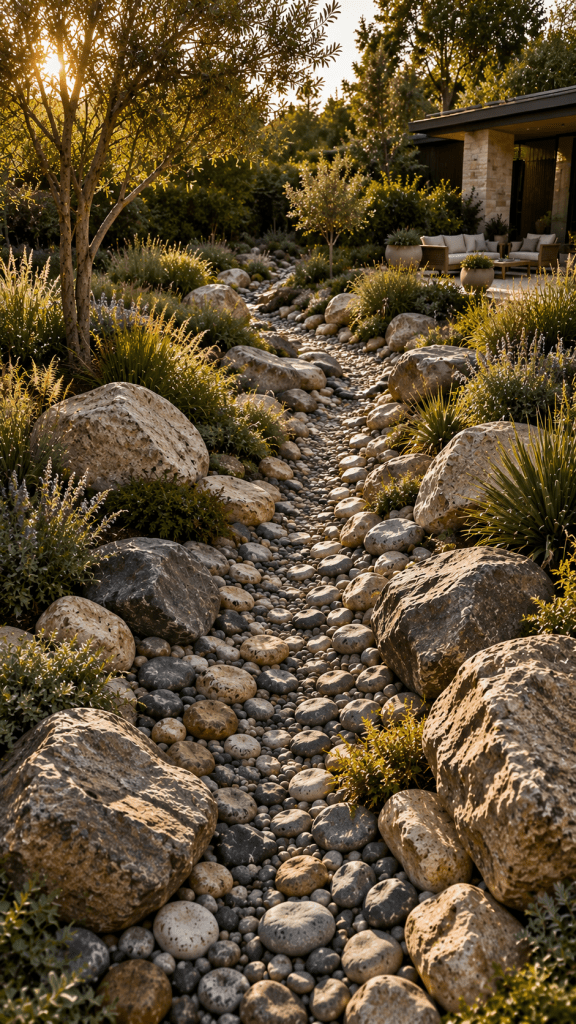
Use Large Boulders to Establish the Structure
Boulders provide visual weight.
They make the riverbed appear geological rather than decorative.
However, simply distributing large rocks evenly along both sides rarely produces a convincing result.
Observe natural landscapes and rocks often appear in groups.
Some may be partially buried. Others overlap visually. A particularly large specimen may sit alone and become a focal point.
Try creating irregular clusters around bends in the creek.
One cluster might contain a dominant boulder surrounded by several medium rocks. Another could feature two stones with grasses growing between them.
The irregularity makes the composition feel believable.
Create Changes in Elevation
A perfectly flat riverbed can still be attractive, but subtle changes in level can dramatically increase realism.
On naturally sloping ground, stones can suggest the remains of small cascades.
Large flat rocks positioned across the channel can imitate natural ledges where water might flow during heavy rainfall.
Even when the creek is completely dry, the viewer can imagine how water would move through it.
This imagined movement gives the landscape energy.
If the property already contains a slope, working with that topography can produce a much more convincing result than attempting to erase it.
Combine Gravel Cobble and Boulder Layers
Scale is the secret to this design.
Begin with smaller gravel as the visual base. Introduce medium cobbles throughout the channel, then add increasingly larger rocks near the banks and around focal areas.
This gradual hierarchy creates complexity.
Avoid making every section equally detailed.
A powerful boulder cluster becomes more impressive when surrounded by simpler areas.
Likewise, a narrow section containing mostly small stones can lead toward a wider area filled with larger rocks.
The viewer experiences a sequence rather than one repetitive pattern.
Add Drought Tolerant Planting 🌵
A rugged dry creek pairs naturally with water-conscious planting.
Depending on the local climate, ornamental grasses, lavender, rosemary, sedges, flowering perennials, succulents, and other drought-tolerant species can create a landscape that feels rich without requiring the appearance of a traditional lush lawn.
Plants should appear to grow around the rocks rather than being arranged in perfectly spaced rows.
Place some close to boulders.
Allow others to occupy small pockets between stone clusters.
Keep several areas completely open.
The mixture of vegetation and exposed geology produces the strongest visual effect.
Build a Dry Riverbed Around Existing Trees
Existing mature trees can become incredible anchors for this style.
Instead of treating the tree and creek as unrelated features, curve the riverbed through the broader landscape around the tree while respecting its root zone.
The trunk provides vertical structure while the stones create horizontal movement.
A few substantial rocks positioned visually near the tree can reinforce the impression of an established natural landscape, but excavation and heavy boulder placement should not damage major roots.
This approach works particularly well in larger yards where mature vegetation already exists.
How to Make Dry Riverbed Landscaping Look Natural Instead of Artificial
Regardless of which Top 3 style you choose, authenticity depends on irregularity.
Perfect symmetry is usually the enemy.
If both banks are identical, every boulder is the same size, and every plant is positioned at equal intervals, the creek will immediately appear manufactured.
Nature operates through controlled randomness.
The challenge is recreating that randomness without producing visual chaos.
Avoid the Necklace of Rocks Effect
A common mistake is lining both edges of the riverbed with medium rocks like a necklace.
This creates an obvious border that rarely resembles a real creek.
Instead, vary the banks.
One section might contain several large rocks. Another might transition directly from small pebbles into planting. Somewhere else, grasses may partially cover the edge.
The boundary should occasionally become difficult to identify.
That ambiguity is what makes naturalistic landscaping convincing.
Vary the Width of the Channel
A dry creek that remains exactly three feet wide for its entire length can resemble a constructed pathway.
Changing the width immediately improves realism.
Create narrow passages around obstacles and wider sections where stones appear to have accumulated.
On larger properties, an expanded gravel area can suggest a natural basin.
On smaller properties, even modest changes in width can make a substantial difference.
Think About Where Water Would Actually Travel
Even decorative dry riverbeds become more believable when their route makes geographical sense.
Water naturally moves downhill.
It travels toward low points and around substantial obstacles.
A creek that appears to climb uphill or abruptly change direction without explanation can look unnatural.
Walk through the garden before designing the route.
Observe existing slopes and drainage patterns after rainfall when possible.
These clues can inspire the shape of the feature.
Choosing Plants for Dry Riverbed Landscaping 🌱
Plants determine whether the riverbed feels woodland-inspired, Mediterranean, contemporary, tropical, or desert-like.
Rather than selecting plants individually, think in communities.
A group of grasses beside a boulder creates one visual unit. Groundcover spreading toward the creek creates another.
Repeated plant communities can connect different sections.
For sunny gardens, combinations of ornamental grasses and flowering drought-tolerant perennials can create movement and seasonal color.
Mediterranean-inspired landscapes can incorporate lavender, rosemary, silvery foliage, and olive-like forms where climate allows.
Shadier gardens may benefit from ferns, sedges, woodland groundcovers, and foliage-focused planting.
The key is restraint.
The riverbed should remain visible.
Plants should frame and interact with it rather than completely burying the stone feature.
Dry Riverbed Landscaping Ideas for Small Backyards
A large landscape is not required.
In fact, a narrow dry creek can be an excellent tool for making a small garden feel deeper.
The trick is proportion.
Huge boulders may overwhelm a tiny courtyard, while an extremely narrow line of identical pebbles may look decorative rather than natural.
Use a mixture of small and medium stones with perhaps one or two carefully scaled larger rocks.
Let the creek enter the composition diagonally rather than running parallel to the fence.
Diagonal lines increase perceived depth.
A small stepping-stone crossing can create another layer of interest.
🌿 Surrounding the far end with taller planting can conceal where the creek finishes, creating the illusion that it continues beyond the visible garden.
Vertical planting also helps.
Instead of using precious floor area for numerous spreading shrubs, incorporate grasses, narrow upright plants, climbers, or a small multi-stem tree.
Dry Riverbed Landscaping for Front Yards
A dry creek can also dramatically improve curb appeal.
Front yards often contain awkward drainage zones, large expanses of lawn, or planting beds without a clear focal point.
A curving stone riverbed can create structure while visually guiding attention toward the entrance.
For a contemporary home, combine pale stone with restrained grasses and large architectural stepping slabs.
For a cottage-inspired property, use softer planting, irregular stones, and flowering perennials.
For a rustic property, larger boulders and native-looking vegetation can create a strong connection to the surrounding environment.
Keep visibility and access in mind.
The feature should complement walkways, driveways, and entrances rather than creating obstacles.
Materials That Make a Dry Riverbed More Beautiful
Stone is obviously the dominant material, but additional materials can dramatically influence the final character.
Natural timber creates warmth.
Weathered wood can be used for a simple bridge, nearby seating, or subtle edging in selected areas.
Stone slabs provide practical crossing points.
Gravel pathways can connect visually with the riverbed while maintaining a slightly different texture.
Metal edging may be useful where a crisp modern boundary is required, although it is usually best concealed.
Mulch can create strong contrast around planted areas, especially when its color complements the surrounding stone.
The best landscapes limit the number of unrelated materials.
Choose a coherent palette and repeat it throughout the property.
Seasonal Interest Makes the Riverbed Even Better 🍂
A dry riverbed should not look beautiful only during summer.
Consider how surrounding plants will change throughout the year.
Ornamental grasses may develop golden seed heads in autumn.
Deciduous shrubs can introduce warm foliage colors.
Evergreens can maintain structure during winter.
Spring bulbs can emerge around selected stones before disappearing beneath later foliage.
The rocks themselves provide permanent structure, which is one reason dry creek landscapes can remain visually interesting during colder months.
After rain, wet stones often become darker and richer in color, creating another temporary transformation.
Even without flowing water, the feature continues changing with weather and seasons.
Common Dry Riverbed Landscaping Mistakes to Avoid
One common mistake is choosing stones that are too uniform.
Another is using an overly rigid channel.
Excessive symmetry can also weaken the illusion.
But perhaps the biggest mistake is treating the creek as an isolated decoration.
A successful dry riverbed should interact with the rest of the garden.
Plants should approach it.
Paths may cross it.
Trees can frame it.
Boulders can connect it to nearby planting beds.
The landscape should feel like one composition.
Another issue is excessive decoration. Too many lanterns, sculptures, bridges, pots, signs, and ornaments can compete with the natural beauty of stone and vegetation.
🌿 Allow the materials themselves to become the decoration.
How to Choose Between These Best 3 Dry Riverbed Landscaping Ideas
Choose 🥇 Naturalistic Planted Dry Creek Landscaping when the goal is to create a lush garden where the riverbed feels as though it has always existed.
This style is particularly effective when planting is already an important part of the landscape. It creates softness, movement, and a sense of discovery.
Choose 🥈 Modern Minimalist Dry Riverbed Landscaping for contemporary architecture and gardens where clean lines are important.
The reduced material palette and carefully positioned plants create a sophisticated result without sacrificing the organic character of river stone.
Choose 🥉 Boulder and Gravel Dry Riverbed Landscaping when drama and natural texture are the priorities.
Large rocks provide incredible visual weight and can make an otherwise flat landscape feel much more established.
There is also no requirement to follow only one approach.
A sophisticated landscape can borrow characteristics from several styles.
For example, a mostly naturalistic creek could transition into a cleaner stone section beside a contemporary patio before becoming rugged and boulder-filled near the back of the property.
Creating a Dry Riverbed That Looks Better with Age
The most beautiful landscapes often improve rather than deteriorate as they mature.
Plants spread slightly between stones.
Moss may develop naturally in suitable shaded climates.
Grasses soften hard edges.
Weather gradually changes the appearance of exposed materials.
Designing with this evolution in mind prevents the garden from feeling overly finished on installation day.
Leave some room for plants to grow.
Do not pack every available space with vegetation immediately.
Give major stones enough visual breathing room.
Choose durable materials whose appearance improves through natural weathering.
A dry riverbed should feel grounded.
Over time, the boundaries between constructed landscape and living garden become less obvious, which is exactly what makes this feature so compelling.
Final Thoughts on the Best 3 Dry Riverbed Landscaping Ideas
Great dry riverbed landscaping is not simply about placing decorative rocks across a yard. It is about creating believable movement through the landscape.
The stones suggest water even when no water is present.
Curves create depth.
Boulders provide permanence.
Plants soften the banks and introduce seasonal life.
Together, these elements can transform a forgotten section of the yard into one of its strongest visual features.
For the richest garden atmosphere, 🥇 naturalistic dry riverbed landscaping with lush planting offers an exceptional combination of stone and greenery. It is ideal for creating a peaceful creek-like landscape where plants gradually merge with the riverbank.
For a cleaner architectural aesthetic, 🥈 modern minimalist dry riverbed landscaping brings together smooth stone, restrained planting, contemporary paving, and sophisticated negative space.
For maximum visual impact, 🥉 boulder and gravel dry riverbed landscaping creates a rugged landscape filled with dramatic scale, texture, and geological character.
Whichever direction is chosen, the strongest design principle remains the same: make the riverbed feel like part of the landscape rather than something placed on top of it. 🌿
Vary the width. Mix stone sizes. Partially bury major boulders. Allow plants to interrupt selected edges. Follow the natural topography whenever possible. Keep decorative objects restrained.
When these details work together, a simple collection of rocks becomes something much more convincing—a beautiful imaginary river flowing permanently through the garden, even when there is not a drop of water in sight. 🌾