Painting is one of the fastest ways to change how an old tire feels in a garden. The dark industrial surface can become softer, brighter, more botanical, or more sophisticated with the right color treatment. But the strongest Tire Planter Painting Ideas are not simply about covering rubber with the brightest paint available.
The real opportunity is to make the tire belong in the garden.
A beautifully painted tire planter can coordinate with flowers, echo the colors of a fence or patio, complement surrounding foliage, and become part of a larger landscape palette. The paint can make the tire visually disappear into the planting—or deliberately turn it into a decorative focal point.
That distinction matters.
Some gardens benefit from understated botanical colors that allow flowers to dominate. Others can support a more artistic painted planter with hand-painted leaves and flowers. And if several tires are used together, a carefully coordinated tonal palette can create a much more polished effect than a random collection of bright colors.
For this guide, the three ideas use paint in distinctly different ways.
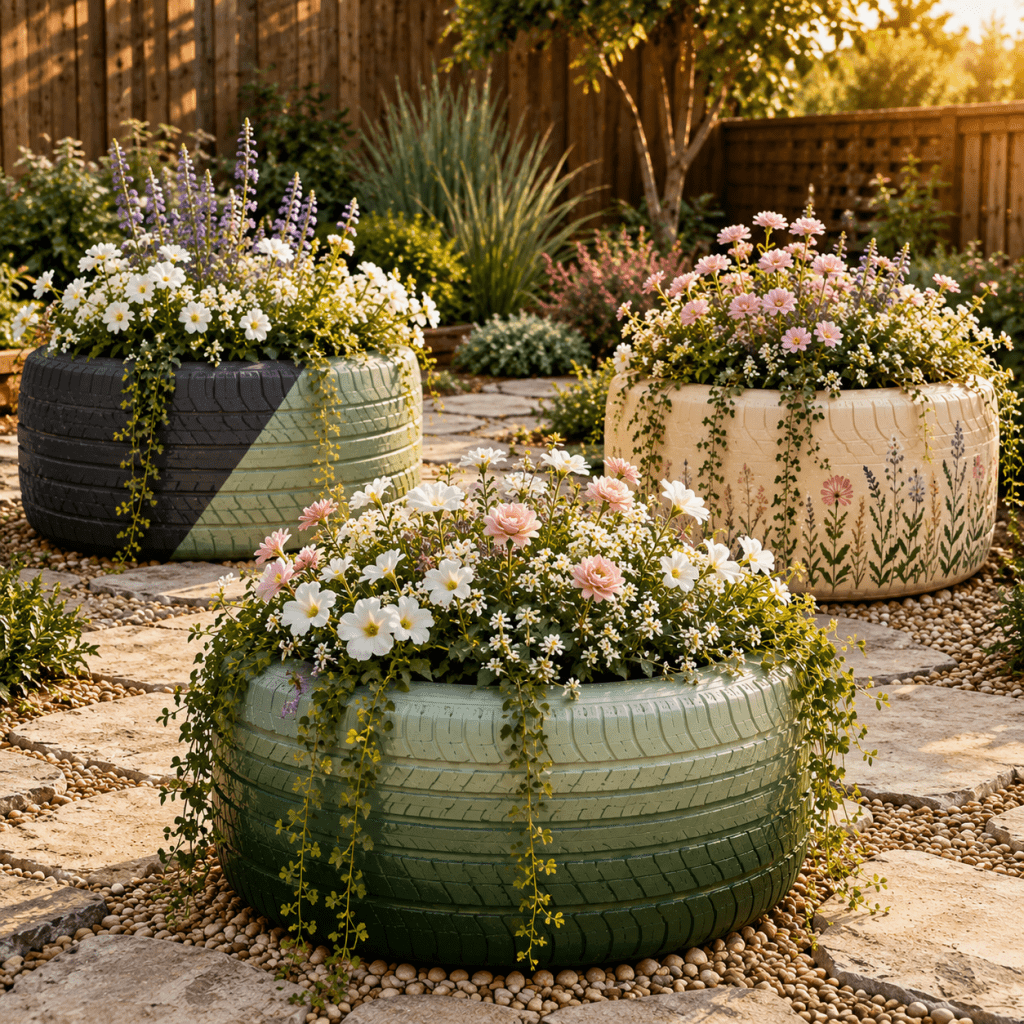
The first creates an elegant botanical ombré effect using several related natural shades. The second uses restrained color blocking to give an old tire a cleaner contemporary identity. The third turns the tire into a hand-painted botanical garden feature with delicate floral artwork.
Here are the 3 best Tire Planter Painting Ideas for transforming old tires into beautiful decorative garden planters.
| Rank | Tire Planter Painting Idea | Main Visual Effect | Best For |
|---|---|---|---|
| 🥇 | Botanical Ombré Tire Planter | Sophisticated tonal color transition | Stylish flower gardens and patios |
| 🥈 | Modern Two Tone Tire Planter | Clean architectural color blocking | Contemporary gardens |
| 🥉 | Hand Painted Wildflower Tire Planter | Artistic botanical character | Cottage and creative gardens |
Important Note: Tire surfaces can be difficult to coat because they flex and may contain dirt, oils, or residues. Clean and prepare the surface carefully and use exterior products whose manufacturers state that they are appropriate for the material and intended outdoor conditions. Follow all product instructions for preparation, ventilation, drying, recoating, and disposal.
🥇 Platz 1 Botanical Ombré Tire Planter
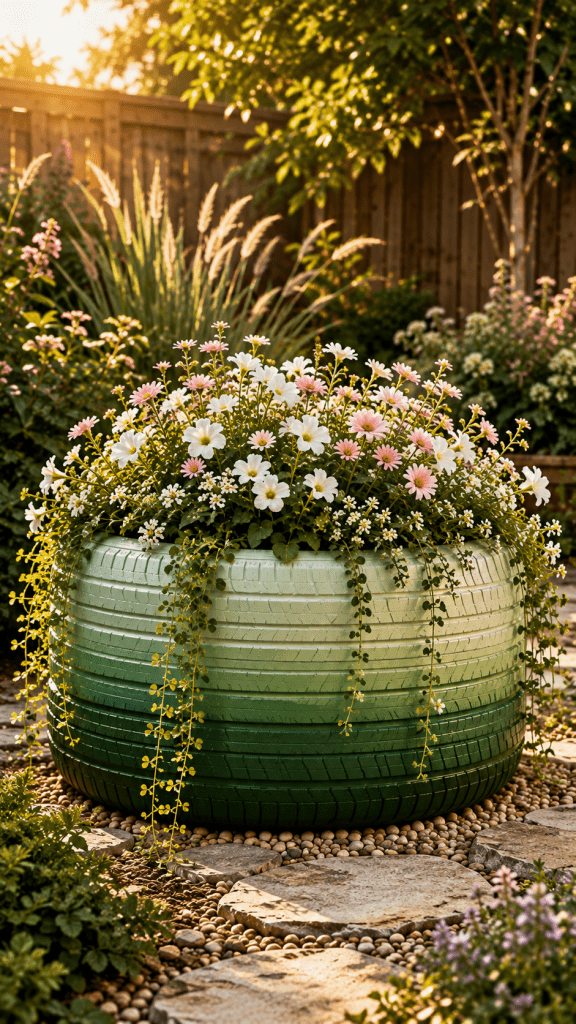
An ombré planter uses several closely related colors that gradually transition from one tone into another.
On an old tire, this can create a surprisingly sophisticated effect.
The Botanical Ombré Tire Planter takes inspiration directly from the garden rather than using artificial-looking rainbow colors.
Imagine a tire transitioning from deep forest green near the bottom through muted sage and into a soft gray-green around the upper edge.
Filled with white and pale pink flowers, the tire feels connected to the foliage around it.
The paint is noticeable, but it does not compete with the plants.
Choose Colors From Nature
The secret is using shades that already make sense outdoors.
Beautiful botanical combinations include:
forest green → sage → soft eucalyptus
or:
deep terracotta → clay → warm sand
or:
charcoal → warm gray → pale stone
or:
dusty blue → blue-gray → muted cream
Each palette creates a different personality.
The green combination feels botanical.
Terracotta feels warm and Mediterranean.
Gray feels contemporary.
Dusty blue feels romantic and cottage inspired.
Keep the Transition Soft
The colors should appear related rather than forming hard horizontal stripes.
A gradual transition creates the ombré effect.
Visually, the tire should feel as though one shade slowly becomes another.
This is especially effective on the curved sidewall because the changing light already creates natural variations in tone.
The color transition can enhance that dimensionality.
Let the Tread Remain Visible
Do not try to make the tire look like perfectly smooth ceramic.
Its texture is part of the transformation.
Visible tread and molded details remind the viewer that the planter began as a recycled tire.
Paint can highlight that texture beautifully.
Subtle shadows between the tread blocks add depth and prevent the finished planter from looking artificial.
Use the Darkest Color Near the Bottom
A darker lower section can visually anchor the planter.
It also creates a natural progression toward lighter colors above.
For example:
deep olive at the bottom
becoming
sage in the middle
and finally
soft eucalyptus near the upper edge.
The planter feels lighter as the eye moves upward toward the flowers.
Match Flowers to the Paint
The planting palette should complement rather than fight the painted surface.
With green ombré, consider:
white + blush pink + deep green foliage
With terracotta ombré:
cream + apricot + muted yellow
With gray ombré:
white + lavender + silver foliage
With dusty blue:
white + pale pink + soft green
This creates one complete color composition.
Keep the Surrounding Garden Restrained
An ombré tire is already decorative.
Give it a calm setting.
Pale gravel works beautifully.
Natural timber creates warmth.
Limestone or weathered stone adds texture.
Green foliage provides a neutral botanical background.
Avoid surrounding the planter with too many additional painted decorations.
Use One Ombré Tire as a Statement
This idea works especially well with one large tire planter.
Place it prominently within a flower bed or patio corner.
Allow enough empty space around it for the color transition to remain visible.
If every tire in the garden uses a dramatic ombré treatment, the effect can become repetitive.
One hero planter can have more impact.
Create a Tonal Set
If you want several tires, another approach is to paint each tire a different shade from the same ombré family.
For example:
Tire 1 = deep sage
Tire 2 = medium sage
Tire 3 = pale eucalyptus
Positioned together, the three planters create a tonal progression without every tire needing multiple colors.
This can look particularly polished.
Why This Idea Takes First Place
The Botanical Ombré Tire Planter earns 🥇 because it celebrates paint without making the garden feel excessively colorful.
It transforms the industrial rubber while still respecting the natural palette of the landscape.
The result can feel decorative, botanical, and surprisingly refined.
🥈 Platz 2 Modern Two Tone Tire Planter
The second idea takes a much more graphic approach.
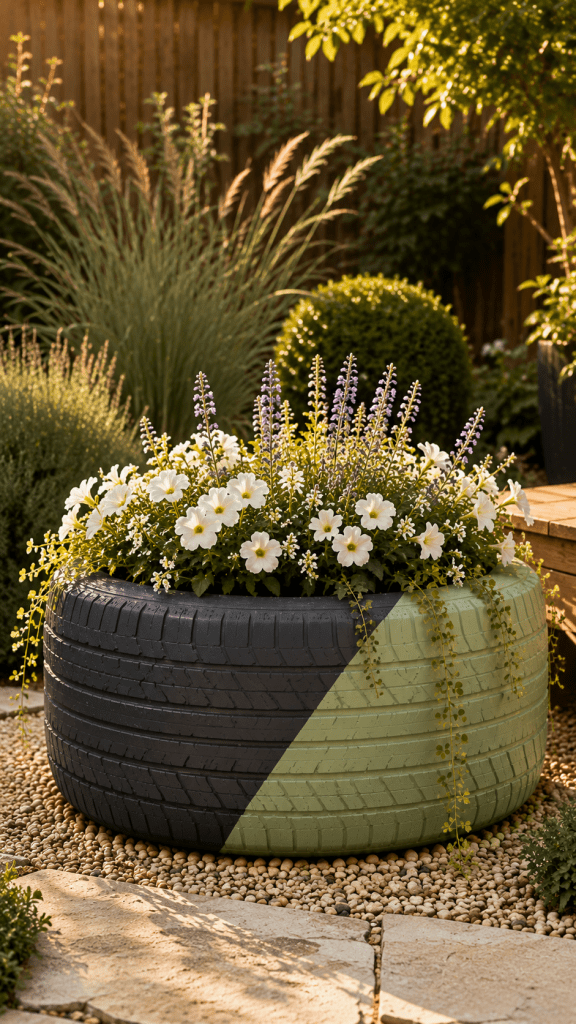
A Modern Two Tone Tire Planter divides the tire into two carefully selected color areas.
Instead of floral decoration or gradual blending, the design relies on clean contrast.
This can give an old tire a much more architectural appearance.
Choose Two Colors That Belong Together
The strongest combinations usually involve one neutral and one botanical or earthy shade.
For example:
charcoal + sage
warm white + terracotta
stone gray + dusty blue
deep olive + warm beige
muted black + clay
Avoid choosing two colors simply because they are both bright.
The combination should relate to the garden.
Decide Where the Color Division Happens
The division does not necessarily need to run horizontally through the center.
A diagonal split can create more movement.
One color might occupy approximately two-thirds of the visible surface while the second creates a smaller accent area.
Another possibility is keeping the sidewall one color and emphasizing selected tread areas with another.
The design should remain simple enough to read from a distance.
Use Asymmetry for a Contemporary Look
A perfectly equal 50/50 split can work, but an asymmetrical division often feels more designed.
Imagine a warm gray tire with one broad muted-sage section wrapping diagonally across the surface.
The result feels graphic without becoming overly decorative.
This is particularly effective in contemporary gardens.
Make the Edge Intentional
Color blocking depends on clean boundaries.
A messy transition can make the planter look unfinished.
Careful surface preparation and masking are therefore important.
Follow the instructions for the coating products you choose, including appropriate drying or recoating times.
The cleaner the division, the stronger the graphic effect.
Coordinate With Architecture
This concept works beautifully when one paint color repeats something from the house or patio.
For example:
a charcoal window frame can inspire the dark section.
A natural-oak fence can pair with warm beige.
Terracotta patio accessories can inspire the accent color.
This creates a visual relationship between the recycled planter and the surrounding architecture.
Use Flowers as the Third Color
Think of the plants as part of the palette.
If the tire uses:
charcoal + sage
add:
white flowers.
Now the complete composition contains three major colors.
If the tire uses:
cream + terracotta
try:
soft apricot flowers.
The flowers complete the design rather than functioning as an unrelated addition.
Use Similar Two Tone Designs Across Several Tires
This concept can work beautifully as a collection.
The tires do not have to be identical.
One could be mostly sage with a charcoal accent.
Another could be mostly charcoal with sage.
A third might use a balanced combination.
Because the same two colors repeat, the collection remains coherent.
Best Setting for This Idea
The Modern Two Tone Tire Planter works especially well:
- beside contemporary patios,
- against natural timber fences,
- near minimalist garden furniture,
- along clean gravel areas,
- beside modern garden sheds,
- or within structured flower beds.
Simple surroundings allow the graphic paint treatment to stand out.
Why It Takes Second Place
The Modern Two Tone Tire Planter earns 🥈 because it can make recycled rubber feel much cleaner and more architectural.
It is colorful without being childish.
It is decorative without requiring detailed artwork.
And it is easy to coordinate with the colors already present in the backyard.
🥉 Platz 3 Hand Painted Wildflower Tire Planter
The third idea embraces the tire as an artistic surface.
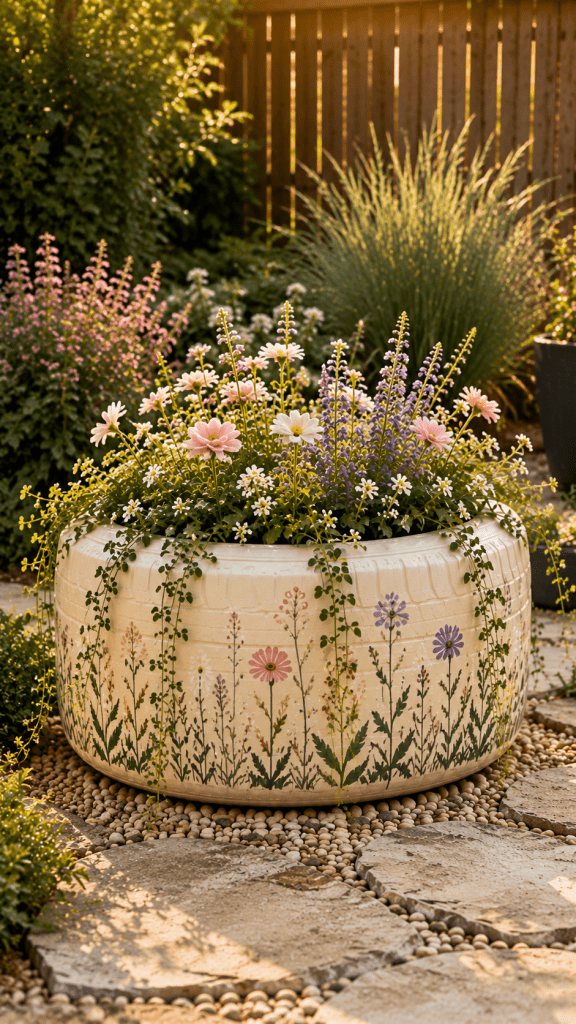
A Hand Painted Wildflower Tire Planter uses botanical illustrations—small flowers, leaves, stems, and delicate vines—to transform the tire into a decorative garden object.
This is the most expressive concept of the three.
But restraint remains important.
The goal is not to cover every centimeter with decoration.
The best botanical tire planter uses enough empty background to let the painted details breathe.
Start With a Muted Base Color
Before adding botanical artwork, establish a calm background.
Excellent base colors include:
- warm cream,
- muted sage,
- dusty blue,
- soft terracotta,
- warm gray,
- or deep charcoal.
The base determines the overall personality.
Cream creates a bright romantic planter.
Sage feels naturally botanical.
Dusty blue has cottage character.
Charcoal creates dramatic contrast with pale floral artwork.
Choose a Limited Botanical Palette
Avoid painting every flower in a different color.
Instead, select a small family.
For example:
white + blush pink + muted green
or:
cream + lavender + sage
or:
apricot + warm white + olive
This keeps the artwork cohesive.
Let the Design Follow the Tire Shape
The tire is circular.
Use that geometry.
Paint delicate stems that curve around the sidewall.
Allow a small vine to follow part of the circumference.
Position flowers so they appear to grow organically across the surface.
The artwork should respond to the object rather than look like a rectangular picture transferred onto it.
Leave Plenty of Empty Space
This is essential.
A few carefully placed flowers can look much more sophisticated than an entire surface filled with motifs.
Imagine one botanical cluster beginning near the lower side.
A thin stem travels upward.
Several leaves branch outward.
Two or three flowers create the main focal detail.
The rest of the painted tire remains visible.
That negative space gives the artwork elegance.
Repeat the Real Flowers in the Painted Design
One of the most charming techniques is connecting the illustration to the actual planting.
If the tire contains lavender-colored flowers, include small lavender-inspired motifs in the painted design.
If the planter contains white daisylike blooms, echo that visual language on the sidewall.
The real flowers appear to continue into the painted surface.
Keep the Artwork Botanical Rather Than Cartoonish
For a sophisticated garden aesthetic, use delicate shapes.
Fine stems.
Simple leaves.
Small flower heads.
Subtle color variation.
The artwork can still be handmade and imperfect.
In fact, slight variation often adds character.
But keeping the botanical forms restrained helps the planter fit naturally into a mature garden.
Place It Where the Artwork Can Be Seen
Do not hide a hand-painted tire beneath dense groundcover.
This concept deserves a more visible position.
A patio edge can work.
So can a gravel garden.
Place it beside a simple fence or near an entrance.
The viewer should be able to appreciate both the painted details and the flowers growing above them.
Use Only a Few Artistic Tires
If every tire receives a different elaborate illustration, the garden can begin to feel like an outdoor craft exhibition.
One or two artistic statement planters are usually enough.
Other tire planters can remain neutral.
This creates hierarchy.
Why It Takes Third Place
The Hand Painted Wildflower Tire Planter earns 🥉 because it offers the most personality.
It turns the recycled material into something handmade and individual.
The idea is particularly strong in cottage gardens, creative patios, and spaces where handcrafted details already belong.
How to Choose a Tire Planter Paint Color
Start with the garden rather than the paint chart.
Look at:
the house exterior
fence
patio
outdoor furniture
existing flower colors
stone and gravel
surrounding foliage
Then choose a color that repeats or complements something already present.
This is one of the easiest ways to make a painted tire look intentional.
The Best Tire Planter Color Families
Different color families create different moods.
| Color Family | Overall Effect | Pairs Beautifully With |
|---|---|---|
| Sage and olive | Botanical and calm | White, pink, timber |
| Charcoal and gray | Modern and understated | White, lavender, stone |
| Terracotta and clay | Warm and earthy | Cream, apricot, limestone |
| Dusty blue | Romantic and cottage inspired | White, pale pink, oak |
| Cream and beige | Soft and neutral | Green foliage, lavender |
| Deep green | Natural and dramatic | White flowers, gravel |
The best color is not necessarily the most noticeable one.
Often, the strongest choice is the shade that connects the planter to its surroundings.
Matte Satin or Glossy Finish
Finish changes the visual character almost as much as color.
A matte or low-sheen appearance can make the tire feel softer and more natural.
A satin-like finish can provide a slightly cleaner decorative look.
A highly glossy finish creates stronger reflections and can emphasize every curve and surface irregularity.
The actual available finish will depend on the coating product suitable for the material.
For garden styling, restrained sheen often integrates more naturally with stone, timber, foliage, and flowers.
How to Prepare a Tire Before Painting
Preparation matters because tires are exposed to road dirt, grime, and residues.
The general objective is to create a surface that is clean, dry, and compatible with the coating system you intend to use.
Follow the paint manufacturer’s specific instructions rather than assuming every product requires the same process.
A typical project may involve:
- Cleaning the tire thoroughly.
- Removing loose dirt and contaminants.
- Allowing the tire to dry fully.
- Completing any surface preparation specified by the coating manufacturer.
- Applying compatible primer if the chosen system requires it.
- Applying the recommended number of paint coats.
- Allowing appropriate curing time before placing the planter outdoors or filling it.
Product directions should take priority because coating systems vary.
Should You Paint the Tire Tread
You can.
Painting the tread creates a more complete color transformation.
It can also emphasize the tire’s original texture.
For a cleaner planter, use the same color across the tread and sidewall.
For a more graphic design, the tread can become a subtle secondary area.
However, avoid adding so many different colors that the tire begins to look visually fragmented.
Should You Paint Inside the Tire
Usually, the most visually important surfaces are those that remain visible after planting.
There is little aesthetic benefit in spending significant effort coating areas that will be completely hidden.
If a coating is used anywhere that may interact with planting materials, follow the product manufacturer’s guidance regarding suitability and intended use.
Focus decorative effort on the visible exterior.
One Painted Tire or Several
Both approaches can work.
One tire can become a statement planter.
Several tires can create a coordinated collection.
If using several, establish a system.
For example:
same color + different flowers
or:
three related tire shades + same flower palette
or:
same two-tone design + varied planting
Consistency prevents the arrangement from looking random.
Three-Tire Color Combination Idea
A sophisticated three-planter collection might use:
Tire 1 — deep sage
Tire 2 — medium botanical green
Tire 3 — pale eucalyptus
Fill all three with combinations of white, blush, and green.
The planters are different but clearly belong together.
Another option is:
charcoal + warm gray + pale stone
with white and lavender flowers.
This creates a much more restrained contemporary garden.
How to Match Painted Tires With Flowers
Think in terms of contrast and harmony.
A dark tire makes pale flowers stand out.
A muted tire allows brighter flowers to dominate.
A warm terracotta planter works naturally with cream and apricot.
Sage supports pink and white beautifully.
Dusty blue pairs naturally with pale pink and green.
You do not need the tire and flowers to match exactly.
They simply need to belong to the same visual story.
Painting Tires for Cottage Gardens
Cottage gardens benefit from softness.
Try:
- dusty blue,
- sage,
- warm cream,
- muted lavender-gray,
- or weathered terracotta.
Use loose flowers and trailing foliage.
A small botanical illustration can work particularly well.
Avoid overly sharp graphic patterns if the surrounding garden is very informal.
Painting Tires for Modern Gardens
Modern spaces benefit from cleaner palettes.
Consider:
charcoal + white
charcoal + sage
warm gray + black
stone + olive
Keep decorative motifs minimal.
Use strong foliage forms and restrained flowers.
A two-tone tire can work especially well here.
Painting Tires for Rustic Gardens
Earthy colors usually integrate best.
Try:
- deep brown,
- muted terracotta,
- olive,
- warm gray,
- or charcoal.
Pair them with natural timber, stone, gravel, and abundant foliage.
The tire should feel weathered into the landscape rather than visually separate from it.
How to Make Painted Tire Planters Look More Professional
The difference often comes down to restraint and consistency.
Use Fewer Colors
Two or three are usually enough.
Prepare the Surface Carefully
A beautiful color cannot compensate for poor coating adhesion.
Keep Painted Edges Intentional
Especially with color blocking.
Coordinate With the Flowers
Treat plants and paint as one palette.
Repeat Colors Elsewhere
Connect the tire to furniture, pots, flowers, or architectural details.
Leave Some Visual Breathing Room
Do not surround an artistic planter with too many competing decorations.
Common Tire Planter Painting Mistakes
One of the most common mistakes is choosing colors without considering the surrounding garden.
Another is putting many unrelated bright colors on several tires.
Poor preparation can also lead to disappointing coating performance.
Painting elaborate details on every tire may overwhelm the landscape.
Another mistake is choosing plants after the painting is finished without considering how the flower colors interact with the planter.
The tire and plants should be designed together.
Should All Tire Planters Match
Not exactly.
They should coordinate.
There is an important difference.
Three identical planters can look very formal.
Three completely unrelated planters can look chaotic.
A better approach is often controlled variation.
For example, use three shades from one color family.
Or use the same base color with slightly different botanical details.
Or reverse the proportions of the same two-tone palette.
The eye recognizes the relationship without seeing exact duplication.
How to Make a Painted Tire Blend Into the Landscape
Choose colors already found nearby.
Use trailing plants to soften the edges.
Place the tire near conventional flower beds.
Repeat its flowers elsewhere.
Use gravel, timber, or stone around the base.
Avoid isolating it in the middle of empty lawn.
Integration makes even a visibly painted tire feel more intentional.
How to Make a Painted Tire the Focal Point
Do the opposite.
Give it space.
Use a stronger color treatment.
Keep the surrounding plants quieter.
Position it against a simple background.
Use one spectacular planting combination.
A focal planter should have visual hierarchy.
Everything around it should support rather than compete with it.
Protecting the Painted Finish Outdoors
Outdoor planters are exposed to sunlight, moisture, temperature changes, dirt, and physical wear.
Choose a coating system intended for appropriate exterior use and compatible with the material.
Follow manufacturer guidance for curing and maintenance.
Expect that any outdoor painted surface may eventually require cleaning or refinishing.
A planter that ages gracefully is often more realistic than expecting a permanently flawless finish.
Tire Planter Painting and Garden Safety
Decoration should never interfere with function.
Keep drainage working correctly.
Do not allow paint or modifications to create areas that collect standing water.
Place planters on stable surfaces.
If tires are stacked, ensure the arrangement remains secure after soil and water add weight.
And consider how hot a painted tire may become in strong direct sunlight when choosing both color and plants.
Which Tire Planter Painting Idea Is Best
Choose the 🥇 Botanical Ombré Tire Planter if you want the most sophisticated color transformation.
Its gradual natural tones can make an old tire feel much softer while still allowing the original texture to remain visible.
Choose the 🥈 Modern Two Tone Tire Planter if you prefer clean lines and contemporary garden styling.
It works especially well around patios, timber fences, gravel, and modern outdoor furniture.
Choose the 🥉 Hand Painted Wildflower Tire Planter if you want something more artistic and personal.
Its botanical details can turn a simple recycled planter into a charming handmade focal point.
Final Thoughts on Tire Planter Painting Ideas
The best Tire Planter Painting Ideas are not necessarily the brightest.
They are the ones that understand the garden around them.
The 🥇 Botanical Ombré Tire Planter uses gradual nature-inspired color to transform rubber without overwhelming the flowers.
The 🥈 Modern Two Tone Tire Planter uses clean color blocking to give an old tire a more architectural and contemporary identity.
And the 🥉 Hand Painted Wildflower Tire Planter celebrates creativity with delicate botanical artwork that connects the planter visually to the flowers growing inside it.
Whatever style you choose, treat the paint, flowers, foliage, and surrounding landscape as one composition.
Choose colors deliberately.
Prepare the surface carefully.
Keep the palette controlled.
Repeat visual elements.
Allow the original tire texture to contribute character.
And avoid adding decoration simply because there is empty space available.
With thoughtful painting and planting, an old black tire can become something completely different:
a colorful garden feature that looks intentional, creative, and genuinely beautiful.