Imagine stepping into your backyard on a beautiful summer morning and discovering dozens of colorful butterflies floating gracefully above vibrant flowers, delicate ornamental grasses, and sunlit garden pathways. The butterfly garden transforms an ordinary outdoor space into a breathtaking living sanctuary where natural beauty, thoughtful landscaping, and wildlife-friendly planting come together. 🦋🌸 Whether you have a spacious backyard, a modest suburban garden, or a small sunny corner, creating a butterfly paradise can bring extraordinary charm and ecological value to your home.
The most beautiful butterfly gardens are more than collections of colorful flowers. They are carefully designed outdoor environments that provide nectar for adult butterflies, host plants for caterpillars, protected resting areas, and flowering plants throughout the growing season. When these essential elements are combined with attractive landscape architecture, the result is a garden that feels both luxurious and wonderfully alive.
Creating this enchanting atmosphere does not require an enormous budget or professional landscaping experience. The secret lies in selecting the right garden concept, arranging plants in visually appealing layers, and understanding how butterflies interact with their surroundings. A strategically designed butterfly garden can become a magnificent focal point while supporting local biodiversity.
Three particularly inspiring approaches stand out for homeowners who want something more distinctive than traditional flower beds. From romantic curved flower borders to sophisticated modern garden islands and intimate butterfly-viewing retreats, these ideas offer different ways to create an outdoor setting filled with movement, color, and natural elegance.
🦋 Why The Butterfly Garden Is One of the Most Beautiful Backyard Landscaping Ideas
A butterfly garden offers a special kind of beauty that traditional landscaping cannot fully reproduce. Instead of relying exclusively on decorative objects, architectural structures, or perfectly trimmed shrubs, it introduces living movement into the landscape. Every butterfly visiting a flower adds a changing detail to the garden, making the experience different from one day to the next.
The appeal becomes especially powerful when colorful flowers are arranged in generous clusters. Purple blossoms, golden-yellow flowers, soft pink petals, and delicate white accents create a naturally harmonious palette. Against a background of fresh green foliage, these colors establish an inviting atmosphere that looks magnificent in morning sunlight.
Butterflies are particularly interesting garden visitors because their presence encourages closer observation of nature. Their feeding habits, preferred flowers, and delicate interactions with plants turn an ordinary backyard into a place of discovery.
Beyond visual beauty, butterfly gardens can support local ecosystems. Flowering plants provide nectar for butterflies and other pollinators, while suitable host plants allow caterpillars to develop. Native vegetation may also benefit other insects and wildlife adapted to the local environment.
According to the University of Florida IFAS Extension guide to butterfly gardens, combining nectar-producing plants, caterpillar host plants, and a variety of vegetation heights creates a more complete butterfly habitat.
For homeowners interested in beautiful yet environmentally responsible landscaping, this approach offers an attractive balance between decorative design and ecological function. 🌿
🌸 The Butterfly Garden Design Essentials for a Stunning Living Landscape
Before selecting a particular garden style, understanding the basic elements of a successful butterfly habitat makes the entire project easier.
Sunlight is one of the most important considerations. Many butterflies are more active in warm, sunny locations because they depend on external warmth to regulate their body temperature. A garden area receiving approximately six or more hours of direct sunlight is often an excellent starting point, although the needs of individual plants and butterfly species vary.
Protection from strong wind is also valuable. Butterflies benefit from sheltered areas where they can feed and rest without constantly battling air movement. Nearby shrubs, strategically positioned fences, or layered vegetation can provide this protection without making the garden feel enclosed.
Plant diversity deserves equal attention. A garden filled with flowers may attract adult butterflies, but it will not necessarily support their complete life cycle. Caterpillars frequently depend on particular plant species, making host plants essential for a genuinely butterfly-friendly landscape.
Finally, an effective design should provide flowers across different parts of the growing season. Combining early-, mid-, and late-season bloomers helps extend the period during which nectar is available.
Choosing the Best Plants for The Butterfly Garden
Different flowers perform different functions in a butterfly garden. Some provide abundant nectar, others serve as caterpillar host plants, and some contribute mainly to the visual composition.
The following table highlights popular choices for butterfly-friendly gardens in suitable parts of North America.
| Plant | Main Garden Benefit | Typical Visual Appeal | Best Placement |
|---|---|---|---|
| Purple coneflower | Nectar for adult butterflies | Pink-purple flowers | Middle flower borders |
| Black-eyed Susan | Nectar and seasonal color | Golden-yellow blossoms | Sunny flower clusters |
| Blazing star | Nectar-rich flower spikes | Tall purple flowers | Vertical accents |
| Native milkweed | Monarch caterpillar host and nectar | Pink, orange, or white flowers, depending on species | Sunny habitat planting |
| Asters | Late-season nectar | Purple, blue, pink, or white blooms | Back and middle borders |
| Goldenrod | Late-season nectar | Vibrant golden flower clusters | Naturalistic planting groups |
| Zinnias | Accessible nectar in suitable varieties | Bright multicolored flowers | Front and middle flower beds |
| Dill and parsley | Host plants for certain swallowtails | Delicate green foliage | Dedicated caterpillar areas |
| Joe-Pye weed | Nectar and structural height | Dusty pink flower clusters | Rear borders in moist soil |
Plant selection should always reflect local climate, soil conditions, and regional butterfly species. Some plants listed above are native only to certain North American regions, and cultivated or introduced species may behave differently in other locations.
A thoughtful planting combination creates visual interest at several heights. Low flowers soften the edge of paths, medium-height perennials establish a colorful middle layer, and taller flowering plants create a rich background.
This layered approach produces the natural depth associated with professionally designed gardens while making it easier for butterflies to discover flowers throughout the landscape.
🥇 Top 1 The Butterfly Garden With Romantic Curved Flower Pathways and Colorful Nectar Borders
The first and perhaps most enchanting design transforms an ordinary backyard into a romantic butterfly paradise using gracefully curved pathways surrounded by abundant flowering plants.
Rather than organizing everything into rigid rectangular beds, this concept introduces gentle movement through sweeping flower borders, natural curves, and softly layered vegetation. The resulting landscape feels inviting, artistic, and beautifully integrated with nature.
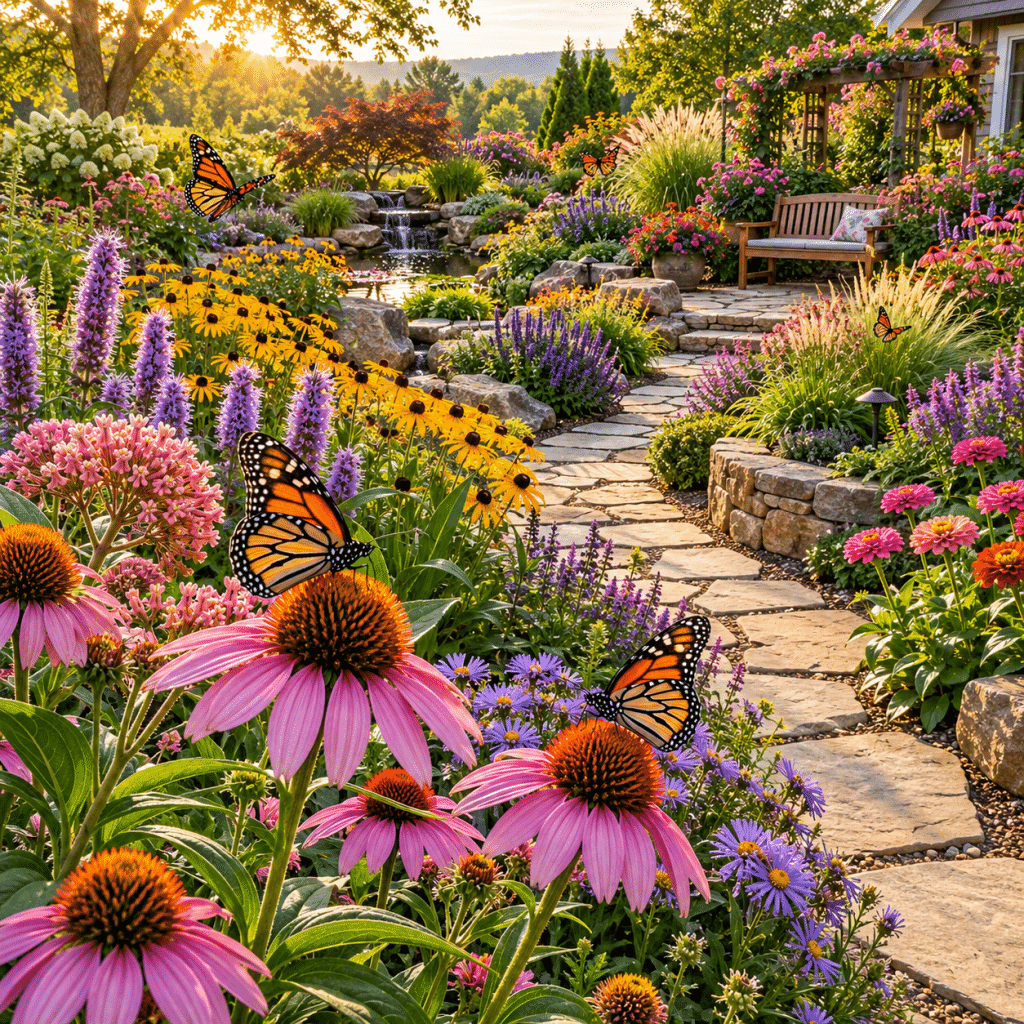
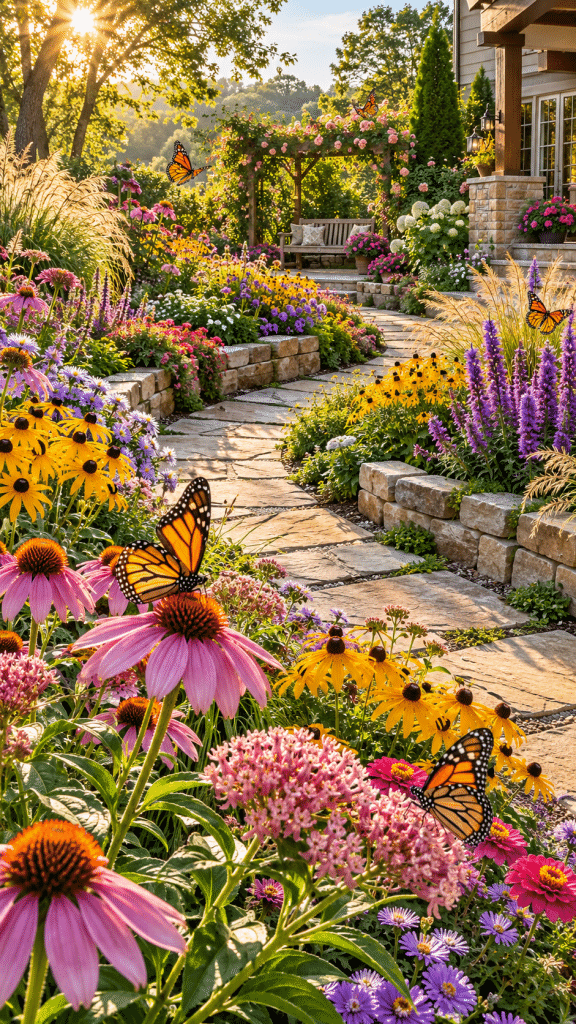
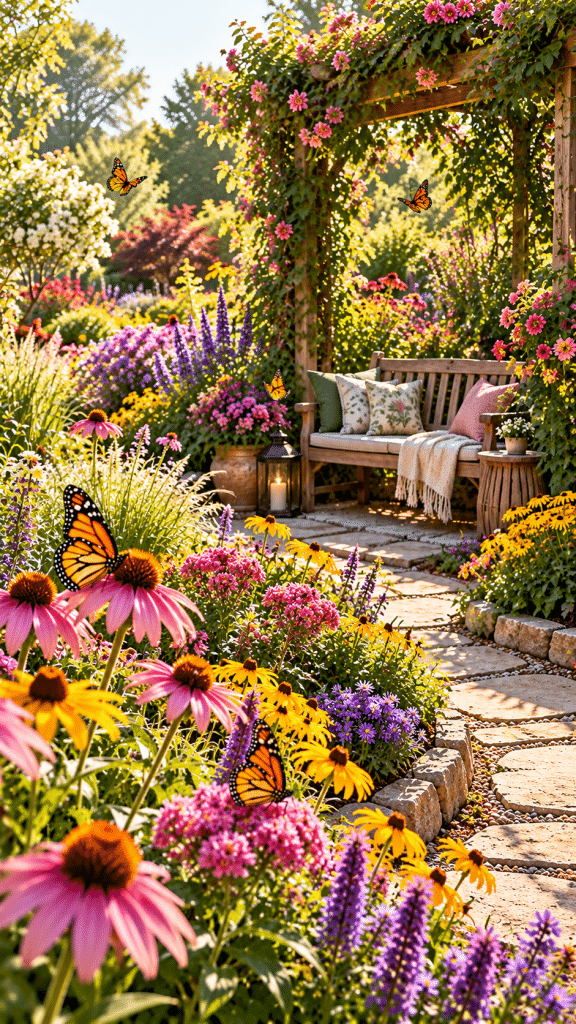
Imagine a narrow stepping-stone pathway winding through generous clusters of purple coneflowers, golden black-eyed Susans, pink asters, and bright summer zinnias. On either side, delicate foliage spills toward the path while butterflies move between overlapping flower groups.
Soft morning sunlight illuminates individual petals, creating a garden that feels almost storybook-like without appearing overly formal or artificial.
🌺 Creating Elegant Curved Borders for The Butterfly Garden
The foundation of this design is a beautifully proportioned curved flower border.
Begin by identifying a sunny section of the backyard where a pathway can move naturally through the space. Instead of drawing perfectly symmetrical curves, create a gentle S-shaped route that encourages a relaxed walk.
The path does not need to extend across the entire yard. Even a short curved walkway surrounded by flowering plants can create an impressive visual transformation.
Natural stepping stones, pale gravel, or compacted permeable pathways complement the softness of the garden. Their understated textures allow the colorful flowers to remain the main attraction.
Along the pathway, arrange plants in generous drifts rather than scattering individual specimens randomly. For example, a broad grouping of purple coneflowers can transition into a sweeping cluster of yellow black-eyed Susans, followed by a softer collection of pale pink blossoms.
These repeated flower groupings help create visual harmony. They also make nectar sources easier for butterflies to locate, especially when multiple flowers of the same species grow closely together.
For an elegant appearance, keep the lowest flowers near the pathway and place taller plants farther toward the back. This arrangement prevents the border from feeling crowded and preserves attractive views through the garden.
🌿 Building a Romantic Layered Flower Composition
The secret to making a curved butterfly border look luxurious is creating depth without losing its natural character.
Start with a front layer of relatively compact flowers. Low-growing native flowering plants, appropriately sized zinnias, and smaller perennial varieties can soften the pathway edges. Their delicate forms establish a welcoming foreground.
The middle layer should provide the strongest concentration of color. Purple coneflowers, bee balm, and suitable native flowering perennials work beautifully here, creating clusters that catch the eye from across the garden.
Behind them, taller asters, blazing stars, or Joe-Pye weed can provide structure, depending on the region and soil moisture.
Allow the flower groups to overlap naturally, avoiding rigid lines that make the planting resemble a commercial display.
For additional texture, incorporate a few regionally native bunchgrasses. Their delicate blades create contrast with broad flower petals and move gracefully in a summer breeze.
However, grasses should serve as supporting elements rather than dominate the planting. The primary goal remains providing abundant nectar and suitable butterfly habitat.
The most memorable compositions repeat selected colors throughout the design. Purple, soft pink, golden yellow, and fresh green create a particularly appealing combination that feels vibrant yet sophisticated.
🦋 Making Curved Flower Pathways More Attractive to Butterflies
A romantic flower garden becomes significantly more valuable when beautiful planting is combined with butterfly-friendly habitat.
Begin by positioning major nectar flower clusters in locations that receive direct sunlight for much of the day. Butterflies are often particularly visible while feeding in warm, sheltered conditions.
Place suitable caterpillar host plants slightly behind the main decorative border, where they can grow naturally without compromising the overall composition.
For example, native milkweed can support monarch caterpillars within their range, while dill, parsley, or fennel may support certain swallowtail species. The exact relationships depend on local butterflies.
A small sunny patch of bare soil or carefully maintained damp sand can also provide an attractive feature for some butterflies. Certain species obtain minerals from moist ground, although not all butterflies exhibit this behavior.
Flat stones positioned near the flowers can create convenient sun-warmed resting surfaces.
These features should appear naturally integrated into the landscape rather than scattered as unrelated decorations.
Another valuable technique is staggering bloom times. Early flowering perennials can introduce the season, abundant summer blossoms can establish the main display, and asters or other suitable late bloomers can extend nectar availability.
When arranged thoughtfully, these overlapping flowering periods give the garden a changing appearance from spring through autumn.
✨ Adding Elegant Details Without Distracting From Nature
Decorative elements should enhance the garden rather than compete with its flowers and butterflies.
A narrow natural-stone pathway offers enough architectural character for this concept, especially when combined with a few weathered rocks or a discreet wooden bench.
A small bench near the end of the curved path can become a beautiful observation point. Positioned to face the sunlit flower border, it encourages quiet moments watching butterflies visit the blooms.
Natural materials such as untreated-looking wood, limestone, and muted gravel complement the flowers without overwhelming them.
Avoid filling the space with numerous ornaments, brightly painted accessories, or excessive lighting fixtures. These elements can make an otherwise beautiful planting feel cluttered.
The strongest visual impression comes from generous flower masses, graceful landscape curves, and authentic natural textures.
As the plants mature, their shapes soften the pathway edges and create an increasingly lush atmosphere.
Best for: Homeowners who love romantic gardens, colorful flower borders, natural landscaping, and picturesque backyard pathways.
🥈 Top 2 The Butterfly Garden With Modern Sculptural Flower Islands and Elegant Minimalist Landscaping
The second design offers a completely different interpretation of butterfly-friendly landscaping.
Instead of a romantic garden filled with winding borders, this concept features bold, sculptural planting islands placed within a contemporary outdoor environment.
The aesthetic combines clean architectural lines, thoughtfully selected natural materials, and generous groups of nectar-rich flowers. It is especially appealing for modern homes where a highly organized garden must complement sleek architecture.
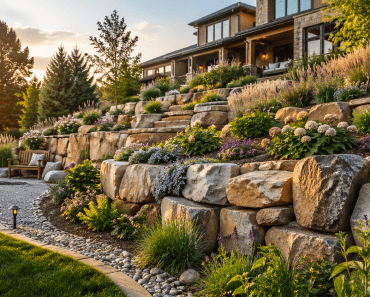
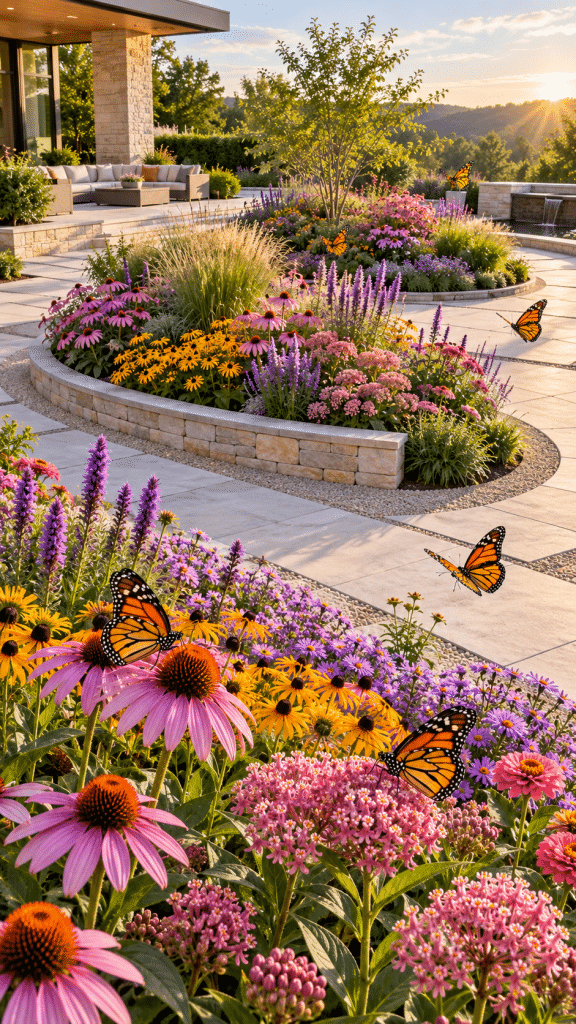
Picture a sophisticated backyard with cream-colored stone paving, warm wooden accents, and several striking flower islands shaped into flowing organic forms.
Each island contains carefully coordinated butterfly plants arranged by height, texture, and flowering season. Bright flowers rise from the greenery, introducing vibrant natural color into the otherwise restrained landscape.
Butterflies floating above the plantings bring movement and softness to the clean architectural setting. 🦋
🌼 Designing Sculptural Planting Islands for The Butterfly Garden
The distinguishing feature of this design is the use of separate yet visually connected planting islands.
Rather than covering the entire yard with flowers, establish two or three generous planting areas that act as focal points.
Organic oval or kidney-shaped forms work especially well because they contrast beautifully with the straight lines of contemporary architecture.
Their boundaries can be defined using natural stone edging, subtle metal landscape borders, or crisp transitions between garden beds and paving.
The planting islands should be large enough to accommodate meaningful flower clusters. Several tiny decorative beds scattered across a large paved surface will generally provide less visual impact and less concentrated habitat.
A particularly attractive arrangement features one large central flower island supported by two smaller plantings positioned at different distances.
This creates depth and encourages the eye to travel through the garden.
For a more cohesive design, repeat a limited collection of butterfly-friendly plant species across the islands.
Purple coneflowers, blazing stars, black-eyed Susans, and locally suitable asters can establish a strong visual language while supporting nectar-feeding butterflies.
Where milkweed is appropriate, include it as part of the planting rather than treating it as an afterthought.
The plants should have sufficient spacing and suitable soil conditions to mature naturally without unnecessary crowding.
🌿 Combining Architectural Structure With Natural Flowering Beauty
Minimalist landscaping often depends on a restrained color palette and clearly defined shapes.
However, a butterfly garden requires enough floral abundance to function as a meaningful habitat.
The solution is to organize flower colors into coordinated groups rather than reducing plant diversity excessively.
One planting island might feature purple and lavender flowering species, while another emphasizes golden yellow and warm orange.
A third island could combine pale pink flowers with soft purple accents, visually connecting the entire landscape.
Within each island, build a layered composition.
Low-growing flowering plants and neat native groundcovers can establish a clean perimeter. Medium-height perennials create the strongest flower display, while a limited number of taller flowers introduce sculptural emphasis.
Native grasses can add architectural texture, but choose varieties that remain compatible with the scale of the surrounding plants.
The result is a garden that looks intentionally designed without becoming sterile.
Natural stone, pale gravel, and carefully selected paving materials work beautifully around these islands. However, the design should preserve generous planted areas rather than replacing most of the garden with hard surfaces.
A butterfly-friendly modern garden succeeds when architecture frames nature instead of dominating it.
🦋 Creating Butterfly Corridors Between Modern Garden Islands
Although the flower islands are visually distinct, they can function as part of a connected habitat.
Arrange them close enough that butterflies can easily move between nectar sources while traveling through the backyard.
Position larger flowering groups in sunny areas and use taller shrubs or other suitable vegetation to create some shelter from prevailing winds.
For example, one island might contain early-season flowers, another might emphasize summer nectar, and the third might include flowers that bloom later in the year.
However, it is generally better for each island to contain more than one flowering season rather than leaving entire beds without blooms for long periods.
Small host-plant clusters can be integrated into individual islands or a nearby dedicated bed.
This arrangement provides feeding and breeding resources while maintaining an attractive contemporary appearance.
The inclusion of appropriately placed shrubs can also create sheltered resting spaces.
If the property already contains native flowering trees or shrubs, incorporate them into the overall habitat design where possible.
The goal is not necessarily to attract the greatest number of butterflies at once. It is to establish a consistent, healthy landscape capable of supporting different species through changing conditions.
✨ Using Premium Materials to Elevate the Design
Materials play an especially important role in a contemporary butterfly garden.
Light-colored natural stone creates an elegant background for vibrant flowers, while weathered wood introduces warmth.
Neutral paving colors such as beige, greige, charcoal, and soft limestone allow the planting islands to stand out.
A modest wooden platform or architectural bench can provide an attractive viewing location near the main flower island.
The garden should also accommodate practical maintenance. Accessible pathways make deadheading, watering, and occasional plant division easier without requiring gardeners to walk through sensitive habitat areas.
For evening ambiance, low-intensity, carefully directed lighting can illuminate pathways or seating areas. Avoid unnecessary illumination of flowering habitat, and turn decorative lights off when they are not needed, since artificial nighttime lighting can disrupt insects and other wildlife.
Avoid overly reflective decorative surfaces that compete with the natural focal points.
The finished landscape should feel clean, intentional, and sophisticated, with the butterflies and flowers supplying its most memorable movement and color.
Best for: Modern suburban homes, contemporary courtyards, minimalist landscaping, and homeowners who prefer structured garden designs with natural ecological benefits.
🥉 Top 3 The Butterfly Garden With a Cozy Butterfly Watching Retreat and Immersive Floral Sanctuary
The third concept transforms a sunny backyard corner into an intimate butterfly-watching retreat.
Unlike designs focused primarily on landscape appearance from a distance, this approach creates a garden meant to be experienced from within.
The central feature is a comfortable seating area surrounded by nectar flowers, caterpillar host plants, and protective vegetation.
Instead of looking across the lawn toward a butterfly garden, homeowners can sit quietly among the flowering plants and observe butterflies at close range.
Imagine a beautiful natural-wood bench resting on a small gravel terrace. Around it, generous clusters of flowering perennials create a colorful, softly enclosed environment.
Purple blossoms rise beside golden flowers, taller vegetation establishes a natural background, and a few sun-warmed stones add understated character.
The scene feels peaceful, personal, and exceptionally inviting. 🌸
🪴 Creating a Cozy Seating Corner Inside The Butterfly Garden
The most important design decision is the placement of the seating area.
Choose a location with a comfortable view of sunny nectar flowers while ensuring the seat itself offers suitable protection from excessive heat.
A bench positioned near the edge of the planting area often works better than placing furniture directly in the middle of the flowers.
This arrangement preserves an open flight path for butterflies and makes the retreat easier to maintain.
A small gravel terrace, permeable stone surface, or simple wooden platform provides a stable foundation.
Natural materials are especially appropriate because they blend with the surrounding plants.
For a charming cottage-inspired appearance, choose a warm-toned wooden bench with simple lines.
For a more contemporary interpretation, a minimalist teak-style seat or natural stone bench can provide a refined focal point.
Avoid oversized furniture that dominates the available garden space.
The seating area should feel intimate, leaving most of the surrounding ground available for living plants.
A narrow approach path can connect the retreat with the house or main garden walkway.
This creates a welcoming transition from everyday outdoor activities into a quieter nature-focused environment.
🌺 Surrounding the Retreat With Fragrant Flowers and Butterfly Habitat
An immersive butterfly retreat depends on strategically arranged planting.
Begin with nectar-rich flowers positioned within comfortable viewing distance of the seat.
Choose regionally appropriate flowering species that butterflies are known to visit, ideally including different flower forms and flowering seasons.
Clusters of coneflowers, asters, bee balm, and other suitable plants can establish abundant feeding opportunities.
Some of these flowers also contribute fragrance, although fragrance alone does not determine how attractive a plant will be to butterflies.
Low flowering plants near the front provide unobstructed views, while medium-height flowers create a colorful surrounding layer.
Place taller plants farther back or along the sides to create a sense of enclosure.
The retreat should remain open enough for sunlight and airflow to reach the flowering areas.
A carefully positioned shrub or small native tree can offer partial shelter, provided it does not shade out plants that need full sun.
To enhance the natural atmosphere, allow selected host plants to occupy a less intensively maintained section beside the retreat.
This creates opportunities to observe more than adult butterflies.
Visitors may notice eggs, caterpillars, or other stages of the butterfly life cycle, depending on the local species and seasonal conditions.
Such moments add educational and ecological value to a garden already designed for relaxation.
🦋 Adding a Butterfly Puddling Area and Sunny Resting Stones
Small habitat features can make the retreat more interesting without introducing elaborate structures.
One possibility is a modest butterfly puddling area.
Some butterfly species, particularly certain males, gather on moist sand or soil to obtain minerals.
To create a suitable location, use a shallow, stable container filled with clean sand and a little water. Keep the sand moist rather than allowing exposed standing water to accumulate.
Place it near a sunny flower border where it can be observed without disturbing visiting insects.
This feature should be considered optional because puddling behavior differs between species, and adding such an area does not guarantee butterfly visits.
Flat stones provide another attractive natural detail.
Position several stones in a sunny location near the flowering plants. Their surfaces can warm in sunlight, offering potential basking sites for butterflies.
Choose natural-looking materials that blend with the surrounding garden.
The placement should appear casual but intentional, as though the stones have always belonged in the landscape.
A nearby group of native shrubs or suitable dense vegetation can provide additional shelter during breezy weather.
These details enrich the garden habitat while preserving a clean, beautiful appearance.
🌿 Designing a Peaceful Nature Retreat That Changes With the Seasons
The strongest butterfly-watching retreats remain visually appealing even when butterfly activity is limited.
Seasonal planting is therefore essential.
Early flowers can introduce fresh color and help supply nectar when local butterflies begin becoming active.
Summer should feature the most abundant flowering display, with overlapping groups of perennials and annuals suited to the climate.
Later-season flowers can extend the colorful atmosphere while providing nectar for butterflies active during autumn or migration.
Seedheads, natural foliage textures, and standing plant stems can contribute visual interest beyond the flowering season.
Instead of removing every spent stem immediately, preserve selected areas of vegetation where insects may be sheltering or overwintering.
The retreat can also incorporate quiet sensory details.
The gentle movement of grasses, subtle fragrance from blooming plants, and the changing pattern of sunlight across flower petals make the space enjoyable even during moments without butterflies.
A small side table for a book or morning coffee may be enough to complete the seating arrangement.
The emphasis should remain on comfort, simplicity, and the surrounding living landscape.
Best for: Small backyards, peaceful garden corners, nature lovers, wildlife observation, and homeowners seeking a relaxing outdoor escape.
🌷 Comparing the Top 3 Butterfly Garden Ideas
Each butterfly garden style offers a different combination of beauty, structure, and experience.
| Design Feature | Romantic Curved Pathways 🥇 | Modern Flower Islands 🥈 | Cozy Butterfly Retreat 🥉 |
|---|---|---|---|
| Overall style | Romantic and naturalistic | Contemporary and structured | Intimate and relaxing |
| Main visual feature | Flowing flower borders | Sculptural planting groups | Seating surrounded by flowers |
| Best garden size | Medium to large | Small to large | Small to medium |
| Primary decorative materials | Natural stone and gravel | Stone, metal edging, and wood | Wood, gravel, and natural rock |
| Planting approach | Sweeping colorful drifts | Organized flower clusters | Layered surrounding habitat |
| Main experience | Exploring a flower pathway | Admiring modern landscape design | Watching butterflies up close |
| Maintenance considerations | Path edging and plant management | Crisp edges and accessible islands | Seating upkeep and habitat care |
The most suitable option depends on the property’s architecture, available sunlight, preferred garden style, and desired outdoor experience.
For homeowners who enjoy romantic landscaping, the curved pathway design offers exceptional visual impact.
Modern flower islands create a more architectural appearance while retaining the ecological advantages of butterfly-friendly plants.
The cozy retreat offers a more personal experience, turning gardening into an opportunity for relaxation and nature observation.
All three approaches can function as genuine butterfly habitats when they contain suitable nectar sources, caterpillar host plants, shelter, and pesticide-free growing areas.
🦋 How to Keep The Butterfly Garden Beautiful and Butterfly Friendly Throughout the Year
A thriving butterfly garden requires a slightly different maintenance philosophy from conventional ornamental landscaping.
Traditional gardens are often maintained to appear perfectly neat, with every damaged leaf removed and every insect treated as a potential problem.
Butterfly-friendly gardening takes a more balanced approach.
Some leaf damage is not only acceptable but desirable, particularly when caused by caterpillars feeding on host plants.
Instead of treating every chewed leaf as a problem, inspect plants carefully to determine whether beneficial wildlife is using them.
This change in perspective allows the garden to become a functioning habitat rather than a purely decorative display.
🌱 Watering and Soil Care for Healthy Butterfly Plants
Healthy flowering plants require appropriate soil conditions and consistent establishment care.
Before planting, identify whether the selected location has sandy, loamy, or clay-heavy soil.
Choose species adapted to those conditions whenever possible.
Many established native plants perform well with relatively little supplemental irrigation, although moisture requirements vary significantly.
New plantings usually need more frequent watering while roots develop.
Water at the soil level when practical, allowing moisture to reach the root zone without repeatedly soaking the foliage.
A suitable layer of organic mulch can help moderate soil temperature and retain moisture, but avoid piling mulch against plant crowns.
Leave selected small patches of exposed soil where appropriate, since some beneficial insects use bare ground for nesting.
Fertilization should be based on actual plant needs rather than an automatic schedule.
Excess fertilizer may encourage lush foliage at the expense of flowers in some species and can contribute to environmental runoff.
The healthiest garden is one where plants are well matched to their location.
🌸 Maintaining Continuous Flowering Without Overmanaging the Garden
A prolonged flowering season makes a butterfly garden more attractive and useful.
Select plants that naturally bloom at different times rather than expecting a single species to provide color continuously.
Some annual flowers benefit from regular deadheading, which can encourage additional flowering.
However, not every plant needs constant trimming.
Native perennials may offer ecological value after flowering through their seeds, stems, or sheltered vegetation.
Allow selected plants to retain mature stems and seedheads, especially where local wildlife uses them.
If a plant becomes too large, consider dividing or selectively pruning it at an appropriate time.
Avoid intensive trimming during periods when caterpillars or butterfly eggs may be present.
A balanced maintenance routine preserves the design while allowing the habitat to function naturally.
🐛 Protecting Caterpillars and Supporting the Complete Butterfly Life Cycle
One of the most rewarding aspects of butterfly gardening is learning to recognize the different stages of butterfly development.
Adult butterflies visit flowers for nectar, but caterpillars generally require specific host plants.
Monarch caterpillars, for example, depend on milkweed species, while different swallowtails may use plants from the carrot family or other host groups.
Providing attractive flowers without suitable host plants may encourage butterfly visits without supporting reproduction.
A carefully designed habitat includes both.
When caterpillars appear, allow them to feed whenever possible.
Their feeding may temporarily reduce the decorative appearance of certain plants, but this is part of the garden’s ecological purpose.
Avoid broad-spectrum insecticides and products intended to kill caterpillars.
Even some pest-control products marketed as organic can harm desirable butterfly larvae.
Local native-plant organizations, botanical gardens, and university extension services can help identify appropriate host plants for the butterflies in a particular region.
Important Note: 🦋 A beautiful butterfly garden is not automatically a safe butterfly habitat. Avoid using pesticides on nectar and host plants, choose locally appropriate noninvasive species, and never assume that a flower attracting adult butterflies will also support caterpillars. In particular, milkweed species should be selected for the local region and climate rather than planted indiscriminately. Protecting the entire butterfly life cycle is more important than achieving perfectly unblemished foliage.
🌼 Common Butterfly Garden Design Mistakes That Reduce Beauty and Wildlife Value
Even a beautifully planted backyard can struggle to attract butterflies when essential design considerations are overlooked.
One of the most common mistakes is selecting flowers based entirely on appearance.
Highly modified double flowers may have reduced nectar accessibility, making them less useful to butterflies than simpler flower forms.
Another mistake is using isolated flowering plants throughout a large landscape.
While individual flowers may receive visits, generous clusters often create more visible and accessible feeding areas.
Groupings also contribute to a more polished design because repeated colors and textures establish stronger visual patterns.
Insufficient sunlight can present another challenge.
Many popular butterfly plants need full sun to bloom well, and butterflies themselves are often more active in warm conditions.
A heavily shaded garden may be attractive, but it generally requires different planting strategies and may support a different collection of butterfly species.
Overcrowding can also undermine the design.
Plants need enough room to reach their mature dimensions, especially when the intention is to create layered planting.
Finally, excessive tidiness can remove valuable habitat.
Constant removal of stems, leaves, and natural vegetation may eliminate places where certain insects shelter or complete parts of their life cycle.
The goal is not neglect. It is selective, informed maintenance that respects both landscape appearance and ecological function.
✨ How to Make a Small Butterfly Garden Look Expensive on a Modest Budget
An impressive butterfly garden does not require premium stonework, oversized structures, or hundreds of plants.
In fact, some of the most beautiful designs rely on simple repetition and thoughtful placement.
Begin by selecting a limited number of compatible flowering species and purchasing enough plants to create meaningful clusters.
A coherent collection of three or four flower colors often appears more refined than a large mixture of unrelated varieties.
Use existing landscape features whenever possible.
An established pathway can be softened with flowers, an unused sunny lawn corner can become a small planting island, and a simple bench can transform a garden edge into a peaceful retreat.
Growing appropriate flowers from seed can reduce planting costs, particularly for annuals and native species that establish reliably from seed in local conditions.
Dividing suitable mature perennials also provides an economical way to expand the planting over time.
Instead of investing heavily in decorative ornaments, focus on plant health, soil preparation, and a strong overall layout.
Well-established flowers create the greatest visual impact.
Natural materials can provide inexpensive finishing touches. Simple stepping stones, reclaimed wood used safely, and locally available stone can support an elegant design without excessive spending.
For a small backyard, a compact crescent-shaped planting around a sunny seating area may be more attractive than several disconnected beds.
The key is to make the garden appear intentional.
When every plant group supports the overall composition, even a relatively small space can feel rich, colorful, and beautifully designed.
🌿 Frequently Asked Questions About The Butterfly Garden
What is the best location for a butterfly garden?
A sunny area protected from strong winds is generally an excellent location.
Many butterfly-friendly flowers grow best with approximately six or more hours of direct sunlight, although individual plant requirements differ.
The location should also have suitable soil drainage and enough space for plants to grow naturally.
A position near a patio, window, or garden seating area can make butterfly watching more enjoyable without compromising the habitat.
How many plants are needed to create a butterfly garden?
There is no universal minimum number of plants required for a butterfly garden.
A few suitable flowering plants can attract visiting butterflies, especially when placed near existing natural habitat.
However, larger clusters usually offer a more substantial nectar resource and stronger visual impact.
For a small garden, begin with several groups of regionally suitable nectar plants and include host plants for local butterfly species.
Expand the planting gradually as space and budget allow.
Can a butterfly garden work in a small backyard?
Absolutely. A butterfly garden can be designed for surprisingly limited spaces.
A compact planting bed, a sunny courtyard, or a series of large containers can provide valuable nectar sources.
Container gardens are particularly suitable when ground-level planting space is unavailable.
Choose containers large enough for healthy root growth and select plant species appropriate for their dimensions.
Where possible, include both nectar plants and host plants rather than relying exclusively on decorative flowers.
Do butterfly gardens need a pond or water fountain?
No. A pond or fountain is not necessary for a successful butterfly garden.
Certain butterflies obtain minerals from damp soil or sand, while many receive moisture through their food sources.
A small, safely maintained patch of moist sand may provide an optional habitat feature.
Traditional deep water dishes are often less practical for butterflies than shallow, stable surfaces.
The most important priorities remain appropriate flowering plants, caterpillar host plants, and a safe environment.
How long does it take for butterflies to discover a new garden?
Butterfly visits vary depending on local populations, season, weather, plant selection, and the availability of surrounding habitat.
Some gardens may receive visitors soon after flowering plants are introduced, while others take longer to develop consistent activity.
The appearance of butterflies cannot be guaranteed by planting a particular flower.
Continued habitat improvement, suitable native plants, and pesticide avoidance can increase the garden’s ecological usefulness over time.
Patience is an important part of butterfly gardening.
🌸 Final Thoughts on Creating The Butterfly Garden of Your Dreams
The butterfly garden is one of the most captivating ways to combine beautiful backyard landscaping with a deeper connection to nature. By introducing carefully selected flowers, graceful planting arrangements, and thoughtful wildlife habitat, an ordinary outdoor area can become a colorful sanctuary filled with seasonal interest and living movement.
For homeowners who love romantic landscapes, 🥇 curved flower pathways offer a breathtaking combination of natural beauty and elegant garden design. Sweeping borders, colorful nectar flowers, and gently winding paths create an atmosphere that feels both enchanting and welcoming.
Those who prefer contemporary outdoor spaces may find 🥈 sculptural flower islands especially appealing. Their clean architectural shapes provide a sophisticated framework for vibrant butterfly-friendly plants, proving that modern landscaping and ecological gardening can work beautifully together.
For a quieter and more intimate experience, 🥉 a cozy butterfly-watching retreat transforms a sunny garden corner into a peaceful destination. Comfortable seating, carefully layered flowers, and natural habitat details encourage meaningful moments observing wildlife.
Whichever design is chosen, the most successful butterfly garden begins with the same principles: abundant nectar, locally appropriate caterpillar host plants, seasonal flowering diversity, safe shelter, and minimal chemical disturbance.
With thoughtful planning and a little patience, even a modest backyard can develop into an extraordinary outdoor haven where beautiful flowers and visiting butterflies create a constantly changing natural masterpiece. 🦋🌿