Old tires can become far more than individual planters. When they are integrated into the structure of a yard, they can help define planting zones, create changes in elevation, guide movement, and add visual rhythm to otherwise ordinary outdoor spaces. That is where Tire Garden Landscaping Ideas become especially interesting.
The difference is scale.
A tire planter is usually one object.
A tire landscaping concept uses several tires as part of the overall garden composition.
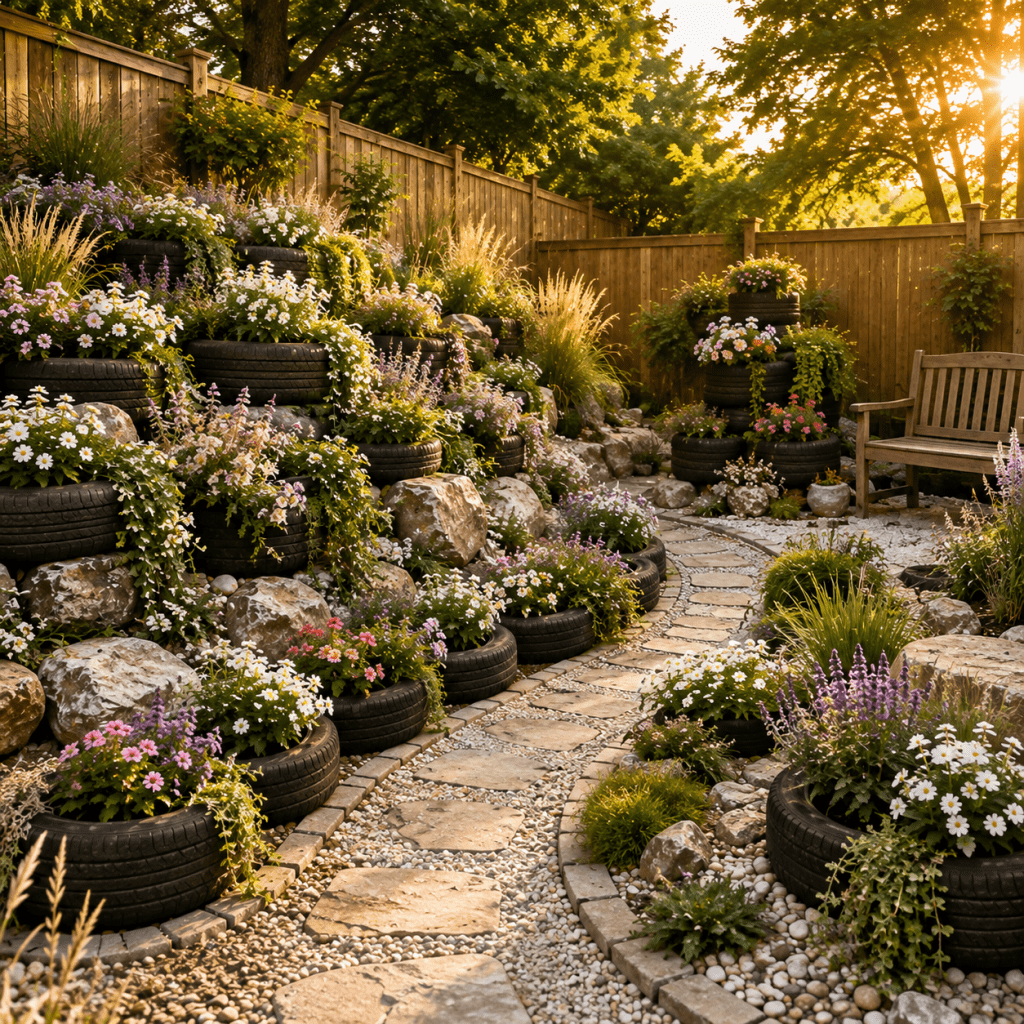
They might form a sculptural planting terrace on a slope, create a flowing border beside a pathway, or become part of a larger backyard focal zone combining flowers, gravel, timber, and layered planting.
This requires more thought than simply positioning tires around the yard.
The tires need to interact with the landscape.
Their shape should reinforce the garden layout. Their color should relate to nearby materials. The plants growing inside and around them should soften the industrial rubber. And the entire feature should have a clear purpose.
For this guide, the three concepts take very different approaches.
The first uses tires to create layered elevation and turn an ordinary slope or flat planting area into a sculptural landscape feature. The second uses partially integrated tire planters to define paths and curved garden zones. The third creates a dedicated tire garden focal area where several recycled planters are visually unified through planting, gravel, and natural materials.
Here are the 3 best Tire Garden Landscaping Ideas for giving an outdoor space a creative and surprisingly polished transformation.
| Rank | Tire Garden Landscaping Idea | Main Landscape Effect | Best For |
|---|---|---|---|
| 🥇 | Layered Tire Terrace Garden | Creates elevation and dramatic planting levels | Slopes and large backyard beds |
| 🥈 | Curved Tire Border Landscape | Defines paths and planting zones | Flower beds and garden walkways |
| 🥉 | Integrated Tire Garden Focal Zone | Creates one cohesive recycled garden feature | Backyard corners and patio areas |
Important Note: Tire landscaping features can hold considerable weight and may remain outdoors for long periods. Position them on stable ground, allow appropriate drainage, and avoid layouts that create trip hazards or unstable stacks. For ornamental landscaping, reused tires are the most straightforward application; for edible crops, purpose-made food-safe growing containers avoid uncertainty about the tire’s previous exposure and material history.
🥇 Platz 1 Layered Tire Terrace Garden
One of the most powerful ways to use old tires in landscaping is to create changes in elevation.
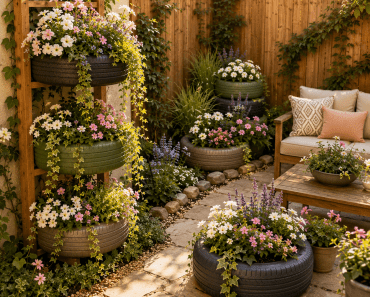
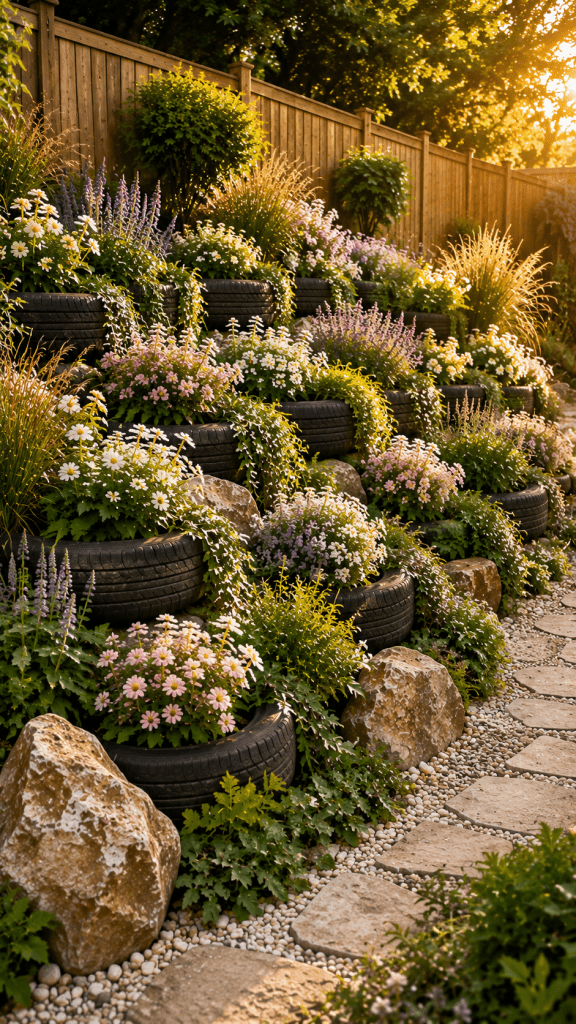
A Layered Tire Terrace Garden uses tires as repeated planting pockets arranged across a slope or built into a deliberately tiered garden bed.
Instead of seeing individual tires, the eye reads a series of planted levels.
This can transform an awkward slope, neglected backyard edge, or flat garden bed into a much more dimensional landscape.
Think in Levels Rather Than Individual Tires
Start with the overall landform.
Where should the garden rise?
Where should it become lower?
Where should the eye naturally travel?
A terrace should create progression.
Imagine a backyard slope with several planting levels.
The lowest tier contains broad groundcover and low flowers.
The middle level contains fuller flowering plants and ornamental grasses.
The upper level introduces taller foliage or a stronger focal planting.
Tires can help define these levels while also acting as individual planting pockets.
The entire composition should feel like one gradual landscape rather than a row of containers.
Follow the Shape of the Ground
The most natural terrace layouts respond to existing land contours.
If the yard slopes gently, allow the tire arrangement to follow that movement.
Do not force every tire into a perfectly straight line unless the garden style is intentionally geometric.
A slightly curved or staggered arrangement often looks more natural.
The tires might rise diagonally across the slope.
Or they may form several broad arcs.
This creates visual movement.
It also helps prevent the landscaping from feeling like a stack of identical objects.
Use Different Tire Heights Carefully
Some tires can remain almost level with the surrounding soil.
Others can sit slightly higher.
A few may create stronger raised planting pockets.
These small changes make the terrace more interesting.
Avoid creating overly tall or unstable stacks simply for dramatic effect.
The goal is layered landscaping, not maximum height.
A series of modest changes in elevation usually integrates more successfully with the garden.
Let Plants Spill Between the Levels
This is essential.
If each tire remains perfectly visible and completely isolated, the landscaping can feel mechanical.
Allow plants to soften the boundaries.
Trailing foliage can cross the tire edges.
Groundcover can spread from the surrounding soil toward the rubber.
Flowers planted directly in the landscape can visually overlap with flowers inside the tires.
This creates continuity.
As the garden matures, the tires become less dominant and the planting layers become more important.
Use Ornamental Grasses for Movement
Flowers provide color, but grasses add landscape texture.
Fine ornamental grasses can soften the strong circles of the tires.
Their narrow blades contrast beautifully with broad rubber forms.
They also introduce movement in the wind.
Place grasses selectively between planting pockets rather than filling every tire with them.
This helps break repetition.
Use Stone and Gravel as Transitional Materials
A terrace can look much more intentional when additional landscape materials are introduced.
Gravel can form narrow pathways between levels.
Natural stones can mark transitions.
Mulch can visually connect planted areas.
Limestone or weathered stone can be especially effective because their natural texture contrasts with the smooth industrial character of rubber.
The aim is not to cover the garden with hardscape.
A little texture is enough to help integrate the tires.
Keep the Tire Palette Quiet
For landscaping, the tires usually work best when they are visually secondary.
Dark charcoal can be surprisingly effective.
Muted brown, olive, warm gray, or earthy terracotta can also blend well.
Brightly painting every tire in unrelated colors may turn the landscape into a craft display rather than a cohesive garden.
If color is used, repeat it.
For example, several muted terracotta tires can connect visually with terracotta pots elsewhere in the garden.
Or charcoal tires can echo dark metal garden furniture.
Create a Strong Planting Gradient
Terraces become more convincing when the planting height changes naturally.
At the front:
low flowers + groundcovers
In the middle:
mounding flowers + foliage
Toward the rear:
ornamental grasses + taller plants
This creates depth.
It also prevents every tire from becoming equally visually important.
Some planting pockets should support the composition rather than compete for attention.
Best Locations for a Tire Terrace Garden
This idea works particularly well:
- on gentle backyard slopes,
- beside retaining areas,
- along broad garden edges,
- near terraced patios,
- in large ornamental beds,
- or anywhere the garden needs stronger vertical structure.
It can also work on relatively flat land by using modest raised planting pockets to create artificial layering.
Why This Idea Takes First Place
The Layered Tire Terrace Garden earns 🥇 because it uses tires as genuine landscape elements rather than isolated recycled containers.
It changes the shape of the garden.
It creates elevation.
It encourages planting layers.
And once foliage begins overlapping the structure, the tires can almost disappear into a much larger landscape composition.
🥈 Platz 2 Curved Tire Border Landscape
The second concept uses tires to define movement through the yard.
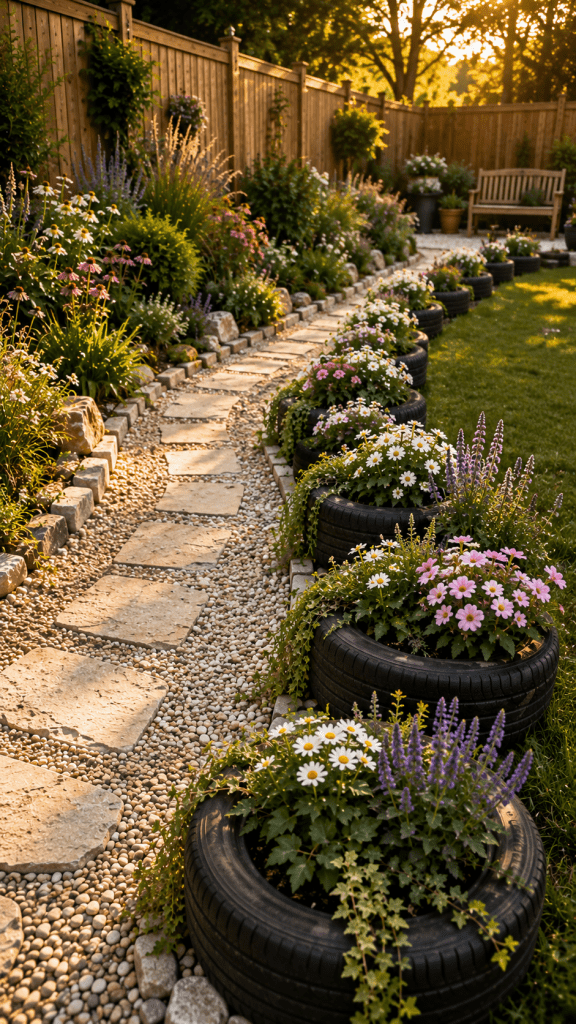
A Curved Tire Border Landscape positions tires along flower beds, pathways, or lawn edges to create a visible but planted boundary.
The important word is curved.
Straight rows can work, but a gentle curve usually feels more natural and helps the garden appear larger and more dynamic.
Use the Border to Guide the Eye
A landscape border should do more than separate grass from flowers.
It should lead the viewer through the garden.
Imagine a pathway that bends gently toward a seating area.
Low tire planters follow one side.
Their circular forms create repetition.
Flowers and foliage soften the individual tires.
The eye follows the curve naturally.
This creates visual direction.
The same technique can work along the front edge of a large flower bed.
Instead of one rigid straight line, the border can move gently in and out.
Partially Bury the Tires
One of the most effective ways to make a tire border look integrated is to reduce how much rubber remains visible.
Partially sinking the tires visually lowers them.
The border begins to behave more like raised planting pockets than a row of objects.
Surrounding mulch, gravel, or groundcover can soften the lower edge further.
This creates a more natural transition.
Avoid Identical Planting in Every Tire
Repeated containers do not require repeated planting.
If every tire contains exactly the same plant in exactly the same quantity, the border can look overly rigid.
Instead, repeat a limited selection.
For example:
Tire 1: white flowers + green foliage
Tire 2: lavender + white flowers
Tire 3: mostly foliage
Tire 4: white flowers + lavender
Tire 5: trailing greenery
The same plants recur, but the combinations vary.
This produces rhythm without monotony.
Use One Connecting Flower Color
A border needs cohesion.
Choose one flower color that appears repeatedly.
White is particularly useful because it works with almost any garden palette.
Lavender can create a calm border.
Soft pink is excellent in romantic cottage gardens.
Yellow creates a brighter, more cheerful landscape.
Whatever color you choose, repeat it often enough that the eye recognizes a pattern.
Add Plants Between the Tires
Do not leave every section between tire planters empty.
Conventional planting can visually connect them.
Low ornamental grasses can sit between tires.
Groundcovers can extend along the border.
Small flowering plants can fill gaps.
This turns a row of containers into a continuous garden edge.
Use Gravel to Reinforce the Curve
A narrow band of gravel can make the border much more defined.
For example, the tire planters can sit between a flower bed and a pale gravel path.
The repeated circular forms then contrast with the long flowing line of the walkway.
This can create a particularly attractive composition.
Keep the Border Low
This concept works best when it does not block the view across the garden.
Most tires should remain relatively low.
If you want occasional height, use plants rather than tall tire stacks.
A few upright grasses or taller flowers can introduce vertical accents without making the border feel heavy.
Coordinate Tire Color With the Landscape
Dark charcoal tires can disappear beautifully against mulch.
Warm gray can relate to stone paving.
Muted olive can connect with foliage.
Terracotta can work near clay pots or brick.
Use the surrounding landscape to determine the tire color.
The border should feel connected to something else in the yard.
Use Curves to Make Small Gardens Feel Bigger
Straight lines can emphasize boundaries.
Curves create mystery.
When a tire border bends around a flower bed and disappears slightly from view, the garden can feel as though it continues farther than it actually does.
This is particularly useful in compact backyards.
A simple curve can create depth without adding any physical space.
Best Places for a Tire Border Landscape
This concept works beautifully:
- along curved garden paths,
- beside flower beds,
- around patio edges,
- along lawns,
- near informal cottage borders,
- or around a defined ornamental planting zone.
It is especially useful when the landscape needs a visible transition between two areas.
Why It Takes Second Place
The Curved Tire Border Landscape earns 🥈 because it gives old tires a practical landscape role.
They are not simply decoration.
They help define space, direct movement, and organize the garden.
When partially concealed by plants and repeated along a gentle curve, the tires can create a surprisingly cohesive landscape edge.
🥉 Platz 3 Integrated Tire Garden Focal Zone
The third idea concentrates the tires into one deliberately designed area rather than distributing them throughout the yard.
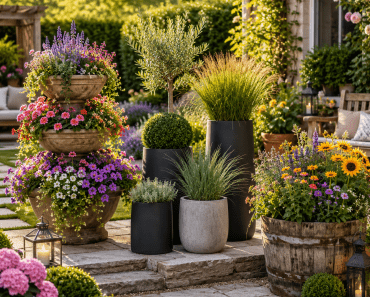
An Integrated Tire Garden Focal Zone combines several tire planters with gravel, timber, stone, flowers, ornamental grasses, and perhaps one garden seat or decorative structure.
The entire zone becomes a single destination.
This is an excellent solution for an awkward backyard corner.
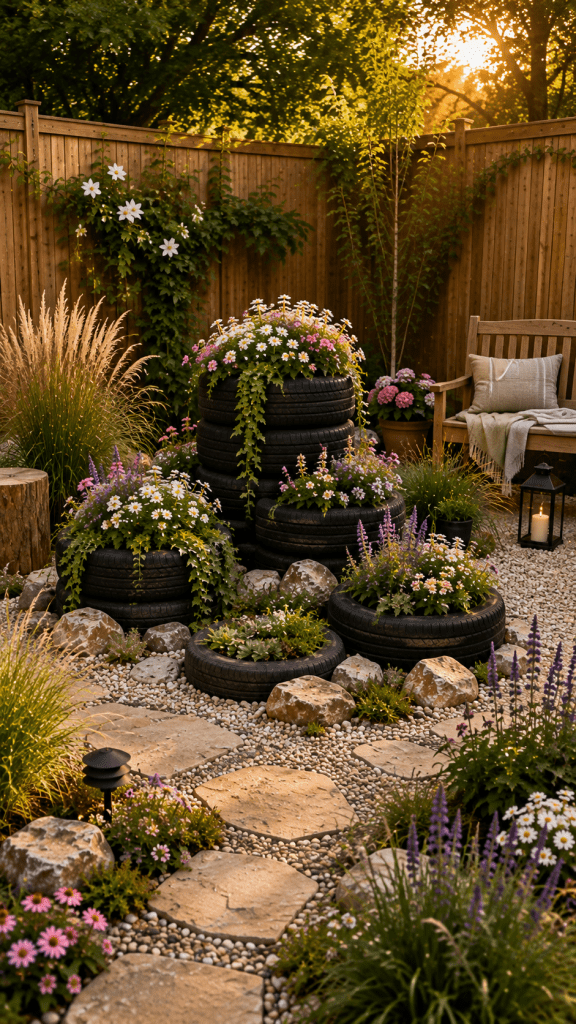
Choose One Area Instead of Scattering Tires Everywhere
A common problem with recycled garden projects is distribution.
One tire beside the shed.
Another near the patio.
Two more by the fence.
Another near a tree.
The yard can begin to feel cluttered.
A focal zone takes the opposite approach.
Concentrate the tire garden in one location.
This creates stronger visual impact and leaves the rest of the yard calmer.
Build a Clear Landscape Base
Start with the ground surface.
A defined gravel bed works beautifully.
Mulch can create a softer look.
Stone edging can establish a boundary.
The base tells the viewer:
this is one intentional garden area.
Without a defined foundation, several tires can appear randomly collected.
Mix Tire Heights
Use variation.
One larger tire planter can become the main focal point.
A smaller planter can sit nearby.
A modest two-level stack can add height.
Another low tire can blend into surrounding flowers.
This variety prevents the area from looking repetitive.
Use One Hero Planter
Every focal zone needs hierarchy.
Choose one tire arrangement to dominate.
This might be a large statement planter overflowing with flowers.
It could be a sculptural stacked tire feature.
Or it might be one especially beautifully painted planter.
The remaining tires should support it.
Do not make every planter equally dramatic.
Add Ornamental Grasses Around the Tires
Grasses are particularly useful in this concept.
They soften the rubber.
They add vertical movement.
They create transition between the tire planters and the rest of the yard.
A few clusters can make the focal zone feel like a real landscape bed rather than a display of containers.
Include Natural Timber
Timber can dramatically soften recycled rubber.
A natural-oak fence behind the area can provide a warm backdrop.
A simple timber bench can connect the zone with outdoor living.
Small timber edging can define part of the gravel.
Even one wood element can help.
The contrast works because the materials feel very different.
Rubber is industrial.
Wood is natural.
Plants bridge the two.
Use Stone for Visual Weight
Natural stone introduces permanence.
A few larger stones can sit near the base of the planters.
A limestone or gravel surface can form the ground plane.
A stone pathway can lead toward the focal zone.
These elements make the recycled tire feature feel more integrated with conventional landscaping.
Keep Decorative Objects Limited
A focal zone does not need to contain everything.
Avoid filling it with multiple signs, figurines, lanterns, painted ornaments, and miscellaneous DIY objects.
Choose a few elements.
For example:
tire planters + gravel + grasses + timber bench
That may already be enough.
Or:
stacked tire feature + stone + flowers + fence
Simple combinations often look more polished.
Repeat Plant Colors Across the Zone
Choose one dominant palette.
For a calm garden:
white + lavender + green
For a warm landscape:
apricot + cream + deep green
For a romantic setting:
soft pink + white + burgundy foliage
For a contemporary look:
white flowers + ornamental grasses + charcoal tires
Repeat the same color in several locations.
This visually ties the separate planters together.
Create a Background Layer
Do not focus only on the tires.
The area behind them matters.
A plain timber fence can be softened with climbing plants.
A masonry wall can gain depth from taller grasses.
A hedge can provide a lush green backdrop.
The focal zone should have foreground, middle ground, and background.
That layering makes it feel much more complete.
Best Places for an Integrated Focal Zone
This concept works particularly well:
- in empty backyard corners,
- beside patios,
- near outdoor seating,
- against garden fences,
- beside sheds,
- or in areas that currently have no clear purpose.
It can transform an overlooked section of the yard into a deliberate destination.
Why It Takes Third Place
The Integrated Tire Garden Focal Zone earns 🥉 because it offers one of the easiest ways to prevent recycled tire landscaping from feeling scattered.
By concentrating the concept into one well-designed area, the rest of the garden can remain visually calm.
The tire planters become a feature rather than background clutter.
What Makes Tire Garden Landscaping Different From Tire Planters
A tire planter focuses on the container.
Landscaping focuses on the relationship between the container and the entire yard.
That means asking different questions.
Instead of:
What flowers should go inside this tire?
ask:
Why is this tire here?
Does it create height?
Does it define the path?
Does it reinforce a curve?
Does it mark the edge of a flower bed?
Does it contribute to a focal point?
Does it connect two landscape materials?
A tire should have a role.
When it does, the garden feels designed.
How to Make Tire Garden Landscaping Look More Natural
The easiest strategy is to reduce isolation.
A tire sitting alone on lawn immediately draws attention to itself.
A tire partially surrounded by foliage feels more integrated.
A group placed within gravel becomes a designed feature.
A planter built into a flower border becomes one landscape layer.
Use plants and materials to connect tires to their surroundings.
The more transitions you create, the less abrupt the recycled material appears.
Use Repetition Without Creating Monotony
Repetition is important in landscaping.
But exact duplication is not required.
You can repeat:
- tire color,
- flower color,
- foliage texture,
- gravel,
- stone,
- timber,
- or planter shape.
For example, all tires may remain charcoal while the flowers vary.
Or every planter might include white flowers while tire colors remain muted and slightly different.
One repeated element is often enough.
Tire Garden Landscaping Color Palettes
A limited palette makes landscape projects feel more cohesive.
| Tire Color | Plants | Surrounding Material | Overall Style |
|---|---|---|---|
| Charcoal | White + green | Pale gravel + timber | Modern natural |
| Sage | Pink + white | Mulch + oak | Soft botanical |
| Terracotta | Cream + apricot | Limestone + gravel | Warm Mediterranean |
| Warm gray | Lavender + silver foliage | Stone paving | Calm contemporary |
| Deep brown | White + grasses | Mulch + natural stone | Rustic natural |
| Dusty blue | White + pale pink | Weathered timber | Cottage inspired |
These are visual starting points rather than strict formulas.
The existing colors of the house, fence, patio, and garden should influence the final choice.
How to Use Tires on a Sloped Garden
Sloped spaces benefit from careful planning.
Rather than placing heavy tire structures loosely on an incline, create stable planting positions that respond to the terrain.
Use modest levels rather than tall stacks.
Avoid layouts that could shift downhill.
Allow water to drain without eroding surrounding soil.
And ensure any retaining function is handled by appropriate landscape construction rather than assuming tires alone provide safe structural retention.
For decorative planting, the tires can enhance a terrace system.
They should not replace properly engineered retaining structures where those are required.
Pathway Landscaping With Tire Planters
Tires can work well beside paths when they remain outside the walking zone.
A repeating series of low planters can reinforce a curve.
Flowers can create seasonal color.
Trailing plants can soften the edge.
But leave enough clearance.
A planter should never force people to step around it unexpectedly.
This is especially important at night, near steps, or where children frequently move through the garden.
The landscape should remain easy to navigate.
How to Create Depth With Tire Planters
Depth comes from overlapping layers.
Place lower planting near the front.
Use medium-height tire planters behind it.
Add ornamental grasses or taller plants in the background.
The viewer then sees several planes.
This makes a relatively shallow garden feel richer.
Color can help too.
Lighter flowers can sit toward the foreground.
Darker foliage can create visual depth behind them.
Paint or Leave the Tires Natural
Both can work.
Dark original rubber often blends surprisingly well with mulch, shadows, and dense foliage.
Painted tires can connect to other landscape colors.
The important question is:
What role should the tire play?
If it should disappear, keep it dark or earthy.
If it should become decorative, introduce controlled color.
If several tires are used, avoid treating each one as a completely separate painting project unless a deliberately playful aesthetic is the goal.
How to Blend Tire Planters With Flower Beds
Repeat plants from the existing bed inside the tires.
This is one of the easiest techniques.
If lavender-colored flowers appear in the ground, include similar color in the planter.
If ornamental grass grows nearby, add a related grass to one tire.
If the flower bed contains white blooms, repeat them.
The eye notices continuity and begins to treat both areas as one garden.
The Importance of Groundcover
Groundcover can dramatically improve recycled tire landscapes.
It hides abrupt edges.
It moves between containers.
It fills small spaces.
It helps the tire look embedded in vegetation rather than placed on top of it.
Choose plants suitable for the light, soil, and climate.
Do not use groundcover solely for visual reasons if it is likely to spread aggressively where you live.
Use Tire Landscaping to Solve Real Problems
The strongest garden features usually solve something.
A terrace can add dimension to a slope.
A tire border can define an unclear flower bed.
A focal zone can improve an unused backyard corner.
A vertical installation can save ground space.
A planter group can soften a blank fence.
Start with the problem.
Then decide whether tires are actually useful there.
This produces better results than beginning with a pile of tires and searching for somewhere to place them.
Common Tire Garden Landscaping Mistakes
One of the biggest mistakes is using too many tires.
Recycled material can quickly dominate the landscape.
Another is placing them randomly without a consistent design system.
Overly bright unrelated colors can create visual clutter.
Ignoring the surrounding garden is another problem.
The tires should interact with nearby flowers, paths, walls, fences, and materials.
Poor drainage can damage plants.
Unstable stacks can create hazards.
And placing tires too close to walkways can interfere with safe circulation.
Creative landscaping still needs practical discipline.
How Many Tires Should You Use
There is no ideal number.
A small garden may need only three.
A larger landscape could support more.
The important factor is visual proportion.
Ask whether each additional tire improves the composition.
If removing one makes the design cleaner, remove it.
Do not use a tire simply because it is available.
Good landscaping is often about deciding what not to include.
Which Tire Garden Landscaping Idea Is Best
Choose the 🥇 Layered Tire Terrace Garden if you want the biggest transformation in the shape and depth of the yard.
It is particularly effective on slopes or in large planting beds where multiple levels can create a dramatic landscape.
Choose the 🥈 Curved Tire Border Landscape if you need to define flower beds, paths, or garden zones.
Its strength comes from repetition and movement rather than height.
Choose the 🥉 Integrated Tire Garden Focal Zone if you want to concentrate recycled planters into one polished area.
This is especially useful when you have an unused backyard corner that needs a clear purpose.
Final Thoughts on Tire Garden Landscaping Ideas
The most successful Tire Garden Landscaping Ideas are not about finding as many ways as possible to display old tires.
They are about using recycled tires to support a larger garden design.
The 🥇 Layered Tire Terrace Garden creates elevation and turns individual planting pockets into a sculptural landscape.
The 🥈 Curved Tire Border Landscape uses repeated low planters to guide the eye, define pathways, and organize planting zones.
And the 🥉 Integrated Tire Garden Focal Zone concentrates several recycled planters into one cohesive backyard destination supported by flowers, gravel, timber, and natural stone.
In every case, the surrounding landscape matters more than the tire itself.
Repeat materials.
Use controlled colors.
Allow plants to soften the rubber.
Create clear transitions.
Give each tire a purpose.
And keep the overall yard visually balanced.
When those principles are followed, old tires no longer look like objects that were simply added to the garden.
They begin to function as part of the landscape itself.