Creating a productive vegetable garden is not simply about finding an empty patch of soil and planting rows of tomatoes, lettuce, and carrots. The smartest Vegetable Garden Layouts organize crops according to sunlight, mature plant size, accessibility, companion planting, irrigation, and seasonal rotation. When these elements work together, even a relatively small garden can feel spacious while producing an impressive amount of fresh food.
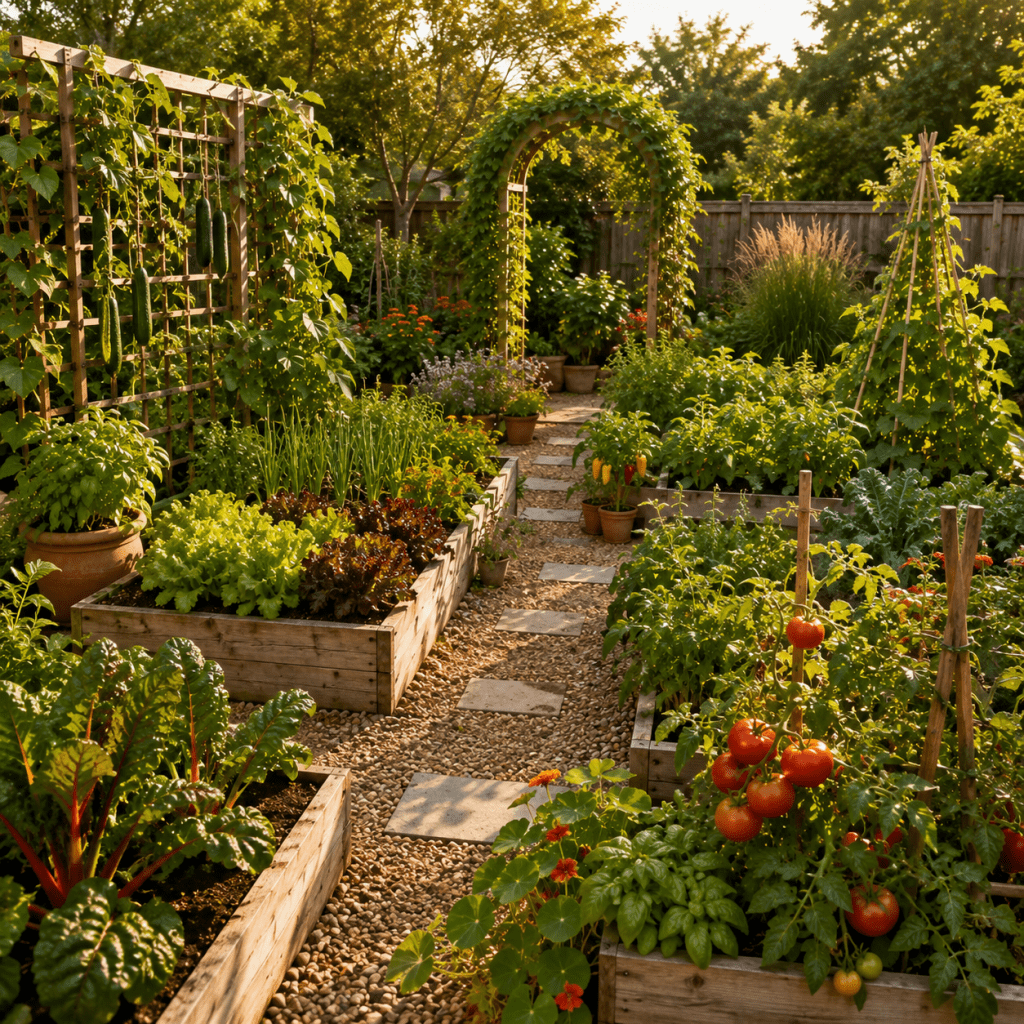
A thoughtful layout can also transform a purely functional growing area into one of the most attractive parts of the backyard. 🌿 Raised beds can create architectural structure, pathways can guide movement, herbs can soften hard edges, and climbing vegetables can add height without consuming valuable ground space.
The best design ultimately depends on how much space is available and how the garden will be used. Some gardeners need maximum productivity from a compact backyard, while others want an abundant mixed garden that feels natural and relaxed. There are also situations where almost no conventional garden space is available, making vertical growing particularly valuable.
These Best 3 Vegetable Garden Layouts explore three very different approaches that can be adapted to small yards, large gardens, modern homes, traditional landscapes, and everything in between.
🌱 Why Vegetable Garden Layouts Matter More Than Most Gardeners Realize
A vegetable garden is an interconnected growing system. Every plant influences the plants around it through shade, root competition, airflow, water consumption, and access to nutrients.
This means placement matters.
A tall wall of corn positioned incorrectly could shade vegetables that need direct sunlight. Large zucchini plants can overwhelm narrow paths. Tomatoes planted too close together may develop poor airflow. Tiny herbs can disappear behind mature peppers or eggplants.
Good Vegetable Garden Layouts anticipate these changes before the plants reach their mature size.
Instead of designing the garden according to how seedlings look in spring, imagine how the entire space will look several months later when vines are climbing, tomatoes are heavy with fruit, squash leaves are spreading, and herbs have doubled or tripled in size.
Accessibility is equally important. Vegetables require regular attention throughout the growing season. Harvesting, pruning, watering, tying vines, removing weeds, inspecting leaves, and replacing plants are much easier when every section of the garden can be reached comfortably.
A beautiful layout therefore combines three things:
🌿 Productivity — efficient use of growing space.
☀️ Plant health — appropriate sunlight, airflow, water, and spacing.
🏡 Design — attractive beds, pathways, structures, and planting combinations.
When all three are considered from the beginning, vegetable gardening becomes significantly easier.
Quick Comparison of the Best 3 Vegetable Garden Layouts
| Vegetable Garden Layout | Best For | Space Efficiency | Maintenance | Visual Style |
|---|---|---|---|---|
| 🥇 Modular Raised Bed Garden | Most home gardens | Excellent | Easy | Structured and elegant |
| 🥈 Mixed Companion Garden | Biodiversity and abundant planting | Very Good | Moderate | Lush and natural |
| 🥉 Vertical Productive Garden | Small yards and patios | Exceptional | Easy to Moderate | Modern and architectural |
Each design solves a different gardening challenge. The first creates an organized framework, the second emphasizes diversity and ecological relationships, and the third takes advantage of vertical space.
🥇 Best 1 Modular Raised Bed Vegetable Garden Layout
Among the most versatile Vegetable Garden Layouts, the modular raised bed system deserves the top position because it balances productivity, accessibility, organization, and visual appeal exceptionally well.
Instead of treating the vegetable garden as one large growing area, divide it into several manageable beds separated by permanent pathways.
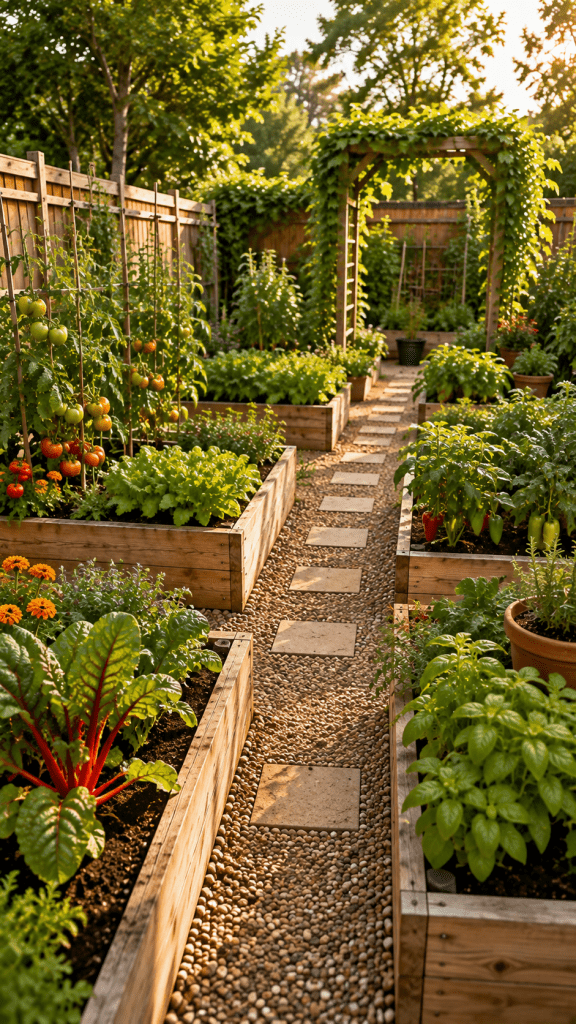
Imagine four to eight rectangular raised beds arranged in a clean geometric pattern. A central pathway creates the primary circulation route, while smaller paths provide access to individual beds.
The resulting garden feels almost like an outdoor room.
Vegetables remain organized within clearly defined planting zones, while pathways prevent gardeners from repeatedly walking over productive soil.
Creating the Basic Raised Bed Vegetable Garden Layout
A practical starting point is to use rectangular beds approximately 3 to 4 feet wide.
The exact length can vary according to the available space.
The width matters because vegetables should ideally be accessible from the pathways without requiring anyone to step inside the bed. A gardener standing along either side should comfortably reach toward the center.
Paths should also be generous enough for everyday gardening activities.
Narrow pathways may initially appear to save space, but they can become frustrating once vegetables begin spilling over the edges. Larger plants such as zucchini, kale, tomatoes, and cucumbers can quickly reduce usable walking space.
Allowing approximately 2 to 3 feet for important pathways usually creates a much more comfortable garden.
Gravel, bark mulch, wood chips, brick, stepping stones, or compacted natural materials can define the circulation areas.
🌿 The result is a garden that remains visually organized even during the most abundant part of summer.
Divide the Garden Into Productive Growing Zones
The modular design becomes particularly powerful when each raised bed has a clear purpose.
One bed might contain tomatoes, peppers, and basil.
Another could contain lettuce, spinach, radishes, and spring onions.
A third could support carrots, beets, onions, and other root crops.
Another bed might become the climbing vegetable zone with cucumbers, pole beans, and peas growing vertically.
This arrangement simplifies maintenance because plants with similar needs can be grouped together.
It also makes seasonal rotation easier.
Instead of trying to remember where individual vegetables were planted throughout a large mixed garden, entire beds can become recognizable growing zones.
For example:
Bed A: tomatoes and companion herbs
Bed B: root vegetables
Bed C: leafy greens
Bed D: legumes
Bed E: cucumbers and climbing vegetables
Bed F: seasonal succession crops
The exact combinations can change every year.
Put Tall Vegetables Where They Will Not Dominate the Garden
Height is one of the most important considerations in productive Vegetable Garden Layouts.
Tomatoes, corn, pole beans, climbing cucumbers, and trellised squash can become dramatically taller than surrounding vegetables.
Place these crops strategically so their mature height does not create unwanted shade over shorter sun-loving plants.
The ideal direction depends on the garden’s location, orientation, season, and surrounding structures, so observe how sunlight moves across the property before permanently positioning large structures.
Trellises can also become attractive architectural features.
Instead of using temporary-looking supports scattered randomly around the garden, consider creating one deliberate vertical growing zone.
A sturdy wooden or metal trellis covered in beans or cucumbers can create a beautiful green wall. 🌱
Create a Central Focal Point
Productive gardens do not need to look purely utilitarian.
One simple design technique is creating a visual focal point at the center or end of the main pathway.
This might be:
A large terracotta planter filled with herbs.
A small fruit tree.
A rustic wooden obelisk covered in climbing beans.
A decorative water container.
A simple garden bench.
Or a sculptural trellis.
The focal point gives the garden visual direction and helps the raised beds feel like part of a deliberate landscape design.
A central herb planter is particularly practical because frequently harvested herbs remain easily accessible.
Use the Bed Edges for Smaller Crops
One of the easiest ways to increase productivity is using the edges of raised beds.
Large vegetables can occupy the center while smaller plants grow around them.
Try edging beds with:
🌿 Parsley
🌿 Chives
🌿 Thyme
🥬 Lettuce
🥕 Radishes
🌱 Green onions
These plants generally require less physical space than large fruiting vegetables and can make use of areas that might otherwise remain empty.
Some can also be harvested relatively quickly, creating opportunities to replace them with another crop later.
Make Succession Planting Part of the Layout
A productive raised bed should rarely remain empty during the main growing season when local conditions allow continued planting.
This is where succession planting becomes useful.
Instead of thinking about each bed as having one crop for the entire year, think of it as a sequence.
A bed might begin with radishes and lettuce.
After those crops are harvested, warm-season vegetables can take their place.
Later, another cool-season crop may follow where climate permits.
This approach dramatically changes how garden space is perceived.
A small raised bed can potentially produce several harvest cycles instead of a single harvest.
Important Note: Always adapt planting dates, crop combinations, irrigation, and sun exposure to your local climate and growing season. A vegetable garden layout that performs beautifully in one region may require different spacing, shade management, or seasonal timing somewhere else.
🥈 Best 2 Lush Companion Planting Vegetable Garden Layout
Not every vegetable garden needs perfectly separated rows.
The second of the Best 3 Vegetable Garden Layouts takes a softer, more natural approach by mixing vegetables, herbs, flowers, and edible plants into a layered garden.
This design can resemble an ornamental border from a distance.
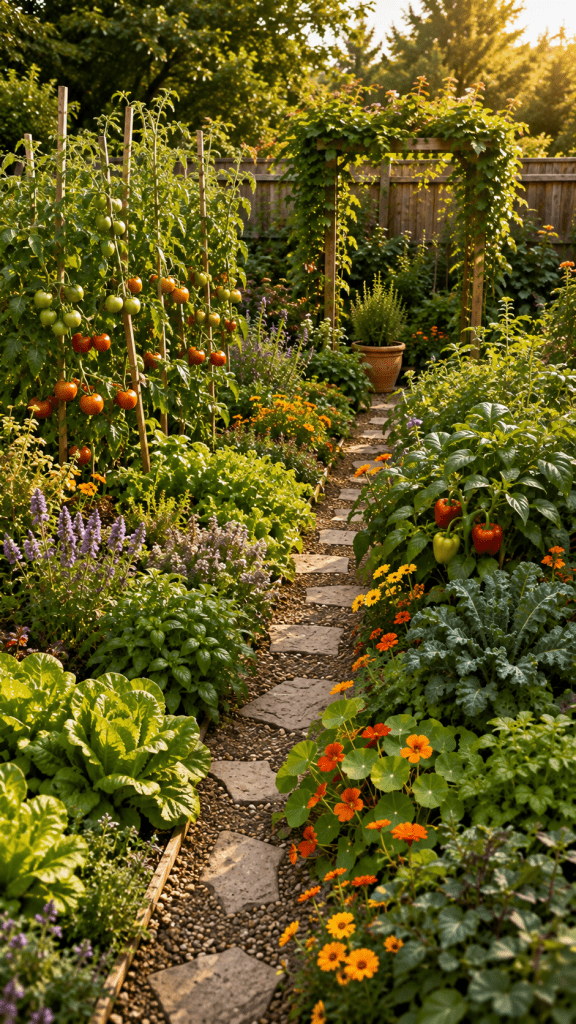
Tomatoes rise above basil and leafy vegetables. Climbing beans cover vertical supports. Calendula, nasturtiums, or other suitable flowers add color between edible crops. Herbs fill small spaces along pathways.
The result feels abundant rather than rigid. 🌻
Build the Vegetable Garden in Layers
The easiest way to understand this layout is to imagine the garden as several vertical layers.
The tallest layer contains climbing and upright crops.
This could include:
Pole beans
Trellised cucumbers
Indeterminate tomatoes
Peas
Other locally appropriate climbing vegetables
The middle layer contains medium-sized vegetables such as peppers, eggplants, bush beans, kale, and compact tomato varieties.
The lower layer contains leafy greens, herbs, radishes, onions, and other smaller crops.
The edge layer can contain low-growing herbs and compact flowers.
This layered arrangement creates significantly more visual depth than conventional rows.
It can also make a small vegetable garden appear larger because the eye moves between different heights and textures.
Create Curved Paths Instead of Straight Rows
A mixed vegetable garden works beautifully with organic pathways.
Instead of rectangular beds, create broad planting islands separated by gently curving paths.
Natural gravel, wood chips, bark mulch, or stepping stones can reinforce the informal atmosphere.
Curves also create a sense of discovery.
From the entrance, the entire garden does not need to be visible at once. A path can disappear behind a tall group of tomatoes or an arch covered in beans before revealing another planting area.
This turns harvesting vegetables into a more immersive garden experience.
The design is especially effective in cottage gardens, rustic landscapes, farmhouse gardens, and informal backyards.
Mix Flowers Into Vegetable Garden Layouts
Flowers can provide much more than decoration.
Appropriate flowering plants can attract pollinating insects and other beneficial garden visitors. Their colors also make vegetable beds feel integrated with the ornamental landscape.
Rather than creating a separate flower bed, distribute flowers strategically throughout the edible garden.
A cluster might appear beside tomatoes.
Another could soften the corner of a vegetable bed.
Low flowers might line a pathway.
The goal is not to overwhelm productive growing space but to weave ornamental plants naturally through it.
🌼 This approach makes the garden visually interesting even before many vegetables are ready for harvest.
Create an Herb Ribbon Along the Path
Herbs are ideal plants for visually connecting different sections of a mixed garden.
Consider creating an informal ribbon of herbs along one or both sides of the primary pathway.
Depending on climate and growing conditions, this might include parsley, thyme, oregano, chives, basil, sage, or other culinary herbs.
Their different foliage textures add visual richness.
They are also easy to harvest because they sit directly beside the walking area.
Fragrant herbs can make the experience particularly enjoyable when leaves brush gently against the edge of a pathway.
Add Vertical Arches Between Growing Areas
A vegetable arch can completely transform the appearance of a productive garden.
Install a sturdy arch over an important pathway and train suitable climbing vegetables upward.
Pole beans and some cucumbers are obvious possibilities.
The structure creates valuable vertical growing space while forming an entrance between garden zones.
Two or three arches can create a dramatic sequence in a larger vegetable garden.
Imagine walking beneath a tunnel of edible greenery with vegetables hanging overhead. 🌿
It is both productive and visually memorable.
Keep Dense Planting Manageable
The biggest challenge with lush Vegetable Garden Layouts is avoiding excessive density.
A garden can look wonderfully abundant while still allowing air to move around plants.
This distinction is important.
Overcrowding may create competition for sunlight, nutrients, and water. Dense foliage can also make inspection and harvesting difficult.
The solution is intentional layering rather than random planting.
Know approximately how large each crop becomes at maturity and leave appropriate room around important plants.
A tiny tomato transplant will not remain tiny.
Neither will a zucchini plant.
Planning according to mature dimensions helps preserve the lush appearance without creating chaos.
🥉 Best 3 Vertical Vegetable Garden Layout for Small Spaces
The third design is particularly valuable for gardeners who believe they do not have enough room to grow vegetables.
Instead of asking how much ground space is available, ask:
How much vertical space is available?
Walls, fences, trellises, arches, railings, and freestanding structures can dramatically increase growing capacity.
This makes vertical gardening one of the most efficient Vegetable Garden Layouts for compact yards, narrow side gardens, courtyards, patios, and urban spaces.
Start With a Productive Garden Wall
Choose a sunny boundary and transform it into the main growing structure.
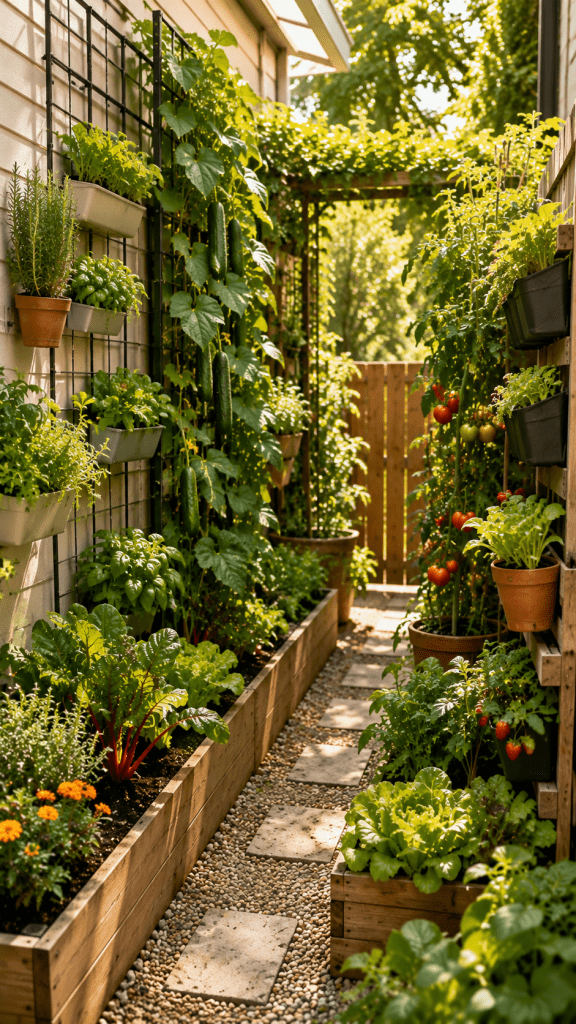
A strong trellis can support climbing crops while containers or narrow beds sit underneath.
The wall can contain multiple growing levels.
At the top, climbing vegetables create height.
At middle levels, hanging or mounted containers can support smaller crops where suitable.
At ground level, narrow raised beds provide space for herbs, greens, peppers, or other compact vegetables.
Suddenly, an area that might otherwise contain only one narrow planting bed becomes a three-dimensional growing system.
Use A Frame Trellises as Productive Architecture
A-frame trellises are particularly useful because they provide growing surfaces on two sides.
They can support climbing crops while leaving usable ground underneath or around them.
Position several structures rhythmically through the garden to create a strong architectural pattern.
This is an excellent approach for contemporary landscapes because vegetable supports become intentional design elements instead of temporary equipment.
Natural timber provides a warm rustic character.
Dark metal can create a cleaner modern aesthetic.
Whichever material is selected, durability and adequate structural strength are essential once vines become heavy.
Turn the Fence Into Part of the Vegetable Garden Layout
A fence occupies valuable vertical real estate.
Instead of leaving it empty, integrate it into the growing plan.
Install trellis panels slightly away from the fence to allow air circulation where appropriate. Use them for suitable climbing vegetables or espalier-style edible plants where climate and plant choice allow.
The base of the fence can contain a narrow planting bed.
This arrangement creates a highly efficient sequence:
Fence → trellis → climbing crop → narrow bed → pathway → compact vegetables
Almost every layer of space has a purpose.
The visual result can be surprisingly luxurious when materials are coordinated throughout the garden.
Combine Containers With Permanent Beds
Vertical vegetable gardens become even more flexible when containers are incorporated.
Large pots can hold tomatoes, peppers, eggplants, or herbs.
Smaller containers can accommodate compact leafy crops and culinary herbs.
Containers also allow gardeners to move certain plants when necessary.
A coordinated collection of terracotta, galvanized metal, timber planters, or simple neutral containers can make the productive garden feel cohesive.
Avoid using too many unrelated container styles if a polished appearance is the goal.
Repeating two or three materials generally produces a calmer visual composition.
Create a Narrow Harvesting Path
Small vegetable gardens need efficient circulation.
Rather than dividing limited space into several wide paths, create one primary route that reaches all major growing zones.
Plants can then rise vertically on either side.
Imagine a narrow gravel path with raised beds below and trellises above.
Leafy greens grow close to the ground.
Peppers and herbs occupy the middle layer.
Beans and cucumbers climb overhead.
This creates the feeling of walking through a miniature edible landscape rather than standing beside a few containers.
☀️ How to Position Vegetable Garden Layouts for Sunlight
Before building permanent beds, spend time observing sunlight.
Vegetables have different light requirements, but many popular fruiting crops perform best with generous direct sunlight.
Tomatoes, peppers, cucumbers, beans, squash, and similar crops are generally associated with sunnier positions.
Leafy vegetables may tolerate different conditions depending on climate and season.
The important point is to map the garden before construction.
Observe the space during morning, midday, and afternoon.
Buildings, fences, mature trees, pergolas, and neighboring structures can create shade that changes dramatically throughout the day.
Seasonal sun angles also matter.
A location that appears sunny during one part of the year may behave differently later.
Permanent raised beds should therefore be positioned according to realistic growing conditions rather than appearance alone.
🌿 Design Vegetable Garden Layouts Around Mature Plant Size
One of the most common garden-planning mistakes is designing around seedlings.
Seedlings are deceptive.
Six newly planted vegetables can look lonely inside a large raised bed. The temptation is to add more plants.
Several weeks later, the same bed may become completely overcrowded.
Always research the approximate mature dimensions and recommended spacing of each crop variety.
Some compact cultivars are specifically suited to containers and small gardens, while vigorous varieties may require dramatically more space.
Think in three dimensions:
Width determines how much bed surface a crop occupies.
Height determines potential shading.
Root space influences underground competition and container requirements.
Good planning considers all three.
💧 Integrate Irrigation Before Planting
Water should not be an afterthought.
Design the irrigation system at the same time as the beds and pathways.
Raised beds can be particularly convenient for drip lines or other targeted irrigation systems.
The objective is simple: make watering consistent and easy.
If watering requires dragging a hose through narrow pathways and around delicate plants every day, the layout is working against the gardener.
Consider where the water source is located before constructing the garden.
Main pathways can provide access for hoses or irrigation lines.
Beds can then be divided into watering zones based on plant needs.
Mulching exposed soil with an appropriate material can also help manage moisture and reduce weed pressure.
🥕 Add a Dedicated Quick Harvest Zone
Frequently harvested vegetables and herbs deserve premium real estate.
Place them close to the kitchen, garden entrance, or primary pathway whenever possible.
Imagine stepping outside and immediately reaching:
Basil.
Parsley.
Chives.
Lettuce.
Green onions.
Other frequently used herbs and greens.
Vegetables that require less frequent attention can occupy more distant sections.
This small planning decision can make the vegetable garden much more convenient for everyday cooking.
🌼 Make Productive Gardens Beautiful
There is no rule saying vegetable gardens must be hidden behind the house.
A thoughtfully designed edible garden can become a landscape feature.
The secret is repetition.
Repeat materials throughout the design.
If raised beds use natural timber, repeat that timber in trellises or benches.
If pathways use pale gravel, use the same material throughout rather than changing surfaces randomly.
Repeat plant forms as well.
A row of herbs along several bed edges creates rhythm.
Matching trellises create structure.
Repeated flowers create color continuity.
This visual consistency helps an otherwise diverse collection of vegetables feel intentional.
🧭 Choosing Between the Best 3 Vegetable Garden Layouts
Choose the modular raised bed layout when organization, accessibility, crop rotation, and a polished appearance are priorities.
It is the strongest all-around solution for many residential gardens.
Choose the lush companion planting layout when the goal is to create an abundant edible landscape filled with vegetables, herbs, flowers, and biodiversity.
This approach works particularly well when a relaxed garden atmosphere is preferred over strict geometry.
Choose the vertical vegetable garden layout when ground space is limited.
It is especially useful for compact urban yards, courtyards, narrow gardens, and other places where vertical surfaces provide more opportunity than conventional beds.
These approaches can also be combined.
A modular raised bed garden might contain one vertical trellis wall.
A companion garden might include geometric raised beds.
A tiny vertical garden might incorporate mixed herbs and flowers.
The best garden rarely follows a rigid formula.
🌱 Plan Vegetable Garden Layouts for Crop Rotation
A good garden layout should work not only this season but next season as well.
Permanent pathways and clearly defined growing zones make it easier to change crop locations from year to year.
Keeping basic planting records can help.
A simple garden notebook or digital sketch showing where major crop groups were grown provides useful information when planning the following season.
Instead of redesigning the entire garden, the structural framework stays consistent while planting arrangements evolve.
This is another advantage of modular beds.
Each bed becomes a flexible growing unit.
One year it might contain tomatoes.
The next year it could contain beans or leafy vegetables.
The garden retains its attractive structure even while the crops change.
🍅 Create a Harvest Focused Vegetable Garden
Ultimately, a productive garden should make harvesting enjoyable.
Vegetables hidden behind inaccessible foliage are easily forgotten.
Tomatoes that cannot be reached comfortably may remain on the vine too long.
Beans growing against an inaccessible fence become difficult to pick.
Pathways, spacing, and vertical structures should therefore be designed around harvesting as much as planting.
Ask whether every plant can be reached easily.
Can both sides of the trellis be accessed?
Can tomatoes be inspected without stepping into another bed?
Can large squash leaves be moved without blocking the entire pathway?
Can herbs be harvested quickly before cooking?
These practical questions often reveal layout problems before construction begins.
🏡 Give the Vegetable Garden a Defined Entrance
Even a small productive garden benefits from a clear entrance.
An entrance creates psychological separation between the surrounding backyard and the growing area.
It does not need to be elaborate.
Two simple timber posts can frame a pathway.
A metal arch covered in climbing vegetables can form a dramatic gateway.
Large planters can mark either side.
A change in paving material can subtly indicate arrival.
Once inside, the main pathway should naturally lead toward the central garden.
This small landscape-design technique can make a modest vegetable plot feel like a dedicated garden destination.
🌿 Final Thoughts on the Best Vegetable Garden Layouts
The most successful Vegetable Garden Layouts do more than fit vegetables into available soil. They organize the entire growing experience.
🥇 The Modular Raised Bed Vegetable Garden Layout provides structure, accessibility, flexibility, and outstanding everyday practicality.
🥈 The Lush Companion Planting Vegetable Garden Layout creates a diverse edible landscape where vegetables, herbs, flowers, pathways, and vertical structures blend naturally together.
🥉 The Vertical Vegetable Garden Layout proves that productive gardening does not necessarily require a large backyard because walls, fences, arches, and trellises can become valuable growing surfaces.
Whichever approach is chosen, begin with sunlight and circulation before deciding where individual crops belong. Design permanent pathways first, identify vertical growing opportunities, consider mature plant dimensions, and keep frequently harvested crops within easy reach.
Then add the details that transform a functional vegetable plot into a beautiful outdoor space: repeated materials, coordinated trellises, attractive pathway surfaces, flowering accents, herbs along bed edges, and perhaps a distinctive entrance or focal point.
A vegetable garden designed this way changes throughout the seasons without losing its underlying structure. Spring may begin with small leafy greens and seedlings. Summer brings towering tomatoes, climbing beans, herbs, cucumbers, and dense foliage. Later harvests reveal the architecture of the beds and pathways again.
That combination of beauty and productivity is what makes a carefully planned vegetable garden so rewarding. 🌱🥕🍅
Instead of simply creating somewhere to grow vegetables, the right layout creates an organized edible landscape—one that makes better use of available space, simplifies everyday maintenance, supports abundant harvests, and becomes an attractive part of the backyard itself.