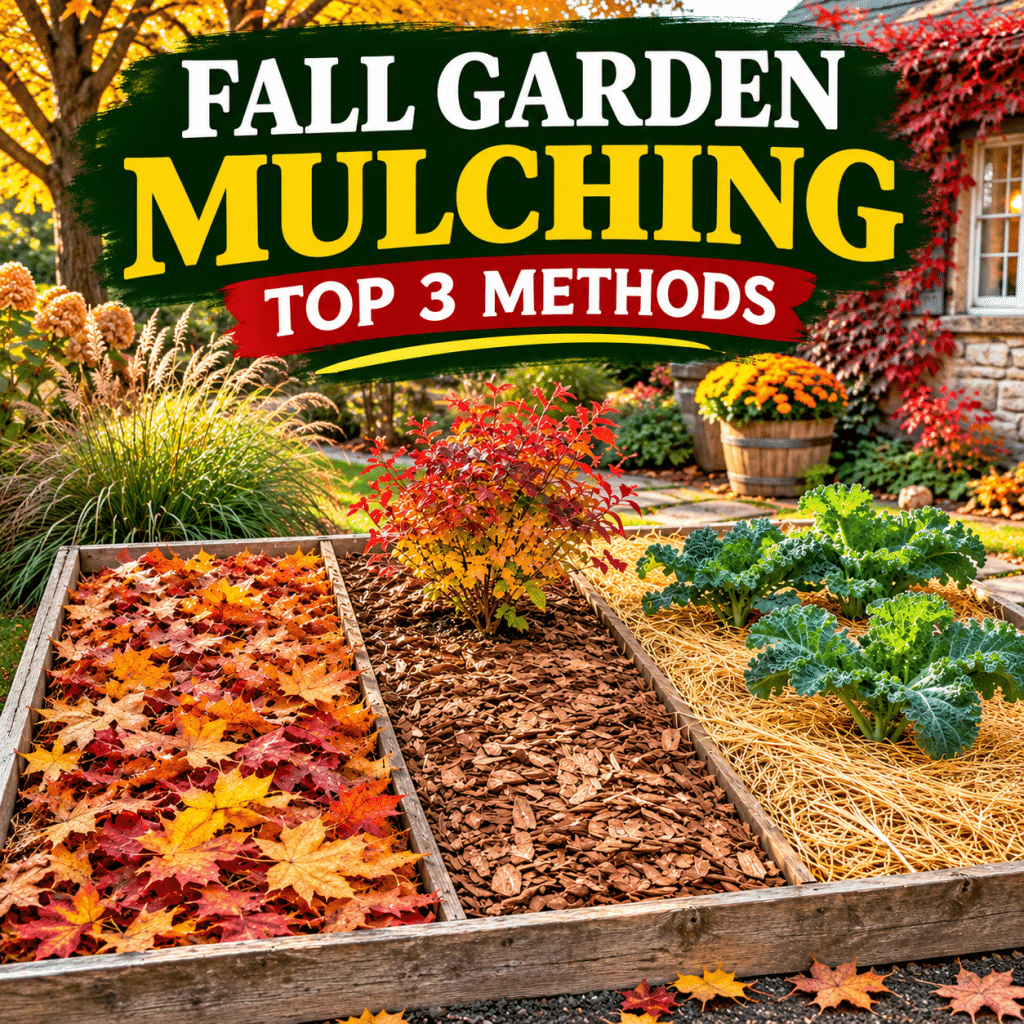
Fall Garden Mulching is one of the most powerful yet surprisingly overlooked gardening techniques for creating healthier soil, protecting valuable plant roots, and preparing an ordinary backyard for an extraordinary spring growing season. While many gardeners focus on removing fallen leaves, cutting back plants, and tidying their outdoor spaces before winter arrives, the real secret to a thriving garden often lies beneath a carefully selected layer of natural mulch.
Imagine walking into your garden after a long winter and discovering soil that feels rich, crumbly, naturally moist, and full of life. Instead of facing compacted earth, persistent weeds, and struggling plants, you find a growing environment ready to support vigorous roots and healthy spring growth. 🍂
This transformation does not require expensive fertilizers, complicated gardening equipment, or an elaborate landscaping project. It begins with understanding how different mulching materials interact with the soil during autumn and winter.
The most effective fall garden mulching techniques work with natural seasonal processes rather than against them. Fallen leaves, untreated wood chips, and clean straw each offer distinctive advantages when applied to the right garden areas.
However, not every mulch works equally well for every plant or climate. A protective layer that benefits an established shrub might be unsuitable for delicate perennial crowns or an actively growing vegetable bed.
The secret is selecting a mulching strategy based on what the soil actually needs.
These three exceptional methods reveal how to transform ordinary garden materials into a practical soil protection system that makes autumn maintenance easier and gives the following growing season a stronger foundation.
🍂 Why Fall Garden Mulching Can Completely Change the Health of Your Garden
Autumn represents a fascinating transition in the garden’s natural cycle.
As temperatures decline and daylight hours shorten, many plants gradually reduce aboveground growth. Deciduous trees shed their leaves, summer annuals complete their life cycles, and perennial plants begin directing resources toward surviving the colder months.
Beneath the surface, however, the soil remains an active environment whenever temperature and moisture conditions permit.
Earthworms, fungi, bacteria, and countless other organisms continue processing organic matter. Their activity contributes to nutrient cycling, soil structure, and the gradual transformation of plant debris into more stable organic material.
When garden soil remains completely exposed, it becomes more vulnerable to several seasonal problems.
Heavy autumn rainfall can dislodge soil particles and cause erosion. Repeated freezing and thawing may disturb shallow roots in cold climates. Bare soil can also experience greater moisture fluctuations and provide opportunities for unwanted weeds to establish.
A suitable organic mulch layer helps moderate these conditions.
🌱 Protect Soil Structure Without Constant Digging
Healthy garden soil contains a network of mineral particles, organic matter, pore spaces, roots, and living organisms.
These components work together to create an environment where water can enter the ground and plant roots can access oxygen.
Repeated disturbance can damage existing soil aggregates, while intense rainfall striking bare ground can contribute to surface crusting and erosion.
Mulch creates a protective covering between the soil and the weather.
Rather than allowing heavy raindrops to strike exposed earth directly, the organic material absorbs some of their impact.
This can be particularly valuable in gardens with sloping ground, fine-textured soil, or sections that receive significant autumn rainfall.
The goal is not to eliminate all soil disturbance permanently. Instead, it is to avoid unnecessary disruption and protect the growing environment between planting seasons.
💧 Reduce Moisture Fluctuations During Changing Weather
Autumn weather can shift rapidly between dry afternoons, prolonged rainfall, and chilly nights.
Without protective cover, the upper layer of garden soil may lose moisture through evaporation or become saturated during heavy precipitation.
Organic mulch can slow surface evaporation and help moderate moisture changes.
Its effectiveness depends on the material, depth, soil texture, drainage, and local climate.
A sandy garden may particularly benefit from improved moisture retention, while a poorly drained clay bed may require a thinner layer and more careful monitoring.
The objective is balanced moisture rather than permanently wet soil.
❄️ Moderate Soil Temperature Changes
One of the greatest benefits of fall mulching is its ability to buffer soil temperature fluctuations.
During winter, exposed soil responds more directly to changes in air temperature.
A suitable mulch covering reduces the speed of those changes, creating a more stable environment around plant roots.
This is especially useful in regions where temperatures repeatedly move above and below freezing.
However, winter insulation and general autumn soil coverage are not identical tasks.
Certain cold-climate perennials and spring-flowering bulbs benefit from protective winter mulch applied after the soil begins to freeze, rather than too early in autumn. This helps avoid encouraging premature growth. UMN Extension
Understanding that distinction makes seasonal mulching considerably more effective.
🥇 Best 1 Fall Garden Mulching With Shredded Autumn Leaves for Living Soil Renewal
The most economical and naturally rewarding fall mulching method begins with a material many homeowners routinely throw away.
Fallen autumn leaves.
Every year, mature deciduous trees produce enormous quantities of organic material. These leaves contain carbon-based compounds and nutrients that gradually return to the soil through decomposition.
In natural woodland ecosystems, fallen leaves accumulate beneath trees and create a protective surface layer.
Over time, decomposers break down this material, contributing to the dark organic-rich conditions commonly associated with healthy forest floors.
Home gardeners can apply the same basic principle on a smaller scale.
Instead of treating leaves as waste, use suitable fallen foliage to create a renewable mulch system that protects soil while gradually feeding the soil ecosystem.
🍁 Choose Healthy Leaves With the Right Texture
The first step is selecting appropriate leaf material.
Leaves collected from healthy deciduous trees are generally excellent candidates for garden mulching.
Maple, birch, beech, and many other common landscape trees provide useful organic material, although decomposition rates differ depending on leaf thickness and chemistry.
Thin leaves usually break down more readily than thick, leathery varieties.
A mixture of different leaf types can create an interesting range of particle sizes and decomposition rates.
Avoid using leaves that may contain herbicide residues or other contaminants.
Where serious plant diseases are present, follow disease-specific sanitation guidance rather than automatically spreading infected debris around susceptible plants.
Also avoid collecting leaves from roadsides or other locations where they may have accumulated pollutants.
The best source is often the garden itself.
🍂 Shred the Leaves to Create a More Effective Mulch
Whole leaves can certainly provide ground protection, but certain types tend to overlap and form dense mats when repeatedly exposed to rainfall.
These compressed layers may restrict air movement and make it harder for moisture to penetrate evenly.
Shredding reduces this problem.
A lawn mower, suitable garden shredder, or leaf vacuum with a mulching function can turn dry fallen leaves into smaller fragments.
The resulting material is easier to distribute and generally settles more evenly across planting areas.
Smaller fragments also provide more surface area for decomposition.
University of Illinois Extension recommends shredding leaves when using them as mulch to reduce the risk of clumping and dense mat formation. Illinois
For practical gardening, the aim is not to pulverize leaves into dust.
A mixture of small, recognizable fragments creates an attractive and functional layer.
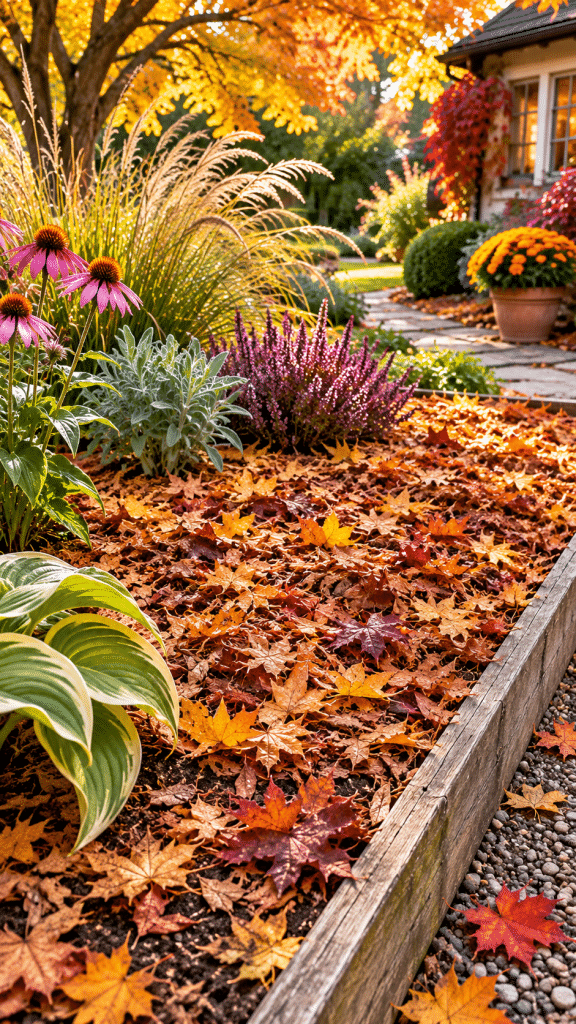
🌿 Build a Natural Leaf Blanket Across Empty Growing Areas
Once the leaves are prepared, distribute them over suitable bare soil.
For many ordinary garden beds, a loose layer around two inches deep provides a useful starting point.
The correct thickness depends on how finely the leaves have been shredded, how quickly they settle, and whether plants are actively growing in the area.
An empty annual bed can tolerate different coverage than a bed filled with tiny winter seedlings.
Spread the material evenly rather than creating thick piles.
Leave breathing space around delicate stems and plant crowns.
Where the garden contains winter vegetables or low-growing plants, ensure the mulch does not cover their leaves or growing points.
The finished surface should resemble a soft, natural woodland floor rather than a heavy blanket of compacted debris.
🪱 Encourage Soil Organisms to Process Organic Matter Naturally
The real beauty of shredded-leaf mulch emerges gradually.
When moisture and temperature conditions are favorable, fungi, bacteria, and soil-dwelling invertebrates begin decomposing the fallen leaves.
Earthworms may draw some organic fragments into their burrows.
Microorganisms process plant compounds, while repeated biological activity contributes to the gradual development and cycling of soil organic matter.
This process is not instantaneous.
Cold weather slows decomposition, and some leaves may remain recognizable well into spring.
That is not necessarily a problem.
A slowly decomposing surface layer can continue protecting the soil while the seasons change.
Gardeners should also understand that surface-applied leaves do not function like a precisely formulated fertilizer.
Nutrient release is gradual, variable, and dependent on biological conditions.
For plants requiring specific nutrient levels, soil testing and appropriate fertilization may still be necessary.
🦋 Preserve Small Wildlife Refuges Beneath the Leaves
A leaf-covered garden can support more than soil health.
Leaf litter provides shelter for many small organisms, including some beneficial insects and other wildlife.
Certain butterflies, moths, native bees, and other creatures use fallen leaves or protected ground-level habitats during vulnerable life stages.
This means aggressive shredding is not always desirable everywhere.
A particularly effective strategy is to divide the garden into functional areas.
Use shredded leaves in cultivated beds where uniform coverage is important.
Preserve some undisturbed leaves beneath suitable shrubs, along sheltered woodland edges, or in low-traffic habitat areas.
This approach combines practical gardening with wildlife conservation.
University of Minnesota Extension also highlights the ecological value of leaving appropriate leaf litter in garden environments. UMN Extension
✨ Create a Beautiful Woodland Inspired Garden Surface
Leaf mulch can contribute to an attractive autumn garden rather than making the landscape appear neglected.
Golden fragments, copper-colored leaves, dark brown textures, and occasional evergreen foliage create a natural seasonal palette.
The effect is especially appealing beneath ornamental trees, near woodland-style plantings, and around natural stone borders.
For a tidy appearance, keep the mulch within clearly defined planting areas.
Remove leaves from slippery walkways and drainage openings.
Allow the beds themselves to retain a softer, more natural texture.
The final appearance feels warm, organic, and thoughtfully maintained.
🌷 How Leaf Mulch Changes by Spring
By spring, the original mulch layer may be noticeably thinner.
Some fragments will have decomposed, while others will have settled into a finer surface covering.
Check the soil before planting.
If the mulch is still thick or wet, pull it aside temporarily to allow the soil surface to warm and dry where necessary.
For direct-sown seeds, create clear planting rows rather than burying small seeds beneath heavy organic material.
Healthy remaining mulch can often be moved around established plants after germination.
This creates a convenient seasonal cycle.
Autumn leaves protect the soil through the colder months, and the remaining organic material continues serving the garden as new plants establish.
🥈 Best 2 Fall Garden Mulching With Natural Wood Chips for Long Lasting Root Protection
While shredded leaves are ideal for inexpensive seasonal soil coverage, natural wood chips offer a more durable approach.
Wood-based mulch is especially valuable around established trees, shrubs, and permanent landscape plantings.
Its larger particles decompose more slowly than many fallen leaves, allowing the protective layer to remain useful for an extended period.
This creates an opportunity to develop a low-maintenance root protection system that combines function with a beautiful, professionally landscaped appearance.
🌳 Select Untreated Wood Chips for a Natural Protective Layer
The quality of wood mulch matters.
Suitable materials include untreated arborist wood chips, aged shredded wood, and appropriate bark products.
Arborist chips often contain a mixture of wood, bark, and small twig fragments.
This variation can produce an appealing natural texture and support gradual decomposition.
Avoid using chemically contaminated wood, painted construction debris, or treated lumber fragments.
Decorative dyed mulch may have an attractive appearance, but its suitability depends on the source material and manufacturing process.
For gardens emphasizing natural soil care, responsibly sourced untreated organic mulch is a straightforward option.
The material should also be appropriate for the location.
Large, coarse chips are generally more suitable around permanent plantings than directly over small emerging seedlings.
🌱 Create a Wide Protective Root Zone Instead of a Mulch Pile
One of the most common mulching mistakes is concentrating wood chips around the trunk of a tree.
This creates a mound sometimes called a mulch volcano.
Although the shape may initially appear neat, it can keep moisture against sensitive bark and obscure the root flare.
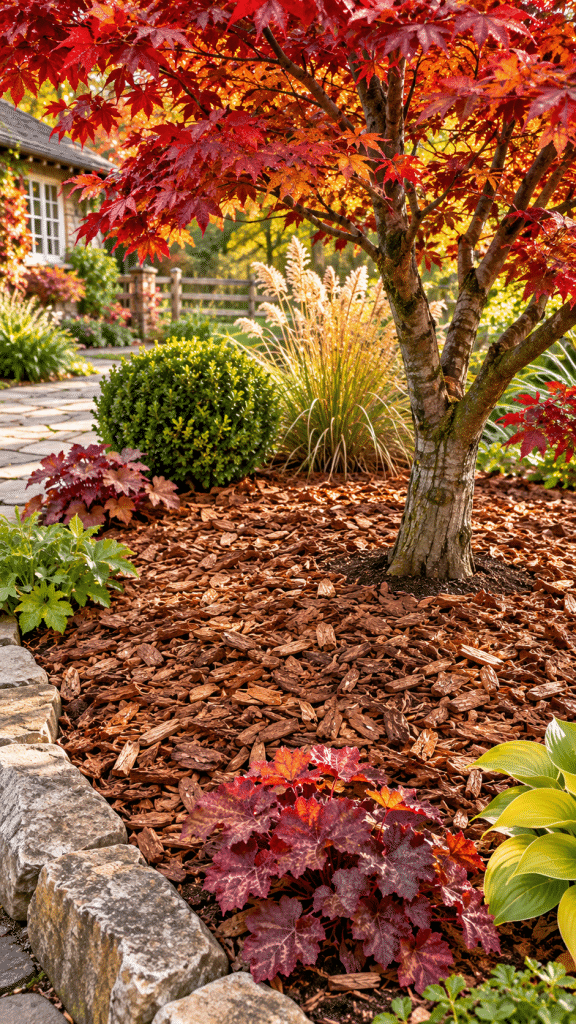
A healthier approach is to spread mulch outward across the surrounding soil.
For many trees and shrubs, a layer around two to three inches deep is a practical starting range.
Keep the material several inches away from trunks and woody stems.
The visible root flare of a tree should remain uncovered.
Penn State Extension emphasizes appropriate mulch depth and keeping mulch away from trunks to reduce moisture-related damage. Penn State Extension
A broad, relatively level mulch ring is generally more beneficial than a narrow, elevated mound.
🌲 Protect Established Shrubs During Autumn Weather Changes
Shrubs often occupy permanent planting locations for many years.
Their root systems benefit from stable soil conditions, particularly during establishment and periods of environmental stress.
Applying organic mulch around appropriate shrubs can help reduce evaporation, moderate temperature changes, and suppress some competing weeds.
Before adding new material, inspect the existing mulch.
If a substantial layer remains from earlier in the year, it may only require redistribution.
Adding several inches of fresh mulch on top of an already thick layer can create unnecessary problems.
The goal is to maintain a suitable total depth rather than automatically apply a new blanket every autumn.
For shrubs planted recently, monitor moisture beneath the mulch.
Cooler temperatures reduce evaporation, but recently installed plants may still need watering when rainfall is insufficient and the ground remains unfrozen.
🍄 Understand How Wood Chips Decompose
Wood chips contain relatively high proportions of carbon-rich material.
Their decomposition is usually slower than that of soft green vegetation or finely shredded leaves.
Microorganisms gradually process the material where moisture, oxygen, and temperature allow.
As the mulch ages, it becomes darker and may develop a more integrated appearance near the soil surface.
A common concern is that wood chips will remove all available nitrogen from the garden.
The reality is more specific.
Microbial decomposition can temporarily immobilize nitrogen where carbon-rich wood is actively mixed into soil, especially near the interface between decomposing material and soil.
However, a surface layer of appropriate wood-chip mulch is not equivalent to mixing large quantities of fresh sawdust throughout the root zone.
For most established ornamental plantings, leaving wood chips on the surface is a practical approach.
Avoid incorporating excessive fresh woody material into vegetable seedbeds.
🏡 Design a Refined Autumn Landscape With Natural Mulch
Wood mulch offers a visually pleasing finish that works with many landscape styles.
Its earthy brown tones complement autumn foliage, ornamental grasses, evergreen shrubs, and natural stone.
In a contemporary garden, a consistent mulch texture can create visual continuity between planting areas.
In a cottage garden, irregular wood fragments provide a softer background for established perennial plantings.
For a more sophisticated appearance, focus on clean boundaries and consistent coverage rather than decorative complexity.
A defined edge between lawn and mulch creates a sense of order.
Natural wood tones also make green foliage and autumn flowers stand out without overwhelming the surrounding garden.
This combination of durability and understated visual appeal makes wood chips particularly useful for permanent landscapes.
❄️ Maintain Wood Chip Mulch Through Winter
Wood mulch generally requires less frequent replacement than many lightweight organic materials.
However, autumn storms and winter weather can displace chips or expose sections of soil.
Inspect the layer occasionally.
Redistribute material that has accumulated against stems.
Check drainage channels and ensure chips are not washing onto pathways.
In windy locations, coarse chips are often easier to manage than very fine shredded material.
When spring arrives, assess the remaining depth before adding anything new.
A thin top-up may be sufficient, and some areas may require no additional mulch at all.
🥉 Best 3 Fall Garden Mulching With Clean Straw for Seasonal Vegetable Bed Protection
The third method offers an entirely different advantage.
Clean straw provides a lightweight, practical covering for many seasonal vegetable growing areas.
Unlike durable wood chips, which are especially suited to permanent landscape plantings, straw can be easier to rearrange when preparing temporary growing spaces.
Its dry, hollow stems create an airy organic layer that can help cover exposed soil and moderate moisture conditions.
When carefully selected and applied, straw mulch can become a useful component of autumn vegetable garden management.
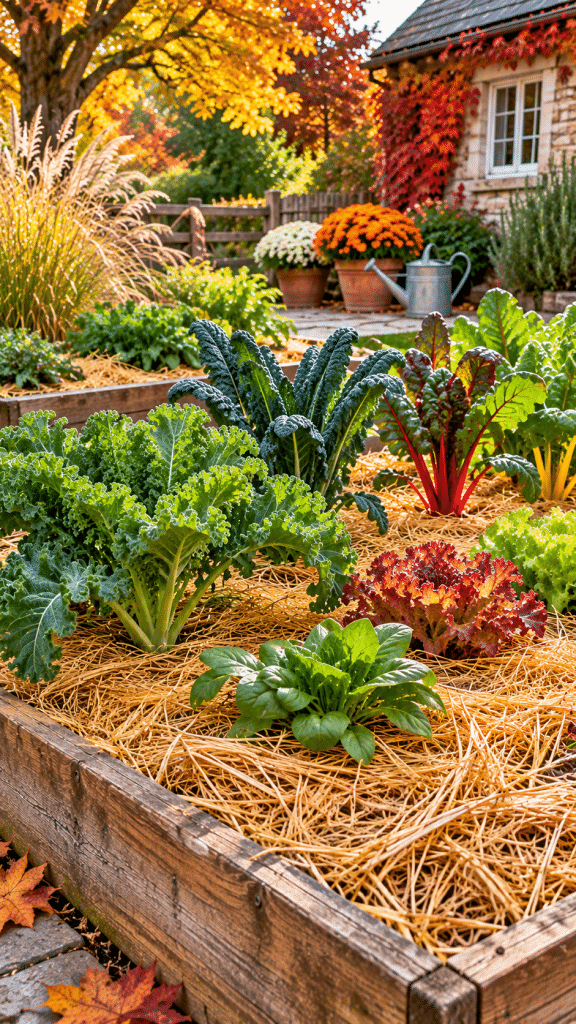
🌾 Understand the Difference Between Straw and Hay
Straw and hay are not interchangeable.
Straw consists primarily of the dry stems remaining after cereal grains such as wheat, barley, or oats have been harvested.
Hay is generally harvested as animal feed and often includes grasses, legumes, leaves, and seed heads.
Because hay may contain substantial quantities of viable seeds, using it as mulch can introduce unwanted plants.
Straw can also contain residual grain seeds, so it is important to obtain clean material from a reliable source.
Inspect bales for excessive seed content, mold, and obvious contamination.
Ask the supplier about herbicide history when the source is uncertain.
Persistent herbicide residues in some agricultural materials can damage sensitive garden crops.
The best straw mulch is clean, dry, appropriately sourced, and reasonably free of viable weed seeds.
🥕 Protect Empty Vegetable Beds From Heavy Rainfall
After autumn crops are harvested, many vegetable gardens are left with broad areas of exposed soil.
These beds can remain vulnerable to rainfall, erosion, and weed establishment until the next planting season.
A loose straw covering reduces direct exposure to weather.
Begin by removing problematic weeds and clearly diseased plant debris.
Leave healthy soil structure largely undisturbed whenever possible.
If compost is needed, apply mature compost at an appropriate rate based on soil condition and crop needs.
Then distribute straw across the soil surface.
For an empty bed, a loose layer around three to four inches deep may provide useful coverage, with the final depth adjusted according to climate, drainage, and how much the straw settles.
Avoid compacting it into an impermeable mass.
The finished covering should be loose enough to allow rainfall to enter the soil.
🌱 Keep Active Winter Crops Accessible
Not every autumn vegetable garden becomes dormant.
In suitable climates, gardeners may continue growing kale, spinach, garlic, onions, or other cool-season crops.
These plants require different mulching considerations than empty beds.
Apply straw between established plants rather than over their crowns.
Maintain clear openings around small seedlings.
For crops grown in rows, place mulch where it will reduce exposed soil without interfering with growth or harvest.
Straw can also make muddy garden areas more manageable after rainfall.
However, wet straw should not remain tightly packed against stems, particularly in poorly drained conditions.
Inspect active growing areas regularly and loosen or remove material where excessive moisture develops.
💧 Balance Moisture and Drainage Beneath the Straw
Straw mulch is effective only when the underlying soil conditions remain suitable.
A raised bed with well-drained soil may respond differently from a low-lying garden with heavy clay.
In a rainy region, excessively deep straw coverage can prolong surface wetness.
In a dry region, the same material may help reduce evaporation.
Before applying additional mulch, check the soil beneath the existing layer.
If it remains persistently saturated, improve drainage and reduce unnecessary coverage.
If the surface dries rapidly despite regular watering, a suitable mulch layer may help conserve moisture.
The goal is a living soil environment with adequate oxygen and water, not a permanently soaked bed.
🌷 Prepare Straw Covered Beds for Spring Planting
One of straw mulch’s greatest advantages is its flexibility.
When spring planting approaches, the material can be moved aside to reveal the growing surface.
This is particularly important for small-seeded vegetables that require reliable contact with prepared soil.
Pull the straw away from direct-seeding rows.
Allow overly wet soil to dry until it is workable.
Avoid cultivating saturated soil because this can damage soil structure and create clods.
After seedlings become established, suitable remaining straw can be repositioned around them.
For transplant crops, create openings that provide enough room for healthy stems and developing roots.
This method reduces the need to remove every piece of organic material from the garden.
Instead, mulch becomes a movable seasonal resource.
✨ Combine Straw With a Low Disturbance Gardening Routine
Straw is particularly useful in gardens managed with limited soil disturbance.
Rather than repeatedly turning the entire bed, gardeners can maintain surface coverage and concentrate soil preparation where planting actually occurs.
This can help protect existing soil structure and reduce unnecessary work.
However, mulching is only one part of maintaining productive vegetable soil.
Crop rotation, suitable compost application, soil testing, irrigation, pest monitoring, and appropriate planting schedules remain important.
A thick straw layer cannot correct severe drainage problems, eliminate all weeds, or replace essential nutrients.
Its value comes from supporting an already thoughtful growing system.
📊 Fall Garden Mulching Comparison of the Best 3 Natural Materials
Choosing the correct material becomes easier when the main differences are viewed side by side.
| Feature | 🥇 Shredded Autumn Leaves | 🥈 Natural Wood Chips | 🥉 Clean Straw |
|---|---|---|---|
| Best application | Seasonal beds and woodland-style areas | Trees, shrubs, and permanent plantings | Vegetable beds and temporary growing areas |
| Main benefit | Recycling organic matter and covering soil | Long-lasting root-zone protection | Flexible seasonal soil coverage |
| Typical starting depth | Around 2 inches | Around 2–3 inches | Around 3–4 inches loosely applied |
| Decomposition | Moderate to relatively fast | Generally slower | Moderate and variable |
| Relative cost | Often free | Free to moderate | Usually purchased |
| Visual appearance | Natural woodland texture | Neat, earthy landscape finish | Rustic agricultural appearance |
| Spring maintenance | Adjust for seedlings and soil warming | Check remaining depth | Move aside for sowing or transplanting |
| Main precaution | Avoid dense, wet leaf mats | Keep away from trunks | Avoid contaminated or seed-filled straw |
| Best overall strength | Soil organic matter recycling | Durable landscape coverage | Convenient vegetable bed management |
These depths are starting guidelines rather than universal requirements.
Material texture, existing mulch, plant sensitivity, climate, drainage, and the season’s primary objective should determine the final application.
For many home gardens, the most successful strategy combines materials rather than using the same mulch everywhere.
🍂 When Is the Best Time for Fall Garden Mulching
Timing matters almost as much as mulch selection.
Autumn temperatures, rainfall, plant dormancy, and the likelihood of freezing weather all influence the ideal application period.
A mulch layer intended to prevent soil erosion may be applied earlier than a winter insulating layer intended to protect sensitive perennial roots.
Understanding these different objectives prevents the common mistake of treating all autumn mulching as a single activity.
🌤️ Early Fall Focus on Exposed Soil and Moisture Management
During early autumn, many gardens still contain actively growing plants.
Temperatures may remain relatively warm, and vegetable crops or perennial flowers may continue developing.
This is a suitable period to inspect existing mulch, remove problematic weeds, and identify exposed soil.
Where necessary, replenish thin organic coverage around established trees and shrubs.
Empty growing areas can also receive appropriate surface protection.
Avoid placing heavy mulch directly over young seedlings or plants that require dry conditions around their crowns.
During this stage, the principal goal is to protect soil without interfering with active growth.
🍁 Mid Fall Prepare Beds as Harvests and Leaf Drop Progress
As autumn advances, more garden space becomes available for seasonal maintenance.
Fallen leaves accumulate, annual crops finish producing, and many plants begin entering dormancy.
This is an excellent opportunity to collect suitable leaf material and prepare it for reuse.
Shredded leaves can be spread across empty beds, while wood mulch can be checked around shrubs and trees.
Gardeners should also inspect drainage before winter rainfall or snowmelt becomes a concern.
Pay attention to areas where water collects.
Mulch is not a substitute for correcting severe drainage problems.
❄️ Late Fall Apply Winter Protection According to Plant Needs
In cold climates, late autumn often introduces freezing temperatures and periods of plant dormancy.
Some perennials and spring-flowering bulbs benefit from winter insulating mulch after the soil begins to freeze.
This timing helps reduce repeated freezing and thawing and may discourage premature growth beneath the covering.
University of Minnesota Extension specifically recommends waiting until the soil begins to freeze before applying certain protective winter mulch layers to perennials and bulbs. UMN Extension
In milder climates where the ground rarely freezes, mulching schedules should emphasize drainage, soil protection, and the requirements of individual plants.
There is no single calendar date that works everywhere.
⚠️ The Most Important Fall Garden Mulching Rule
Important Note: Never assume that thicker mulch provides better protection. Excessive organic material can trap moisture against stems, bury sensitive plant crowns, interfere with seedling emergence, and create unfavorable conditions in poorly drained soil. Keep tree root flares visible, maintain appropriate clearance around trunks and stems, and adjust mulch depth and winter application timing according to the plant species and local climate.
A carefully applied moderate layer often provides more reliable benefits than an excessively thick covering.
🌱 How to Prepare the Garden Before Applying Fall Mulch
A successful mulching project begins with a few simple observations.
The existing condition of the soil determines how much preparation is necessary.
Rather than following an identical routine for every bed, examine each area individually.
Remove Problematic Weeds Before Covering the Ground
Mulch can suppress the germination of some weeds by reducing light at the soil surface.
However, it does not eliminate every established weed.
Persistent perennial weeds may continue growing through organic mulch, especially when they have extensive underground storage organs.
Remove troublesome weeds before applying fresh material.
Avoid spreading mature weed seed heads into productive growing areas.
If the bed contains desirable self-seeding plants, identify those seedlings before removing everything.
A little preparation now can reduce future competition.
Inspect Soil Moisture and Drainage
Before spreading mulch, examine the soil.
It should not be treated as healthy merely because its surface looks dark.
Check whether it drains adequately and whether water remains trapped in low areas after rainfall.
Heavy clay soil may require different management from sandy soil.
If drainage is poor, correct the underlying issue rather than covering it with increasingly thick organic material.
In extremely dry conditions, water established plants appropriately before applying mulch.
This helps prevent the misleading situation where the top of the mulch appears damp while the root zone remains dry.
Preserve Healthy Soil Life and Useful Plant Residues
Autumn maintenance does not require removing every stem, leaf, and natural fragment from the garden.
Healthy plant residues may provide ground protection and wildlife habitat.
At the same time, disease management sometimes requires selective sanitation.
Remove material that poses a clear plant health problem, but avoid unnecessary disturbance elsewhere.
A balanced approach protects useful biological activity without ignoring genuine pest or disease concerns.
🪱 How Fall Mulching Improves the Soil Over Time
The most interesting effects of organic mulch often occur gradually.
The visible surface covering represents only one part of the process.
Beneath it, biological decomposition, water movement, root growth, and seasonal temperature changes interact.
Organic Matter Supports Better Soil Function
Organic matter contributes to important soil properties, including aggregation, moisture retention, and nutrient cycling.
As plant-based mulch decomposes, some of its material becomes part of the soil organic matter system.
The amount and speed of incorporation depend on environmental conditions and the type of mulch.
Leaves may break down relatively quickly in warm, moist conditions.
Coarse wood chips often remain recognizable for longer.
Straw decomposition varies with temperature, moisture, microbial activity, and the material’s composition.
These differences explain why a combination of mulch types can be useful across a diverse garden.
Soil Cover Helps Reduce Erosion
Exposed soil is particularly vulnerable when rainfall strikes the surface directly.
A well-distributed organic covering intercepts some of that rainfall energy.
Mulch can also slow surface water movement and help reduce the displacement of fine soil particles.
This matters in gardens that experience heavy autumn storms.
However, slopes require additional consideration.
Loose, lightweight material may wash away during strong runoff.
Where erosion is severe, improved drainage, suitable planting, or more substantial erosion-control measures may be necessary.
Mulch supports soil protection, but it cannot replace comprehensive site management.
Mulch Encourages a More Natural Soil Surface
An established garden does not need to resemble freshly tilled bare earth throughout the year.
Many natural plant communities maintain some form of ground cover.
Leaves, decomposing vegetation, low-growing plants, and other organic materials protect the surface.
Mulching creates an opportunity to reproduce aspects of these conditions in cultivated landscapes.
The result is a less exposed, more biologically connected growing environment.
This does not guarantee perfect soil.
It does, however, provide a practical foundation for long-term improvement.
🏡 How to Choose Fall Mulch for Different Garden Conditions
The best mulching material depends on location as much as personal preference.
A single backyard may contain several distinct growing environments.
Some areas receive full sun and dry quickly.
Others remain shaded and damp.
Permanent ornamental planting areas may need a different approach from productive vegetable beds.
Sunny Gardens With Fast Drying Soil
In sunny areas, surface evaporation can be significant even during autumn.
A suitable organic covering helps slow moisture loss.
Wood chips may work well around established shrubs.
Shredded leaves can protect open seasonal beds.
Straw may be convenient around vegetables where adequate space exists between plants.
Monitor the moisture beneath the mulch rather than judging conditions from the appearance of the surface.
Shaded Gardens With Naturally Moist Soil
Shaded areas often remain cooler and wetter than exposed locations.
These conditions can slow drying after rainfall.
Use mulch more cautiously where drainage is limited.
Avoid thick, compacted leaf mats around sensitive crowns.
Maintain airflow around low-growing plants.
In naturally moist woodland-style settings, a modest leaf layer may be effective, but the exact amount should reflect existing ground cover and moisture conditions.
Gardens Exposed to Strong Wind
Wind can displace lightweight mulch before it settles.
Coarse wood chips often remain more stable than loose straw or large dry leaves.
Shredded leaves generally distribute more evenly and are less likely to blow away than whole leaves.
In particularly exposed locations, apply mulch during calmer conditions and avoid leaving loose piles along pathways.
Established plants and appropriate garden boundaries can also reduce movement.
The goal is a stable protective covering that stays where it is needed.
🍂 Common Fall Garden Mulching Mistakes That Can Ruin the Results
Even natural gardening methods can cause problems when applied incorrectly.
Most mulching mistakes involve inappropriate material, excessive depth, poor placement, or insufficient attention to soil conditions.
Applying Fresh Mulch Over an Already Thick Layer
Adding more mulch every autumn without checking the previous layer can gradually create excessive coverage.
Before buying or collecting additional material, measure the depth already present.
If the original layer remains adequate, redistribute it instead of adding more.
Organic mulch should be maintained according to need, not automatically replaced on a fixed schedule.
Covering Tree Trunks and Sensitive Plant Crowns
Mulch should protect the surrounding soil rather than bury vulnerable plant tissues.
Keep woody trunks and sensitive stems clear.
Avoid covering the growing points of low perennials.
For trees, maintain a visible root flare.
The most beneficial root-zone protection extends outward across the soil instead of upward around the trunk.
Using Unverified Agricultural Materials
Not all straw, hay, manure, or compost is safe for every garden.
Some materials may contain viable weed seeds, unwanted pathogens, or herbicide residues.
Ask questions about source and treatment history when purchasing agricultural byproducts.
Avoid using questionable material in productive vegetable beds, especially around sensitive crops.
Natural appearance alone does not guarantee suitability.
Ignoring Spring Soil Warming
A winter mulch layer may remain useful during cold weather but become inconvenient when spring planting begins.
Thick organic coverage can delay warming and drying of the soil surface.
Where early planting is important, pull mulch aside from the intended seedbed at the appropriate time.
After crops establish, remaining suitable material can often be returned around the plants.
This seasonal flexibility is more useful than maintaining the same depth everywhere throughout the year.
🌷 A Simple Fall Garden Mulching Plan for a Healthier Spring Garden
A successful autumn mulching routine does not need to be complicated.
The most effective approach divides the garden into distinct management areas.
Start with permanent trees and shrubs.
Inspect existing wood-based mulch, restore coverage where necessary, and maintain clear spaces around trunks.
Next, examine the seasonal growing beds.
Use suitable shredded leaves to protect exposed soil where they will not smother existing plants.
For vegetable beds, consider whether straw offers the flexibility needed for seasonal planting and harvesting.
Finally, identify areas that should remain relatively undisturbed for wildlife.
Some protected leaf litter may be more valuable left intact than collected and shredded.
As winter progresses, monitor drainage and check for material displaced by wind or storms.
When spring arrives, adjust the coverage according to soil temperature, planting plans, and emerging vegetation.
This creates a practical annual rhythm rather than an endless cycle of buying and replacing garden products.
❓ Frequently Asked Questions About Fall Garden Mulching
Is Fall Garden Mulching Better Than Spring Mulching
Neither season is universally better because the objectives can differ.
Fall mulching can protect exposed soil during winter, recycle autumn leaves, and reduce some seasonal temperature fluctuations.
Spring mulching may help conserve moisture and suppress weeds as temperatures rise.
Certain plants require specific timing for winter insulation, while others benefit from maintaining appropriate mulch coverage through much of the year.
The best results come from matching application timing to the garden’s actual needs.
Can You Use Fallen Leaves Directly as Garden Mulch
Yes, suitable fallen leaves can provide valuable organic ground cover.
Shredding is often helpful because it reduces the tendency of some whole leaves to form dense mats.
However, leaving some intact leaf litter in suitable habitat areas can support wildlife.
Avoid material that is contaminated or inappropriate because of a specific plant disease concern.
Should You Remove Fall Mulch in Spring
Complete removal is not always necessary.
Check the remaining material and the condition of the soil beneath it.
Move mulch away from direct-seeding areas, emerging crowns, or soil that needs additional warming and drying.
Where suitable, remaining organic material can continue protecting the soil around established plants.
Does Fall Mulching Prevent All Weeds
No.
Mulch can reduce germination of some weeds by limiting light at the soil surface, but established perennial weeds may continue growing.
Windblown seeds can also germinate in accumulated organic material.
Good weed management combines appropriate mulch coverage with regular observation and timely removal.
Can Fall Mulch Attract Pests
Organic mulch provides shelter for a variety of organisms.
Many are beneficial or harmless, but certain environments can also favor slugs, rodents, or other unwanted garden visitors.
Avoid creating excessively thick, damp piles near vulnerable plants.
Keep mulch away from building siding and maintain appropriate clearances around foundations.
Monitor the garden and adjust the material when specific pest problems occur.
Is Fall Garden Mulching Suitable for Every Climate
Mulching can be beneficial in many climates, but the ideal material, depth, and timing vary.
In freezing regions, winter insulation may be an important objective.
In mild, rainy climates, drainage and excessive moisture require greater attention.
In warmer, drier climates, moisture conservation may be the primary benefit.
Local growing conditions should always guide the final approach.
🌿 Final Thoughts on Creating a Beautiful Garden With Fall Mulching
A healthy spring garden often begins with the quiet decisions made during autumn.
Rather than allowing valuable organic material to go to waste, thoughtful mulching turns seasonal leftovers into practical soil protection.
Shredded autumn leaves create an economical and naturally renewable covering that supports gradual organic matter recycling.
Untreated wood chips provide durable protection for permanent trees and shrubs while creating a refined landscape appearance.
Clean straw offers flexible seasonal coverage for vegetable beds, allowing gardeners to adjust the mulch as crops are planted and harvested.
Each method serves a distinct purpose, and none requires every part of the garden to be managed identically.
The most successful fall garden mulching strategy begins with understanding the soil, selecting appropriate materials, and applying them at the right depth and time.
🍂 A garden protected thoughtfully in autumn has a stronger foundation for healthy roots, active soil life, and beautiful new growth when spring finally arrives.