Fall Garden Pathway Ideas can completely transform an ordinary backyard into a breathtaking autumn retreat filled with golden foliage, charming natural textures, elegant stone details, and irresistible seasonal beauty. As summer gradually fades and the garden begins to embrace warmer shades of amber, copper, burgundy, and rustic brown, a thoughtfully designed pathway becomes one of the most captivating features of the entire outdoor landscape. Rather than simply providing a convenient route between different garden areas, the perfect autumn pathway creates a beautiful visual journey that celebrates the changing seasons.

🍁 Imagine walking through a peaceful garden where rustic stepping stones disappear beneath magnificent maple trees, golden leaves frame a charming woodland trail, and soft autumn sunlight illuminates every natural detail. The combination of thoughtfully selected pathway materials, complementary plants, and seasonal textures can make even a modest backyard feel like an enchanting countryside escape.
The beauty of a fall garden pathway lies in its ability to combine practical landscape design with extraordinary seasonal atmosphere.
Natural stone, decorative gravel, weathered brick, and carefully arranged paving materials can establish a timeless foundation that remains attractive throughout the year. During autumn, these permanent features become especially beautiful when surrounded by changing foliage, ornamental grasses, late-season flowers, and warm landscape lighting.
Unlike elaborate garden renovations that require redesigning entire lawns or planting borders, improving an existing pathway can dramatically change how an outdoor space looks and feels.
A narrow garden trail can become a romantic woodland passage. A simple gravel route can evolve into a sophisticated cottage garden feature. Even a compact backyard can accommodate a contemporary stepping-stone walkway that introduces striking architectural character.
The secret is choosing a pathway design that complements the surrounding landscape while creating a distinct visual experience.
The following Best 3 Fall Garden Pathway Ideas explore three exceptional approaches: an enchanting woodland stepping-stone trail, a charming rustic gravel pathway, and a sophisticated modern geometric garden walk.
Each design offers a different combination of materials, seasonal colors, practical advantages, and aesthetic possibilities, making it easier to create an unforgettable autumn garden without sacrificing year-round functionality.
🍂 Why Fall Garden Pathway Ideas Can Make an Ordinary Backyard Feel Extraordinary
A beautiful garden pathway does much more than connect one outdoor destination to another.
It establishes movement, creates visual structure, and encourages visitors to explore the garden at a slower, more enjoyable pace.
During autumn, these qualities become particularly important because the landscape experiences dramatic changes in color, light, and texture.
Trees that appeared uniformly green during summer may develop brilliant golden or crimson foliage. Ornamental grasses can turn bronze and copper. Late-blooming flowers introduce vibrant accents against the increasingly muted garden background.
A thoughtfully positioned pathway brings these elements together into one harmonious composition.
Instead of viewing every planting area separately, visitors experience the landscape as a connected sequence of beautiful moments.
🌿 Create a Natural Sense of Discovery Through the Garden
One of the most captivating qualities of a garden path is its ability to create anticipation.
A pathway that gently disappears behind a small tree, mature shrub, or ornamental grass planting can make the garden feel larger and more mysterious.
This design principle works particularly well in autumn because seasonal foliage provides natural visual layers.
Golden leaves in the foreground, reddish shrubs in the middle distance, and evergreen plants farther away can establish impressive depth.
The pathway becomes the element that connects these layers.
A straight trail may emphasize architectural simplicity, while a gently meandering path creates a more relaxed, nature-inspired atmosphere.
Neither approach is automatically better.
The ideal layout depends on the garden’s dimensions, existing structures, slope, and intended use.
For smaller gardens, even a subtle change in direction can make the walking experience more interesting without wasting valuable space.
🍁 A memorable autumn pathway should feel like a natural invitation to explore rather than an obstacle separating different garden areas.
✨ Use Autumn Colors to Enhance Permanent Landscape Materials
Pathway materials influence how seasonal colors appear throughout the garden.
Warm-toned brick can complement orange and burgundy foliage, creating a traditional countryside atmosphere.
Pale limestone or light-colored concrete pavers can introduce contrast against dark mulch, golden ornamental grasses, and crimson leaves.
Weathered natural stone provides an organic appearance that blends beautifully with woodland vegetation.
Decorative gravel offers a softer visual texture, particularly when surrounded by rustic timber edging or low-growing plants.
These material relationships become especially important in late autumn when many flowering plants have finished blooming.
A durable pathway with attractive proportions can maintain the garden’s visual character even after trees become bare.
This makes pathway design a valuable investment in year-round beauty rather than a temporary seasonal decoration.
🥇 Best 1 Fall Garden Pathway Ideas With Enchanting Woodland Stepping Stones and Golden Autumn Leaves
An enchanting woodland stepping-stone pathway is one of the most romantic ways to celebrate the natural beauty of autumn.
This design captures the peaceful atmosphere of an elegant countryside woodland while maintaining the practicality of a carefully planned garden trail.
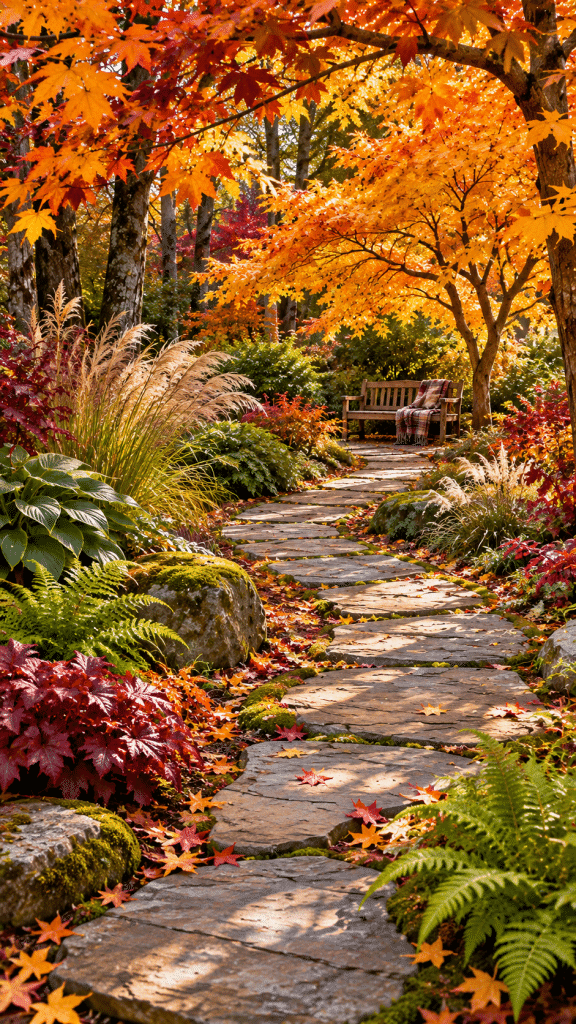
Imagine a gently meandering route composed of irregular natural stone slabs, passing beneath graceful deciduous trees and through layers of low-growing woodland plants.
Magnificent golden foliage provides a warm overhead canopy.
Ferns, shade-tolerant groundcovers, and soft moss-like textures introduce beautiful greenery along the edges.
A scattering of fallen leaves rests naturally among the planting areas, creating the impression of a peaceful forest floor.
The result is a breathtaking autumn garden pathway that feels organic, timeless, and wonderfully inviting.
The most successful woodland designs avoid excessive ornamentation.
Instead, they rely on the natural character of stone, carefully selected vegetation, and harmonious relationships between the pathway and surrounding landscape.
🍁 Choose Irregular Natural Stone for an Authentic Woodland Appearance
Natural stone provides the foundation for this enchanting pathway design.
Flagstone, slate, sandstone, and other suitable locally available stones can produce beautiful results.
For a woodland-inspired garden, irregular stone shapes often appear more natural than perfectly symmetrical paving patterns.
Their distinctive edges create an informal composition that resembles a walking trail through the countryside.
However, visual irregularity should not mean uncomfortable or unstable walking surfaces.
Choose stones with relatively even upper surfaces and appropriate slip resistance.
Each stone should be securely installed over a properly prepared base so that it does not rock when stepped on.
Spacing should reflect comfortable natural walking distances.
Before installing the stones permanently, arrange them temporarily and walk along the proposed route several times.
This simple process helps identify awkward steps, uncomfortable gaps, and unnecessary changes in direction.
Larger stepping stones can make the pathway feel more substantial while providing enough surface area for comfortable footing.
Where the pathway serves as an everyday access route, continuous paving may be more practical than widely spaced stones.
The goal is to preserve an organic appearance without compromising functionality.
🌳 Frame the Woodland Pathway With Beautiful Autumn Trees
Trees play an essential role in creating the magical atmosphere associated with woodland garden pathways.
Their branches provide overhead structure, while their changing foliage introduces magnificent seasonal colors.
Depending on climate, garden size, and growing conditions, suitable trees may include Japanese maples, serviceberries, dogwoods, and selected compact ornamental maples.
Japanese maples can create striking autumn displays in shades of scarlet, orange, and golden yellow, depending on the variety.
Serviceberries may provide attractive seasonal foliage and delicate branching patterns.
Certain dogwoods offer rich reddish or purple autumn colors, while their distinctive structure can remain attractive after leaf fall.
However, tree selection must consider mature dimensions.
Planting a large-growing tree too close to a narrow pathway can eventually cause overcrowding or conflicts with nearby paving.
Root behavior, available sunlight, soil conditions, and underground utilities should also influence placement.
An existing mature tree may already provide the perfect setting for a woodland-inspired trail.
Rather than planting additional trees unnecessarily, the pathway can be designed to celebrate the natural beauty of established vegetation.
🌳 The most captivating woodland pathways often use existing trees as their primary architectural features.
🌿 Introduce Layered Woodland Plants for Rich Natural Texture
A woodland pathway becomes more immersive when its edges contain several complementary planting layers.
Low-growing groundcovers can soften the visual boundary between stones and surrounding soil.
Ferns introduce delicate foliage textures, while suitable shade-tolerant perennials add seasonal interest.
Evergreen plants help maintain visual structure when deciduous foliage disappears.
For a harmonious effect, repeat selected plant varieties along the pathway instead of introducing a completely different species every few feet.
This creates a natural rhythm that guides the eye through the garden.
Consider contrasting broad leaves with finer fern foliage or pairing dark evergreen greenery with pale stone surfaces.
Plants should be chosen according to the actual growing conditions.
Some woodland species prefer moist, organic-rich soil, while others tolerate drier shade.
Avoid placing moisture-loving plants where soil remains consistently dry beneath mature tree roots.
Similarly, avoid forcing shade-loving plants into exposed areas that receive intense afternoon sunlight.
A successful woodland pathway feels lush because each plant thrives naturally in its chosen location.
🍂 Create a Golden Autumn Atmosphere Without Covering the Walking Surface
Fallen autumn leaves are among the most beautiful decorative elements in a woodland garden.
Their golden, amber, copper, and reddish colors provide seasonal richness that would be difficult to reproduce with artificial decorations.
However, fallen leaves should be treated as an accent rather than a thick covering across the walking route.
Leaves can remain in suitable planting beds and naturalized areas where they contribute to the woodland atmosphere.
On the actual pathway, regular clearing helps keep stepping stones visible and reduces slippery conditions.
This creates a beautiful contrast between the clean stone walking surfaces and the richly textured garden floor.
A natural leaf-mulch layer around suitable plants can also provide ecological benefits, although excessive buildup around crowns and trunks should be avoided.
The visual objective is controlled natural beauty.
A woodland trail should feel romantic and relaxed without becoming neglected or difficult to navigate.
🪵 Add a Rustic Resting Corner Along the Woodland Trail
A small resting area can transform a woodland pathway from a practical garden feature into an inviting outdoor experience.
Consider placing a simple weather-resistant wooden bench beside a particularly beautiful section of the trail.
Position it where visitors can appreciate seasonal foliage, a mature tree, or an attractive garden view.
A natural timber bench can complement the woodland setting without introducing excessive visual complexity.
Stone seating may provide another beautiful option for gardens with a more permanent architectural character.
The surrounding area can feature a modest arrangement of suitable evergreen plants or ornamental grasses.
Avoid placing decorative objects directly within the walking route.
The resting corner should feel like a natural extension of the pathway rather than an obstruction.
In a small backyard, even a compact bench positioned at the end of a short stepping-stone route can create the impression of a secluded garden destination.
The emotional appeal of this design comes from its simplicity.
A comfortable place to sit among changing autumn leaves can make the garden feel more peaceful, personal, and connected to nature.
🥈 Best 2 Fall Garden Pathway Ideas With Rustic Gravel Trails and Charming Cottage Garden Character
A rustic gravel pathway offers an irresistible combination of countryside charm, natural texture, and flexible garden design.
This approach is particularly attractive for homeowners who appreciate traditional cottage gardens, relaxed farmhouse landscapes, and romantic autumn outdoor spaces.
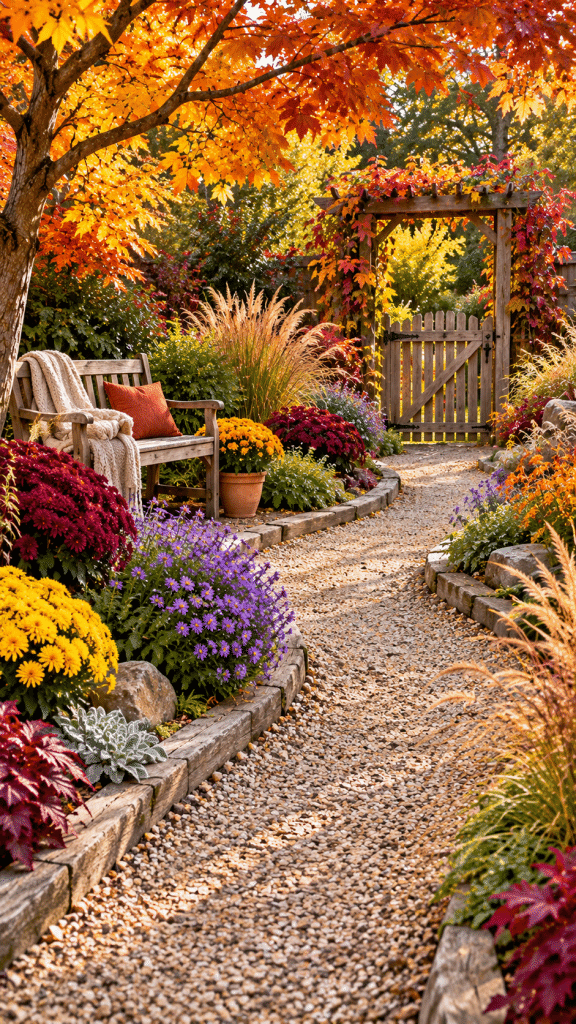
Imagine a beautiful gravel trail winding gently through a backyard, bordered by weathered timber edging, late-season flowers, and soft bronze-colored ornamental grasses.
The pale gravel creates a natural contrast against the surrounding autumn colors.
Rustic garden features introduce warmth, while carefully positioned plants soften the pathway’s edges.
Unlike a formal paved walkway, a gravel trail often feels relaxed and approachable.
Its simple texture encourages the eye to appreciate surrounding plants rather than concentrating exclusively on the walking surface.
With suitable base preparation, edging, and maintenance, gravel can also provide a practical surface for secondary garden routes.
🪨 Select Decorative Gravel That Complements Autumn Colors
The color and texture of gravel strongly influence the finished appearance of a pathway.
Warm beige, honey-colored, buff, and soft gray aggregates can look especially attractive against autumn vegetation.
Cream-colored gravel introduces a bright contrast beside burgundy foliage and dark evergreen plants.
Muted gray gravel creates a more understated appearance that works beautifully with weathered wood, bronze grasses, and rustic garden accessories.
Angular crushed aggregate generally interlocks more effectively than rounded pea gravel, making it a useful consideration where a firmer walking surface is desired.
Rounded stones may create an attractive decorative finish but can shift more readily underfoot.
Before selecting a material, consider its intended use.
A lightly used decorative trail has different performance requirements from a frequently traveled route carrying wheelbarrows or gardening equipment.
Gravel depth, particle size, supporting base, and edging all influence long-term performance.
It is also important to consider maintenance.
Gravel can migrate into adjacent planting areas, accumulate leaves, or require occasional replenishment.
A well-planned installation reduces these problems while preserving its beautiful natural appearance.
🪵 Define the Pathway With Rustic Timber or Natural Stone Edging
Edging plays an important role in keeping gravel pathways visually organized.
Without suitable boundaries, loose aggregate may gradually spread into nearby soil, lawn, or planting areas.
Rustic timber edging can reinforce a traditional cottage garden atmosphere.
Its warm brown color pairs beautifully with copper foliage, golden grasses, and natural garden textures.
Natural stone edging offers a more permanent appearance and may complement existing rock features.
Brick edging introduces classic countryside character, especially when paired with traditional garden architecture.
For a softer appearance, the edging can be visually integrated into adjacent planting rather than becoming a dominant decorative feature.
However, edging must remain secure and should not create an avoidable tripping hazard.
Where the pathway borders a lawn, properly installed flush or low-profile edging can simplify maintenance.
In an informal cottage garden, the best edging often appears almost invisible from a distance.
Its purpose is to maintain the pathway’s shape while allowing surrounding plants to remain the main attraction.
🌼 Surround the Gravel Trail With Late Season Flowers
One of the most beautiful aspects of a cottage garden pathway is its relationship with flowering plants.
During autumn, late-season flowers can introduce surprising bursts of color against an increasingly golden landscape.
Depending on local climate and growing conditions, suitable choices may include asters, chrysanthemums, sedums, and selected autumn-blooming perennials.
Asters can provide charming purple, lavender, pink, or blue-toned flowers.
Garden chrysanthemums introduce warm seasonal colors, including yellow, orange, burgundy, and bronze.
Autumn-flowering stonecrops, often sold as sedums, may develop beautiful pink or reddish flower heads that complement gravel and weathered timber.
These flowers can be arranged in natural-looking groups along the pathway.
Instead of planting individual specimens at equal intervals, create small repeating clusters that produce visual continuity.
For example, a group of burgundy chrysanthemums near one section of the trail can be balanced by another group farther along the route.
This approach creates movement without making the garden feel overly formal.
🌼 Beautiful cottage pathways achieve their romantic atmosphere through repeated natural textures and carefully balanced seasonal colors.
Plant spacing remains important.
Flowers should be positioned far enough from the walking surface to prevent overcrowding as they mature.
Overhanging stems may look charming in photographs but should not make the route difficult to use.
🌾 Introduce Ornamental Grasses for Soft Autumn Movement
Ornamental grasses are particularly valuable beside rustic gravel pathways because they introduce movement and seasonal texture.
Their delicate foliage can soften the hard visual character of gravel while creating a beautiful contrast in height.
Many suitable ornamental grasses develop warm golden, bronze, or reddish tones as temperatures change.
Their seed heads may remain attractive through late autumn and into winter.
Compact fountain grasses and certain native grass species can work well in appropriately sized gardens, although availability, hardiness, and invasive potential vary by region.
For smaller pathways, choose compact or clump-forming varieties that will not overwhelm the available space.
Consider placing taller grasses near wider planting sections or gentle changes in direction.
Shorter varieties can soften nearby edges without obstructing the walkway.
Repeating the same grass in several places creates a cohesive design.
During autumn breezes, their movement introduces a dynamic quality that contrasts beautifully with the stillness of natural stone and gravel.
The result is a garden pathway that feels alive throughout the season.
🏡 Create a Charming Destination With Rustic Garden Features
A pathway becomes more interesting when it leads toward a recognizable destination.
For a rustic cottage garden, this might be a small potting corner, a traditional wooden gate, a simple arbor, or a secluded seating area.
A weathered garden bench surrounded by seasonal planting can become an attractive focal point.
Alternatively, a modest timber arbor can create a graceful transition between two different garden spaces.
The destination does not need to be expensive or elaborate.
In fact, restrained designs often look more authentic.
A simple wooden gate framed by mature plants can create a charming countryside atmosphere without requiring extensive construction.
For backyard gardens with limited space, the gravel trail may connect a patio to a raised-bed gardening area or small outdoor retreat.
This creates a practical relationship between everyday garden activities and the pathway’s decorative character.
The most important consideration is ensuring the route feels purposeful.
A pathway that connects meaningful garden spaces generally creates a stronger landscape composition than one introduced solely as decoration.
🥉 Best 3 Fall Garden Pathway Ideas With Modern Geometric Pavers and Sophisticated Autumn Contrast
Modern geometric garden pathways offer a striking alternative to traditional woodland and cottage garden designs.
This approach combines clean architectural lines, carefully selected paving materials, and restrained autumn planting to create an exceptionally elegant outdoor environment.
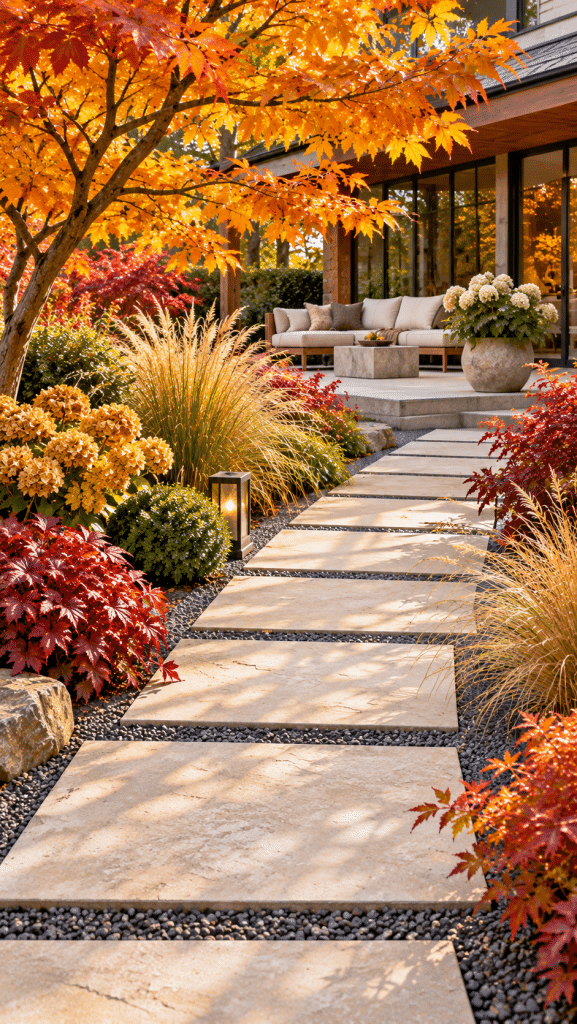
Imagine a contemporary backyard featuring large rectangular stone pavers arranged in a rhythmic sequence across a beautifully organized landscape.
Dark decorative gravel or low-growing greenery creates contrast between the paving sections.
Golden ornamental grasses soften the surrounding edges, while deep burgundy foliage introduces rich seasonal color.
The result resembles a professionally designed outdoor space associated with sophisticated modern homes and luxury landscape architecture.
What makes this style particularly appealing is its balance between simplicity and visual impact.
Instead of relying on numerous decorative accessories, the design emphasizes proportion, repetition, materials, and carefully controlled color.
⬜ Use Large Rectangular Pavers for a Bold Architectural Statement
Large-format rectangular or square pavers establish the visual foundation of a modern garden pathway.
Their clean edges and consistent proportions introduce order into the surrounding landscape.
Depending on the home’s architecture, suitable materials may include textured concrete pavers, natural stone slabs, or high-quality outdoor paving products.
Warm gray, limestone beige, charcoal, and muted taupe can work especially well with autumn colors.
Light pavers appear striking beside dark gravel and bronze planting.
Charcoal surfaces can create a sophisticated contrast with golden leaves and ornamental greenery.
However, dark paving may absorb considerable heat in sunny conditions, so material choice should account for local climate and intended use.
Surface texture is equally important.
Avoid selecting highly polished materials simply because they appear luxurious in photographs.
Outdoor paving should provide suitable traction when wet.
For a clean contemporary appearance, keep the pathway layout visually consistent.
A regular pattern of rectangular pavers can create an elegant rhythm without requiring complicated decorative arrangements.
📐 Create Visual Rhythm Through Thoughtful Paver Spacing
The spacing between modern pavers contributes significantly to the overall design.
Evenly arranged slabs can create a pleasing sense of movement.
However, spacing should never be determined exclusively by appearance.
The pathway must remain comfortable and safe for its intended users.
For a decorative garden route, individual stepping stones may provide an attractive visual effect.
For frequently used paths, a more continuous and stable surface is often preferable.
Large spaces between slabs can make walking uncomfortable, particularly for children, older visitors, or people using mobility aids.
A modern design can still preserve its geometric character with closely arranged paving and narrow, properly constructed joints.
Before permanent installation, test the layout by walking naturally along the proposed route.
Consider how the pathway will function when carrying garden tools, watering cans, or outdoor supplies.
The best contemporary pathways appear effortless because their dimensions have been carefully considered.
🌿 Combine Minimalist Paving With Sculptural Autumn Plants
Modern pathway planting emphasizes structure and repetition.
Instead of using numerous unrelated plant varieties, select a restrained palette with complementary forms and colors.
Clump-forming ornamental grasses can create elegant vertical accents.
Compact evergreen shrubs establish year-round stability.
Dark-leaved perennials or suitable burgundy foliage plants introduce dramatic contrast.
Low-growing groundcovers can soften selected transitions between paving and planting areas.
The strongest compositions often repeat a few distinctive plant forms.
For example, a sequence of bronze-toned grasses can establish movement along one side of the pathway.
A group of neatly shaped evergreen shrubs can introduce visual balance on the opposite side.
A carefully positioned specimen plant may serve as a focal point near the pathway’s destination.
Avoid introducing too many competing elements.
The beauty of modern garden design comes from making every material and plant feel intentional.
🍂 A sophisticated autumn garden pathway can achieve remarkable visual impact with only a few carefully selected colors and textures.
💡 Introduce Subtle Warm Lighting for an Elegant Autumn Evening Atmosphere
Lighting can dramatically change the appearance of a modern pathway after sunset.
During autumn, shorter daylight hours make practical garden illumination especially valuable.
Low-voltage or appropriately rated outdoor lighting can help define the walking route while highlighting selected architectural features.
Warm-white lighting often complements the rich tones of autumn foliage.
Recessed fixtures, low-profile bollards, and discreet landscape lights can work beautifully when installed appropriately.
Instead of placing bright fixtures along every section, focus on areas where illumination improves orientation and visibility.
Changes in direction, transitions between surfaces, and nearby steps deserve particular attention.
Lighting should not create uncomfortable glare or shine directly into neighboring properties.
For a refined visual effect, the pathway itself should remain the main architectural feature.
The lighting simply reveals its form after dark.
🖤 Pair Modern Pavers With Dark Gravel and Golden Foliage
One of the most compelling modern autumn color combinations features light paving, dark gravel, and golden vegetation.
This palette creates impressive contrast without relying on excessive ornamentation.
Pale rectangular pavers provide visual clarity.
Charcoal or dark gray gravel defines the surrounding spaces.
Golden ornamental grasses introduce natural warmth.
A few carefully selected burgundy plants can add depth and sophistication.
This combination works particularly well in contemporary gardens where architectural simplicity is important.
For a softer version, replace dark gravel with warm beige aggregate and use muted bronze foliage.
For a more dramatic appearance, choose medium-gray paving framed by rich planting greens and copper-colored grasses.
The specific palette should complement existing garden materials, including fencing, patios, retaining walls, and outdoor furniture.
Coordinating these elements creates a cohesive landscape rather than a collection of disconnected decorative features.
📊 Comparing the Best 3 Fall Garden Pathway Ideas
Each pathway style offers distinctive visual qualities and practical considerations.
The ideal choice depends on the garden’s architecture, existing vegetation, expected foot traffic, available budget, and maintenance preferences.
| Design feature | 🥇 Woodland Stepping Stones | 🥈 Rustic Gravel Trail | 🥉 Modern Geometric Pavers |
|---|---|---|---|
| Main visual appeal | Enchanting natural woodland atmosphere | Romantic countryside charm | Sophisticated contemporary elegance |
| Primary materials | Irregular natural stone | Decorative crushed gravel | Large-format stone or concrete pavers |
| Autumn color palette | Golden yellow, amber, forest green | Copper, beige, burgundy, bronze | Charcoal, taupe, gold, muted green |
| Best garden setting | Shaded and woodland-inspired gardens | Cottage gardens and informal backyards | Contemporary and minimalist landscapes |
| Suggested planting | Ferns, shade plants, woodland groundcovers | Asters, chrysanthemums, ornamental grasses | Sculptural grasses, evergreens, structural perennials |
| Maintenance needs | Leaf clearing, weeding, stone inspection | Raking, edging maintenance, occasional gravel replenishment | Surface cleaning, joint maintenance, paver inspection |
| Walking surface | Individual stones or continuous natural paving | Loose aggregate | Individual or continuous paved sections |
| Accessibility consideration | Wide gaps may limit access | Loose gravel can be difficult for wheels | Firm continuous paving can provide better access when properly designed |
| Design personality | Peaceful and romantic | Welcoming and rustic | Elegant and architectural |
The comparison highlights an important consideration: the most visually impressive pathway is not necessarily the most practical choice for every garden.
A woodland trail may be ideal for a quiet shaded backyard.
A rustic gravel route can suit a relaxed countryside setting.
A modern paved pathway may provide a more appropriate surface where stable everyday access is a priority.
The University of Florida’s landscape guidance similarly emphasizes choosing garden walkways according to circulation needs, surrounding landscape design, and material performance rather than appearance alone. Gardening Solutions
🛠️ How to Plan Beautiful Fall Garden Pathway Ideas Before Installation
Even the most beautiful pathway design can disappoint if installation begins without adequate planning.
A successful project should consider circulation, drainage, soil stability, garden dimensions, and long-term maintenance.
These practical details are especially important during autumn because wet weather and fallen leaves may expose weaknesses that remain unnoticed in summer.
📏 Measure the Available Space and Determine the Pathway’s Purpose
Begin by identifying the pathway’s primary function.
Will it provide daily access between the house and a backyard seating area?
Will it connect a vegetable garden to a tool shed?
Or will it serve as a decorative walking trail through ornamental planting?
Different purposes require different dimensions and surface choices.
A narrow secondary garden path may accommodate occasional single-person use.
A frequently used main route should provide more comfortable space for movement and carrying items.
As a general planning reference, walkways around 36 inches wide or greater may be appropriate for many everyday residential routes, while paths intended for two people walking together may require additional width. Gardening Solutions
Accessibility requirements can demand different dimensions, turning areas, slopes, and surface specifications.
Before finalizing the layout, evaluate how people actually move through the garden.
A beautifully curved route may be unnecessary if everyday users naturally prefer a direct connection.
A decorative trail may benefit from gentle movement where its main purpose is relaxation and exploration.
Good design combines visual appeal with comfortable circulation.
💧 Prepare the Ground for Reliable Autumn Drainage
Drainage is one of the most important considerations when installing a garden pathway.
Autumn rainfall can reveal low spots where water collects, soil becomes muddy, or paving remains damp for extended periods.
Before construction, observe how rainwater moves through the proposed area.
Identify locations where puddles form or runoff travels toward buildings.
Different pathway materials require different installation methods.
Gravel needs an appropriately prepared, stable, free-draining base.
Natural stone requires secure support to prevent uneven settlement.
Modern paving may require carefully constructed bedding, edge restraints, and suitable drainage provisions.
Where practical, permeable materials can help rainwater infiltrate the ground rather than immediately becoming surface runoff.
The Royal Horticultural Society recommends considering permeable paving because extensive impermeable surfaces can increase runoff and contribute to drainage problems. RHS Advice
For challenging slopes, persistently saturated soil, or routes close to building foundations, professional drainage advice may be appropriate.
A pathway should not accidentally direct water toward the house or neighboring property.
🪨 Choose Pathway Materials Based on Seasonal Performance
Material selection should consider much more than color.
The surface must tolerate expected weather conditions, foot traffic, and routine maintenance.
Natural stone offers long-lasting visual appeal when installed correctly.
Gravel can provide an attractive informal surface but requires containment and occasional upkeep.
Concrete pavers offer flexibility in dimensions and architectural styles.
Some materials may become slippery when covered with algae, moisture, or decomposing leaves.
Others can become unstable if their supporting base is poorly prepared.
Selecting a suitable texture, foundation, and drainage system helps prevent these problems.
For gardens in cold climates, freeze-thaw conditions and frost movement may also influence construction requirements.
For regions with heavy autumn rainfall, drainage and slip resistance deserve particular attention.
⚠️ Important Note: Never sacrifice pathway safety for decorative appearance. Wet autumn leaves can conceal uneven stones and create slippery walking conditions, especially on smooth paving. Keep frequently used routes clear, provide adequate lighting, and choose stable, slip-resistant surfaces with appropriate drainage. Raised or loose paving should be repaired promptly, and any major changes involving steep slopes or accessibility should be designed according to applicable local requirements.
A well-constructed pathway can remain attractive for many years, making careful preparation more valuable than temporary visual shortcuts.
🍁 How to Make Fall Garden Pathway Ideas Look More Beautiful With Seasonal Details
Once the pathway’s permanent structure is established, subtle seasonal elements can enhance its appearance.
The most sophisticated autumn gardens use decoration to reinforce existing landscape character rather than conceal it.
Natural materials, suitable plants, and controlled lighting often create a stronger result than excessive seasonal accessories.
🎃 Add Small Seasonal Accents Without Overcrowding the Path
Decorative pumpkins and gourds can introduce charming autumn character when placed thoughtfully beside a pathway.
In a rustic cottage garden, a small grouping near a bench or garden entrance may complement gravel and weathered timber.
A woodland pathway can benefit from natural arrangements featuring suitable branches, pinecones, and seasonal textures.
Modern gardens generally look more cohesive with fewer decorative items.
A restrained arrangement beside a focal plant may be more effective than numerous accessories distributed along the entire route.
Keep decorations outside the walking area.
Avoid stacking objects where they could roll, fall, obstruct visibility, or interfere with routine maintenance.
Seasonal accents should enhance the garden rather than create additional hazards.
🌻 Repeat Autumn Colors for a Harmonious Landscape
Color repetition is an effective way to make a garden pathway look professionally designed.
Instead of introducing a completely new decorative palette at every turn, select a few complementary autumn colors.
For a woodland garden, golden yellow, deep green, and natural brown can create a peaceful atmosphere.
For a cottage garden, combine copper, burgundy, muted pink, and rustic beige.
For a modern pathway, consider charcoal, soft taupe, bronze, and restrained golden accents.
Repeat these colors through suitable plants, pathway materials, and selected accessories.
This creates visual continuity from the beginning of the pathway to its destination.
It also allows the garden to remain attractive as individual plants change throughout the season.
🌙 Extend the Beauty of the Pathway Into Autumn Evenings
Autumn garden pathways can look especially beautiful during the early evening.
Warm lighting can reveal the texture of natural stone, highlight ornamental grasses, and create inviting contrasts between illuminated and shaded areas.
For a woodland trail, discreet lighting may emphasize selected trees or changes in direction.
For a rustic gravel pathway, modest low-profile fixtures can provide practical orientation.
For a contemporary paved route, carefully positioned architectural lighting reinforces the geometric layout.
Choose outdoor-rated products suitable for the installation environment.
Lighting should be secure, weather-resistant, and arranged to minimize glare.
The overall effect should feel welcoming rather than excessively bright.
💰 Budget Friendly Ways to Create Beautiful Fall Garden Pathways
A stunning garden pathway does not always require a complete landscape renovation.
Existing materials, thoughtful planning, and gradual improvements can produce remarkable results.
The most economical approach often begins by identifying which parts of the current pathway can be retained.
🔨 Refresh an Existing Path Before Replacing It
An older pathway may appear unattractive because of accumulated dirt, overgrown edges, weeds, or uneven landscaping.
Before removing the entire structure, evaluate whether careful repairs could restore its appearance.
Cleaning suitable paving surfaces can reveal their original colors.
Repositioning loose stones may improve comfort and visual consistency when the underlying problem is also corrected.
Refreshing adjacent planting can make an ordinary path feel completely different.
A simple border of suitable autumn flowers or ornamental grasses may transform the overall composition.
For gravel pathways, correcting edging problems and replenishing displaced aggregate can improve both appearance and usability.
These smaller improvements are often more affordable than full replacement.
🌿 Invest in a Few Long Lasting Plants
Plants can dramatically influence how expensive or sophisticated a pathway appears.
However, purchasing numerous mature specimens may not be necessary.
A smaller selection of well-positioned plants can create greater visual impact than crowded planting.
Choose species that match the garden’s sunlight, soil, climate, and available space.
Repeat complementary plants along the pathway to create a cohesive landscape.
Allow sufficient room for mature growth.
A thoughtful planting arrangement can become more beautiful over time as vegetation establishes naturally.
🧱 Use One Main Material for a More Cohesive Appearance
Combining too many pathway materials can make a small garden appear visually cluttered.
Using one dominant surface often creates a stronger impression.
For example, a rustic gravel trail can rely primarily on a consistent aggregate color.
A woodland pathway can feature one coordinated family of natural stones.
A modern route can use matching geometric pavers throughout the space.
Accent materials may still be introduced selectively, but they should support the main design.
This approach can simplify installation, purchasing decisions, and future repairs.
It also makes the garden feel carefully organized rather than assembled from unrelated elements.
❄️ Keeping Fall Garden Pathways Beautiful Through Winter and Spring
A successful autumn pathway should remain practical and visually attractive after the season ends.
As trees lose their leaves and flowering plants become dormant, the pathway’s permanent structure becomes more prominent.
This is when durable materials, well-defined edges, and evergreen planting demonstrate their long-term value.
🍂 Maintain Clear Walking Surfaces During Late Autumn
Fallen leaves can collect quickly along garden paths, particularly beneath deciduous trees.
Regular clearing helps preserve the appearance of paving and gravel while reducing slip risks.
Remove accumulated leaves from frequently used walking surfaces.
Inspect low spots where water may collect.
Check gravel edging and ensure loose material has not spread into adjacent lawns or planting areas.
Look for rocking pavers or exposed roots that may require attention.
Avoid aggressive cleaning techniques that could damage natural stone, paving joints, or surrounding plants.
Regular light maintenance is often more effective than allowing debris and organic growth to accumulate for long periods.
🌲 Preserve Winter Structure With Evergreen Plants
Evergreen plants can maintain attractive garden composition after deciduous foliage disappears.
Compact shrubs, suitable conifers, and evergreen groundcovers may provide year-round color and texture.
Choose plants according to their mature size and environmental requirements.
Avoid allowing branches to obstruct the pathway.
In woodland settings, evergreen foliage can provide contrast against pale winter stone.
In cottage gardens, structured greenery creates balance among dormant perennials.
In contemporary landscapes, evergreen forms reinforce the pathway’s architectural simplicity.
The goal is to preserve visual interest without relying exclusively on seasonal flowers.
🌷 Prepare the Pathway for a Beautiful Spring Transition
As winter ends, the pathway becomes an important framework for emerging spring growth.
Inspect the walking surface for seasonal damage.
Reposition or repair unstable materials where necessary.
Refresh appropriate planting areas and remove weeds before they spread.
Evaluate whether any plants have outgrown their original space.
The pathway should remain visible and comfortable as surrounding vegetation expands.
Spring bulbs and suitable early-flowering perennials may offer attractive seasonal accents, provided they are planted according to local growing conditions.
An intelligently designed pathway supports these changes without requiring a complete redesign every season.
This long-term flexibility is one of the strongest reasons to invest in quality garden circulation and durable landscape materials.
🌟 Which Fall Garden Pathway Idea Is Best for Your Backyard
The perfect pathway depends on the atmosphere you want to create and how the garden will be used.
For a peaceful, nature-inspired backyard, woodland stepping stones offer exceptional charm.
Their irregular stone forms, golden foliage, and shade-tolerant planting create an enchanting retreat that feels connected to the natural landscape.
For a relaxed garden with traditional countryside personality, rustic gravel provides warmth and flexibility.
Its textured surface pairs beautifully with late-season flowers, ornamental grasses, and simple wooden garden features.
For a contemporary outdoor space, modern geometric paving offers architectural sophistication.
Large-format pavers, restrained planting, and carefully balanced autumn colors can create a luxurious appearance without excessive decoration.
The three approaches should not necessarily be combined within one small garden.
A clear design identity often produces a stronger overall impression.
However, larger properties may use different pathway treatments in separate areas where they serve distinct functions.
A firm paved main route might connect everyday destinations, while a secondary woodland trail provides a peaceful recreational walk.
The important principle is maintaining visual continuity through coordinated materials, planting, and landscape character.
A beautiful pathway should feel naturally connected to the garden around it.
✨ Final Thoughts on the Best 3 Fall Garden Pathway Ideas
The most captivating Fall Garden Pathway Ideas combine beautiful natural materials, thoughtful seasonal planting, and practical landscape design to transform ordinary backyard spaces into extraordinary autumn retreats.
An impressive garden pathway does not need extravagant decorations or unnecessarily complicated construction.
Its beauty comes from proportion, harmonious colors, reliable materials, and the way it invites people to experience the surrounding landscape.
🥇 Woodland Stepping Stones With Golden Autumn Leaves create an enchanting natural atmosphere, combining irregular stone surfaces, graceful trees, layered greenery, and peaceful garden scenery.
🥈 Rustic Gravel Trails With Cottage Garden Charm introduce romantic countryside character through decorative aggregate, weathered edging, late-season flowers, and softly moving ornamental grasses.
🥉 Modern Geometric Pavers With Sophisticated Autumn Contrast deliver contemporary elegance through clean architectural lines, striking material combinations, sculptural planting, and subtle landscape lighting.
Each design offers a distinctive opportunity to celebrate autumn while improving the garden’s everyday functionality.
A woodland trail creates a sense of quiet discovery.
A gravel pathway introduces warmth and rustic personality.
A geometric paved walkway transforms garden circulation into an elegant architectural statement.
Choosing the right design begins with understanding the existing outdoor environment, including sunlight, soil conditions, available dimensions, drainage, and the relationship between planting and hardscape features.
Permanent materials should provide reliable structure, while seasonal plants and restrained decorative details introduce changing colors and textures.
The result is a garden that feels beautiful during autumn yet remains welcoming throughout the year.
🍁 With thoughtfully selected stones, charming natural textures, elegant foliage combinations, and a pathway that invites exploration, even a simple backyard can become a breathtaking autumn paradise filled with warmth, beauty, and timeless garden character.