Planting fall cover crops for raised beds is one of the most effective ways to improve soil fertility, protect valuable nutrients, suppress unwanted weeds, and prepare your vegetable garden for a more productive growing season. Instead of leaving raised beds empty after the final autumn harvest, you can grow beneficial plants that continue working beneath the soil surface throughout fall and winter.

Cover crops are sometimes called green manure or living soil protectors because they provide benefits without necessarily producing an edible harvest. Their roots help improve soil structure, support beneficial microorganisms, capture nutrients, and create a healthier growing environment for future vegetables.
What makes this gardening technique particularly attractive is that it allows nature to perform much of the work. Rather than depending entirely on purchased soil amendments every spring, gardeners can use carefully selected plants to help maintain the long-term productivity of their raised beds.
However, not every cover crop is suitable for a small raised bed. Some grow aggressively, while others are difficult to terminate before spring planting. Choosing the right varieties can make the difference between a healthier vegetable garden and unnecessary maintenance.
The following three fall cover crop strategies offer different advantages, from low-maintenance winter soil protection to biological nitrogen fixation and deep soil improvement.
Why Fall Cover Crops for Raised Beds Are a Game Changer for Soil Health
Raised beds offer exceptional advantages for growing vegetables, herbs, and other edible plants. However, intensive gardening can gradually reduce soil fertility, particularly when the same growing spaces produce multiple harvests throughout the year.
Every tomato, cucumber, pepper, and leafy vegetable absorbs nutrients from the soil. Without an effective strategy for maintaining those nutrients and supporting soil biology, raised beds may become less productive over time.
Fall cover cropping addresses this challenge by introducing plants specifically selected for their soil-building properties.
🌱 Maintaining an Active Underground Ecosystem
Healthy garden soil contains an extraordinary community of bacteria, fungi, earthworms, and other beneficial organisms. These organisms contribute to nutrient cycling, organic matter decomposition, and the development of stable soil aggregates.
Living cover crop roots release organic compounds that provide resources for microorganisms surrounding the root system. This underground activity can continue whenever temperatures and moisture conditions remain suitable for plant growth.
Even after winter-sensitive cover crops die, their decomposing roots provide organic material that contributes to the soil ecosystem.
Rather than treating raised bed soil as a simple growing medium, cover cropping encourages gardeners to manage it as a living biological system.
Capturing Nutrients Before Winter
After summer vegetables finish growing, unused nutrients may remain in the soil. Autumn rainfall and winter precipitation can move some of these nutrients beyond the reach of future vegetable roots.
Fast-growing cover crops absorb available nutrients and temporarily store them within their leaves, stems, and roots.
As terminated cover crops decompose, some of these nutrients gradually become available again. The rate of nutrient release depends on temperature, moisture, plant maturity, and the characteristics of the cover crop.
This process is particularly valuable in raised beds containing lightweight soil mixtures that drain quickly.
Improving Soil Structure Without Excessive Digging
Repeated digging can disturb existing soil aggregates and fungal networks. Cover crops offer another approach by allowing living roots to penetrate the growing medium naturally.
Different cover crop species produce different root structures. Some develop dense networks of fine roots, while others produce deeper root systems that explore lower soil layers.
When these roots decompose, they contribute organic matter and leave small channels that can support water infiltration, root development, and soil aeration.
Over several growing seasons, consistent cover cropping can become an important component of a long-term soil improvement strategy.
Best 3 Fall Cover Crops for Raised Beds at a Glance
The most suitable cover crop depends on your local winter temperatures, spring planting schedule, available growing space, and soil improvement objectives.
These three options represent distinctly different approaches to autumn cover cropping.
| Cover crop strategy | Primary benefit | Winter behavior | Spring maintenance | Ideal for |
|---|---|---|---|---|
| Oats and field peas | Nutrient capture and nitrogen fixation | Usually winterkills in sufficiently cold climates | Low in cold regions | Early spring vegetables |
| Crimson clover | Biological nitrogen fixation | Climate dependent | Moderate | Nutrient-demanding summer vegetables |
| Winter cereal rye | Extensive root growth and nutrient capture | Highly winter hardy | Moderate to high | Late spring and summer planting |
Oats and field peas provide a practical starting point for many gardeners, while crimson clover offers a legume-focused approach. Winter cereal rye is especially useful when stronger winter protection and extended root activity are priorities. Pertanian Purdue+2
🥇 Best 1 Fall Cover Crops for Raised Beds With an Oat and Field Pea Mixture for Effortless Spring Preparation
An oat and field pea mixture is an excellent introduction to cover cropping because it combines two complementary plant families within the same raised bed.
Oats belong to the grass family, while field peas belong to the legume family. Together, they provide different root structures, nutrient-management functions, and decomposition characteristics.
This combination is particularly attractive for gardeners who want to improve their soil without creating a complicated spring maintenance routine.
In sufficiently cold winter climates, both plants can naturally die back, leaving organic residues and decomposing roots behind.

Why Oats and Field Peas Work So Well Together
Oats develop extensive fibrous roots that occupy numerous small spaces throughout the upper soil layers.
These roots help capture available nutrients while supporting the development of soil aggregates. The upright growth of oats also provides physical support for the climbing stems of field peas.
Field peas contribute another valuable function through their association with nitrogen-fixing bacteria. When compatible bacteria are present and growing conditions are suitable, small nodules develop on the roots.
Inside these nodules, atmospheric nitrogen is converted into forms that support plant growth.
The combination creates a more diverse biological environment than growing either crop independently. Oats emphasize nutrient capture and fibrous root development, while field peas offer the potential to introduce biologically fixed nitrogen into the system.
Creating a Balanced Cover Crop Mixture
Successful cover crop mixtures require thoughtful seed distribution. Planting too many oats can create excessive competition, while an overly dense field pea planting can reduce airflow and make the cover crop difficult to manage.
A commercially prepared oat and field pea mixture designed for garden cover cropping is often the simplest choice.
Alternatively, gardeners can purchase the seeds separately and combine them according to recommended mixed-crop seeding rates.
| Plant characteristic | Oats | Field peas |
|---|---|---|
| Plant family | Grass | Legume |
| Root structure | Dense fibrous roots | Branched roots |
| Growth habit | Upright | Climbing or spreading |
| Primary soil function | Nutrient capture | Nitrogen fixation potential |
| Residue characteristics | Relatively carbon rich | Relatively nitrogen rich |
| Winter survival | Generally limited in cold climates | Depends on variety and temperature |
The objective is to establish a healthy and reasonably uniform plant population rather than achieving maximum growth density.
A balanced mixture allows both species to occupy their respective ecological roles without overwhelming the limited growing area of a raised bed.
When to Plant Oats and Field Peas in Fall
Timing is especially important because this mixture needs sufficient autumn growing time before prolonged freezing temperatures arrive.
A practical starting point is sowing approximately six to eight weeks before the expected first fall frost, adjusting the schedule for local conditions and seed recommendations.
Gardeners in northern regions may need to sow in late summer, while those experiencing longer autumn seasons can often plant later.
The ideal opportunity typically occurs when an early vegetable crop finishes producing and its growing space becomes available.
For example, a raised bed previously occupied by bush beans, early potatoes, or cucumbers may become an excellent location for this mixture.
How to Plant an Oat and Field Pea Cover Crop
Begin by removing remaining vegetable plants that would interfere with seed establishment.
The soil surface should be reasonably level, with enough loose material to provide good contact between the seeds and soil.
Field peas generally benefit from deeper placement than oats. Sowing the two species separately can therefore provide more consistent establishment than scattering them together without considering seed depth.
A practical approach involves the following planting sequence:
- Sow field peas approximately 1 to 1½ inches deep, following the seed supplier’s instructions.
- Distribute oat seeds evenly across the bed.
- Cover the oats with approximately ½ to 1 inch of soil.
- Gently firm the surface without compacting the entire bed.
- Water thoroughly using a gentle spray.
- Maintain consistent moisture during germination.
Once the seedlings establish themselves, the cover crop usually requires relatively little intervention beyond occasional watering during dry weather.
Avoid unnecessary nitrogen fertilizer applications, especially when encouraging the nitrogen-fixing activity of legumes.
What Happens During Winter
One of the most appealing characteristics of this cover crop mixture is its potential to winterkill.
In regions experiencing sufficiently cold temperatures, oats and many field pea varieties gradually die during winter. Their foliage settles onto the soil surface, while their root systems begin decomposing underground.
The dead vegetation continues to provide some physical protection against rainfall and wind.
As temperatures rise in spring, microbial activity increases and the organic residues gradually break down.
In milder winter climates, however, some plants may survive. Gardeners should inspect the bed rather than automatically assuming the entire cover crop has died. Penn State Extension+1
Preparing the Raised Bed for Early Spring Vegetables
By early spring, an oat and field pea bed that has successfully winterkilled may require very little preparation.
Excessive surface residues can be moved aside where direct seeding is planned. Decomposing roots can remain underground, where they contribute organic material without requiring removal.
If any living plants remain, terminate them before establishing vegetables.
This approach works particularly well for gardeners planning to grow lettuce, spinach, carrots, radishes, or other vegetables that benefit from an early planting window.
The relatively straightforward transition between autumn cover cropping and spring vegetable production makes this mixture the most versatile choice for many small raised bed gardens.
The Biggest Advantages of This Cover Crop Strategy
The greatest advantage is the balance between soil improvement and manageable maintenance.
Gardeners receive the benefits of two complementary plant types without necessarily needing specialized equipment, extensive digging, or complicated spring termination.
It is also an approachable method for beginners who want to observe how cover crops perform before experimenting with more persistent winter-hardy species.
Over time, rotating an oat and field pea mixture through different raised beds can help distribute these benefits throughout the vegetable garden.
🥈 Best 2 Fall Cover Crops for Raised Beds With Crimson Clover for Natural Nitrogen Enrichment
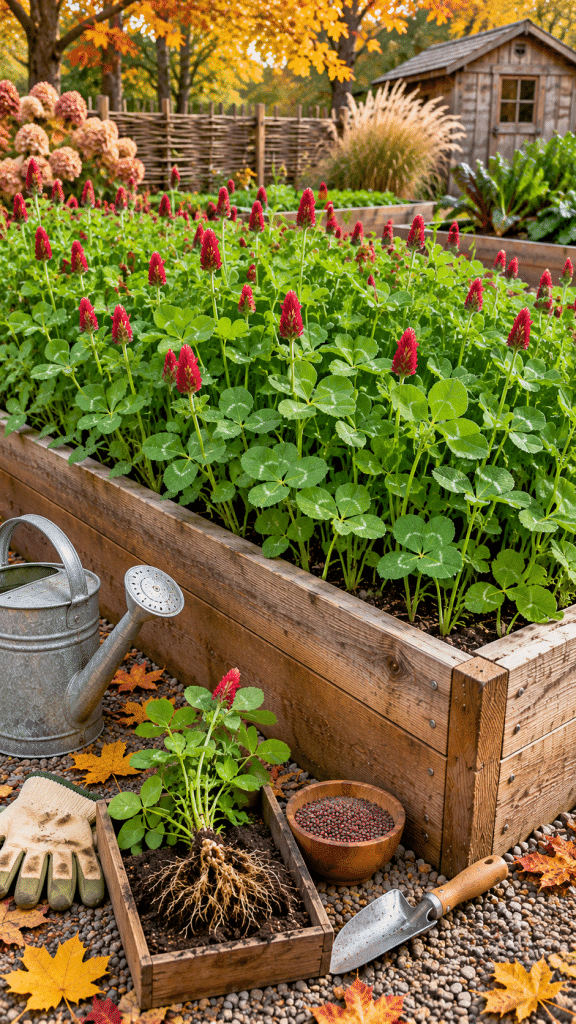
Crimson clover is an outstanding choice for gardeners who want to emphasize biological soil fertility while introducing a visually attractive and functional plant into their autumn growing spaces.
Its botanical name is Trifolium incarnatum, and it is widely recognized for its distinctive green foliage and deep crimson flower heads.
Unlike permanent clover lawns, crimson clover can be managed as a temporary annual cover crop that occupies a raised bed between vegetable-growing seasons.
Its most important contribution comes from its ability to form beneficial relationships with nitrogen-fixing soil bacteria.
Understanding the Nitrogen Fixation Process
Nitrogen is essential for plant development because it contributes to chlorophyll production, proteins, and numerous biological processes.
Although the atmosphere contains abundant nitrogen, most garden vegetables cannot directly access atmospheric nitrogen gas.
Crimson clover forms a symbiotic relationship with compatible rhizobia bacteria. These microorganisms establish nodules on the plant roots, where biological nitrogen fixation takes place.
The resulting nitrogen supports the growth of the clover itself. When the plant is terminated and its biomass decomposes, some of this nitrogen can become available to subsequent crops.
The actual contribution varies considerably depending on plant growth, soil conditions, bacterial activity, and termination timing.
Crimson clover should therefore be viewed as a biological fertility-building tool rather than a guaranteed replacement for every fertilizer application.
Why Crimson Clover Is Particularly Suitable for Raised Beds
Many traditional cover crops develop substantial amounts of vegetation that can become difficult to manage within confined growing spaces.
Crimson clover generally offers a more manageable growth habit than vigorous climbing legumes such as hairy vetch.
Its relatively low-growing foliage during early development allows it to establish a protective plant community without immediately overwhelming the raised bed.
As the growing season progresses, the root system explores the soil while aboveground foliage captures sunlight and contributes organic material.
The result is a cover crop that combines practical soil-management benefits with attractive seasonal growth.
Selecting the Right Planting Window
Crimson clover benefits from an early enough autumn start to establish a healthy root system before severe winter conditions.
Planting approximately six to eight weeks before the expected first frost is a useful starting point, although local recommendations may differ.
In mild-winter regions, autumn-planted crimson clover can survive and resume vigorous growth as temperatures increase.
In colder regions, winter survival becomes less predictable. Snow cover, extreme temperatures, soil drainage, and variety selection can all influence the outcome.
| Winter climate | Potential crimson clover performance |
|---|---|
| Mild winters | Often survives and resumes growth in spring |
| Moderate winters | Survival depends on establishment and weather |
| Severe winters | Significant winter damage or winterkill may occur |
| Wet winters | Poor drainage may reduce establishment and survival |
Gardeners should choose their planting schedule according to regional climate conditions rather than relying exclusively on calendar dates.
How to Establish Crimson Clover Successfully
Crimson clover seeds are considerably smaller than oat or field pea seeds. Consequently, they require a finer seedbed and shallower planting depth.
A smooth, lightly loosened soil surface provides a suitable foundation for germination.
Seeds can be distributed uniformly across the raised bed and covered with a thin layer of soil, generally around ¼ inch deep or according to the seed supplier’s guidance.
Where compatible rhizobia bacteria are not already present, using an appropriate legume inoculant may improve the likelihood of successful nodulation.
After planting, maintain consistent moisture until seedlings become established.
Water gently because strong water pressure can displace the small seeds and create uneven plant distribution.
🌿 Supporting Soil Biology With Living Clover Roots
A healthy crimson clover planting creates more than a visible layer of green foliage.
Below the surface, developing roots interact with soil microorganisms and contribute organic compounds to the surrounding soil environment.
These interactions are particularly valuable in intensively managed raised beds where periods of continuous vegetable production may alternate with extended periods of bare soil.
As clover roots expand and eventually decompose, they contribute to the ongoing turnover of organic materials.
This biological activity complements other soil fertility practices, including appropriate nutrient management and thoughtful crop rotation.
When to Terminate Crimson Clover in Spring
Crimson clover requires a carefully planned termination schedule when it survives winter.
Allowing it to develop additional spring growth can increase biomass and potentially improve its nitrogen contribution. However, extending the cover crop growing period also delays vegetable planting.
For gardeners planning summer vegetables such as tomatoes, peppers, squash, or cucumbers, the additional spring growing window may be beneficial.
Cutting the clover before viable seeds develop helps reduce the possibility of unwanted seedlings appearing throughout the vegetable garden.
Depending on plant maturity, simply cutting the foliage may not completely terminate the crop. Shallow undercutting, suitable tarping, or additional management may be necessary. Ask Extension+1
Important Timing Considerations
Important Note: Always select fall cover crops according to your next vegetable planting date as well as their soil-building benefits. For living cover crops, generally allow at least two to three weeks between successful termination and spring planting, with additional time where heavy residues, cool weather, or crop-specific requirements make it necessary.
Which Vegetables Benefit From a Crimson Clover Rotation
Crimson clover is particularly attractive as a preceding cover crop for vegetables with relatively substantial nitrogen requirements.
Tomatoes, sweet corn, squash, pumpkins, and leafy brassicas may all benefit from improved nitrogen cycling when the cover crop is managed appropriately.
However, nutrient release from decomposing clover does not always coincide perfectly with vegetable nutrient requirements.
A soil test and observation of plant performance can help determine whether additional nutrients are needed.
The greatest benefits emerge when crimson clover becomes part of a broader fertility-management strategy rather than being treated as a single-season solution.
Why Crimson Clover Deserves a Place in Your Autumn Garden
Crimson clover combines biological nitrogen fixation, living root activity, attractive foliage, and manageable seasonal growth.
Its versatility makes it particularly appealing for gardeners transitioning from intensive summer vegetable production into a period dedicated to soil fertility.
For raised beds scheduled to return to production in late spring, crimson clover can offer an excellent balance between biological improvement and practical garden management.
🥉 Best 3 Fall Cover Crops for Raised Beds With Winter Cereal Rye for Powerful Root Driven Soil Improvement
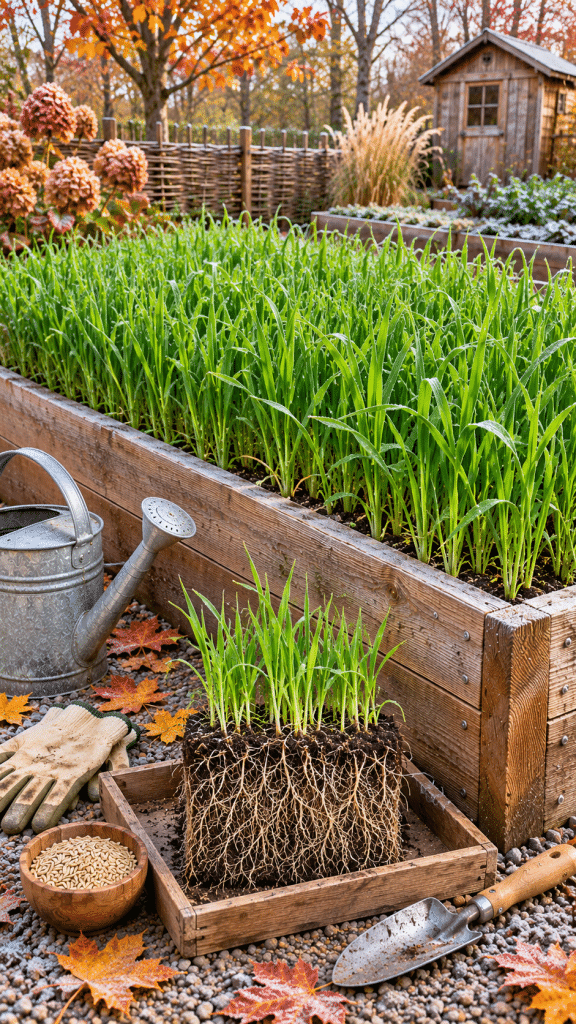
Winter cereal rye is one of the most effective cover crop options for gardeners who need reliable cold-weather survival and extensive root development.
Its botanical name is Secale cereale. It should not be confused with annual ryegrass, which belongs to a different genus and requires different management.
Winter cereal rye is especially valuable when raised beds become available relatively late in autumn or when gardeners want living vegetation to remain established through winter.
Unlike winter-sensitive oats, cereal rye can tolerate substantial cold and resume vigorous growth when favorable spring conditions return.
Why Winter Rye Develops Such an Effective Root System
Cereal rye produces an extensive fibrous root network capable of exploring large portions of the growing medium.
These fine roots occupy numerous soil pores and interact with surrounding mineral particles and organic materials.
As the plant grows, it absorbs available nutrients and stores them within its tissues.
When the crop is eventually terminated, its roots and residues contribute organic material to the raised bed.
The root system makes winter rye particularly useful in beds that have experienced declining soil structure, although severely compacted or poorly drained conditions may require additional corrective measures.
Capturing Residual Nutrients During the Offseason
Winter rye does not fix atmospheric nitrogen in the same way that crimson clover or field peas do.
Instead, it functions primarily as a nutrient scavenger.
After a season of vegetable production, available nitrogen may remain within the growing medium. Winter rye can absorb some of this nitrogen and reduce the opportunity for it to be lost through leaching.
This characteristic is particularly valuable during periods when rainfall is frequent and vegetable roots are no longer actively growing.
The captured nutrients remain temporarily stored within the cover crop biomass until decomposition releases them again.
Establishing Winter Rye Later in Autumn
Winter rye can often be established later than many other autumn cover crops, although earlier planting generally allows greater growth before winter.
This flexibility makes it useful for raised beds that remain occupied by vegetables well into the autumn season.
Once the final harvest is complete, cereal rye can be planted into a prepared seedbed with relatively little disturbance.
Gardeners should distribute the seeds evenly and cover them approximately ½ to 1 inch deep, adjusting according to the seed supplier’s recommendations.
Adequate moisture is necessary for germination. Newly planted beds should be monitored during dry periods, even when daytime temperatures have started declining.
How Winter Rye Behaves During Cold Weather
During favorable autumn conditions, cereal rye establishes green shoots and a developing root system.
As temperatures become colder, aboveground growth slows significantly. The plant can survive winter conditions that would kill less cold-tolerant cover crops.
When spring temperatures increase, rye resumes active growth.
This continued growth provides an additional period of root activity and nutrient uptake, which can be particularly valuable for raised beds that will not be planted with vegetables until later in spring.
However, its ability to survive winter also means gardeners must take responsibility for effective termination.
Managing Winter Rye Before Vegetable Planting
Winter rye is more demanding to terminate than a winterkilled oat and field pea mixture.
If allowed to develop mature stems, it can produce a substantial amount of tough vegetation that becomes difficult to manage within small raised beds.
For many home gardeners, terminating rye while it is still relatively young provides a more manageable transition.
Cutting alone may allow immature rye to regrow. Severing the plants below their crowns, carefully incorporating the vegetation, or using an effective light-blocking treatment can provide more reliable results.
Crimping generally becomes more dependable at an appropriate reproductive growth stage and should not be assumed to kill young rye. UMN Extension+2
| Termination method | Practical suitability for raised beds |
|---|---|
| Cutting alone | Easy but may require follow-up treatment |
| Shallow undercutting | Useful for small growing spaces |
| Shallow incorporation | Effective when soil conditions are suitable |
| Opaque tarping | Useful for gardeners minimizing digging |
| Crimping | More suitable at the appropriate mature growth stage |
Choosing the right termination method before planting the cover crop helps prevent unnecessary complications in spring.
Understanding Temporary Nitrogen Immobilization
Winter rye produces relatively carbon-rich residues, particularly as the plants become older and more fibrous.
During decomposition, microorganisms may temporarily use available soil nitrogen while breaking down this material.
This process is known as nitrogen immobilization.
Although the nitrogen has not necessarily been permanently lost, it may temporarily become less available to newly planted vegetables.
Managing rye while it is younger, allowing sufficient decomposition time, and evaluating soil fertility before vegetable planting can reduce potential problems.
Gardeners should be especially cautious when transitioning from mature rye to small, directly seeded vegetables.
Choosing the Right Vegetables After Winter Rye
Winter rye is often more convenient before transplanted summer vegetables than before very early spring crops.
Tomato seedlings, peppers, eggplants, and other vegetables planted after the danger of frost has passed provide a longer window for cover crop management.
Small-seeded vegetables may be more sensitive to undecomposed residues and compounds released by rye.
For this reason, gardeners planning early carrots, lettuce, or similar crops may find a winterkilled cover crop more practical.
Winter rye performs best when the entire planting sequence is designed around its strengths and management requirements.
How to Choose the Best Fall Cover Crops for Raised Beds Based on Your Gardening Goals
Different raised beds do not necessarily require identical cover crops.
A vegetable garden containing several growing spaces can benefit from assigning a different cover crop strategy to each bed.
The most effective approach begins with identifying what the soil needs and when the bed must return to vegetable production.
Choose Oats and Field Peas for Early Spring Planting
If your goal is to begin growing vegetables as soon as spring conditions become suitable, an oat and field pea mixture is an excellent starting point in climates where it reliably winterkills.
The combination offers useful autumn growth without requiring extensive spring termination.
This makes it particularly appropriate for beds scheduled to grow early-season vegetables.
Choose Crimson Clover for Biological Fertility
If your main objective is supporting natural nitrogen cycling before planting nutrient-demanding summer vegetables, crimson clover deserves serious consideration.
Its potential nitrogen contribution makes it an appealing option for beds that will remain unplanted until later in spring.
The longer growing window also provides more flexibility for termination and decomposition.
Choose Winter Rye for Extended Winter Root Activity
If your raised bed becomes available late in autumn or requires a persistent winter-hardy cover, cereal rye may provide the greatest flexibility.
Its extensive root system and nutrient-scavenging abilities make it a valuable component of a soil regeneration strategy.
However, it is most appropriate for gardeners prepared to manage active spring growth.
| Gardening objective | Recommended cover crop |
|---|---|
| Minimal spring maintenance in cold climates | Oats and field peas |
| Early spring vegetable production | Oats and field peas |
| Biological nitrogen fixation | Crimson clover |
| Late spring tomato planting | Crimson clover |
| Late autumn cover crop establishment | Winter cereal rye |
| Extensive fibrous root development | Winter cereal rye |
| Beginner-friendly cover cropping | Oats and field peas |
| Persistent living winter vegetation | Winter cereal rye |
How Much Cover Crop Seed Do You Need for a Raised Bed
One advantage of raised bed gardening is that relatively small quantities of seed can establish an entire cover crop.
A standard 4-by-8-foot raised bed contains 32 square feet of growing space.
Unlike large agricultural fields, these compact gardens allow precise seed distribution and relatively close monitoring during germination.
The following quantities provide approximate starting estimates for individual species rather than complete mixtures.
| Cover crop | Approximate seed per 100 sq ft | Approximate seed per 4-by-8-foot bed |
|---|---|---|
| Oats | 3–4 oz | 27–36 g |
| Field peas | 4–6 oz | 36–54 g |
| Crimson clover | 1–2 oz | 9–18 g |
| Winter cereal rye | 3–5 oz | 27–45 g |
Actual seeding requirements vary by seed variety, germination percentage, planting method, and growing conditions.
When creating mixtures, use recommended mixture rates rather than automatically combining the full individual seeding rates of each species.
Overseeding can create unnecessary competition, while insufficient seed distribution may result in significant gaps throughout the bed.
A Practical Fall Cover Crop Rotation for Three Raised Beds
Gardeners with three or more raised beds can take advantage of different cover crop characteristics by developing a rotating soil improvement system.
Instead of planting the same cover crop everywhere, each growing space can receive a strategy suited to its upcoming vegetables.
Raised Bed One The Early Spring Vegetable Bed
Plant oats and field peas after the final summer harvest.
Allow the cover crop to establish throughout autumn and naturally winterkill where temperatures are sufficiently cold.
During early spring, prepare planting rows for spinach, lettuce, radishes, carrots, and other cool-season vegetables.
This bed prioritizes convenience and an efficient transition between growing seasons.
Raised Bed Two The Natural Fertility Bed
Plant crimson clover sufficiently early in autumn to encourage healthy establishment.
Allow surviving plants to resume growth during spring before terminating them ahead of summer vegetable planting.
Use this raised bed for tomatoes, peppers, squash, or other crops suited to the resulting fertility-management schedule.
This bed emphasizes biological nitrogen cycling and seasonal organic matter production.
Raised Bed Three The Root Development Bed
Plant winter cereal rye after later autumn vegetables finish producing.
Allow the rye to establish during autumn and remain through winter.
Terminate the cover crop in spring with sufficient time for residue management before planting summer vegetables.
This bed prioritizes persistent living roots and residual nutrient capture.
| Raised bed | Fall cover crop | Following vegetable season |
|---|---|---|
| Bed 1 | Oats and field peas | Early spring |
| Bed 2 | Crimson clover | Late spring |
| Bed 3 | Winter cereal rye | Late spring or early summer |
In subsequent years, the cover crop assignments can be rotated to distribute their different soil-management benefits across the garden.
Common Mistakes When Growing Fall Cover Crops for Raised Beds
Even beneficial plants can create unexpected difficulties when they are established or managed incorrectly.
Understanding the most common mistakes helps gardeners achieve better results while avoiding unnecessary spring maintenance.
Planting Cover Crops Too Late
A common mistake is waiting until freezing temperatures are imminent before sowing cover crop seeds.
Although winter rye can tolerate relatively late establishment, other cover crops may struggle to develop enough foliage and roots before winter.
Weak establishment limits nutrient capture, root development, and biomass production.
Planning cover crop planting dates before the final vegetable harvest makes it easier to use the available autumn growing window effectively.
Choosing Crops Without Considering Winter Temperatures
A cover crop that winterkills in a northern garden may remain alive throughout winter in a milder southern climate.
Similarly, a crop expected to survive winter may experience severe damage during unusually cold conditions.
Local climate knowledge is therefore essential when choosing between winter-sensitive and winter-hardy cover crops.
Ignoring Spring Termination Requirements
The benefits of vigorous cover crop growth can quickly become inconvenient when gardeners need the same space for vegetables.
Winter-hardy species should always be selected with a realistic termination method in mind.
This is particularly important for small raised beds where large equipment is unnecessary or impractical.
Careful planning prevents cover crops from becoming competitors for water, nutrients, sunlight, and growing space.
Allowing Cover Crops to Produce Mature Seeds
Most cover crops should be terminated before they produce viable seeds.
Allowing mature seed heads to develop can create unwanted seedlings throughout future growing seasons.
These volunteer plants may compete with vegetables and complicate garden maintenance.
Regular spring observation is especially important when warmer weather causes rapid growth and flowering.
Expecting Immediate Results
Cover cropping is a gradual soil-management practice rather than an instant solution.
Changes in organic matter, soil structure, nutrient cycling, and biological activity depend on many factors and often become more apparent after repeated growing seasons.
Combining cover cropping with appropriate irrigation, crop rotation, and soil testing produces a more comprehensive approach to long-term raised bed productivity.
Frequently Asked Questions About Fall Cover Crops for Raised Beds
What Is the Easiest Fall Cover Crop for Beginners
Oats are among the easiest cover crops for beginners, particularly in climates where they naturally die during winter.
Combining oats with field peas provides additional biological diversity and potential nitrogen fixation without significantly increasing maintenance when both crops winterkill.
Can Cover Crops Grow in Small Raised Beds
Absolutely. Cover cropping works in compact raised beds as well as larger vegetable gardens.
Even a small 2-by-4-foot bed can support a temporary cover crop planting.
The key is selecting manageable species and adjusting seed quantities to the available growing area.
Should Cover Crop Roots Be Removed in Spring
Generally, healthy cover crop roots can remain in the soil after the plants have been successfully terminated.
As the roots decompose, they contribute organic materials and leave channels within the growing medium.
Complete root removal is usually unnecessary unless required for effective termination or another specific management concern.
Do Cover Crops Replace Fertilizer
Not necessarily.
Legume cover crops can introduce biologically fixed nitrogen, while other cover crops can capture and recycle existing nutrients.
However, cover crops do not automatically supply every nutrient required for productive vegetable growth.
Soil testing remains a useful tool for identifying deficiencies and determining whether supplemental nutrients are necessary.
Can Cover Crops Be Planted Without Tilling
Yes. Many cover crops can be planted by lightly preparing the soil surface, sowing seeds at the appropriate depth, and ensuring adequate seed-to-soil contact.
Deep tilling is generally unnecessary for establishing a cover crop in a well-maintained raised bed.
What Is the Latest Fall Cover Crop to Plant
Winter cereal rye is generally among the more flexible options for late autumn planting because of its cold tolerance.
Nevertheless, successful establishment still requires suitable soil conditions, adequate moisture, and temperatures that permit germination.
Local planting recommendations are more reliable than a universal final planting date.
Are Cover Crops Better Than Traditional Mulch
Cover crops and traditional mulch perform different functions.
Living cover crops actively develop roots, absorb nutrients, and interact with microorganisms. Traditional mulch provides passive soil protection without requiring plant establishment or termination.
Cover crops are especially useful when the objective is biological soil improvement between vegetable-growing seasons, whereas traditional mulch may be more convenient when insufficient growing time remains.
Final Thoughts on the Best Fall Cover Crops for Raised Beds
🍂 Autumn does not have to represent the end of productive garden activity. It can become the beginning of an entirely different growing season dedicated to restoring and maintaining soil health.
The best fall cover crops for raised beds are those that complement your climate, vegetable planting schedule, and long-term gardening objectives.
Oats and field peas offer the best balance of beginner-friendly establishment, biological diversity, and straightforward spring preparation in sufficiently cold climates.
Crimson clover provides an exceptional opportunity to support biological nitrogen fixation and prepare growing spaces for nutrient-demanding summer vegetables.
Winter cereal rye delivers persistent winter growth, extensive fibrous roots, and valuable nutrient capture for gardeners willing to manage its spring development.
Each strategy performs a distinct function, allowing gardeners to select the right approach for individual raised beds instead of relying on a single universal solution.
The greatest transformation happens when cover cropping becomes a consistent part of the annual vegetable-growing cycle.
Rather than allowing valuable growing spaces to remain biologically inactive between harvests, autumn cover crops turn the offseason into an opportunity for continuous soil improvement.
🌱 A productive spring vegetable garden begins long before the first spring seeds are planted. With the right fall cover crops, that preparation can start naturally beneath the soil surface months earlier.