🍂 Fall Vegetable Garden Ideas can completely transform an ordinary backyard into a thriving autumn harvest paradise filled with beautiful leafy vegetables, colorful root crops, and delicious homegrown food. While many gardeners believe the vegetable-growing season ends when summer fades, autumn offers an extraordinary opportunity to create a productive edible landscape that feels refreshing, organized, and surprisingly abundant.
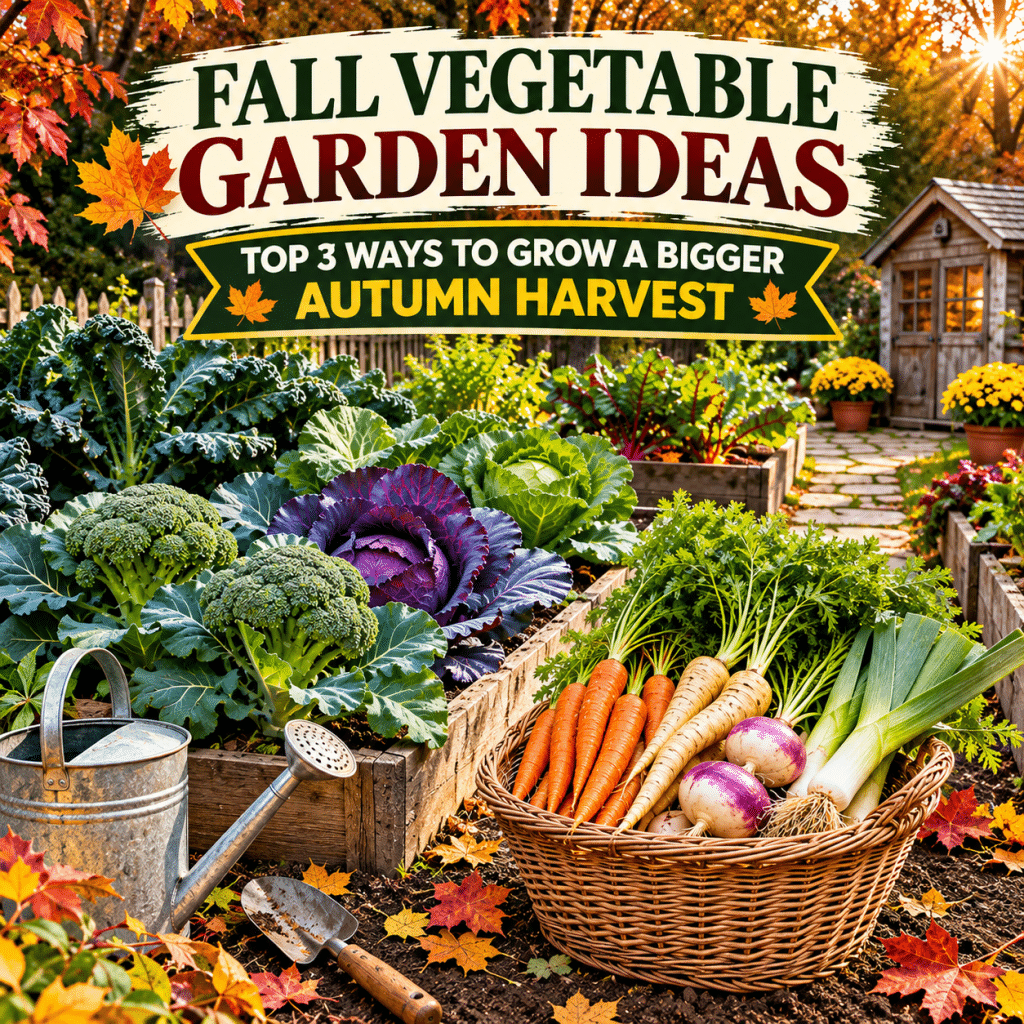
Imagine walking through your garden on a crisp autumn morning, surrounded by magnificent purple cabbages, lush emerald-green broccoli plants, vibrant rainbow chard, and neatly arranged rows of freshly growing vegetables. Golden leaves scatter across charming garden pathways, while the rich colors of seasonal crops create a breathtaking contrast against the warm tones of the surrounding landscape.
This beautiful scene is more achievable than many homeowners realize.
Unlike summer vegetable gardens, which often demand frequent watering and constant attention during intense heat, fall vegetable gardens can benefit from cooler temperatures, reduced heat stress, and growing conditions that favor many nutritious crops.
However, successful autumn gardening requires more than simply planting another collection of vegetables.
🌱 The secret to an extraordinary fall vegetable garden is creating a thoughtful growing system that combines seasonal crop selection, intelligent planting schedules, and beautiful edible garden design.
The best autumn vegetable gardens are not necessarily the largest or most expensive. They are carefully designed spaces where every planting area has a clear purpose, every crop contributes to the harvest, and every gardening decision supports seasonal productivity.
Some gardens emphasize dramatic architectural vegetables with magnificent foliage and substantial harvests.
Others focus on clever planting sequences that provide fresh ingredients across several autumn weeks.
Still others create beautiful edible landscapes dedicated to flavorful vegetables that can be harvested, stored, and enjoyed long after their main growing period.
These Best 3 Fall Vegetable Garden Ideas explore three distinctive approaches that transform the entire vegetable-growing experience.
Instead of focusing on raised bed construction, decorative containers, or conventional garden landscaping, these ideas emphasize the vegetables themselves, their productive relationships, and the practical systems that make autumn harvests more rewarding.
Each concept combines beautiful garden organization with realistic growing techniques suitable for different backyard sizes and seasonal conditions.
The result is a vegetable garden that looks extraordinary while offering a genuinely useful source of fresh, homegrown food.
🍁 Why Fall Vegetable Garden Ideas Can Create a More Beautiful and Productive Backyard
Autumn offers a distinctive combination of growing conditions that can benefit many vegetables.
As temperatures become cooler, crops that struggle during summer heat may grow more comfortably.
Leafy vegetables such as spinach, kale, and Swiss chard often perform particularly well during mild autumn weather.
Certain members of the cabbage family also develop excellent quality when their growth occurs during favorable cool-season conditions.
For gardeners who experienced disappointing summer lettuce crops or vegetables that bolted too quickly, autumn can provide an opportunity to try again.
However, temperature is only one part of the growing equation.
Shorter daylight hours, approaching frost, soil conditions, and regional climate patterns all influence which vegetables can be grown successfully.
A gardener in a mild coastal region may enjoy a considerably longer autumn growing season than someone living in an area where hard freezes arrive early.
This makes careful crop selection essential.
Cooler Weather Can Improve the Quality of Certain Vegetables
Many cool-season vegetables develop desirable flavors and textures when grown under suitable autumn conditions.
Kale, for example, may become noticeably sweeter after exposure to cool temperatures because changes in plant carbohydrate metabolism can influence its flavor.
Carrots and parsnips can also develop appealing sweetness during cool weather.
Broccoli and cabbage generally prefer moderate growing temperatures rather than prolonged extreme heat.
🥬 These seasonal characteristics make autumn an excellent time to concentrate on vegetables that contribute fresh flavor, nutritional variety, and beautiful foliage to the garden.
Nevertheless, cooler weather does not automatically guarantee superior harvests.
Plants still require sufficient sunlight, adequate water, suitable soil nutrients, and enough time to mature.
Extremely low temperatures can damage crops, while excessively warm autumn conditions can cause difficulties for vegetables that prefer cooler weather.
The most successful gardeners respond to their actual local conditions rather than assuming every autumn behaves the same way.
Autumn Vegetables Can Become Beautiful Landscape Features
A vegetable garden does not need ornamental flowers to look spectacular.
Many edible crops naturally display remarkable colors, textures, and architectural forms.
Purple cabbage creates magnificent rounded shapes.
Dark green Tuscan kale produces striking upright leaves with an almost sculptural appearance.
Rainbow chard introduces vibrant stems in shades of yellow, pink, orange, and red.
Broccoli adds substantial foliage and attractive green heads, while delicate carrot leaves provide contrasting texture.
When these vegetables are arranged thoughtfully, an ordinary productive garden can resemble a professionally designed edible landscape.
✨ The most beautiful autumn vegetable gardens allow healthy, thriving crops to become the main decorative attraction.
This approach creates a garden that is visually appealing throughout the growing period rather than only during harvest.
As plants mature, their changing proportions and foliage colors naturally transform the appearance of the backyard.
🌿 Best 3 Fall Vegetable Garden Ideas at a Glance
Before choosing a garden design, it helps to understand how the three concepts differ.
Each approach has a distinctive purpose, making it possible to select one that matches the available space, growing season, and preferred harvests.
| Fall Vegetable Garden Idea | Main Crops | Primary Purpose | Best Feature |
|---|---|---|---|
| 🥇 Architectural Autumn Brassica Garden | Broccoli, cabbage, kale, kohlrabi | Grow substantial cool-season vegetables | Dramatic foliage and impressive harvests |
| 🥈 Succession Harvest Vegetable Garden | Radishes, arugula, baby greens, turnips | Produce crops through carefully timed sowings | Multiple harvest opportunities |
| 🥉 Autumn Root and Winter Pantry Garden | Parsnips, carrots, rutabagas, leeks | Grow vegetables for hearty meals and storage | Long-lasting seasonal food supply |
The first concept emphasizes large, beautifully structured vegetables that create a striking garden composition.
The second concentrates on timing, allowing the growing space to produce a sequence of different harvests.
The third celebrates vegetables that develop beneath the soil or remain useful during the colder part of the season.
Together, these approaches demonstrate how vegetable gardening can become more organized, productive, and visually impressive during autumn.
🥇 Best 1 Fall Vegetable Garden Ideas With a Magnificent Architectural Brassica Harvest Paradise
One of the most spectacular ways to create a fall vegetable garden is by designing a dedicated growing area around the cabbage family.
Broccoli, cabbage, kale, cauliflower, and kohlrabi offer an extraordinary range of shapes, foliage textures, and seasonal colors.
Unlike small, delicate vegetables, many brassicas develop substantial leaves that create a bold architectural presence in the garden.
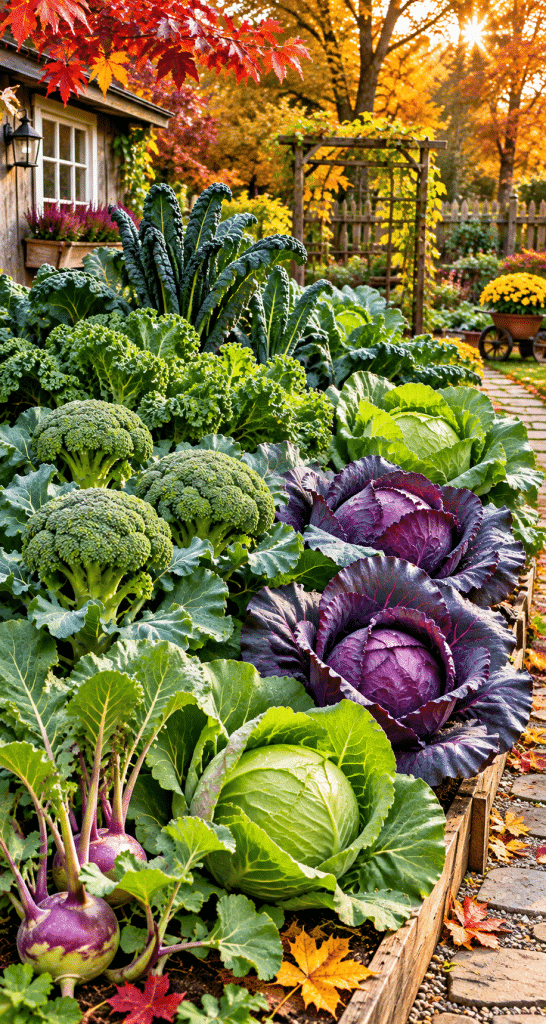
Imagine a beautifully maintained autumn vegetable plot where enormous blue-green cabbage leaves frame magnificent purple cabbage heads.
Behind them, tall Tuscan kale plants create sculptural vertical accents.
Vigorous broccoli plants occupy the central growing areas, their broad leaves surrounding developing green florets.
Compact purple kohlrabi introduces unexpected color near the edges of the planting arrangement.
Golden autumn sunlight illuminates the foliage, revealing delicate leaf veins, natural waxy surfaces, and beautiful variations of green and violet.
🥦 An architectural brassica garden transforms ordinary food production into a dramatic edible landscape filled with impressive seasonal character.
The appeal of this design extends beyond appearance.
Brassicas can provide substantial harvests, and choosing crops with different maturity periods allows the garden to produce several types of vegetables.
The key is giving each crop enough growing space while selecting varieties suitable for the local autumn season.
Design a Beautiful Brassica Garden With Distinctive Vegetable Layers
Successful edible garden design often begins with plant height and mature proportions.
Instead of arranging vegetables randomly, organize brassicas into carefully planned planting zones.
Position taller varieties where they will not unnecessarily shade smaller crops.
In the Northern Hemisphere, taller crops are often placed toward the northern side of a garden, although the most appropriate arrangement depends on the site and surrounding structures.
Tuscan kale can provide a beautiful vertical background.
Its long, dark green leaves create a distinctly architectural appearance that contrasts wonderfully with the rounded shapes of cabbage plants.
Broccoli can occupy the middle growing area.
Its large foliage creates a substantial green presence, while developing heads become the main productive feature.
Toward the front, compact kohlrabi varieties introduce unusual rounded swollen stems and broad leaves.
The result is a carefully layered arrangement rather than a conventional collection of identical vegetable rows.
Combine Purple Cabbage and Green Broccoli for Stunning Contrast
Color can make a vegetable garden feel exceptionally sophisticated.
Purple cabbage is particularly valuable because its richly colored foliage introduces visual drama without sacrificing productivity.
The rounded heads contrast beautifully with the irregular leaf patterns of broccoli.
For a coordinated arrangement, repeat small groups of purple cabbage throughout the garden instead of concentrating all the colorful plants in one corner.
This creates a sense of rhythm.
Meanwhile, green broccoli plants provide a natural visual transition between dark kale and purple cabbage.
🌿 Repeating complementary foliage colors makes an edible garden look more intentional while keeping the emphasis on healthy vegetable production.
Avoid overcrowding plants simply to create a lush appearance.
Large heading cabbages and broccoli varieties may need considerable space at maturity.
Always follow the spacing instructions for the specific varieties being grown.
Choose Brassica Varieties According to Your Remaining Growing Season
Not all brassicas mature at the same speed.
This is particularly important when planning an autumn garden.
Kohlrabi and some kale varieties can offer relatively quick harvest opportunities.
Heading cabbage, broccoli, and cauliflower generally require more time, particularly when grown from seed.
In many regions, these larger crops are started during summer or established as transplants before the main autumn growing period.
This gives them enough time to develop before cold temperatures and shorter days slow their growth.
| Vegetable | Approximate Days to Harvest | Main Growing Advantage |
|---|---|---|
| Kohlrabi | 45–65 days from seed | Compact plants and relatively quick harvests |
| Kale | 50–75 days from seed for mature leaves | Repeated leaf harvesting |
| Broccoli | 60–100 days from transplant or seed depending on variety | Substantial central heads and possible side shoots |
| Cabbage | 70–120 days depending on variety and starting method | Dense heads suitable for many recipes |
| Cauliflower | 55–100 days from transplant depending on variety | Attractive edible heads |
These ranges are general estimates rather than guaranteed harvest schedules. Seed packets often distinguish between days from sowing and days from transplanting, and actual growth depends on temperatures, daylight, and variety.
For gardeners with short autumn seasons, starting with appropriately sized transplants may be more realistic than direct-sowing slow-growing brassicas late in the year.
Protect the Brassica Garden From Common Seasonal Pests
Although cooler weather may reduce the activity of some garden pests, brassicas are not automatically pest-free during autumn.
Cabbageworms, cabbage loopers, aphids, and flea beetles can damage susceptible crops.
Young seedlings are particularly vulnerable.
Inspect the undersides of leaves regularly for eggs, caterpillars, and other signs of feeding.
Fine insect-exclusion netting can be useful when installed before pests establish themselves.
The netting must be secured properly and kept from trapping insects inside.
If biological or other pest-control products become necessary, choose those labeled for the crop and pest, and follow local regulations and product directions.
Healthy plants also need sufficient airflow.
Large brassica leaves can overlap as plants mature, creating shaded areas where moisture remains for longer periods.
Adequate spacing helps improve access for inspection and maintenance.
🐛 Regular observation is one of the simplest ways to prevent small pest problems from becoming serious harvest losses.
Turn the Brassica Garden Into a Beautiful Autumn Kitchen Experience
An architectural brassica garden is especially rewarding when its harvests become part of everyday cooking.
Fresh broccoli can be steamed, roasted, or added to hearty vegetable dishes.
Kale provides flavorful leaves for soups, sautés, and other seasonal recipes.
Cabbage can be used in slaws, braised dishes, fermented preparations, and comforting autumn meals.
Kohlrabi offers a crisp texture that works well in salads or cooked vegetable dishes.
The diversity makes it possible to grow several different ingredients within a relatively cohesive garden design.
Harvest individual vegetables when they reach appropriate maturity rather than waiting until every plant is ready.
For kale, carefully removing suitable mature leaves while protecting the growing point can allow additional harvests.
Broccoli should generally be harvested while the flower buds remain tight, before they begin opening.
Cabbage heads are usually harvested when they have reached the expected firmness and size for their variety.
✨ This garden concept is ideal for homeowners who want an impressive edible landscape that combines dramatic visual structure with satisfying autumn harvests.
🥈 Best 2 Fall Vegetable Garden Ideas With an Intelligent Succession Harvest System for Continuous Seasonal Abundance
The second concept approaches autumn vegetable gardening from a completely different perspective.
Instead of concentrating on the appearance of individual mature plants, this garden is organized around the timing of successive harvests.
A succession harvest vegetable garden uses carefully scheduled plantings to make productive use of the available growing period.
Rather than sowing every seed on the same day, gardeners establish selected crops at intervals that match their growth rates and the time remaining before unfavorable weather.
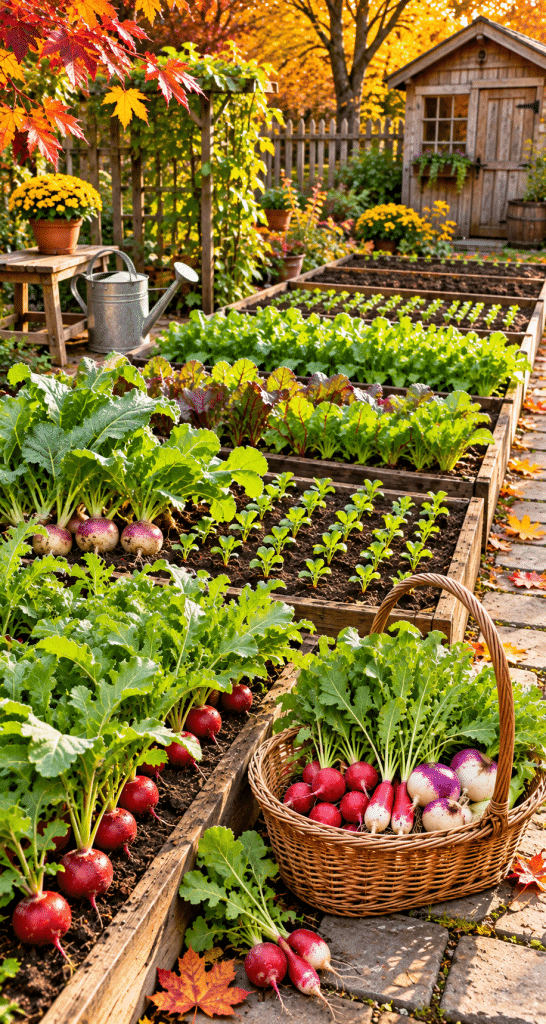
Imagine a charming backyard vegetable plot divided into orderly planting lanes.
One section contains mature radishes ready to harvest.
Nearby, vigorous arugula plants have developed a carpet of tender green foliage.
Another section displays young turnip seedlings, while a recently planted area contains emerging baby greens.
Each growing zone represents a different stage of vegetable development.
The garden feels dynamic because something is always emerging, maturing, or becoming ready to harvest.
🥬 A succession harvest garden turns planting dates into a practical tool for making the most of autumn growing opportunities.
This design can be especially useful for gardeners who prefer regular, manageable harvests rather than collecting an overwhelming quantity of the same vegetable at once.
It also encourages careful planning.
Success depends on understanding crop maturity, the amount of suitable growing weather remaining, and how quickly plants develop as daylight decreases.
Create a Simple Autumn Vegetable Planting Calendar
Before sowing seeds, identify the approximate date when hard frost or unsuitable growing conditions are likely to occur in your area.
For regions with frost, local historical first-frost dates provide a useful starting point.
However, an average date is not a guarantee.
A damaging freeze may arrive earlier or later, and different crops tolerate different degrees of cold.
Next, examine the estimated maturity period for each crop.
Fast-growing vegetables are particularly useful for succession gardening because several plantings may be possible during a sufficiently long autumn season.
Examples include radishes, arugula, mustard greens, and certain baby-leaf salad crops.
Turnips and other vegetables with longer growing periods may also fit into the calendar when planted early enough.
For each sowing, consider the difference between the estimated harvest date and the arrival of colder, darker conditions.
Understand Why Autumn Succession Planting Differs From Spring
Spring vegetable growth often accelerates as days become longer and temperatures warm.
Autumn usually follows the opposite pattern.
Even when a vegetable tolerates cold weather, its growth may slow substantially as daylight hours decrease.
This means a crop advertised as maturing in 30 days under favorable conditions may take longer when planted late in the season.
A practical autumn calendar should therefore include an allowance for slower growth.
Rather than planting a new crop every week indefinitely, concentrate the most important sowings during the period when sufficient growing time remains.
🌱 The goal is not to force continuous growth throughout winter but to establish a carefully timed series of crops that can mature under realistic local conditions.
Organize the Garden Into Four Productive Harvest Lanes
A simple four-lane arrangement can make succession gardening easier to manage.
The lanes do not need to be physically separated by elaborate structures.
They can be ordinary sections of prepared garden soil with clearly marked boundaries.
The first lane can contain quick-growing radishes.
The second can support arugula or another suitable leafy crop.
The third can contain baby turnips.
The fourth can be reserved for a subsequent sowing of fast-growing greens.
As vegetables mature and are harvested, their sections can be replanted if sufficient growing time remains.
This arrangement encourages efficient use of space while keeping different crops easy to identify.
For larger gardens, the same approach can be repeated across several planting areas.
For smaller backyards, four narrow sections may provide all the organization needed.
Use Quick Growing Vegetables for Early Autumn Harvests
Radishes are particularly useful because many small varieties mature relatively quickly under favorable conditions.
They are usually direct-sown, making them convenient for repeated planting.
Arugula is another excellent option.
Its tender leaves can provide a flavorful harvest, and young plants generally establish well during suitable cool weather.
Mustard greens offer additional variety through distinctive leaf shapes and flavors.
Baby turnips can produce tender roots when allowed enough time and space to develop.
The most useful crop combinations are those with compatible seasonal requirements but different culinary purposes.
For example, a succession garden containing radishes, arugula, and turnips can provide crisp roots, peppery leaves, and versatile cooking vegetables.
This creates more practical value than repeatedly planting a single crop simply because it grows quickly.
Plan Your Fall Vegetable Garden Ideas Around Realistic Harvest Windows
The following example demonstrates how successive plantings can be organized in a mild autumn climate with enough growing time remaining.
| Planting Phase | Main Activity | Suitable Crops | Expected Purpose |
|---|---|---|---|
| Early autumn | Establish the first sowings | Radishes, arugula, baby turnips | Begin seasonal harvest production |
| 10–14 days later | Sow a second small section | Radishes, suitable baby greens | Spread out harvest dates |
| Another 10–14 days later | Evaluate remaining season before sowing | Fast-growing leafy crops | Fill a later harvest window |
| Late autumn | Harvest established crops and assess conditions | Mature greens and remaining roots | Collect crops before damaging weather |
This is an illustrative schedule, not a universal planting calendar. The later sowings should be omitted if they are unlikely to mature before local conditions become unsuitable.
The strongest succession system balances ambition with practicality.
Repeated planting is worthwhile only when plants have a reasonable opportunity to reach harvestable size.
Avoid the Problem of Too Many Vegetables Maturing Together
One common challenge in home vegetable gardening is harvesting more produce than the household can use.
A large sowing of radishes might produce dozens of mature roots within a relatively short period.
If the household cannot consume them quickly, some may become oversized or lose their preferred texture.
Smaller sowings can help distribute the harvest.
For example, instead of planting a large area of radishes at once, divide the available space into several smaller sections.
Sow each section at an appropriate interval.
This creates a more manageable supply when the season is long enough.
The same principle can be applied to arugula and other quick-growing greens.
🥗 Smaller, thoughtfully timed harvests can be more useful than one enormous harvest that arrives all at once.
Improve Soil Management Between Successive Plantings
Succession gardening requires attention to soil health because the same growing area may support more than one crop during a season.
After harvesting, remove unsuitable plant debris and assess the condition of the soil.
Avoid repeatedly cultivating the area unnecessarily, especially when soil is wet.
Lightly incorporating suitable finished compost may help replenish organic matter, although actual nutrient needs should be guided by soil conditions and crop requirements.
Do not assume every new sowing requires another heavy fertilizer application.
Excessive nutrients can create imbalanced growth and contribute to environmental problems.
A soil test can provide useful guidance for longer-term vegetable garden management.
Also consider crop families when deciding what to plant next.
Radishes, arugula, turnips, mustard greens, cabbage, and broccoli all belong to the brassica family.
Repeatedly planting these crops in the same location may increase the risk of persistent crop-family-specific pest and disease problems.
Where possible, organize longer-term rotations using crops from different plant families.
Make the Succession Garden Visually Appealing
A productive succession garden can also become an attractive backyard feature.
The key is maintaining clear planting zones while allowing vegetables at different growth stages to create natural visual interest.
Freshly emerging seedlings introduce delicate textures.
Developing leafy vegetables create larger green patches.
Mature root crops contribute dense foliage before harvest.
Simple wooden markers can identify planting dates and varieties.
Clean walking paths keep each section accessible.
Avoid leaving harvested areas neglected when the growing season has ended.
If no further crop is appropriate, protect exposed soil with a suitable mulch or another locally appropriate soil-management practice.
🍂 An intelligent succession garden is especially appealing because its appearance changes naturally throughout the season, reflecting the ongoing cycle of planting, growth, and harvest.
🥉 Best 3 Fall Vegetable Garden Ideas With a Beautiful Autumn Root and Winter Pantry Sanctuary
The third concept celebrates one of the most satisfying aspects of autumn gardening: growing vegetables that can provide hearty meals and, in suitable conditions, useful stored harvests.
An autumn root and winter pantry garden is designed around crops that develop substantial edible roots or provide flavorful ingredients for cool-weather cooking.
Parsnips, carrots, rutabagas, and leeks create a wonderfully practical combination.
Unlike decorative garden arrangements that are designed primarily for visual appeal, this garden emphasizes food quality, seasonal abundance, and thoughtful harvest management.
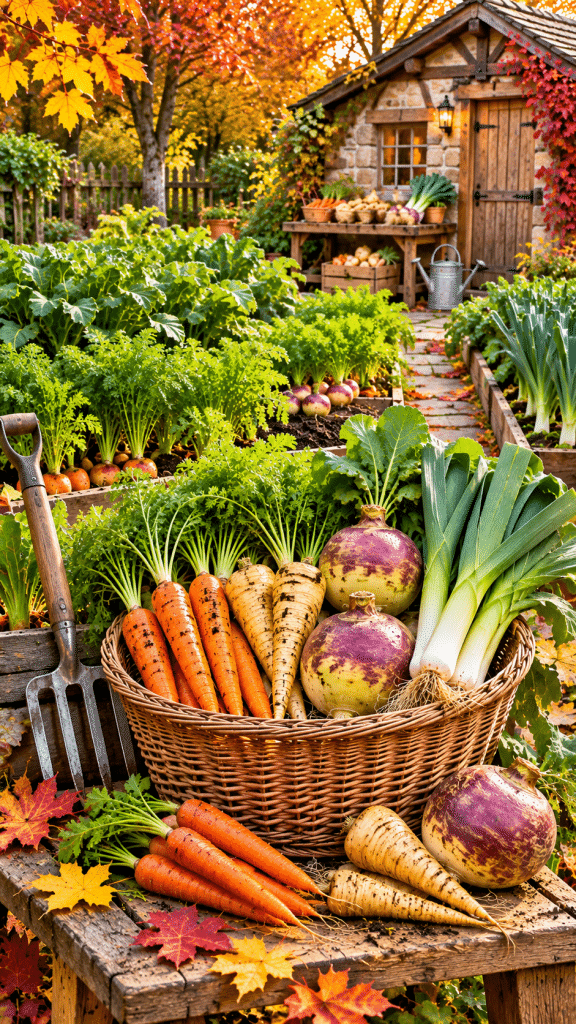
Imagine a beautiful traditional kitchen garden with long, neatly maintained planting rows surrounded by warm autumn foliage.
Delicate carrot leaves create feathery green textures.
Broad rutabaga leaves introduce bold forms.
Deep green leek foliage rises vertically above the soil.
Parsnips quietly develop their pale roots underground while their leaves add another layer of greenery.
A rustic wooden harvest basket sits beside the growing area, filled with freshly lifted carrots, golden rutabagas, and carefully trimmed leeks.
🥕 An autumn root and winter pantry garden transforms a simple vegetable plot into a beautiful source of ingredients for comforting seasonal meals.
Its appeal comes from the relationship between what grows in the garden and how the vegetables are eventually used.
Instead of harvesting everything immediately, gardeners can plan for fresh use, short-term refrigeration, suitable storage, and preservation where appropriate.
This approach is particularly rewarding for households that enjoy cooking with homegrown ingredients.
Design a Traditional Autumn Root Vegetable Garden With Elegant Growing Rows
Root vegetables often benefit from organized planting arrangements.
Clearly defined rows make thinning, weeding, watering, and harvesting easier.
For an attractive design, arrange the crops in groups according to their mature foliage characteristics.
Carrots produce fine, delicate leaves that create a soft visual texture.
Rutabagas develop broader foliage that contrasts with the finer leaves of root crops.
Leeks contribute upright, blade-like leaves that can serve as natural vertical accents.
Parsnips add another distinctive leaf shape while developing edible roots beneath the surface.
The combination creates a garden that is both orderly and visually varied.
Prepare the Soil for Healthy Root Development
Soil quality plays a particularly important role in root vegetable gardening.
Carrots and parsnips develop best when their roots can grow through reasonably loose, stone-free soil.
Compacted soil, excessive stones, or obstructive debris may cause misshapen roots.
Good drainage is also important.
Prolonged waterlogging can damage roots and encourage disease.
Before planting, evaluate the existing soil structure and remove major obstructions where practical.
Avoid excessive nitrogen fertilization, which may encourage vigorous foliage without proportionate root development.
Fresh, undecomposed manure placed directly in the root-growing zone can also contribute to undesirable root development and food-safety concerns.
🌱 Healthy root crops begin with suitable soil conditions rather than elaborate garden accessories.
Choose Vegetables That Offer Different Autumn Harvest Experiences
A pantry-oriented garden becomes more valuable when its crops provide different flavors, textures, and storage possibilities.
Carrots are versatile ingredients suitable for fresh eating, roasting, soups, and other dishes.
Parsnips offer a distinctive sweet, earthy flavor that works particularly well in roasted vegetable combinations.
Rutabagas contribute substantial roots that can be mashed, roasted, or added to hearty stews.
Leeks provide a mild onion-like flavor and are valuable in soups, savory dishes, and vegetable preparations.
Each crop has different growing requirements.
Parsnips typically need a relatively long growing season, making them unsuitable for late direct sowing in many climates.
They are often planted well before autumn and harvested during the cooler part of the year.
Leeks may also require a lengthy establishment period.
Rutabagas are commonly planted to mature during cool weather, while carrots can be scheduled according to their variety and the regional growing season.
Understand Which Vegetables Should Be Started Before Autumn
A common misconception is that every autumn vegetable should be planted after summer ends.
In reality, many successful autumn harvests begin with sowings made during summer.
This is particularly true for slow-growing root vegetables.
Parsnips may require several months to develop mature roots.
Leeks also need sufficient time to establish and develop useful stems.
Rutabagas are often planted during summer for autumn harvesting, depending on regional conditions.
Carrots offer more flexibility, but their successful harvest still depends on temperature and available growing time.
The following table provides a general comparison.
| Vegetable | Approximate Growing Period | Typical Autumn Strategy | Main Culinary Benefit |
|---|---|---|---|
| Parsnips | 100–140 days | Start earlier for cool-season harvest | Sweet roasted roots |
| Carrots | 60–90 days | Time sowing for autumn maturity | Versatile fresh and cooked vegetables |
| Rutabagas | 80–100 days | Establish in time for cool-weather maturity | Hearty roots for soups and roasting |
| Leeks | 100–150 days or longer | Establish well before the main autumn harvest period | Mild aromatic stems |
The numbers vary significantly among cultivars and growing conditions.
For reliable results, use regional planting guidance and the instructions supplied for each variety.
Create a Beautiful Harvesting Ritual for Autumn Vegetables
Harvesting root vegetables offers a different experience from gathering leafy greens.
Much of the crop develops invisibly beneath the soil.
As harvest time approaches, gardeners can check the size of selected roots according to the characteristics of the variety.
For carrots, gently clearing soil near the crown can help estimate root diameter.
Parsnips should be harvested carefully to avoid breaking their long roots.
Rutabagas are generally harvested when they reach a desirable size, before becoming unnecessarily large or woody.
Leeks can be lifted or dug when their stems have developed sufficiently.
A garden fork can help loosen soil around mature roots, reducing the likelihood of damage.
Avoid pulling aggressively when the soil is compacted.
🥕 The anticipation of discovering beautifully formed vegetables beneath the soil makes autumn harvesting especially satisfying.
For a coordinated kitchen garden appearance, keep a suitable harvest basket or washable collection container nearby.
Collect vegetables carefully and avoid leaving freshly harvested produce exposed to harsh sunlight or inappropriate temperatures.
Different crops require different cleaning, handling, and storage methods.
Preserve the Harvest With Practical Storage Techniques
One of the greatest advantages of a pantry-oriented vegetable garden is the opportunity to enjoy produce beyond the day it is harvested.
However, storage conditions matter.
Carrots and parsnips generally store best under appropriately cold, humid conditions that limit moisture loss while avoiding freezing damage during storage.
Rutabagas can also maintain quality for an extended period when harvested and stored correctly.
Leeks have different storage characteristics and are generally better suited to timely use or suitable refrigeration rather than being treated exactly like dry storage onions.
Damaged vegetables should be separated from produce intended for longer storage.
Bruised or cut roots are often more vulnerable to deterioration.
A dedicated refrigerator drawer, appropriate cool storage space, or other controlled storage method can help preserve quality.
The suitability of an outdoor cellar or storage area depends on temperature, humidity, ventilation, sanitation, and local climate.
🌟 Important Note: Autumn planting and harvesting schedules must be adjusted to local climate conditions. Cool-season vegetables may tolerate light frost, but their survival and growth vary by species, variety, plant maturity, and temperature. Root crops intended for storage also require appropriate postharvest handling. Never assume that all autumn vegetables can remain in the ground through severe winter weather or be stored safely under identical conditions.
Turn Homegrown Roots Into Delicious Seasonal Meals
The real satisfaction of growing pantry vegetables becomes clear in the kitchen.
Freshly harvested carrots can be roasted alongside parsnips to create a naturally sweet side dish.
Rutabagas can be incorporated into substantial autumn soups.
Leeks provide a flavorful base for vegetable stews, potato dishes, and comforting seasonal recipes.
Combining these ingredients creates opportunities to use several parts of the garden in a single meal.
For example, a simple autumn vegetable soup might include sliced leeks, diced carrots, and cubed rutabaga.
A roasted vegetable platter can feature carrots and parsnips seasoned with herbs.
This connection between gardening and cooking makes the growing process more meaningful.
The garden is no longer simply an outdoor hobby.
It becomes an active part of household food preparation.
✨ A beautiful autumn root garden offers the pleasure of watching vegetables mature, harvesting them at the appropriate moment, and transforming them into memorable home-cooked meals.
🍂 How to Choose the Right Fall Vegetable Garden Idea for Your Backyard
The best vegetable garden is the one that matches your growing conditions and practical needs.
If your main goal is an impressive landscape filled with substantial vegetables, the architectural brassica garden is an excellent choice.
Its strong foliage shapes and striking color combinations make it particularly attractive in backyards where the garden is visible from a patio, terrace, or kitchen window.
However, brassicas need suitable planting dates, adequate spacing, and regular pest inspection.
If your priority is frequent harvesting and efficient use of growing space, the succession harvest garden offers a different advantage.
It can provide a series of smaller harvests when the season is long enough.
This design is especially helpful for gardeners who enjoy sowing seeds regularly and monitoring crop development.
The autumn root and winter pantry garden is ideal for people who enjoy cooking with seasonal vegetables and want to plan their harvests around practical food use.
It generally requires earlier preparation because several featured crops need relatively long growing periods.
These three concepts can also complement one another.
A larger backyard might contain a dedicated brassica zone, a smaller succession sowing area, and a separate plot for longer-season root vegetables.
A compact backyard may be better suited to one carefully selected concept.
The important decision is not how many types of vegetables can be squeezed into the available space.
It is how effectively the garden can support healthy growth and useful harvests.
🌱 Essential Soil Preparation for Successful Fall Vegetable Garden Ideas
Good soil preparation is fundamental to productive autumn gardening.
Before planting, examine the soil for compaction, poor drainage, excessive dryness, and leftover plant material from previous crops.
Remove weeds and crop debris that may harbor persistent pests or diseases.
Healthy, disease-free organic material may be composted using appropriate methods.
Diseased material should be managed according to the particular disease and local guidance rather than automatically being returned to the vegetable garden.
If the soil is low in organic matter, suitable finished compost can help improve its physical condition.
However, compost is not a substitute for understanding nutrient needs.
A soil test can identify important issues such as unsuitable pH or deficiencies and excesses of particular nutrients.
Maintain Soil Moisture Without Encouraging Waterlogging
Autumn gardens still require adequate water.
Cool weather may reduce evaporation compared with hot summer conditions, but newly sown seeds and young seedlings remain vulnerable to drying out.
Consistent moisture is particularly important during germination.
Root vegetables can also develop poorly when moisture fluctuates dramatically.
At the same time, overwatering can create problems.
Saturated soil limits oxygen availability and may increase the risk of root diseases.
Check soil moisture beneath the surface rather than relying only on its appearance.
Water according to plant needs, soil conditions, and recent rainfall.
Where practical, morning watering can help foliage dry during the day.
Protect Bare Soil With Suitable Organic Materials
Mulching can help moderate soil moisture and reduce unwanted weed growth.
Shredded untreated leaves and other appropriate organic materials may be useful in autumn vegetable gardens.
However, mulch thickness should reflect the crop and its stage of development.
Tiny seedlings can struggle if buried beneath heavy mulch.
Direct-sown seed rows should remain accessible for germination and emergence.
Established vegetables may benefit from mulch applied around, rather than over, their growing points.
The objective is to protect the soil without interfering with healthy plant development.
☀️ Position Your Autumn Vegetable Garden for the Best Available Sunlight
Sunlight becomes increasingly important as autumn progresses.
In many temperate locations, shorter days and lower sun angles reduce the amount of energy available for plant growth.
A garden that received abundant sunlight in midsummer may become shaded by buildings, fences, or trees later in the year.
Before establishing new planting areas, observe how sunlight moves across the backyard.
Choose locations that receive sufficient direct sunlight for the intended crops.
Many vegetables perform best with approximately six or more hours of useful direct sunlight, although requirements vary.
Leafy vegetables can sometimes tolerate somewhat less sunlight than fruiting crops, but reduced light generally slows their development.
For autumn gardening, maximizing suitable light exposure is often more valuable than choosing a location solely for decorative appeal.
🐛 Common Fall Vegetable Gardening Mistakes That Can Ruin Your Harvest
Even carefully designed autumn gardens can struggle when basic growing requirements are overlooked.
One of the most common mistakes is planting too late.
Cold-tolerant vegetables still need sufficient time to establish and develop.
Another frequent problem is overcrowding.
Large cabbage plants require considerably more room than young seedlings initially suggest.
Carrots and other root crops may produce poor-quality harvests when they are not thinned properly.
Gardeners may also underestimate pest pressure.
Cooler weather does not eliminate caterpillars, aphids, slugs, and other organisms that damage vegetables.
Regular inspection remains important.
Excessive fertilization can create additional difficulties, particularly when growing crops where balanced root development matters.
Finally, harvest timing should not be ignored.
Broccoli heads can lose quality if they are allowed to flower.
Radishes may become overly mature.
Some leafy vegetables decline in quality when left unharvested too long.
🍁 A beautiful fall vegetable garden depends on consistent attention to planting dates, spacing, plant health, and appropriate harvesting.
🏡 How to Make a Fall Vegetable Garden Look Beautiful Without Sacrificing Productivity
Vegetable gardens can be as visually appealing as ornamental landscapes when their layouts are thoughtfully organized.
Start by establishing a clear structure.
Straight planting rows suit traditional kitchen gardens.
Curved paths and softly arranged planting zones can create a more informal appearance.
Regardless of the design, maintain convenient access to the growing areas.
Avoid walking directly on cultivated soil whenever possible because repeated foot traffic can contribute to compaction.
Use Leaf Shapes and Colors as Natural Garden Decoration
The vegetables themselves can provide the strongest visual appeal.
Dark green kale creates vertical texture.
Purple cabbage introduces rich seasonal color.
Leeks contribute elegant upright foliage.
Carrots offer delicate, feathery greenery.
Broad rutabaga leaves add contrast.
The combination of different mature plant forms gives the garden depth and personality.
Repeating selected vegetables across the space can create visual consistency without unnecessary decorative objects.
The most attractive arrangements are those that continue to work practically as the crops mature.
Create a Comfortable Garden Harvesting Area
A useful autumn vegetable garden should make harvesting easy and enjoyable.
Keep paths stable and clear of slippery plant debris.
Position frequently harvested crops within comfortable reach.
A small weather-resistant garden bench or suitable work surface can provide space for sorting vegetables and setting down harvesting equipment.
Choose a location that does not cast unwanted shadows over crops.
Simple garden labels can help identify varieties and planting dates.
These practical details contribute to a more organized, welcoming outdoor environment.
✨ Beauty and productivity work best together when every garden feature supports the growing experience.
🥕 Frequently Asked Questions About Fall Vegetable Garden Ideas
What Are the Best Vegetables to Grow in a Fall Garden?
The best choices depend on climate, planting date, and available growing time.
Kale, spinach, radishes, arugula, turnips, carrots, broccoli, cabbage, and other cool-season crops may be suitable.
Fast-growing vegetables are often useful for shorter autumn growing windows.
Longer-season vegetables generally need to be planted earlier.
Check regional planting calendars before selecting crops.
When Should You Start a Fall Vegetable Garden?
Many fall vegetable gardens begin during summer rather than autumn.
Slow-growing crops may need to be established several months before the intended harvest.
Fast-growing vegetables can sometimes be planted closer to the beginning of autumn.
The correct schedule depends on the crop, local temperatures, daylight, and expected frost conditions.
Can You Grow Fall Vegetables in a Small Backyard?
Yes.
A compact garden can provide useful harvests when growing space is organized efficiently.
Choose vegetables that suit the available sunlight and soil conditions.
Avoid overcrowding.
If space is extremely limited, concentrate on one main garden concept rather than attempting to grow every possible crop.
Do Fall Vegetables Need Full Sun?
Most vegetables grow best with substantial sunlight.
Many benefit from at least six hours of direct sun daily.
Some leafy crops can tolerate partial shade, but reduced light often slows their growth.
Autumn gardens should be positioned to receive the best available sunlight as seasonal conditions change.
Can Fall Vegetables Survive Frost?
Some vegetables tolerate light frost, and certain established crops can survive lower temperatures.
However, tolerance varies significantly.
A light frost is not equivalent to a prolonged hard freeze.
Plant maturity, cultivar, soil moisture, and prior exposure to cold can influence survival.
Protective materials may help under suitable conditions, but they cannot guarantee survival during severe weather.
What Makes a Fall Vegetable Garden More Productive?
Productivity depends on matching crops to suitable growing conditions.
Choose realistic planting dates, maintain healthy soil, provide sufficient sunlight, and manage water carefully.
Use appropriate plant spacing and inspect regularly for pests or diseases.
Harvest vegetables at the correct stage of maturity.
In longer autumn seasons, carefully planned succession planting can create additional harvest opportunities.
Can Fall Vegetables Be Harvested Throughout Winter?
In some climates, certain established vegetables can remain harvestable during winter.
Mild winters may allow continued growth of suitable crops.
In colder regions, growth often slows dramatically or stops during the darkest and coldest periods.
Some mature root crops may remain in the soil for part of the winter under appropriate conditions, while others require harvesting and storage.
Always consider local temperature extremes and crop characteristics.
🌟 Final Thoughts on the Best 3 Fall Vegetable Garden Ideas
The most extraordinary autumn vegetable gardens combine practical growing techniques with thoughtful planning and an appreciation for the natural beauty of edible plants.
Instead of treating autumn as the end of the gardening season, these ideas reveal how it can become a rewarding period of harvesting, experimentation, and preparation.
🥇 The Architectural Autumn Brassica Garden is perfect for gardeners who want dramatic foliage, beautiful vegetable arrangements, and impressive cool-season crops. Purple cabbage, broccoli, kale, and kohlrabi create a magnificent edible landscape that offers both visual appeal and substantial harvests.
🥈 The Intelligent Succession Harvest Garden focuses on carefully timed plantings that distribute vegetable production across the available autumn growing period. Quick-growing radishes, leafy vegetables, and turnips create opportunities for multiple harvests while encouraging efficient use of garden space.
🥉 The Autumn Root and Winter Pantry Garden celebrates flavorful vegetables that connect the backyard directly to the kitchen. Carrots, parsnips, rutabagas, and leeks create an attractive growing environment while providing delicious ingredients for hearty seasonal meals and, where suitable, longer-term storage.
Each concept offers a distinctive advantage.
One transforms vegetables into dramatic architectural features.
Another makes planting schedules the foundation of productivity.
The third celebrates the satisfaction of growing, harvesting, and preparing delicious seasonal food.
The ideal garden may combine elements from all three, but even one carefully implemented idea can transform an ordinary backyard.
🍂 The greatest beauty of a fall vegetable garden comes from discovering that the changing season is not simply a time of fading summer color but an opportunity for a completely different kind of abundance.
With suitable crops, intelligent planting schedules, healthy soil, and consistent attention to seasonal conditions, a backyard vegetable garden can become a breathtaking autumn sanctuary filled with fresh flavors, beautiful foliage, and meaningful harvests.
And while the surrounding landscape gradually prepares for winter, a thoughtfully planned vegetable garden can continue offering one of gardening’s most satisfying rewards: the pleasure of growing something wonderful with your own hands.