Fall Bulb Planting Ideas can transform an ordinary garden into a spectacular spring flower paradise long before the first warm days arrive. While most gardeners are busy collecting fallen leaves, decorating their porches, and preparing their outdoor spaces for winter, autumn offers an incredible opportunity to create something truly magical beneath the soil. 🌷🍂 With a thoughtful combination of tulips, daffodils, crocuses, hyacinths, and other spring-flowering bulbs, even a modest backyard can become an unforgettable landscape filled with color, fragrance, and beautiful seasonal surprises.
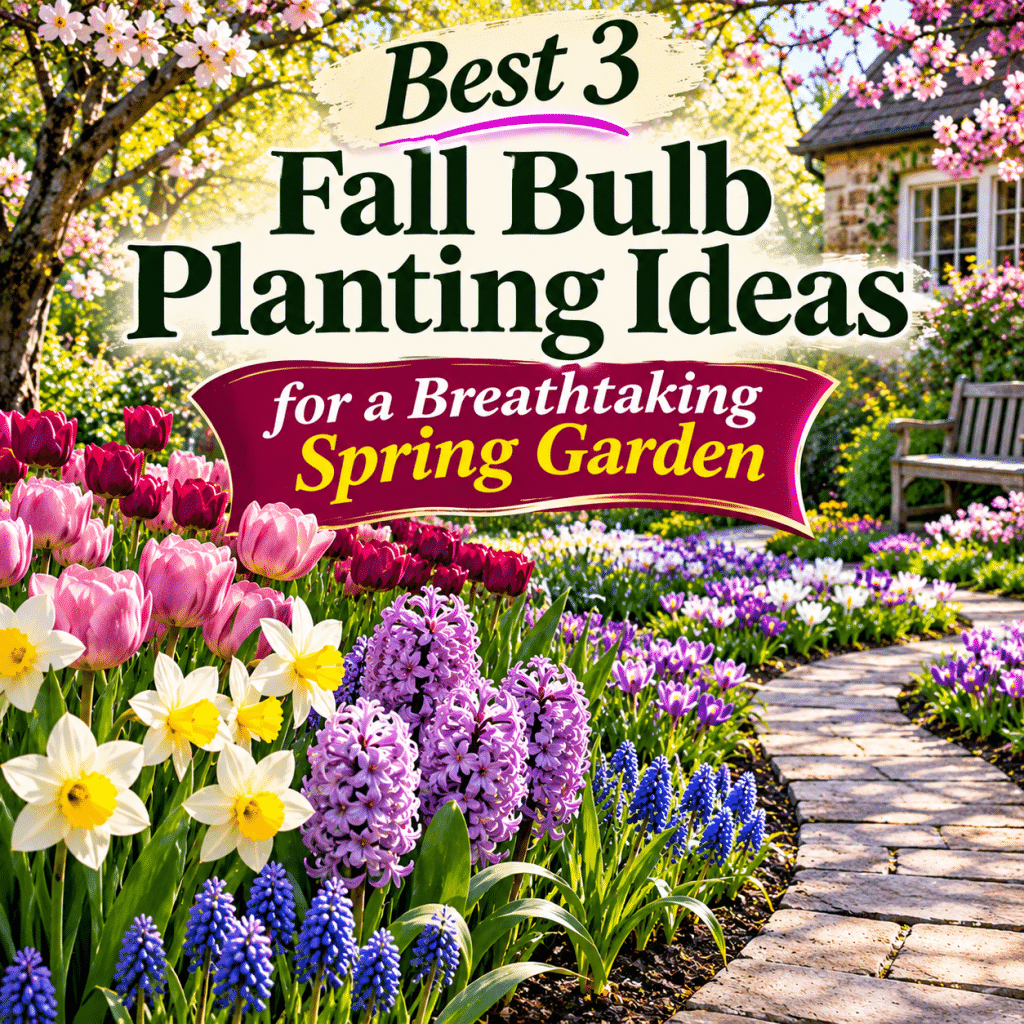
The secret to an extraordinary spring garden is not simply planting as many bulbs as possible. It is understanding how different flowers emerge, how their colors complement one another, and how carefully planned planting arrangements can create the impression of a professionally designed landscape.
Imagine stepping outside after a long winter to discover delicate purple crocuses emerging through the grass, followed by cheerful daffodils, elegant tulips, and breathtaking late-spring ornamental alliums. Every few weeks, your garden reveals another beautiful transformation.
The most successful fall bulb gardens combine artistic design with practical planting techniques. Bulbs need suitable temperatures, well-drained soil, appropriate planting depths, and enough time to establish healthy roots before winter.
These Best 3 Fall Bulb Planting Ideas explore three distinctive approaches to creating a memorable spring landscape. From romantic layered flower islands to naturalistic woodland carpets and architectural tulip displays, each design offers a different way to turn autumn planting into an extraordinary spring experience.
🌷 Why Fall Bulb Planting Ideas Can Create a More Beautiful Spring Garden
One of the most fascinating characteristics of spring-flowering bulbs is their ability to develop quietly beneath the ground while the garden appears dormant.
During autumn, many hardy bulbs begin producing roots that will support their growth in spring. The cold temperatures of winter then help satisfy the chilling requirements of species such as tulips, daffodils, and hyacinths.
When spring arrives, the energy stored inside each bulb supports rapid new growth and the emergence of beautiful flowers.
This natural process makes autumn the perfect opportunity to plan a colorful garden months in advance.
Unlike many annual flowers that require frequent seasonal replacement, suitable hardy bulbs can provide years of enjoyment when planted under favorable conditions. Certain daffodils, crocuses, and smaller naturalizing bulbs may even multiply over time, creating increasingly generous displays.
Another advantage is their incredible versatility.
Spring bulbs can be planted in traditional garden beds, beneath deciduous trees, between perennial plants, along pathways, and in carefully prepared containers.
They can create dramatic color combinations or subtle naturalistic arrangements that seem to belong effortlessly within the landscape.
For gardeners who enjoy thoughtful design, bulbs offer an unusually rewarding opportunity to work with color, height, texture, and timing simultaneously.
Understanding the Difference Between Fall Planting and Spring Flowering
Although the bulbs are planted in autumn, most of the classic varieties associated with fall bulb gardening flower during the following spring.
This distinction is important when planning a seasonal garden.
Tulips, daffodils, crocuses, grape hyacinths, and ornamental alliums are popular fall-planted choices because they benefit from a period of cool weather before flowering.
Their blooming periods differ considerably.
Crocuses and snowdrops can emerge near the end of winter, while daffodils and hyacinths commonly provide color during early to mid-spring.
Many tulip varieties bloom during mid-spring, and certain ornamental alliums extend the display into late spring or early summer.
By combining flowers with different blooming periods, gardeners can create a continuous sequence of seasonal interest instead of a single short-lived display.
This is one of the most effective principles behind successful fall bulb planting.
🥇 Best 1 Fall Bulb Planting Ideas With a Romantic Layered Spring Flower Island
The first and most luxurious design transforms an ordinary garden bed into a beautifully layered island of spring flowers.
Instead of planting bulbs in straight rows or predictable geometric patterns, this approach uses sweeping curves, overlapping flower groups, and carefully selected color combinations to create a romantic landscape.
The inspiration comes from traditional English country gardens, European spring flower festivals, and naturalistic floral compositions.
Picture generous clusters of creamy white daffodils surrounded by soft pink tulips, delicate lavender hyacinths, and scattered blue grape hyacinths.
The arrangement feels abundant without appearing chaotic.
Each flower contributes a different height, texture, and blooming period, creating a living composition that evolves throughout spring. 🌸
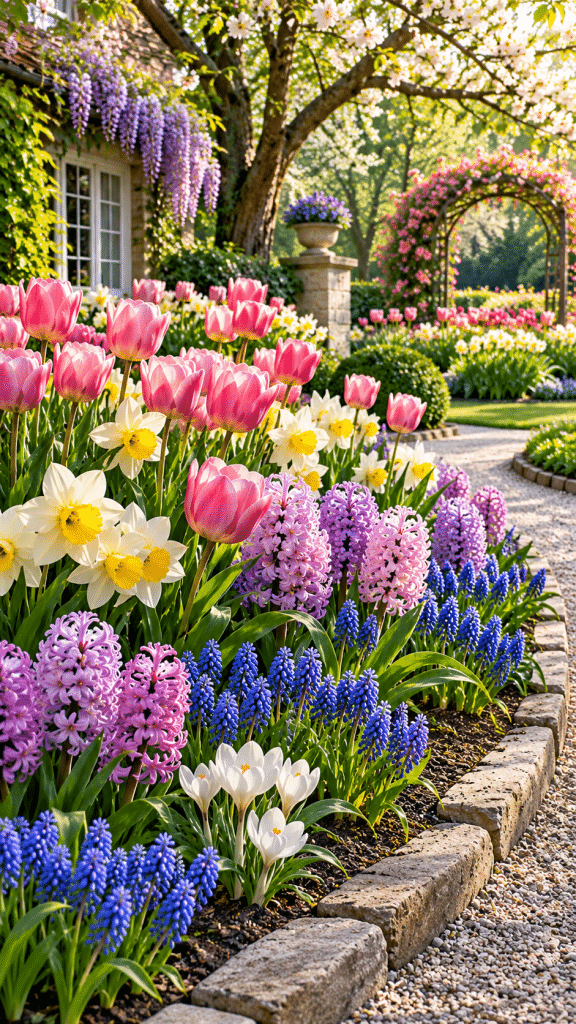
Create a Luxurious Color Palette With Soft Pink Tulips and Creamy Daffodils
The most appealing romantic bulb gardens often begin with a restrained color palette.
Rather than mixing every available tulip color, choose three or four harmonious shades that reinforce the same atmosphere.
A particularly elegant combination includes blush pink, ivory, pale lavender, and soft yellow.
Blush tulips provide graceful shapes and gentle color. Creamy daffodils introduce brightness and movement, while lavender hyacinths contribute dense flower clusters and fragrance.
Small blue grape hyacinths can fill spaces between the larger flowers, creating a rich visual foundation.
For a sophisticated result, repeat these colors in several overlapping groups rather than concentrating each flower variety in a separate isolated section.
This repetition allows the planting to feel continuous.
A large cluster of pale pink tulips near the center can be echoed by smaller groups toward the edges, while ivory daffodils connect different sections of the design.
The objective is to create a naturally flowing landscape where the eye moves smoothly between flower combinations.
Use Layered Bulb Planting for Extraordinary Floral Depth
One of the most exciting techniques for creating an abundant spring display is layered bulb planting.
This approach positions compatible bulbs at different depths according to their individual planting requirements.
Larger bulbs generally occupy deeper planting positions, while smaller bulbs are placed closer to the soil surface.
For example, tulips may form the deeper layer, followed by suitable small daffodils or hyacinths, with grape hyacinths or crocuses placed nearer the surface.
The exact arrangement depends on bulb size, variety, root development, and the depth recommended by the supplier.
A layered planting does not necessarily mean stacking bulbs directly on top of one another.
Slightly offsetting the bulbs provides room for roots and shoots to develop while maintaining an attractive planting density.
This technique is especially useful in deep garden beds or sufficiently large containers where planting space is limited but spring impact is important.
As the season progresses, different flowers emerge at different times.
Early crocuses introduce the first delicate color.
Daffodils and hyacinths follow, creating a fuller spring composition.
Finally, taller tulips can rise above the lower flowers, delivering a beautiful final transformation.
The result resembles a carefully choreographed floral performance.
Shape the Flower Island With Curved Edges and Natural Groupings
The outline of a planting area can dramatically influence the overall appearance of a bulb garden.
For a romantic flower island, avoid an excessively narrow bed or a collection of disconnected small patches.
Instead, create one generous planting area with softly curved boundaries.
An oval, kidney-shaped, or irregular island can look especially beautiful within a lawn or alongside an existing garden border.
Position taller flowers toward the middle or rear, depending on the viewing angle.
Place shorter bulbs closer to the edges, allowing their smaller flowers to remain visible.
To achieve a natural effect, arrange bulbs in irregular clusters rather than perfectly even lines.
Groups of seven, eleven, fifteen, or more bulbs can create a more substantial visual impression than isolated individual flowers.
In a larger landscape, overlapping drifts of the same variety can make the garden appear especially impressive.
The aim is controlled abundance.
Although the final composition should look effortless, its beauty comes from careful consideration of scale, spacing, and repetition.
Combine Spring Bulbs With Emerging Perennial Foliage
A romantic bulb island becomes even more attractive when it is connected to the garden’s broader seasonal planting.
Low-growing perennial foliage can provide an appealing transition between spring flowers and the surrounding landscape.
Suitable companion plants may include hardy geraniums, hostas, brunnera, or other perennials selected for the site’s climate and light conditions.
Their emerging leaves can complement spring flowers without competing too aggressively during the earliest blooming period.
As bulb foliage begins to yellow later in spring, developing perennial plants can gradually disguise the untidy leaves.
This creates a garden that continues to look intentional even after the main spring bulb display has finished.
The important principle is to avoid cutting healthy bulb foliage too early.
Bulbs rely on their leaves after flowering to replenish stored energy for future growth.
Allowing foliage to mature naturally helps preserve the strength of perennializing bulbs.
🥈 Best 2 Fall Bulb Planting Ideas With a Magical Woodland Flower Carpet
The second design embraces a completely different aesthetic.
Instead of formal flower islands and carefully arranged color combinations, this concept creates the appearance of a naturally occurring spring woodland.
Imagine delicate snowdrops scattered beneath bare deciduous trees, purple crocuses emerging between patches of moss, and graceful groups of miniature daffodils spreading across the forest floor.
The result feels peaceful, enchanting, and wonderfully organic. 🌿
This planting style is especially suitable for gardens with mature deciduous trees, informal lawns, shaded edges, and areas where a naturalistic landscape is preferred.
It also offers an opportunity to establish flowering bulbs that may gradually multiply and spread when growing conditions are favorable.
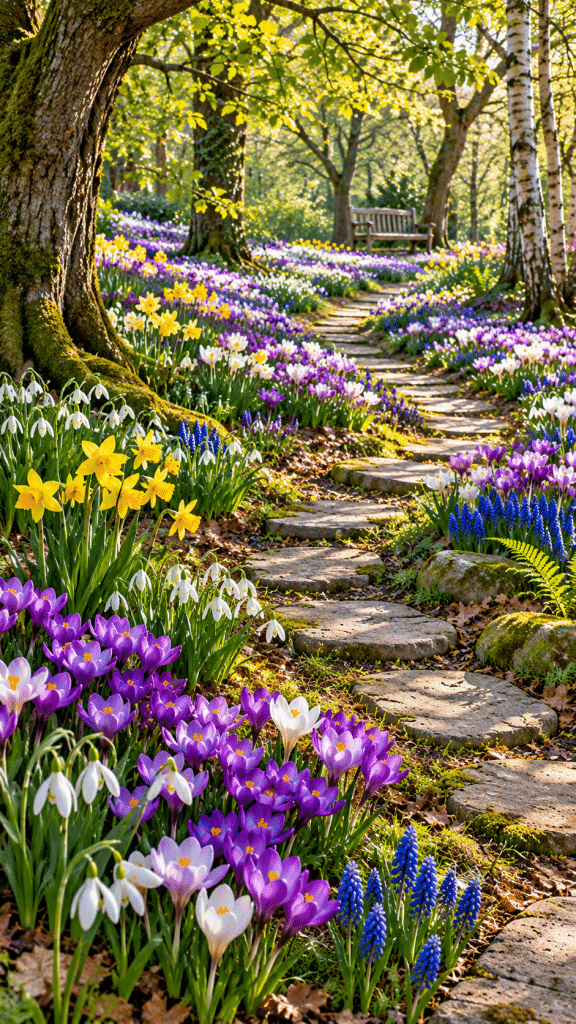
Naturalize Crocuses and Snowdrops Beneath Deciduous Trees
Naturalizing is the process of establishing bulbs in arrangements that resemble spontaneous growth.
Instead of creating rigid planting patterns, bulbs are distributed in informal groups that imitate naturally occurring colonies.
Crocuses are particularly effective for this purpose.
Their small flowers can appear in purple, white, yellow, and striped varieties, creating colorful patches against the muted landscape of early spring.
Snowdrops offer an entirely different character.
Their delicate white flowers hang gracefully above narrow foliage, often creating the impression of tiny lanterns emerging from the winter garden.
Beneath suitable deciduous trees, early spring bulbs can take advantage of sunlight that reaches the ground before the tree canopy becomes fully covered with leaves.
However, tree-root competition, soil moisture, and summer shade must be considered carefully.
Not every tree creates suitable conditions.
Choose locations where the soil drains adequately and where the selected bulbs can establish without severe competition from dense roots.
For large naturalized areas, begin with several concentrated patches rather than distributing a small number of bulbs across an enormous space.
Over time, successful varieties may gradually expand.
Create Natural Flower Drifts With Miniature Daffodils
Miniature daffodils are another beautiful choice for woodland-inspired bulb planting.
Their small flowers have a charming appearance that feels less formal than the larger trumpet daffodils often used in traditional flower beds.
Soft yellow, creamy white, and pale lemon varieties can create delicate displays beneath trees or beside woodland paths.
Instead of planting them in perfect circles, arrange the bulbs in irregular drifts.
A useful design technique is to gently scatter bulbs across a prepared planting area and plant them approximately where they land, adjusting spacing where necessary.
This creates a less predictable arrangement than measuring identical distances between every flower.
Some clusters may contain five bulbs, while others contain ten or more.
Small openings between groups allow the surrounding landscape to remain visible.
The overall effect should resemble a natural colony rather than a decorative flower installation.
For a more layered appearance, combine miniature daffodils with small drifts of crocuses and grape hyacinths.
Their differences in height and flower shape introduce complexity without overwhelming the woodland atmosphere.
Design a Winding Woodland Path Through Spring Flowers
A simple garden path can transform naturalized bulbs into an immersive landscape experience.
Rather than viewing the spring flowers from a distance, a narrow stepping-stone path allows visitors to move gently through the display.
Natural stone, weathered brick, gravel, or rustic stepping stones can complement this aesthetic.
The path should follow a relaxed curve rather than a perfectly straight line.
Position flowering bulbs in irregular groups beside the route, allowing some clusters to extend closer to the stones while others remain farther away.
This variation creates depth and visual movement.
In larger gardens, occasional clusters of slightly taller daffodils can serve as gentle focal points.
Smaller crocuses and snowdrops provide delicate detail near the ground.
The combination of soft flowers, natural materials, and winding movement creates an atmosphere reminiscent of a romantic European woodland garden.
Make the Woodland Garden Beautiful Without Constant Maintenance
One of the greatest advantages of naturalistic bulb planting is its potential for relatively low maintenance once suitable varieties become established.
However, successful naturalizing depends on choosing bulbs that are well adapted to the site.
Some tulip hybrids may produce magnificent flowers during their first spring but become less reliable in subsequent years.
By comparison, many daffodil species and selected crocuses can return successfully in suitable climates and soils.
Snowdrops can also establish colonies, although their performance depends on moisture, soil conditions, and local climate.
Avoid disturbing established bulbs unnecessarily.
Allow foliage to complete its growth cycle after flowering, and minimize soil cultivation around established colonies.
If bulbs are planted in a lawn, delay mowing the flowering areas until the bulb foliage has yellowed sufficiently.
This allows the plants to replenish their stored energy.
Over time, the woodland garden can develop a mature and increasingly natural appearance.
🥉 Best 3 Fall Bulb Planting Ideas With Architectural Tulip Waves and Dramatic Spring Color
The third design introduces a bold, contemporary approach to spring bulb planting.
Instead of romantic cottage-garden abundance or naturalistic woodland displays, this concept uses carefully repeated tulip varieties, sculptural ornamental alliums, and strong geometric relationships.
The result is a striking landscape that looks especially beautiful beside modern homes, architectural garden walls, minimalist terraces, and structured pathways.
Imagine deep burgundy tulips rising through a sea of ivory flowers, followed by elegant purple allium spheres hovering above fresh green foliage.
The design feels dramatic, polished, and intentionally composed. ✨
Although the planting itself is relatively straightforward, its visual impact comes from disciplined color selection and confident repetition.
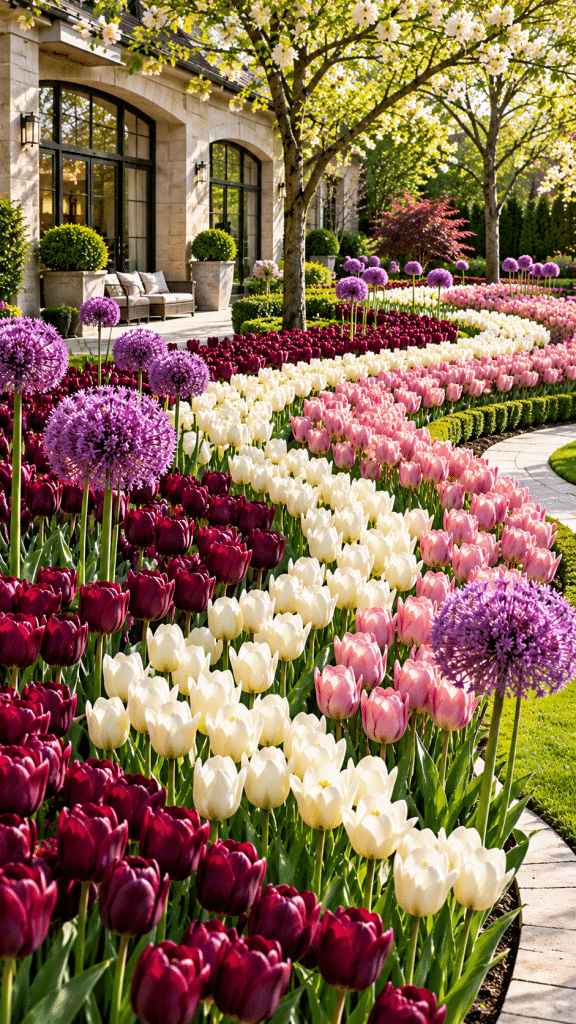
Create Dramatic Tulip Waves With Two Contrasting Colors
A modern tulip garden often looks more sophisticated when it uses fewer colors.
Instead of combining many unrelated varieties, select two contrasting shades and repeat them throughout the planting.
One striking combination pairs deep burgundy tulips with creamy white varieties.
Another uses soft peach tulips alongside pale lavender or rich purple flowers.
For a warmer architectural landscape, consider apricot, amber, and copper-inspired tones.
The bulbs can be arranged in broad ribbons that flow across the garden bed.
These ribbons may follow the shape of a pathway, echo the edge of a terrace, or create sweeping curves through a rectangular planting space.
Avoid making the ribbons too narrow.
A generous width allows enough flowers to create a continuous visual impression during peak bloom.
Where possible, choose tulip varieties with similar flowering periods so the contrasting colors appear together.
Differences in height should also be considered.
Two varieties with closely matched heights produce a clean, cohesive composition.
Alternatively, one slightly taller variety can create subtle visual depth without disrupting the overall rhythm.
Add Sculptural Alliums for a Second Architectural Display
Ornamental alliums can extend the architectural character of the planting beyond the main tulip season.
Many varieties produce spherical flower heads composed of numerous tiny blossoms.
Their dramatic shapes contrast beautifully with the upright forms of tulip flowers.
Purple and white alliums are especially effective in contemporary designs.
Position them in repeated groups rather than scattering isolated plants randomly.
Their tall stems can create elegant vertical accents above lower-growing plants.
Because many ornamental alliums flower later than early spring bulbs, they can provide an appealing transition toward late spring and early summer.
This helps the garden maintain visual interest after the initial tulip display has faded.
For a more restrained aesthetic, select one allium variety and repeat it consistently.
A single sculptural flower shape often creates a stronger architectural statement than several competing varieties.
Use Repetition and Negative Space for a Luxury Garden Effect
One defining characteristic of sophisticated landscape design is the relationship between planted areas and open space.
A garden does not need to be filled completely with flowers to appear luxurious.
In fact, carefully preserved negative space can make a bold planting more memorable.
Consider a modern rectangular bed with several generous bands of tulips separated by low-growing greenery or simple groundcover.
The repeated forms create visual rhythm.
Open areas allow each flower group to stand out.
In a narrow front garden, this technique can make the landscape feel more organized and spacious.
The architecture of the house should influence the planting geometry.
Straight garden walls may suit confident linear arrangements.
Curved walkways may benefit from flowing ribbons.
Circular patios can be complemented by repeated arcs or concentric planting patterns.
The goal is to establish a relationship between the flowers and the surrounding architecture.
Plan a Beautiful Transition After the Tulips Finish Blooming
A successful architectural bulb garden must remain attractive after the tulips fade.
This is particularly important because tulip foliage gradually loses its fresh appearance while the bulbs replenish their energy reserves.
Strategically positioned perennial foliage can soften this transition.
Low ornamental grasses, suitable hardy geraniums, and selected perennial plants may help maintain the garden’s structure.
Later-emerging foliage can gradually fill spaces around the fading tulips.
However, avoid planting aggressive companions that overwhelm the bulbs or create excessive competition.
If tulips are being grown primarily for a single spectacular season, some gardeners choose to treat them as annual displays.
Others select perennializing varieties and maintain the bulbs in place.
The appropriate choice depends on climate, cultivar, drainage, and the desired appearance.
In either case, planning the garden’s appearance beyond peak tulip season creates a more polished and sustainable design.
🌱 Fall Bulb Planting Ideas Comparison for Different Garden Styles
Each of the three designs offers a unique visual experience.
The best option depends on the garden’s architecture, available space, growing conditions, and the atmosphere you want to create.
| Garden Design | Recommended Bulbs | Visual Style | Ideal Location | Main Advantage |
|---|---|---|---|---|
| 🥇 Romantic Layered Flower Island | Tulips, daffodils, hyacinths, grape hyacinths | Soft, luxurious, romantic | Curved flower beds and open lawns | Rich color and layered blooming |
| 🥈 Magical Woodland Flower Carpet | Crocuses, snowdrops, miniature daffodils | Naturalistic, enchanting, peaceful | Suitable deciduous woodland edges and informal lawns | Potential for naturalizing and gradual expansion |
| 🥉 Architectural Tulip Waves | Tulips and ornamental alliums | Modern, dramatic, structured | Contemporary borders and pathways | Strong visual repetition and sculptural flowers |
For gardeners who enjoy a cottage-garden aesthetic, the romantic layered flower island offers an appealing combination of color and seasonal abundance.
Those who prefer natural landscapes may find the woodland approach especially rewarding.
Meanwhile, architectural tulip waves provide a striking option for contemporary gardens where clean lines and bold visual statements are important.
🍂 When to Plant Fall Bulbs for the Best Spring Flowers
Planting time is one of the most important factors influencing the success of spring-flowering bulbs.
In many temperate Northern Hemisphere climates, fall planting typically takes place from September through November, depending on the region and weather conditions.
However, the calendar alone is not always a reliable guide.
Soil temperature is especially important.
Many hardy spring-flowering bulbs establish roots most effectively when the soil has cooled, commonly around 40–55°F or 4–13°C, while remaining workable.
Planting too early during prolonged warm weather may encourage premature growth or increase the risk of disease.
Planting very late may limit the time available for root establishment before the ground freezes.
The ideal timing varies significantly between regions.
Fall Bulb Planting Calendar by Climate
| Climate or Growing Region | Approximate Planting Period | Main Consideration |
|---|---|---|
| Cold northern climates | September to October | Establish roots before sustained ground freezing |
| Cool temperate climates | October to November | Wait for consistently cooler soil |
| Mild winter regions | November to December or later | Choose appropriate varieties and verify chilling needs |
| Warm climates with little winter chill | Climate dependent | Some bulbs need prechilling or may perform better as annuals |
These periods are general guidelines rather than fixed planting deadlines.
Gardeners should consider regional conditions, soil temperatures, and supplier instructions.
In climates with mild winters, some tulip and hyacinth varieties may require artificial chilling before planting.
Not all bulbs require identical treatment, so research individual species before refrigerating them.
Prechilling should be conducted according to reputable local guidance, with bulbs kept away from ripening fruit that releases ethylene gas.
🌟 Important Note: Most traditional spring-flowering bulbs require a period of cool temperatures to bloom properly. Always match bulb varieties and planting schedules to the local climate, and prioritize well-drained soil because prolonged waterlogging can cause bulbs to rot.
🌷 How Deep Should You Plant Fall Flower Bulbs
Correct planting depth helps bulbs establish healthy roots, maintain stable temperatures, and develop strong flowers.
A widely used guideline for many hardy spring-flowering bulbs is to plant them at a depth approximately two to three times the height of the bulb.
However, planting depth varies by species, bulb size, and soil conditions.
It is important to follow the instructions provided for the specific variety.
Planting depth is commonly measured from the bottom of the bulb to the finished soil surface.
Large bulbs generally require deeper planting than smaller varieties.
The following table provides approximate starting points.
| Bulb Variety | Typical Planting Depth | Approximate Spacing | Common Blooming Period |
|---|---|---|---|
| Tulips | 6–8 inches | 4–6 inches | Mid to late spring |
| Daffodils | 6–8 inches | 4–6 inches | Early to mid-spring |
| Hyacinths | 4–6 inches | 4–6 inches | Early to mid-spring |
| Crocuses | 2–4 inches | 2–3 inches | Late winter to early spring |
| Grape hyacinths | 3–4 inches | 2–3 inches | Early to mid-spring |
| Snowdrops | 2–3 inches | 2–3 inches | Late winter to early spring |
| Ornamental alliums | 3–8 inches depending on variety | 4–12 inches depending on size | Late spring to early summer |
Actual planting requirements may differ substantially among cultivars and species.
Very large ornamental alliums, for example, need different spacing from smaller varieties.
For best results, use these figures as general guidance and follow species-specific planting recommendations.
Position Every Bulb Correctly
Most familiar bulbs have a pointed upper end and a flatter basal plate where roots develop.
The pointed end should generally face upward.
The flatter root-producing side should rest against the soil beneath it.
If a bulb has an irregular shape and its orientation is uncertain, consult the planting instructions for that particular species.
When preparing a larger planting area, loosen the soil before positioning the bulbs.
This encourages more consistent rooting and makes it easier to place bulbs at the correct depth.
Avoid pressing bulbs forcefully into compacted soil.
Instead, create a suitable planting hole or trench, position the bulbs carefully, and refill with loose soil.
🌿 Preparing the Perfect Soil for Fall Bulb Planting
Healthy soil is one of the most important foundations for a successful spring bulb garden.
Although bulbs contain stored energy, their roots still need access to oxygen, moisture, and suitable nutrients.
Poor drainage can cause serious problems.
When soil remains saturated for extended periods, bulbs may become vulnerable to rot.
This is particularly concerning in heavy clay soil or areas where rainwater collects.
Improve Drainage Before Planting
Begin by examining how water behaves in the intended planting area.
If puddles remain for long periods after rainfall, the site may not provide suitable drainage.
In heavy soil, incorporating finished compost across the wider planting area can improve soil structure over time.
Raised beds may offer a practical alternative in locations where drainage remains poor.
Avoid placing bulbs directly into isolated pockets of sand or gravel within heavy clay soil, because this does not necessarily solve drainage problems and may create conditions where water accumulates.
For container-grown bulbs, use containers with drainage holes and a suitable, free-draining potting mix.
Good drainage is more important than adding excessive fertilizer.
Choose Healthy Bulbs Before Planting
Beautiful spring flowers begin with high-quality planting material.
Healthy bulbs should generally feel firm and substantial for their size.
Avoid bulbs showing obvious signs of decay, extensive mold, serious mechanical damage, or unusual softness.
Large, healthy bulbs of a particular variety often produce stronger flowers during their first season, although performance also depends on growing conditions.
Purchase bulbs from reputable suppliers and store them in a cool, dry, ventilated place until planting.
Do not leave unplanted bulbs exposed to excessive heat or moisture.
The sooner bulbs are planted under appropriate seasonal conditions, the sooner they can begin establishing roots.
Water and Mulch Carefully
After planting, water the soil thoroughly enough to settle it around the bulbs.
During dry autumn weather, additional watering may be needed while roots establish.
However, avoid maintaining constantly saturated conditions.
In many gardens, natural autumn rainfall provides much of the necessary moisture.
A modest layer of organic mulch can help regulate soil temperature, reduce moisture fluctuations, and protect the soil surface.
In colder climates, mulch applied after the soil begins freezing can help reduce repeated freezing and thawing.
Avoid piling thick mulch directly against emerging shoots.
The objective is protection and moderation, not creating excessively wet conditions.
🌸 How to Create Continuous Spring Blooms With Fall Planted Bulbs
One of the most effective ways to make a bulb garden feel extraordinary is to plan for a sequence of blooms.
Rather than choosing flowers that all bloom at approximately the same time, combine early, middle, and late spring varieties.
This allows the garden to reveal new colors and textures throughout the season.
A carefully designed sequence can transform a relatively small planting area into an evolving display.
Start With Early Spring Crocuses and Snowdrops
The earliest flowers often create the greatest emotional impact.
After weeks of gray skies and dormant plants, the appearance of even a few small blossoms can make the garden feel alive again.
Snowdrops and early crocuses are ideal candidates for this first stage.
Their modest height makes them suitable for planting near walkways, beneath appropriate deciduous trees, or along the edges of garden beds.
Because their flowers are small, generous groupings generally create a stronger visual effect than scattered individual bulbs.
Introduce Daffodils and Hyacinths for a Fuller Display
As temperatures rise, daffodils and hyacinths can create the next wave of spring color.
Daffodils contribute cheerful flowers and graceful stems.
Hyacinths introduce dense flower clusters and a distinctive fragrance.
Their different shapes provide interesting contrast.
In romantic gardens, creamy daffodils can be paired with lavender hyacinths for a delicate pastel composition.
In bolder landscapes, golden yellow daffodils may be combined with deep purple varieties.
Choose species and cultivars with overlapping bloom periods when a coordinated display is desired.
Finish With Tulips and Ornamental Alliums
Tulips provide some of the most dramatic flowers of spring.
Their elegant shapes and wide color range make them particularly valuable for both naturalistic and contemporary designs.
Early, midseason, and late tulip varieties can extend the tulip display when their blooming periods are planned carefully.
Later ornamental alliums provide another distinctive phase.
Their spherical flowers rise above the developing spring landscape, creating strong silhouettes and architectural interest.
Together, these planting groups can keep the garden visually engaging over an extended period.
The exact flowering sequence will depend on climate, seasonal weather, and selected varieties.
🏡 Creative Places to Plant Spring Bulbs in an Ordinary Backyard
Beautiful bulb planting does not require an enormous garden.
Some of the most memorable displays appear in compact spaces where the flowers are positioned carefully.
The key is choosing locations where the blooms will be noticed and appreciated.
Along a Garden Walkway
A narrow ribbon of bulbs beside a pathway creates a welcoming spring atmosphere.
Use repeating groups of daffodils, tulips, or grape hyacinths to establish visual rhythm.
For a more natural effect, allow the groups to vary slightly in size.
Choose shorter varieties near the path edge so they remain visible and do not overwhelm the walkway.
Around a Garden Bench
A quiet seating area surrounded by spring flowers can become one of the most charming destinations in the garden.
Plant taller bulbs toward the rear and smaller flowers near the front.
Soft pastel combinations create a peaceful atmosphere, while rich purple and white flowers provide dramatic contrast.
Position the flowers where they receive appropriate light and where their mature foliage will not interfere with seating.
Beneath Suitable Deciduous Trees
Early spring bulbs can create beautiful carpets beneath some deciduous trees.
The open canopy may allow sufficient sunlight to reach the flowers before leaves fully emerge.
However, dense tree roots and excessively dry soil can make establishment difficult.
Choose adaptable naturalizing bulbs and avoid damaging major tree roots during planting.
In Deep Decorative Containers
Containers provide an attractive alternative for patios, balconies, and entrances.
A sufficiently deep pot can accommodate carefully layered bulbs, creating a concentrated spring display.
Ensure the container has drainage holes and can withstand expected winter temperatures.
In very cold regions, above-ground pots may need additional protection because container soil can freeze more severely than surrounding garden soil.
For a beautiful spring entrance, consider combining compatible tulips, miniature daffodils, and grape hyacinths in a large container.
🐿️ Protecting Fall Planted Bulbs From Common Garden Problems
Even carefully planned bulb gardens can encounter challenges.
Rodents, unsuitable drainage, poor planting depth, and premature foliage removal are among the issues that can affect spring flowering.
Understanding these problems before planting helps prevent disappointment.
Protect Bulbs From Hungry Wildlife
Certain animals may dig up or eat newly planted bulbs.
Tulips and crocuses can be particularly attractive to some rodents.
Where wildlife pressure is significant, physical protection may be necessary.
A properly installed wire-mesh barrier can help protect vulnerable planting areas while allowing shoots to emerge.
Choose an appropriate mesh size and installation method for the animals involved.
Daffodils are often avoided by many mammals because they contain toxic compounds, making them useful in gardens where browsing pressure is a concern.
However, no planting is completely guaranteed against every animal.
Remember that daffodil bulbs are also poisonous to people and pets if ingested, so handle and store them responsibly.
Avoid Overcrowding and Poor Drainage
Dense planting can create a magnificent floral display, but excessively crowded bulbs may compete for growing space and nutrients.
Follow recommended spacing guidelines while using generous groups to create visual impact.
Poor drainage can be even more damaging.
Bulbs exposed to persistent standing water may rot before they have the opportunity to flower.
If the planting area remains waterlogged, improving drainage or choosing another location is usually more effective than repeatedly replacing failed bulbs.
Allow Bulb Foliage to Mature Naturally
One common mistake is removing bulb leaves immediately after flowering.
Although fading foliage may appear untidy, it performs an essential function.
The leaves continue photosynthesizing and help replenish the bulb’s stored energy.
Removing them too early can weaken future flowering.
Allow foliage to yellow and decline naturally before cutting it back.
Companion perennials can help disguise the leaves during this transition.
For naturalized bulbs planted in lawns, postpone mowing the affected areas until foliage has completed its growth cycle.
🌷 Making Fall Bulb Planting Ideas Look Professionally Designed
Professional-looking bulb gardens are rarely the result of complicated techniques.
Instead, they rely on a handful of consistent design principles.
Scale is one of the most important.
A small number of isolated flowers may disappear visually within a large garden.
Generous groupings create stronger color impact and more memorable compositions.
Repetition is equally valuable.
Repeating the same flower variety in several areas gives the landscape a cohesive identity.
Contrast can then provide excitement.
Tall flowers beside short flowers, rounded blossoms beside spiky flowers, and pale colors beside rich shades all introduce visual interest.
However, too much contrast can become visually overwhelming.
Limit the number of dominant colors within each planting composition.
For a romantic garden, use harmonizing pastels.
For a woodland garden, emphasize natural distribution and gradual transitions.
For a contemporary garden, use confident repetition and strong geometric relationships.
The arrangement should complement the overall character of the landscape.
Calculate the Number of Bulbs Before Buying
A successful design begins with a realistic planting plan.
Measure the intended planting area and decide whether the bulbs will cover the entire space or occupy selected drifts.
For example, a compact flower island may contain several concentrated groups of tulips and daffodils with smaller bulbs positioned between them.
A woodland garden may need many small bulbs to create noticeable patches of color.
An architectural design may require repeated rows or bands of the same cultivar.
Bulb spacing influences the quantity needed.
Closer spacing generally creates a fuller first-year display, while wider spacing can leave room for varieties intended to multiply.
Use the mature size and planting recommendations of each variety to estimate quantities.
Purchasing a few additional bulbs may be helpful for filling gaps and maintaining consistent visual groups.
Consider the View From Your Home
A beautiful bulb garden should not be designed only for visitors walking through the landscape.
Consider how the flowers will appear from frequently used windows, doors, and seating areas.
A colorful spring island positioned opposite a living room window can provide daily enjoyment during the earliest weeks of the growing season.
A woodland carpet visible from a kitchen window may create a beautiful morning scene.
Architectural tulip ribbons can be particularly effective when viewed from slightly elevated positions.
Thinking about these viewpoints before planting can dramatically improve the final composition.
🌼 Final Thoughts on Creating an Unforgettable Spring Garden With Fall Bulbs
The beauty of fall bulb planting lies in its extraordinary combination of simplicity and anticipation.
A few hours spent preparing the soil and arranging carefully selected bulbs can create months of excitement as gardeners imagine the flowers waiting beneath the ground.
The most beautiful designs do more than introduce seasonal color.
They create atmosphere.
A romantic layered flower island brings softness, abundance, and elegant cottage-garden charm.
A magical woodland carpet creates a peaceful landscape filled with delicate blossoms and natural beauty.
An architectural tulip garden transforms simple flower shapes into a bold composition of color, height, and repetition.
Each approach offers a distinctive way to celebrate the arrival of spring.
For the most rewarding results, select healthy bulbs, plant them at suitable depths, provide well-drained soil, and consider how different varieties will bloom throughout the season.
Most importantly, think beyond individual flowers.
Consider the entire landscape, the movement of colors across planting areas, the relationship between flowers and surrounding architecture, and the changing character of the garden from late winter into early summer.
With these Best 3 Fall Bulb Planting Ideas, even an ordinary backyard can become a breathtaking spring flower paradise filled with romantic beauty, enchanting natural details, and unforgettable seasonal color. 🌷✨