Finding the right gutter downspout drainage ideas can completely change how a yard handles heavy rain. A downspout may look like a small part of a home’s exterior, but it manages an enormous amount of water during storms. When that water is released directly beside the house, it can create muddy planting beds, soil erosion, standing water, damaged landscaping, and unwanted moisture around the foundation.
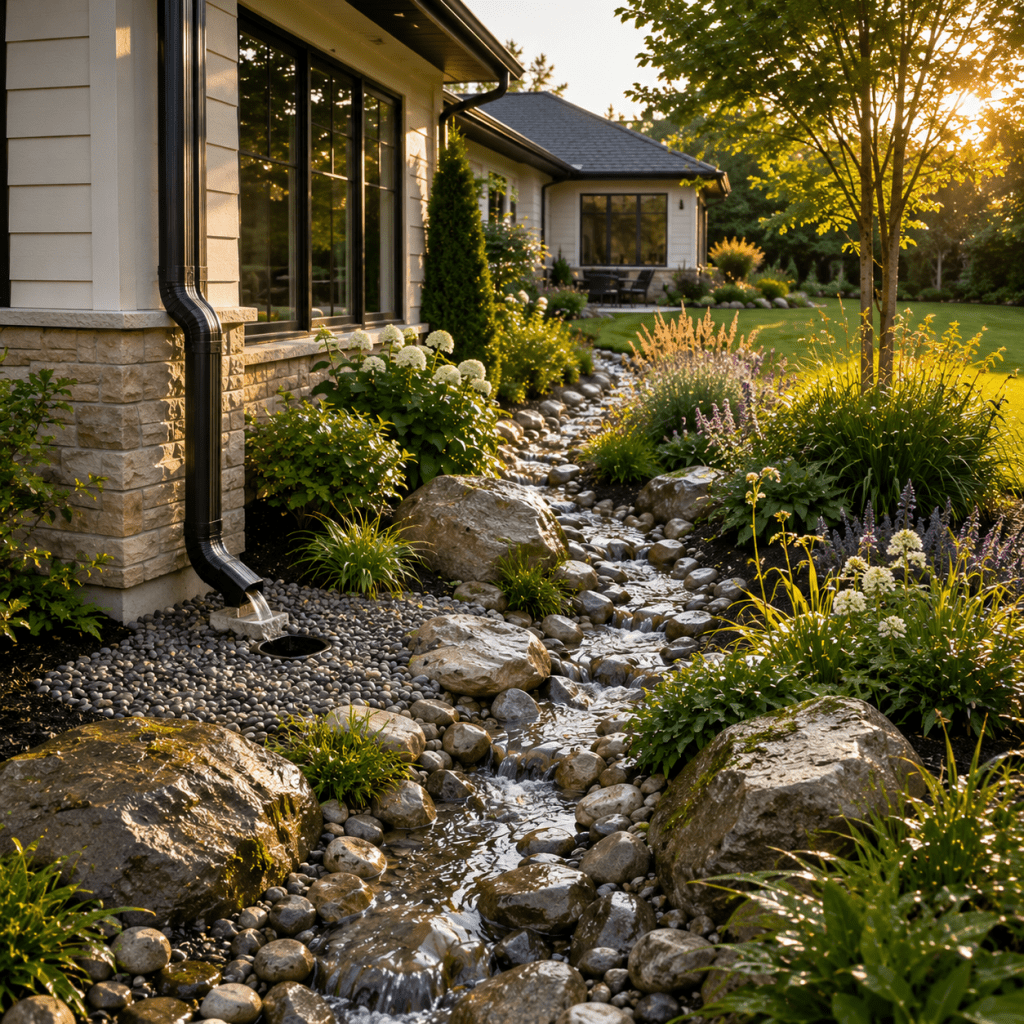
The best drainage solutions do much more than move rainwater somewhere else. They integrate water management into the landscape so the system becomes functional, attractive, and surprisingly discreet. 🌧️ Instead of allowing a plastic extension or exposed pipe to dominate the side of the house, thoughtful landscaping can transform drainage into a polished part of the garden.
Some homeowners need a simple underground system that carries water toward a safe discharge area. Others may benefit from a beautiful dry creek bed that turns runoff into a landscape feature. Properties with naturally low areas can often use a rain garden to capture and slowly absorb stormwater.
The following Best 3 gutter downspout drainage ideas represent three distinctly different approaches. Each option solves a particular landscape challenge while creating opportunities for a cleaner, more intentional outdoor design.
Why Gutter Downspout Drainage Ideas Matter More Than They Seem 🌧️
A roof acts like a huge rain collector.
During a storm, water falling across hundreds or thousands of square feet of roofing is directed toward a relatively small number of gutters and downspouts. That concentration means an ordinary-looking downspout can release a substantial volume of water into one small section of landscaping.
If the downspout terminates directly beside the foundation, the surrounding soil can become repeatedly saturated.
Over time, this may contribute to erosion, muddy areas, damaged plants, basement or crawl-space moisture problems, and deterioration around hardscape edges. Even when serious structural problems never develop, poorly controlled runoff can make an otherwise beautiful landscape look unfinished.
Good drainage design therefore begins with one basic objective:
Move or manage roof runoff without creating another problem elsewhere.
The best system depends on several factors, including soil type, yard slope, rainfall intensity, available space, local drainage rules, existing landscaping, and the location of safe discharge or infiltration areas.
A compact suburban yard may require underground piping because there is little room for surface drainage. A larger naturalistic garden may have enough space for a decorative dry creek. A property with a suitable low area and permeable soil may benefit from a planted rain garden.
Understanding these differences makes it easier to select a solution that works technically while also improving the visual quality of the landscape.
Best 3 Gutter Downspout Drainage Ideas at a Glance
| Drainage Idea | Best For | Visual Style | Installation Level | Main Advantage |
|---|---|---|---|---|
| 🥇 Underground Downspout Drainage | Clean modern landscapes and limited spaces | Minimal and nearly invisible | Moderate to advanced | Moves water discreetly away from the house |
| 🥈 Dry Creek Bed Drainage | Sloped yards and decorative landscapes | Natural and highly visible | Moderate | Combines drainage with landscape design |
| 🥉 Rain Garden Drainage | Eco-conscious and plant-focused gardens | Lush and botanical | Moderate | Captures runoff and encourages infiltration |
Each of these solutions can be effective when correctly designed. The important distinction is how the water is handled after leaving the downspout.
Some systems transport it. Others slow it down. Others temporarily collect it and allow the surrounding soil and vegetation to absorb it.
That difference is what makes each idea suitable for a particular property.
🥇 Best 1 Underground Gutter Downspout Drainage for a Clean Hidden Solution
For homeowners who want drainage infrastructure to almost disappear, underground gutter downspout drainage is one of the most practical options.
Instead of leaving a long downspout extension lying across the lawn, the downspout connects to a buried drainage system. Water travels through the pipe toward an appropriate outlet, infiltration area, or other properly designed termination point.
Visually, this creates an exceptionally clean result.
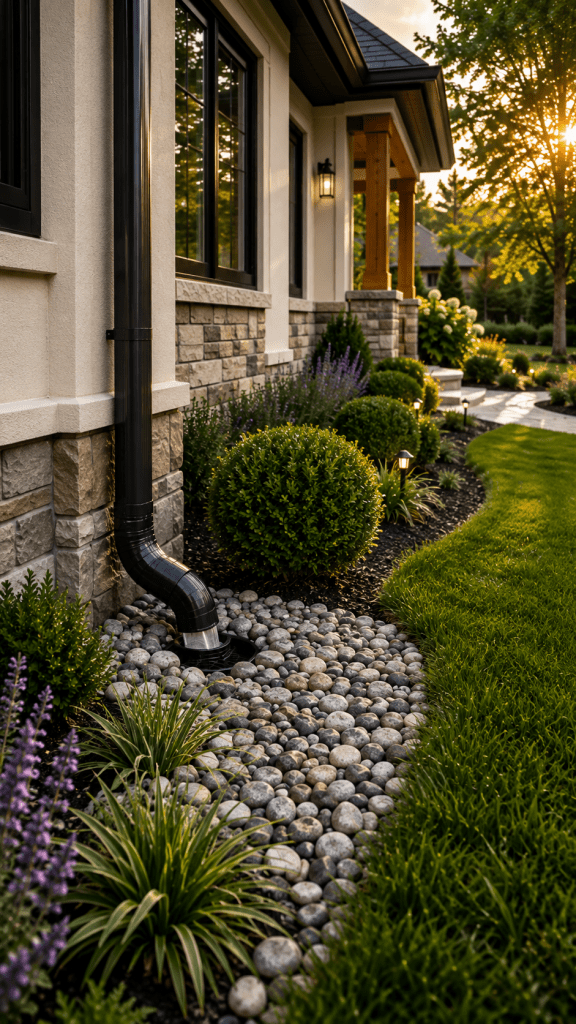
The visible downspout can transition neatly into the ground near the foundation, leaving lawns, pathways, planting beds, and outdoor living areas largely uninterrupted.
This makes underground drainage particularly attractive around contemporary homes, carefully landscaped front yards, and properties where visible utility components would distract from the architecture.
How Underground Gutter Downspout Drainage Ideas Work
The basic concept is straightforward.
Rainwater moves from the roof into the gutter, travels down the downspout, enters a buried pipe, and is transported away from the foundation.
However, the effectiveness of the system depends heavily on design details.
The underground pipe needs an appropriate route and slope. Water should not simply be moved from one problematic location to another. The final discharge point must be capable of receiving the expected runoff without causing erosion, flooding neighboring properties, or sending water back toward the building.
Access for cleaning is another important consideration.
Leaves, roof debris, seeds, and small twigs can enter gutter systems. A buried drainage line that cannot be inspected or maintained may eventually become clogged.
Thoughtful installations often incorporate accessible connections, cleanouts, debris management, or other maintenance features.
Create a Nearly Invisible Transition
One of the most attractive characteristics of underground drainage is how discreet the system can become.
Imagine a modern house surrounded by warm limestone paving, ornamental grasses, clipped shrubs, and carefully maintained lawn. A long black corrugated pipe stretching across that composition would immediately attract attention.
An underground connection solves that visual problem.
The downspout can descend along the exterior wall and disappear into a subtle drainage connection near ground level.
Around the transition, decorative gravel or carefully positioned plants can soften the remaining infrastructure without blocking access.
The result feels intentional rather than improvised.
Underground Drainage Works Beautifully with Modern Landscaping
Contemporary landscape design often depends on strong lines and uncluttered surfaces.
Large-format pavers, geometric lawns, linear planting beds, gravel zones, architectural planters, and simple plant palettes all benefit from hidden utilities.
Underground downspout drainage complements this approach because the functional components remain mostly below the surface.
🌿 A narrow bed of ornamental grasses can conceal the transition.
🪨 Decorative stone can create a clean maintenance zone.
🏡 Matching the visible downspout color to the exterior trim can make the entire installation feel integrated with the architecture.
The goal is not necessarily to make the downspout invisible. Instead, it should look like an intentional architectural element rather than an afterthought.
Where Should Underground Downspout Water Go
This is one of the most important questions in the entire drainage design.
A buried pipe does not solve a drainage problem merely because the pipe disappears underground.
The runoff still needs somewhere appropriate to go.
Depending on the property, local requirements, soil conditions, and drainage strategy, the system might terminate at an approved surface outlet, daylight location, infiltration feature, dry well, rain garden, or another properly engineered drainage destination.
The correct solution varies considerably between properties.
A yard with a strong natural slope may allow water to exit safely at a lower elevation. A flat property may require a completely different strategy.
Important Note: Never assume that burying a downspout pipe automatically solves the drainage problem. The outlet, soil conditions, slope, local regulations, and relationship to neighboring properties should be evaluated before installation. Water must be directed to a safe and appropriate location rather than simply transferred somewhere else.
Pros and Considerations of Underground Drainage
The biggest advantage is appearance.
Once installed, very little of the drainage infrastructure needs to remain visible. This makes the solution especially useful for front yards and sophisticated landscape designs.
It can also keep long extensions away from lawn equipment and pedestrian areas.
However, buried systems require planning.
Excavation is necessary, underground utilities must be considered before digging, and the system should remain maintainable. Poor slope, undersized components, crushed pipes, clogged lines, or unsuitable discharge points can reduce performance.
For that reason, underground drainage works best when it is treated as a complete water-management system rather than simply a buried extension.
🥈 Best 2 Dry Creek Gutter Downspout Drainage Ideas for Beautiful Natural Runoff
A dry creek bed offers a completely different interpretation of gutter drainage.
Instead of hiding water underground, this approach celebrates the path water takes through the landscape.
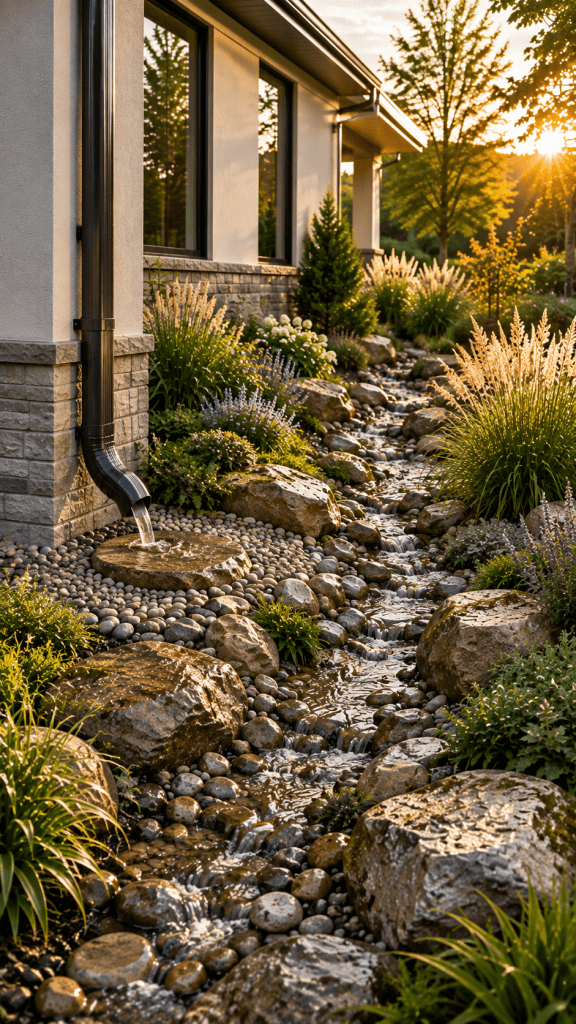
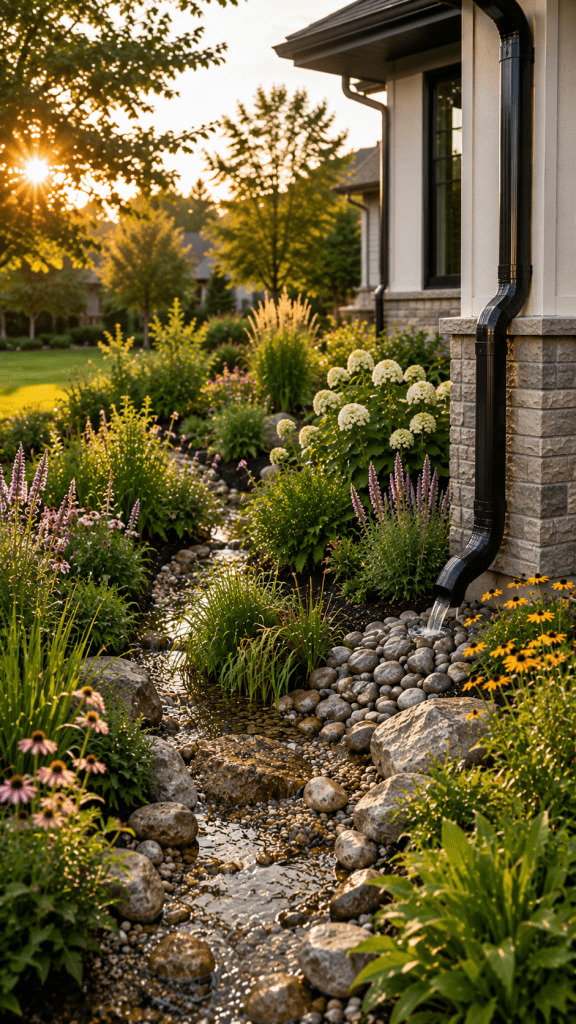
A carefully designed channel filled with river stones, cobbles, gravel, and strategically positioned boulders can receive water from a downspout and guide runoff through the yard.
When it is dry, the feature looks like a natural stone stream.
When rain arrives, it temporarily becomes an active drainage channel.
This combination of function and aesthetics makes the dry creek one of the most visually interesting gutter downspout drainage ideas for garden-focused properties.
Turn Rainwater Into a Landscape Feature
The most beautiful dry creek beds rarely look like straight trenches filled with identical rocks.
Natural streams vary.
They curve gently through the landscape, become wider in some places and narrower in others, and contain stones of different sizes. Large boulders often anchor bends while smaller cobbles and gravel fill the channel.
Recreating these characteristics helps the drainage feature look believable.
The transition from the downspout is particularly important.
Rather than allowing a metal or vinyl downspout to abruptly dump water onto decorative stones, the area can be visually softened with a larger splash stone, gravel basin, or carefully composed cluster of rocks.
This creates the impression that the drainage feature belongs to the garden.
Use Different Stone Sizes for Natural Character 🪨
Variation is essential.
Using only one size of rounded river rock can make a dry creek look artificial. A more sophisticated composition combines several materials.
Large weathered boulders can establish the main structure.
Medium river cobbles provide texture around the edges.
Smaller stones and gravel fill gaps and help create visual transitions.
The exact material palette should complement the surrounding architecture.
Warm beige, cream, and soft-gray stones can work beautifully beside natural wood and warm-toned houses. Charcoal and cool-gray stones can suit contemporary architecture with black metal details.
The goal is visual continuity.
A drainage feature should feel connected to the property rather than appearing as an isolated strip of stone.
Plant Around the Dry Creek for a Lush Effect 🌿
Plants can dramatically change the character of a dry creek.
Without vegetation, the feature may appear architectural and minimalist. With layered planting, it can become lush and naturalistic.
Ornamental grasses are especially effective because their fine foliage contrasts beautifully with heavy stone.
Groundcovers can soften the edges.
Shrubs can create height and depth farther from the active drainage path.
Moisture-tolerant plants may be appropriate in locations that periodically receive additional water, provided the species match the actual soil, climate, light conditions, and drainage pattern.
Plants should not obstruct the primary water route.
Instead, they should frame it.
A strong design might feature a clear stone channel through the center, irregular boulders along the edges, and gradually increasing vegetation beyond the main flow area.
Follow the Natural Slope of the Yard
Dry creek drainage becomes much more convincing when it follows existing topography.
Water naturally seeks lower elevations.
Forcing a decorative creek against the natural grade can create unnecessary complications and may require substantial earthwork.
Instead, observe where runoff already tends to travel.
A subtle low point between two planting areas might provide an ideal route. The creek can then transform that existing drainage pattern into something intentional.
On sloping properties, the effect can be particularly dramatic.
The stone channel can descend gently through terraced planting areas, pass beneath a small decorative bridge, or curve around established trees before reaching a suitable destination.
Avoid Making the Creek Too Perfect
Nature rarely produces perfectly symmetrical drainage channels.
This is why slight irregularity usually improves the appearance of a dry creek bed.
Vary the width.
Create gentle bends.
Position a few larger stones partially within the channel.
Allow plants to overlap certain edges without blocking flow.
A dry creek designed with these details can look as though it has always existed in the landscape.
At the same time, aesthetics should never compromise drainage capacity. Decorative placement must still allow stormwater to travel safely through the intended route.
When Dry Creek Drainage Makes the Most Sense
Dry creek beds can be particularly useful when a property has enough visible landscape space to accommodate them.
They work well in garden borders, side yards, sloped landscapes, and larger front yards where drainage infrastructure can become part of the visual design.
They may be less appropriate in extremely narrow spaces where the required channel would interfere with circulation.
Maintenance should also be considered.
Leaves and sediment can accumulate between rocks. Aggressive plants may spread into the channel. Heavy runoff can move smaller stones if the system is not appropriately designed.
Occasional inspection helps maintain both appearance and function.
🥉 Best 3 Rain Garden Gutter Downspout Drainage for a Lush Eco Friendly Landscape
The third approach changes the objective entirely.
Rather than primarily transporting runoff across the property, a rain garden is designed to temporarily receive water and encourage it to infiltrate appropriately.
This creates one of the most botanical and environmentally integrated gutter drainage solutions.
A downspout can feed water toward a shallow landscaped depression filled with plants selected for the site’s conditions. During rainfall, the garden temporarily collects runoff. Afterward, the water gradually drains and infiltrates rather than remaining permanently ponded.
The result can look like an ordinary beautiful planting bed during dry weather.
That makes rain gardens particularly appealing for homeowners who want drainage infrastructure to become part of the garden.
How Rain Garden Gutter Downspout Drainage Ideas Work 🌱
A rain garden is not simply a low spot filled with water-loving plants.
Successful design depends on soil infiltration, grading, incoming runoff volume, overflow planning, plant selection, and the relationship between the garden and nearby structures.
Water from the downspout is directed toward the planted depression.
The garden temporarily stores a manageable volume of runoff and gives it time to soak into suitable soil.
Plants and soil help create a landscape system that manages water while providing visual interest.
Because the area experiences changing moisture levels, plant selection matters.
The lowest portions may periodically become wet, while higher edges can remain considerably drier.
A layered planting design can respond to these different conditions.
Make the Rain Garden Look Intentional
One common misconception is that environmentally focused drainage landscaping must look wild or messy.
It does not.
A rain garden can be highly sophisticated.
For a contemporary property, the planting palette can be restrained. Repeated groups of grasses, flowering perennials, and structural shrubs can create rhythm and clarity.
A more naturalistic garden can use greater botanical diversity.
Stone edging, carefully shaped contours, and a defined entrance for runoff can further strengthen the design.
The secret is to make the boundaries readable.
When the edges are deliberate and plants are arranged thoughtfully, the rain garden looks like an intentional landscape feature rather than an accidental wet area.
Create Layers of Plants for Seasonal Beauty 🌸
Planting design gives the rain garden its personality.
Start with structural plants that maintain recognizable form through much of the year.
Add grasses for movement and fine texture.
Introduce flowering plants that provide seasonal color.
Groundcovers can help visually connect the garden to surrounding beds.
Instead of selecting plants solely because they are labeled as moisture tolerant, consider the actual conditions of each planting zone.
Some sections may experience temporary saturation after storms but become relatively dry between rainfall events.
Local native plants can often be excellent candidates because appropriate species are adapted to regional conditions and may also provide ecological benefits.
A landscape professional or local horticultural resource can help identify species suited to the site’s soil, sunlight, and rainfall patterns.
Add an Elegant Stone Inlet
The point where water enters the rain garden deserves attention.
A downspout abruptly terminating in the middle of flowers may look unfinished and can create localized erosion.
Instead, create a deliberate inlet.
A short path of smooth cobbles can carry water from the downspout toward the depression.
A broad flat stone can function visually as a splash area.
A narrow gravel swale can provide another transition.
These small details can make the system look professionally integrated.
During dry weather, the stone inlet becomes a decorative feature. During rainfall, its purpose becomes immediately clear.
Always Plan for Overflow
Every rain garden has a capacity.
Exceptional storms can exceed it.
Therefore, a safe overflow route is an essential part of the design.
Once the intended temporary storage area fills, excess water should have a controlled route toward an appropriate location.
Without overflow planning, the rain garden could simply move the flooding problem to another part of the yard.
This principle applies to nearly every drainage strategy:
Always think about where the water goes next.
Drainage is a sequence, not a single component.
How to Choose Between These Best 3 Gutter Downspout Drainage Ideas
Choosing between underground drainage, a dry creek, and a rain garden becomes easier when the priorities of the property are clear.
If visual simplicity is the highest priority, underground drainage is often the strongest candidate.
If the landscape needs a dramatic decorative feature, a dry creek can transform necessary drainage into garden architecture.
If planting and on-site stormwater management are central goals, a properly designed rain garden may provide the most rewarding result.
Choose Underground Drainage When
🏡 You prefer a clean landscape with minimal visible infrastructure.
This option works particularly well around modern homes, formal gardens, narrow side yards, and manicured lawns.
It is also helpful where exposed downspout extensions would interfere with walking paths or lawn maintenance.
The tradeoff is that buried infrastructure can be harder to inspect, making good installation and maintenance access especially important.
Choose a Dry Creek When
🪨 You want the drainage system to become part of the landscape design.
Dry creeks work beautifully in naturalistic gardens and sloping yards.
They are visually expressive and can turn a previously awkward runoff path into one of the most memorable elements of the garden.
The feature needs enough space, however, and the stone channel must be designed to handle the expected flow.
Choose a Rain Garden When
🌿 You want a lush planted solution that temporarily manages runoff on site.
Rain gardens can create impressive seasonal interest while integrating water management into the planting design.
However, they depend heavily on site conditions.
Soil that drains extremely slowly, difficult grading, insufficient space, or inappropriate placement near structures may require another approach or professional design assistance.
Small Gutter Downspout Drainage Ideas for Tight Spaces
Not every home has enough space for a large dry creek or expansive rain garden.
Fortunately, small spaces can still benefit from thoughtful drainage design.
A narrow side yard, for example, may use a discreet underground line while maintaining a slim gravel planting strip above it.
A compact front garden could use a short decorative stone channel to transition runoff toward another drainage component.
The key is to reduce visual clutter.
Instead of adding multiple disconnected drainage accessories, choose one clear route for the water and integrate that route with the existing architecture and landscaping.
Vertical planting, narrow ornamental grasses, compact shrubs, and clean gravel borders can make functional drainage areas feel surprisingly sophisticated.
Gutter Downspout Drainage Ideas for Front Yard Curb Appeal
Front yards require special consideration because every utility element influences curb appeal.
A beautiful façade can lose some of its visual impact when long plastic extensions stretch across planting beds.
For this reason, front-yard drainage should ideally coordinate with the architecture.
Match downspout finishes to gutters or exterior trim.
Use landscape materials that already appear elsewhere on the property.
If decorative stone is used near the downspout, repeat similar stone in another garden feature so the material looks intentional.
Planting can also provide subtle screening.
An ornamental grass positioned near the downspout may soften its appearance without completely blocking maintenance access.
A low evergreen shrub can help visually anchor the corner of the building.
The most successful front-yard solutions balance three priorities:
drainage performance, maintenance access, and visual integration.
Common Gutter Downspout Drainage Mistakes to Avoid
Even attractive drainage projects can fail when basic water behavior is overlooked.
One common mistake is directing water too close to the foundation.
Another is installing a pipe without understanding where it ultimately discharges.
Some homeowners create decorative stone areas that look attractive but provide no meaningful route for water.
Others create depressions that unintentionally hold water for excessive periods.
Clogging is another frequent problem.
Gutters filled with leaves can overwhelm or obstruct downstream drainage components. Underground lines may collect debris. Dry creeks can accumulate sediment. Rain gardens can become less effective if their inlet or overflow areas are neglected.
Drainage therefore requires occasional maintenance.
After major storms, inspect how the system actually performs.
Look for erosion.
Check whether water is traveling along the intended path.
Notice whether unexpected puddles develop.
Examine the outlet.
Real rainfall provides valuable information about how well the landscape drainage system is working.
Combine Gutter Downspout Drainage Ideas for Better Results
These three ideas do not always need to function independently.
Some of the most sophisticated landscapes combine them.
For example, a downspout could connect to a short buried line that transports water beneath a pathway. The pipe could then emerge into a decorative dry creek before the runoff reaches a planted infiltration area.
This creates a sequence:
Downspout → underground pipe → dry creek → rain garden.
Each component performs a different role.
The underground section keeps water away from circulation areas.
The dry creek slows and visually expresses the runoff.
The rain garden provides temporary storage and infiltration where site conditions permit.
This hybrid approach can be especially useful on larger properties where drainage needs to travel through several landscape zones.
However, combining systems also increases design complexity. Capacity, elevations, overflow, maintenance, and local requirements should all be considered as part of the complete system.
Make Functional Drainage Look Expensive ✨
High-end landscape design often succeeds because functional elements are treated with the same attention as decorative ones.
Drainage should be no exception.
Instead of choosing materials in isolation, coordinate them with the house.
A contemporary home with pale limestone, white oak accents, black metal windows, and ornamental grasses might use soft-gray drainage stone and dark downspouts.
A rustic property could use weathered boulders, warm river cobbles, and layered native-style planting.
A cottage garden might integrate a rain garden with flowering perennials and softly curving stone edges.
Consistency creates sophistication.
Even a relatively simple drainage feature can feel luxurious when the material palette is restrained and repeated throughout the property.
Landscaping Around Gutter Downspout Drainage
The space immediately around a downspout deserves more design attention than it usually receives.
Because this area is frequently exposed to concentrated runoff, delicate plants placed directly beneath the outlet may struggle.
Stone can create a useful transition zone.
A small gravel or cobble area beneath the outlet can visually connect the downspout with the broader drainage system while protecting exposed soil from direct impact.
Plants can then begin around the edges.
This creates a natural progression:
architecture → downspout → stone → plants → landscape.
That sequence feels much more intentional than placing flowers directly around a utility component.
Final Thoughts on the Best 3 Gutter Downspout Drainage Ideas
The most effective gutter downspout drainage ideas solve water problems while improving the overall landscape.
🥇 Underground Downspout Drainage is the strongest choice for homeowners who want a clean and nearly invisible solution. It can preserve modern landscaping, eliminate awkward surface extensions, and discreetly transport runoff toward an appropriate destination.
🥈 Dry Creek Gutter Downspout Drainage turns stormwater management into a striking landscape feature. With layered river stones, sculptural boulders, ornamental grasses, and natural curves, the drainage route can become one of the most beautiful parts of the garden.
🥉 Rain Garden Gutter Downspout Drainage offers a lush botanical approach. When site conditions are suitable and the garden is properly designed, it can temporarily capture roof runoff while creating a vibrant planted area with seasonal interest.
There is no single drainage solution that works perfectly for every property.
Soil conditions, rainfall, roof area, topography, available space, local regulations, neighboring properties, and existing landscaping all influence the final decision.
The strongest approach begins by understanding where the water originates, how much runoff needs to be managed, where it naturally wants to travel, and where it can safely end up.
Once those practical questions are answered, drainage becomes an opportunity for design rather than an inconvenience.
A downspout can disappear into a sophisticated underground system. A troublesome runoff route can become a dramatic stone creek. An ordinary low area can evolve into a lush rain garden.
That is what makes these Best 3 gutter downspout drainage ideas so useful: each transforms an everyday home-maintenance problem into an opportunity for a cleaner, healthier, and more beautiful landscape.