A Burgundy Flowers Garden can completely transform an ordinary outdoor space into something dramatic, romantic, and surprisingly sophisticated. Instead of relying on the usual bright pinks, yellows, and oranges, this garden style uses deep wine red, merlot, plum, oxblood, and burgundy flowers to create layers of color that feel richer and more intentional.
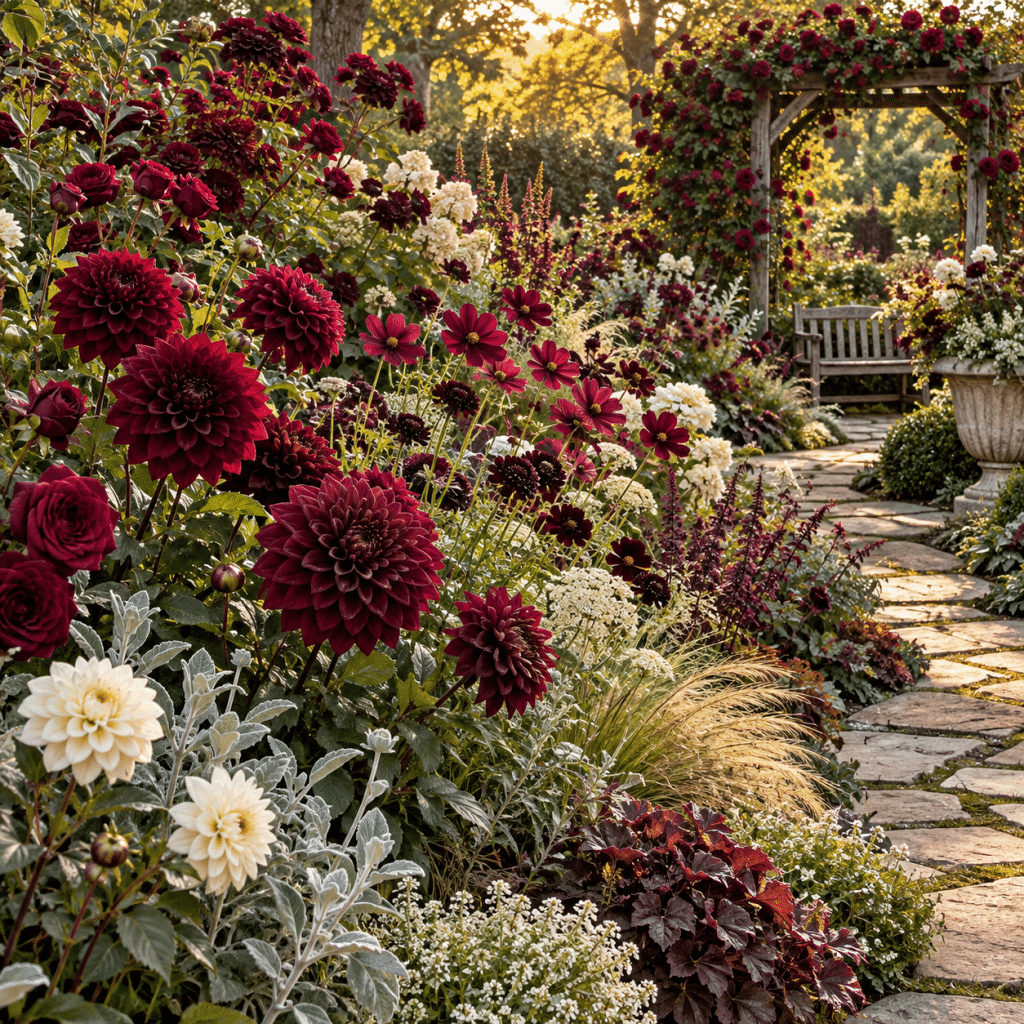
Burgundy is especially powerful in a garden because it behaves almost like a neutral. From a distance, very dark burgundy flowers can look mysterious and nearly black, while sunlight reveals red, purple, and warm wine-colored undertones. When these flowers are paired with cream blooms, silvery foliage, soft grasses, muted greens, or antique-colored garden materials, the result can look extraordinarily elegant.
🍷 Burgundy flowers also work beautifully through several seasons. They can complement fresh spring greenery, intensify the lush feeling of summer, and transition naturally into the deeper colors associated with autumn.
However, the most memorable burgundy gardens usually do not come from simply planting every dark-red flower available. The secret is creating contrast, rhythm, height, and enough breathing room for the burgundy tones to stand out.
These Top 3 Burgundy Flowers Garden ideas explore three very different approaches: a layered romantic border, a moody modern garden, and an abundant cottage-style garden filled with wine-colored flowers.
Each idea can be adapted to a small backyard, front garden, flower bed, patio border, or larger landscape.
Why Burgundy Flowers Look So Beautiful in a Garden
Burgundy sits somewhere between deep red, plum, brown, and purple. Because of this complexity, it can coordinate with far more colors than many gardeners initially expect.
A bright red flower immediately demands attention. Burgundy behaves differently.
It creates depth.
A dark wine-colored bloom positioned behind pale flowers can make the lighter flowers appear brighter. Burgundy foliage can visually anchor airy grasses. Deep plum flowers can make ordinary green leaves suddenly look fresher and more saturated.
This makes burgundy especially useful when designing a garden with a sophisticated color palette.
🌿 Instead of thinking of burgundy as one isolated color, imagine a family of related shades:
- dark wine
- merlot
- mulberry
- oxblood
- black cherry
- deep plum
- burgundy red
- mahogany
- dark cranberry
- aubergine
Mixing several of these tones prevents the garden from appearing flat.
Texture matters just as much as color.
A velvet-like burgundy flower creates a different effect from a glossy dark leaf. Delicate wine-colored petals feel softer than dense burgundy flower heads. A combination of these surfaces makes the planting look more natural and visually interesting.
Best Color Combinations for a Burgundy Flowers Garden
Choosing companion colors carefully can dramatically change the atmosphere of a burgundy garden.
Some combinations feel romantic and old-fashioned. Others feel modern and architectural.
The following palette provides a useful starting point.
| Burgundy Garden Combination | Overall Mood | Best Supporting Elements |
|---|---|---|
| Burgundy and Cream | Elegant and romantic | White roses, ivory flowers, pale stone |
| Burgundy and Blush | Soft and feminine | Dusty pink blooms, pale peach accents |
| Burgundy and Silver | Modern and sophisticated | Artemisia, silver foliage, gray gravel |
| Burgundy and Olive Green | Natural and earthy | Herbs, grasses, evergreen foliage |
| Burgundy and Bronze | Rich autumn atmosphere | Copper planters, dried grasses |
| Burgundy and Plum | Moody and dramatic | Dark foliage, purple flowers |
| Burgundy and Soft Green | Fresh and balanced | Ferns, ornamental grasses |
| Burgundy and White | High contrast and clean | White hydrangeas, pale garden furniture |
Cream is one of the safest companion colors because it prevents dark flowers from disappearing visually.
Silver foliage is another excellent choice. Its pale surface reflects light and creates a clear boundary around darker flowers.
For a more naturalistic garden, pair burgundy blooms with several shades of green rather than introducing too many additional flower colors.
Important Note: Avoid filling the entire garden with extremely dark burgundy flowers. Without lighter foliage or flowers between them, the planting can visually merge into one heavy mass, particularly in shaded areas. Use pale flowers, silver leaves, grasses, or fresh green foliage to create separation.
🥇 Best 1 Burgundy Flowers Garden With Layered Wine Colored Borders
The first and most versatile approach is a layered Burgundy Flowers Garden border.
This style works especially well along fences, garden paths, patios, house foundations, and backyard boundaries.
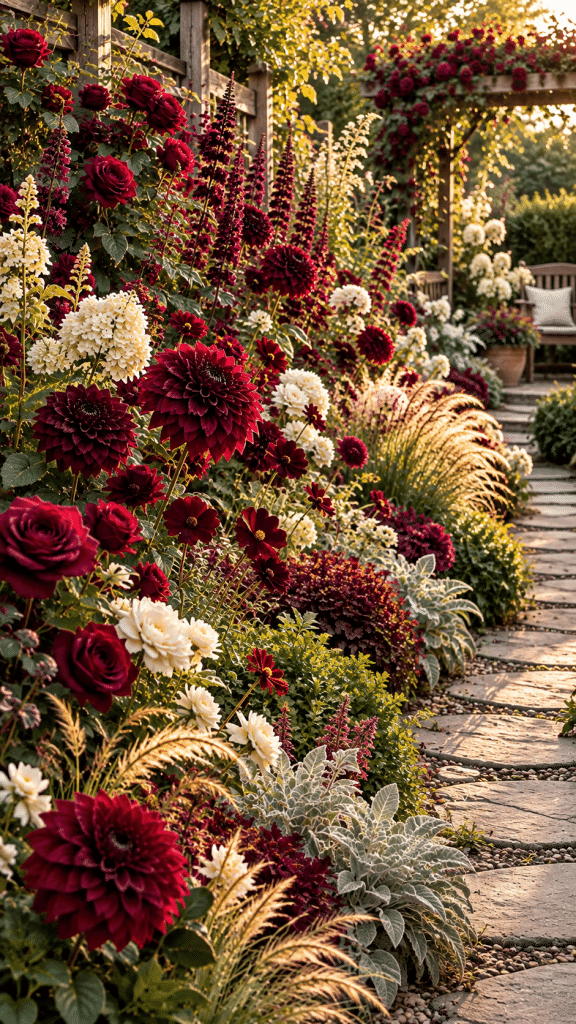
The basic idea is simple: create several levels of planting rather than placing flowers randomly across the bed.
Tall plants form the background.
Medium-height flowers create the main visual mass.
Lower flowers and foliage soften the front edge.
This layered approach makes even a relatively narrow border appear deeper and more established.
Start With a Deep Burgundy Background
The back of the border should contain a few strong vertical elements.
Instead of creating a continuous wall of one plant, repeat taller burgundy flowers at intervals.
Dark dahlias are particularly effective because their large blooms can become focal points from late summer into autumn. Burgundy hollyhocks can create an old-garden atmosphere, while taller varieties of snapdragons or deep-colored salvias can introduce vertical flower spikes.
A few dark-leaved shrubs can also help establish structure.
The purpose of this background is not to dominate the bed.
It should create occasional dark anchors that give the lighter layers in front greater visual impact.
🌿 A beautifully designed border often repeats the same burgundy tone several times rather than using many unrelated flower colors.
Repeating color creates visual rhythm.
The eye naturally moves from one burgundy cluster to another, making the entire border feel connected.
Fill the Middle Layer With Romantic Burgundy Flowers
The center of the border is where the garden can become lush and expressive.
This layer can include dahlias, roses, chrysanthemums, scabiosa, cosmos, ranunculus, or other flowers available in dark wine and burgundy shades.
Different flower shapes are important.
Imagine one rounded dahlia beside a delicate scabiosa flower. Nearby, airy flower stems can rise above broader leaves.
Although the colors are similar, the changing shapes create visual variety.
For a sophisticated result, avoid planting every flower in equal quantities.
Choose two or three dominant plants and use the others as accents.
For example, a border might feature large burgundy dahlias as the primary flower, smaller wine-colored cosmos for movement, and pale cream flowers scattered between them.
The effect feels more intentional than a collection of unrelated plants.
Brighten the Burgundy Garden With Cream Flowers
Dark flowers become far more noticeable when placed beside lighter ones.
Cream is particularly effective because it produces contrast without looking harsh.
Pure white can create a stronger contemporary effect.
Ivory and warm cream feel softer.
Try allowing pale flowers to weave through the burgundy planting rather than planting them in completely separate blocks.
A few cream blooms appearing unexpectedly among dark wine flowers can create a beautiful layered effect.
Soft blush flowers can also work, especially when the goal is a romantic garden.
Use them sparingly.
Too much pink may shift the garden away from the sophisticated burgundy palette toward a more conventional mixed flower garden.
Use Ornamental Grasses for Movement
Flowers provide color, but grasses provide movement.
This becomes especially valuable in a dark-colored garden.
Fine grass blades catch sunlight and visually separate dense clusters of flowers. Their movement also prevents the garden from feeling static.
Choose grasses with soft green, cream, tan, or bronze tones.
During late summer and autumn, seed heads can become an important part of the composition.
🍂 Burgundy flowers surrounded by warm dried grasses can look particularly beautiful in September and October.
The combination connects flowering plants with the seasonal landscape.
Finish the Front Edge With Low Burgundy Accents
The front edge of the border should generally remain lower and lighter.
Small burgundy flowers can appear here, but they should be balanced with fresh green foliage.
Low-growing plants can gently spill toward the pathway.
Avoid creating a perfectly straight edge.
Slight irregularity makes the border look more established and natural.
Small stones, weathered brick, or simple steel edging can define the bed without competing with the plants.
The final result should feel abundant but controlled.
From a distance, the burgundy flowers become repeating points of color rather than one solid dark block.
How to Make a Layered Burgundy Border Look Larger
One of the easiest mistakes in a small garden is placing the tallest plants against the back and gradually reducing every plant to exactly the same height toward the front.
Although technically organized, the effect can become predictable.
Instead, allow a few medium-height flowers to move forward.
Let several lower plants appear deeper in the bed.
This creates overlapping layers.
The garden immediately feels deeper.
Another technique is repeating the same flower in several locations.
If burgundy dahlias appear in only one spot, they become an isolated feature.
If they appear three times along the border, they visually connect the entire planting.
Repeating companion foliage has the same effect.
Three patches of silver leaves can create a rhythm that keeps the garden composition cohesive.
🥈 Best 2 Burgundy Flowers Garden With Moody Modern Planting
A romantic border is not the only way to use burgundy.
The second idea takes the opposite approach.
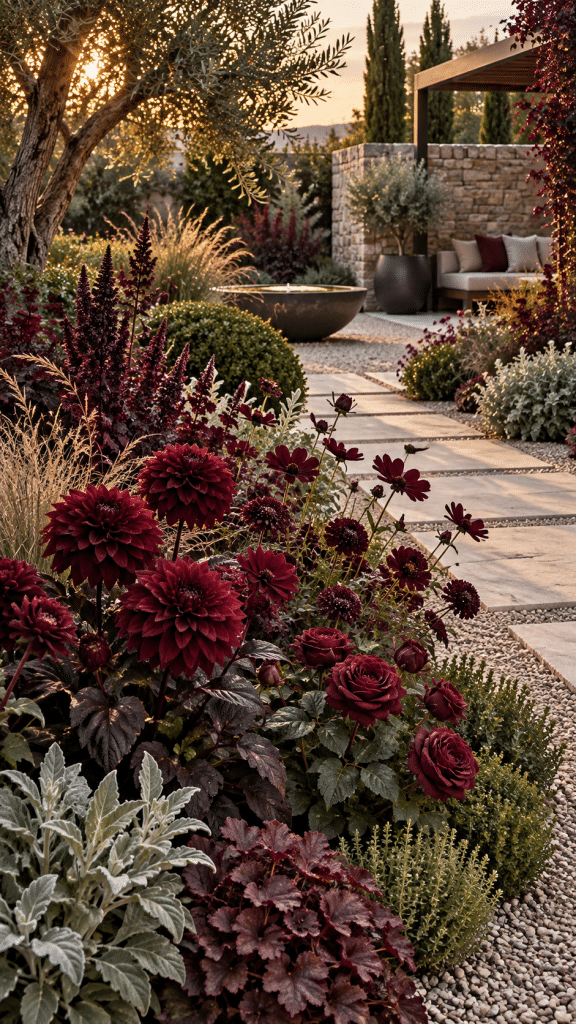
A modern Burgundy Flowers Garden uses fewer plants, clearer shapes, architectural foliage, and larger areas of negative space.
Instead of trying to fill every centimeter of soil, the garden allows individual plants to become sculptural features.
This approach is especially effective around contemporary homes, modern patios, gravel gardens, minimalist courtyards, and clean front-yard landscapes.
Build the Palette Around Burgundy and Olive Green
One of the most refined combinations for modern landscaping is burgundy with muted olive green.
The contrast is subtle rather than dramatic.
Olive foliage has enough yellow warmth to complement dark red flowers, while still keeping the overall palette natural.
The result can feel sophisticated without becoming formal.
Use burgundy flowers in concentrated clusters.
Around them, create larger areas of simple green foliage.
This difference in density makes the flower color appear stronger.
🌱 In modern garden design, empty space is part of the composition.
A section of gravel or a simple pathway between planting groups can make the flowers appear more valuable because each group receives visual attention.
Add Dark Burgundy Foliage
Flowers are temporary.
Foliage can continue the color story long after individual blooms fade.
Dark-leaved plants are therefore extremely useful in a modern burgundy garden.
Choose foliage that appears deep wine, plum, chocolate-burgundy, or almost black.
Use these plants carefully.
One architectural dark-leaved plant may have more impact than ten smaller ones crowded together.
Place them where they can create contrast against a light background such as cream walls, pale gravel, concrete paving, or lighter green shrubs.
The interaction between background and foliage is important.
A dark plant placed against another dark plant can disappear.
The same plant against pale stone becomes dramatic.
Mix Burgundy Flowers With Silver Foliage
Silver creates one of the strongest sophisticated combinations with burgundy.
Plants with gray-green or silver leaves catch light even in subdued weather.
This brightness allows the wine-colored flowers to remain clearly visible.
Silver foliage can also make a burgundy planting feel more contemporary.
Rather than filling the bed with many colorful companion flowers, allow foliage to provide contrast.
This keeps the palette restrained.
Try combining:
dark burgundy flowers,
soft silver foliage,
olive-green leaves,
cream grasses,
and one neutral hardscape material.
That is often enough.
Use Gravel Instead of Traditional Mulch
The ground surface can influence the entire mood of the garden.
Traditional brown bark mulch creates a casual natural effect.
Fine gravel produces a cleaner, more architectural appearance.
Warm gray gravel pairs beautifully with burgundy.
Pale beige gravel creates more contrast.
Dark charcoal gravel can produce an intense moody look, although it should be balanced with lighter foliage to prevent the overall design from becoming too dark.
Create defined planting islands within the gravel.
Plants should emerge from these islands like individual compositions.
The result can feel similar to a gallery where every plant has its own visual space.
Introduce Sculptural Burgundy Flowers
Modern gardens benefit from flowers with strong silhouettes.
Large spherical flower heads, vertical spikes, and clearly defined petals work particularly well.
Rather than mixing twenty flower varieties, select a few plants with distinctive shapes.
A group of large burgundy dahlias can become a focal point.
Nearby, narrow grasses provide contrast.
Further along, a cluster of dark wine flower spikes can repeat the color vertically.
This repetition maintains continuity while allowing each planting group to remain visually simple.
Add One Strong Architectural Feature
Modern gardens often look most polished when vegetation is balanced by one clear structural element.
This might be:
a simple bench,
a stone wall,
a large ceramic planter,
a contemporary birdbath,
a raised steel planter,
or a narrow water feature.
Keep the material palette limited.
For a Burgundy Flowers Garden, excellent combinations include charcoal steel, weathered bronze, pale stone, warm wood, and muted ceramic.
Avoid overly decorative objects.
The flowers should remain the visual focus.
Burgundy Flowers Garden for Small Spaces
A small garden does not require small ideas.
In fact, burgundy can be extremely effective in compact spaces because the depth of the color makes a simple planting scheme feel intentional.
One large container can create a stronger impression than many unrelated small pots.
Choose a wide planter and combine one burgundy flowering plant with textured foliage and a trailing accent.
Repeat the same color palette in two or three nearby containers.
This creates unity.
Balconies and patio gardens can use the same principle.
🍷 Rather than filling every pot with a different flower color, choose a restrained palette of burgundy, cream, green, and perhaps a little bronze.
The repetition makes even inexpensive containers look more coordinated.
Window boxes can also adopt the burgundy theme.
Use dark flowers as the central accents and allow pale trailing plants to soften the edges.
Because window boxes are normally seen from a distance, strong color contrast is especially important.
🥉 Best 3 Burgundy Flowers Garden With Romantic Cottage Abundance
The third idea celebrates abundance.
A cottage-style Burgundy Flowers Garden should feel layered, generous, slightly wild, and full of changing textures.
Unlike the clean modern style, this garden intentionally allows plants to mingle.
Flowers lean into pathways.
Vines climb structures.
Herbs, ornamental plants, and flowers appear together.
However, successful cottage gardens are not truly random.
Their apparent spontaneity usually comes from carefully repeated plants and colors.
Burgundy is particularly useful because it can visually connect an otherwise diverse planting.

Start With Burgundy Roses as Romantic Anchors
Roses immediately create a romantic garden atmosphere.
Deep wine-colored varieties can become powerful focal points within a cottage garden.
Place them near entrances, seating areas, arches, or pathways where their flowers can be appreciated closely.
Rather than surrounding the roses only with other roses, mix them with lighter companion plants.
Cream flowers can brighten the composition.
Soft grasses can introduce movement.
Herbs can create fragrance and informal foliage.
The goal is to make the roses appear integrated into the garden rather than displayed as isolated specimens.
Climbing burgundy roses can also frame an archway or garden gate.
This can create an unforgettable entrance, particularly when combined with green vines and pale flowers.
Mix Dahlias Through the Garden
Dahlias are perfect for adding bursts of deep burgundy during late summer and early autumn.
Their strong geometric flowers contrast beautifully with softer cottage plants.
Instead of creating one formal dahlia bed, place small groups throughout the garden.
Allow them to appear behind shorter flowers or between shrubs.
This scattered repetition creates a sense that the color naturally travels across the landscape.
Different flower forms can also be combined.
One large decorative dahlia might appear near a seating area.
Smaller burgundy varieties can be repeated along the pathway.
The consistent color ties them together.
Add Burgundy Cosmos for Airy Movement
Large flowers need delicate companions.
Cosmos can provide exactly that effect.
Their thinner stems and lighter flower structure create movement between denser plants.
Dark wine and burgundy cosmos can be particularly beautiful because they appear almost translucent when sunlight passes through the petals.
Plant them in small drifts rather than perfect rows.
Allow them to weave between other flowers.
The result creates a slightly wild cottage character.
A breeze moving through their stems can soften the heavier visual weight of dahlias and roses.
Blend Flowers With Herbs
One of the easiest ways to make a cottage garden appear established is mixing decorative flowers with useful plants.
Herbs contribute different leaf shapes, fragrances, and textures.
Sage can provide soft gray-green foliage.
Thyme can cover low edges.
Rosemary creates narrow evergreen texture.
Parsley can add fresh green forms.
These plants also help prevent the garden from becoming a continuous sea of colorful blooms.
Green foliage creates visual pauses.
That makes the burgundy flowers easier to notice.
Create a Meandering Garden Path
A straight pathway can make a small garden feel shorter.
A gently curving path creates mystery.
Use natural stone, aged brick, gravel, or stepping stones.
Let the planting slightly soften the edges.
Low flowers can lean toward the pathway.
Herbs can grow between larger plants.
Occasional burgundy flowers should appear near the edge so visitors experience the color at close range.
A cottage path should suggest that more garden lies beyond the next curve.
Even in a small backyard, this technique can create the illusion of greater depth.
Add a Rustic Garden Structure
Cottage gardens benefit from vertical elements.
An arbor, simple wooden arch, rustic trellis, or small pergola can immediately make the planting feel more mature.
Allow climbing plants to soften the structure.
Burgundy flowers nearby can connect the structure with the surrounding garden.
Weathered wood works particularly well because its muted brown tones naturally complement wine-colored flowers.
Painted cream structures create more contrast.
Dark green structures can nearly disappear into foliage, allowing the flowers to remain dominant.
The Best Burgundy Flowers to Grow
Not every plant will suit every climate or garden condition, but several flower groups are particularly useful when building this color palette.
Burgundy Dahlias
Dahlias are among the most dramatic options.
Their large flowers make excellent focal points, and the burgundy color can range from warm wine red to extremely dark plum.
They work beautifully in garden borders and cutting gardens.
Because their blooms can be substantial, pair them with smaller or airier plants.
This prevents the planting from looking visually heavy.
Burgundy Roses
Roses provide structure as well as flowers.
They can work in formal borders, cottage gardens, patio containers, and vertical planting.
Deep wine-colored roses look particularly striking beside cream flowers.
They can also complement gray-green foliage.
Burgundy Chrysanthemums
Chrysanthemums can extend the burgundy palette later into the growing season.
They are particularly effective in autumn garden compositions.
Combine them with grasses, pumpkins, bronze foliage, or late-season perennials for a rich harvest-season atmosphere.
Burgundy Scabiosa
Scabiosa brings a delicate flower form.
Its smaller rounded blooms sit on thinner stems, creating movement and airiness.
This makes it an excellent companion for heavier flowers.
Burgundy Cosmos
Cosmos has an informal, romantic character.
Deep chocolate-burgundy or wine-colored varieties can appear almost velvet-like.
Use them in cottage gardens, pollinator gardens, and relaxed borders.
Burgundy Ranunculus
Ranunculus provides densely layered petals and a luxurious appearance.
Its flower form can feel almost like a miniature rose.
Dark wine varieties are especially beautiful when planted beside cream, blush, or soft peach flowers.
Burgundy Amaranthus
Amaranthus can introduce unusual shapes into the garden.
Its dramatic flower clusters create movement and texture.
It is particularly effective in gardens where the goal is a slightly wild or artistic atmosphere.
How to Keep Burgundy Flowers From Looking Too Dark
Dark-colored gardens can become visually heavy if every plant has similar tones.
The easiest solution is contrast.
Use at least three levels of brightness.
The darkest level might include burgundy flowers and deep foliage.
The middle level could contain olive, sage, and medium green leaves.
The lightest level should include cream flowers, silver foliage, pale grasses, stone, or light-colored garden materials.
This range gives the eye somewhere to travel.
Sunlight should also be considered.
Deep burgundy flowers generally reveal more color in good light.
In very deep shade, some varieties may appear almost black.
Positioning lighter flowers nearby can help maintain visual separation.
Creating a Burgundy Garden That Looks Good Beyond Flowering Season
A flower garden should not rely completely on flowers.
Once blooms disappear, structure becomes much more important.
Include evergreen shrubs, ornamental grasses, seed heads, interesting bark, and plants with persistent foliage.
These elements maintain the shape of the garden.
Grasses are particularly valuable because they can remain attractive after flowering plants fade.
During autumn, their warm tan and bronze tones coordinate naturally with burgundy.
Seed heads can also be left standing when appropriate.
Their silhouettes add texture during cooler months.
In winter, garden structures become more visible.
A simple arch, stone edge, pathway, or sculptural planter can keep the garden visually interesting even when many plants are dormant.
Burgundy Flowers Garden Ideas for Autumn
Burgundy becomes particularly powerful in autumn.
At this time of year, surrounding foliage begins shifting toward yellow, copper, bronze, brown, and red.
Wine-colored flowers naturally fit into this seasonal palette.
Instead of using bright orange everywhere, create a more sophisticated autumn garden with burgundy, plum, muted bronze, cream, olive, and dried grass tones.
🍂 Pumpkins can be introduced carefully.
Cream or muted green pumpkins often coordinate better with burgundy flowers than very bright orange ones.
Dark decorative gourds can also complement the palette.
Add a few lanterns or candles around seating areas for an evening atmosphere.
Warm light enhances the red undertones of burgundy flowers and makes the garden feel especially rich at sunset.
How to Design a Burgundy Cutting Garden
A burgundy cutting garden can provide flowers for indoor arrangements while still looking beautiful outdoors.
Organize the planting primarily by growing needs, but repeat complementary colors across the bed.
Dahlias can provide large focal flowers.
Cosmos and scabiosa can offer lighter supporting stems.
Amaranthus can add unusual texture.
Cream or white flowers can provide contrast.
Foliage plants should also be included.
A bouquet containing only dark flowers may appear heavy.
Fresh green leaves, silvery stems, or pale flowers make the burgundy tones appear richer.
Harvesting regularly can also encourage many flowering plants to continue producing blooms.
The cutting garden therefore becomes both practical and decorative.
Burgundy Flowers Garden Styling Around a Patio
Patios often contain large areas of hard materials such as stone, concrete, or wood.
Burgundy flowers can soften these surfaces.
Place larger flowering containers near corners rather than lining every edge with small pots.
This creates stronger visual anchors.
Combine several container sizes.
A tall pot can hold architectural foliage.
A wider planter can contain burgundy flowers.
A smaller pot can add trailing greenery.
Repeat the same materials across the containers.
For example, three aged terracotta pots of different sizes look more cohesive than three unrelated decorative pots.
Outdoor furniture can also support the palette.
Natural wood, cream cushions, muted olive fabrics, and charcoal metal all work well with burgundy flowers.
Common Mistakes to Avoid
The first common mistake is using too many dark colors.
Burgundy needs contrast.
Without lighter plants, the garden loses definition.
Another mistake is choosing only one flower shape.
A bed containing many round dark flowers can quickly feel repetitive.
Combine rounded flowers with spikes, airy stems, grasses, and different leaf forms.
Avoid excessive symmetry in relaxed gardens.
Perfect repetition can make a cottage-style planting feel artificial.
Instead, repeat plants with slight variations in spacing.
Finally, do not ignore foliage.
Flowers attract attention, but leaves occupy the garden for much longer periods.
Choosing attractive foliage can make the difference between a garden that looks beautiful for three weeks and one that remains interesting throughout the season.
Choosing the Right Top 3 Burgundy Flowers Garden Style
Each of the three approaches creates a different atmosphere.
The layered wine-colored border is the most adaptable.
It suits many traditional backyards and works beautifully along fences or garden paths.
The moody modern planting is ideal for homeowners who prefer clean shapes, restrained colors, and contemporary landscaping.
The romantic cottage garden is best for spaces where abundance, softness, and an informal atmosphere are desired.
None requires an enormous garden.
The important principle is repeating the burgundy color while allowing different textures, heights, and supporting colors to create depth.
Final Thoughts on Creating a Burgundy Flowers Garden
A Burgundy Flowers Garden can feel romantic, modern, mysterious, elegant, or wonderfully wild depending on how the color is used.
The strongest designs rarely rely on burgundy alone.
They use the dark wine tones as anchors and surround them with carefully chosen contrasts.
Cream flowers provide brightness.
Silver foliage adds sophistication.
Olive greenery makes the palette feel natural.
Bronze and dried grasses strengthen the autumn atmosphere.
🌿 Most importantly, allow the garden to develop in layers.
Use tall flowers and shrubs for structure, medium flowers for visual abundance, delicate plants for movement, and lower foliage to soften the ground.
Among the Top 3 Burgundy Flowers Garden ideas, the layered border offers timeless elegance, the modern garden creates dramatic simplicity, and the cottage garden produces romantic abundance.
Whichever approach is chosen, repeating a controlled palette of wine red, plum, merlot, cream, green, and subtle bronze can turn even an ordinary flower bed into a garden that feels carefully designed and surprisingly luxurious.
🍷 Burgundy does not need to dominate the landscape to make an impact.
Sometimes a few strategically repeated dark flowers are enough to change the entire character of the garden.