The best Driveway Planter Ideas can completely change the way a home looks before anyone even reaches the front door. A driveway is often treated as nothing more than a practical surface for cars, yet it occupies a surprisingly large part of the front landscape. When thoughtfully placed planters, sculptural plants, seasonal flowers, and attractive containers are introduced, that ordinary paved area can suddenly feel polished, welcoming, and intentionally designed.
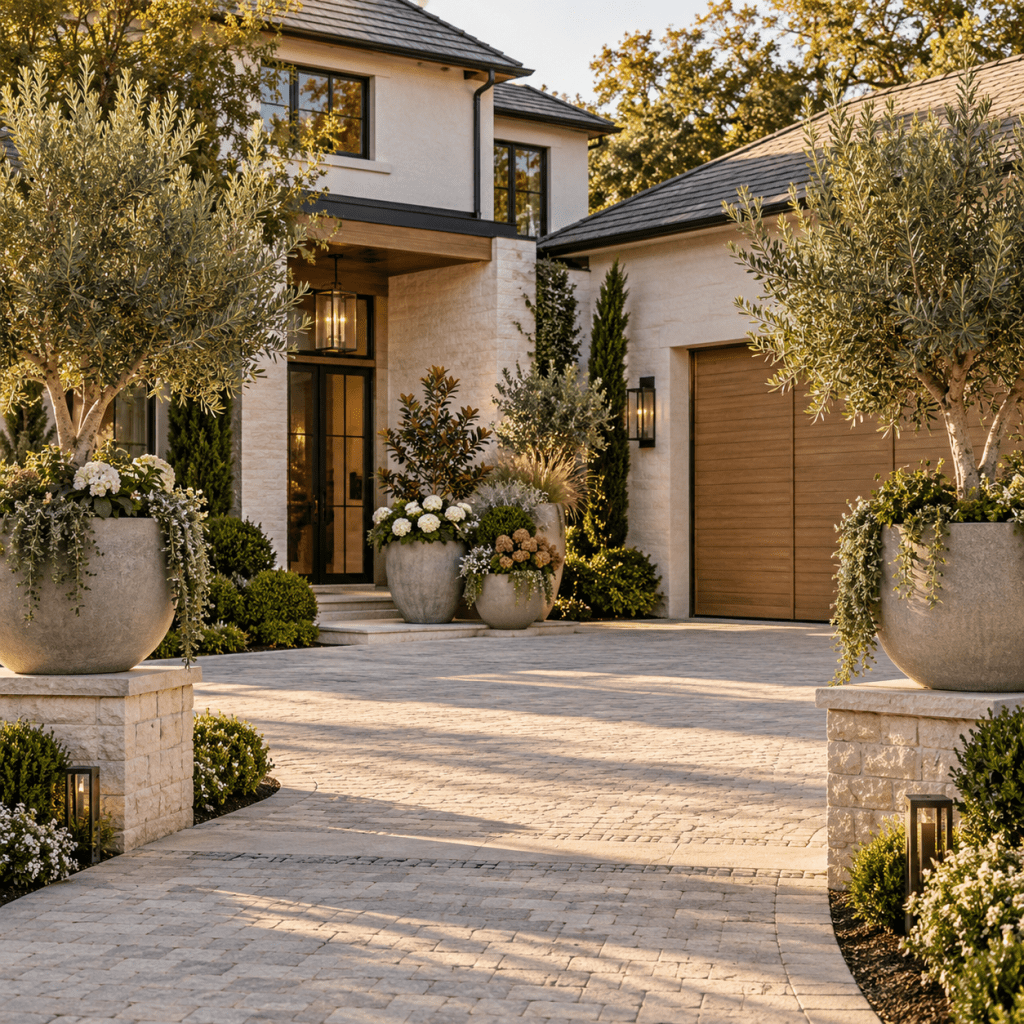
A beautiful driveway does not require a huge landscaping budget or an enormous garden. In many cases, just a few carefully selected containers can soften hard paving, emphasize an entrance, create symmetry, or introduce color exactly where it is needed. 🌿 The secret is choosing a planter concept that works with the architecture of the house instead of filling every available space with random pots.
The most successful driveway arrangements also look good from several viewpoints. They should feel attractive when seen from the street, while driving toward the house, and when walking from the driveway to the entrance. That means scale, shape, repetition, plant height, and container materials all deserve attention.
These Top 3 Driveway Planter Ideas offer three very different approaches. One creates a luxurious formal entrance, another produces a softer layered garden effect, and the third turns simple planters into flexible seasonal focal points. Each can be adapted to modern, traditional, cottage, farmhouse, Mediterranean, or contemporary homes.
Why Driveway Planters Can Transform the Entire Front Yard
Driveways naturally contain a large amount of concrete, gravel, brick, asphalt, or stone. Even when the paving is beautiful, the surface can dominate the front yard visually. Planters introduce something the paving cannot provide on its own: height, movement, texture, softness, and seasonal change.
A tall olive tree, clipped evergreen, ornamental grass, or small flowering shrub immediately interrupts a long stretch of hard surface. 🌱 This can make the driveway feel more connected to the surrounding landscape rather than appearing like a separate utilitarian zone.
Planters are especially valuable for homes with limited planting beds. Narrow driveways often leave very little room between the pavement, fences, garage walls, and neighboring properties. A container allows greenery to be added without constructing a permanent border.
They also create visual direction. Two large planters can mark the beginning of a driveway. A repeated row can lead the eye toward the house. A pair near the garage can frame the architecture, while a collection close to the front steps can create a transition between driveway and entrance.
Another advantage is flexibility. Permanent landscaping can take years to mature and may be difficult to relocate. Containers can be moved, replanted, grouped differently, or updated seasonally. That makes them particularly useful when experimenting with a new front yard design.
Driveway Planter Ideas Quick Comparison
Before choosing a direction, it helps to compare the visual effect, maintenance level, and best placement for each of the Top 3 concepts.
| Driveway Planter Idea | Overall Look | Best Container Style | Ideal Plants | Best Placement | Maintenance |
|---|---|---|---|---|---|
| 🥇 Sculptural Entrance Planters | Elegant and architectural | Oversized stone ceramic or concrete | Olive trees topiary evergreens grasses | Driveway entrance garage or front steps | Low to moderate |
| 🥈 Layered Mixed Planters | Lush and garden inspired | Large neutral pots grouped in different sizes | Shrubs perennials grasses trailing plants | Driveway edges corners and transition zones | Moderate |
| 🥉 Seasonal Statement Planters | Flexible and decorative | Urns bowls troughs and classic pots | Seasonal flowers branches evergreens pumpkins | Near garage doors gates and pedestrian areas | Moderate to high |
The right choice depends on the atmosphere you want to create. A minimal contemporary house may look better with fewer oversized containers, while a cottage or traditional property can comfortably support more layered planting.
It is usually better to repeat one strong visual idea than to introduce many unrelated container styles.
Important Note: Keep planters far enough away from the active driving area so car doors, wheels, mirrors, delivery vehicles, and pedestrians can move safely without hitting containers or overhanging plants.
🥇 Top 1 Driveway Planter Ideas With Oversized Sculptural Entrance Planters
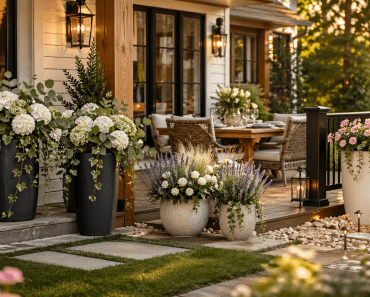
The first concept is ideal when the goal is to make the driveway feel more expensive, architectural, and intentional. Instead of using several small flowerpots, choose one or two oversized containers and treat them almost like outdoor sculptures.
Large planters naturally create stronger visual impact because their proportions relate better to a house façade, garage door, or wide driveway. Tiny pots often disappear visually when placed beside large architectural surfaces. A substantial container filled with a carefully shaped tree or evergreen has enough presence to balance those elements.
This is one of the most effective approaches for modern and luxury-style homes because it creates impact without visual clutter. ✨
Create a Strong Entrance With Symmetrical Planters
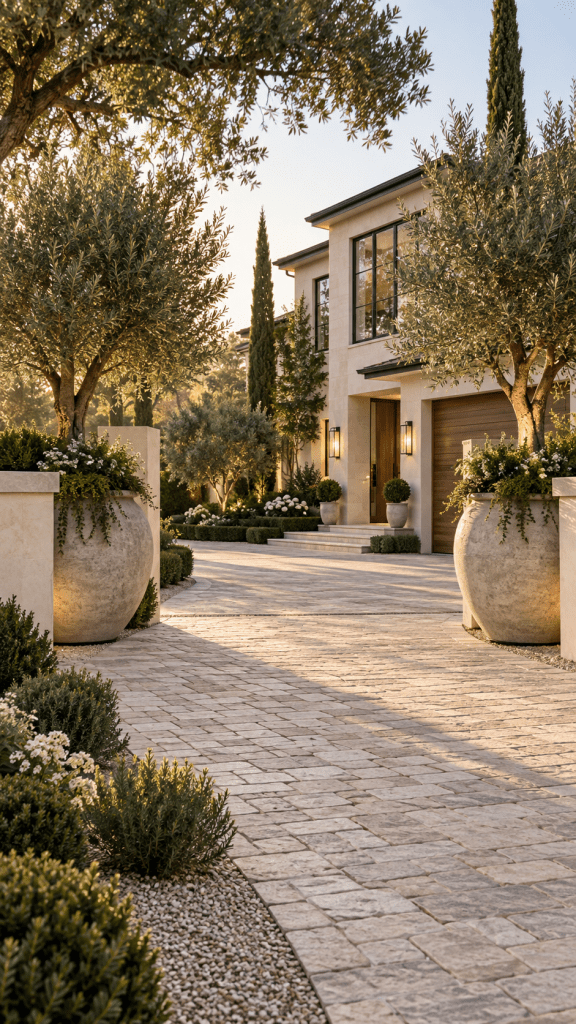
Placing matching planters on opposite sides of a driveway entrance instantly establishes a sense of order. This arrangement can work beautifully beside gateposts, pillars, low walls, or where the driveway meets the street.
Symmetry communicates intention. Even a relatively simple home can feel more formal when two identical containers frame the arrival point.
For a modern property, consider tall cylindrical planters, rectangular architectural containers, or large rounded pots in finishes such as warm gray, charcoal, limestone beige, matte black, or soft off-white.
Traditional homes can use classic urns, rounded stone pots, aged terracotta, or elegant tapered containers.
The plants should have enough height to be visible from a distance without creating a traffic visibility problem. Compact evergreen standards, small olives, dwarf conifers, or carefully clipped shrubs can work extremely well.
Use One Sculptural Plant Instead of Too Many Flowers
One mistake with driveway containers is assuming that every pot needs to overflow with colorful blooms. Sometimes a single strong plant creates a far more sophisticated effect.
An olive tree with a beautiful irregular trunk, for example, can look elegant in a large weathered container. Ornamental grasses create movement and softness while maintaining a contemporary appearance.
Evergreen spheres or cones offer a more structured effect. They remain visually useful even when flowering plants elsewhere in the garden disappear during colder months.
For warmer climates, architectural plants such as agave-like forms, palms, yucca-style plants, or sculptural tropical foliage may create the same dramatic effect.
The goal is simplicity. 🌿 One impressive plant should become the focal point rather than being hidden inside an overly complicated combination.
Frame the Garage Without Making It Feel Busy
Garage doors often dominate the front façade because of their size. Strategically positioned planters can visually soften them.
Place one large planter on each side of the garage if there is adequate room. Avoid blocking sensors, doors, pedestrian routes, or vehicle turning space.
Tall narrow containers work especially well where horizontal space is limited. They provide visual height without extending too far into the driveway.
If the garage façade is very wide, consider repeating the planter material elsewhere near the front door. This creates a visual relationship between the vehicle entrance and pedestrian entrance.
For example, two large charcoal planters near the garage might be echoed by smaller matching pots beside the porch.
Match Container Materials to the Architecture
A planter should look like part of the property rather than an object that was randomly added later.
Concrete and fiberstone containers suit modern architecture particularly well. Their simple surfaces complement glass, metal, smooth stucco, and contemporary brick.
Terracotta works beautifully with Mediterranean, rustic, cottage, and farmhouse homes. Aged finishes can introduce character without demanding bright colors.
Natural stone containers provide a timeless appearance and work especially well beside limestone, brick, gravel, or traditional masonry.
Dark metal containers can create strong contrast against pale walls, although they may become hot in intense sunlight. Consider local climate conditions before choosing materials.
When possible, repeat colors already found on the house. A warm gray container might echo window frames, roof tones, stonework, or paving.
This subtle repetition helps create a professionally designed appearance.
🥈 Top 2 Driveway Planter Ideas With Layered Greenery and Naturalistic Planting
The second concept moves away from strict symmetry and instead creates the impression that a small garden has grown naturally around the driveway.
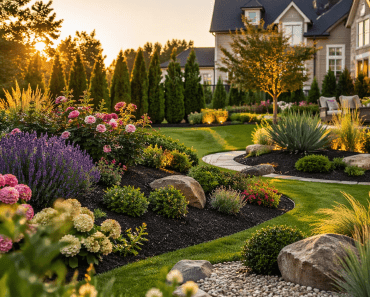
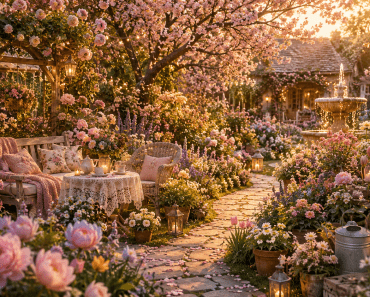
This approach works beautifully for cottages, farmhouse-inspired homes, relaxed contemporary landscapes, and properties where the driveway meets existing flowerbeds.
Instead of using identical pots, combine two or three compatible containers in slightly different sizes. Fill them with plants of different heights and textures.
The result should feel abundant but controlled. 🌸
Build Every Planter With Height Texture and Movement
A successful mixed container usually contains more than one visual layer.
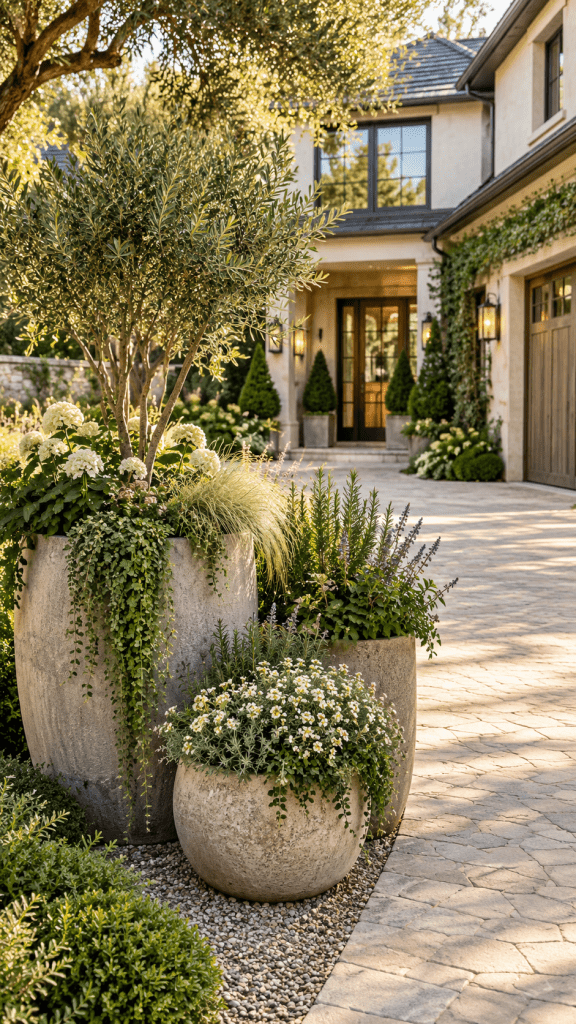
Start with a taller structural plant that establishes height. This might be an ornamental grass, compact shrub, flowering perennial, small evergreen, or upright foliage plant.
Next, add plants that provide volume around the middle of the container. These create fullness and connect the taller element with lower plants.
Finally, introduce something softer near the edge. Trailing foliage, delicate grasses, or small flowering plants can spill slightly over the rim and soften the container.
The composition does not have to follow a rigid formula. In fact, a slightly irregular arrangement often feels more natural.
Imagine tall feathery grasses rising through the center, muted flowering perennials filling the middle, and soft foliage relaxing over the sides. That combination immediately looks more established than a container filled with only one layer of short flowers.
Use a Restrained Color Palette
Naturalistic does not have to mean chaotic.
Limiting the color palette usually produces a more sophisticated result. Instead of combining every available flower color, choose two or three dominant tones and repeat them throughout the driveway landscape.
A soft palette might include cream, pale pink, lavender, dusty purple, and muted green.
A warmer combination could use terracotta, burgundy, rust, golden grasses, and deep green foliage.
Modern neutral planting may rely almost entirely on shades of green, silver, beige, and white.
Repetition is what ties the containers together. If one planter contains a burgundy foliage plant, introducing the same tone somewhere else helps the overall arrangement look intentional.
Connect Driveway Planters With Existing Garden Beds
One of the easiest ways to make planters look professionally integrated is to repeat plants already growing nearby.
Suppose ornamental grasses are planted along the front path. Using a smaller version of the same grass inside driveway containers creates visual continuity.
If lavender, hydrangeas, salvias, roses, or evergreen shrubs already appear near the house, similar colors or textures can be repeated in pots.
The container then feels like an extension of the garden rather than a separate decorative feature.
This is particularly useful when the driveway sits between two landscaped areas. Containers can visually bridge those spaces.
Create Beautiful Driveway Corners
Driveway corners are often overlooked. Yet these spaces can be ideal locations for grouped planters because cars are less likely to interfere with them when the placement is carefully planned.
Try grouping three containers in different heights rather than placing three identical pots in a straight line.
Use one large pot as the visual anchor, a medium container beside it, and a smaller pot slightly forward.
The plants should also vary in height. A tall grass or shrub can rise from the largest container, while the medium pot holds a rounded flowering plant and the smaller one introduces trailing foliage.
The uneven composition creates depth.
For a more cohesive appearance, keep the containers within the same material family. Three slightly different terracotta pots feel connected even when their shapes are not identical.
Soften Long Driveway Edges
Long straight driveways can feel severe, especially when they are bordered by walls or fences.
Planters can interrupt that strong line.
However, placing a pot every few feet may create clutter. Instead, use occasional planting moments.
A large container might appear near the beginning, another near a pedestrian gate, and a final arrangement closer to the house.
This creates rhythm without turning the driveway into an obstacle course.
Where space allows, elongated trough planters can be especially effective. Fill them with ornamental grasses, evergreen foliage, lavender-like plants, or compact shrubs.
The horizontal shape follows the driveway while the plants soften its edges.
🥉 Top 3 Driveway Planter Ideas With Seasonal Statement Displays
The third idea is perfect for anyone who enjoys changing outdoor décor throughout the year.
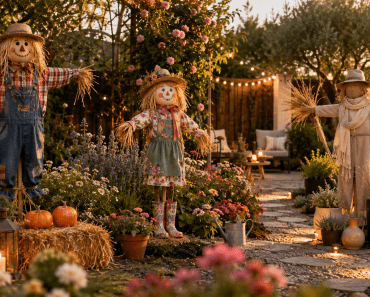
Seasonal planters allow the driveway to reflect spring flowers, summer greenery, autumn textures, or winter evergreens without redesigning the permanent landscape.
The containers themselves remain constant while the contents change.
This strategy is especially useful near the garage, gate, mailbox area, or walkway from the driveway to the front entrance.
Make Spring Driveway Planters Feel Fresh Rather Than Overdecorated
Spring containers naturally invite color, but they do not need to look overly busy.
Start with a foundation of fresh green foliage and introduce a limited selection of seasonal flowers.
White, pale yellow, blush, lavender, and soft blue can create a fresh spring palette. 🌷
Bulbs and cool-season flowers can be combined with evergreen or structural foliage so the container still looks substantial once individual blooms begin fading.
For a sophisticated arrangement, avoid filling every inch with identical flowers. Allow variation in height and texture.
Branches with emerging leaves can also add dramatic vertical structure to a large spring container.
Create Full Summer Planters With Heat Tolerant Layers
Summer driveway planters face difficult conditions because paving reflects heat and containers can dry more quickly than garden soil.
Choose plants suited to the amount of sun and heat the driveway receives.
A successful summer arrangement often combines durable foliage with long-flowering plants. This means the planter remains attractive even when some blooms temporarily disappear.
Consider using strong foliage shapes as the foundation and flowers as accents rather than depending entirely on flowers.
For example, a central grass surrounded by softer foliage and a limited number of colorful blooms may require less visual maintenance than a container filled only with flowers.
Larger containers can also help because they generally hold more soil and moisture.
Turn Autumn Planters Into Rich Textural Displays
Autumn may be the most visually rewarding season for driveway containers. 🍂
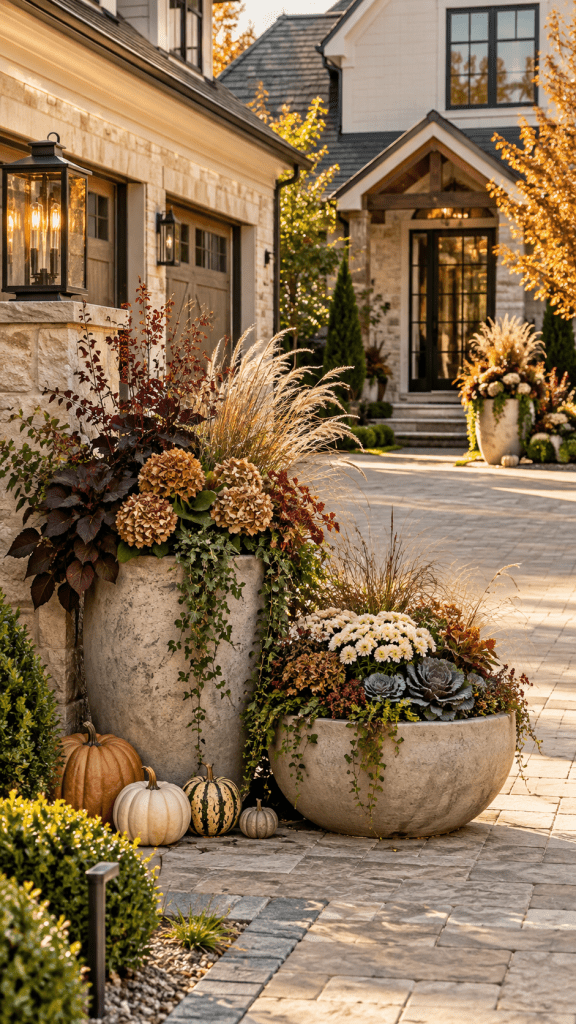
Instead of relying only on flowers, introduce natural materials such as ornamental grasses, seed heads, branches, dried foliage, small decorative pumpkins, or textured evergreen plants.
Deep burgundy, bronze, muted orange, creamy beige, dark green, brown, and dusty purple create a mature autumn palette.
A large planter filled with tall grasses and dark foliage can look elegant even without bright flowers.
For a more welcoming harvest style, arrange pumpkins beside the base of the container rather than trying to place everything inside it.
The surrounding paving becomes part of the display.
Keep the arrangement slightly asymmetrical for a relaxed look. One large planter, several pumpkins in different sizes, and one low pot of seasonal flowers can often create more impact than a perfectly mirrored display.
Use Winter Evergreens for Structure
During winter, structure becomes more important because flowering options may be limited in many climates.
Evergreen branches, compact conifers, clipped shrubs, bare decorative branches, pinecones, or winter berries can create dramatic containers.
Tall branches provide height, evergreen foliage adds body, and smaller textural materials fill the lower portion.
Warm outdoor lighting can enhance these displays beautifully during darker months.
Simple micro lights or nearby architectural lighting may highlight branches and foliage without making the arrangement look excessively festive.
In milder climates, winter containers can focus on foliage rather than traditional cold-weather plants.
The objective is to maintain visual interest when the rest of the landscape becomes quieter.
How to Choose the Right Planter Size for a Driveway
Scale is one of the most important factors in successful driveway design.
Outdoor containers often need to be larger than expected because they are viewed against large surfaces. A planter that looks enormous inside a garden center may appear surprisingly small beside a two-car garage.
For major focal points, oversized containers usually look better than collections of tiny pots.
Large pots also provide more soil volume, which can improve moisture retention and create better growing conditions for larger plants.
Smaller containers still have a role, but they are usually more effective when grouped near pedestrian zones, steps, or doors where people view them from close range.
A useful strategy is to create hierarchy.
Use the largest planter for the main focal point, medium containers for supporting areas, and small pots only as finishing details.
This prevents every element from competing for attention.
Best Materials for Driveway Planters
Container material affects both appearance and performance.
Terracotta offers warmth and natural character. It works particularly well with rustic, Mediterranean, cottage, and traditional architecture.
Glazed ceramic containers provide stronger color and a polished finish. Neutral glazes tend to remain versatile as planting styles change.
Concrete creates a contemporary architectural look and can withstand strong visual competition from large driveways and buildings.
Lightweight composite containers can reproduce the appearance of stone or concrete while being easier to move.
Metal planters create crisp modern lines but should be selected carefully in hot climates because surfaces may heat significantly.
Wooden containers can work well with farmhouse or naturalistic landscapes, especially when the wood tone relates to fencing, garage doors, gates, or architectural cladding.
Whatever material you choose, consistency matters more than strict uniformity. You do not need every planter to be identical, but the collection should appear related.
Choose Plants That Match the Driveway Conditions
Driveways can create challenging microclimates.
Paving often reflects heat toward nearby plants. Wind exposure may be greater than in sheltered garden beds. Containers also dry more quickly than surrounding soil.
Observe the area before choosing plants.
A driveway receiving strong afternoon sun needs very different plants from one shaded by mature trees or the house.
Water availability also matters. If dragging a hose toward distant driveway planters becomes inconvenient, choose drought-tolerant plants or consider a simple irrigation solution.
Wind can affect tall ornamental grasses and small trees. Large containers with substantial weight are safer for exposed areas.
The mature size of each plant should also be considered.
A plant that looks perfect when newly purchased may eventually extend into the driveway or block a walkway. Choose varieties that can remain within the desired space.
Use Repetition to Make Driveway Planters Look Professionally Designed
Professional landscapes often feel cohesive because they repeat visual elements.
This principle is easy to apply to driveway containers.
Repeat a planter color, plant variety, foliage shape, or material several times.
For example, three charcoal containers positioned in different areas can visually connect the driveway even if each contains different plants.
Alternatively, repeat the same ornamental grass across several different containers.
Color repetition works as well. Burgundy foliage near the driveway entrance can be echoed in a smaller pot beside the front door.
These subtle relationships help the eye understand that the entire front yard belongs to one design.
🌿 Repetition does not mean everything must match perfectly. Too much uniformity can make a relaxed landscape feel stiff. The goal is connection rather than duplication.
Add Lighting Around Driveway Planters
Beautiful containers should not disappear after sunset.
Outdoor lighting can turn planters into architectural features at night.
A small uplight positioned near a sculptural tree can project dramatic shadows onto a wall. Low landscape lights can highlight ornamental grasses or textured foliage.
If planters frame a gate or entrance, lighting can also make the arrival area easier to understand visually.
Warm light generally complements natural stone, terracotta, greenery, and wood beautifully.
Avoid excessive brightness. The goal is to create atmosphere and visibility, not illuminate every leaf.
Planters located near existing wall lights or garage lighting may not require additional fixtures.
Observe the driveway after dark before adding anything. You may discover that existing lighting already creates an attractive effect.
Keep Driveway Planters Practical and Easy to Maintain
Beautiful planting is only successful when it can be maintained realistically.
Start with good drainage. Containers exposed to rain need openings that allow excess water to escape.
Choose a suitable growing medium rather than filling large pots entirely with heavy garden soil.
Regular watering may be necessary, especially during warm weather. Grouping plants with similar water requirements makes maintenance easier.
Remove dead flowers or damaged leaves when needed, but avoid selecting combinations that require constant attention unless gardening is something you enjoy.
Evergreens, ornamental grasses, compact shrubs, and strong foliage plants can reduce maintenance compared with containers dependent entirely on seasonal flowers.
Seasonal displays can also be simplified. Instead of replacing every plant, maintain a permanent structural plant and change only the smaller accents around it.
This saves time while keeping the driveway fresh.
How to Make Driveway Planter Ideas Look Expensive on a Smaller Budget
Luxury landscaping is often associated with expensive materials, but visual discipline can create a similar impression for less.
The first strategy is using fewer containers.
Three high-impact planters usually look more sophisticated than fifteen unrelated small pots.
Second, choose a restrained color palette. Neutral planters can remain useful for years even as seasonal plant colors change.
Third, invest in one strong structural plant and surround it with more affordable supporting plants.
Fourth, repeat inexpensive plants. A group of the same ornamental grass often looks more intentional than several random species.
Fifth, allow plants to mature.
Newly planted containers sometimes appear sparse. Give them time before adding more material. Overfilled containers can quickly become difficult to maintain.
Finally, keep the surrounding driveway clean and uncluttered. Even beautiful planters lose impact when surrounded by unnecessary items.
Visual simplicity costs nothing but makes a significant difference. ✨
Final Thoughts on the Top 3 Driveway Planter Ideas
The most effective driveway landscaping is not about covering every empty space with plants. It is about choosing a few strategic areas where greenery can improve the architecture, soften paving, and make the arrival experience more welcoming.
🥇 Oversized sculptural entrance planters are the strongest choice for homeowners who love a clean, refined, architectural look. One or two substantial containers with olive trees, clipped evergreens, ornamental grasses, or other structural plants can transform an ordinary driveway into a polished entrance.
🥈 Layered naturalistic driveway planters create a softer garden atmosphere. Mixing shrubs, grasses, perennials, flowers, and trailing foliage can visually connect the driveway with the rest of the landscape while bringing movement and texture to hard paved areas.
🥉 Seasonal statement planters offer the greatest flexibility. Spring flowers, lush summer foliage, autumn branches, ornamental grasses, pumpkins, and winter evergreens can refresh the driveway throughout the year without changing the permanent landscape.
The best Driveway Planter Ideas ultimately balance beauty with practicality. Containers should complement the house, leave enough space for cars and pedestrians, tolerate the local growing conditions, and be realistic to maintain.
A thoughtfully chosen planter can do far more than hold plants. It can frame a view, soften architecture, define an entrance, guide visitors toward the front door, and establish the visual personality of the entire property.
With the right scale, limited materials, repeated colors, and carefully chosen greenery, even a simple driveway can become one of the most attractive parts of the front yard. 🌿