Fall Leaf Composting is one of the most rewarding ways to transform an ordinary seasonal gardening chore into a valuable investment in the future of your garden. Instead of treating fallen autumn leaves as unwanted waste, gardeners can convert them into nutrient-rich compost, beneficial organic matter, and beautifully textured soil amendments that improve growing conditions throughout the year.
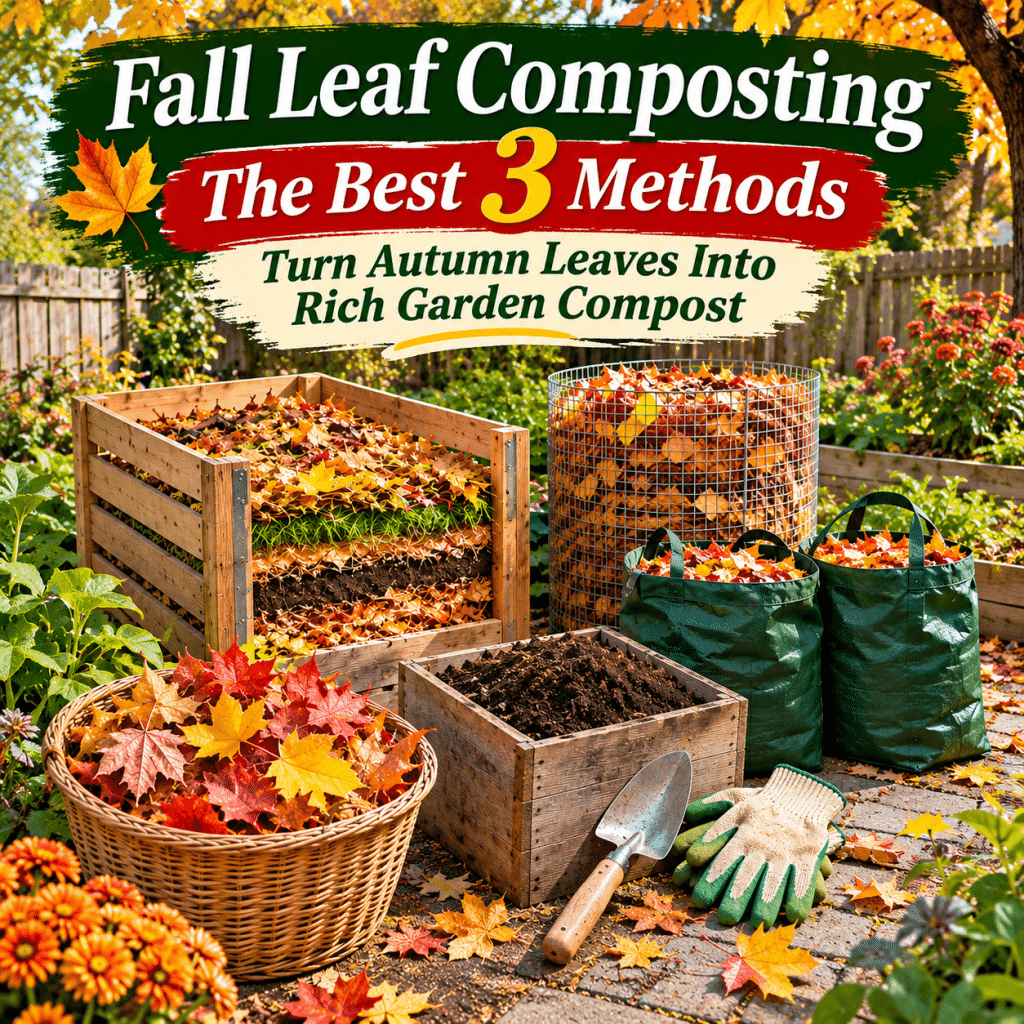
Every autumn, deciduous trees release enormous quantities of leaves containing carbon and various minerals absorbed during the growing season. Although these leaves may initially appear dry, brittle, and practically useless, they provide an important food source for the microorganisms responsible for natural decomposition.
What makes autumn leaf composting particularly attractive is its accessibility. You do not need expensive gardening equipment, specialized fertilizers, or a large backyard to get started. With the right combination of materials, moisture, oxygen, and patience, even a modest collection of fallen leaves can become a valuable gardening resource.
However, not every composting method delivers the same results. Some techniques prioritize rapid decomposition, while others produce exceptionally fine organic matter or minimize the amount of maintenance required.
The following three Fall Leaf Composting methods focus specifically on controlled decomposition, microbial activity, compost production, and soil improvement, offering practical solutions for gardeners with different spaces, schedules, and gardening goals.
Why Fall Leaf Composting Is Worth the Effort
Fallen autumn leaves represent one of nature’s most abundant renewable gardening resources. In natural woodland environments, leaves gradually decompose on the forest floor, contributing to the development of organic-rich soil.
Home gardeners can recreate this biological process in a more controlled environment. By collecting and composting autumn leaves, it becomes possible to produce useful soil amendments rather than purchasing large quantities of commercially manufactured products.
Unlike synthetic fertilizers, which primarily supply specific nutrients, finished compost contributes to the physical, chemical, and biological characteristics of garden soil.
Its benefits can continue long after the compost has been incorporated into vegetable beds, flower gardens, or planting areas.
🍂 Creating a Valuable Source of Organic Matter
Organic matter plays an essential role in maintaining productive soil. Sandy soils often benefit from improved moisture retention, while heavy clay soils can develop better aggregation and structure over time.
Composted leaves also provide food and habitat for beneficial soil organisms. These organisms participate in nutrient cycling and contribute to the development of a healthy underground ecosystem.
Regular additions of finished leaf compost can gradually improve the overall quality of garden soil, particularly in areas that have experienced years of intensive cultivation.
🌱 Supporting a More Sustainable Garden
Transporting fallen leaves away from residential properties requires collection, transportation, and processing. Composting those materials at home creates a more localized cycle in which organic resources remain available within the garden.
Leaves collected in autumn can eventually support vegetables, flowering perennials, ornamental shrubs, and other plants during future growing seasons.
This approach transforms a seasonal byproduct into a productive resource without requiring complicated technology.
💰 Reducing Long Term Gardening Expenses
Gardeners frequently purchase compost, soil conditioners, and organic amendments to maintain planting beds.
Although homemade leaf compost may not completely replace every soil product, it can reduce the quantity of commercial amendments needed.
Over several years, a consistent autumn composting routine can produce substantial amounts of useful organic matter from materials that would otherwise be discarded.
Comparing the Best 3 Fall Leaf Composting Methods
Choosing the right composting technique depends on the amount of fallen leaves available, the desired finished product, available space, and how much time you are willing to spend maintaining the system.
| Composting Method | Approximate Processing Time | Maintenance | Main Result | Best For |
|---|---|---|---|---|
| 🥇 Layered Hot Composting | 3–6 months or longer | Moderate to high | Mixed garden compost | Vegetable gardens and productive planting beds |
| 🥈 Fungal Leaf Mold Composting | 12–24 months | Low | Fine leaf mold | Soil conditioning and moisture retention |
| 🥉 Aerated Bag Composting | 9–24 months | Low | Decomposed leaf organic matter | Small gardens and limited spaces |
These processing times are approximate. Climate, leaf species, particle size, moisture, microbial activity, and maintenance practices can significantly influence decomposition.
Hot composting offers the greatest potential for relatively rapid results. Leaf mold production emphasizes fungal decomposition and soil conditioning, while aerated bag composting provides a compact alternative for gardeners with limited outdoor space.
🥇 Best 1 Fall Leaf Composting With a Layered Hot Composting System for Faster Garden Gold
A layered hot composting system is an excellent choice for gardeners who want to transform large quantities of autumn leaves into finished compost as efficiently as possible.
Unlike systems that rely almost entirely on the slow decomposition of dry leaves, hot composting combines carbon-rich materials with nitrogen-rich ingredients. This mixture encourages intense microbial activity, which generates heat and accelerates the breakdown of organic matter.
When properly managed, the system can produce dark, crumbly compost suitable for numerous garden applications.
This technique is particularly useful for homeowners with mature deciduous trees, productive vegetable gardens, and access to fresh green gardening materials.
Understanding the Science Behind Hot Leaf Composting
Autumn leaves generally contain a relatively high proportion of carbon. Carbon provides an energy source for composting microorganisms, but those organisms also require nitrogen to grow and reproduce.
A compost pile consisting exclusively of dry leaves may decompose slowly because nitrogen is limited. Introducing nitrogen-rich ingredients helps create a more favorable environment for bacterial activity.
As microorganisms consume organic materials, they release heat. Under suitable conditions, the internal temperature of the compost pile rises considerably above the surrounding air temperature.
An initial carbon-to-nitrogen ratio of approximately 25:1 to 30:1 is commonly considered favorable for active composting.
Because most home gardeners cannot precisely calculate the chemical composition of every ingredient, observing the pile’s temperature, smell, moisture, and decomposition progress provides a practical alternative.
Selecting the Right Composting Ingredients
A successful hot composting system begins with a diverse collection of suitable materials.
Dry autumn leaves form the primary carbon-rich ingredient. Shredding them before composting increases the surface area available to microorganisms and helps prevent large leaves from forming compacted layers.
Nitrogen-rich materials can include fresh untreated grass clippings, vegetable scraps, coffee grounds, and appropriate green plant trimmings.
Combining several different materials generally creates a more balanced composting environment than relying entirely on a single ingredient.
| Composting Material | Main Contribution | Recommended Use |
|---|---|---|
| Shredded autumn leaves | Carbon | Primary composting ingredient |
| Fresh grass clippings | Nitrogen | Mix thoroughly to prevent compaction |
| Vegetable scraps | Nitrogen and moisture | Distribute throughout the pile |
| Used coffee grounds | Nitrogen | Add in moderate quantities |
| Shredded plain cardboard | Carbon and structure | Supplement when necessary |
| Mature compost | Microorganisms | Optional starter material |
| Small woody fragments | Air spaces and structure | Use sparingly |
Meat, dairy products, cooking oils, pet waste, and plants contaminated with persistent herbicides should generally be excluded from ordinary backyard composting systems.
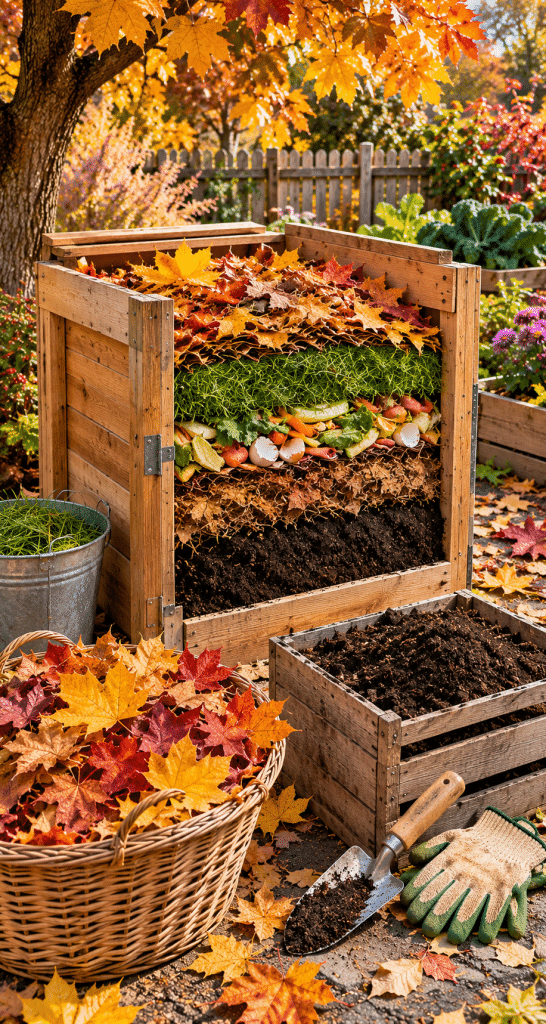
Building an Efficient Layered Leaf Composting Bin
A practical hot composting enclosure can be constructed from untreated wooden pallets, suitable wire mesh, or commercially available composting containers designed for adequate ventilation.
For gardeners aiming to achieve substantial microbial heating, a pile approximately three feet wide, three feet deep, and three feet high provides a useful starting size.
Begin with a loose foundation of coarse organic materials that allows some airflow near the bottom. Add shredded autumn leaves, followed by a smaller quantity of nitrogen-rich ingredients.
Continue alternating materials while gently mixing adjacent layers rather than creating thick, isolated sections.
This mixing process is important because compacted grass clippings and tightly packed leaves can restrict oxygen movement.
Water should be added gradually during construction, especially when the collected leaves are exceptionally dry.
The completed pile should contain sufficient moisture to support microbial activity without becoming saturated.
Managing Moisture Oxygen and Temperature
Moisture management is one of the most important elements of successful Fall Leaf Composting.
Beneficial composting microorganisms require water to remain active. Excessive dryness slows decomposition, while excessive moisture can displace oxygen and encourage unpleasant anaerobic conditions.
A practical moisture target is a texture similar to a wrung-out sponge. The material should feel damp but should not release substantial quantities of water when gently squeezed.
Oxygen is equally important. Turning the compost periodically introduces fresh air and moves less-decomposed exterior materials toward the biologically active center.
A long-probe compost thermometer can help gardeners monitor internal temperatures. An active pile may reach approximately 130–150°F (54–66°C) under suitable conditions.
Important Note: Finished appearance alone does not guarantee that compost is mature or free from pathogens and weed seeds. Allow actively composted material to cure until it remains near ambient temperature, smells earthy, and shows no significant reheating after turning. Ordinary backyard composting should not be relied upon to sanitize hazardous or contaminated materials.
Recognizing the Different Stages of Decomposition
During the early stage, recognizable leaf fragments, green materials, and vegetable scraps remain visible.
As decomposition progresses, microbial activity increases, the pile begins to settle, and many of the original ingredients gradually lose their recognizable appearance.
The active heating stage may occur in several cycles, particularly when turning introduces additional oxygen.
Eventually, microbial activity slows as readily available organic materials become depleted. The compost begins entering its curing stage.
Mature compost typically develops a dark brown color, an earthy fragrance, and a relatively crumbly texture.
Some resistant woody fragments may remain. These can be screened out and returned to a new compost pile.
Using Finished Hot Leaf Compost in the Garden
Finished compost produced through this method is particularly useful in vegetable gardens, where repeated cultivation can gradually reduce soil organic matter.
A modest layer of mature compost can be incorporated into the upper portion of established garden soil before planting.
Flower gardens can also benefit from improved soil structure and biological activity.
When used in container gardening, finished compost should generally be blended with other suitable growing-medium ingredients rather than used as the sole potting material.
The nutrient content of homemade compost varies considerably, so additional fertilization may still be necessary depending on plant requirements and existing soil conditions.
Why This Method Deserves First Place
Layered hot composting offers an excellent combination of processing speed, material versatility, and practical garden applications.
It allows gardeners to combine autumn leaves with numerous other biodegradable household and garden materials.
Although it requires more monitoring than the other techniques, the resulting compost can become an important component of a productive home gardening system.
For gardeners who enjoy actively managing decomposition and producing substantial quantities of soil amendments, this approach offers exceptional potential.
🥈 Best 2 Fall Leaf Composting With a Fungal Leaf Mold Chamber for Exceptional Soil Improvement
Not every composting method needs to generate intense heat or require frequent turning.
Leaf mold production represents a slower, more natural approach that emphasizes the fungal decomposition of autumn leaves.
The resulting material, commonly known as leaf mold, has a soft, dark, finely textured appearance reminiscent of the organic layer found beneath established woodland vegetation.
Although leaf mold is not generally as nutrient-rich as mixed garden compost, its ability to contribute organic matter and improve moisture retention makes it particularly valuable.
This technique is ideal for gardeners who prefer minimal maintenance and are willing to allow natural biological processes to develop over several seasons.
Understanding the Difference Between Leaf Mold and Ordinary Compost
Traditional mixed composting relies on a combination of bacterial and fungal activity, supported by diverse carbon-rich and nitrogen-rich ingredients.
Leaf mold production relies more heavily on fungi and other decomposers capable of breaking down resistant plant structures.
Autumn leaves contain cellulose and varying quantities of lignin, both of which contribute to their structural strength.
These materials require time to decompose, especially in tougher, thicker leaves.
The resulting leaf mold is primarily valued as a soil conditioner rather than a concentrated fertilizer.
Its physical characteristics make it particularly attractive for gardeners interested in improving soil texture and water management.
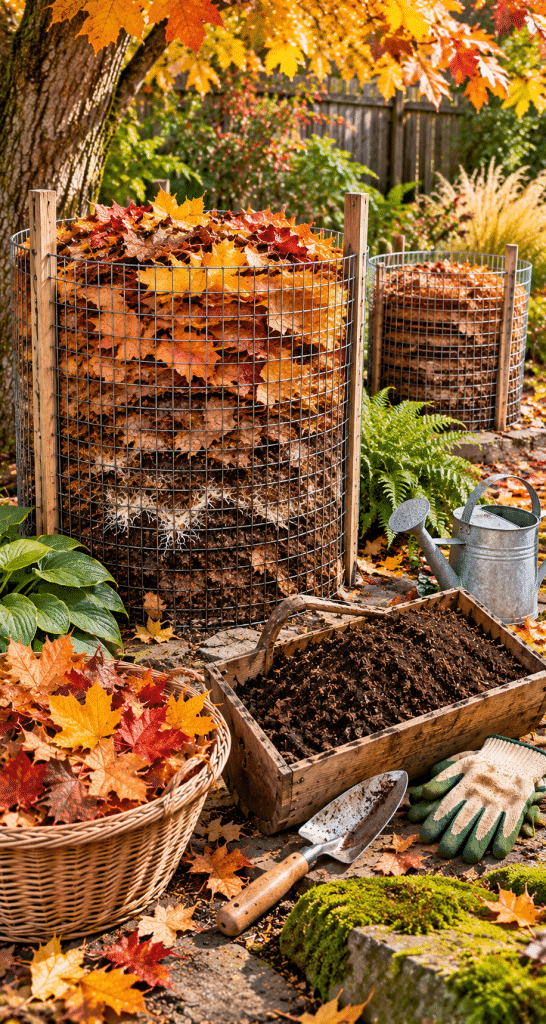
Creating a Dedicated Fungal Decomposition Chamber
A leaf mold chamber can be constructed using galvanized wire mesh supported by several sturdy garden stakes.
A cylindrical enclosure offers a simple design that allows air and rainfall to reach the stored leaves while preventing them from scattering across the garden.
A diameter of approximately three to four feet provides a practical storage capacity for many residential gardens.
Choose a sheltered location with partial shade whenever possible. Protection from strong winds and intense sunlight helps reduce excessive drying.
Unlike a conventional hot composting bin, a leaf mold chamber does not require frequent additions of nitrogen-rich materials.
Its primary ingredients are fallen deciduous leaves, sufficient moisture, oxygen, and time.
Choosing Leaves for Better Decomposition
Different tree species produce leaves with different physical and chemical characteristics.
Thin, soft leaves often decompose more rapidly than thick, leathery leaves containing greater proportions of resistant compounds.
Shredding slower-decomposing leaves can significantly improve their suitability for leaf mold production.
| Type of Leaf | Relative Decomposition Speed | Preparation |
|---|---|---|
| Birch | Fast | Light shredding optional |
| Ash | Fast | Shredding optional |
| Maple | Moderate to fast | Shredding recommended |
| Beech | Moderate to slow | Shred before composting |
| Oak | Generally slow | Thorough shredding beneficial |
| Magnolia | Slow | Shred into smaller pieces |
These differences are relative rather than fixed. Environmental conditions and individual leaf characteristics strongly influence the actual decomposition rate.
Mixing leaves from several tree species can help create a more varied organic material.
Establishing the Ideal Fungal Environment
After collecting the leaves, place them inside the chamber and moisten them thoroughly if necessary.
The objective is to maintain a consistently damp environment without creating stagnant, waterlogged conditions.
Occasional rainfall may provide sufficient moisture in humid climates. During unusually dry weather, supplemental watering may be required.
As the leaves settle, additional autumn leaves can be added, although maintaining separate yearly batches makes it easier to distinguish mature leaf mold from recently collected materials.
A loosely fitted cover can reduce drying while still allowing ventilation.
Frequent turning is unnecessary. An occasional gentle mixing may help redistribute moisture, but the primary advantage of this method is its low-maintenance character.
Developing a Two Year Leaf Mold Rotation
One particularly effective strategy involves creating two or three separate leaf mold chambers.
The first chamber receives freshly collected autumn leaves during the current year.
The second chamber contains the previous year’s partially decomposed material.
A third chamber, when available, holds older material that is approaching maturity.
The Two Year Leaf Mold Cycle
A rotating system provides space for fresh autumn leaves while older batches mature naturally.
This rotation creates a continuous supply of organic material without requiring gardeners to restart their entire composting process every autumn.
Simple weather-resistant labels identifying the collection year can make managing multiple chambers easier.
Over time, the system becomes a predictable annual gardening routine.
Recognizing High Quality Mature Leaf Mold
Mature leaf mold should have a soft, loose, earthy texture.
Most individual leaves should have lost their original shape, although small resistant fragments may remain.
The material should not smell sour, excessively fermented, or unpleasantly stagnant.
Well-decomposed leaf mold often feels surprisingly lightweight and can absorb substantial amounts of moisture.
Depending on leaf species and environmental conditions, achieving this texture may require one to two years or occasionally longer.
Patience is an essential ingredient in this particular Fall Leaf Composting technique.
Using Leaf Mold to Improve Challenging Garden Soils
Leaf mold is especially valuable in gardens containing sandy soil that dries rapidly.
Its organic structure can contribute to improved water retention, helping create more stable moisture conditions around plant roots.
Heavy clay soil can also benefit from regular additions of organic matter, which may encourage improved aggregation and workability over time.
Leaf mold is particularly useful around woodland-style planting areas and shade-loving perennials that naturally thrive in organic-rich growing environments.
It can also be incorporated as one component of suitable homemade growing-medium mixtures.
However, its relatively modest nutrient contribution means that plants with substantial nutritional requirements may need additional sources of fertility.
Why This Method Deserves Second Place
Fungal leaf mold composting stands out because it transforms a single abundant autumn resource into a highly useful soil conditioner.
The method requires relatively little active maintenance, specialized equipment, or additional composting ingredients.
Its principal disadvantage is the extended decomposition period.
For gardeners interested in long-term soil improvement, moisture management, and natural biological processes, however, that additional time can be well worth the investment.
🥉 Best 3 Fall Leaf Composting With an Aerated Bag System for Small Gardens
Limited outdoor space should not prevent gardeners from converting autumn leaves into useful organic matter.
Aerated bag composting offers a compact solution that can be adapted to small backyards, courtyard gardens, and properties without sufficient room for permanent composting enclosures.
The method involves placing prepared autumn leaves inside durable, ventilated bags, maintaining suitable moisture, and allowing decomposition to progress gradually.
Unlike large hot composting systems, individual bags generally do not retain enough heat to support sustained high-temperature decomposition.
Instead, this approach operates primarily as a compact, low-temperature leaf decomposition system.
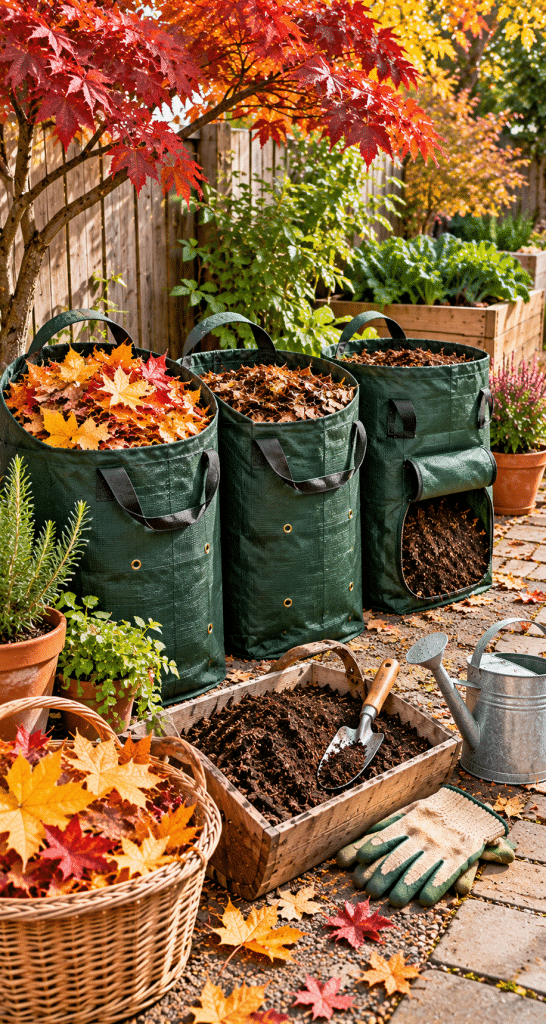
Choosing Suitable Composting Bags
The ideal composting bag should be durable enough to withstand prolonged outdoor exposure and the gradual weight changes associated with wet organic materials.
Reusable woven polypropylene garden sacks, purpose-made composting bags, and suitably prepared heavy-duty outdoor bags are practical possibilities.
Ventilation is essential. Non-breathable bags require multiple small openings to permit oxygen movement and allow excess moisture to escape.
Bags should remain protected from sharp objects, prolonged intense sunlight, and locations where standing water frequently accumulates.
Reusable containers offer the additional advantage of reducing unnecessary plastic consumption over successive composting seasons.
Preparing Autumn Leaves for Compact Composting
Preparation is especially important when composting leaves in bags because the restricted space makes compaction more likely.
Large whole leaves can cling together when wet, creating dense layers that limit oxygen movement.
Shredding the leaves before filling the bags helps prevent this problem and exposes additional surfaces to decomposing organisms.
A small quantity of mature compost can be mixed with the leaves if available, although it is not essential.
The leaves should be evenly moistened before storage rather than relying entirely on water penetrating the bags later.
Avoid compressing the contents excessively. A relatively loose arrangement provides better opportunities for oxygen circulation.
Establishing an Effective Bag Composting Routine
Fill each bag with prepared leaves while leaving enough space for the contents to be gently moved and redistributed.
Secure the opening loosely or use a closure that does not create an airtight environment.
Place the bags in a shaded, sheltered outdoor location with adequate drainage.
Periodically inspect the contents to ensure they have not become excessively dry or waterlogged.
Gently shaking or repositioning the bags occasionally can help redistribute moisture and expose different portions of the material to available oxygen.
The objective is to maintain stable decomposition conditions rather than accelerate the process through constant disturbance.
Organizing Composting Bags by Collection Date
A simple labeling system can greatly improve the effectiveness of this technique.
Each bag can be identified according to the month and year in which its leaves were collected.
Older bags should remain separate from newly filled containers, allowing gardeners to evaluate their maturity independently.
| Bag Label | Contents | Expected Development |
|---|---|---|
| Autumn Year 1 | Fresh shredded leaves | Early decomposition |
| Spring Year 2 | Overwintered leaves | Partially decomposed material |
| Autumn Year 2 | Older decomposing leaves | Potentially approaching maturity |
| Mature Batch | Fully decomposed leaves | Ready for suitable soil applications |
Actual progress should always be assessed by examining the contents rather than relying entirely on the date.
This organized system allows gardeners to maintain multiple small batches without requiring large permanent structures.
Preventing Common Bag Composting Problems
Unpleasant odors are often associated with insufficient oxygen or excessive moisture.
When a bag develops a strong sour smell, opening it temporarily, loosening the contents, and improving ventilation can help restore more favorable conditions.
If the leaves remain dry and unchanged for several months, additional moisture may be required.
Excessively wet bags should be repositioned in a better-drained location and inspected for blocked ventilation openings.
Physical deterioration of the containers should also be monitored.
Damaged bags can release plastic fragments into the organic material, making regular inspection particularly important when using conventional plastic storage bags.
Making the Most of Finished Bag Compost
The finished product from a properly managed leaf-only bag system is generally similar to leaf mold.
It is best used primarily as an organic soil conditioner rather than as a complete fertilizer.
Small garden beds, ornamental planting areas, and courtyard gardens can benefit from regular additions of this decomposed material.
Gardeners can also blend modest quantities into suitable container-growing mixtures.
Because each bag produces a relatively limited volume, the finished material can be reserved for garden areas that need organic matter most urgently.
Why This Method Deserves Third Place
Aerated bag composting earns its position because of its simplicity, affordability, and adaptability.
It eliminates the need for substantial construction projects and allows gardeners to adjust composting capacity by adding or removing individual containers.
Although it is generally slower and less productive than a well-managed hot composting system, its compact design makes it an excellent choice for smaller properties.
It also provides an accessible introduction to Fall Leaf Composting for beginners who want to understand decomposition before investing in larger composting structures.
How to Troubleshoot Common Fall Leaf Composting Problems
Even carefully designed composting systems can experience occasional difficulties.
Most problems develop when the relationship between moisture, oxygen, temperature, and available nutrients becomes unbalanced.
Recognizing these warning signs early allows gardeners to correct the underlying issue before decomposition slows significantly.
| Common Problem | Likely Cause | Practical Solution |
|---|---|---|
| Leaves remain unchanged | Insufficient moisture or slow decomposition | Moisten and shred materials |
| Sour or unpleasant smell | Excess moisture or insufficient oxygen | Aerate and improve drainage |
| Hot compost pile remains cold | Small pile or insufficient nitrogen | Increase volume and balance ingredients |
| Thick compacted leaf layers | Whole wet leaves | Break apart and mix thoroughly |
| Excessive ammonia smell | Too much nitrogen | Add shredded dry leaves |
| Compost attracts rodents | Unsuitable food ingredients | Remove attractants and secure the enclosure |
| Compost dries rapidly | Excessive sun or wind exposure | Provide shelter and restore moisture |
| White fungal growth | Often normal fungal decomposition | Maintain suitable moisture and ventilation |
The presence of fungi is not automatically a sign of failure. Fungal activity is especially important during the decomposition of woody and fibrous leaf materials.
Gardeners should evaluate the overall condition of the composting environment rather than interpreting individual biological changes in isolation.
A healthy composting system generally progresses toward darker organic matter with an increasingly earthy fragrance.
Creating an Annual Fall Leaf Composting Schedule
Establishing a predictable seasonal routine makes leaf composting easier to manage over multiple years.
Instead of treating every autumn as a completely new project, gardeners can develop a continuous cycle of collecting, preparing, decomposing, curing, and harvesting organic materials.
This approach is particularly effective when several composting methods are used together.
| Season | Main Composting Activity | Expected Benefit |
|---|---|---|
| 🍂 Fall | Collect, shred, and organize leaves | Establish new compost batches |
| ❄️ Winter | Monitor moisture and protect against saturation | Maintain suitable conditions |
| 🌷 Spring | Inspect decomposition and turn active piles | Encourage renewed microbial activity |
| ☀️ Summer | Monitor curing and moisture | Support maturation |
| 🍁 Following Fall | Harvest mature batches and restart the cycle | Maintain continuous production |
Cold winter temperatures may substantially reduce microbial activity, particularly in small or exposed composting systems.
This slowdown is normal. Decomposition can accelerate again when environmental conditions become more favorable during spring.
By organizing compost batches according to their age and intended purpose, gardeners can develop a reliable long-term source of organic soil amendments.
How Much Finished Compost Can Autumn Leaves Produce
One of the most noticeable changes during leaf decomposition is the dramatic reduction in volume.
Freshly collected autumn leaves contain numerous air spaces and relatively large plant structures.
As decomposition progresses, these structures break down, the material settles, and microorganisms release part of the original carbon as carbon dioxide.
Consequently, a large collection of fresh leaves eventually produces a much smaller quantity of finished organic matter.
Illustrative Leaf Compost Volume Reduction
Fresh loose autumn leaves
100%
Shredded and settled leaves
65%
Partially decomposed leaves
35%
Mature leaf mold
20%
Illustrative relative volume only. Actual reduction depends on leaf species, initial packing density, moisture, and decomposition conditions.
This reduction should not discourage gardeners. The finished material is considerably more decomposed, physically stable, and suitable for soil improvement than the original loose leaves.
Collecting sufficient leaves and maintaining several batches can help compensate for the natural loss of volume.
Can You Combine All Three Fall Leaf Composting Methods
Gardeners with access to abundant autumn leaves do not necessarily need to choose just one technique.
A combined composting strategy can provide different types of organic amendments throughout the year.
Shredded leaves can be mixed with nitrogen-rich materials in a hot composting enclosure to produce mixed garden compost.
Additional leaves can be stored in a dedicated fungal decomposition chamber, creating a longer-term supply of leaf mold.
Smaller surplus quantities can be placed inside aerated bags, particularly when the primary composting enclosures have reached their capacity.
This diversified approach helps gardeners manage fluctuating quantities of autumn leaves while maintaining several useful decomposition processes.
It also provides greater flexibility when weather conditions temporarily slow one particular composting system.
Frequently Asked Questions About Fall Leaf Composting
Can You Make Compost Using Only Fall Leaves
Yes. Autumn leaves can decompose without additional nitrogen-rich ingredients.
However, the resulting material is generally classified as leaf mold, and decomposition is usually slower than in a balanced hot composting system.
Leaf-only composting is particularly suitable for gardeners seeking a low-maintenance soil conditioner.
Should Autumn Leaves Be Shredded Before Composting
Shredding is strongly beneficial for many types of fallen leaves.
Smaller particles expose more surface area to microorganisms and reduce the likelihood of tightly compacted layers developing inside composting containers.
Thin leaves may decompose successfully without shredding, while tougher oak, beech, and magnolia leaves generally benefit from additional preparation.
Can You Compost Wet Autumn Leaves
Wet leaves can be composted successfully, provided they are not excessively saturated or compacted.
Moderate moisture supports microbial activity, but waterlogged conditions restrict oxygen availability.
Mixing wet leaves with drier shredded materials can help establish a more favorable composting environment.
Can You Compost Oak Leaves
Oak leaves can be composted, although they often decompose more slowly than thinner deciduous leaves.
Shredding them and mixing them with other suitable composting materials can help improve processing efficiency.
Their initial chemical characteristics do not necessarily translate into strongly acidic finished compost.
Does Fall Leaf Composting Continue During Winter
Yes, although the decomposition rate depends heavily on temperature and environmental conditions.
Microbial activity may slow considerably during freezing weather, especially near the exterior of composting piles.
Larger, biologically active compost piles may retain some internal warmth, while smaller leaf mold chambers and composting bags generally follow seasonal temperature changes more closely.
Is Leaf Compost Better Than Commercial Fertilizer
Leaf compost and commercial fertilizer perform different functions.
Composted leaves primarily contribute organic matter, support biological activity, and improve certain physical properties of garden soil.
Commercial fertilizers supply specific nutrients in more concentrated and measurable quantities.
Depending on soil conditions and plant requirements, using both appropriately may provide better results than relying entirely on either one.
Do You Need a Compost Accelerator for Autumn Leaves
Commercial compost accelerators are not essential.
Naturally occurring microorganisms are already present on leaves and throughout the garden environment.
Suitable moisture, oxygen availability, particle size, and balanced ingredients generally have a greater practical influence on successful decomposition.
A small quantity of mature compost can introduce additional microorganisms, but favorable environmental conditions remain the most important consideration.
Final Thoughts on the Best 3 Fall Leaf Composting Methods
Fall Leaf Composting transforms one of autumn’s most abundant natural resources into something that can contribute to healthier and more productive gardens for years to come.
The layered hot composting system offers the greatest potential for relatively rapid production of versatile mixed compost. Its combination of carbon-rich leaves, nitrogen-rich ingredients, moisture, and oxygen creates a biologically active environment capable of processing substantial quantities of organic materials.
The fungal leaf mold chamber offers a slower alternative focused on exceptional soil conditioning. Its minimal maintenance requirements make it particularly attractive for gardeners who appreciate natural decomposition and long-term improvements in soil structure.
The aerated bag composting system demonstrates that even limited outdoor space can accommodate productive leaf decomposition. Its affordability, flexibility, and straightforward maintenance make it suitable for beginners and small-space gardeners alike.
🍂 The greatest advantage of these three techniques is that they transform an unavoidable seasonal occurrence into a renewable gardening resource.
Every fallen leaf contains organic material that can eventually return to the soil. With appropriate preparation and suitable decomposition conditions, autumn’s seemingly ordinary garden waste can become the foundation of improved growing environments.
Rather than purchasing every soil amendment your garden requires, consider developing a composting system that makes better use of the natural materials already available.
Today’s fallen leaves could become the organic-rich foundation supporting tomorrow’s flourishing flowers, productive vegetable gardens, and thriving ornamental plants.
Sometimes the most valuable gardening resources are not found inside expensive bags at a garden center.
They are already falling from the trees in your own backyard.