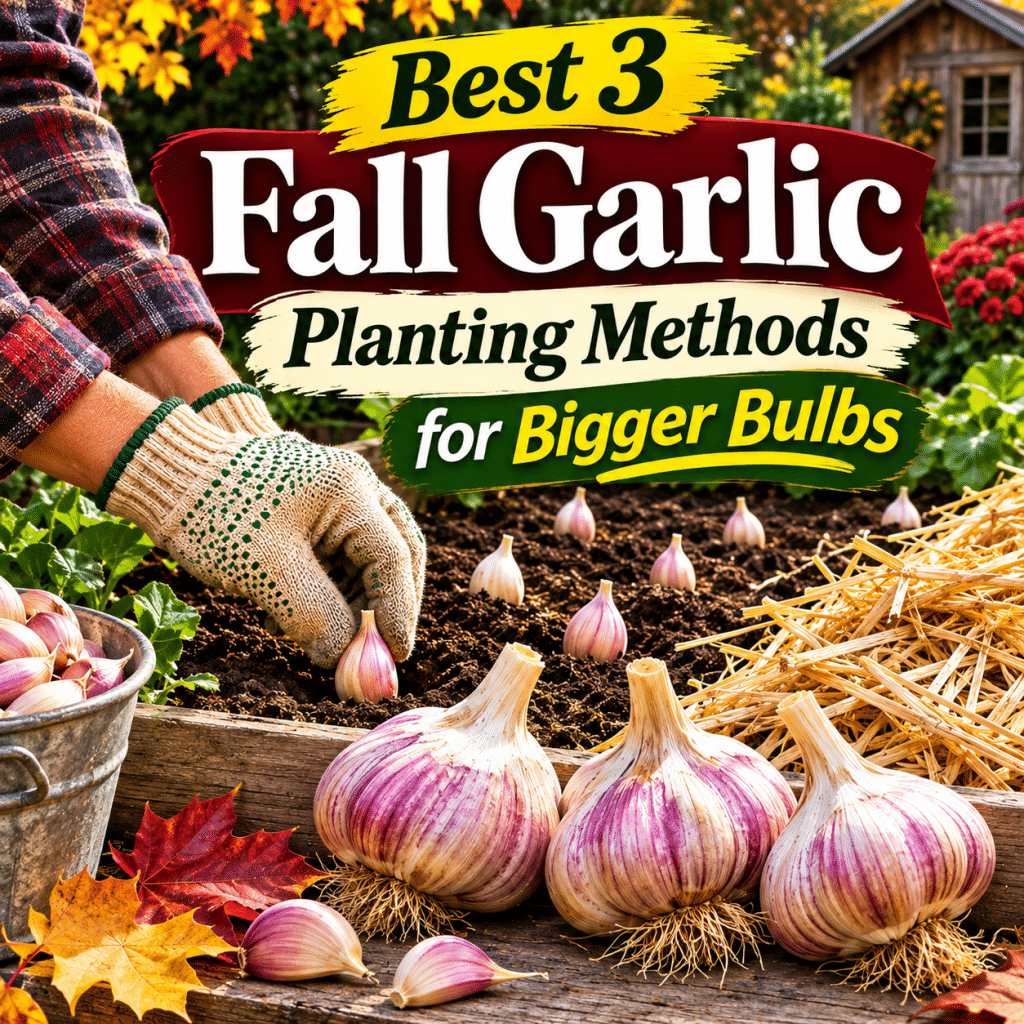
Fall Garlic Planting is one of the smartest gardening decisions you can make before winter arrives. While many gardeners are clearing their vegetable beds and preparing for colder weather, experienced growers are quietly planting individual garlic cloves that can develop into beautiful, flavorful bulbs by the following summer. With the right timing, healthy planting stock, and properly prepared soil, even a modest backyard garden can produce an impressive garlic harvest.
The fascinating thing about growing garlic is that much of its early development happens beneath the soil. While the garden appears dormant during the coldest months, garlic cloves can establish the root systems they need for vigorous spring growth. Those underground roots become the foundation for strong foliage, healthy bulb formation, and a satisfying harvest.
However, successful garlic cultivation involves more than simply pushing cloves into the ground. Planting too early, choosing unsuitable varieties, working with poorly drained soil, or overcrowding the bulbs can significantly reduce the quality of your harvest.
Fortunately, garlic is remarkably adaptable when its basic growing requirements are respected. Whether you have an established vegetable garden, a small sunny backyard, or a limited planting area, there are practical ways to create productive garlic-growing conditions.
The Best 3 Fall Garlic Planting Methods focus on three distinctive approaches: a traditional deep-rooted garden bed, a precision-planted garlic growing grid, and a protective winter-mulched garlic garden. Each method offers different advantages depending on your climate, available space, and gardening goals.
Beyond the three planting methods, understanding the correct planting calendar, garlic varieties, seasonal maintenance, and harvesting techniques can transform a simple fall gardening project into a dependable annual tradition.
🌱 Why Fall Garlic Planting Can Produce Better Summer Harvests
Garlic has a fascinating growing cycle that makes autumn planting especially valuable in many temperate climates.
Unlike vegetables that are planted and harvested within a single warm season, garlic often spends several months developing before its bulbs reach maturity. Fall planting takes advantage of this extended growing period.
When healthy garlic cloves are placed into suitable autumn soil, they begin producing roots. Depending on the temperature and planting date, the cloves may also develop small green shoots before winter.
As temperatures fall, growth slows substantially. In areas where the soil freezes, garlic enters a dormant or nearly dormant stage until conditions improve.
When spring arrives, established garlic plants can resume growth quickly because their root systems have already begun developing.
This head start is one reason fall-planted garlic frequently produces larger bulbs than garlic planted late in spring under otherwise similar conditions.
🌿 The Hidden Advantage of Strong Autumn Root Development
Garlic roots are responsible for absorbing the water and nutrients that support the plant throughout its growing season.
A well-established root system allows the plant to take advantage of warming spring temperatures and increasing daylight without needing to begin its entire growth cycle from scratch.
The best autumn growing conditions encourage root development without excessive aboveground foliage.
In colder regions, this means planting early enough for roots to establish but not so early that the garlic produces substantial tender growth before severe winter weather.
In milder climates, garlic may remain actively growing through much of winter. In these locations, choosing varieties adapted to local temperatures is particularly important.
The ultimate objective is to establish healthy plants that can produce vigorous leaves during spring and devote sufficient energy to bulb enlargement as their growing season progresses.
🧄 Why Garlic Needs the Right Seasonal Temperature
Garlic bulb development is influenced by both temperature and day length.
Exposure to sufficiently cool conditions helps trigger the physiological processes associated with bulb formation. This process is commonly called vernalization.
Different garlic varieties have different chilling requirements, which explains why a variety that performs beautifully in a northern garden may produce disappointing results in a warm southern region.
Cold-hardy hardneck garlic generally performs well in areas with pronounced winters, while many softneck varieties are better adapted to regions with milder winter conditions.
Selecting locally adapted garlic is therefore just as important as choosing the right planting method.
🏆 Best 3 Fall Garlic Planting Methods for an Abundant Harvest
The best planting approach depends on your garden’s soil, winter conditions, and available growing space.
Some gardeners benefit from creating a deeply prepared traditional bed that supports extensive root development. Others achieve excellent results through carefully measured planting grids that make efficient use of limited space.
In particularly cold climates, a well-designed protective mulch system can help garlic survive repeated freezing and thawing.
The following three methods offer practical solutions for different growing situations while maintaining the essential conditions garlic needs to thrive.
🥇 Best 1 Fall Garlic Planting in a Deeply Prepared Garden Bed for Bigger Bulbs
A traditional garden bed with loose, fertile, well-drained soil is one of the most dependable environments for growing garlic.
This method focuses on creating generous underground growing space so that roots can spread naturally while developing bulbs remain surrounded by healthy soil.
It is particularly suitable for gardeners who want to grow enough garlic for regular household cooking, winter storage, and future planting.
The secret lies in preparing the soil before the cloves are planted.
🌱 Creating the Ideal Deep Rooting Environment
Garlic performs best in soil that drains freely while retaining sufficient moisture for steady growth.
Heavy, compacted soil can interfere with root development and may remain excessively wet during winter. Poor drainage also increases the risk of clove deterioration and bulb rot.
Begin by choosing a sunny garden location that receives approximately six to eight hours of direct sunlight during the active growing season.
Remove weeds, stones, and leftover roots from previous crops. Loosen the planting area to a depth of approximately 8–12 inches where soil conditions permit, without unnecessarily disturbing healthy soil structure.
If your soil is compacted, incorporate mature compost to improve its physical condition and support soil organisms.
Avoid using large amounts of fresh manure immediately before planting. Undecomposed organic materials can create inconsistent growing conditions and may contribute to nutritional imbalances.
A soil test provides the most reliable basis for adjusting fertility and pH.
Garlic generally performs well in slightly acidic to neutral soil, often around pH 6.0–7.0. UMN Extension+1
🧄 Selecting the Strongest Garlic Cloves
The quality of your planting cloves has a major influence on the eventual harvest.
Choose firm, healthy bulbs from a reputable supplier that sells garlic suitable for planting.
Certified disease-free planting stock is particularly valuable because garlic is propagated vegetatively. Diseases and pests carried by infected bulbs can be introduced directly into garden soil.
Separate the bulbs into individual cloves shortly before planting, taking care not to damage their protective coverings.
Larger, healthy cloves generally have greater stored energy and are often better candidates for producing substantial bulbs.
Keep the papery clove skins intact whenever possible because they help protect the cloves during handling and planting.
Discard cloves showing mold, soft spots, obvious pest damage, or unusual discoloration.
For home gardeners aiming to produce premium-quality garlic, selecting excellent planting material is far more valuable than trying to compensate for unhealthy cloves with additional fertilizer.
📏 The Correct Garlic Planting Depth and Spacing
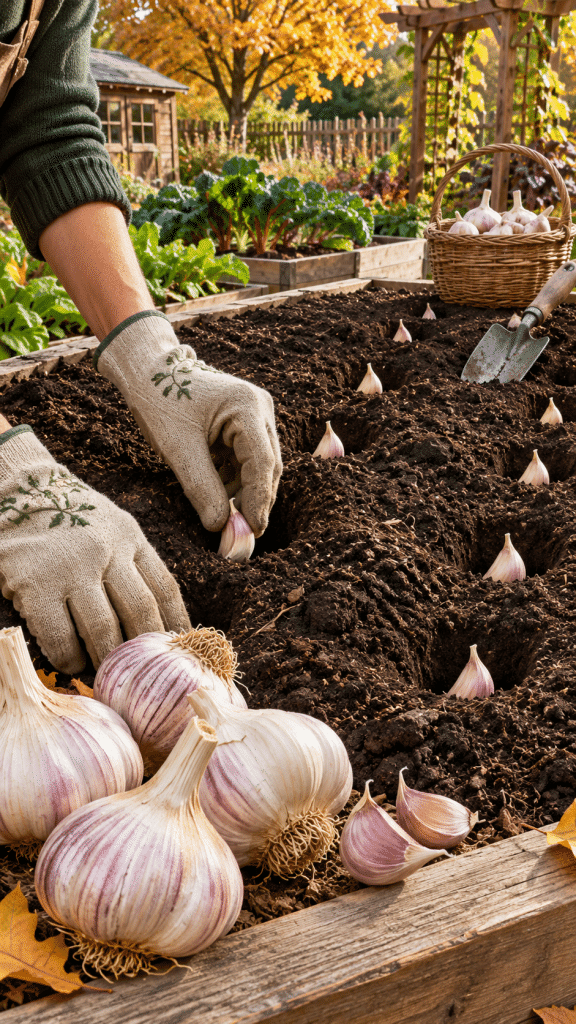
Once the soil is ready, establish straight planting rows that allow adequate space for bulb development.
Place each clove into the soil with its pointed end facing upward and its broad basal plate facing downward.
The basal plate is the area where new roots emerge.
In many home gardens, cloves are planted with approximately 2 inches of soil covering their tops, although deeper planting may be appropriate in colder climates and according to regional growing recommendations.
Space individual cloves approximately 4–6 inches apart, with rows commonly separated by 12–18 inches or more depending on the growing system.
This arrangement provides room for bulb enlargement while making weeding, watering, and harvesting manageable.
Cover the cloves with loose soil, gently firm the surface, and water sufficiently to settle the soil around them.
Avoid pressing the planting bed so firmly that it becomes compacted.
✨ Why This Traditional Method Produces Reliable Results
Deeply prepared garden beds create a balanced environment for garlic roots and developing bulbs.
The soil offers substantial space for root expansion, while the regular row arrangement makes plant maintenance straightforward.
Another advantage is the opportunity to improve the same growing area gradually through thoughtful crop rotation and organic matter management.
After harvesting the garlic, the bed can be used for an appropriate follow-up crop, provided local growing-season conditions allow.
This method is especially valuable for gardeners who prioritize dependable production and enjoy maintaining a dedicated vegetable-growing area.
🥈 Best 2 Fall Garlic Planting With a Precision Grid for Maximum Garden Productivity
Gardeners with limited growing space can benefit from a carefully organized garlic planting grid.
Unlike traditional rows, a precision grid distributes cloves evenly throughout a designated growing area.
This approach can make efficient use of a small garden while maintaining the spacing garlic requires for healthy development.
The result is a neat, productive planting arrangement that is easy to measure, maintain, and monitor.
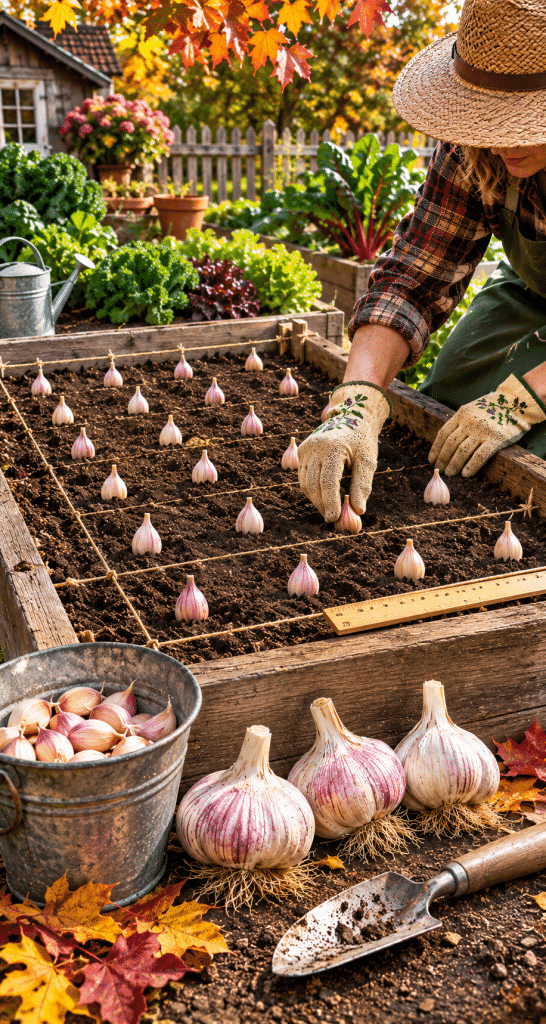
📐 Designing a Space Efficient Garlic Grid
Begin by determining the exact dimensions of the area available for garlic.
A square or rectangular planting space works particularly well because it can be divided into uniform sections.
For example, a 4-foot-wide planting bed can accommodate multiple lines of cloves spaced approximately 6 inches apart.
Instead of planting tightly packed rows, establish an evenly spaced grid that provides each plant with its own growing area.
Avoid placing cloves closer than the spacing recommended for your selected variety.
Although closer planting may increase the number of plants, it can also reduce individual bulb size.
A grid with approximately 6-inch spacing is a practical starting point for many home gardens, especially where larger bulbs are desired.
Use a measuring tape, planting board, or simple wooden spacing guide to maintain consistency.
🌿 Why Equal Spacing Matters for Garlic Bulb Development
Every garlic plant competes with neighboring plants for sunlight, moisture, and nutrients.
When planting distances vary substantially, some plants may develop under relatively crowded conditions while others have more resources available.
Consistent spacing helps create a more uniform growing environment.
As garlic foliage expands during spring, evenly distributed plants can receive adequate sunlight and airflow.
This arrangement also makes it easier to identify struggling plants and remove weeds before they become established.
A well-planned grid can create a visually appealing vegetable garden, but its most important advantage is the balance between efficient land use and proper plant development.
🧄 How Many Garlic Cloves Fit in a Small Garden
The following table provides approximate planting capacities for different growing spaces using a 6-inch grid.
| Planting area | Approximate number of cloves | Best use |
|---|---|---|
| 2 × 2 feet | 16 | Small experimental garlic patch |
| 2 × 4 feet | 32 | Compact backyard garden |
| 3 × 4 feet | 48 | Moderate household garlic supply |
| 4 × 4 feet | 64 | Productive small garden |
| 4 × 8 feet | 128 | Larger seasonal garlic harvest |
These estimates assume a regular 6-inch grid with the first planting positions approximately 3 inches from the edges. Actual capacity will depend on bed layout, access, variety, and planting margins.
The table also illustrates an important gardening principle: substantial garlic harvests do not necessarily require large properties.
A carefully managed 4 × 4-foot space may accommodate dozens of garlic plants.
However, the actual number of usable bulbs will depend on plant health, growing conditions, and successful harvesting.
🌱 Preparing a Precision Planting Surface
A garlic grid works best when the planting surface is relatively level and easy to measure.
Remove weeds and add finished compost where needed.
Check that the soil drains adequately, particularly if the planting area has experienced waterlogging during previous winters.
Mark the planting positions with a spacing tool.
At each marked point, create a planting hole that reaches the appropriate depth for your climate and soil conditions.
Insert one healthy garlic clove with its pointed end upward.
Cover each planting hole carefully and water the entire area evenly.
After planting, label the grid with the garlic variety and planting date.
Labels are especially useful when testing different cultivars because they allow you to compare their growth, bulb size, and storage performance.
🌟 The Advantage of Growing Different Garlic Varieties
A precision grid offers an excellent opportunity to experiment with multiple garlic varieties.
For example, one portion of the garden might contain a cold-hardy hardneck cultivar, while another contains a softneck variety suited to the local climate.
Keep different varieties in clearly identified sections.
Comparing varieties under similar growing conditions can reveal which garlic performs best in your soil.
Gardeners may discover that one variety produces larger bulbs, another offers a more complex flavor, and a third maintains better quality during storage.
These observations become increasingly valuable from year to year.
Rather than assuming the most expensive or largest planting bulbs will always perform best, local growing results can guide future decisions.
🥉 Best 3 Fall Garlic Planting With Protective Winter Mulch for Strong Spring Growth
In regions where winter temperatures regularly fall below freezing, a protective mulch layer can be an important part of successful garlic cultivation.
This method combines careful fall planting with a seasonal covering designed to moderate soil-temperature fluctuations.
Its greatest advantage is helping protect the growing area from repeated freezing and thawing, which can cause frost heaving and disturb developing root systems.
Mulching also offers useful benefits for weed management and moisture conservation.
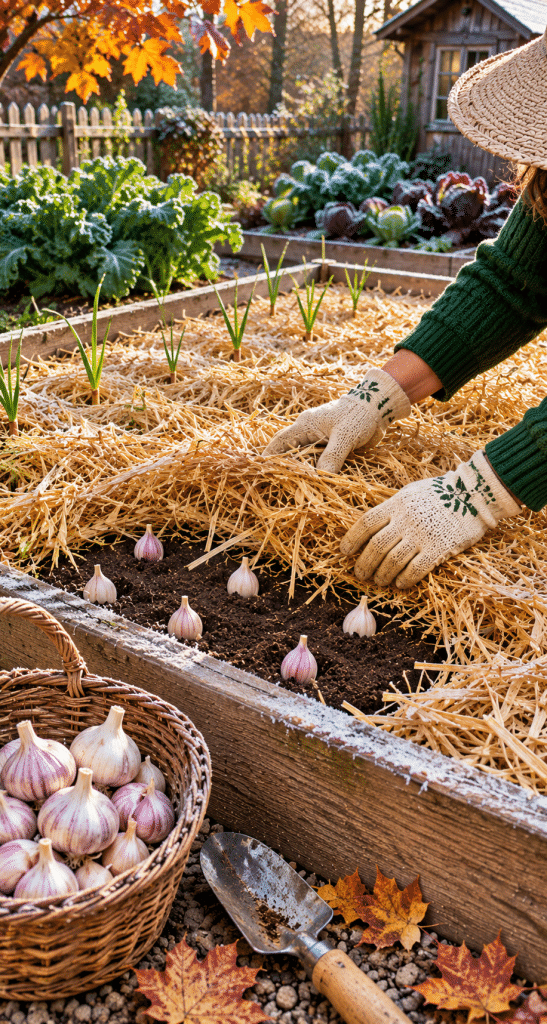
🍂 Why Winter Mulch Can Protect Garlic
During winter, exposed garden soil may experience substantial temperature changes.
Repeated freezing and thawing can cause soil to expand and contract.
This process can gradually push shallowly rooted plants upward, potentially exposing developing cloves or roots to damaging conditions.
A loose organic mulch layer helps moderate these temperature fluctuations.
Clean straw, shredded leaves, and other suitable materials can provide insulation while protecting the soil surface.
The ideal mulch depth depends on the severity of local winter weather, soil conditions, and the material being used.
In colder climates, extension recommendations commonly range from approximately 3–6 inches, with some regions using deeper layers for winter protection. Washington State University+2
Mulch should remain loose enough to avoid forming a dense, waterlogged covering.
🌾 Choosing the Best Mulching Materials
Not all organic materials behave the same way when exposed to rain, snow, and freezing temperatures.
Clean straw is popular because it is relatively lightweight and can provide useful insulation.
Shredded autumn leaves are another practical option, particularly for gardeners who want to reuse natural materials already available in their yards.
However, leaves should be shredded or loosely distributed rather than allowed to form thick, compacted mats.
A dense layer of wet leaves can reduce airflow and retain excessive moisture.
Coarse, clean organic materials are generally preferable to materials that easily become saturated and tightly packed.
The following comparison highlights the characteristics of common mulching options.
| Mulch material | Main advantage | Potential limitation |
|---|---|---|
| Clean straw | Loose insulation and weed suppression | May contain unwanted seeds if poorly sourced |
| Shredded autumn leaves | Readily available and biodegradable | Can mat together when overly wet |
| Pine needles | Lightweight and relatively loose | May shift in exposed, windy areas |
| Chopped dry plant material | Useful recycled garden material | Must be disease-free and properly prepared |
| Finished compost | Improves soil surface conditions | Provides less winter insulation than a thick loose mulch |
For severe winter conditions, straw or another locally recommended insulating mulch is often the most practical choice.
❄️ When to Apply Mulch During Fall Garlic Planting
Timing matters when applying winter protection.
In areas with freezing winters, gardeners commonly plant their garlic first and apply a substantial insulating layer after the soil has cooled or begun freezing.
This approach helps reduce excessive early warming and protects against frost heaving.
However, recommendations vary with regional climate.
Some areas benefit from applying mulch shortly after planting, while others recommend waiting until the ground freezes.
Gardeners in mild climates may need only a thin layer for weed suppression and moisture management rather than substantial winter insulation.
🌟 Important Note: Fall Garlic Planting should always be adjusted to local winter conditions. Excessive mulch over poorly drained soil can trap unwanted moisture, while insufficient protection in areas with repeated freeze thaw cycles may expose garlic to frost heaving. Follow regional planting and mulching recommendations rather than applying the same winter protection everywhere.
🌱 Managing Mulch When Spring Arrives
As temperatures begin to rise, inspect the garlic bed regularly.
Some garlic shoots may emerge through a loose mulch layer without assistance.
If the mulch becomes heavily compacted or prevents young leaves from developing normally, carefully loosen or move it away from the emerging plants.
Avoid completely exposing the soil unnecessarily if the mulch is helping control weeds and maintain moisture.
The objective is to provide sufficient access to sunlight and air while retaining the benefits of soil protection.
In unusually wet spring conditions, additional mulch removal may be necessary to help the soil dry.
With appropriate management, the winter-mulched garlic bed can transition smoothly into a productive spring-growing area.
📅 When Is the Best Time for Fall Garlic Planting
Choosing the correct planting date is one of the most important decisions in garlic cultivation.
The ideal date varies considerably depending on geography, elevation, temperature patterns, and how quickly the soil cools during autumn.
In regions with freezing winters, garlic is commonly planted several weeks before the ground becomes permanently frozen.
This gives the cloves an opportunity to establish roots without encouraging excessive early foliage growth.
A general planning window is approximately 4–6 weeks before the ground is expected to freeze, although regional extension guidance may recommend earlier or later planting. Illinois Extension+1
Rather than relying exclusively on a calendar date, gardeners should monitor local soil conditions.
🍁 Fall Garlic Planting Calendar by Growing Region
The following calendar provides broad seasonal guidance for temperate Northern Hemisphere gardens.
| Climate region | Typical planting period | Main consideration |
|---|---|---|
| Very cold northern climates | September to early October | Allow time for rooting before freeze |
| Cold winter regions | October | Plant before persistent soil freezing |
| Moderate winter regions | October to November | Avoid planting during unusually warm conditions |
| Mild winter regions | November to December | Choose adapted varieties with suitable chilling requirements |
| Very warm winter regions | Region specific | Bulb formation may require specially adapted varieties or chilling management |
These periods are general guidelines rather than fixed planting dates.
Local frost dates, soil temperatures, and the suitability of specific cultivars should determine the final planting schedule.
🌡️ What Happens When Garlic Is Planted Too Early
Planting garlic while soil temperatures are still unusually warm can encourage excessive foliage development.
In cold climates, substantial tender top growth may become vulnerable to winter damage.
Although garlic can survive some foliage injury, excessive early growth is generally not the desired outcome.
Planting very early can also extend exposure to certain pests and diseases when growing conditions remain warm.
The goal is not to produce the tallest garlic plants before winter.
Instead, successful autumn planting focuses on developing strong roots while maintaining a healthy balance between underground and aboveground growth.
⏳ What Happens When Garlic Is Planted Too Late
Late planting creates a different challenge.
If the ground freezes soon after the cloves are planted, they may have insufficient time to establish strong roots.
Poorly rooted garlic may experience slower spring development, especially when winter conditions are severe.
However, planting late does not automatically mean the crop will fail.
In some regions, cloves planted shortly before freezing may survive and begin growing when the soil warms.
The eventual harvest may be smaller or less consistent, depending on conditions.
When the soil remains workable and is not waterlogged, late autumn planting may still be worthwhile.
🧄 Hardneck Versus Softneck Garlic for Fall Planting
Selecting the right garlic type can dramatically improve the chances of a successful harvest.
Most commonly cultivated garlic belongs to two broad groups: hardneck and softneck.
Although both are used in cooking, they differ in their growth characteristics, climate preferences, and storage behavior.
Understanding these differences helps gardeners avoid planting varieties poorly suited to their local conditions.
❄️ Hardneck Garlic for Colder Winter Gardens
Hardneck garlic is generally well adapted to regions with pronounced winter cold.
It produces a stiff central flowering stalk, commonly called a garlic scape.
Gardeners often remove the tender scapes in late spring or early summer to encourage the plant to direct more resources toward bulb production.
The scapes themselves are edible and can be used in sauces, stir-fries, and other dishes.
Hardneck garlic varieties often produce relatively large cloves arranged around the central stalk.
Their flavors can range from robust and spicy to rich and complex.
Popular hardneck groups include Rocambole, Porcelain, and Purple Stripe garlic.
For gardeners in colder regions, choosing an adapted hardneck variety can be an excellent starting point.
☀️ Softneck Garlic for Milder Winter Regions
Softneck garlic is widely grown in regions with comparatively mild winters.
It generally lacks the prominent hard central stalk associated with hardneck garlic.
The flexible stems of many softneck varieties make them suitable for traditional garlic braiding after harvest and curing.
Softneck bulbs frequently contain more individual cloves, although the cloves may vary substantially in size.
Many softneck varieties also offer excellent storage potential under suitable conditions.
Artichoke and Silverskin garlic are two commonly recognized softneck groups.
Gardeners living in warmer regions should pay particular attention to cultivar descriptions because not every softneck variety has identical temperature requirements.
📊 Hardneck and Softneck Garlic Comparison
| Feature | Hardneck garlic | Softneck garlic |
|---|---|---|
| Climate preference | Generally colder winters | Generally milder winters |
| Central stalk | Usually produces a stiff scape | Usually lacks a prominent hard scape |
| Clove arrangement | Often fewer larger cloves | Often more cloves of varying sizes |
| Culinary flavor | Frequently robust and complex | Mild to strong depending on cultivar |
| Storage potential | Often shorter | Often longer |
| Braiding suitability | Usually difficult | Often suitable |
| Best growing strategy | Fall planting with appropriate winter protection | Fall planting with locally adapted varieties |
Neither type is universally superior.
The best choice depends on the gardener’s climate, culinary preferences, and intended storage period.
🌿 How to Prepare Garlic Cloves Before Planting
Preparing garlic cloves correctly is a simple process, but it deserves attention.
Healthy planting material is the foundation of a successful crop.
The first step is to obtain garlic specifically intended for cultivation whenever possible.
Garlic purchased from ordinary grocery stores may be suitable in some situations, but its variety, growing history, and disease status are often uncertain.
Some commercially sold garlic may also have received treatments intended to influence sprouting or storage.
Using reputable planting stock reduces unnecessary uncertainty.
🧄 Separate Garlic Bulbs Carefully
Keep garlic bulbs intact until relatively close to planting day.
When ready, gently separate them into individual cloves.
Avoid cutting through the cloves or damaging the basal plates.
Each clove should remain firm and retain as much of its protective skin as possible.
Select the healthiest, largest cloves for planting and reserve smaller sound cloves for cooking if desired.
Do not plant cloves showing signs of decay.
Because many garlic diseases can survive in infected planting material, careful selection is essential.
🌱 Should Garlic Cloves Be Soaked Before Planting
Some gardeners soak garlic cloves before planting, but routine soaking is not necessary for successful establishment.
Healthy cloves can be planted directly into properly prepared soil.
Unnecessary soaking, especially for extended periods or under unhygienic conditions, may create additional opportunities for deterioration.
Treatment recommendations differ depending on the disease or pest involved, and an unsuitable homemade treatment may damage planting material without providing meaningful protection.
The most reliable approach for home gardeners is to begin with clean, healthy planting stock and avoid unnecessary handling.
💧 How Much Water Does Fall Planted Garlic Need
Garlic needs adequate moisture to establish roots, but it does not tolerate persistently waterlogged soil.
After planting, water the bed sufficiently to settle the soil around the cloves if rainfall has not already provided adequate moisture.
During autumn, monitor the soil rather than watering according to a rigid schedule.
Cool temperatures usually reduce evaporation, so the soil may remain moist longer than it would during summer.
If autumn weather is unusually dry, occasional watering may help establish roots before winter.
If the soil is already wet from regular rainfall, additional irrigation may be unnecessary.
🌧️ Avoiding Excessive Winter Moisture
Poor drainage is one of the most serious problems for overwintering garlic.
Cloves sitting in saturated soil can deteriorate before the growing season begins.
This problem is especially common in low-lying planting locations where rainwater collects.
A properly prepared planting area should allow excess water to move away from the developing root zone.
Raised soil levels may help in gardens with naturally heavy soil, but drainage problems should be addressed rather than simply concealed.
Avoid walking on saturated planting beds, because compression can further damage soil structure.
🌞 Spring Watering for Healthy Bulb Formation
As temperatures rise and garlic resumes vigorous growth, its water requirements increase.
Consistent soil moisture becomes particularly important during active leaf growth and bulb enlargement.
A common recommendation is approximately 1 inch of water per week during spring and early summer, including rainfall, adjusted for soil and weather conditions. Washington State University+1
Water deeply enough to moisten the root zone rather than applying frequent shallow irrigation.
As the crop approaches maturity, reduce watering according to local recommendations and the condition of the plants.
Continuing to saturate the soil near harvest can interfere with proper bulb maturation and increase the risk of deterioration.
🌾 The Best Fertilizing Strategy for Fall Garlic
Garlic benefits from fertile soil, but more fertilizer does not automatically result in larger bulbs.
A productive crop requires a balanced supply of essential nutrients throughout its growing cycle.
Nitrogen supports vigorous foliage development, while phosphorus, potassium, and other nutrients contribute to overall plant health.
The best fertilization strategy begins with a soil test.
This helps identify actual nutrient requirements and reduces the risk of applying unnecessary amendments.
🍂 Building Fertility Before Planting
Before planting garlic, incorporate finished compost if the soil would benefit from additional organic matter.
Compost can support beneficial soil organisms and help improve moisture retention and drainage characteristics.
However, compost alone does not always provide the precise nutrient balance a crop requires.
If a soil test indicates deficiencies, apply appropriate fertilizers according to the recommendations.
Avoid placing concentrated fertilizer directly against the garlic cloves.
This can damage young developing roots.
Instead, incorporate recommended amendments evenly into the soil before planting.
🌱 Supporting Healthy Spring Growth
Garlic often has a substantial nitrogen requirement during its period of active spring foliage growth.
Gardeners may need to provide additional nitrogen when plants begin growing vigorously, especially in soils with limited available nutrients.
The exact amount depends on soil fertility, previous amendments, and regional growing recommendations.
Excessive nitrogen late in the growing season can be counterproductive, encouraging continued foliage development when the plant should be progressing toward bulb maturation.
A carefully timed fertility program encourages strong early growth without unnecessarily delaying harvest.
🚫 Common Fall Garlic Planting Mistakes That Reduce Harvest Quality
Garlic is relatively straightforward to cultivate, yet several avoidable mistakes can lead to disappointing results.
Recognizing these problems before planting can save an entire growing season.
❌ Planting Garlic in Heavy Wet Soil
Waterlogged conditions can damage cloves and encourage disease.
If your garden soil becomes saturated after rain, improve drainage before planting.
Avoid selecting a location where puddles remain for long periods.
Healthy roots require both moisture and oxygen.
❌ Planting Garlic Cloves Upside Down
Garlic cloves should normally be planted with the pointed end upward and the basal plate downward.
Although cloves may still grow when planted incorrectly, improper orientation can produce irregular growth and waste some of the plant’s stored energy.
Taking a moment to position each clove correctly is a simple way to improve planting consistency.
❌ Crowding Too Many Garlic Plants Together
Garlic needs adequate space for bulb enlargement.
Planting cloves too closely may increase the number of plants but reduce average bulb size.
For gardeners seeking large, well-formed bulbs, appropriate spacing is more valuable than maximum planting density.
❌ Ignoring Weeds During Spring
Garlic does not compete particularly well with aggressive weeds.
Weeds can consume moisture and nutrients while shading developing plants.
Regular, gentle weed removal is especially important during spring.
Avoid deep cultivation near garlic because its roots can be damaged by excessive soil disturbance.
❌ Replanting Garlic in the Same Soil Repeatedly
Growing garlic and other allium crops continuously in the same location can increase certain disease and pest problems.
Where space permits, rotate garlic with unrelated crops.
The appropriate rotation period depends on the disease risks in the garden, but a multi-year rotation can be beneficial.
Never use visibly diseased garlic bulbs as planting material.
🐛 Protecting Fall Garlic From Pests and Diseases
Healthy garlic plants begin with prevention.
Many pest and disease problems are difficult to correct once they become established in a planting bed.
Clean planting stock, appropriate crop rotation, soil drainage, and good garden sanitation provide essential protection.
🧄 Watch for Garlic Bulb and Root Problems
Garlic can be affected by various soilborne pathogens, including those associated with basal rot and white rot.
Symptoms may include yellowing foliage, weak growth, deteriorating roots, or rotting bulbs.
Unfortunately, these symptoms can also result from unrelated problems such as excessive moisture or nutritional deficiencies.
Accurate diagnosis is important before choosing a treatment.
If a serious disease is suspected, seek guidance from a local agricultural extension service or plant diagnostic laboratory.
Avoid moving potentially infected bulbs or soil into healthy planting areas.
🌿 Keep the Garlic Bed Clean and Well Managed
Weed removal, appropriate spacing, and careful watering can reduce unnecessary plant stress.
Inspect foliage regularly during spring.
Look for unusual discoloration, distorted growth, or signs of pest damage.
Avoid working extensively with plants when they are wet if doing so could spread disease.
Clean gardening tools when moving between potentially infected and healthy growing areas.
These straightforward practices can help protect the crop without introducing unnecessary chemical treatments.
🌸 What to Do When Garlic Scapes Appear
One of the most interesting stages of hardneck garlic cultivation occurs when the plants begin producing scapes.
These slender green stalks emerge from the center of the plant and often develop distinctive curling shapes.
Garlic scapes are associated with the plant’s reproductive development.
Many gardeners remove them while they are still tender to help direct plant resources toward bulb enlargement.
✂️ When to Remove Garlic Scapes
Scapes are typically harvested after they become long enough to handle and begin curling, although the ideal timing varies with variety and growing conditions.
Use clean gardening scissors or carefully snap the tender stalk.
Avoid damaging the surrounding garlic leaves.
The leaves are important because they continue producing the carbohydrates that support bulb development.
Removing scapes can help increase bulb size in many hardneck varieties. SDSU Extension+1
🍽️ Using Fresh Garlic Scapes in the Kitchen
Fresh garlic scapes offer a delicious bonus harvest before the mature bulbs are ready.
They have a distinctive garlic flavor and are often tender enough for quick cooking.
Chopped scapes can be added to stir-fries, blended into pesto, grilled with vegetables, or used in savory sauces.
Their flavor is often milder and greener than mature garlic cloves.
This additional edible harvest makes hardneck garlic particularly appealing to gardeners who enjoy growing unusual seasonal ingredients.
☀️ How to Know When Fall Planted Garlic Is Ready to Harvest
Garlic harvested too early may produce undersized bulbs with insufficiently developed protective wrappers.
Garlic left in the ground too long may experience excessive wrapper deterioration, which can reduce storage quality.
Recognizing the correct harvest stage is therefore essential.
In many temperate regions, fall-planted garlic is ready in late spring or summer, often around June through August depending on climate and variety.
The calendar provides only a general estimate.
The condition of the plants is a more useful guide.
🍃 Reading the Garlic Leaves
As garlic approaches maturity, its lower leaves begin turning yellow and drying.
Many gardeners harvest when several lower leaves have died back while a number of upper leaves remain green.
The ideal balance varies by garlic type.
Rather than waiting until every leaf is completely dry, inspect a sample bulb when the crop begins showing maturity.
A mature bulb should have well-developed cloves and protective wrappers.
If the bulb is still small and poorly differentiated, it may require additional growing time.
If the wrappers are deteriorating and the cloves begin separating, harvest may already be overdue.
🧄 Harvesting Garlic Without Damaging the Bulbs
Use a garden fork or suitable digging tool to loosen the soil several inches away from the plants.
Lift the bulbs gently from underneath.
Avoid pulling forcefully on the foliage, especially in compacted soil.
Damaged bulbs are less suitable for long-term storage.
Brush away loose soil without aggressively stripping off the protective wrappers.
Keep harvested garlic out of strong direct sunlight, particularly during hot weather.
Handle the bulbs carefully because bruising and cuts can shorten storage life.
🌬️ How to Cure Garlic for Long Lasting Storage
Curing allows harvested garlic to dry gradually, helping the protective outer layers become papery and suitable for storage.
This stage is particularly important when the goal is to use homegrown garlic for several months.
Freshly harvested garlic contains considerable moisture.
Storing uncured bulbs in poorly ventilated conditions can encourage spoilage.
🌿 Creating the Ideal Garlic Curing Space
Select a dry, shaded, well-ventilated location protected from rainfall.
A covered porch, ventilated shed, or similar sheltered area may be suitable, provided temperatures are not excessively hot.
Arrange garlic in loose bundles or spread the bulbs on racks that allow air to circulate.
Avoid piling large quantities into tightly packed containers.
Depending on humidity, weather, and bulb size, curing often takes approximately two to four weeks.
The bulbs are generally ready for trimming and storage when their outer wrappers have become dry and the necks have dried sufficiently.
🧺 Preparing Garlic for Storage
Once the garlic has cured, gently remove excess loose soil and trim the roots.
For hardneck garlic, the dried stems are often cut back before storage.
Softneck garlic can be trimmed or braided, depending on the variety and intended storage method.
Keep the outer protective wrappers intact.
Select a cool, dry, dark, well-ventilated storage location appropriate for your climate.
Avoid sealed plastic bags because trapped moisture can encourage deterioration.
Inspect stored garlic periodically and remove bulbs that show signs of spoilage.
🌱 Saving the Best Garlic Bulbs for Next Fall
One of the most rewarding aspects of garlic gardening is the opportunity to save healthy bulbs for future planting.
Instead of purchasing an entirely new supply every year, gardeners can reserve selected bulbs from successful crops.
This practice can gradually create a planting-stock collection adapted to the conditions of a particular garden.
However, careful selection is essential.
🧄 Choose Healthy Bulbs Rather Than Simply the Largest
Large bulbs are attractive candidates for future planting, but size should not be the only selection factor.
Choose bulbs with excellent overall condition, firm cloves, intact wrappers, and no visible disease symptoms.
Consider how well each garlic variety performed throughout the growing season.
Plants that developed strong foliage, mature bulbs, and good storage quality may provide useful planting material for the next season.
Avoid saving bulbs from plants that showed unexplained weakness, abnormal growth, or disease symptoms.
📦 Store Planting Garlic Separately
Keep garlic intended for replanting clearly labeled and separate from the kitchen supply.
Store it in conditions appropriate for the variety until the next planting period.
Inspect the bulbs before planting to ensure they remain healthy.
Over several seasons, careful selection and good garden records can help identify the varieties that consistently perform best.
However, saving bulbs does not eliminate the need for disease prevention.
If disease becomes established, replacing planting stock with certified disease-free material may be necessary.
📋 Seasonal Fall Garlic Planting and Harvest Care Guide
A successful garlic crop requires different forms of attention throughout the growing season.
The following schedule provides a practical overview.
| Season | Main gardening task | Primary goal |
|---|---|---|
| Early fall | Select varieties and prepare soil | Establish suitable growing conditions |
| Mid to late fall | Plant healthy cloves | Encourage root development |
| Late fall to winter | Apply mulch where appropriate | Protect soil and developing plants |
| Early spring | Check emergence and manage mulch | Encourage healthy foliage |
| Mid spring | Control weeds and manage nutrients | Support vigorous growth |
| Late spring | Monitor moisture and harvest scapes | Encourage bulb development |
| Early to midsummer | Inspect maturity and harvest | Collect well-developed bulbs |
| Summer | Cure and store harvested garlic | Preserve harvest quality |
| Following fall | Replant selected healthy cloves | Continue the growing cycle |
The schedule should be adjusted to local climate conditions.
Garlic grown in regions with mild winters may remain green and active for much of the season, while plants in colder climates may spend several months dormant beneath mulch or snow.
💡 Frequently Asked Questions About Fall Garlic Planting
Can Garlic Be Planted in November
Yes. November is an appropriate planting month in many regions with moderate or mild autumn conditions.
In colder climates, however, the ground may already be frozen or close to freezing.
Planting success depends more on soil conditions and the time available for root establishment than on the month alone.
Where the soil is still workable, well drained, and not frozen, planting may remain possible.
How Deep Should Garlic Be Planted in Fall
Garlic planting depth varies with winter severity, soil type, and local recommendations.
In many gardens, approximately 2 inches of soil above the pointed tip of the clove is a useful starting point.
Colder regions may recommend greater planting depth.
Always distinguish between the depth of the planting hole and the amount of soil covering the top of the clove when following instructions.
Can You Plant Garlic in a Small Backyard
Absolutely.
Garlic is well suited to modest growing areas because individual plants occupy relatively little space.
A carefully planned 4 × 4-foot growing area may accommodate approximately 64 cloves at 6-inch grid spacing.
The final number should reflect the selected variety and available space.
Good sunlight, suitable soil, and consistent maintenance are more important than having a large garden.
Does Garlic Need Full Sun
Garlic generally performs best with at least six hours of direct sunlight during its active growing season.
More sunlight can be beneficial where temperatures and moisture conditions remain suitable.
Shaded planting locations may produce weak foliage and smaller bulbs.
Choose a location where spring and early summer sunlight reaches the plants reliably.
Should Garlic Be Covered With Straw in Winter
Straw mulch can be highly beneficial in areas with cold winters and repeated freezing and thawing.
However, thick winter mulch is not necessary in every climate.
In mild or unusually wet regions, excessive mulch can retain unwanted moisture.
Use the amount and timing appropriate to local conditions.
Can Store Bought Garlic Be Planted
Some store-bought garlic may sprout and grow successfully, but its variety, disease status, and storage history are often unknown.
For dependable results, purchase planting stock from a reputable supplier.
This is particularly important when establishing a new garlic bed where soilborne diseases could create long-term problems.
Why Are My Garlic Bulbs Small
Small garlic bulbs can result from several different conditions.
Common causes include inadequate sunlight, overcrowding, insufficient nutrients, inconsistent moisture, unsuitable varieties, or poor planting timing.
Premature harvesting can also lead to disappointing bulb size.
Evaluate the entire growing cycle rather than assuming one factor caused the problem.
Can Garlic Survive Snow
Many cold-hardy garlic varieties can survive snowy winters when properly established and suited to the local climate.
Snow itself can provide some insulation.
The greater concerns are often severe soil-temperature fluctuations, frost heaving, and excessively wet soil.
Appropriate planting depth and winter mulch can provide additional protection where necessary.
When Should Garlic Be Harvested After Fall Planting
In many temperate climates, garlic planted during autumn is harvested the following late spring or summer.
Harvest timing depends on variety, planting date, temperature, and growing conditions.
Monitor the lower leaves as they begin yellowing and inspect sample bulbs to determine maturity.
Avoid harvesting solely because a particular date has arrived.
Is Fall Garlic Planting Better Than Spring Planting
Fall planting is often preferable in climates where garlic benefits from winter chilling and a longer growing season.
It allows root development before spring and frequently supports larger bulb production.
Spring planting can still be successful, particularly with suitable varieties and planting material that has received appropriate chilling.
However, spring-planted garlic may produce smaller bulbs when the growing season is too short or conditions are unsuitable.
🌟 The Secret to a Beautiful and Productive Garlic Harvest
The difference between an ordinary garlic patch and a genuinely productive one often comes down to decisions made months before harvest.
Healthy planting cloves, locally appropriate varieties, well-drained soil, adequate sunlight, and correct autumn timing form the foundation of successful garlic cultivation.
The Best 3 Fall Garlic Planting Methods provide three useful approaches for achieving those goals.
A deeply prepared traditional garden bed offers generous growing space and dependable soil conditions. A precision planting grid makes efficient use of a small backyard while maintaining consistent spacing. A winter-mulched garlic bed provides valuable protection where freezing temperatures and frost heaving threaten developing plants.
Each method can be adapted to the needs of a particular garden.
The most successful growers also understand that garlic should not be rushed. Autumn root development, winter rest, vigorous spring foliage, and summer bulb maturation are interconnected stages of one extended growing cycle.
With thoughtful preparation and patient seasonal care, a small collection of garlic cloves planted during fall can become a remarkable harvest of flavorful bulbs.
And perhaps the most satisfying part is knowing that some of those beautiful homegrown bulbs can be saved and planted again, transforming one successful harvest into the beginning of a productive gardening tradition.