Fall Hanging Basket Ideas can transform an ordinary porch, balcony, patio, or garden entrance into a breathtaking autumn retreat filled with seasonal colors, cascading foliage, and unexpected botanical beauty. While traditional fall decorations often focus on pumpkins, wreaths, and ground-level flower arrangements, hanging baskets offer something remarkably different. They bring autumn color into the air, create beautiful vertical layers, and make even the smallest outdoor spaces feel thoughtfully designed.
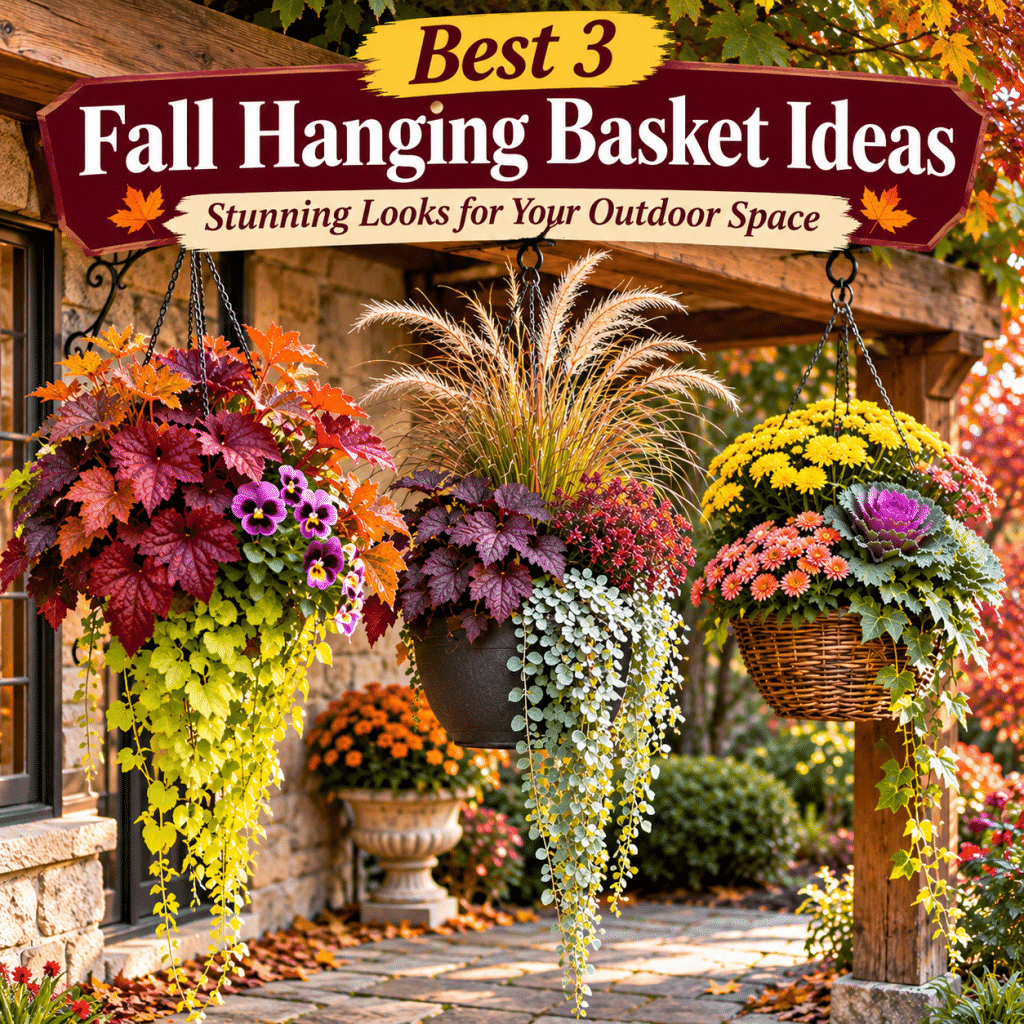
🍂 Imagine walking toward your front door beneath a spectacular arrangement of copper-colored leaves, delicate burgundy flowers, and soft golden vines cascading from an elegant hanging basket. The surrounding landscape might already be fading into winter, but your suspended autumn garden continues to create warmth, movement, and visual interest.
The secret to creating exceptional fall hanging baskets is not simply choosing seasonal flowers. It involves understanding how colors interact, how plants grow at different heights, and how carefully selected textures can make a relatively small arrangement feel luxurious.
Instead of repeating conventional flower combinations, three extraordinary design approaches stand out for their distinctive personalities. The first embraces a romantic woodland atmosphere, the second explores sophisticated architectural contrasts, and the third creates an enchanting autumn display that gradually changes as the season progresses.
Each concept offers a different way to celebrate fall through beautiful suspended planting arrangements. Whether your outdoor space features rustic wooden architecture, contemporary garden furniture, or a cozy cottage-inspired entrance, these creative designs can introduce an entirely new dimension to seasonal decorating.
🍁 Why Fall Hanging Basket Ideas Are Becoming an Essential Part of Beautiful Autumn Gardens
Autumn landscapes possess a special charm that no other season can completely reproduce. Golden sunlight becomes softer, leaves develop extraordinary colors, and cooler temperatures invite a more intimate relationship with outdoor spaces.
However, many traditional autumn arrangements concentrate visual interest near the ground. Pumpkins gather beside doorsteps, containers line pathways, and decorative branches stand in large planters.
Hanging baskets introduce an overlooked design opportunity by filling the space between ground-level decorations and architectural features.
A carefully positioned basket can soften the appearance of a porch ceiling, frame a window, accentuate a pergola, or create a welcoming atmosphere around an otherwise ordinary entrance.
The suspended position also allows trailing plants to perform beautifully. Instead of spreading across the soil, their stems descend naturally and create decorative movement.
In autumn, this effect becomes particularly attractive when bronze foliage, burgundy flowers, silver leaves, and warm golden textures appear together.
The Secret to Making Fall Hanging Baskets Look More Expensive
The most luxurious arrangements rarely contain the greatest number of plants.
Instead, they rely on thoughtful proportions, restrained color palettes, and carefully chosen botanical contrasts.
A basket overflowing with six competing flower colors can appear crowded, while one featuring three complementary tones often looks considerably more sophisticated.
Consider combining deep burgundy, muted copper, and soft golden green. These colors echo the natural transformation of deciduous trees without creating an overwhelmingly bright arrangement.
Another effective combination includes plum-purple foliage, silvery trailing leaves, and delicate ivory flowers.
The visual impact comes from the relationship between individual elements rather than the expense of the plants themselves.
Texture plays an equally important role. Large rounded leaves create a sense of stability, narrow grass blades introduce movement, and trailing stems establish graceful vertical lines.
The basket material should complement these features.
Dark metal frames provide architectural definition, woven coconut-fiber liners create rustic softness, and weather-resistant containers in subdued colors can make the plants appear especially vibrant.
A well-composed arrangement should feel intentional from every viewing angle.
🥇 Best 1 Fall Hanging Basket Ideas With an Enchanted Woodland Cascade and Romantic Autumn Colors
The first design transforms a traditional hanging basket into a miniature autumn woodland.
Rather than creating a conventional dome of colorful flowers, this arrangement imitates the natural layers of a forest floor, bringing together richly colored foliage, delicate flowering plants, and flowing botanical textures.
The result is romantic, atmospheric, and visually captivating.
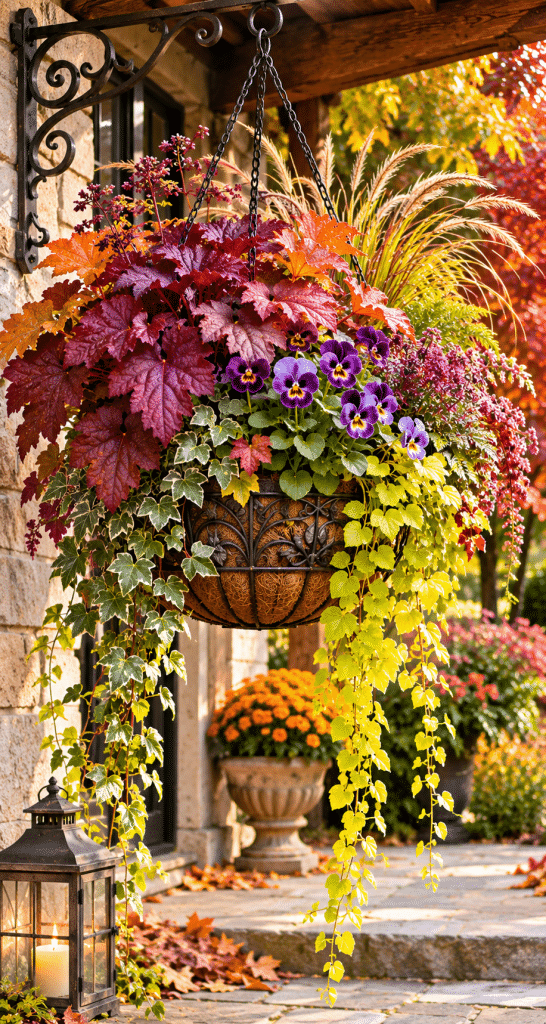
Imagine a generously proportioned hanging basket suspended beneath an old wooden porch beam. Deep burgundy leaves form the central attraction, while golden-green vines descend around the edges. Small violet flowers appear between the foliage, adding softness without competing with the dramatic autumn colors.
This approach is particularly effective in cottage gardens, woodland-inspired patios, rustic outdoor seating areas, and entrances surrounded by mature trees.
🍂 Create a Dramatic Woodland Centerpiece With Burgundy Foliage
The foundation of this arrangement is a striking foliage plant that provides both volume and color.
Heuchera, commonly known as coral bells, offers particularly attractive possibilities.
Cultivars with deep purple, bronze, amber, or caramel-colored leaves can become the visual centerpiece of a suspended arrangement.
Unlike flowers that depend on continuous blooming, colorful foliage contributes decorative interest throughout much of the season.
A compact heuchera with richly colored leaves provides a beautiful contrast against trailing golden foliage.
Choose a variety with a mature size appropriate for the basket, since some coral bells eventually develop substantial crowns.
Position the heuchera slightly behind the center when the basket is viewed primarily from one direction, or nearer the middle when it will be visible from several angles.
This subtle positioning technique allows surrounding plants to create a layered composition without hiding the centerpiece.
Another possibility is a compact ornamental kale variety with purple or cream-colored central leaves.
Although kale creates a more sculptural appearance than heuchera, its dense rosette can be highly attractive during cooler weather.
For a genuinely woodland-inspired effect, however, the softer leaf shapes and warm colors of coral bells usually feel more natural.
🌿 Add Cascading Golden Vines for a Magical Forest Effect
The next element introduces movement.
Trailing plants are essential because they distinguish a hanging basket from a conventional flower container.
Golden creeping Jenny, botanically known as Lysimachia nummularia ‘Aurea’, can produce beautiful curtains of small, rounded leaves.
Its chartreuse and golden tones contrast wonderfully with burgundy foliage.
Place compact plants near the outer rim, allowing their stems to extend naturally beyond the basket as they grow.
The resulting visual effect resembles golden woodland vines spilling over a moss-covered bank.
However, creeping Jenny can spread aggressively in some regions. Its use is best limited to responsibly maintained containers where escaping stems can be controlled, and it should be avoided where it is considered invasive.
Variegated English ivy offers another trailing option in regions where it is suitable and permitted, although English ivy is invasive in many areas and should not be allowed to establish outside the basket.
A safer approach in regions with ivy restrictions is to select a locally appropriate trailing plant with similar color and growth characteristics.
For a softer silver accent, consider Dichondra argentea ‘Silver Falls’ in mild autumn climates.
Its delicate rounded leaves create beautiful silvery strands, although it is frost-tender and should not be relied upon for prolonged freezing weather.
The most interesting woodland baskets use trailing plants with different lengths rather than cutting every stem into an identical shape.
This produces a natural, slightly irregular silhouette reminiscent of vegetation growing along a forest hillside.
💜 Introduce Delicate Autumn Flowers Between the Foliage
Flowers should support the woodland atmosphere rather than dominate it.
Small-flowered violas are excellent candidates for cool-season hanging baskets.
Their delicate blooms provide charming accents between larger leaves and trailing stems.
Choose violet, soft lavender, cream, or muted yellow varieties to preserve a natural autumn palette.
Deep purple violas can create a particularly sophisticated relationship with copper-colored heuchera.
Another attractive option is a compact fall-flowering aster suited to container cultivation.
Asters introduce a delightful meadow-like character through their small, daisy-shaped flowers.
However, their mature size varies considerably, so select compact varieties rather than large landscape cultivars.
For warmer climates where autumn temperatures remain moderate, trailing diascia can offer a beautiful cloud of small flowers in coral, pink, or peach.
The important principle is restraint.
Instead of adding every attractive fall flower available at the nursery, choose one flowering variety and allow foliage textures to create most of the composition.
🍃 Give the Woodland Basket an Authentic Natural Finish
The final details should make the basket appear as though it belongs naturally within the surrounding landscape.
A dark wire frame lined with coconut fiber provides an excellent foundation.
Small areas of preserved decorative moss can be tucked into visible spaces near the rim, provided the moss is sourced responsibly and does not obstruct drainage.
Weather-resistant decorative twigs can also introduce subtle woodland character.
Use only a few lightweight branches, securely anchored so they cannot fall or unbalance the arrangement.
Avoid attaching heavy pinecones, stones, or oversized decorative objects to a basket suspended above walking areas.
The plants themselves should remain the main attraction.
A particularly beautiful finishing technique is to allow one trailing plant to descend farther than the others.
This creates a dramatic botanical focal point that feels elegant rather than artificial.
✨ Where This Romantic Fall Hanging Basket Looks Most Beautiful
Woodland-inspired baskets are especially effective beneath rustic wooden structures.
A covered porch with exposed beams provides a perfect architectural backdrop.
The rich colors also look beautiful against natural stone, aged brick, weathered timber, and dark painted exterior walls.
For a cohesive appearance, position two baskets at slightly different heights near an outdoor seating area.
Their irregular trailing foliage will create an inviting canopy without making the space feel overly formal.
In smaller gardens, one generously planted basket can become a striking standalone feature.
The most important consideration is lighting.
Many heucheras prefer partial shade, although tolerance varies by cultivar and climate. Violas appreciate cooler conditions and sufficient light for flowering.
Choose plant varieties whose light requirements overlap, and avoid placing a shade-oriented combination in intense afternoon sunshine.
The final result should resemble a small piece of enchanted autumn woodland suspended in the air.
🥈 Best 2 Fall Hanging Basket Ideas With Modern Architectural Foliage and Sophisticated Autumn Contrast
The second design takes autumn hanging baskets in an entirely different direction.
Instead of romantic abundance, it emphasizes sculptural shapes, controlled movement, and refined color contrast.
This concept is inspired by contemporary garden architecture, minimalist European landscape design, and the understated beauty of ornamental foliage.
The arrangement should look almost like a living botanical sculpture.
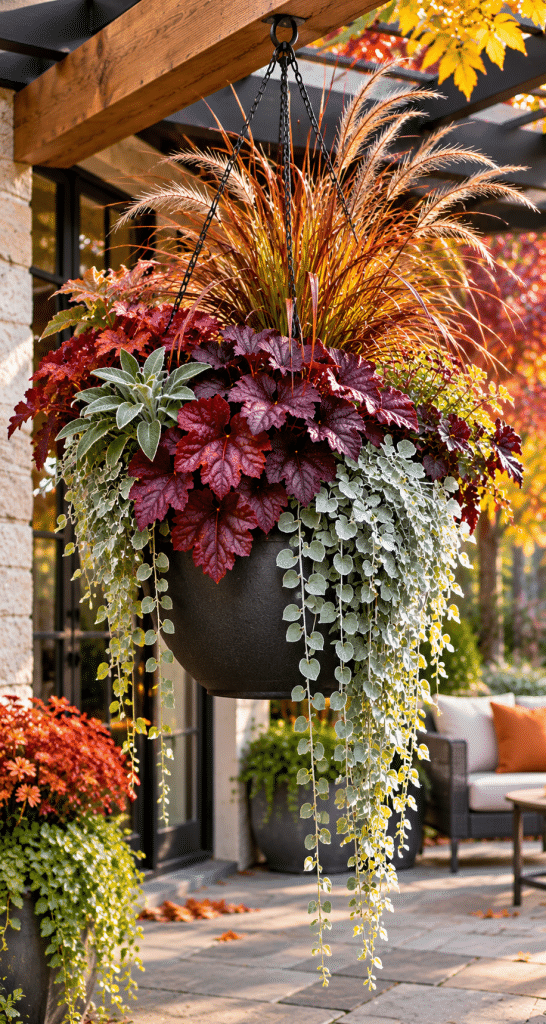
Imagine a matte charcoal hanging container filled with narrow copper-colored grass blades, compact burgundy foliage, and elegant silver trails.
There are few flowers, if any.
Every plant has a specific visual function, creating a sophisticated arrangement that complements modern outdoor spaces.
This style is particularly well suited to contemporary homes, minimalist patios, urban balconies, and outdoor spaces featuring concrete, black steel, or natural stone.
🪴 Build the Arrangement Around a Sculptural Ornamental Grass
The centerpiece of this design is an appropriately sized ornamental grass or sedge.
Compact carex varieties are especially interesting because they introduce fine linear foliage without overwhelming smaller containers.
Some cultivars offer bronze, copper, olive, or warm golden coloring that complements autumn beautifully.
Their arching leaves create dynamic lines that contrast with the rounded shape of a hanging basket.
Choose a compact cultivar with a mature spread suited to the container.
Avoid using large ornamental grasses that will eventually exceed the basket’s root space or produce excessive weight.
Position the grass centrally or slightly off-center depending on the desired appearance.
A centered placement produces symmetry and stability.
An off-center placement creates a more artistic composition, particularly when combined with longer trailing foliage on the opposite side.
The architectural quality comes from allowing each plant to retain its distinctive growth habit.
Avoid excessive pruning that forces the grass into an unnatural shape.
🖤 Combine Burgundy Leaves With Metallic Silver Accents
Once the grass establishes the central structure, introduce contrasting foliage.
A compact dark-leaved heuchera can provide a dramatic foundation.
Its broad leaves offer visual weight beneath the narrow ornamental grass blades.
The relationship between fine and broad textures is what makes this combination so attractive.
For another architectural accent, consider a compact ornamental cabbage or kale.
Its symmetrical rosette introduces a striking geometric shape, particularly when viewed from slightly above or from a nearby upper-level window.
Silvery foliage can then complete the composition.
In climates without early frost, Dichondra ‘Silver Falls’ provides graceful trailing movement and an attractive metallic appearance.
For colder areas, look for locally hardy trailing or evergreen alternatives that tolerate the intended exposure.
The goal is to create contrast using form and foliage rather than relying entirely on brightly colored flowers.
A simple palette of charcoal, copper, burgundy, and silver can feel surprisingly luxurious.
🌾 Design a Balanced Arrangement With Three Distinct Plant Shapes
One of the most effective techniques in contemporary planting design is combining three different growth forms.
The first is an upright or arching centerpiece.
The second is a compact, rounded plant that creates visual mass.
The third is a trailing plant that extends beyond the container.
Together, these shapes produce movement while maintaining clear structure.
For example, a compact bronze carex might rise gently above a dark-leaved coral bell, while a silvery trailing plant descends from the outer edge.
Each element remains visually distinguishable.
This approach avoids the crowded appearance that can occur when several plants with similar growth habits compete for attention.
The spacing between plants is equally important.
Young plants may initially appear separated, but their mature dimensions should guide the planting design.
A hanging basket that feels slightly restrained immediately after planting often becomes beautifully balanced as the plants establish.
🏡 Choose a Basket That Enhances Contemporary Garden Architecture
Container selection is particularly important for this design.
A traditional woven basket can create a rustic appearance that conflicts with the architectural planting style.
Instead, consider a lightweight, weather-resistant hanging planter with a matte charcoal, warm gray, or muted bronze finish.
Simple geometric shapes work particularly well.
Round containers introduce a soft contrast to angular building features, while subtly faceted designs can echo contemporary architecture.
The hanging chains or cables should appear visually discreet and must be rated for the fully watered basket’s weight.
A black metal support can blend effectively with a dark container.
If the arrangement is suspended beneath a modern pergola, position it where the foliage can be appreciated against a relatively uncluttered background.
Avoid hanging it directly in front of heavily patterned walls or dense shrubbery.
The clean architectural aesthetic depends on giving the plants enough visual space.
🌤️ Use Autumn Light to Reveal Beautiful Foliage Textures
Autumn sunlight can dramatically change the appearance of this arrangement throughout the day.
Low-angle morning light highlights the delicate edges of ornamental grasses.
Soft afternoon light can intensify the warm tones of bronze and burgundy foliage.
Silver leaves often appear particularly luminous when illuminated from the side.
Position the basket where natural light enhances these qualities without exposing sensitive plants to unsuitable conditions.
Some bronze sedges prefer partial shade, while other ornamental plants perform best in brighter locations.
It is important to match the selected cultivars rather than assuming all decorative foliage plants have identical requirements.
A sheltered location can also prevent excessive wind from damaging delicate trailing stems.
For maximum visual impact, hang the basket where its contrasting shapes are visible from a comfortable viewing distance.
The arrangement should resemble a carefully composed piece of contemporary garden art.
✨ Why This Minimalist Design Can Stay Attractive Longer
Flower-heavy baskets depend on healthy blossoms for much of their appearance.
When temperatures fall, flowering may slow or stop.
Foliage-centered arrangements offer a different advantage.
Their primary beauty comes from leaf color, texture, and plant structure.
With appropriately hardy plants, they can continue to provide decorative interest even when few flowers remain.
This does not mean every foliage plant will survive winter.
Some silver trailers and ornamental varieties are sensitive to freezing temperatures, and their suitability depends on climate.
However, a carefully selected combination of hardy sedges, evergreen accents, and colorful foliage plants can provide a longer-lasting seasonal display than a basket composed entirely of tender summer annuals.
The architectural design also ages gracefully.
As plants grow, their natural forms often become more expressive without requiring a perfectly symmetrical silhouette.
For homeowners who appreciate understated outdoor elegance, this is a particularly appealing autumn arrangement.
🥉 Best 3 Fall Hanging Basket Ideas With a Changing Autumn Color Story and Magical Seasonal Layers
The third design is based on a fascinating idea: a hanging basket that changes its appearance as autumn progresses.
Instead of creating one static arrangement, this approach combines plants with different seasonal strengths.
Early autumn flowers establish the initial color palette.
As temperatures cool, ornamental foliage becomes increasingly important.
Later in the season, evergreen elements maintain structure while selected cool-weather flowers continue providing color when conditions allow.
The effect is a suspended garden that tells a visual story through the changing season.
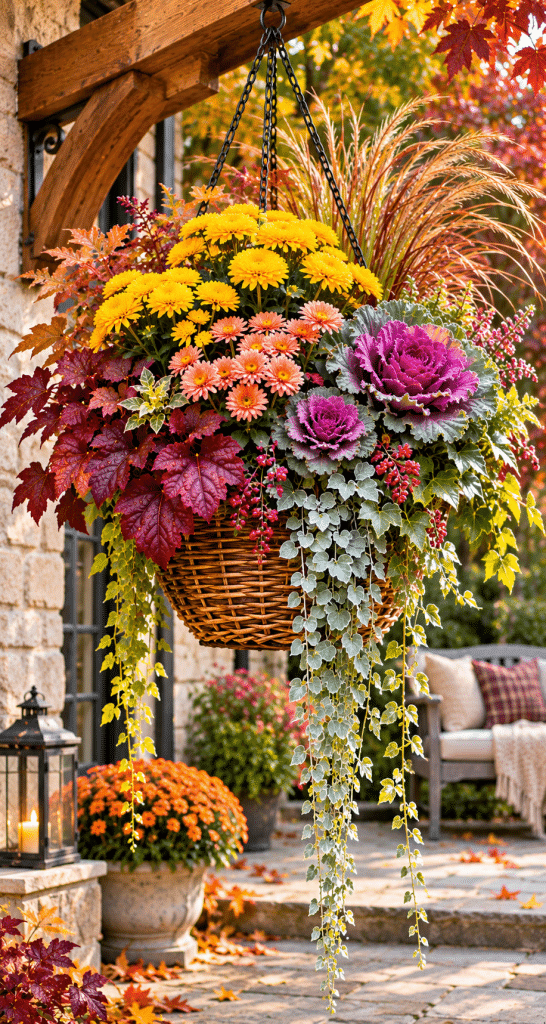
Imagine a basket that begins with warm peach and golden flowers, gradually emphasizes burgundy and purple foliage, and eventually reveals an elegant combination of deep green leaves, cream-colored blooms, and silvery trailing stems.
The transformation is not a dramatic overnight change.
It occurs naturally as plants respond to seasonal conditions and as individual components are refreshed when necessary.
This concept is ideal for gardeners who enjoy observing seasonal transitions and maintaining decorative arrangements over several months.
🌻 Begin With Warm Early Autumn Flowers
The first stage celebrates the remaining warmth of early fall.
Compact chrysanthemums can introduce classic autumn colors, including copper, bronze, gold, rust, and deep red.
Although mums are frequently used in ground-level displays, smaller cultivars can also become attractive hanging-basket accents.
Select compact plants that fit comfortably within the container.
Large florist mums may be too bulky for mixed hanging arrangements, especially when combined with multiple additional plants.
Warm-colored violas offer another possibility.
Yellow, orange, bronze, and cream varieties contribute delicate blooms while allowing the basket to retain a natural appearance.
In mild climates, trailing diascia may add soft peach or coral flowers.
The objective is to establish a warm palette without filling every available space with short-lived blooms.
Allow room for the foliage that will become increasingly prominent later in the season.
A combination of one compact flowering centerpiece, one foliage accent, and one trailing plant can provide a strong starting point.
🍁 Create a Beautiful Transition With Colorful Ornamental Foliage
The second stage emphasizes leaves rather than flowers.
Ornamental kale is particularly interesting because its central coloring often becomes more vivid as temperatures cool.
Depending on the variety, its leaves may develop purple, rose, cream, or white tones.
This seasonal response makes kale a natural candidate for an autumn arrangement designed around changing color.
However, ornamental kale can grow relatively broad and heavy.
Choose compact rosette-forming cultivars and avoid overcrowding the basket.
Another effective foliage plant is heuchera.
Depending on the cultivar, its foliage may display amber, caramel, deep purple, or reddish-brown tones.
These colors complement the changing appearance of ornamental kale and provide visual continuity when individual flowers begin to decline.
For a more delicate effect, introduce a small trailing plant with green or variegated foliage.
The trailing element creates a consistent silhouette while the colors above it evolve.
This is an important principle in seasonal design.
Not every component needs to change simultaneously.
A stable framework makes subtle transformations more noticeable and aesthetically pleasing.
🌲 Extend the Display With Cool Weather Greenery
As late autumn approaches, evergreen plants become especially valuable.
Compact ivy can provide year-round foliage in appropriate regions, although its invasive potential makes local restrictions and responsible containment essential.
Low-growing winter heather, Erica carnea, may also be suitable for cool-season baskets where its soil and climate requirements can be met.
Its compact evergreen growth provides texture, while suitable cultivars may produce flowers during winter or early spring.
Some small sedges retain attractive foliage through cooler months.
A hardy viola can contribute blooms during milder periods, depending on local winter conditions.
These plants introduce a quieter kind of beauty.
The dramatic warmth of early autumn gradually gives way to more restrained combinations of deep green, silver, purple, and cream.
Rather than maintaining the same bright floral appearance indefinitely, the basket becomes increasingly sculptural.
That transition reflects the natural atmosphere of the changing garden.
🧡 Introduce Subtle Decorative Details That Can Be Changed Throughout Autumn
A seasonally evolving hanging basket can also include a few carefully selected decorative accents.
Early in autumn, a lightweight artificial miniature pumpkin or weather-resistant ornament in muted copper may complement the flowers.
Later, the decoration can be replaced with a small natural-looking botanical accent.
Toward the end of the season, a simple weather-resistant ribbon or a few securely attached decorative seedhead stems can provide understated seasonal interest.
These accents should remain secondary.
Overdecorating the basket can obscure its natural beauty and make the arrangement look crowded.
Any ornament must be lightweight, stable, and safely secured.
Avoid placing loose objects where wind could dislodge them.
Natural materials should also be inspected periodically because damp autumn conditions can encourage deterioration.
The most successful seasonal arrangements do not resemble heavily decorated artificial displays.
They retain the appearance of living gardens, with subtle additions that support the changing atmosphere.
🌙 Create a Magical Evening Appearance With Carefully Positioned Lighting
One of the most captivating possibilities for this design is highlighting the basket after sunset.
A nearby outdoor-rated wall light can reveal the shapes of trailing foliage and the warm colors of autumn flowers.
Soft illumination creates delicate shadows against the surrounding wall or porch structure.
For a contemporary effect, a small outdoor-rated spotlight positioned away from the basket can illuminate the underside of cascading plants.
The light should be aimed carefully to avoid glare and excessive brightness.
Warm-white illumination generally complements autumn colors more naturally than harsh blue-toned lighting.
Electrical components must be suitable for outdoor use and protected from water exposure according to their manufacturer’s instructions.
Avoid wrapping unsuitable decorative lights directly around wet plant material or placing electrical components in constantly damp potting mix.
The most sophisticated result is subtle illumination that emphasizes the plants rather than overwhelming them.
A basket with changing foliage colors can look beautiful during the day and surprisingly atmospheric in the evening.
🌼 Best Plants for Fall Hanging Basket Ideas Compared
Choosing the right plants is essential because autumn conditions vary significantly between regions.
A basket designed for a mild coastal climate may require very different plants from one exposed to early freezing temperatures.
The following comparison highlights useful characteristics of popular seasonal plants.
| Plant | Main Visual Attraction | Preferred Light | Seasonal Considerations | Best Design |
|---|---|---|---|---|
| Heuchera | Burgundy, copper, caramel, or purple foliage | Partial shade to sun depending on cultivar and climate | Often perennial; roots need winter protection in exposed baskets | Romantic woodland and modern |
| Violas | Small flowers in purple, yellow, cream, or mixed colors | Sun to partial shade | Cool-season flowering; performance varies with winter severity | Woodland and changing seasons |
| Compact chrysanthemums | Warm bronze, gold, red, and orange blooms | Full sun | Seasonal flowering; survival depends on cultivar and protection | Changing seasons |
| Ornamental kale | Sculptural foliage with purple, pink, or cream centers | Full sun to partial shade | Color often intensifies in cool weather | Modern and changing seasons |
| Compact Carex | Fine arching leaves in green, gold, or bronze | Varies by species and cultivar | Some varieties retain foliage through winter | Modern architectural |
| Golden creeping Jenny | Trailing golden-green leaves | Sun to partial shade | Can be invasive; use only where appropriate | Romantic woodland |
| Silver Falls Dichondra | Elegant silver trailing stems | Sun to partial shade | Frost-tender | Modern and woodland in mild climates |
| Winter heather | Evergreen texture and seasonal flowers | Sun to partial shade | Needs suitable soil conditions and climate | Changing seasons |
| Diascia | Small peach, pink, or coral flowers | Sun to partial shade | Cool-weather color in suitable climates; hardiness varies | Woodland and changing seasons |
The comparison demonstrates why a successful basket requires more than simply choosing visually attractive plants.
Growth habit, root space, water requirements, sunlight, and temperature tolerance must work together.
A plant that looks beautiful beside another in a nursery display may not be suitable for sharing the same hanging basket.
For example, a moisture-loving plant may struggle beside a drought-tolerant plant if both are planted into one uniformly watered container.
Similarly, a shade-oriented foliage arrangement should not be combined with flowers that require intense sunlight to bloom reliably.
The best combinations begin with compatible growing requirements and then build their visual identity around color and texture.
🛠️ How to Build Fall Hanging Baskets That Look Professionally Designed
Even the most beautiful planting concept can disappoint if the basket is poorly constructed.
Hanging baskets are different from ordinary garden containers because they have limited soil volume, elevated exposure, and specific structural requirements.
Their position makes them particularly vulnerable to drying winds, sudden temperature changes, and uneven watering.
The construction process should therefore prioritize plant health and structural stability before decorative details.
Choose the Right Basket Size and Structure
A basket approximately 12 to 14 inches across offers enough space for a relatively simple mixed planting.
Larger baskets measuring around 16 to 18 inches can accommodate more elaborate compositions, although they also become significantly heavier when watered.
The ideal size depends on the selected plants and the available support.
A larger container does not automatically produce a better design.
In fact, a compact arrangement with carefully chosen plants often looks more elegant than an oversized basket packed with competing varieties.
Wire baskets lined with coconut fiber create excellent natural textures.
Plastic and resin hanging containers may retain moisture longer, depending on their construction.
Regardless of material, adequate drainage is essential.
Choose a container that allows excess water to escape without trapping roots in persistently saturated potting mix.
The hanging bracket, hook, ceiling attachment, and chains must all support the fully watered basket, including its mature plants and any decorative additions.
Prepare a Lightweight Growing Medium
Ordinary garden soil is usually unsuitable for hanging baskets.
It can become compacted, drain poorly, and add unnecessary weight.
A high-quality container potting mix provides a better foundation.
Look for a medium designed to maintain moisture while allowing sufficient drainage and root aeration.
Some commercial mixes contain perlite or other lightweight materials that improve their structure.
Fill the basket while leaving a small watering space below the rim.
This makes irrigation easier and reduces the likelihood of water immediately spilling over the sides.
Moisten the potting mix before planting so the roots are introduced into an evenly damp environment.
If using a coconut-fiber liner, check that the liner fits securely and retains enough mix without restricting drainage.
Arrange the Plants Before Planting
One of the easiest ways to improve a hanging basket is to experiment with the layout before removing plants from their nursery pots.
Place the selected plants inside or around the basket and observe their shapes.
Identify the primary focal point.
Then position compact supporting plants around it.
Finally, arrange trailing plants where their stems can develop naturally beyond the rim.
Rotate the basket and examine it from several angles.
A design that looks balanced from one direction may appear empty from another.
If the basket will hang against a wall, the front-facing composition can receive slightly greater emphasis.
If it will be suspended in an open pergola, a more balanced arrangement around the entire circumference is preferable.
Do not plant more specimens than the container can reasonably support.
Plants need enough root space and airflow to remain healthy as they mature.
Plant at the Correct Depth
When transferring plants from nursery containers, gently loosen excessively circling roots without unnecessarily damaging the root system.
Place each plant at approximately the same soil depth it occupied previously.
Burying the crown too deeply may encourage rot, particularly during damp autumn weather.
Fill gaps with potting mix and firm it gently around the roots.
Avoid compressing the mix excessively.
Once planting is complete, water thoroughly until excess moisture begins draining from the bottom.
Allow the basket to drain before hanging it in its final position.
The finished arrangement should look balanced, secure, and proportionate to the surrounding space.
🌧️ The Essential Autumn Care Routine for Hanging Baskets
Cooler weather often reduces water consumption compared with summer, but hanging baskets should never be assumed to stay moist simply because autumn has arrived.
Wind, sunlight, container material, plant size, and rainfall exposure all influence moisture levels.
A covered porch basket may receive very little rain even during wet weather.
Conversely, a basket exposed to repeated autumn storms may become excessively saturated if drainage is inadequate.
A consistent care routine helps preserve the beauty of each design.
💧 Water According to Soil Moisture Instead of a Fixed Schedule
Check the potting mix regularly by touching the soil beneath the surface.
If the upper layer feels dry, assess the moisture slightly deeper before deciding whether to water.
The correct frequency depends on the plants and conditions.
Newly planted baskets may need careful monitoring while roots become established.
During warm, windy early autumn days, the mix can dry more quickly than expected.
Later in the season, cooler weather may reduce watering needs substantially.
Avoid watering automatically every day without checking moisture.
Persistent saturation can damage roots, especially when temperatures are low.
Water thoroughly when necessary, then allow excess moisture to drain freely.
✂️ Remove Faded Flowers and Damaged Foliage
Regular maintenance keeps the arrangement attractive.
Remove fading blossoms from plants that benefit from deadheading, including many pansies and violas.
Trim damaged or diseased foliage promptly.
If trailing stems become excessively long or uneven, shorten them selectively rather than cutting every stem to the same length.
This preserves a natural cascading appearance.
Ornamental grasses generally require less frequent trimming during autumn.
Their fine foliage can remain decorative even when flower-heavy plants begin to decline.
For foliage-focused baskets, simply removing damaged leaves may be sufficient.
🌡️ Protect the Basket During Unexpected Frost
Autumn weather can change rapidly.
A mild afternoon may be followed by a freezing night, particularly in continental or elevated regions.
The exposed roots of hanging-basket plants can experience colder conditions than roots insulated by surrounding garden soil.
For this reason, the hardiness of a plant growing in the ground does not always predict its performance in a suspended container.
When severe cold is forecast, move portable baskets to a suitable sheltered location if possible.
Temporary protection may also help during brief cold spells, depending on the plant species and local conditions.
Do not assume that a thin covering will protect sensitive plants during prolonged freezing weather.
Choose appropriately hardy plants for regions where baskets must remain outdoors through winter.
🌿 Important Note: Always match the plants to the actual temperature, sunlight, and moisture conditions of the hanging location. A beautiful combination will not remain healthy if its plants have incompatible growing requirements, and hanging containers can expose roots to greater cold and drying stress than plants growing in the ground.
🌱 Feed Carefully as Growth Slows
Autumn plants generally require less fertilizer as growth slows.
Excessive feeding can encourage tender growth that may be vulnerable to cold.
If the potting mix already contains slow-release fertilizer, additional feeding may not be necessary immediately.
For actively flowering baskets, use an appropriate fertilizer according to the product instructions and the plants’ needs.
Avoid applying strong fertilizer solutions to dry or stressed roots.
As temperatures become colder and active growth declines, reduce feeding accordingly.
The objective is to support healthy plants rather than force rapid growth during a season when many species are naturally slowing down.
🎨 How to Choose the Perfect Fall Hanging Basket Color Palette
Color coordination can completely change the atmosphere of an outdoor arrangement.
The same basket shape may look rustic, romantic, contemporary, or dramatic depending on the selected tones.
Three palettes work particularly well with the featured designs.
Romantic Copper and Burgundy
This combination emphasizes deep red-purple foliage, soft copper leaves, and golden-green trailing plants.
It creates warmth and a slightly mysterious atmosphere.
The palette is especially attractive against brick, dark wood, and weathered stone.
Choose restrained purple flowers to add depth without introducing too many unrelated colors.
Modern Silver and Bronze
This palette pairs metallic silver foliage with warm bronze grasses and dark burgundy accents.
It is particularly beautiful against black, gray, cream, or white exterior walls.
The restrained colors allow unusual leaf shapes to become the main attraction.
This combination suits contemporary architectural spaces where excessive floral decoration might feel out of place.
Soft Gold and Plum
Golden violas, plum-colored foliage, and evergreen accents create a welcoming seasonal atmosphere.
The colors feel cheerful without becoming overly bright.
This combination works well on traditional porches, balconies, and smaller garden entrances.
It also creates a natural transition toward the cooler colors of late autumn.
🏡 The Best Places to Hang Autumn Baskets for Maximum Visual Impact
Placement is just as important as plant selection.
A spectacular arrangement positioned in the wrong location may receive little attention or struggle to grow.
The best position combines suitable growing conditions with an attractive architectural backdrop.
Frame the Front Porch Without Overcrowding the Entrance
A pair of hanging baskets can create an elegant entrance.
Position them symmetrically when the architecture is formal, or use one basket as an asymmetrical accent when the entrance is smaller.
Choose plants whose mature trailing length will not obstruct the doorway, lighting fixtures, or walking area.
A rich woodland arrangement can soften a traditional porch.
A sculptural grass-centered basket may provide a more appropriate accent for a contemporary entrance.
The hanging height should allow people to pass safely beneath the basket while keeping the plants visible.
Create a Vertical Garden on a Small Balcony
Hanging baskets are particularly useful in outdoor spaces with limited floor area.
They introduce greenery without occupying the space needed for seating or movement.
A small balcony can accommodate one or two thoughtfully positioned baskets that provide far more visual interest than their footprint suggests.
Choose lightweight containers and avoid allowing water to drip onto neighboring properties or pedestrian areas.
If the balcony is exposed to strong wind, use suitable supports and plants with sturdy growth habits.
Check building rules and structural restrictions before installing brackets or suspending substantial weights.
Add Botanical Drama to a Pergola
Pergolas offer exciting opportunities for displaying autumn baskets.
Their overhead structure creates a natural framework for suspended greenery.
A basket placed near a seating area can soften architectural lines and make the space feel more intimate.
However, avoid positioning large, heavy baskets directly above frequently occupied seating without properly engineered and secure supports.
Consider the relationship between hanging plants and climbing vegetation already growing on the pergola.
If the structure is covered with dense foliage, a contrasting basket may be more effective than one that disappears into the surrounding greenery.
A silver-and-bronze architectural arrangement can provide beautiful definition against dark climbing plants.
Highlight a Quiet Garden Corner
Not every hanging basket needs to decorate the main entrance.
A secluded corner can become more inviting with a suspended seasonal arrangement.
Hang a basket from a sturdy garden structure near a bench, provided the support is appropriate and installation is secure.
The trailing foliage can create a gentle visual connection between overhead branches and lower-growing plants.
This arrangement works particularly well with the romantic woodland concept.
It introduces a focal point without requiring major landscaping changes.
🍃 Common Fall Hanging Basket Mistakes That Can Ruin a Beautiful Arrangement
Even experienced gardeners occasionally encounter problems with seasonal hanging baskets.
Most difficulties are related to overcrowding, unsuitable plant combinations, inconsistent watering, or poor placement.
Understanding these mistakes can help an arrangement remain attractive for longer.
Choosing Plants Only Because Their Colors Match
Color coordination is important, but horticultural compatibility matters more.
Two plants may look spectacular together while requiring very different growing conditions.
A moisture-loving plant may struggle when paired with a drought-tolerant species.
Similarly, a sun-loving flowering plant may perform poorly beside a foliage plant that needs substantial shade.
Select plants with compatible requirements first.
Then develop the color palette using varieties that can grow successfully together.
Overfilling the Basket Immediately
A densely planted basket can look impressive on the day it is created.
However, overcrowded roots compete for moisture, nutrients, and available space.
Poor airflow may also contribute to plant health problems.
Use the mature size of each plant as a guide rather than choosing quantities based only on its nursery appearance.
Allowing some room for growth helps the arrangement develop naturally.
Ignoring the Weight of Wet Soil
A basket becomes significantly heavier after watering.
Large plants, saturated growing medium, and decorative accessories can add substantial weight.
Use appropriately rated brackets and fasteners installed into a suitable structural support.
Do not rely on lightweight decorative hooks for heavy planted containers.
Inspect chains, attachment points, and basket frames periodically for corrosion or damage.
Using Summer Plants Without Considering Frost
Some beautiful trailing plants continue performing during mild autumn weather but decline rapidly after freezing temperatures.
This is particularly relevant for tender species used for silver foliage or late-season flowers.
If the arrangement needs to survive into winter, select species with suitable cold tolerance.
Otherwise, treat tender plants as seasonal accents that may need replacement.
Planning for this transition from the beginning prevents disappointment.
Neglecting the View From Below
Hanging baskets are often seen from underneath rather than from directly above.
An arrangement that looks impressive on a planting table may appear sparse after being suspended.
Position trailing plants around visible edges and allow foliage to soften the container.
For baskets that will be viewed from below, emphasize cascading growth rather than relying entirely on low-growing flowers hidden within the upper surface.
This small design adjustment can significantly improve the finished appearance.
💰 How to Create Beautiful Fall Hanging Baskets Without Spending Too Much
A luxurious autumn basket does not require expensive plants or elaborate decorations.
A limited budget can produce an outstanding result when the design emphasizes a strong centerpiece and carefully selected supporting elements.
Begin by reusing a structurally sound hanging basket from a previous season.
Clean the container before filling it with fresh potting mix.
If the liner has deteriorated, replace it rather than purchasing an entirely new basket.
Choose one distinctive focal plant.
A richly colored heuchera, compact ornamental grass, or seasonal kale can provide the main visual attraction.
Add a small number of compatible supporting plants.
Instead of buying several different flower varieties, use one repeating color to create consistency.
Trailing foliage can provide much of the decorative impact.
If suitable plants are already growing in your garden, division or propagation may be possible depending on the species and season.
Use only healthy, legally propagated plants, and avoid transferring pests or diseases into the new container.
Another cost-saving strategy is to prioritize foliage perennials that can later be transferred into an appropriate garden location.
This gives some plants a potential role beyond their temporary seasonal display.
However, survival after transplanting will depend on the plant, climate, and growing conditions.
The most attractive baskets are not necessarily the most expensive.
They are the arrangements that make each chosen element feel essential.
🍂 How to Keep the Autumn Look Beautiful as Winter Approaches
A hanging basket designed for autumn does not need to disappear immediately when colder weather arrives.
Its appearance can evolve as the season changes.
Begin by removing exhausted annual flowers and checking the remaining plants for health.
Healthy hardy foliage plants may continue providing structure.
Where appropriate, replace declining seasonal flowers with compact cool-weather plants that share compatible soil and light requirements.
Small violas, suitable winter heathers, and hardy evergreen accents may provide additional interest in climates where they can survive.
Avoid repeatedly disturbing the roots of established plants unless replacements are necessary.
A basket that has developed a strong root system may be better maintained through selective trimming and limited changes.
In regions with severe winters, moving tender arrangements into protected conditions or dismantling them before prolonged freezing may be the more practical option.
Winter care should reflect local climate rather than following one universal schedule.
A successful seasonal transition maintains the overall design identity while allowing the planting to respond naturally to changing weather.
The romantic woodland basket might become quieter and more foliage-focused.
The architectural arrangement may retain its sculptural shape.
The changing-season design can gradually exchange warm flowers for evergreen textures and restrained winter colors.
Each approach offers its own interpretation of the transition from autumn abundance to winter simplicity.
❓ Frequently Asked Questions About Fall Hanging Basket Ideas
What Flowers Are Best for Fall Hanging Baskets?
Pansies, violas, compact chrysanthemums, suitable snapdragons, and diascia are attractive possibilities for fall hanging baskets.
The best choice depends on climate, sunlight, and the expected duration of the display.
In cooler regions, pansies and violas are particularly useful because many varieties tolerate relatively low temperatures.
Compact chrysanthemums offer rich seasonal color but may have a shorter flowering period.
For a balanced arrangement, combine flowers with foliage plants rather than relying entirely on blooms.
Can Hanging Baskets Survive Frost?
Some hanging baskets can withstand light frost when planted with appropriately hardy species.
However, cold tolerance varies considerably among plants.
The elevated position of hanging containers also makes roots more vulnerable to temperature fluctuations.
A plant that survives winter in a garden bed may require additional protection when grown in a hanging basket.
Severe or prolonged freezing can damage even relatively hardy container plants.
How Many Plants Should Go Into a Fall Hanging Basket?
Plant quantity depends on container diameter and the mature size of the selected species.
A 12- to 14-inch basket commonly accommodates around three to five appropriately sized plants.
Larger baskets may accommodate more, but vigorous species require additional space.
For a sophisticated design, fewer plants with contrasting shapes can be more effective than a crowded mixture.
Are Mums Good for Autumn Hanging Baskets?
Yes, compact chrysanthemums can create beautiful fall hanging baskets.
Their rich colors are particularly suitable for traditional autumn palettes.
Choose smaller cultivars that fit comfortably within the available root space.
Mums generally perform best with adequate sunlight and consistent moisture.
Their flowering period depends on the cultivar and growing conditions, so combining them with attractive foliage can help maintain visual interest after blooms fade.
What Are the Best Trailing Plants for Autumn Hanging Baskets?
Potential choices include golden creeping Jenny, suitable ivy varieties, and silver dichondra.
However, creeping Jenny and English ivy are invasive in some regions and should be avoided where they pose environmental risks.
Silver dichondra is attractive in mild conditions but is sensitive to frost.
Choose locally appropriate trailing species that match the basket’s light, temperature, and moisture requirements.
How Often Should Fall Hanging Baskets Be Watered?
There is no single watering schedule suitable for every basket.
Water needs depend on weather, plant type, basket material, and exposure.
Check the potting mix regularly rather than watering automatically.
When watering is needed, apply enough water to moisten the root zone and allow excess moisture to drain.
Reduce watering as growth slows and temperatures decline, while continuing to prevent damaging drought stress.
Can Fall Hanging Baskets Be Used in Shady Areas?
Yes, provided the plants are selected for the available light.
Heuchera and certain sedges can be attractive components in partly shaded locations.
Some violas may also perform well with partial shade.
Deep shade presents greater challenges for flowering plants, so foliage-centered arrangements may be more effective.
Always check the requirements of individual varieties.
What Makes Fall Hanging Baskets Look Professionally Designed?
Professional-looking arrangements usually rely on clear focal points, compatible plant selections, thoughtful proportions, and controlled color palettes.
Combining different plant forms is particularly effective.
Use an upright or arching centerpiece, a compact supporting plant, and trailing foliage to create depth and movement.
Choose a basket material that complements the architecture, and avoid adding too many decorative accessories.
A strong design should remain attractive even when viewed from several different angles.
🌟 Final Thoughts on the Best 3 Fall Hanging Basket Ideas
Beautiful fall hanging baskets offer far more than a convenient place to display seasonal flowers.
They create an opportunity to bring the colors, textures, and atmosphere of autumn into an entirely different dimension of outdoor design.
The Enchanted Woodland Cascade is ideal for anyone who loves romantic garden styling, dramatic burgundy leaves, golden trailing foliage, and the natural beauty of a forest-inspired composition.
The Modern Architectural Foliage arrangement offers a more contemporary interpretation, combining ornamental grasses, sculptural leaves, and understated metallic colors to create a sophisticated living statement.
The Changing Autumn Color Story celebrates the progression of the season itself, allowing flowers, foliage, and evergreen elements to create a display that gradually develops a new personality as colder weather approaches.
All three designs demonstrate that an unforgettable hanging basket does not depend on excessive decoration or an overwhelming number of plants.
Instead, the most beautiful results come from thoughtful combinations, harmonious colors, healthy growing conditions, and an appreciation for the natural forms of individual plants.
🍁 Whether suspended beside a welcoming front door, beneath an elegant pergola, or above a peaceful garden corner, a carefully designed autumn hanging basket can transform an overlooked space into something truly extraordinary.
With the right plants and a little creative imagination, even one hanging basket can capture the richness of fall and make an outdoor space feel warmer, more beautiful, and wonderfully inviting.