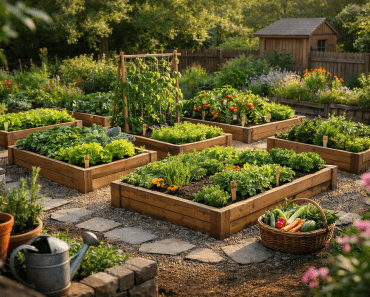
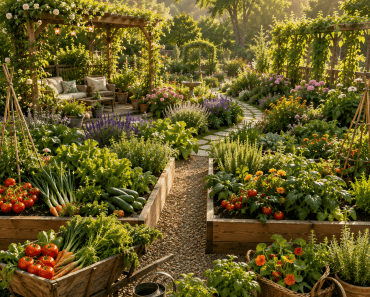
A Garden Weasel might look like a simple gardening tool, but using it correctly can change the way you prepare soil, control young weeds, and maintain your vegetable beds throughout the growing season. Instead of spending hours breaking up surface clumps with a traditional hoe or repeatedly bending over to cultivate small garden spaces, this clever rotary cultivator offers a practical way to make everyday vegetable gardening more manageable. 🌱
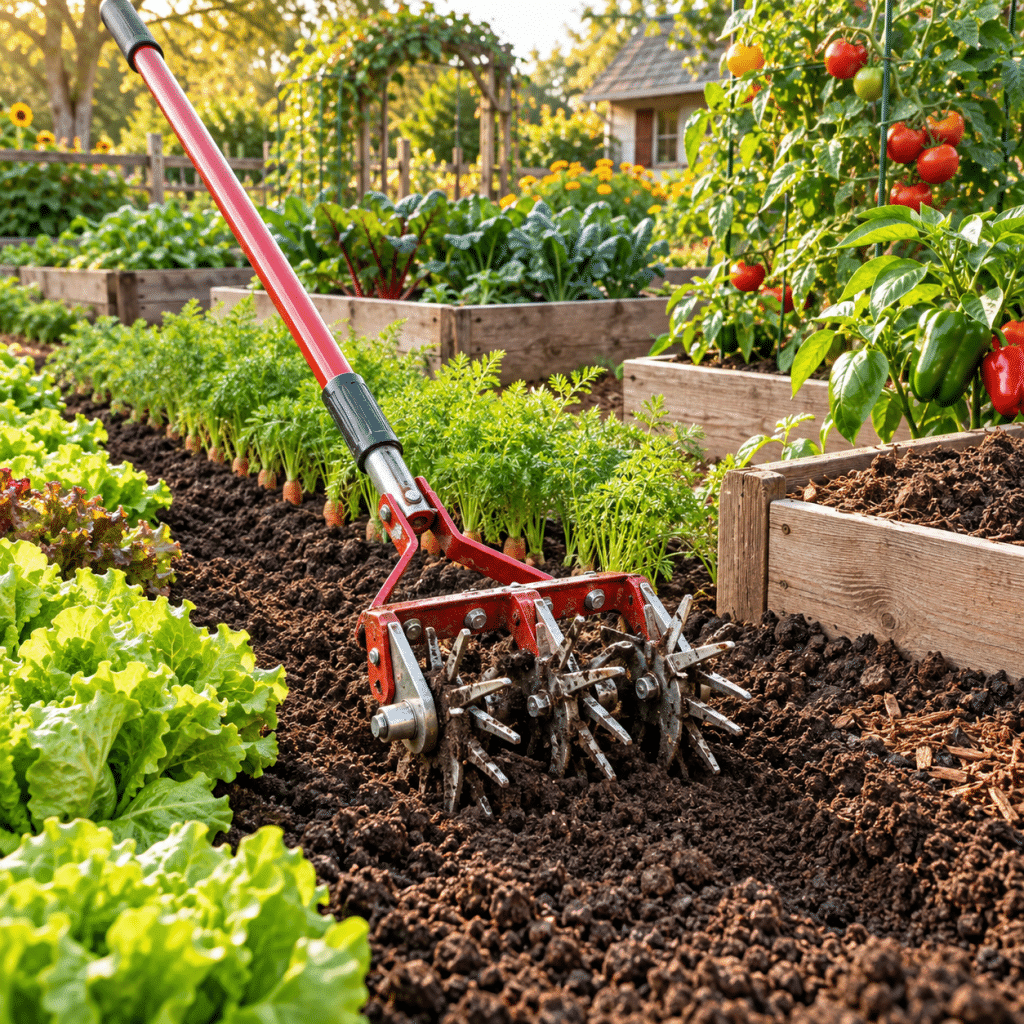
For gardeners who love growing fresh tomatoes, peppers, carrots, lettuce, beans, and other homegrown vegetables, maintaining workable soil is an essential part of creating a productive growing environment. However, healthy vegetable gardening involves more than simply planting seeds and watering them occasionally. Soil structure, weed competition, organic matter, and careful cultivation all influence how successfully vegetables develop.
That is where a Garden Weasel becomes particularly useful.
With its rotating metal tines, this manual cultivator can loosen the upper soil layer, disturb newly emerging weeds, and help incorporate suitable amendments into prepared garden beds. Its long handle also makes many routine tasks possible from a standing position.
The most interesting advantage is its versatility. One tool can perform several important gardening jobs without requiring electricity, gasoline, or complicated equipment.
However, the real secret is understanding when to use it, how deeply to cultivate, and when leaving the soil undisturbed is the better choice.
These Best 3 Ways to Use a Garden Weasel focus on practical vegetable garden applications that can help beginners and experienced gardeners maintain attractive, organized, and productive growing spaces.
🌿 What Is a Garden Weasel and Why Is It Useful for Vegetable Gardening
A Garden Weasel is a gardening tool brand known for manual soil cultivators, including rotary models equipped with rotating metal wheels or tines.
Unlike a traditional garden hoe that slices or scrapes across the soil surface, the original rotary Garden Weasel uses rolling cultivation. As the gardener moves the tool across suitable soil, the rotating tines disturb the surface and break apart smaller soil clumps.
This movement makes it useful for several routine vegetable gardening activities.
The original rotary model features three removable or interchangeable tine wheels that allow the working width to be adjusted for different areas. This is helpful when moving between open planting beds and narrower spaces that require greater control.
Its long handle also provides an ergonomic advantage because gardeners can work upright instead of constantly crouching or kneeling.
For someone maintaining multiple vegetable beds, this convenience can make short gardening sessions more comfortable.
However, it is important to understand that a rotary Garden Weasel is primarily a cultivation tool, not a replacement for every type of soil preparation equipment.
It works particularly well on reasonably workable soil that has already been established as a growing bed.
Extremely compacted ground, thick roots, large rocks, and dense perennial weed infestations may require other tools or a different preparation method.
Used appropriately, the Garden Weasel becomes a valuable addition to a vegetable gardener’s collection of everyday equipment.
🥕 Quick Comparison of the Best 3 Garden Weasel Uses
| Garden Weasel Technique | Best Time to Use | Main Benefit | Ideal Garden Situation |
|---|---|---|---|
| 🥇 Prepare Fine Seedbeds | Before sowing seeds | Breaks surface clumps and creates a workable planting surface | Carrots, lettuce, radishes, spinach |
| 🥈 Control Young Weeds | When weeds are small | Disturbs shallow weed seedlings before they become established | Vegetable rows and open bed spaces |
| 🥉 Incorporate Compost | Before planting or between crops | Helps mix suitable organic amendments into the upper soil layer | Established vegetable beds and seasonal replanting areas |
Each technique solves a different vegetable gardening challenge.
The first focuses on establishing a suitable environment for germination. The second helps prevent unwanted plants from competing with vegetables. The third supports ongoing soil improvement and seasonal bed renewal.
Together, these three techniques create a practical approach to using the Garden Weasel throughout the gardening year.
🥇 Best 1 Use a Garden Weasel to Prepare Fine Seedbeds Before Planting Vegetables
One of the most useful ways to operate a Garden Weasel is preparing the surface of an established vegetable bed before sowing seeds.
Many popular vegetables begin life as surprisingly delicate seedlings.
Carrots, radishes, lettuce, spinach, and other small-seeded vegetables benefit from a planting surface that allows seeds to make good contact with the soil while avoiding large obstacles that interfere with emergence.
Unfortunately, garden soil does not always remain conveniently crumbly.
Rainfall, previous cultivation, dry weather, and natural settling can leave the surface uneven or covered with hardened clumps.
A rotary Garden Weasel can help improve the condition of this upper layer without requiring a large powered tiller.
The objective is not to pulverize the entire garden bed into dust. Instead, the goal is to create a moderately fine, level surface suitable for sowing while preserving useful soil structure beneath it.
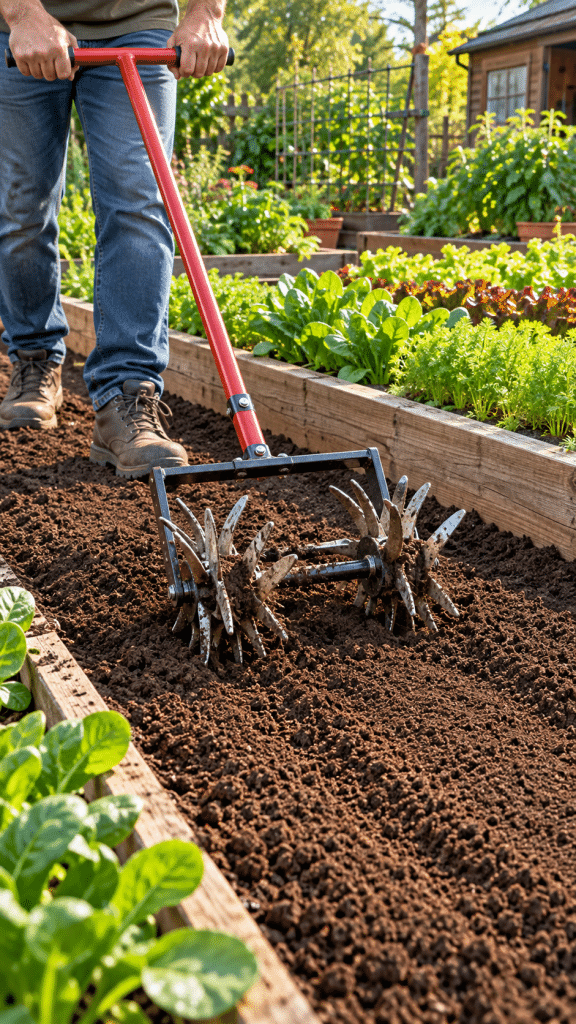
🌱 How to Use a Garden Weasel for Vegetable Seedbed Preparation
Begin by examining the soil rather than immediately reaching for the cultivator.
Healthy cultivation starts with suitable moisture conditions.
Soil that is excessively wet can smear and become compacted when disturbed. Soil that is extremely dry and hard may resist the rotating tines or break into large, stubborn chunks.
A useful field test is to squeeze a small handful of soil.
If it forms a sticky mass that remains wet and plastic, postpone cultivation.
If it crumbles with gentle pressure, the soil may be ready for light preparation.
Once the moisture level is suitable, remove large stones, branches, and other objects that could interfere with the tool.
Position the Garden Weasel at one end of the planting bed and roll it forward and backward across the exposed soil using steady, controlled movements.
The rotating tines should loosen the upper surface and gradually break apart manageable clumps.
Avoid applying unnecessary downward force.
Excessive pressure can make the tool harder to control and may disturb more soil than necessary.
For wider planting areas, work in overlapping passes until the surface becomes reasonably uniform.
The final result should feel loose enough for shallow seed furrows but still contain small, stable aggregates rather than looking like powdered flour.
🥬 Why This Garden Weasel Method Works Well for Small Seeded Vegetables
Small vegetable seeds need appropriate planting depth, moisture, and good contact with surrounding soil for successful germination.
Large surface clumps can create irregular seed placement and pockets of air that reduce consistent contact between seeds and moist soil.
A lightly cultivated seedbed makes it easier to draw straight planting furrows and cover seeds evenly.
Consider a raised bed intended for lettuce and radishes.
Instead of digging deeply into the bed, roll the Garden Weasel across the exposed surface before creating shallow seed rows.
This provides a more manageable area for precise sowing.
Carrots are another good example.
Because carrot seeds are small and the developing roots benefit from a suitable soil environment, preparing a surface free of major obstructions can make sowing easier.
However, shallow rotary cultivation alone will not correct deep compaction, large buried stones, or serious drainage problems.
Those conditions require separate attention before planting.
🌿 Gardening tip: Use the Garden Weasel to improve the immediate planting surface, but avoid repeatedly disturbing deeper layers of an already healthy bed.
🥕 Create a More Organized Vegetable Planting Area
An attractive vegetable garden often begins with careful preparation.
After cultivating the soil surface, use a straight board, planting guide, or garden marker to establish neat seed rows.
The Garden Weasel can prepare the planting zone while a hand tool creates the actual furrows at the correct depth.
This separation of tasks is important.
Rotary cultivation loosens soil, but individual vegetables still require specific sowing depths and spacing.
For example, lettuce seeds are generally planted much more shallowly than large beans.
Following the seed packet instructions is therefore more reliable than assuming that every crop can be planted at the same depth.
Once seeds are covered, gently firm the soil where appropriate to maintain seed-to-soil contact.
Water with a gentle spray to avoid washing the seeds away.
A smooth, well-prepared surface can also make it easier to identify emerging vegetable seedlings and distinguish them from unwanted weeds.
In a small kitchen garden, these details create a growing space that feels organized and practical rather than chaotic.
🌼 When to Avoid Using the Garden Weasel During Seedbed Preparation
Although soil preparation is one of the tool’s strongest applications, more cultivation does not automatically create better growing conditions.
Established raised beds with excellent soil structure may need only a light surface adjustment before sowing.
Repeated aggressive cultivation can damage soil aggregates, expose dormant weed seeds, and disturb soil organisms.
It is also important to avoid cultivating immediately after heavy rainfall.
Wet soil can lose structure when worked, especially when it contains a high proportion of clay.
Another situation requiring caution is a bed filled with living roots from previous crops.
If large roots remain in place, carefully remove unwanted plant material or choose a suitable bed-clearing method before using the rotary cultivator.
The best approach is selective cultivation.
Prepare only the areas that actually need attention, and leave healthy soil undisturbed whenever possible.
🥈 Best 2 Use a Garden Weasel to Control Young Weeds Between Vegetable Rows
Weeds are among the most persistent challenges in vegetable gardening.
Even carefully prepared planting beds can quickly develop unwanted seedlings after rainfall or irrigation.
These young plants compete with vegetables for sunlight, moisture, nutrients, and growing space.
If ignored, some weeds grow rapidly, produce seeds, and become increasingly difficult to remove.
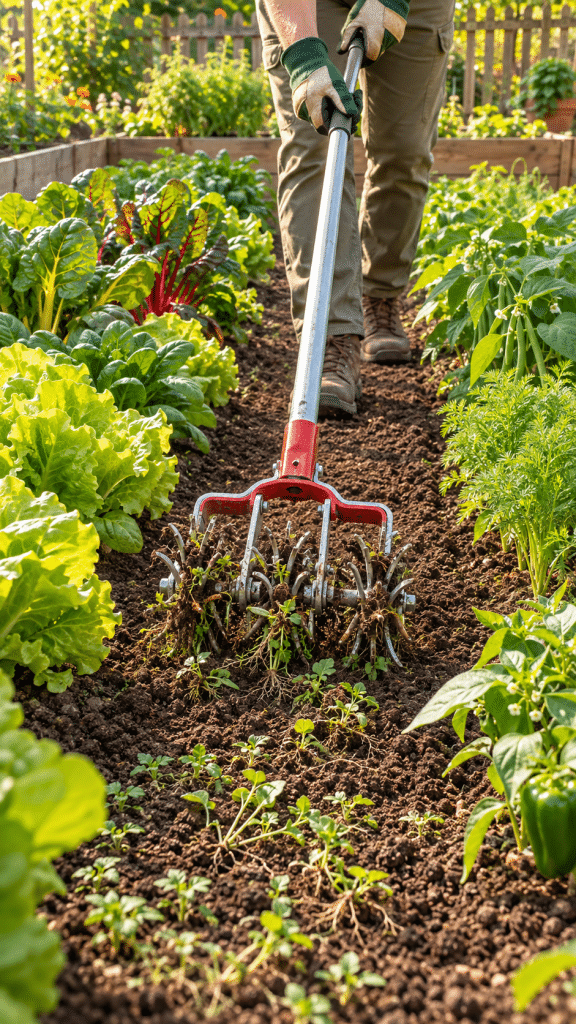
A Garden Weasel provides a useful mechanical approach to managing very young weeds in suitable spaces between vegetable rows.
Instead of allowing weeds to become large and deeply rooted, gardeners can use shallow surface cultivation to disturb them while they are still vulnerable.
This approach works particularly well in an established vegetable garden where the gardener can clearly identify crop rows and maintain adequate distance from vegetable stems.
🌱 How a Garden Weasel Helps With Early Weed Control
When the rotary tines move through the upper soil layer, they can uproot, dislodge, or damage small weed seedlings.
Very young weeds often have limited root systems and are less resilient than mature plants.
Disturbing them before they become established can reduce the amount of hand weeding required later.
However, the technique works best when weeds are small and conditions allow disturbed seedlings to dry out.
Mature perennial weeds with extensive underground roots are much more difficult to control through shallow cultivation.
Some perennial species can even regenerate from root or stem fragments left in the soil.
For that reason, the Garden Weasel should be regarded as an early weed-management tool rather than a universal weed remover.
Its greatest value comes from timely, controlled use.
🌿 The Best Way to Use a Garden Weasel Between Vegetable Rows
Start by identifying the crop plants and the open spaces that can be cultivated safely.
In a newly planted vegetable bed, this may be straightforward because the rows are clearly defined.
As vegetables mature, however, the root systems can extend much farther than the visible leaves or stems.
This means that cultivation should become increasingly cautious as the growing season progresses.
Move the Garden Weasel through accessible bare-soil strips using light pressure and shallow passes.
Avoid rolling the rotating tines directly against vegetable stems.
Maintain enough clearance to protect the crop and its roots.
Where available, an adjustable rotary cultivator can be configured for a narrower working width, provided the manufacturer’s instructions permit the adjustment.
This may be useful when cultivating relatively open spaces between rows of beans, young brassicas, or other vegetables.
Close to crop stems, a small hand cultivator or careful hand weeding is usually the safer choice.
The purpose is to disturb weeds without sacrificing healthy vegetable roots.
🥬 Why Shallow Cultivation Is Better Than Deep Disturbance
An important principle of weed management is that the gardener should disturb only as much soil as necessary.
Deep cultivation between established vegetable plants can sever roots and create unnecessary stress.
Some vegetable crops develop extensive shallow feeder roots that absorb water and nutrients from the surrounding soil.
Tomatoes, peppers, cucumbers, and many other vegetables can have roots extending well beyond their stems.
Aggressive cultivation near these plants may injure the roots even when the surface appears relatively empty.
Shallow weed control reduces this risk while focusing on small weeds growing near the surface.
It also limits the amount of buried weed seed brought toward conditions favorable for germination.
Although some soil disturbance is unavoidable, keeping it minimal is usually a sensible strategy.
⚠️ Important Note: Never use a rotary Garden Weasel aggressively around established vegetable roots, directly over seedlings, or in saturated soil. The tines can damage desirable plants and soil structure. Keep cultivation shallow, maintain a safe distance from crops, and use hand weeding or mulch where the tool cannot operate safely.
☀️ Choose the Right Weather for Weed Cultivation
Weather conditions can influence whether mechanical weed control is successful.
For example, shallow cultivation on a relatively dry day may leave small uprooted weeds exposed on the soil surface.
If they dry out before reestablishing contact with moist soil, many seedlings will die.
However, heavy rainfall immediately after cultivation can sometimes allow disturbed weeds to recover or encourage additional weed seeds to germinate.
Timing cultivation around favorable conditions can improve results.
This does not mean gardeners must wait for extremely hot weather.
Instead, choose conditions when the soil is workable and there is a reasonable opportunity for disturbed seedlings to dry.
Gardens with irrigation systems require additional consideration.
Watering immediately after cultivating weeds may reduce the effectiveness of this technique.
Where possible, coordinate cultivation with the garden’s watering schedule without depriving the vegetables of needed moisture.
🌱 A short, well-timed session can be more effective than an extensive session performed under unsuitable conditions.
🌼 Combine Garden Weasel Weeding With Mulching
The Garden Weasel becomes especially useful when combined with a sensible mulching strategy.
Cultivation can address small weeds in exposed areas, while mulch reduces the amount of light reaching the soil surface and can discourage further weed germination.
Common vegetable garden mulches include clean straw, shredded leaves, and other suitable organic materials.
The best choice depends on the vegetables being grown, the local climate, and the condition of the soil.
After clearing young weeds, allow the disturbed soil to settle as appropriate before applying mulch.
Spread the mulch in a way that protects the soil without burying small seedlings or piling excessive material against plant stems.
As the vegetable canopy expands, the need for repeated cultivation may decrease.
Large leaves can shade portions of the soil, and well-maintained mulch can further reduce weed pressure.
This creates a practical division of labor.
The Garden Weasel handles selected open areas during early growth, while mulch and careful hand weeding protect the garden later.
The result is a maintenance system that relies less on repeated disturbance.
🥉 Best 3 Use a Garden Weasel to Mix Compost Into Vegetable Garden Soil
Healthy vegetable soil depends on more than simply breaking apart clumps and removing weeds.
Organic matter plays an important role in supporting soil structure, moisture management, biological activity, and nutrient cycling.
Finished compost is one of the most familiar materials used to improve garden soil.
It can contribute organic matter and, depending on its composition and maturity, plant nutrients.
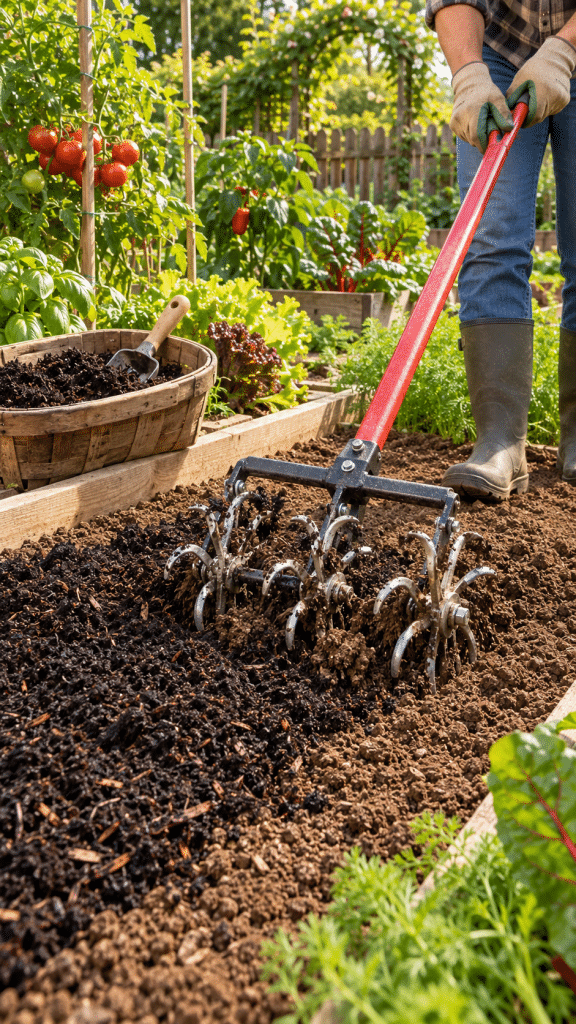
A Garden Weasel can help incorporate suitable compost into the upper layer of an established bed before planting or during seasonal bed renewal.
This application is particularly convenient when the gardener wants to refresh a small planting area without using a powered tiller.
However, incorporating compost is not always necessary.
In many well-managed vegetable beds, applying finished compost to the surface can be equally appropriate or preferable.
The best method depends on the existing soil, the crop being planted, and the gardener’s soil management approach.
🌿 How to Use a Garden Weasel to Mix Finished Compost
Begin with mature, properly finished compost.
Finished compost usually has a relatively uniform appearance, an earthy smell, and limited recognizable original materials.
Unfinished compost can continue decomposing in ways that temporarily affect nutrient availability or growing conditions.
Remove large undecomposed pieces before application if necessary.
Next, spread a modest, even layer of compost over the empty planting area.
The amount should be based on existing soil conditions, compost characteristics, crop needs, and ideally soil-test guidance.
Overapplying nutrient-rich compost, especially manure-based compost, can contribute to excessive nutrient accumulation.
Once the material has been distributed, use the Garden Weasel to make light, overlapping passes through the upper soil layer.
The rotating tines can help blend some compost with the surrounding soil.
Avoid trying to force the tool deeply into compacted ground.
The objective is shallow incorporation, not extensive soil inversion.
After cultivation, inspect the surface.
If the compost appears reasonably distributed and the soil remains structurally sound, additional passes may be unnecessary.
Water as appropriate for the upcoming crop and planting conditions.
🥕 Refresh Vegetable Beds Between Growing Seasons
One of the most convenient moments to use a Garden Weasel is during the transition between vegetable crops.
Imagine a bed that has just finished producing an early harvest of radishes or spring lettuce.
Instead of leaving it empty for the rest of the growing season, the gardener may want to plant another suitable crop.
This is commonly known as succession planting.
The bed may need only minor preparation before the next seeds or transplants are introduced.
Start by removing unwanted crop residues and weeds.
Healthy plant material may be composted or managed according to the garden’s usual practices, while diseased material may require different handling.
Examine the soil surface and determine whether cultivation is actually needed.
If the bed is already loose, well structured, and covered with suitable organic material, extensive disturbance is unnecessary.
Where the surface has crusted or needs light incorporation of a soil amendment, a Garden Weasel may be useful.
Make a limited number of passes through the empty planting area.
Then smooth the seedbed, plant the next crop according to its requirements, and water appropriately.
This focused approach helps gardeners keep small vegetable beds productive without treating every replanting as a major soil renovation project.
🍅 Improve Soil Management Without Overcultivating
There is an important difference between improving soil and repeatedly disturbing it.
A healthy vegetable garden contains an intricate network of roots, soil organisms, pores, and organic materials.
Excessive cultivation can disrupt that network.
For this reason, the Garden Weasel should be used with a clear purpose.
When compost can be left on the surface, shallow incorporation may not be needed.
Surface applications can allow organic material to gradually interact with soil through rainfall, watering, and biological processes.
This is especially relevant in established raised beds that have already developed favorable soil structure.
However, a small amount of shallow mixing may be appropriate when preparing a planting surface or incorporating an amendment according to specific instructions.
The key is moderation.
Rather than automatically cultivating the entire garden each season, evaluate individual planting areas.
Some beds may need light loosening.
Others may benefit more from mulch, compost applied on top, or simply leaving the soil undisturbed.
🌱 The most productive use of a Garden Weasel is often the smallest amount of cultivation required to accomplish a specific task.
🌼 Use a Garden Weasel for Small Kitchen Garden Maintenance
Small kitchen gardens are especially well suited to targeted cultivation because their growing areas are compact and frequently replanted.
A gardener may maintain several beds containing lettuce, leafy greens, herbs, radishes, carrots, and seasonal vegetables.
Each bed can require attention at different times.
One section may be ready for new seeds, another may need early weed removal, and a third may be undergoing preparation for a new crop.
A Garden Weasel can support these different maintenance activities when the soil and plant spacing are suitable.
The tool’s manual operation is convenient for small tasks because it requires no fuel or electrical connection.
It can also be stored in a typical garden shed or garage alongside other hand tools.
For gardeners who enjoy maintaining beds in short sessions, this accessibility can be a meaningful advantage.
Instead of waiting until an entire garden needs attention, individual areas can be maintained when necessary.
The result is a more responsive approach to vegetable gardening.
🌱 How to Choose the Right Garden Weasel for Your Vegetable Garden
The term Garden Weasel can refer to several different gardening tools, so choosing the correct model matters.
The original rotary cultivator is designed for rolling cultivation with rotating tine wheels.
It is particularly useful for surface soil preparation and cultivation in appropriately sized open areas.
Some rotary models allow their tine configurations to be adjusted, making them more adaptable to different working widths.
A Garden Weasel Garden Claw is a different tool.
Rather than using rotating wheels, the Garden Claw uses a twist-action mechanism to loosen soil.
This can make it useful for certain soil preparation tasks, but its operating method is not identical to that of the original rotary cultivator.
Garden Weasel also offers smaller hand tools intended for close work.
These may be more appropriate for narrow spaces where a full-size cultivator would be difficult to control.
The following comparison helps distinguish the most practical applications.
| Tool Type | Main Movement | Best Application | Important Limitation |
|---|---|---|---|
| Original Garden Weasel Rotary Cultivator | Rolling rotary tines | Surface seedbed preparation and cultivation of open areas | Limited effectiveness in deeply compacted soil |
| Garden Weasel Garden Claw | Pressing and twisting | Loosening localized areas of soil | Can disturb existing roots if used too close to plants |
| Small Hand Cultivator | Controlled hand movement | Precise cultivation around accessible small spaces | Slower for larger beds |
The best choice depends on the job rather than simply the size of the garden.
For an established vegetable bed with long planting rows, a rotary cultivator may be convenient.
For a small localized area requiring twist-action loosening, a Garden Claw may be more suitable.
When working near delicate seedlings, a small hand tool often provides better precision.
Understanding these differences can prevent frustration and reduce accidental plant damage.
🥬 Common Garden Weasel Mistakes That Can Harm a Vegetable Garden
Even a well-designed gardening tool can cause problems when used incorrectly.
One common mistake is cultivating wet soil.
When soil is saturated, disturbance may damage its structure and create clods that become difficult to manage after drying.
Another mistake is applying excessive force in an attempt to cultivate deeply.
A rotary cultivator is not designed to solve every deep compaction problem.
Forcing the tines into unsuitable ground can make the process inefficient and may increase strain on the gardener.
A third mistake is cultivating too close to established vegetables.
The visible portion of a plant does not reveal the full extent of its root system.
Roots frequently occupy soil well beyond the stem.
Damaging these roots can interfere with plant growth, particularly during hot or dry conditions.
Gardeners should also avoid expecting shallow cultivation to eliminate established perennial weeds.
Species that spread through underground structures may require careful removal or a longer-term management strategy.
Another overlooked mistake is cultivating unnecessarily.
Soil does not need to be disturbed simply because a tool is available.
Mulching, surface composting, and thoughtful planting practices can often reduce the need for repeated cultivation.
Finally, keep the tool clean and inspect the tines regularly.
Remove trapped plant material, clean soil from moving parts, and follow the manufacturer’s maintenance instructions.
Proper storage helps keep the tool ready for future gardening sessions.
☀️ When Is the Best Time to Use a Garden Weasel
The best time to use a Garden Weasel depends on the gardening task.
For seedbed preparation, use the tool shortly before sowing, once the soil is workable and not excessively wet.
For young weed control, begin when unwanted seedlings are small enough to be disturbed easily and the crop rows can be identified safely.
For compost incorporation, use it before planting or when refreshing an empty bed, provided incorporation is actually beneficial.
These activities may occur at different times depending on the climate.
In regions with cold winters, much vegetable garden preparation takes place in spring after the soil becomes workable.
In warmer climates, vegetable production may continue through several planting cycles.
Gardeners in areas with hot summers may prefer to perform physically demanding work during cooler parts of the day.
In regions with distinct rainy seasons, soil moisture conditions may have a greater influence on cultivation timing than the calendar.
The guiding principle is simple.
Cultivate according to soil conditions and crop needs rather than following a rigid schedule.
A productive garden does not require constant mechanical intervention.
It requires timely attention to the conditions that influence plant growth.
🥕 Can a Garden Weasel Replace a Traditional Garden Tiller
A Garden Weasel can replace some tasks normally performed with larger equipment, but it cannot replace every function of a garden tiller.
A powered tiller is designed to move and disturb substantially more soil than a typical manual rotary cultivator.
This can be useful in certain site-preparation situations, although deep or repeated tillage also carries soil-structure risks.
A Garden Weasel is better suited to relatively shallow cultivation in manageable areas.
It offers greater convenience for routine maintenance when a full-size machine would be unnecessary.
For example, preparing the top layer of an established lettuce bed rarely requires a large powered tiller.
Similarly, disturbing small weeds between accessible rows can be accomplished without starting an engine.
However, attempting to establish an entirely new vegetable garden in deeply compacted ground may require a broader soil preparation strategy.
That strategy could involve assessing drainage, removing major obstacles, loosening compacted layers where appropriate, or creating raised beds.
In some cases, building soil through organic matter, mulching, cover crops, and reduced disturbance may be more beneficial than mechanical tillage.
The Garden Weasel therefore works best as part of a practical gardening system rather than as a universal solution.
🌿 How to Maintain a Garden Weasel for Long Lasting Performance
Good maintenance begins immediately after use.
Moist soil and plant debris can accumulate around cultivating tines, especially when working in soil containing substantial organic matter.
Remove accumulated material carefully while keeping hands clear of sharp edges.
A stiff brush can be useful for cleaning soil from hard-to-reach areas.
If rinsing is necessary, dry the tool afterward according to the manufacturer’s recommendations.
Inspect the rotating components and check that removable tine assemblies remain properly secured.
If a wheel is damaged or does not rotate correctly, address the issue before using the tool again.
Avoid continuing to cultivate with damaged components.
Store the Garden Weasel in a sheltered, dry location rather than leaving it exposed to rain and standing moisture.
Hanging it on a suitable garage or shed wall can keep the tines away from walkways and reduce the risk of accidental contact.
Before the next gardening season, perform a quick inspection.
Check the handle, connections, and cultivating wheels.
This simple routine helps preserve the tool’s usability and makes routine vegetable garden care more convenient.
🌼 Frequently Asked Questions About Using a Garden Weasel
Can You Use a Garden Weasel in a Raised Vegetable Bed
Yes, a rotary Garden Weasel can be useful in raised vegetable beds, particularly when preparing an open planting surface or controlling young weeds.
However, raised bed soil often already has favorable structure and may not require regular cultivation.
Use the tool only when there is a specific need, and avoid disturbing established roots.
Narrow raised beds may require a reduced tine width or a smaller hand cultivator.
Does a Garden Weasel Remove Weeds Permanently
No, a Garden Weasel does not permanently eliminate weeds.
Shallow cultivation can be effective against many young annual weed seedlings, but new weeds may continue to emerge from seeds in the soil.
Established perennial weeds may survive or regenerate after cultivation.
Combining timely cultivation with mulch, appropriate planting density, and regular observation provides a more reliable weed-management strategy.
Is a Garden Weasel Good for Clay Soil
A Garden Weasel may help cultivate the surface of clay soil when moisture conditions are suitable.
However, very wet clay can smear and compact when worked, while extremely dry clay may be too hard for effective shallow rotary cultivation.
The tool cannot independently correct severe compaction or drainage problems.
Long-term soil management practices, including suitable organic matter additions and avoiding unnecessary traffic on growing beds, are often more important.
Can You Use a Garden Weasel Around Tomato Plants
It is possible to use a Garden Weasel in open soil areas near young tomato plantings, but caution is essential.
Tomatoes develop roots that can extend outward from the visible stem.
Cultivating too closely or too deeply can damage these roots.
As tomato plants become established, mulch and careful hand weeding are generally safer around their root zones.
Should You Use a Garden Weasel Before Every Planting
Not necessarily.
If the soil is already in good condition, additional cultivation may provide little benefit.
A light surface adjustment may be useful when sowing small seeds, but repeated cultivation can unnecessarily disturb soil structure.
Evaluate the planting area before deciding whether the Garden Weasel is needed.
Can a Garden Weasel Mix Fertilizer Into the Soil
A rotary Garden Weasel can help incorporate certain soil amendments into the upper soil layer when their application instructions recommend incorporation.
However, fertilizer rates and placement depend on the product, the crop, and the soil’s nutrient status.
Follow fertilizer labels and use soil-test recommendations where available.
Avoid automatically mixing large amounts of fertilizer throughout a bed.
Is a Garden Weasel Worth Using in a Small Vegetable Garden
For gardeners who regularly prepare small planting areas, manage young weeds, or refresh established beds, a Garden Weasel can be a convenient manual tool.
Its greatest benefit is making selected cultivation tasks easier without requiring motorized equipment.
However, gardeners with heavily mulched no-dig beds may have little need for frequent cultivation.
Its value depends on how the garden is maintained.
🌱 Final Thoughts on the Best 3 Ways to Use a Garden Weasel
A Garden Weasel is most effective when used thoughtfully rather than continuously.
Its practical value comes from performing specific cultivation jobs at the right moment while avoiding unnecessary disturbance of established vegetable beds.
The Best 3 Ways to Use a Garden Weasel are preparing manageable seedbeds before sowing, controlling young weeds in accessible areas, and incorporating suitable compost or soil amendments when shallow mixing is beneficial.
Each application contributes to a different stage of vegetable garden maintenance.
Seedbed preparation creates a workable surface for new crops. Early weed control reduces competition before unwanted plants become difficult to manage. Selective compost incorporation can support soil management during planting and seasonal bed renewal.
Together, these methods offer a simple approach to maintaining productive vegetable beds without depending on large gardening machines.
The secret is not cultivating more often.
It is learning when cultivation will genuinely improve growing conditions and when healthy soil should be left alone.
With careful timing, controlled technique, appropriate mulching, and attention to plant roots, a Garden Weasel can become a practical companion for growing fresh, healthy vegetables in a beautiful and manageable home garden. 🌿🥕🍅