Monstera Plant Care can be surprisingly simple once you understand what this tropical houseplant actually needs. With its dramatic split leaves, lush tropical appearance, and ability to transform an ordinary corner into a beautiful indoor jungle, Monstera has become one of the most popular houseplants for modern homes. But keeping it healthy requires more than simply placing it near a window and watering it occasionally.
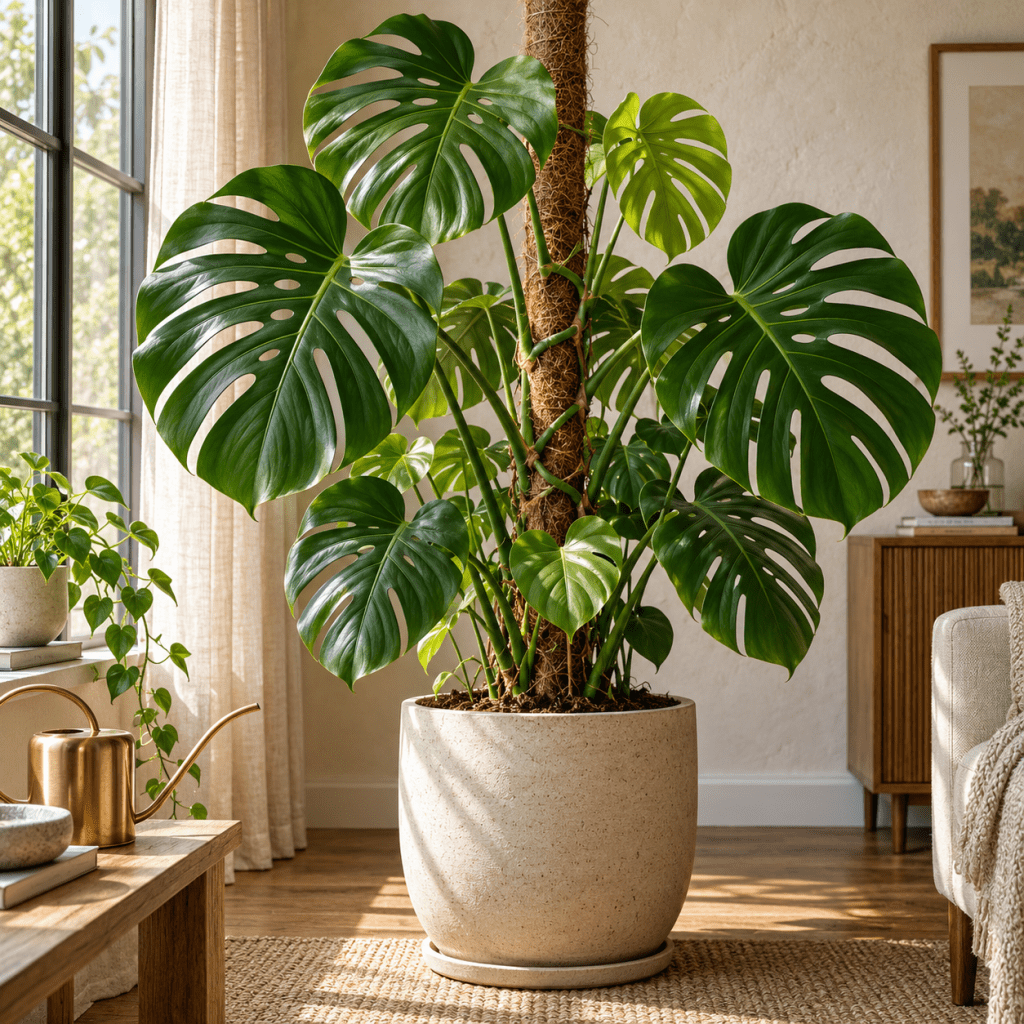
A thriving Monstera depends on three major factors: the right light, the right watering routine, and the right growing environment. When these three areas are balanced, the plant can produce larger foliage, stronger stems, healthier roots, and increasingly impressive leaf fenestrations.
🌿 The best part is that Monstera plants are generally forgiving. They can tolerate small mistakes, making them suitable for both beginners and experienced plant lovers. However, consistent care makes a dramatic difference between a Monstera that merely survives and one that becomes a spectacular indoor statement plant.
This guide explores the Top 3 Monstera Plant Care ideas that matter most, along with practical tips for soil, humidity, fertilizing, pruning, repotting, propagation, pest prevention, and encouraging larger split leaves.
Quick Monstera Plant Care Guide
Before exploring the three most important care strategies, it helps to understand the basic growing requirements of Monstera.
| Care Factor | Best Condition | What to Avoid |
|---|---|---|
| ☀️ Light | Bright indirect light | Harsh prolonged direct sun |
| 💧 Water | Water when top soil begins drying | Constantly wet soil |
| 🌱 Soil | Airy well draining potting mix | Heavy compact soil |
| 💦 Humidity | Moderate to high humidity | Extremely dry air |
| 🌡️ Temperature | Warm indoor temperatures | Cold drafts |
| 🌿 Fertilizer | Balanced fertilizer during active growth | Excessive feeding |
| 🪴 Pot | Container with drainage holes | Pots without drainage |
| 🪵 Support | Moss pole or sturdy plant support | Allowing mature vines to collapse |
| ✂️ Pruning | Remove damaged or unwanted growth | Excessive pruning at once |
These basic conditions work together. Improving only one element may help your plant, but combining good light, responsible watering, and healthy root conditions usually produces the strongest results.
🥇 Top 1 Monstera Plant Care Secret Give It Bright Indirect Light
Light is arguably the most important factor in successful Monstera Plant Care. Monstera plants naturally grow beneath and around trees in tropical environments, where they receive abundant filtered light rather than constant harsh sunlight.
Inside the home, the goal is to recreate that bright but protected environment.
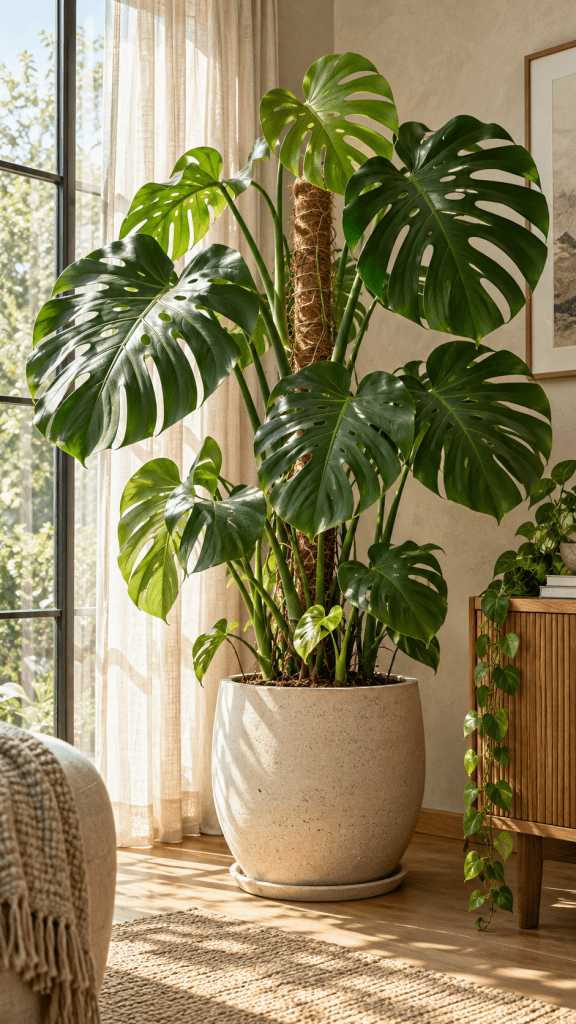
Why Bright Indirect Light Matters for Monstera Plant Care
Monstera plants use light to produce energy through photosynthesis. When they receive enough light, they usually grow faster, develop stronger stems, and produce increasingly larger leaves.
One of the most exciting characteristics of mature Monstera foliage is the formation of splits and holes called fenestrations. Although plant age, genetics, support, and overall health contribute to fenestration, sufficient light is one of the major environmental factors that helps encourage mature growth.
A Monstera growing in a dark corner may remain alive, but its growth can become slower. Leaves may stay relatively small, stems may stretch toward the nearest light source, and the distance between leaves may increase.
🌞 Moving the plant into brighter indirect light can sometimes create a noticeable improvement over subsequent growth cycles.
Best Window Locations for Monstera
Several indoor locations can work extremely well.
A position near an east-facing window often provides gentle morning sunlight followed by bright ambient light during the rest of the day.
A location near a south-facing or west-facing window can also work, particularly when the strongest sunlight is filtered through sheer curtains or when the plant sits slightly away from the glass.
North-facing windows may provide enough light in very bright rooms, although the plant may grow more slowly depending on the season, surrounding buildings, and climate.
The important idea is not simply the direction of the window. Observe how much usable daylight actually reaches the plant.
Signs Your Monstera Needs More Light
Your Monstera may be asking for brighter conditions when you notice:
- 🌱 unusually slow new growth
- 🍃 smaller leaves than previous growth
- 🪴 long stretched stems between leaves
- 🌿 fewer fenestrations on mature growth
- ↗️ strong leaning toward the window
- 🟡 soil remaining wet for unusually long periods
Low light can indirectly contribute to watering problems because plants use water more slowly when growth and photosynthesis decrease.
Moving the plant closer to brighter light may therefore improve both growth and soil drying patterns.
Can Monstera Handle Direct Sunlight
Monstera can tolerate some gentle direct sunlight, particularly softer morning light. However, sudden exposure to strong midday or afternoon sun can scorch leaves that have been growing indoors.
Sunburn often appears as pale, yellowish, tan, or brown damaged patches.
If you want to introduce stronger light, gradual acclimation is safer than immediately moving the plant from a shaded corner into intense sunlight.
Important Note: When changing your Monstera to a significantly brighter location, increase its sun exposure gradually. Sudden intense sunlight can damage leaves even when the plant could eventually tolerate brighter conditions.
Rotate Your Monstera for Balanced Growth
Monsteras naturally orient themselves toward light. Without occasional rotation, indoor plants can become dramatically one-sided.
Rotating the container slightly every few weeks can encourage more balanced growth when the plant is displayed decoratively.
However, once a mature Monstera is attached firmly to a support pole and positioned intentionally toward a window, frequent rotation may become less practical. In that situation, focus on maintaining stable orientation and supporting the climbing side correctly.
🥈 Top 2 Master the Monstera Watering Routine
Watering is where many houseplant problems begin.
Monstera enjoys moisture, but it does not want its roots sitting permanently in saturated soil. The ideal watering strategy creates a repeating cycle where the plant receives a thorough drink and then the soil partially dries before the next watering.
That rhythm gives the roots access to both moisture and oxygen.
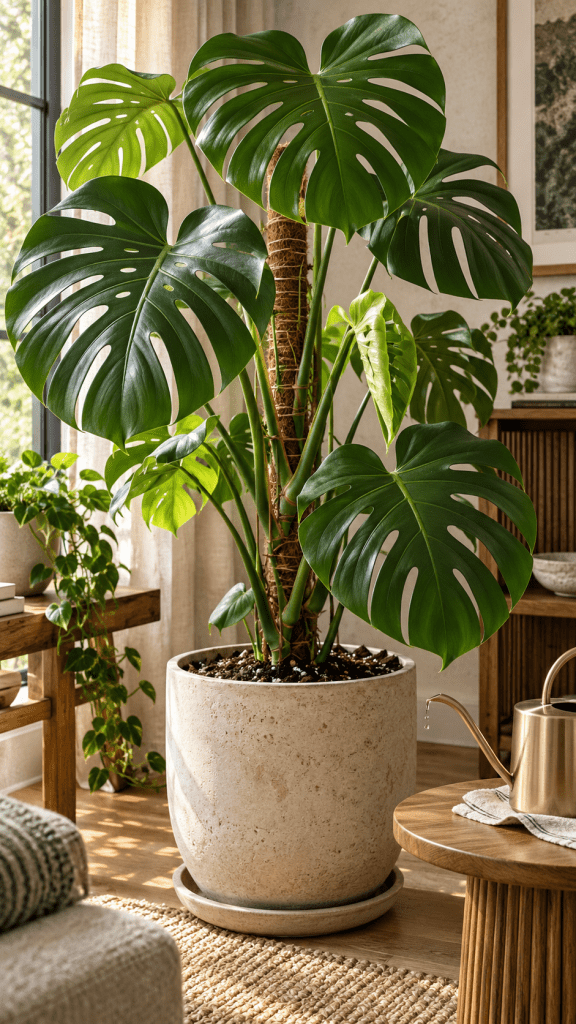
The Best Monstera Plant Care Watering Method
Instead of watering according to a rigid calendar, check the soil.
Insert your finger into the upper layer of the potting mix. When the top several centimeters feel dry while the deeper soil still retains some moisture, the plant is usually approaching watering time.
When watering, apply enough water to moisten the root zone thoroughly.
If the container has drainage holes, excess water should eventually flow from the bottom. Allow the extra water to drain rather than leaving the pot sitting in a saucer filled with water.
💧 Thorough watering encourages more even moisture distribution than repeatedly adding tiny amounts of water to the surface.
Why Fixed Watering Schedules Often Fail
You may see advice recommending watering Monstera every seven days or every two weeks. These schedules can provide a rough starting point, but they should not replace checking the plant and soil.
Water use changes according to:
- ☀️ available light
- 🌡️ temperature
- 💦 humidity
- 🪴 container size
- 🌱 soil composition
- 🍃 plant size
- 🏠 airflow
- 🌦️ season
A large Monstera growing in bright warm conditions may drink considerably faster than a small plant growing in a cooler low-light room.
Therefore, the question should not be How many days since the last watering but rather Has the soil dried enough for another watering.
Signs of Overwatering
Excess water combined with poor drainage can create serious problems.
Potential symptoms include yellowing leaves, consistently wet soil, soft stems near the soil line, unpleasant smells from the potting mix, and declining roots.
One yellow leaf does not automatically mean overwatering. Older leaves occasionally die naturally. But repeated yellowing combined with continuously saturated soil deserves attention.
The real issue is often not the amount of water given at one time. It is the frequency of watering relative to how quickly the soil dries.
A Monstera can receive a large quantity of water during one watering session as long as the excess drains away and the soil is allowed to partially dry afterward.
Signs of Underwatering
Underwatered Monstera plants may develop drooping foliage, dry soil, crispy brown edges, or curled leaves.
When the entire root ball becomes extremely dry, water may sometimes run quickly around the edges of the container without properly soaking the soil.
In this situation, water slowly and thoroughly so the potting mix can absorb moisture again.
Do not compensate for chronic underwatering by suddenly keeping the soil permanently wet. Simply return to a healthier cycle.
Water Quality and Monstera
Most Monsteras adapt well to ordinary household water.
If leaf tips repeatedly turn brown despite good watering habits and adequate humidity, mineral buildup can sometimes contribute. Occasional deep watering that allows excess water to drain through the container can help flush accumulated salts from fertilizer and water.
Using filtered water may also help in areas with particularly mineral-heavy water, although it is not essential for every household.
🥉 Top 3 Build the Perfect Soil Root and Humidity Environment
Healthy foliage begins underground.
A beautiful Monstera requires roots that can access water, nutrients, and oxygen. Creating the right root environment is therefore one of the most valuable long-term improvements you can make.
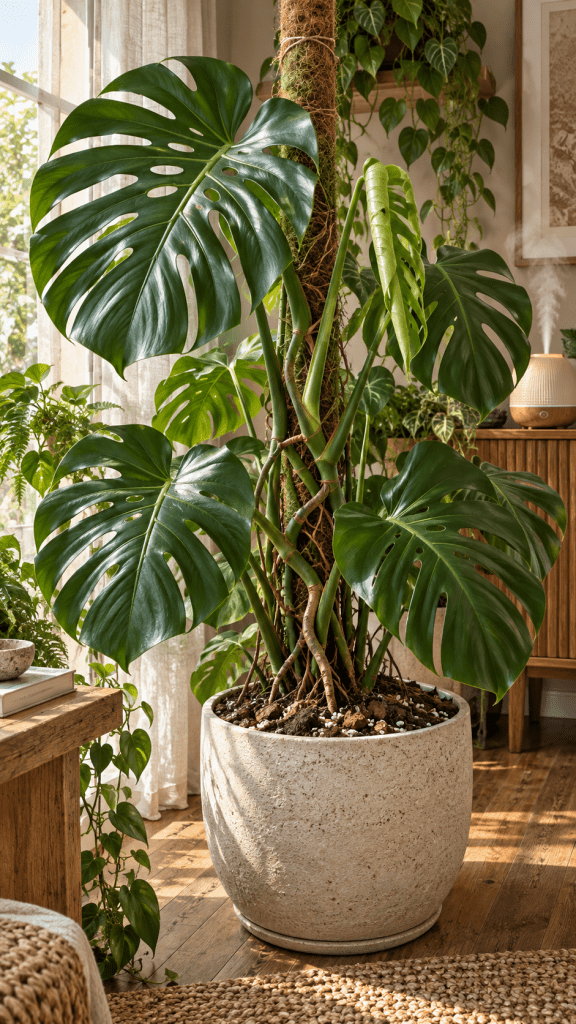
Best Soil for Monstera Plant Care
Monstera prefers an airy, moisture-retentive but well-draining growing medium.
A good mix may combine ordinary indoor potting soil with chunkier ingredients that improve airflow.
Popular components include:
- 🌿 quality potting mix
- 🌳 orchid bark
- 🪨 perlite or pumice
- 🥥 coco coir
- 🌱 compost or worm castings in moderate amounts
The exact formula matters less than the physical structure.
The finished mixture should hold enough moisture for roots to drink without becoming dense, muddy, or waterlogged.
A chunky soil structure also allows roots to grow through small air spaces more naturally.
Choosing the Right Pot
Drainage holes are extremely useful for Monstera plants.
They allow excess water to leave the container and make thorough watering much safer.
Decorative pots without drainage can still be used as outer cachepots. Simply keep the Monstera inside a smaller nursery container with drainage holes and remove it when watering.
🪴 Pot size also matters.
Placing a small root system inside an oversized container can leave large amounts of unused soil wet for extended periods. When repotting, move up gradually rather than immediately choosing a dramatically larger container.
Humidity for Healthier Monstera Leaves
Monstera originates from tropical regions and generally appreciates moderate to higher humidity.
However, many plants can adapt to average indoor humidity when other care conditions are good.
Higher humidity can be especially helpful when:
- the air is extremely dry
- air conditioning runs frequently
- heating systems operate during winter
- new leaves struggle to unfurl
- crispy leaf edges repeatedly appear
Grouping plants together may slightly improve the local environment, while a humidifier provides more reliable humidity control.
Misting creates only temporary surface moisture and generally does not raise room humidity for long.
Temperature and Airflow
Monsteras prefer warm stable indoor conditions.
Avoid placing the plant directly beside extremely cold drafts, strong air-conditioning vents, heaters, or frequently opened doors during cold weather.
Good airflow is still beneficial.
The objective is gentle air circulation without repeated blasts of extremely hot or cold air.
How to Encourage Bigger Monstera Leaves
Large Monstera leaves are one of the main reasons people love this plant.
Producing impressive mature foliage requires patience because leaf size often increases gradually as the plant matures.
Several factors can help.
Give Your Monstera Something to Climb
Monstera is naturally a climbing plant.
In its native growth habit, it climbs trees and uses aerial roots to anchor itself to supporting surfaces.
Indoors, providing a moss pole, coco pole, wooden plank, or sturdy trellis can help encourage a more vertical growth habit.
🌿 Climbing support becomes especially valuable as the plant grows larger.
Without support, mature stems may eventually spread outward, bend, or become difficult to manage.
Attach the main stem loosely to the support rather than tying individual leaf petioles tightly.
The leaves need room to move and orient themselves toward light.
Combine Support With Strong Light
A support pole alone will not automatically create enormous leaves.
The most impressive growth usually occurs when climbing support is combined with:
- bright indirect light
- healthy roots
- consistent watering
- appropriate nutrition
- warm temperatures
- adequate time
Plant maturity also matters.
Young Monstera plants naturally produce smaller leaves before developing the dramatic fenestrated foliage associated with mature specimens.
How to Fertilize Monstera Without Overdoing It
Fertilizer supports growth, but more fertilizer does not automatically produce a better plant.
During periods of active growth, a balanced houseplant fertilizer can help replenish nutrients used by the plant.
Follow the label instructions rather than assuming a stronger concentration will produce faster results.
🌱 Consistent moderate feeding is generally safer than occasional excessive fertilization.
When Monstera Needs Fertilizer Most
Feeding is most useful when the plant is actively producing new leaves and roots.
Growth may slow during cooler or darker periods, especially in seasonal climates.
When growth naturally slows, fertilizer requirements may also decrease.
Observe the plant rather than applying nutrients automatically throughout the entire year.
Signs of Excess Fertilizer
Too much fertilizer can cause salt accumulation in the soil.
Potential symptoms include damaged leaf tips, root stress, mineral deposits around the pot, and declining plant health.
If overfertilization is suspected, flushing the soil thoroughly with water and temporarily reducing feeding may help.
Monstera Pruning Tips for Better Shape
Pruning helps control size and improve the overall appearance of a mature Monstera.
Use clean sharp pruning tools and decide why you are pruning before making cuts.
Possible reasons include removing damaged leaves, controlling excessive growth, shaping the plant, or creating cuttings for propagation.
✂️ Avoid randomly cutting healthy foliage simply because the plant looks temporarily uneven.
Monstera growth naturally changes direction as stems climb toward light and support.
Remove Damaged Leaves Strategically
Leaves that are severely damaged, diseased, or almost entirely yellow can usually be removed.
Cut the leaf stem cleanly near the main stem without damaging nearby growth.
Removing one damaged leaf will not automatically solve the underlying problem.
Always investigate why the damage happened.
Was the soil too wet?
Was the plant exposed to intense sunlight?
Did the soil become completely dry?
Was a cold draft involved?
Treating the cause prevents future damage.
How to Repot a Monstera
Monsteras do not need constant repotting.
Repotting becomes helpful when roots become extremely crowded, water passes through the pot unusually quickly, the plant becomes unstable, or the growing medium has broken down significantly.
Choose a container only moderately larger than the existing root system.
Repotting Step by Step
Gently remove the plant from its container and inspect the roots.
Healthy roots are generally firm rather than mushy.
Loosen tightly circling roots carefully when possible.
Add fresh airy potting mix to the new container, position the plant at approximately the same soil depth, and fill around the root ball.
Avoid burying the stem excessively.
Water appropriately after repotting and return the plant to a familiar bright location while it adjusts.
Some temporary drooping after repotting can occur as the plant adapts.
Monstera Aerial Roots Explained
Aerial roots often surprise new Monstera owners.
These brown or tan roots grow from the stem above the soil and are a normal part of the plant.
In nature, they help the plant climb and collect moisture.
Indoors, aerial roots can be guided toward a moss pole, placed carefully into the potting medium when practical, or simply left alone.
🌱 They are not a sign that something is wrong.
Avoid repeatedly cutting all aerial roots purely for appearance if you are trying to encourage mature climbing growth.
Easy Monstera Propagation
Monstera is popular partly because it can be propagated relatively easily.
The most important detail is the node.
A leaf by itself may remain green in water for some time, but successful long-term propagation generally requires a cutting that includes a node capable of producing new growth.
Propagating Monstera in Water
Choose a healthy stem section containing at least one node.
Place the node in clean water while keeping unnecessary foliage above the waterline.
Position the cutting in bright indirect light.
Change the water regularly if it becomes cloudy or dirty.
Over time, roots should begin forming.
Once the cutting develops a healthy root system, it can be transferred into an appropriate potting mix.
Propagating Directly in Soil
Monstera cuttings can also be rooted directly in a light airy growing medium.
This method avoids the later transition from water roots to soil conditions.
Maintain gentle moisture without saturating the soil and provide warm bright indirect light.
Patience is important because visible above-ground growth may take longer than expected while roots develop.
Common Monstera Problems and What They Usually Mean
Even healthy plants occasionally develop imperfect leaves.
Understanding common symptoms helps you respond appropriately.
Yellow Monstera Leaves
Yellow leaves can have multiple causes.
Common possibilities include overly wet soil, natural aging of older foliage, insufficient light, root stress, or nutrient-related issues.
Do not diagnose the problem based only on color.
Consider the condition of the soil, roots, light exposure, and watering history together.
Brown Crispy Leaf Edges
Crispy edges are often associated with overly dry conditions, inconsistent watering, low humidity, or mineral stress.
Inspect the entire plant before changing your routine dramatically.
A few brown tips do not necessarily mean the plant is unhealthy.
Brown Soft Patches
Soft dark patches combined with wet soil deserve more attention.
They may indicate moisture-related damage or root problems.
Check whether the pot drains properly and whether the soil remains saturated for too long.
Curling Leaves
Leaves may curl because of dehydration, environmental stress, temperature extremes, or occasionally pest problems.
Check soil moisture first, followed by environmental conditions.
Monstera Pest Prevention
Healthy Monsteras are fairly resilient, but indoor plants can still attract pests such as spider mites, scale insects, mealybugs, and thrips.
Inspecting the plant regularly makes pest control much easier.
Pay special attention to the undersides of leaves, leaf joints, new growth, and stems.
🔍 Early detection is far easier to manage than a large infestation.
Clean Monstera Leaves Regularly
Large Monstera leaves collect dust.
A layer of dust can make foliage look dull and may reduce how efficiently the leaf surface receives light.
Wipe leaves gently with a damp soft cloth.
Avoid excessive leaf-shine products that create artificial coatings.
Clean natural foliage is already beautiful.
How to Style Monstera as Home Decor
A healthy Monstera is not only a plant. It can become a major architectural element inside a room.
Its sculptural leaves work beautifully with modern, minimalist, tropical, Scandinavian, bohemian, and organic contemporary interiors.
Create a Statement Corner
Place a mature Monstera near a bright window where its leaves have enough space to spread.
Pair it with natural materials such as:
- 🤎 warm oak
- 🪨 stone
- 🧺 woven baskets
- 🤍 linen
- 🏺 ceramic planters
- 🌿 neutral textured walls
The dramatic foliage creates enough visual interest that the surrounding decor can remain simple.
Use an Elevated Decorative Planter
A decorative planter can transform a basic nursery plant into a sophisticated interior feature.
Choose a planter proportional to the plant.
Large Monsteras often look best in simple substantial containers that visually balance their broad foliage.
Neutral shades such as cream, charcoal, terracotta, greige, black, or warm stone allow the leaves to remain the focal point.
Seasonal Monstera Plant Care
Your care routine may need to change throughout the year.
Plants growing in tropical climates may maintain relatively consistent growth, while those in seasonal climates often slow down when days become shorter.
Spring and Summer Care
During brighter warmer periods, Monsteras often grow more actively.
You may notice faster soil drying, increased leaf production, and stronger demand for nutrients.
This is usually the best period for:
🌱 fertilizing
🪴 repotting
✂️ propagation
🪵 adding support
🌿 training new growth
Monitor soil frequently because watering needs may increase.
Fall and Winter Care
During darker periods, growth may slow.
The soil may stay wet longer, meaning watering frequency should often decrease.
Continue providing the brightest appropriate indirect light possible.
Avoid compensating for reduced sunlight by adding more fertilizer or more water.
Less growth usually means the plant is using fewer resources.
Top 3 Monstera Plant Care Mistakes to Avoid
Even experienced plant owners sometimes make these common mistakes.
1 Watering Too Frequently
Constant moisture is one of the fastest ways to create root problems.
Allow part of the soil to dry before watering again.
Remember that slightly dry soil for a short period is usually easier for Monstera to handle than constantly saturated roots.
2 Keeping Monstera in a Dark Corner
Monstera may survive in moderate or relatively low light, but surviving is different from thriving.
If you want large leaves and impressive fenestration, brighter indirect light is usually necessary.
Decorative placement should still respect the biological needs of the plant.
3 Ignoring the Climbing Growth Habit
A young Monstera may look compact, but mature plants become large climbing vines.
Providing support early can make the plant easier to manage and encourage a more natural growth pattern.
Waiting until stems become extremely long and tangled can make training much more difficult.
Best Monstera Plant Care Routine for Beginners
Beginners do not need an overly complicated routine.
A simple consistent system works extremely well.
Once every few days, visually inspect the plant.
Check whether new leaves are developing, whether foliage appears upright, and whether pests are visible.
Before watering, test the soil.
Every few weeks, wipe dust from large leaves and inspect the stems.
During active growth, fertilize according to product instructions.
As the plant becomes larger, evaluate whether it needs stronger support or additional space.
🌿 Consistency beats perfection.
A Monstera does not require constant attention. It benefits most from stable conditions and thoughtful observation.
Final Thoughts on the Top 3 Monstera Plant Care Secrets
The most successful Monstera Plant Care routine does not need dozens of complicated rules.
Focus first on the three fundamentals.
🥇 Provide bright indirect light so the plant has enough energy to produce strong growth and increasingly mature leaves.
🥈 Water according to soil conditions rather than a rigid schedule, allowing the upper potting mix to dry before watering thoroughly again.
🥉 Create a healthy root environment with airy soil, good drainage, warm conditions, and appropriate humidity.
Once these foundations are correct, everything else becomes easier.
Fertilizer can support new growth. A climbing pole can encourage larger mature foliage. Strategic pruning can improve shape. Regular cleaning and pest inspections can keep leaves attractive.
The result can be a Monstera that grows from a small houseplant into a dramatic living feature filled with enormous sculptural leaves.
And that is the real secret behind impressive Monstera plants.
They are rarely created by one special product or complicated trick. They become beautiful through good light, healthy roots, thoughtful watering, and consistent care over time. 🌿