Narrow Garden Designs can completely change the way a long, slim outdoor space feels. Instead of treating a narrow garden as an awkward leftover strip between walls, fences, or buildings, the right design can transform it into an intimate outdoor retreat filled with greenery, texture, movement, and architectural character. Even a garden with very limited width can feel sophisticated when every meter has a clear purpose.
The biggest mistake in a narrow garden is often trying to make it behave like a large backyard. Oversized lawns, scattered planting, bulky furniture, and too many unrelated features can make the space feel even tighter. A more successful approach works with the proportions rather than fighting them. 🌿 Long sightlines can become dramatic garden views, vertical boundaries can become lush planting surfaces, and small pockets can become beautifully defined destinations.
The best narrow gardens also create a sense of discovery. Instead of revealing the entire space immediately, they use planting, pathways, screens, changes in material, and carefully positioned focal points to encourage the eye to travel through the garden.
Among the many possibilities, three approaches stand out for their combination of beauty, practicality, and visual impact. These Best 3 Narrow Garden Designs range from lush layered garden corridors to architectural courtyard-style spaces and compact multifunctional retreats.
Why Narrow Garden Designs Can Be More Interesting Than Large Gardens
A narrow garden naturally creates one of the most powerful tools in landscape design: direction.
When someone enters a long garden, the eye automatically travels toward the far end. That creates an opportunity to build a strong visual journey. A beautiful tree, sculptural planter, bench, fountain, pergola, or dramatic planting composition at the end of the garden can become much more noticeable than it would in a wide open backyard.
The boundaries are also closer to the viewer. This might initially feel like a disadvantage, but it means materials and planting have greater visual impact. A climbing jasmine covering a wall, ornamental grasses brushing against a pathway, or warm timber screening can become a major part of the experience.
🌿 Narrow gardens can feel especially intimate because the landscape surrounds the person rather than sitting at a distance.
Instead of thinking about how little width is available, it is more useful to think about how much vertical space, depth, texture, and sequence can be created.
The Most Important Principles Behind Successful Narrow Garden Designs
Before choosing a specific style, it helps to understand several principles that work particularly well in long and compact gardens.
One of the most important is avoiding a single uninterrupted corridor. A completely straight path positioned between two identical borders can exaggerate the narrow proportions. Unless the goal is a highly formal garden, introducing subtle changes in direction usually creates a more interesting composition.
Another useful technique is dividing the garden into visual zones. These divisions do not necessarily require walls. A small tree, pergola, cluster of tall grasses, raised planter, change in paving, or lightweight timber screen can subtly separate one part of the garden from another.
This prevents the entire length from being visible at once.
Vertical planting is equally important. Because horizontal space is limited, fences and walls become valuable garden surfaces. Climbers, espalier trees, wall planters, and narrow trellises can introduce substantial greenery without consuming much floor area.
Finally, narrow gardens benefit from restraint. Using fewer materials and repeating them throughout the space often looks more luxurious than introducing many different decorative elements.
Quick Comparison of the Best 3 Narrow Garden Designs
| Narrow Garden Design | Best For | Main Feature | Planting Style | Overall Feeling |
|---|---|---|---|---|
| 🥇 Layered Garden Journey | Long narrow gardens | Curving or offset pathway | Lush layered planting | Natural and immersive |
| 🥈 Architectural Courtyard Garden | Modern homes | Structured zones and geometric paving | Sculptural minimalist planting | Sophisticated and luxurious |
| 🥉 Multifunctional Garden Retreat | Very small narrow gardens | Integrated seating and vertical greenery | Compact space-saving planting | Cozy and practical |
Each approach solves the same spatial challenge differently. The ideal choice depends on whether the priority is greenery, architectural elegance, or maximum functionality.
🥇 Best 1 Layered Narrow Garden Designs With a Hidden Garden Journey
The first of the Best 3 Narrow Garden Designs turns a long garden into a sequence of lush landscapes rather than one obvious rectangular space.
This approach works beautifully when the goal is to make the garden feel larger, greener, and slightly mysterious.
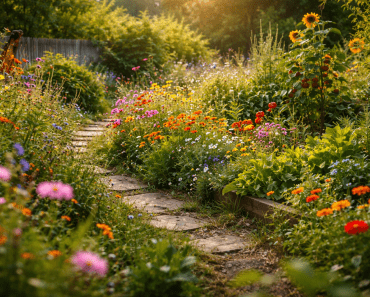
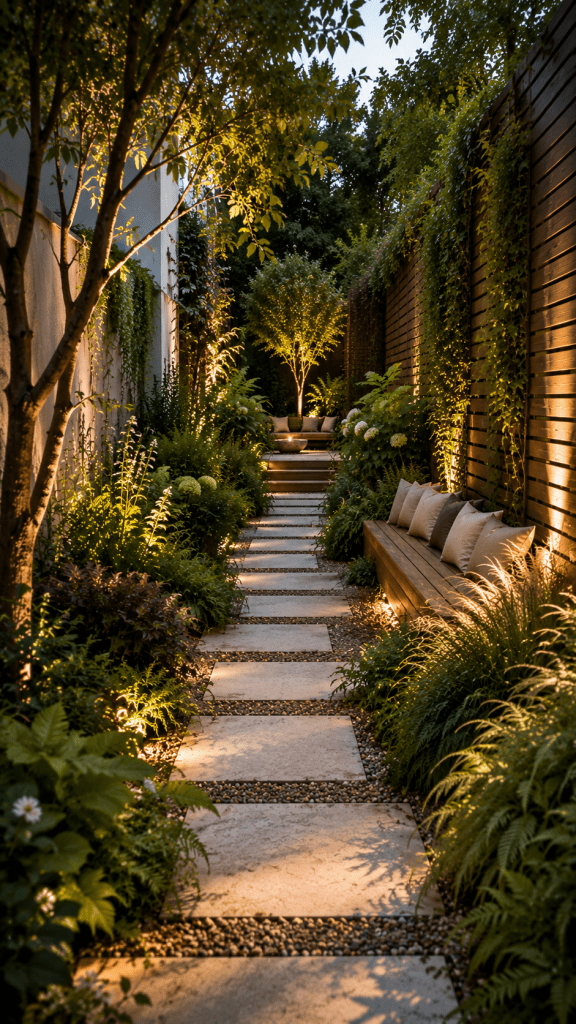
Instead of positioning a straight path directly through the center, the pathway gently shifts from one side to another. It does not need dramatic curves. Even small offsets can interrupt the tunnel effect commonly found in narrow gardens.
Large-format stepping stones, natural stone slabs, brick, or gravel can create the pathway.
Planting then overlaps the edges.
🌾 Ornamental grasses might lean slightly over the path.
🌿 Ferns can soften shaded corners.
🌸 Flowering perennials can provide seasonal color.
Small multi-stem trees can rise above lower planting and create a layered canopy.
The result feels less like walking through a narrow backyard and more like following a pathway through a miniature landscape.
Creating Depth in Layered Narrow Garden Designs
Depth is created by controlling what can and cannot be seen.
If someone standing at the entrance can immediately see every feature at the opposite end, the true dimensions of the garden become obvious. Partially obscuring the view creates visual uncertainty.
A multi-stem tree positioned approximately one-third of the way through the garden can be extremely effective.
Behind it, the pathway might shift slightly.
Farther ahead, a second planting zone or seating area becomes partially visible.
This sequence encourages curiosity.
The garden begins to feel longer because the eye moves through several layers instead of measuring one uninterrupted distance.
Tall plants should generally be positioned carefully rather than forming continuous dense walls. Strategic clusters create depth while maintaining enough openness to prevent the space from feeling enclosed.
Use Planting in Three Vertical Layers
One particularly effective technique is creating three planting levels.
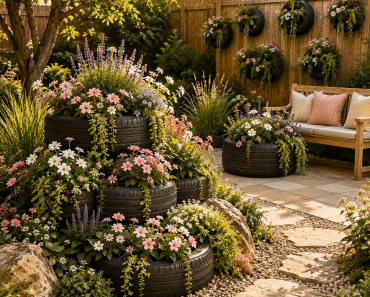
The lowest layer can include creeping groundcovers, low herbs, compact grasses, or flowering perennials. These soften paving and disguise hard boundaries.
The middle layer can include shrubs, ferns, hydrangeas, ornamental grasses, and medium-height perennials. This layer provides most of the garden’s visual volume.
The upper layer can include small trees, climbing plants, tall grasses, or carefully trained shrubs.
Together, these layers create an immersive landscape without requiring a very wide planting bed.
Instead of seeing a fence immediately, the viewer sees overlapping leaves, branches, flowers, and textures.
This is one of the simplest ways to make a narrow garden feel considerably richer.
Create a Strong Destination at the End
The end of a long garden deserves special attention because it naturally becomes a focal point.
Leaving this area empty often wastes one of the strongest design opportunities.
Consider placing a beautiful bench beneath a small tree, a sculptural planter, a compact water feature, or a simple garden artwork there.
A small seating nook can be particularly effective.
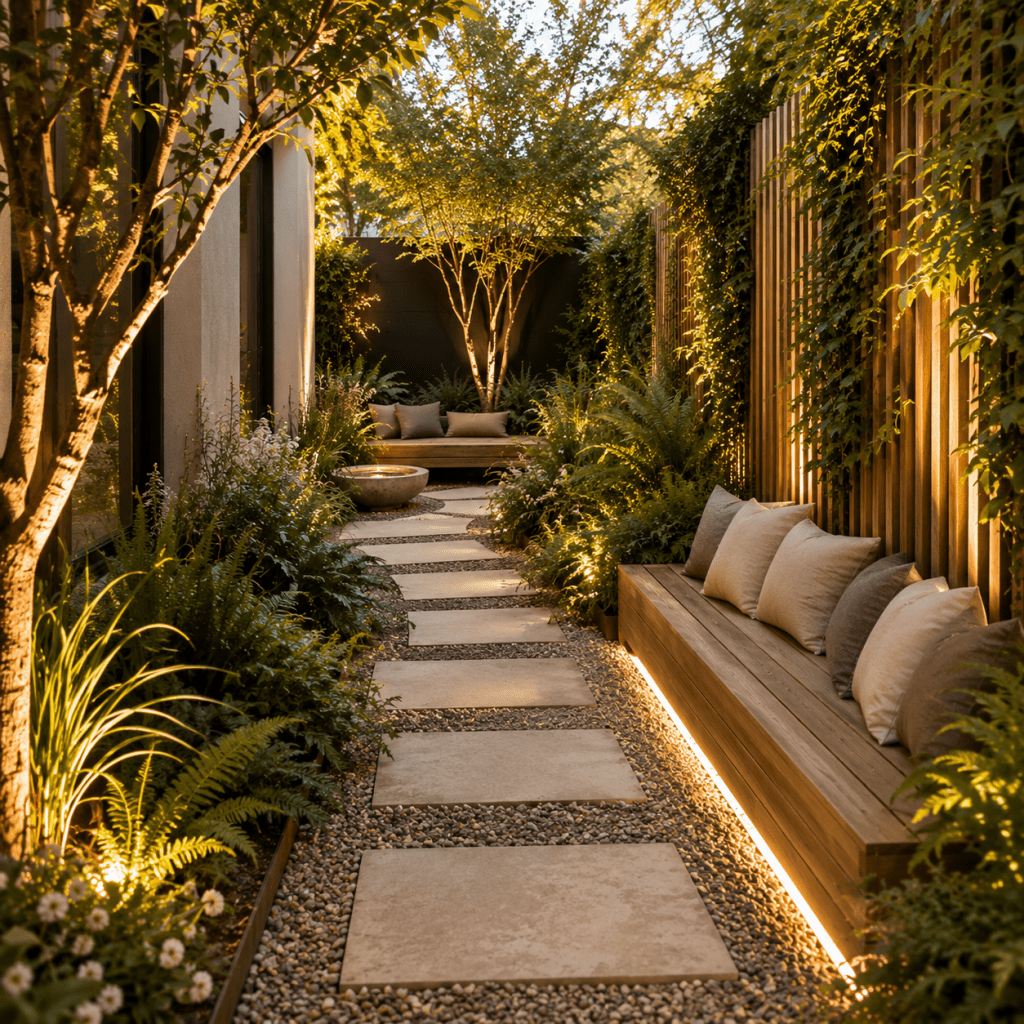
Imagine a timber bench positioned against a dark garden wall, surrounded by ferns and ornamental grasses. A multi-stem tree creates a delicate canopy overhead while warm integrated lighting illuminates the foliage during the evening.
Suddenly, the end of the garden becomes a destination rather than a boundary.
Important Note: Avoid placing too many large focal points along a narrow garden. One dominant destination supported by a few subtle secondary features usually creates a stronger and more spacious composition.
🥈 Best 2 Architectural Narrow Garden Designs With Modern Courtyard Zones
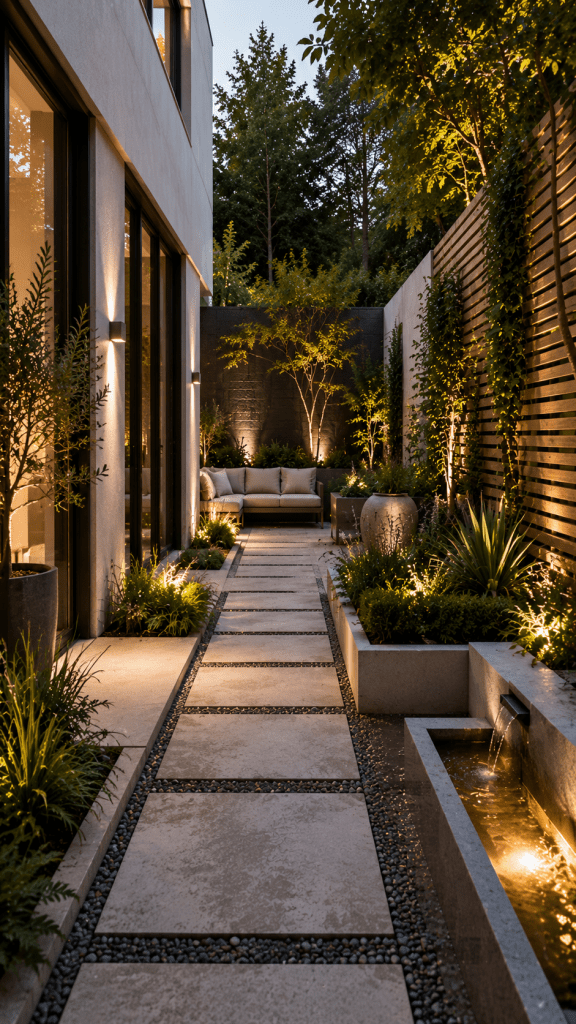
For contemporary houses, an architectural approach can create some of the most sophisticated Narrow Garden Designs.
Instead of trying to disguise the rectangular proportions completely, this design embraces geometry.
Clean paving lines, structured planting beds, timber screens, raised planters, and carefully positioned furniture create a garden that feels intentional rather than restricted.
The secret is proportion.
Large elements can actually work surprisingly well in narrow spaces when there are fewer of them.
For example, three large limestone paving slabs surrounded by fine gravel may feel calmer and more spacious than dozens of small pavers.
Similarly, one sculptural tree can create more impact than several unrelated shrubs.
✨ Simplicity becomes the luxury feature.
Divide Architectural Narrow Garden Designs Into Outdoor Rooms
A long garden can often accommodate several small zones.
Near the house, there might be a dining terrace.
The middle section could become a planted transition zone.
The far end might contain a lounge bench or quiet reading area.
The divisions should remain subtle.
A change from stone paving to gravel can signal a new area without creating a physical barrier.
A slim pergola can frame another section.
Raised planters can define seating without requiring additional walls.
The goal is to create multiple experiences while preserving visual continuity.
When done successfully, walking through the garden feels similar to moving through connected rooms inside a well-designed house.
Choose Large Format Materials
Small gardens often tempt homeowners to choose small materials.
However, excessive visual joints can make the garden feel busy.
Large-format limestone, porcelain, concrete slabs, or natural stone can create a cleaner surface with fewer interruptions.
A narrow pathway made from oversized rectangular slabs can emphasize elegance rather than limited dimensions.
Fine gravel between paving areas can provide contrast and improve drainage while maintaining a soft garden atmosphere.
Natural timber can then introduce warmth.
For example, pale limestone paving paired with natural oak or cedar screening creates a sophisticated balance between contemporary architecture and organic texture.
Black steel details can provide small moments of contrast without dominating the design.
Add Sculptural Planting Instead of Too Many Plants
Architectural gardens benefit from strong plant shapes.
Rather than filling every centimeter with different species, consider repeating a limited plant palette.
A row of upright ornamental grasses can create rhythm.
Clipped evergreen forms can introduce structure.
A multi-stem tree can become a living sculpture.
Climbing greenery can soften boundary walls.
Repeating the same plant at several points also connects different garden zones visually.
This repetition creates coherence.
🌿 A garden with ten carefully selected plant species can sometimes feel much more sophisticated than one containing thirty unrelated varieties.
Seasonal plants can still provide variation, but the underlying structure should remain simple.
Integrate a Minimal Water Feature
Water can be surprisingly effective in narrow gardens.
A huge pond is unnecessary.
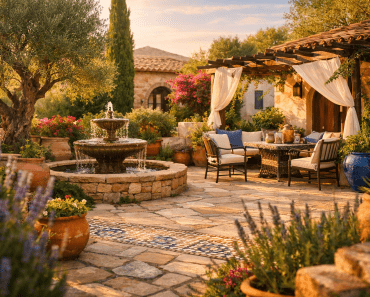
Instead, consider a long narrow reflecting channel, a compact wall fountain, or a simple stone water bowl.
The reflections introduce movement and depth.
Even a shallow rectangular pool positioned beside a pathway can visually expand the space because the reflected sky creates another perceived dimension.
Sound can be equally important.
Gentle moving water can mask nearby traffic or neighborhood noise, making an urban garden feel more secluded.
Keep the design restrained. A minimalist water feature should support the architecture rather than become an oversized decorative centerpiece.
🥉 Best 3 Multifunctional Narrow Garden Designs With Built In Seating and Vertical Greenery
The third idea is ideal when every centimeter needs to work hard.
These Narrow Garden Designs combine seating, planting, storage, vertical greenery, and flexible entertaining space into one compact layout.
Instead of placing freestanding furniture throughout the garden, built-in elements are integrated along the boundaries.
This immediately improves circulation.
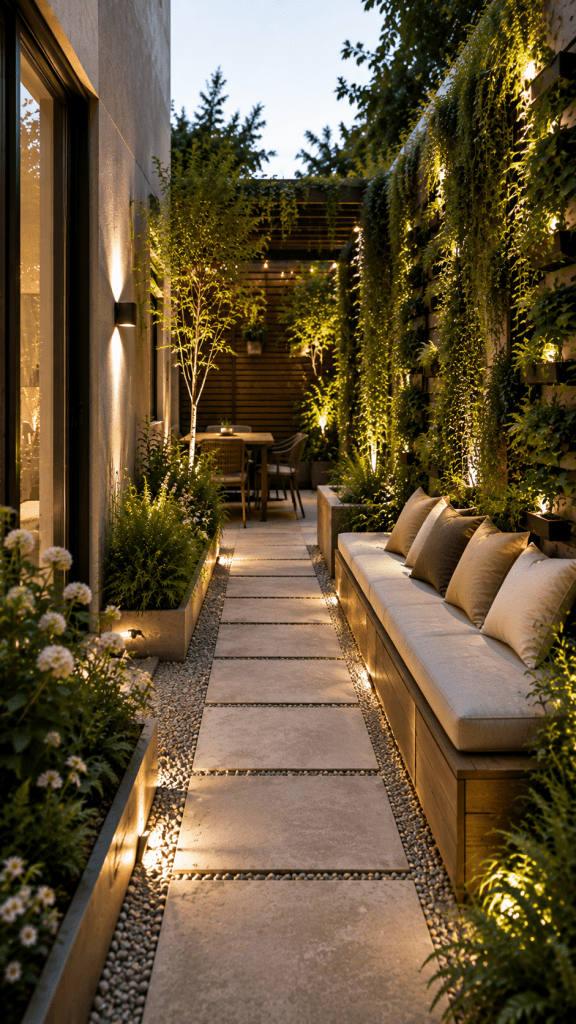
A slim timber bench, for example, can run along one side of the garden while raised planting behind it creates a green backdrop.
Storage can even be concealed beneath the seating.
Opposite the bench, a narrow planting strip or vertical green wall adds vegetation without making the central area feel crowded.
The middle remains relatively open.
This creates a surprisingly comfortable outdoor living space even when the garden is only a few meters wide.
Built In Seating Makes Narrow Garden Designs Feel Larger
Freestanding chairs require circulation space around them.
Built-in seating does not.
This makes benches particularly valuable in compact gardens.
A long bench positioned directly against a boundary can provide seating for several people while consuming relatively little usable space.
Adding cushions creates comfort without introducing bulky furniture.
The bench can also become part of the garden architecture.
Imagine a floating timber seat against a warm rendered wall with cascading plants growing from a slim planter behind it.
At night, hidden LED lighting beneath the seat creates a subtle floating effect.
The design remains practical during the day while becoming atmospheric after sunset.
Turn the Walls Into Garden Space
When floor space is limited, the boundaries become extremely valuable.
Climbing plants are one of the easiest solutions.
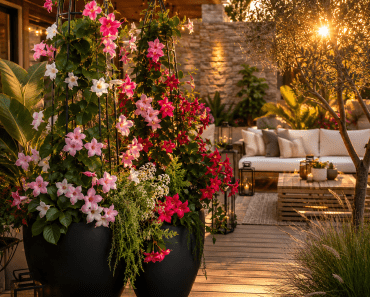
Star jasmine, climbing roses, clematis, ivy, or other climate-appropriate climbers can cover large surfaces while requiring relatively narrow planting zones.
Trellises can support the plants and create additional architectural detail.
Espalier fruit trees are another interesting possibility.
Apples, pears, citrus, and other suitable trees can sometimes be trained flat against walls, depending on climate and growing conditions.
This allows a narrow garden to include productive planting without requiring conventional orchard space.
Wall-mounted planters can also introduce herbs or small ornamental plants.
The result is a garden that expands vertically rather than horizontally. 🌱
Create One Flexible Central Space
The central zone should remain as open as possible.
This space might function differently depending on the day.
It could provide circulation during normal use.
A lightweight table could transform it into a dining area.
Children might use it as a temporary play area.
It could also accommodate yoga, gardening projects, or entertaining.
Flexible furniture works especially well here.
Choose chairs that can be stacked, folded, or moved easily.
Small round tables generally interfere less with circulation than large rectangular ones.
Keeping this central area flexible prevents the garden from becoming permanently dominated by furniture.
How to Make Narrow Garden Designs Look Wider
Several visual tricks can subtly change the perceived proportions of a narrow garden.
One is emphasizing horizontal lines across the width rather than continuously reinforcing the length.
Paving can help.
Instead of installing long paving boards parallel to the garden, placing materials across the width can visually stretch the space sideways.
Planting can perform a similar role.
Broad clusters of grasses or low shrubs positioned perpendicular to the main direction interrupt the long corridor effect.
Another technique involves varying the width of the pathway.
A path that becomes slightly wider near a seating area creates the impression that the garden itself is expanding.
Mirrors can occasionally be used, although they need careful positioning to avoid looking artificial. Reflective surfaces partially hidden behind foliage are usually more convincing than a large exposed mirror.
Narrow Garden Designs for Privacy
Privacy can be challenging because neighboring windows and boundaries are often close.
The instinctive solution is sometimes to build the tallest possible fence, but this can create a boxed-in feeling.
Layered screening usually works better.
Start with the existing boundary.
Then introduce climbing plants or narrow trellises.
Small trees can provide additional screening higher up.
A lightweight pergola may offer overhead structure without completely blocking sunlight.
The goal is to filter views rather than constructing an opaque enclosure around every side.
Plants with delicate foliage can be particularly effective because they create privacy while allowing light to pass through.
Bamboo can work in some situations, but species selection and root containment require careful consideration because some varieties can spread aggressively.
Choosing Plants for Narrow Garden Designs
Plant selection should be based on local climate, sunlight, soil, drainage, and maintenance preferences, but plant shape is particularly important in compact gardens.
Choose plants that provide substantial visual interest without rapidly overwhelming pathways.
Upright grasses are useful because they create height without excessive width.
Climbing plants provide greenery using minimal ground area.
Compact shrubs create structure.
Small multi-stem trees provide vertical interest and canopy without necessarily requiring the footprint of a large shade tree.
A balanced narrow garden might combine evergreen structure with seasonal flowering plants.
This keeps the garden visually attractive throughout the year while allowing seasonal changes to create variety.
Texture is also important.
Combining fine grasses, broad leaves, delicate flowers, and structured evergreen foliage creates depth even when the color palette remains restrained.
Lighting Ideas for Narrow Garden Designs
Lighting becomes especially dramatic in narrow gardens because nearby surfaces catch and reflect the illumination.
Instead of flooding the entire garden with bright light, use multiple low-intensity sources.
Uplights beneath small trees can reveal branch structure.
Low pathway lights can guide movement.
Hidden lighting beneath benches or raised planters can create a subtle floating effect.
Wall lights can emphasize textured stone, brick, timber, or rendered surfaces.
Warm light generally creates a comfortable residential atmosphere.
💡 The objective is not to make the garden look like daytime.
A more sophisticated approach allows certain areas to disappear into shadow while important plants and architectural details remain illuminated.
This creates depth.
The far end of the garden should usually receive some lighting as well. A softly illuminated tree or feature wall draws the eye toward the distance, making the garden appear longer at night.
Materials That Make Narrow Garden Designs Feel Expensive
Luxury does not necessarily come from expensive materials.
Consistency often matters more.
Using two or three complementary materials throughout the garden can create a much more refined result than combining numerous unrelated finishes.
Natural stone provides timeless texture.
Timber introduces warmth.
Fine gravel softens hard landscaping.
Dark metal provides architectural contrast.
For example, a narrow garden could use pale limestone for paving, natural timber for seating and screening, and black steel for subtle edging.
Plants then become the primary source of color.
This creates a calm foundation that can remain attractive even as planting changes throughout the seasons.
Material transitions should also be intentional. If the pathway changes from stone to gravel, the transition can mark the entrance to another garden zone rather than occurring randomly.
Common Narrow Garden Design Mistakes to Avoid
One common mistake is placing planting beds of exactly the same width along both boundaries.
This creates a symmetrical corridor that emphasizes the narrow proportions.
Varying the planting depth produces a more natural and spacious composition.
Another mistake is using too many tiny features.
Several small pots, multiple decorative ornaments, different paving patterns, numerous furniture pieces, and excessive plant varieties can quickly create visual clutter.
Choose fewer but stronger elements.
Oversized furniture is another problem.
A beautiful outdoor sofa becomes frustrating if people need to squeeze around it every time they walk through the garden.
Circulation should always remain comfortable.
Finally, do not ignore the view from inside the house.
In many homes, the narrow garden is visible through kitchen, dining, or living room windows throughout the day.
The garden therefore acts almost like a living artwork.
Position major focal points where they can also be appreciated from indoors.
Budget Friendly Narrow Garden Designs
A narrow garden does not need to be completed at once.
Start with the structural decisions.
Determine the pathway, seating location, major planting areas, and final focal point before purchasing decorative accessories.
Plants can then be introduced gradually.
Smaller specimens are usually less expensive and can establish surprisingly quickly when planted correctly.
Gravel is another useful material for budget-conscious projects because it can cover relatively large areas while maintaining a natural appearance.
Simple timber trellises can transform unattractive boundaries without requiring complete fence replacement.
Paint can also dramatically change the atmosphere.
A dark fence can visually recede behind green foliage, while warm neutral tones can create a brighter courtyard feeling.
Invest first in elements that are difficult to change later, such as drainage, paving, electrical infrastructure, and major built-in structures.
Decorative pieces can evolve over time.
Which of the Best 3 Narrow Garden Designs Should You Choose
Choosing between these three ideas depends primarily on how the garden will be used.
Choose 🥇 Best 1 Layered Narrow Garden Designs With a Hidden Garden Journey if greenery is the main priority. This approach is ideal for creating a lush sanctuary where planting dominates the experience.
Choose 🥈 Best 2 Architectural Narrow Garden Designs With Modern Courtyard Zones if the garden connects to a contemporary house and needs to feel polished, structured, and sophisticated. It works particularly well for entertaining and modern outdoor living.
Choose 🥉 Best 3 Multifunctional Narrow Garden Designs With Built In Seating and Vertical Greenery when space is extremely limited and functionality is essential. Integrated seating and vertical planting allow a surprisingly small garden to provide substantial everyday value.
There is no need to follow only one approach.
Some of the most successful gardens combine them.
A narrow garden might have architectural paving near the house, transition into layered naturalistic planting, and finish with a compact built-in seating nook.
The important principle is maintaining a consistent visual language throughout the space.
Final Thoughts on Narrow Garden Designs
The best Narrow Garden Designs prove that limited width does not have to mean limited creativity. In many cases, narrow proportions can actually produce a stronger garden experience because they naturally encourage movement, framed views, intimate seating areas, vertical planting, and carefully planned focal points.
🥇 A Layered Garden Journey uses planting and changing sightlines to transform a long rectangular space into an immersive landscape.
🥈 An Architectural Courtyard Garden embraces clean geometry, sophisticated materials, and defined outdoor rooms to create a contemporary retreat.
🥉 A Multifunctional Garden Retreat maximizes every available centimeter through built-in seating, flexible open space, and vertical greenery.
Whichever approach is chosen, the most successful narrow garden will rarely be the one containing the greatest number of features. It will be the one where each element contributes to a deliberate sequence.
Use planting to soften boundaries. 🌿 Use pathways to control movement. Use vertical surfaces instead of overcrowding the ground. Create one memorable destination at the far end. Keep materials consistent, furniture proportional, and lighting subtle.
With these principles, even an ordinary strip of outdoor space can become a sophisticated garden that feels private, layered, functional, and surprisingly expansive.