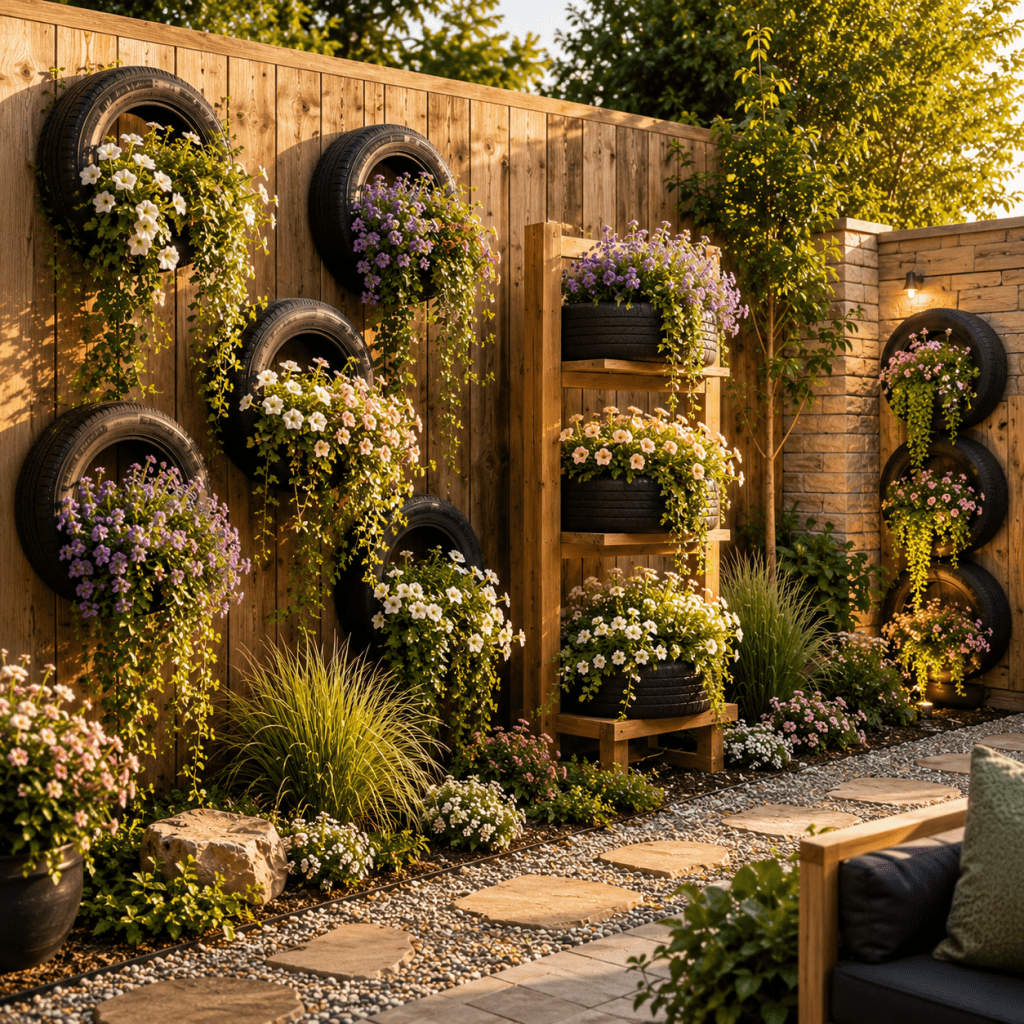
When garden space is limited, the most valuable direction is often upward. That is exactly where Vertical Tire Garden Ideas become especially useful. Instead of allowing old tires to occupy valuable ground area, a vertical arrangement turns them into elevated planting pockets that can transform fences, walls, narrow side yards, and compact patios.
The key is to think beyond simply hanging one tire.
A true vertical tire garden should behave like a complete planting system. It can organize several tires across a wall, create multiple growing levels on a freestanding timber structure, or combine tires with climbing and cascading plants so the entire surface begins to feel alive.
Done well, the result can be much more sophisticated than a typical recycled garden project.
The tires provide structure. The plants provide softness. The vertical framework creates rhythm. And the background ties everything together.
For this guide, the three concepts are deliberately different. The first turns a plain wall or fence into a dramatic living display. The second uses a freestanding tiered frame that works especially well when permanent wall mounting is not ideal. The third creates a compact vertical corner garden designed specifically for very small outdoor spaces.
Here are the 3 best Vertical Tire Garden Ideas for getting more planting impact from limited space.
| Rank | Vertical Tire Garden Idea | Main Visual Effect | Best For |
|---|---|---|---|
| 🥇 | Sculptural Tire Living Wall | Dramatic multi-level vertical display | Fences and blank garden walls |
| 🥈 | Freestanding Tiered Tire Garden Frame | Flexible structured vertical planting | Patios and rented spaces |
| 🥉 | Compact Corner Tire Garden Tower | Maximum impact in minimal space | Tiny backyards and narrow corners |
Important Note: Vertical tire gardens can become extremely heavy once filled with growing medium and watered. Use structurally appropriate supports, secure every planter properly, and avoid installations above seating, play areas, or frequently used walkways. Reused tires are most straightforward for ornamental planting rather than edible crops when their material history is uncertain.
🥇 Platz 1 Sculptural Tire Living Wall
The most dramatic way to use vertical space is to treat the entire wall as one garden composition.
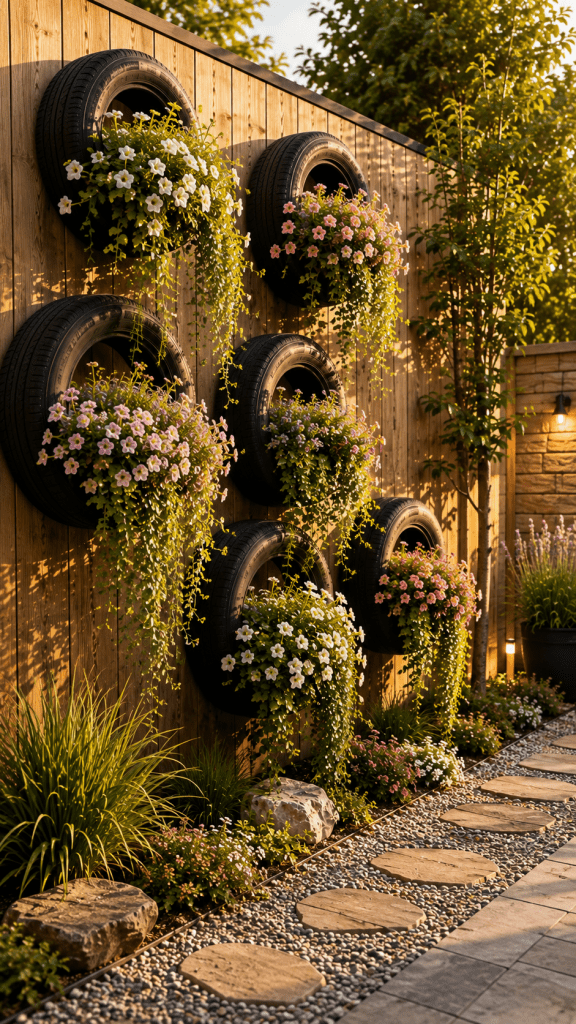
A Sculptural Tire Living Wall uses several tires arranged across a strong fence, masonry wall, or purpose-built vertical structure. The tires sit at carefully chosen heights, while flowers, foliage, and trailing plants visually connect them.
The result is not simply a collection of mounted planters.
It becomes a living installation.
Design the Wall Before Positioning the Tires
Start with the empty surface.
Look at its width, height, material, and surrounding landscape.
Then imagine where visual weight should sit.
A symmetrical grid can create a clean contemporary result.
An asymmetrical layout creates more movement.
For example, you might place:
one tire high on the left,
two across the middle,
one slightly lower on the right,
and another near the bottom.
The eye moves naturally across the wall rather than reading a rigid row.
A diagonal arrangement is another possibility.
The tires can climb gradually from lower left to upper right, giving the composition a sense of upward movement.
Avoid Covering the Entire Wall
Negative space is essential.
If every part of the wall is filled with tires, the display can feel heavy and crowded.
Allow the background to remain visible.
A natural-oak fence, pale masonry wall, weathered brick, or rendered surface can become part of the overall design.
The contrast between the strong circular tire shapes and the calm background gives the arrangement more clarity.
Use Different Planting Behaviors
A vertical garden becomes much more interesting when every planter is not identical.
Higher tires should emphasize cascading plants.
They are viewed from below, so foliage spilling downward becomes especially important.
Middle planters can combine mounding flowers, trailing foliage, and one or two upright accents.
Lower tires can contain fuller planting with more visible structure.
This produces a natural progression from top to bottom.
Let Plants Connect Separate Tires
The tires may be physically separate, but they should feel visually linked.
Trailing foliage can descend toward the planter below.
Climbing plants can grow around the vertical structure.
Small vines can extend sideways.
Repeating the same flower in several tires also creates continuity.
The goal is to make the wall feel like one ecosystem rather than several isolated circles.
Choose a Limited Tire Palette
The wall already contains repetition.
Paint can either strengthen that rhythm or make it chaotic.
For a sophisticated result, choose one color family.
Good options include:
- charcoal,
- muted sage,
- warm gray,
- dusty blue,
- terracotta,
- soft stone.
You can use the same color on every tire or gradually vary the tone.
For example:
deep charcoal → medium gray → pale stone
or:
deep sage → muted sage → soft olive
Tonal variation creates interest while keeping the display coherent.
Create Contrast With the Background
If the wall is light, darker tires often work beautifully.
If the wall is dark timber, lighter muted tires may create stronger definition.
Against dense greenery, pale flowers can help the planter shapes remain visible.
Think in terms of contrast.
The tire, planting, and background should not all occupy the same visual tone.
Add Ground Planting Beneath the Wall
One of the strongest ways to make a vertical tire garden feel complete is to continue the planting at ground level.
Low ornamental grasses can sit beneath the installation.
Groundcovers can spread along the base.
A narrow flower bed can repeat some of the same plants used in the tires.
This visually connects the vertical and horizontal garden.
Without that connection, the wall can feel detached from the rest of the landscape.
Best Places for a Tire Living Wall
This concept works particularly well:
- along long backyard fences,
- against blank garden walls,
- in narrow side yards,
- behind patio seating,
- beside outdoor dining areas,
- or wherever conventional flower beds would take up too much space.
It can also disguise an unattractive surface surprisingly effectively.
Why This Idea Takes First Place
The Sculptural Tire Living Wall earns 🥇 because it delivers the strongest transformation.
A plain vertical surface becomes a layered garden filled with flowers, texture, and depth.
And because the tires occupy wall space rather than floor space, the actual footprint remains relatively small.
🥈 Platz 2 Freestanding Tiered Tire Garden Frame
Not every garden has a wall or fence suitable for supporting heavy planters.
That is where the Freestanding Tiered Tire Garden Frame becomes useful.
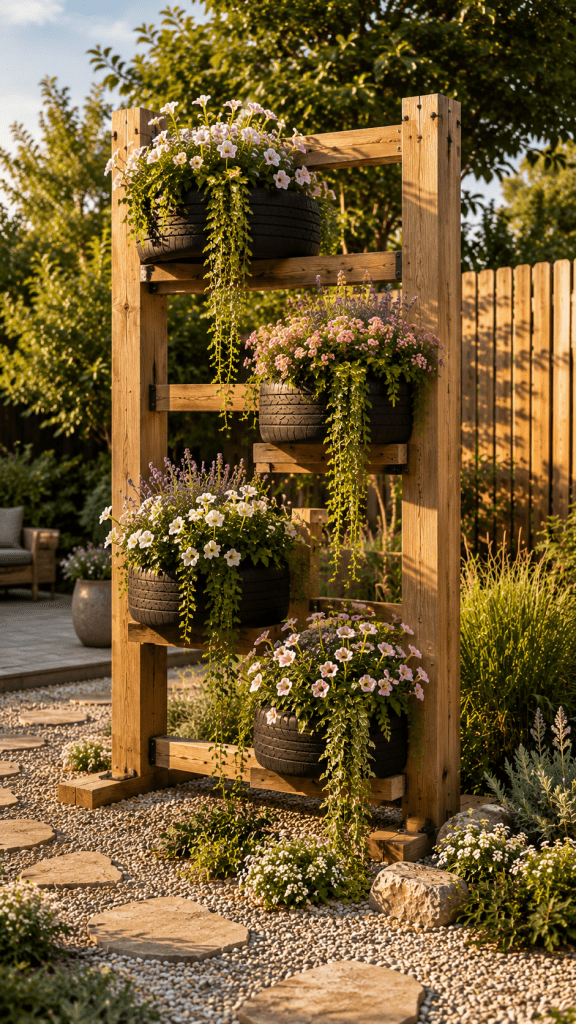
Instead of attaching tires directly to an existing structure, this concept uses a purpose-built frame to support several planters at different heights.
The structure can become almost like an outdoor shelving system for recycled tire planters.
Think of It as Garden Furniture
A well-designed freestanding frame should feel intentional.
Natural timber is particularly effective.
It visually softens the rubber and creates a warmer garden aesthetic.
Dark metal can work in contemporary spaces.
Whatever material is chosen, the frame should be designed for the actual weight of the loaded planters and outdoor conditions.
Visually, the frame can include:
two vertical posts,
several horizontal supports,
and tires positioned at staggered heights.
The exact engineering should follow the required load and installation conditions.
Stagger Rather Than Stack
One advantage of a frame is that the tires do not need to sit directly above one another.
Position them at different horizontal points.
One might sit high on the left.
Another could occupy the center.
Two more may sit lower toward the opposite side.
This creates a more dynamic arrangement and gives each planter enough room for foliage to spread.
Use the Frame as Part of the Design
Do not try to hide the structure completely.
If it is made from beautiful natural timber, let some of it remain visible.
The contrast between warm wood, dark or muted tires, and green planting can be extremely attractive.
A black steel frame creates a different aesthetic: cleaner, more architectural, and contemporary.
The structure should complement the surrounding garden rather than look purely functional.
Introduce Multiple Plant Layers
Higher planters can contain trailing flowers.
Middle planters can use mounding foliage.
Lower tires can include fuller plants.
You can even use the base of the frame for conventional pots or low ground planting.
This creates several layers without requiring a wide garden bed.
Make the Plant Palette Consistent
A freestanding structure can quickly become busy because the frame, tires, and plants are all visible.
A limited planting palette helps.
For example:
white flowers + green foliage + burgundy accents
creates a strong but controlled look.
Or:
lavender + pale pink + silver foliage
produces a softer romantic effect.
You can repeat the same trailing plant in every tire to visually tie the structure together.
Use It as a Garden Divider
A freestanding vertical garden does not always need to sit against a wall.
It can divide outdoor zones.
For example, it can visually separate:
a patio from a lawn,
a dining zone from a garden bed,
or a utility area from an ornamental garden.
The plants then provide partial screening while the vertical structure defines the space.
Create a Double-Sided Garden
If the frame is visible from both sides, consider planting accordingly.
Some tires can face one direction.
Others can face the opposite side.
This creates visual interest from multiple viewpoints.
It also makes the structure especially suitable for central patio or courtyard locations.
Best Places for a Freestanding Tire Garden
This concept works well:
- on patios,
- in courtyards,
- beside outdoor seating,
- in rented gardens where permanent wall installation may not be desirable,
- along wide pathways,
- or as a garden divider.
It offers more flexibility than a permanently mounted tire wall.
Why It Takes Second Place
The Freestanding Tiered Tire Garden Frame earns 🥈 because it combines vertical planting with flexibility.
It does not depend on an existing wall.
It can become a decorative structure in its own right.
And it offers far more design freedom than simply stacking tires on the ground.
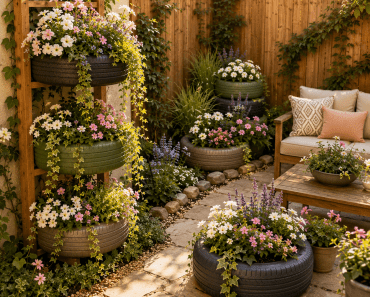
🥉 Platz 3 Compact Corner Tire Garden Tower
Sometimes the available space is extremely limited.
Maybe there is only one unused corner beside a fence.
Perhaps the garden is narrow.
Maybe a patio needs greenery without sacrificing walking space.
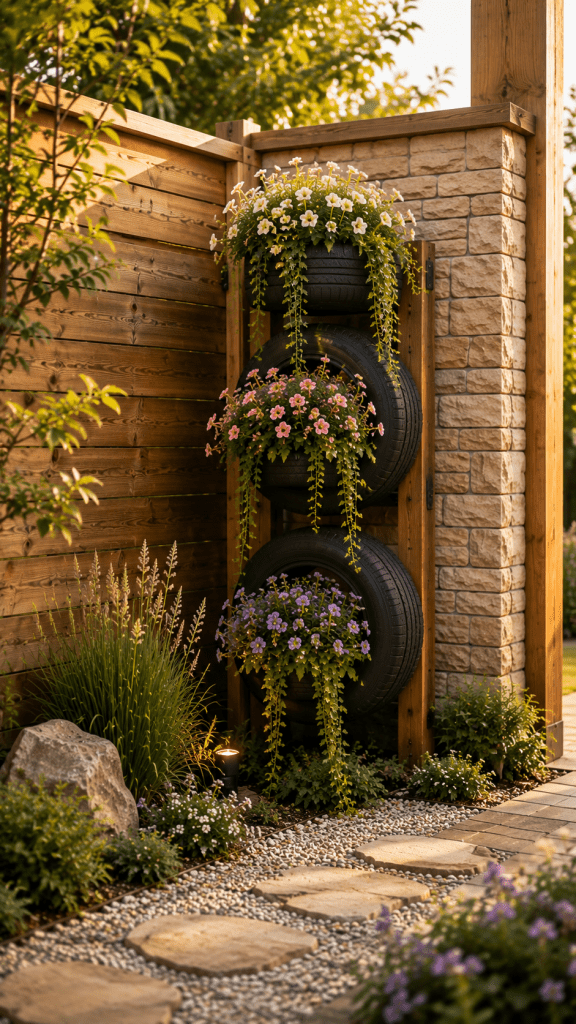
The Compact Corner Tire Garden Tower is designed for exactly that situation.
It concentrates vertical planting into one small footprint.
Use the Corner as Natural Framing
Corners are often difficult garden spaces.
They may feel empty, dark, or visually awkward.
A vertical tire arrangement can turn that weakness into a focal point.
Place the structure where two walls, fences, or garden edges meet.
The surrounding surfaces naturally frame the planter.
This makes even a relatively small installation feel intentional.
Keep the Footprint Narrow
The goal is not to create a broad display.
Use only enough width to establish visual structure.
Two or three tires can sometimes be sufficient.
They may be mounted on a narrow frame or arranged vertically with appropriate support.
The key is to create height without projecting too far into the usable space.
Use Cascading Plants to Fill the Empty Vertical Area
A compact structure becomes more visually substantial when plants extend beyond the tire edges.
Trailing foliage can descend from the upper level.
Flowers can spill sideways.
Fine vines can move toward the surrounding fence.
The plants effectively increase the visual size of the garden without increasing the physical footprint very much.
Keep the Colors Quiet
Small spaces can become visually crowded quickly.
Use a restrained palette.
Dark charcoal tires with white flowers and green foliage can look very clean.
Muted sage with pale pink blooms produces a softer effect.
Warm terracotta with cream flowers can create a cozy Mediterranean character.
Avoid combining too many strong paint colors, flower colors, and decorative patterns in one small corner.
Introduce Light-Colored Flowers in Dark Corners
If the area receives appropriate growing conditions but appears visually dark, pale flowers can help brighten it.
White, cream, pale pink, or lavender blooms reflect more visual light than deep red or burgundy.
Pair them with varied green foliage to avoid a flat appearance.
Add a Small Ground Layer
Even though the concept is vertical, a small amount of planting at the bottom makes the tower feel connected to the landscape.
One low conventional planter can work.
A narrow patch of groundcover can soften the base.
A small gravel bed can define the feature.
You do not need much.
The goal is simply to prevent the vertical structure from looking as though it stops abruptly at the ground.
Keep Maintenance Practical
A compact corner garden can become difficult to access if the planters are positioned too high or too close to surrounding structures.
Think about watering and routine care before finalizing the arrangement.
You should be able to reach the plants safely.
The planter should also have enough airflow and appropriate light for the species selected.
Best Places for This Idea
The Compact Corner Tire Garden Tower works especially well:
- in tiny backyards,
- on compact patios,
- beside narrow pathways,
- between a shed and fence,
- in courtyard corners,
- or wherever floor space is extremely valuable.
Why It Takes Third Place
This concept earns 🥉 because it solves the most extreme space problem.
It does not try to create an entire wall garden.
Instead, it turns one underused vertical corner into a concentrated planting feature.
Vertical Tire Garden vs Hanging Tire Planter
These two ideas are related, but they are not the same.
A Hanging Tire Planter usually focuses on one suspended tire or several independently suspended planters.
A Vertical Tire Garden is more systematic.
It treats multiple planting levels and the supporting surface or structure as one composition.
Think of it this way:
Hanging tire planter = individual feature
Vertical tire garden = complete vertical planting system
This distinction is useful when designing the space and when choosing which idea best suits your garden.
How to Make a Vertical Tire Garden Look More Professional
Recycled materials can look sophisticated when the design is disciplined.
Repeat the Same Materials
If natural oak is used for the vertical frame, repeat timber somewhere nearby.
If the base uses gravel, connect it visually with an existing gravel path.
Limit the Paint Colors
One tire color or one tonal family is usually enough.
Repeat Plants
Choose one flower or foliage plant that appears across multiple tires.
Leave Negative Space
Do not fill every available section of the wall or frame.
Hide Technical Details Where Possible
Mounting hardware should be structurally correct, but unnecessary visual clutter can be minimized through thoughtful positioning and finishing.
How Many Tires Should a Vertical Garden Use
There is no ideal number.
A small frame might need only three.
A large wall could accommodate more.
The correct quantity depends on:
- wall size,
- tire size,
- structural capacity,
- visual spacing,
- maintenance access,
- and total loaded weight.
Do not assume that more tires create more impact.
Four beautifully spaced planters can look better than twelve crowded ones.
Choose Plants Based on Viewing Height
This is particularly important in vertical gardens.
Plants at eye level can display both flowers and foliage.
Higher plants are often viewed from below.
They benefit from cascading growth.
Lower plants are viewed from above or directly from the front.
They can support fuller upright forms.
Design each tire based partly on how it will actually be seen.
Use Foliage to Create Year-Round Structure
Flowers may dominate seasonal photographs, but foliage often determines whether the vertical garden looks good for longer periods.
Choose leaves with different forms.
Combine fine foliage with broader leaves.
Introduce subtle variations in green.
A little burgundy or silver foliage can add contrast.
This creates interest even when flowering is reduced.
How to Water a Vertical Tire Garden
Watering requirements depend on the plants, climate, exposure, and container design.
Higher planters may dry more quickly because they can receive more wind.
Planters beneath overhangs may receive less rainfall.
The vertical position can therefore create different moisture conditions across the same structure.
Check each planter rather than assuming they all behave identically.
And ensure that excess water can drain safely without creating problems for the tires or structures below.
Drainage Is Especially Important on Walls
Water from an upper planter may fall toward the structure or planter beneath it.
That needs to be considered during design.
Avoid creating situations where water continually saturates timber, masonry, or mounting points.
Allow drainage to move safely away from structural components whenever possible.
Good drainage is not just about plant health.
It also protects the installation.
Consider Heat Exposure
Dark rubber can absorb considerable heat in strong sunlight.
A tire positioned against a hot wall may experience even higher temperatures.
This makes location especially important.
Observe how much direct sun the wall receives.
Consider reflected heat from masonry.
Choose plants appropriate for the actual microclimate rather than simply selecting the most visually attractive flowers.
Create a Strong Background
A vertical tire garden always interacts with the surface behind it.
Natural timber creates warmth.
Pale plaster or masonry provides contrast.
Brick introduces texture.
Dark fencing can create a dramatic backdrop for light flowers.
Use the background intentionally.
If the wall already has a strong pattern or many decorative features, keep the tire arrangement simpler.
Common Vertical Tire Garden Mistakes
The first is overcrowding.
Too many tires leave no visual breathing room.
Another is ignoring loaded weight.
A planter that seems light when empty can become extremely heavy after soil and water are added.
Random plant selection is another problem.
If every tire has unrelated colors and growth habits, the wall may feel chaotic.
Poor maintenance access can also cause problems.
A planter positioned beautifully but impossible to water safely is not a successful design.
And finally, failing to integrate the base can make the vertical garden look like an object attached to the wall rather than part of the landscape.
Which Vertical Tire Garden Idea Is Best
Choose the 🥇 Sculptural Tire Living Wall if you want the most dramatic transformation of a fence or wall.
It creates the strongest sense of a complete vertical garden.
Choose the 🥈 Freestanding Tiered Tire Garden Frame if you need more flexibility or do not want to rely on an existing structure.
It can work as a garden feature, divider, or portable-looking installation.
Choose the 🥉 Compact Corner Tire Garden Tower if space is extremely limited.
It concentrates planting into one narrow area while still creating valuable height and visual interest.
Final Thoughts on Vertical Tire Garden Ideas
The best Vertical Tire Garden Ideas do much more than move tire planters off the ground.
They use height strategically.
The 🥇 Sculptural Tire Living Wall turns a plain fence or wall into a layered botanical display.
The 🥈 Freestanding Tiered Tire Garden Frame creates a flexible vertical planting structure that can become part of the garden architecture.
And the 🥉 Compact Corner Tire Garden Tower shows that even a tiny unused corner can support a surprisingly rich garden feature.
Whichever approach you choose, treat the vertical surface as part of the design.
Plan the spacing before adding tires.
Repeat plants and colors.
Use trailing foliage to connect different levels.
Leave enough negative space.
And make structural strength, drainage, access, and stability part of the design from the beginning.
When those elements work together, old tires no longer feel like containers simply attached to a wall.
They become the framework for a living vertical landscape.