Stacking old tires is one of the easiest ways to turn a simple recycled planter into a much more dramatic garden feature. Instead of keeping every tire at ground level, Stacked Tire Planter Ideas introduce height, structure, and layered planting that can make even a small backyard feel more designed.
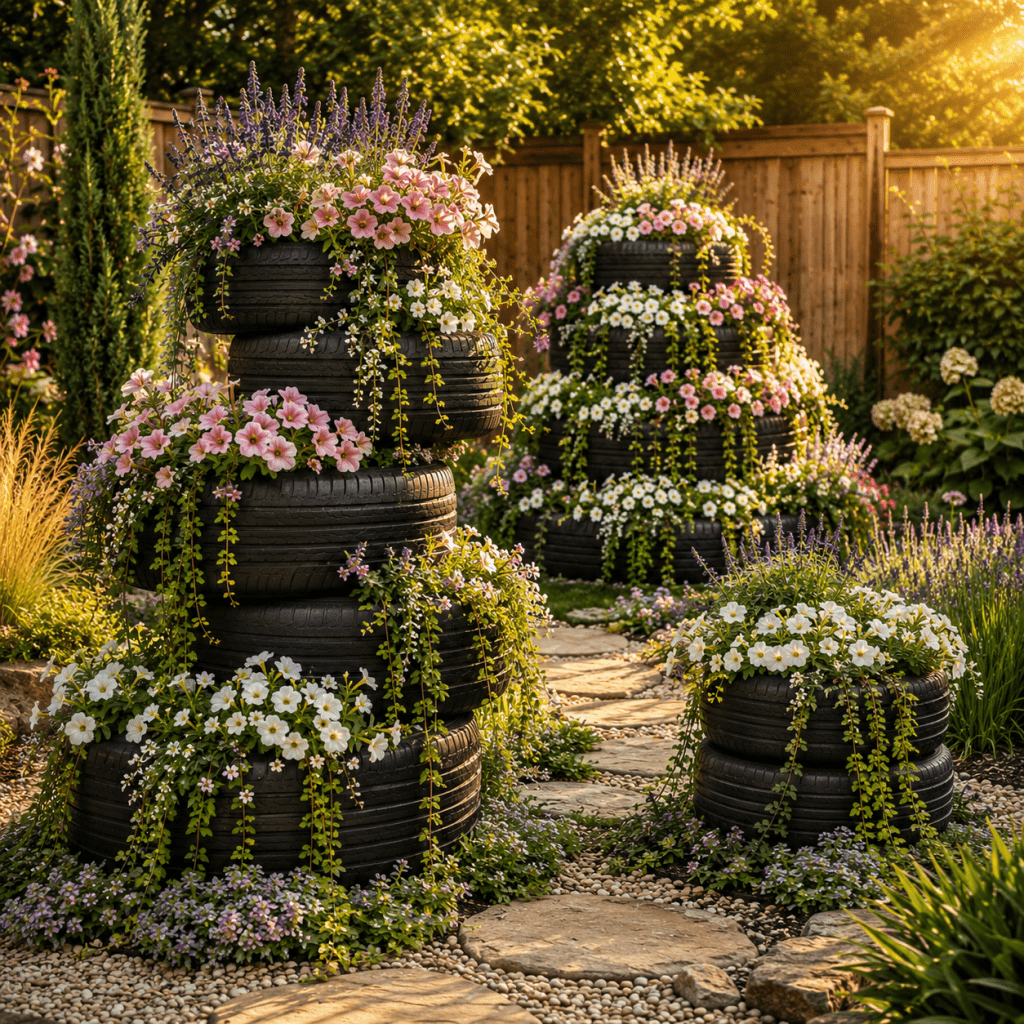
The strongest stacked tire planters are not just piles of tires filled with soil.
They are compositions.
Each level should have a purpose. One layer may create height, another can hold dense flowering plants, and a lower section can support trailing foliage that softens the entire structure. The arrangement of the tires matters just as much as the plants growing inside them.
A good stacked planter should feel balanced from a distance and interesting up close.
It should also visually belong in the surrounding garden rather than appearing like a separate DIY object.
For this guide, the three ideas take distinctly different approaches. The first creates a dramatic staggered floral tower. The second uses a wide tiered structure for a lush cascading effect. The third keeps the stack compact and sculptural, making it ideal for smaller outdoor spaces.
Here are the 3 best Stacked Tire Planter Ideas for creating an eye-catching garden display.
| Rank | Stacked Tire Planter Idea | Main Visual Effect | Best For |
|---|---|---|---|
| 🥇 | Staggered Floral Tire Tower | Dramatic height and movement | Backyard focal points |
| 🥈 | Tiered Cascading Tire Planter | Lush layered flowers | Patios and large garden corners |
| 🥉 | Compact Sculptural Tire Stack | Strong shape in a small footprint | Small gardens and narrow spaces |
Important Note: Stacked tire planters become significantly heavier once filled with growing medium and watered. Build on a stable surface, keep the stack secure, and avoid unstable arrangements that could shift or tip. For ornamental planting, reused tires are generally the most straightforward use; purpose-made food-safe containers are preferable when growing edible crops and material history is uncertain.
🥇 Platz 1 Staggered Floral Tire Tower
The most visually powerful stacked tire planter is rarely a perfectly straight column.
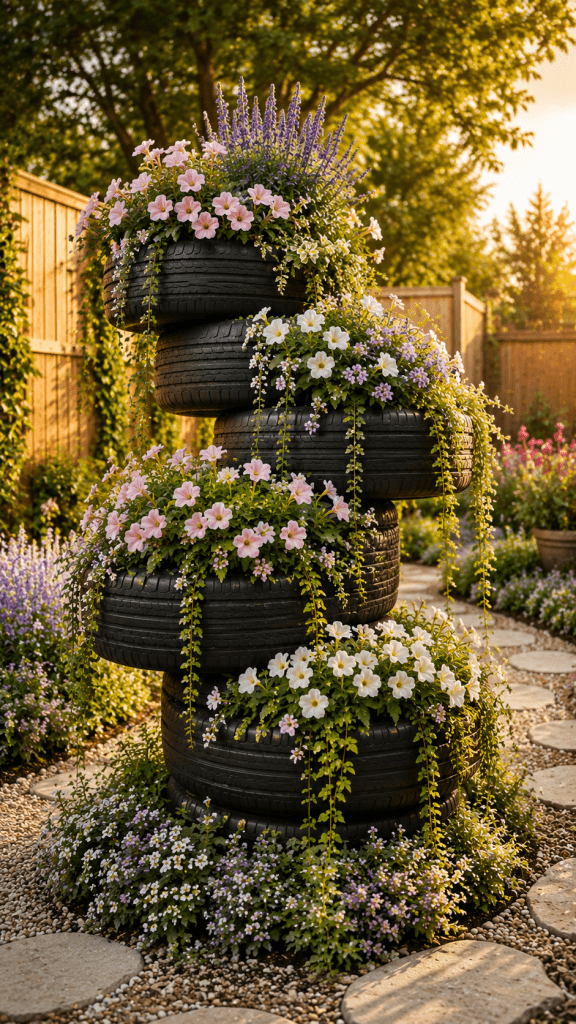
A Staggered Floral Tire Tower creates movement by shifting the tires slightly from one level to the next.
Instead of reading as one rigid vertical stack, the structure develops rhythm.
That small change makes an enormous difference.
The arrangement becomes more sculptural and gives plants more opportunities to cascade between levels.
Build With Asymmetry
Imagine three or four tires.
The lowest tire forms the base.
The second is positioned slightly off-center.
The third shifts in another direction.
A final smaller visual crown can complete the composition.
The tires should still remain structurally stable, but visually they do not need to align perfectly.
This gives the tower a more organic silhouette.
From one side, part of the lower planter remains visible.
From another, a higher tire overlaps it.
These changes create depth.
Use Each Level Differently
One of the biggest mistakes with stacked tire planters is planting every level in the same way.
That makes the structure repetitive.
Instead, give each tier a specific role.
The top can contain taller flowers or architectural foliage.
The middle can be dense with mounding blooms.
The lower level can emphasize trailing plants.
This creates a natural visual progression.
Top = height
Middle = fullness
Bottom = movement
The entire stack begins to function like one large container.
Let Plants Bridge the Gaps
If every tire remains clearly visible, the arrangement can feel too mechanical.
Use trailing foliage to visually connect the levels.
A vine spilling from the upper tier can partially cover the tire beneath it.
Flowers growing outward from the middle level can overlap the lower tire.
At the base, low plants can merge with surrounding groundcover.
These overlapping layers help disguise the boundaries between individual tires.
Choose a Controlled Color Palette
Because the stack already has a strong shape, too many colors can make it feel chaotic.
A restrained planting palette is usually more effective.
Try:
white + lavender + green
for a calm romantic appearance.
Or:
soft pink + burgundy + green
for a richer look.
For a warm summer palette:
cream + apricot + deep green
can work beautifully.
The same color should appear on more than one level.
That repetition keeps the stack visually connected.
Keep the Tires Dark or Muted
Brightly painting every tire is not necessary.
A dark charcoal stack with pale flowers can look surprisingly elegant.
Muted olive, warm gray, deep brown, or soft terracotta can also work.
The advantage of a restrained tire color is simple:
the flowers remain the focal point.
As the plants mature, portions of the rubber may disappear behind foliage anyway.
Use the Base to Anchor the Tower
A tall structure needs visual weight near the ground.
Surround the lowest tire with gravel, mulch, low flowers, or groundcover.
This makes the stack feel rooted rather than temporary.
Natural stones can also help connect it with the surrounding landscape.
Avoid placing too many decorative objects around the base.
The tower itself already has enough visual presence.
Best Locations for This Idea
The Staggered Floral Tire Tower works best where it can be seen from a distance.
Good locations include:
- at the end of a garden path,
- beside a patio,
- against a simple fence,
- near a shed,
- in a neglected backyard corner,
- or within a larger flower bed.
It is especially effective where the garden needs one strong vertical focal point.
Why This Idea Takes First Place
The Staggered Floral Tire Tower earns 🥇 because it uses the unique shape of stacked tires most effectively.
It creates height without becoming rigid.
It supports layered planting.
And once flowers begin cascading between levels, the structure becomes much softer than the material suggests.
🥈 Platz 2 Tiered Cascading Tire Planter
The second idea spreads the structure outward rather than upward.
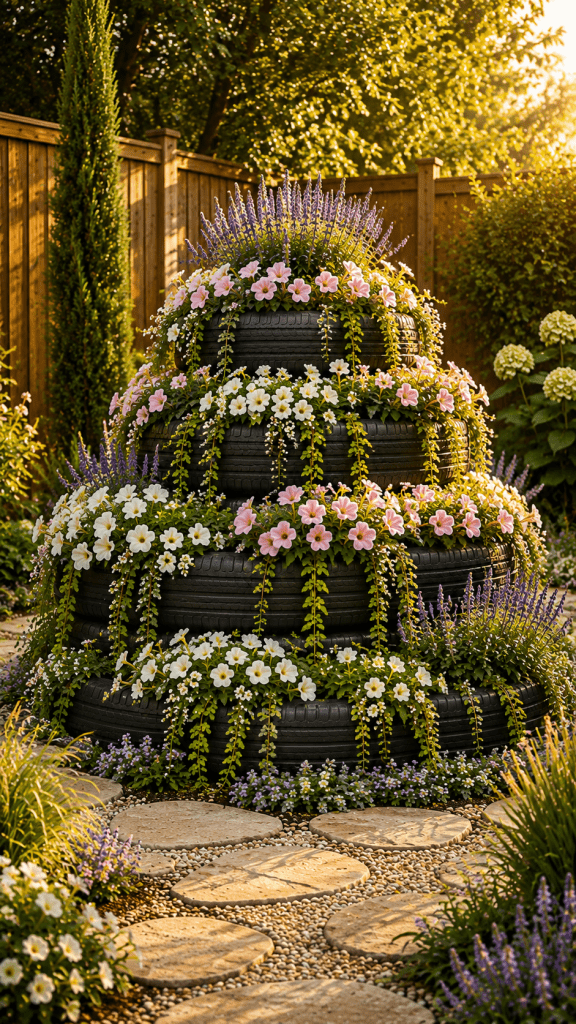
A Tiered Cascading Tire Planter uses several tires arranged in a broad stepped formation, creating multiple planting levels without forming a narrow tower.
This is ideal when you want a substantial flower display that still feels grounded.
Think of It Like Garden Steps
Imagine one tire at the back.
Two sit slightly lower in front.
Another one or two may form the lowest layer.
The structure creates a staircase effect.
Each tire remains accessible and visible.
This setup also allows flowers to cascade from one level toward another.
The result feels lush.
Make the Highest Tier the Visual Anchor
The rear or uppermost tire should contain the strongest structural planting.
Use taller flowers, ornamental foliage, or grasses to establish height.
This gives the arrangement a clear starting point.
The plants should then become progressively lower toward the front.
This creates a natural slope.
Emphasize Cascading Plants in the Middle
The middle tiers are where movement happens.
Trailing flowers can spill over the tire edges and visually connect one level to the next.
This can create the impression of a continuous floral waterfall.
You do not need every plant to trail.
A mixture of mounding and trailing growth gives a fuller result.
Keep the Front Layer Soft
The lowest tier should transition gently into the surrounding garden.
Use lower-growing flowers and foliage.
Allow some plants to extend beyond the tire.
Nearby groundcover can help blur the edge even further.
This prevents the structure from ending abruptly.
Use Repetition to Unite the Levels
A tiered display can contain many plants, so repetition is essential.
Choose one flower or foliage plant that appears in every level.
For example, white trailing flowers could repeat throughout the structure.
Or one burgundy foliage plant could appear in several tires.
This creates continuity.
Without repetition, the planter can look like several unrelated mini-gardens.
Paint the Tires as One Family
If you want to paint the structure, treat all tires as part of one palette.
You could use the same color throughout.
Or use related shades.
For example:
deep sage + medium sage + pale sage
or:
charcoal + warm gray + stone
Avoid using unrelated colors on every tier unless your goal is intentionally playful.
Best Places for a Tiered Tire Planter
This concept works especially well:
- beside broad patios,
- along the edge of a lawn,
- against a retaining wall,
- in large garden corners,
- near outdoor seating,
- or as part of a flower border.
It needs more horizontal room than a narrow tire tower.
That extra width is what makes the planting feel abundant.
Why It Takes Second Place
The Tiered Cascading Tire Planter earns 🥈 because it creates one of the lushest displays while remaining visually stable and grounded.
It is ideal for gardeners who want plenty of flowers without building a very tall structure.
🥉 Platz 3 Compact Sculptural Tire Stack
Not every garden has room for a large floral tower.
The Compact Sculptural Tire Stack is designed for smaller spaces.
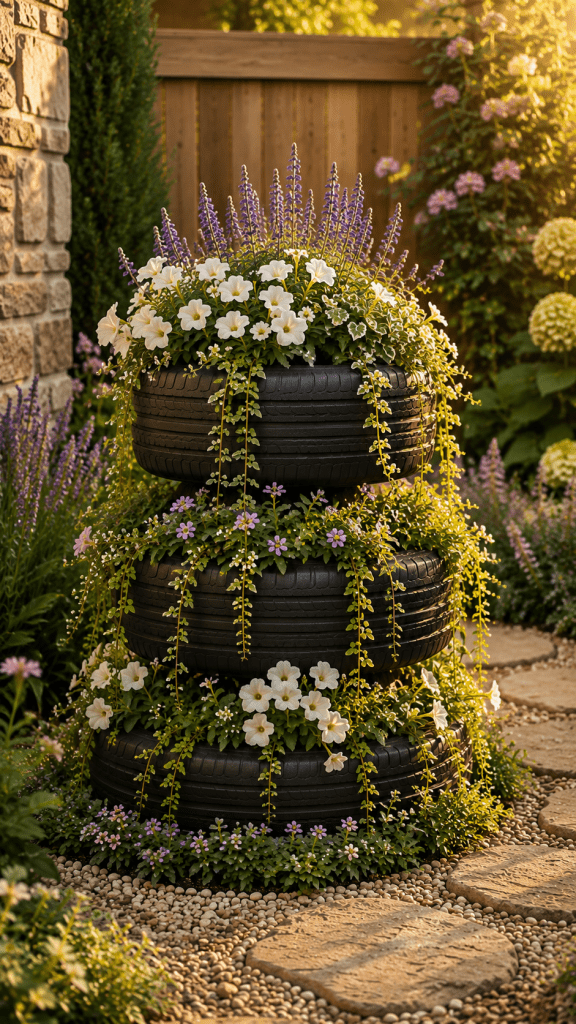
It uses only a few tires, arranged tightly but intentionally, to create a strong vertical accent without occupying much ground.
This concept is especially effective in narrow patios, side yards, and small backyard corners.
Use Fewer Tires
Two or three tires are often enough.
The key is proportion.
A compact stack should not feel oversized relative to the surrounding space.
One tire can form the base.
A second can sit slightly offset above it.
A third can complete the shape.
The structure remains simple but still creates more impact than a single planter.
Focus on Shape
Because there are fewer tiers, the silhouette becomes especially important.
Avoid simply stacking the tires like a column.
Instead, introduce a slight shift in position.
This creates a more sculptural appearance.
You can also orient the stack toward a nearby wall or garden feature so it feels integrated with the architecture.
Use One Strong Planting Palette
Small spaces benefit from visual restraint.
Choose one dominant flower color and support it with foliage.
For example:
white flowers + green foliage + dark tire
creates a clean contemporary effect.
Or:
soft pink + sage foliage + warm gray tire
creates a softer look.
The limited palette prevents the compact feature from feeling cluttered.
Let One Plant Become the Hero
Instead of filling every level with many different species, use one strong plant repeatedly.
A trailing flower can appear in all three tires.
Or one ornamental foliage plant can repeat between the levels.
This reinforces the sculptural form.
Keep Decoration Minimal
A compact planter already makes a strong statement.
Avoid adding signs, ornaments, painted patterns, and too many accessories around it.
Let the shape, plants, and surrounding materials do the work.
Place It Against a Simple Background
A plain wall or fence can make a compact stack look much more intentional.
The simple backdrop highlights the form.
Natural timber is particularly effective.
So are pale masonry walls and restrained garden fences.
The tire structure becomes almost like a piece of living outdoor sculpture.
Best Locations for This Idea
The Compact Sculptural Tire Stack works well:
- beside narrow patios,
- in small courtyard corners,
- along side yards,
- beside garden steps,
- against fences,
- near entrances,
- or at the end of a short pathway.
It offers vertical interest without consuming too much ground space.
Why It Takes Third Place
The Compact Sculptural Tire Stack earns 🥉 because it solves a practical design problem.
It allows you to use stacked tires even when the garden is small.
With only a few tires and a disciplined planting palette, the result can feel intentional rather than crowded.
How Many Tires Should You Stack
There is no universal number.
The right stack depends on:
- tire size,
- available space,
- total loaded weight,
- planting style,
- and structural stability.
For many decorative garden features, two to four levels are visually sufficient.
More tiers do not automatically create a better planter.
In fact, taller arrangements can become visually heavy and physically less stable.
The goal is not maximum height.
The goal is proportion.
Straight Stack or Staggered Stack
Both approaches can work.
A straight vertical stack creates a cleaner, more geometric look.
A staggered stack feels more organic and provides more visible planting surface between levels.
For contemporary gardens, a straight alignment may suit the architecture.
For cottage or informal gardens, staggered positioning usually feels more natural.
The choice should match the surrounding landscape.
The Best Plants for Stacked Tire Planters
The most successful planting combinations include different growth habits.
Use:
upright plants for height,
mounding plants for fullness,
and trailing plants for softness.
Foliage plants are valuable too.
They maintain structure even when flowering slows.
Choose locally suitable ornamentals according to light, climate, and mature size.
Avoid selecting plants solely because they look good when young.
A stacked planter can quickly become overcrowded if mature dimensions are ignored.
How to Make a Stacked Tire Planter Look More Professional
The difference often comes down to details.
Repeat One Flower
Using the same plant on several levels creates continuity.
Limit Tire Colors
One color or one tonal family usually works better than many unrelated shades.
Hide Soil Edges
A tidy soil surface or appropriate mulch makes the planting feel more finished.
Soften the Base
Use groundcover, gravel, or nearby planting so the lowest tire does not look isolated.
Leave Some Breathing Room
Do not surround the stack with too many decorations.
Let the structure remain clear.
Should Stacked Tires Be Painted
Painting is optional.
Dark unpainted tires can recede beautifully behind green foliage.
Muted painted tires can coordinate with the garden.
Bright colors can create a cheerful focal point.
The right choice depends on what you want people to notice first.
If the plants should dominate, keep the tires subtle.
If the stack itself is part of the decorative statement, stronger color can work.
If painting, use an exterior coating compatible with the material and follow the manufacturer’s preparation and application instructions.
Drainage and Stability Are Essential
A stacked tire planter needs to work as well as it looks.
Water should be able to drain appropriately.
The base should sit on stable ground.
The tires should not shift easily.
Remember that wet growing medium adds significant weight.
Avoid placing a tall stack where it could become a hazard if disturbed.
A secure, modest-height structure is more valuable than an impressive-looking arrangement that is unstable.
How to Integrate a Stacked Tire Planter Into the Landscape
Do not treat the stack as a completely separate object.
Connect it to something nearby.
Repeat one flower from an existing bed.
Match the tire color to another planter.
Use the same gravel found on a nearby path.
Place the stack beside a material already present in the garden, such as timber or stone.
Even one visual connection can make the feature feel intentional.
Common Stacked Tire Planter Mistakes
One common mistake is building too high.
Another is planting each level with completely unrelated flowers.
Using too many paint colors can also overwhelm the structure.
Sparse planting can make the tires dominate visually.
Poor placement is another issue.
A large stack should not interrupt important pathways or make a small garden feel cramped.
And finally, ignoring structural stability can turn a decorative idea into a practical problem.
Good garden design should be beautiful and functional.
Which Stacked Tire Planter Idea Is Best
Choose the 🥇 Staggered Floral Tire Tower if you want the strongest visual impact.
It creates height, movement, and a spectacular layered floral effect.
Choose the 🥈 Tiered Cascading Tire Planter if you have more horizontal space and want an abundant flower display that feels broad and grounded.
Choose the 🥉 Compact Sculptural Tire Stack if space is limited.
It offers vertical interest with a smaller footprint and works especially well in compact backyards.
Final Thoughts on Stacked Tire Planter Ideas
The best Stacked Tire Planter Ideas use height as a design tool rather than simply piling tires on top of one another.
The 🥇 Staggered Floral Tire Tower creates a dramatic vertical focal point with layered flowers and trailing foliage.
The 🥈 Tiered Cascading Tire Planter spreads the structure outward, producing a lush stepped flower display.
And the 🥉 Compact Sculptural Tire Stack proves that even a small garden can benefit from the shape and height of stacked planters.
Whatever approach you choose, keep the composition intentional.
Use different plant heights.
Repeat colors.
Allow foliage to soften the tire edges.
Keep the structure stable.
And connect the planter visually with the surrounding garden.
When all of those elements work together, stacked tires stop looking like a pile of recycled material.
They become a genuine garden feature.