A Garden Croton can completely change the personality of an outdoor space without relying on flowers for constant color. With leaves splashed in brilliant yellow, fiery orange, deep burgundy, scarlet red, lime green, and even near-black tones, crotons bring the visual drama normally associated with tropical resorts directly into the home garden. Their extraordinary foliage makes them especially valuable for gardeners who want bold color that lasts far longer than a typical flowering season.
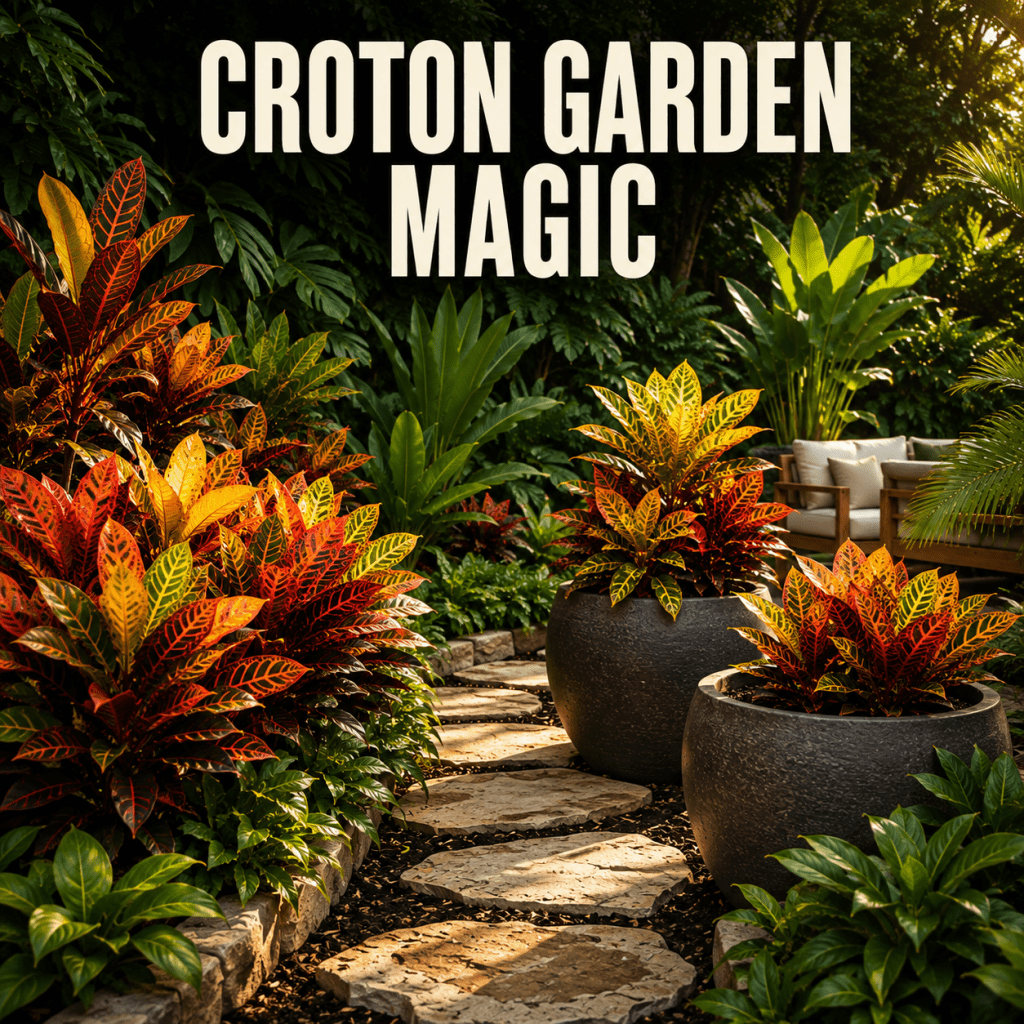
The botanical croton most commonly grown as an ornamental is Codiaeum variegatum. It is prized for foliage that can vary dramatically in shape, pattern, and color. Some varieties produce broad leathery leaves painted with strong veins, while others have narrow twisting foliage covered with speckles or irregular patches. Because of this diversity, Garden Croton plants can work in several completely different landscape styles.
The secret is not simply planting as many colorful crotons as possible. 🌿 A beautiful croton garden depends on composition. The surrounding greenery, background materials, plant heights, sunlight, and spacing all influence whether those spectacular leaves appear sophisticated or chaotic.
Instead of treating crotons as random tropical accents, consider designing the entire planting around their strongest qualities. The following Top 3 Garden Croton ideas explore three distinct approaches: a dramatic tropical border, an elegant container display, and a layered croton-and-greenery garden.
Each offers a different way to turn these intensely colorful plants into a convincing landscape feature.
Why Garden Croton Is Such a Powerful Landscape Plant
Garden design usually relies heavily on flowers to introduce color. The problem is that flowers are temporary. A spectacular flowering display can disappear within weeks, leaving behind a landscape dominated almost entirely by green foliage.
Crotons approach color differently.
Their leaves become the decoration.
Depending on the variety and growing conditions, a single plant can display combinations of green, cream, yellow, orange, pink, crimson, and burgundy simultaneously. 🍂 Even individual leaves can contain several colors.
This characteristic allows crotons to function almost like permanent floral arrangements.
They can create visual interest around patios, entrances, pathways, courtyards, pool areas, and garden beds even when surrounding plants are not blooming.
Another advantage is structural diversity. Croton foliage is not limited to one shape. Different cultivars may have broad oval leaves, long narrow leaves, twisting foliage, lobed leaves, or unusual interrupted forms. Combining carefully selected varieties can therefore introduce both color and texture.
However, crotons are genuinely tropical plants. They perform best where conditions are warm and frost-free. Gardeners in cooler climates often grow them as seasonal outdoor plants or keep them in containers that can be moved into protected conditions when temperatures fall.
This climate sensitivity makes placement an important part of successful Garden Croton design.
Important Note: Garden Croton is a tropical plant that does not tolerate frost well. In climates with cold winters, grow crotons in movable containers or treat them as warm-season outdoor plants so they can be protected when temperatures drop.
Understanding that limitation actually opens several interesting design possibilities, especially when containers and mixed tropical planting schemes are involved.
Garden Croton Design at a Glance
Before choosing a landscape style, it helps to understand how the three main approaches differ.
| Garden Croton Idea | Best Feature | Ideal Location | Visual Character | Design Difficulty |
|---|---|---|---|---|
| 🥇 Tropical Croton Border | Maximum foliage impact | Fence lines, walls, pathways | Bold, lush, resort-inspired | Moderate |
| 🥈 Croton Container Garden | Flexible and controlled | Patio, porch, entrance, balcony | Elegant, curated, sophisticated | Easy |
| 🥉 Layered Croton Garden | Natural landscape depth | Garden beds and courtyards | Botanical, balanced, immersive | Moderate |
There is no universally superior option.
The best choice depends on the size of the outdoor space, local climate, existing landscape, and how much visual intensity is desired.
A tropical border creates the strongest statement. Containers offer flexibility and easier seasonal management. Layered planting produces the most natural and integrated appearance.
Here is how each approach can be developed successfully.
🥇 Best 1 Tropical Garden Croton Border for Maximum Color Impact
One of the most spectacular ways to use Garden Croton is to create a dedicated tropical foliage border.
Instead of scattering individual crotons throughout a large garden, group several plants into a deliberate composition. Concentrating the foliage produces much greater visual impact because the eye reads the planting as one substantial mass of color rather than several unrelated decorative plants.
Imagine a warm garden wall surrounded by dense tropical foliage. Deep-green plants establish a calm background while crotons rise through the planting with leaves painted in yellow, orange, crimson, and burgundy.
The result can feel remarkably luxurious.
It resembles the richly planted borders often associated with tropical resorts and botanical gardens, yet the concept can be adapted to surprisingly modest residential spaces.
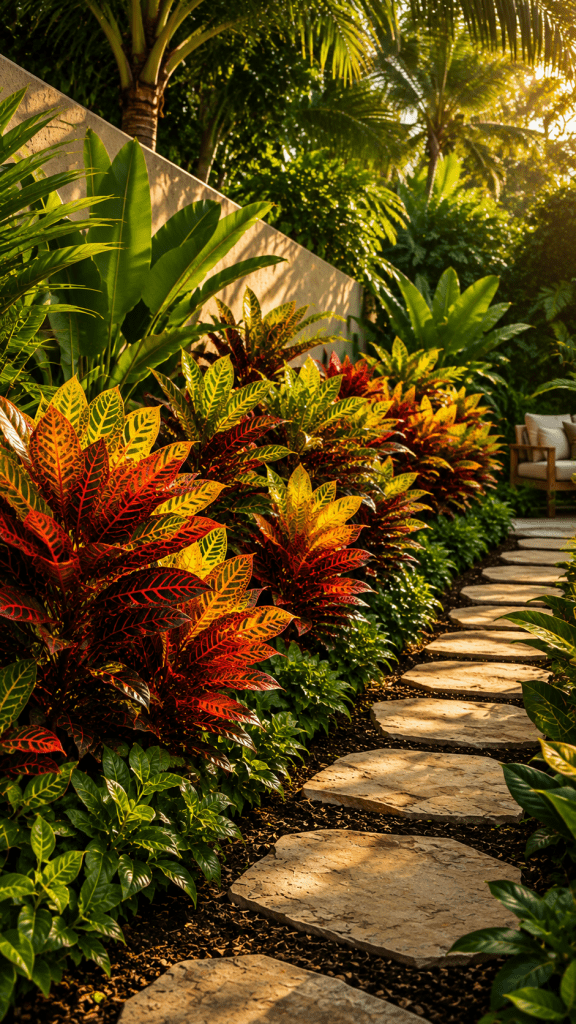
Create a Garden Croton Border Against a Simple Background
Background choice is extremely important when working with colorful foliage.
Crotons already contain a large amount of visual information. Their leaves may combine several colors with complex veins, speckles, and irregular patterns. Placing them against an equally complicated background can make the garden feel restless.
A simple background gives those leaves room to shine.
Consider positioning a croton border against materials such as:
- Warm white rendered walls
- Charcoal or dark-painted fences
- Natural stone
- Simple timber screens
- Dense dark-green hedges
- Neutral masonry walls
Dark green is particularly effective.
A background composed of lush green foliage creates natural contrast without competing with the crotons. Yellow and orange leaves appear brighter, while burgundy and scarlet tones gain greater depth.
This is one reason crotons can look much more sophisticated when mixed with restrained tropical greenery rather than surrounded entirely by other multicolored plants.
Use Repetition Instead of Random Variety
It can be tempting to buy one specimen of every interesting croton variety available.
That approach often produces a collection rather than a landscape.
For a more professional Garden Croton border, repetition is usually stronger.
Select perhaps two or three compatible foliage styles and repeat them through the bed. One variety might provide predominantly yellow-green leaves, another orange and red foliage, and a third darker burgundy tones.
Repetition creates rhythm.
The same colors appearing several times along the border visually connect the planting and prevent the landscape from becoming fragmented.
🌿 Think of crotons as colors in a painting rather than individual collector plants.
The goal is not necessarily maximum variety. The goal is maximum composition.
Build the Border in Layers
A flat row of identical plants can look formal, but crotons become much more dramatic when arranged in layers.
Use taller specimens toward the back of the planting and medium-height plants through the center. Smaller foliage plants can soften the foreground.
This creates depth.
The viewer sees overlapping leaves at multiple levels instead of a single horizontal line.
For example, the rear layer could contain mature crotons and taller tropical foliage. The middle layer could feature the most colorful crotons. The foreground could transition into lower green plants or groundcover.
The arrangement creates a gradual visual progression from low foliage to dramatic upright color.
It also makes a relatively narrow garden bed appear deeper.
Let Green Become the Visual Resting Space
One of the biggest mistakes in colorful tropical landscaping is assuming every plant must be colorful.
Actually, green is what makes intense color effective.
Imagine an entire border filled with red, yellow, orange, purple, and variegated foliage. Each plant competes for attention, and eventually nothing becomes the focal point.
Now imagine the same crotons surrounded by large areas of deep green.
Suddenly the colored leaves become extraordinary.
🌴 Green foliage functions as visual negative space.
Plants with large, simple green leaves can be especially effective because their calm shapes contrast beautifully with intricate croton patterns.
The final landscape can still feel lush and tropical without becoming visually exhausting.
Add Natural Materials Around the Croton Border
Ground materials can strengthen the entire composition.
Natural stone edging, dark mulch, decorative gravel, or weathered timber can create a quieter foundation beneath the colorful foliage.
Dark mulch is particularly useful because it visually disappears beneath the plants while making yellow and lime foliage appear brighter.
Natural stone provides another possibility.
Warm limestone or pale stone can complement orange and yellow crotons, while charcoal stone creates a stronger contemporary contrast.
Avoid using too many decorative materials simultaneously.
Crotons already provide the ornament.
The hardscape should support them rather than compete with them.
Where This Garden Croton Idea Works Best
The tropical border concept is particularly effective beside:
- Garden walls
- Entrance paths
- Pool landscapes
- Courtyard boundaries
- Privacy fences
- Outdoor lounge areas
- Tropical-style patios
A narrow border can even transform an otherwise ordinary side yard.
The key is creating enough repetition that the crotons feel intentional.
A single plant says decoration.
A coordinated group says landscape design.
🥈 Best 2 Garden Croton Container Display for Elegant Tropical Style
Not every Garden Croton needs to be planted directly in the ground.
In fact, container gardening can be one of the most stylish and practical ways to display these spectacular plants. 🪴
Containers provide greater control over composition and placement while allowing crotons to become architectural decorative features.
This approach is particularly valuable in climates where winter temperatures become too cold for permanent outdoor cultivation.
But practicality is only part of the appeal.
A carefully designed croton container arrangement can look remarkably sophisticated.
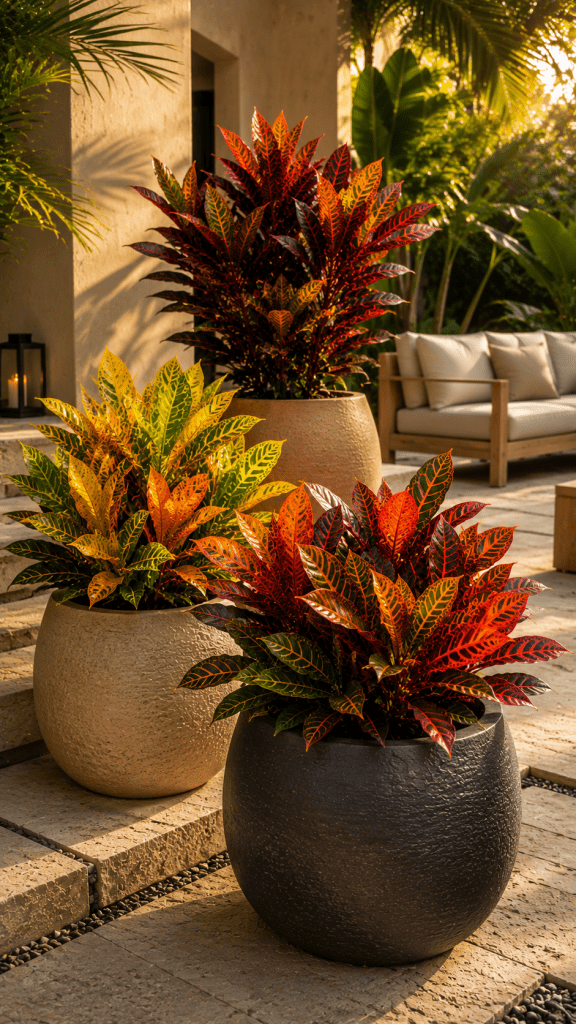
Choose Large Simple Containers for Garden Croton
Because croton foliage is visually complex, the most successful containers are often relatively simple.
Think large ceramic pots in warm white, matte charcoal, sand, taupe, terracotta, or muted stone finishes.
A clean container creates a visual foundation.
The plant becomes the artwork.
Highly patterned pots combined with highly patterned croton foliage can sometimes produce excessive visual competition.
Instead, choose containers with interesting texture but restrained color.
Hand-finished terracotta can create a warm tropical atmosphere, while charcoal containers make bright yellow and orange foliage appear especially vivid.
Warm ivory or stone-colored planters create a softer contemporary look.
Create a Three Pot Garden Croton Composition
One of the easiest ways to make container planting appear professionally styled is to use an odd-numbered grouping.
Three containers work particularly well.
Rather than choosing three identical pots at identical heights, create subtle variation.
Place the tallest container slightly behind the others. Position a medium pot nearby and a smaller pot toward the foreground.
This creates a triangular composition.
The plants should also vary slightly in height and color.
For example, the tallest croton could feature deep burgundy and green leaves. The middle plant could emphasize orange and yellow. The smallest could contain brighter yellow-green foliage.
The colors remain related while the differences create movement.
✨ This arrangement can instantly transform an empty patio corner.
Use Garden Croton Beside an Entrance
Crotons naturally attract attention, making them excellent candidates for entrance landscaping.
A pair of substantial croton containers positioned near a doorway can create an immediate tropical statement.
For a more formal appearance, use matching containers and similar plants.
For a relaxed botanical style, use slightly different container sizes and foliage colors.
The surrounding architecture matters.
Against a white or cream exterior, red and burgundy crotons create dramatic contrast. Against dark charcoal walls, yellow and orange foliage becomes luminous.
Natural wood doors can work beautifully with almost every croton palette because the warm tones echo the plant’s orange, red, and yellow pigmentation.
Turn a Patio Into a Tropical Garden Without Permanent Planting
A paved patio sometimes lacks softness.
There may be beautiful furniture and elegant flooring, yet the space can still feel architecturally hard.
Croton containers solve this quickly.
Position large plants around seating areas rather than lining them evenly against the walls. This allows foliage to partially frame the furniture and creates a more immersive environment.
A large croton near one corner can become an anchor.
Smaller green plants can then bridge the transition between the colorful foliage and surrounding architecture.
This approach is especially useful for renters or anyone who does not want to redesign permanent garden beds.
The landscape can evolve simply by moving containers.
Mix Crotons With Neutral Green Container Plants
Just as green foliage improves an in-ground croton border, it also improves container compositions.
Not every pot needs a croton.
Try combining one spectacular croton with several quieter green plants.
The croton becomes the hero.
For example, a large orange-red croton could sit beside pots containing simple broad-leaf greenery and soft cascading plants.
The variation in leaf shape adds interest without adding excessive color.
This technique can make an inexpensive collection of plants look considerably more curated.
Why Container Garden Croton Is Ideal for Smaller Spaces
Small gardens require visual discipline.
Too many competing plants can make limited space feel even smaller.
Container crotons solve this problem by concentrating color into controlled focal points.
One beautifully shaped plant may be enough to transform a balcony corner.
Three coordinated pots may be enough for an entire small patio.
Containers also make experimentation easier.
If the composition feels unbalanced, move a pot.
If one plant receives too much harsh exposure, relocate it.
If winter temperatures become unsuitable, move the plant to a protected environment.
That flexibility makes container gardening one of the most accessible ways to experiment with crotons.
🥉 Best 3 Layered Garden Croton With Lush Greenery for Natural Tropical Depth
The third approach is ideal for gardeners who love crotons but do not necessarily want them to dominate the entire landscape.
Instead, use Garden Croton as a colorful accent inside a predominantly green layered garden.
This produces a more natural botanical atmosphere.
Rather than immediately seeing a wall of intense color, the viewer discovers flashes of orange, yellow, and burgundy between layers of greenery. 🌿
The result feels deeper, calmer, and often more mature.
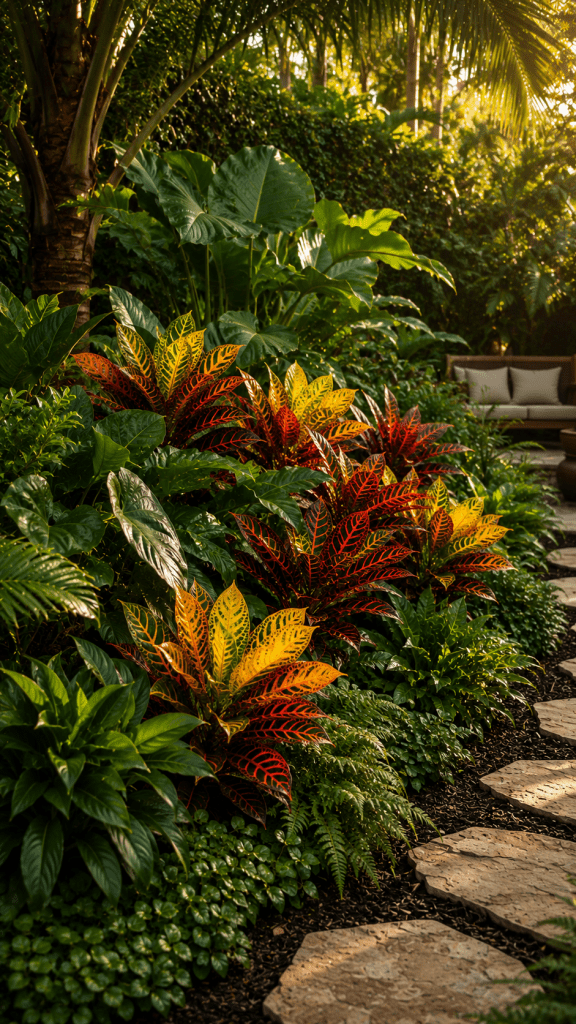
Treat Garden Croton as a Focal Accent
A useful principle in landscape design is hierarchy.
Some plants should dominate.
Others should support.
In this concept, crotons become focal plants while surrounding greenery creates the framework.
Imagine a lush garden bed composed mainly of deep green leaves. In three strategic locations, clusters of crotons introduce fiery color.
The eye naturally moves from one colorful cluster to another.
This movement gives the landscape direction.
If the same number of crotons were distributed evenly throughout the bed, the composition could feel less intentional.
Strategic concentration is more powerful.
Combine Different Leaf Shapes
Color is only one part of foliage design.
Shape matters just as much.
Croton leaves can be relatively narrow, broad, curled, lobed, or elongated depending on the cultivar. Pairing these with contrasting foliage shapes creates a richer botanical composition.
Broad green leaves can make narrow croton foliage appear more delicate.
Fine-textured grasses or fern-like plants can make broad croton leaves appear stronger and more sculptural.
Rounded leaves can soften highly angular foliage.
This type of contrast is subtle but extremely important.
A successful tropical garden is not merely a collection of green plants. It is a composition of different leaf sizes, silhouettes, textures, and heights.
Create Three Distinct Planting Levels
A layered garden becomes especially convincing when vegetation occupies several vertical levels.
The upper level establishes height and enclosure.
The middle level provides most of the visual substance.
The lower level connects the garden to the ground.
Crotons usually work beautifully within the middle layer because their colorful leaves remain close enough to eye level to be appreciated.
Behind them, taller green foliage creates a darker backdrop.
In front, low-growing greenery softens the bed edges.
This three-level structure can make even a relatively compact garden feel immersive.
🌱 The eye cannot immediately see every part of the planting, which creates a sense of depth.
Use Crotons to Guide the Eye Through the Garden
Color can act as navigation.
A bright croton near the beginning of a pathway attracts attention. Another group farther along encourages the eye to continue through the landscape. A final colorful cluster near a seating area creates a destination.
This technique is particularly effective in long narrow gardens.
Instead of revealing everything at once, repeated croton colors establish a visual journey.
The plants essentially become markers.
Yellow foliage is especially useful for this purpose because it remains visually prominent against dark greenery.
Red and burgundy crotons can create deeper focal points that feel slightly more subtle.
Using both allows the designer to control where attention goes first.
Introduce Stone for a Botanical Garden Atmosphere
Natural stone pairs beautifully with crotons.
The contrast between rugged neutral stone and intensely colored glossy foliage creates a sophisticated tropical aesthetic.
Consider irregular stepping stones surrounded by greenery.
A croton positioned beside one stone becomes a striking visual moment.
Large weathered rocks can also help separate planting clusters and introduce permanent structure.
The garden then retains visual interest even when plants are pruned or temporarily less dense.
Stone should appear integrated rather than artificially scattered.
Partially bury larger rocks and allow some foliage to overlap their edges.
This creates the impression that the garden has developed naturally around them.
Add a Winding Path Through the Garden Croton Planting
If space allows, a narrow path can transform a planted bed into an experience.
Rather than viewing crotons from one fixed position, visitors move through them.
A gently curving path is particularly effective because it prevents the entire route from being visible immediately.
Crotons can be positioned near bends where their colorful foliage becomes gradually revealed.
The pathway itself does not need to be elaborate.
Simple natural stepping stones, gravel, or compact paving can work.
What matters is the relationship between movement and planting.
This approach creates a garden that feels discovered rather than simply observed.
How to Choose the Right Garden Croton Color Palette
Crotons are famous for multicolored foliage, but not every garden needs every available color.
A controlled palette often produces stronger results.
For a bright tropical garden, emphasize lime green, golden yellow, orange, and fresh green. These colors create an energetic atmosphere and look especially vivid in sunlight.
For a sophisticated landscape, emphasize deep green, burgundy, rust, muted orange, and dark red.
This combination feels richer and more subdued.
For a contemporary garden, try using mostly green-yellow crotons against charcoal architecture or dark foliage.
The high contrast creates a clean graphic effect.
Color selection can also relate to surrounding materials.
Warm terracotta paving naturally complements orange and burgundy foliage.
Pale limestone works beautifully with yellow-green crotons.
Dark stone emphasizes nearly every bright croton color.
The garden becomes more coherent when plant colors and hardscape materials feel intentionally connected.
How Light Changes the Appearance of Garden Croton
Light plays an enormous role in how crotons look.
Their extraordinary coloration can become much more dramatic under suitable growing conditions, although the exact response varies by cultivar.
A plant hidden in very dark conditions may not develop the same intensity associated with beautifully colored crotons.
However, suddenly exposing a plant accustomed to sheltered conditions to harsh sunlight can also stress foliage.
The best approach is to understand the needs of the specific variety and acclimate plants appropriately when changing exposure.
From a design perspective, directional light is particularly beautiful.
Morning or late-afternoon sunlight passing through croton leaves can reveal their translucent yellow, orange, and red pigmentation.
🍁 Some leaves almost appear to glow.
This makes crotons excellent plants for locations where low-angle sunlight enters the garden.
Consider how sunlight moves through the landscape before deciding where the strongest focal planting should go.
Garden Croton Styling Mistakes That Can Ruin the Look
The biggest mistake is using too many unrelated colors without visual structure.
Crotons are already dramatic. Combining numerous cultivars with colorful flowers, brightly painted containers, decorative ornaments, and complicated paving can quickly overwhelm the garden.
Restraint creates sophistication.
Another common mistake is planting isolated crotons without considering repetition.
One croton here, another far away, and another in a completely different area can feel accidental.
Repeating similar foliage colors helps visually connect separate areas.
Scale also matters.
A tiny croton planted alone against a huge blank wall may appear insignificant. Either increase the plant grouping or introduce other vegetation that creates a gradual transition in scale.
Finally, avoid treating the ground as an afterthought.
Messy bed edges, exposed irrigation equipment, random empty pots, and inconsistent mulch can weaken an otherwise beautiful planting.
The supporting details matter because vivid croton foliage naturally attracts attention to the entire surrounding area.
How to Make a Garden Croton Landscape Look More Expensive
Luxury garden design is rarely about filling every available space.
It is usually about editing.
Choose fewer materials and repeat them consistently.
If the garden uses natural stone, allow the same stone to appear in edging, stepping surfaces, or decorative accents.
If containers are used, keep their colors coordinated even when their sizes differ.
Repeat croton colors strategically.
A burgundy croton near the entrance can visually connect with another burgundy specimen beside a seating area.
Use large masses of green foliage rather than many tiny unrelated plants.
This creates visual calm.
Another powerful technique is maintaining generous spacing where appropriate. Every colorful plant does not need to touch the next one. Allowing dark greenery or neutral architecture to appear between focal plants gives each croton greater visual importance.
✨ Think boutique tropical resort rather than crowded plant nursery.
The difference is composition.
Choosing Between the Top 3 Garden Croton Ideas
Each of these three concepts creates a distinctly different outdoor atmosphere.
Choose 🥇 Tropical Garden Croton Border when the goal is maximum drama.
This is the strongest choice for gardeners who want crotons to become one of the defining features of the landscape. Repeated groups, layered planting, and simple backgrounds allow the extraordinary foliage to dominate.
Choose 🥈 Garden Croton Container Display when flexibility is essential.
Containers are ideal for patios, entrances, balconies, courtyards, and climates where plants may need seasonal protection. They also make it easier to experiment with composition without committing to permanent landscape changes.
Choose 🥉 Layered Garden Croton With Lush Greenery when a natural botanical appearance is preferred.
This approach uses crotons more selectively. Instead of creating uninterrupted color, it allows vibrant foliage to emerge from layers of deep green plants.
The three styles can even coexist.
A home might have elegant croton containers at the entrance, a colorful tropical border beside the patio, and more subtle croton accents throughout the rear garden.
Consistency in foliage colors and materials can connect all three spaces.
Creating a Garden Croton Focal Point That Looks Beautiful From Every Angle
A successful focal point should not only look attractive from one carefully selected viewing position.
Consider where the garden will actually be seen.
Perhaps the most important view is from inside the living room.
Maybe it is visible from an outdoor dining table.
Perhaps visitors encounter the planting immediately after entering the property.
Identify those primary viewpoints before arranging the plants.
Place the strongest croton color where it will naturally attract attention.
Then use supporting greenery to frame it.
If the planting can be viewed from multiple sides, avoid creating a composition with a clearly unfinished back. Use taller central plants surrounded by gradually lower foliage so the arrangement feels intentional from several directions.
Containers can be rotated occasionally if necessary, while permanent beds require more thoughtful planning.
The strongest garden designs consider not only individual plants but also how people move through and experience the space.
Final Thoughts on Creating a Spectacular Garden Croton Landscape
A Garden Croton does not need flowers to become one of the most colorful elements in an outdoor space.
Its foliage already provides the spectacle.
The challenge is allowing that spectacle to feel intentional.
The 🥇 Tropical Garden Croton Border offers the greatest visual impact, transforming an ordinary wall, fence, or pathway into a dense tropical statement.
The 🥈 Garden Croton Container Display provides elegance and flexibility, making it particularly valuable for patios, entrances, small gardens, and climates requiring seasonal plant protection.
The 🥉 Layered Garden Croton With Lush Greenery creates a quieter and more immersive result, allowing flashes of colorful foliage to emerge naturally between layers of green.
Whichever approach is chosen, the same principle remains important: crotons become more impressive when the surrounding design is restrained.
Let deep green foliage provide contrast.
Let natural stone, neutral containers, timber, and simple architecture create a calm foundation.
Repeat selected croton colors rather than collecting every possible variation.
Build layers instead of planting everything at one height.
And use sunlight strategically so those remarkable leaves can reveal their full range of yellow, orange, red, burgundy, and green.
🌿 A thoughtfully designed Garden Croton landscape can feel simultaneously tropical, artistic, and sophisticated. Instead of relying on short-lived flowers for impact, the garden gains its personality from extraordinary foliage—turning even a relatively simple outdoor space into a colorful botanical retreat.