Fall frost protection ideas can make an extraordinary difference between a garden that suddenly loses its productivity after one cold night and a garden that continues to thrive throughout the changing season. As autumn temperatures begin to drop, tender vegetables, delicate flowers, young seedlings, and sensitive container plants become increasingly vulnerable to unexpected frost.
Many gardeners underestimate how quickly frost damage can occur. A garden that looks perfectly healthy in the afternoon may display wilted leaves, damaged flowers, and discolored stems the following morning. Even a relatively short period of freezing conditions can damage sensitive plant tissues and interrupt the final weeks of autumn harvesting.
Fortunately, protecting a garden from fall frost does not necessarily require expensive greenhouses, sophisticated equipment, or complicated permanent installations. A combination of temporary protective structures, strategic heat retention, and intelligent garden organization can create surprisingly effective protection.
The best approach is to focus on immediate, short-term frost protection rather than permanently preparing the entire garden for winter. This allows gardeners to respond to changing weather conditions while extending the growing season and preserving valuable plants.
These three practical fall frost protection strategies offer different ways to protect vegetables, flowers, herbs, and container plants without sacrificing the beauty or functionality of an autumn garden.
🍂 Why Fall Frost Protection Is More Important Than Many Gardeners Realize
The transition from autumn to winter rarely follows a predictable pattern. Several consecutive days of pleasant sunshine can suddenly be interrupted by a freezing night, followed by another period of relatively warm weather.
Without adequate protection, that first frost can prematurely end an otherwise productive gardening season.
Tomatoes may still have ripening fruit, peppers may continue developing, and autumn flowers may remain attractive for several additional weeks. Protecting these plants during occasional cold nights allows gardeners to benefit from favorable daytime temperatures afterward.
Frost can also develop when the reported air temperature is slightly above freezing because exposed plant surfaces may become colder than the surrounding air. Clear skies and calm nighttime conditions can increase this risk. Yard and Garden+1
Successful frost protection involves several important objectives:
- 🌡️ Maintaining a slightly warmer environment around vulnerable plants.
- 🌱 Protecting sensitive leaves, stems, flowers, and developing fruit.
- ☀️ Capturing natural warmth during daylight hours.
- 🛡️ Reducing plant exposure to cold nighttime conditions.
- 🥬 Extending the autumn vegetable harvesting season.
- 💰 Avoiding unnecessary plant replacement costs.
- 🍁 Preserving the beauty of seasonal garden displays.
Rather than treating every plant in the garden identically, effective frost protection focuses on the plants that genuinely need assistance.
Understanding Which Garden Plants Need Fall Frost Protection
Different plants respond to cold temperatures in remarkably different ways. While some vegetables can survive several light frosts, others may suffer considerable damage during their first exposure to freezing conditions.
Understanding these differences helps gardeners allocate their protective materials more efficiently.
Tender summer vegetables generally require immediate attention when frost becomes possible. Meanwhile, established cool-season vegetables may tolerate colder conditions without additional intervention.
Container plants deserve special consideration because their roots have less surrounding soil to buffer temperature fluctuations.
Fall Frost Protection Requirements for Different Garden Plants
| Garden Plant | Frost Sensitivity | Recommended Protection | Priority |
|---|---|---|---|
| Tomatoes | Very high | Supported frost blanket | Very high |
| Basil | Very high | Indoor relocation or early harvest | Very high |
| Peppers | Very high | Protective tunnel | Very high |
| Cucumbers | Very high | Supported frost cover | Very high |
| Begonias | Very high | Sheltered relocation | Very high |
| Petunias | High | Individual protective cover | High |
| Lettuce | Moderate | Lightweight frost fabric | Medium |
| Swiss chard | Moderate | Protective row cover | Medium |
| Parsley | Low to moderate | Temporary covering | Medium |
| Carrots | Relatively low | Protection during stronger freezes | Low |
| Spinach | Relatively low | Seasonal row cover when necessary | Low |
| Kale | Relatively low | Protection during severe cold | Low |
| Established hardy shrubs | Species dependent | Selective protection | Variable |
Actual frost tolerance depends on plant variety, maturity, acclimatization, exposure, and the duration of freezing temperatures.
Prioritizing tender plants prevents gardeners from spending unnecessary time protecting established vegetation that is naturally adapted to autumn weather.
🥇 Best 1 Fall Frost Protection Ideas With a Modular Overnight Frost Shield System
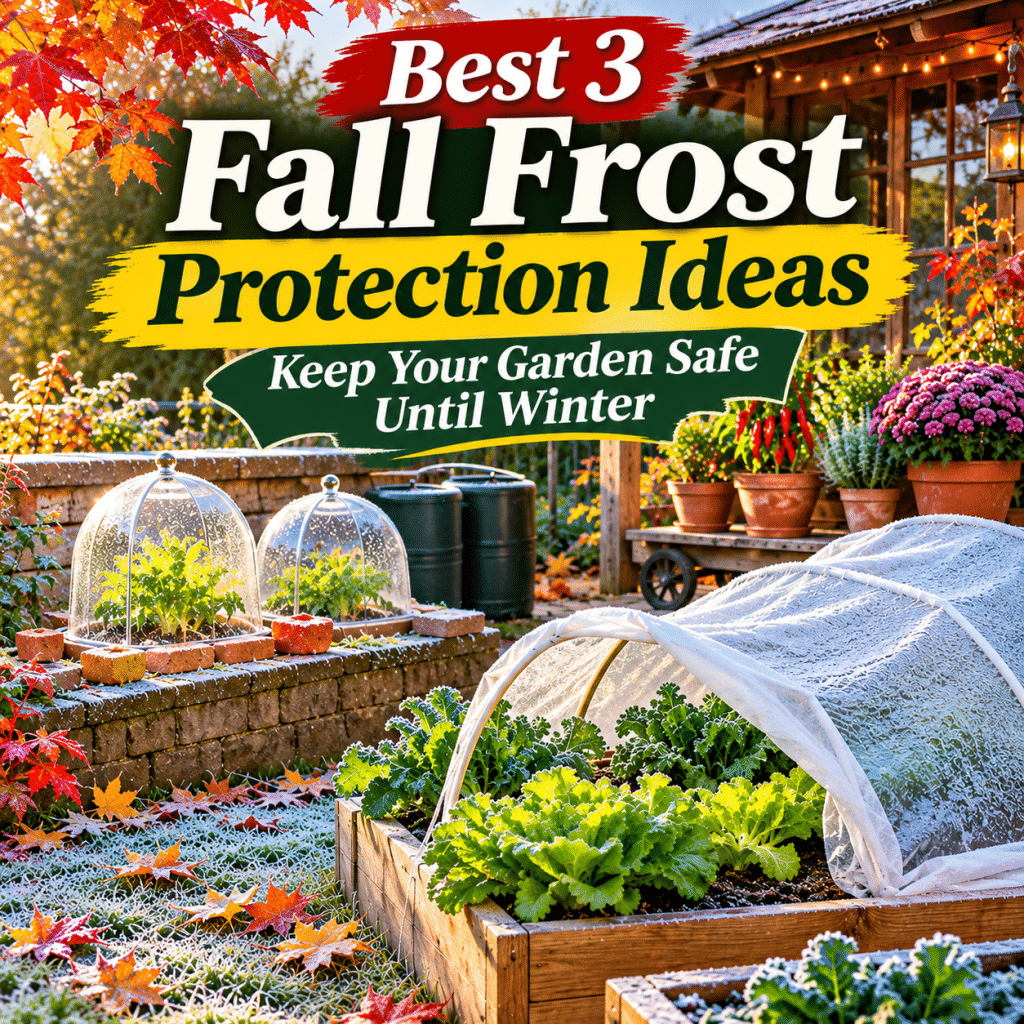
One of the most effective fall frost protection ideas involves creating a modular overnight frost shield system that can be installed, adjusted, and removed according to changing weather conditions.
Unlike permanent greenhouses or traditional winter garden structures, this approach focuses on temporary nighttime protection.
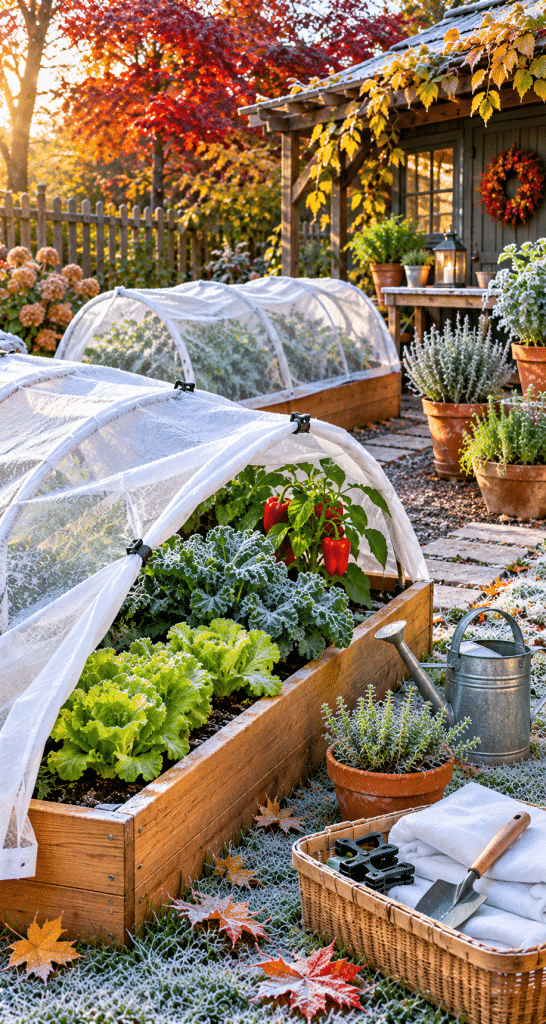
The concept combines lightweight support frames, breathable horticultural fabric, adjustable fasteners, and reusable ground anchors to create flexible protective environments around vulnerable plants.
Its greatest advantage is adaptability. Gardeners can protect an entire vegetable row, a small flower bed, several individual plants, or a collection of autumn herbs using the same basic system.
During warm and sunny days, the protective fabric can be opened or removed. When temperatures begin to fall, the garden can quickly return to its protected configuration.
Creating a Flexible Framework Around Vulnerable Plants
A successful modular frost shield begins with a lightweight supporting structure.
Flexible fiberglass hoops, galvanized garden hoops, bamboo supports, or appropriately sized PVC garden frames can provide the foundation for temporary protection.
The structure should create sufficient space between the protective covering and delicate plant foliage. Maintaining this separation reduces the possibility of damage where cold covering materials come into contact with sensitive leaves.
Low-growing vegetables may only require relatively short hoops. Taller plants, including mature peppers and flowering ornamentals, benefit from higher structures with additional internal clearance.
Instead of constructing one enormous protective tunnel, consider dividing larger garden areas into several independently managed sections.
This creates greater flexibility because different plants can receive different levels of protection.
Choosing the Best Frost Protection Fabric
The protective material plays an essential role in determining how effectively the system performs.
Horticultural frost fabrics are particularly useful because many are designed to allow some sunlight, moisture, and air to penetrate while slowing the loss of warmth.
Different fabric weights provide different levels of protection. Heavier fabrics generally retain more warmth but can also reduce light transmission.
Ordinary household sheets may provide temporary assistance during an unexpected frost. However, they can become heavy when wet and may require stronger supporting structures.
| Protective Material | Main Advantage | Best Application |
|---|---|---|
| Lightweight frost fabric | Good light transmission | Occasional light frost |
| Medium-weight frost fabric | Balanced protection | Autumn vegetable beds |
| Heavyweight frost blanket | Greater insulation | Colder autumn nights |
| Cotton bed sheets | Affordable emergency protection | Small garden areas |
| Reusable garden fleece | Flexible seasonal use | Mixed vegetable gardens |
| Clear greenhouse film | Weather-resistant outer barrier | Ventilated support structures |
The most appropriate material depends on the severity of the expected weather and the sensitivity of the plants underneath.
A lightweight fabric may be perfectly adequate during a brief light frost, whereas more demanding conditions may require additional protection or indoor relocation.
Designing a Quick Release Covering System
The convenience of a frost protection system becomes especially important when autumn weather changes frequently.
Gardeners are more likely to use protective covers consistently when installing them takes only a few minutes.
Reusable greenhouse clips, fabric clamps, garden stakes, and weighted fabric edges can create an efficient attachment system.
One side of the fabric can remain attached to the framework while the opposite side is designed to open easily. During favorable weather, the covering can be rolled back and secured above or beside the plants.
As evening approaches, the fabric can be lowered again without completely reconstructing the protective arrangement.
This approach is particularly useful for gardeners who want to continue harvesting vegetables throughout autumn.
Capturing Ground Heat Beneath the Frost Shield
A frost cover does more than simply separate plants from the outside environment.
During daylight hours, garden soil absorbs energy from the sun. As nighttime temperatures fall, some of that stored warmth is released into the surrounding environment.
A correctly installed frost shield helps retain a portion of this warmth around the protected plants.
For this reason, coverings should extend toward the soil surface rather than being wrapped tightly around individual plant stems.
Securing the lower edges also helps reduce unwanted air movement beneath the covering. UF/IFAS Extension Okaloosa County+1
Important Note: Never allow ordinary plastic sheeting to rest directly against frost-sensitive foliage. Support it above the plants, secure the covering before sunset, and provide ventilation when daytime temperatures rise to prevent overheating and moisture accumulation.
Using Double Layer Frost Protection During Colder Nights
When colder conditions are expected, gardeners may consider a layered protective arrangement.
A breathable inner frost fabric can surround the growing area while a separately supported outer layer provides additional protection.
Maintaining an air space between the layers may improve insulation and reduce direct exposure to the outer cold surface.
However, additional layers do not guarantee survival during prolonged or severe freezes. The effectiveness of the system depends on available ground warmth, wind conditions, fabric characteristics, and the duration of the cold weather.
Morning ventilation becomes especially important with multilayer systems because enclosed environments can warm rapidly under direct sunlight.
Making the Frost Shield System Visually Attractive
Temporary frost protection does not need to make an autumn garden look disorganized.
Consistent hoop spacing, neatly secured fabrics, and matching fasteners can create a clean and professional appearance.
Cream-colored horticultural fabrics look particularly attractive against natural cedar beds, copper-colored autumn foliage, gravel pathways, and dark green vegetable leaves.
A dedicated wooden storage box near the garden can hold unused covers and clips.
When the protective structures are opened during the day, the garden retains its natural autumn appearance while remaining prepared for the next cold evening.
Why This Fall Frost Protection Idea Deserves First Place
The modular frost shield system offers an excellent combination of affordability, versatility, and practicality.
It can protect productive vegetable beds without requiring major structural changes, and most components can be reused during future growing seasons.
Gardeners can also expand the system gradually, beginning with a few vulnerable plants before protecting larger areas.
Its flexibility makes it especially valuable in regions where autumn temperatures fluctuate dramatically between warm days and freezing nights.
🥈 Best 2 Fall Frost Protection Ideas Using Passive Solar Heat Storage
The second exceptional frost protection strategy involves using naturally collected solar warmth to create a more favorable nighttime environment around vulnerable plants.
Instead of relying entirely on protective fabrics, this method introduces thermal mass into selected garden areas.
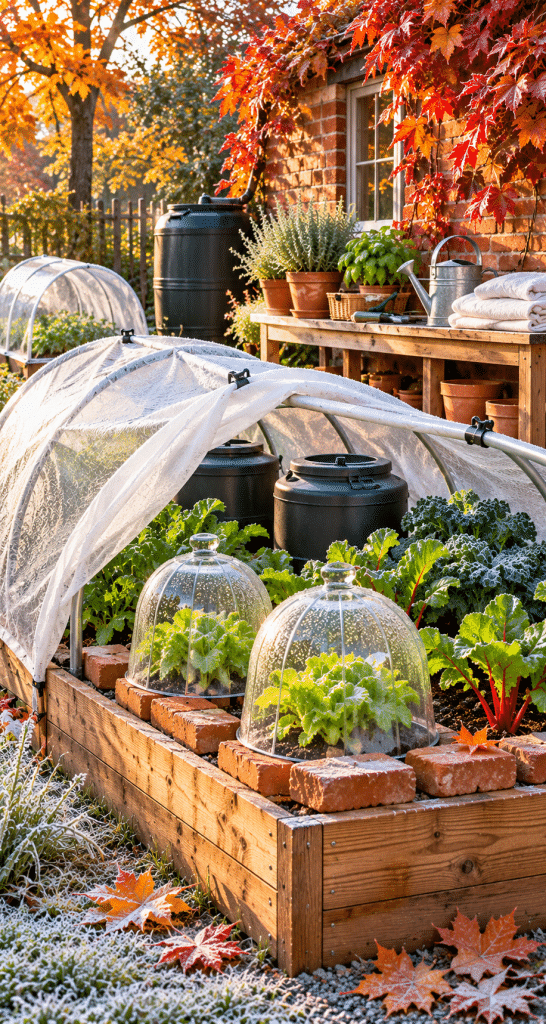
Water-filled containers, suitable masonry surfaces, and sheltered sunny locations can absorb warmth during the day and gradually release some of that energy as temperatures decline.
Although passive solar heat storage cannot replace adequate protection during severe freezing conditions, it can provide useful supplementary assistance during suitable autumn weather.
Understanding How Passive Thermal Mass Works
Different materials absorb and release heat at different rates.
Water is particularly useful because it can store substantial thermal energy relative to its volume.
When water-filled containers receive sunlight during the day, their temperature can gradually increase. After sunset, they begin releasing heat into the cooler surrounding environment.
Masonry materials, including bricks and stone, can also collect solar warmth, although their performance varies depending on size, composition, sunlight exposure, and environmental conditions.
The benefits are usually greatest when thermal storage is combined with an appropriate covering that reduces heat loss.
Agricultural extension guidance recognizes water containers as one possible supplementary method for protecting plants during radiational frost events. MyTexas Resource Library+1
Creating a Water Filled Thermal Protection System
A simple thermal protection system can be assembled using sturdy, reusable water containers.
Dark-colored containers positioned in sunny locations can absorb solar energy during favorable autumn days.
They can be arranged around the outer edges of vulnerable vegetable groupings without shading the plants excessively.
Smaller containers are easier to move and rearrange, while larger containers can provide more thermal mass.
The arrangement should remain stable, with sufficient space for plant growth, air circulation, watering, and harvesting.
Containers should also be suitable for outdoor use and have enough expansion space if the water freezes.
During the evening, the containers and plants can be enclosed within a supported frost covering.
This creates a small protected environment where both ground warmth and stored solar energy may contribute to slowing nighttime cooling.
Building a Solar Assisted Frost Protection Zone
A sunny section of the garden can become a dedicated frost protection zone for particularly valuable plants.
South-facing walls in the Northern Hemisphere often provide favorable opportunities for collecting autumn sunlight.
A garden area near a sun-warmed brick wall, stone boundary, or sheltered courtyard may experience different temperature conditions from an exposed section of the backyard.
Placing vulnerable plants within these favorable microclimates can reduce their exposure to some cold-weather conditions.
However, reflected sunlight and stored warmth should be considered supplementary benefits rather than reliable guarantees against freezing.
A minimum-maximum thermometer can help gardeners understand how these locations actually perform.
Comparing Different Passive Heat Storage Materials
| Thermal Storage Material | Portability | Practical Use | Relative Cost |
|---|---|---|---|
| Dark water containers | High | Temporary plant protection | Low |
| Large water barrels | Low | Larger protected zones | Moderate |
| Terracotta bricks | Moderate | Small sheltered growing areas | Low |
| Natural stone | Low | Existing garden structures | Variable |
| Concrete pavers | Moderate | Sunny garden boundaries | Low |
| Existing brick walls | Permanent | Sheltered microclimates | No additional cost |
Water-filled containers generally offer greater flexibility for gardeners who want to experiment with temporary arrangements.
Existing masonry features are particularly useful because they can be incorporated without introducing additional equipment.
Combining Solar Heat Storage With Individual Plant Cloches
Individual garden cloches offer an attractive way to protect smaller groups of vulnerable plants.
Transparent cloches can collect solar warmth during the day while reducing exposure to nighttime air movement.
They are especially suitable for small herbs, compact vegetables, and young ornamental plants.
A small water container placed nearby, underneath a sufficiently large protective structure, may provide additional thermal buffering.
Clear cloches must be ventilated during sunny conditions. Even during cool autumn weather, temperatures inside a closed transparent enclosure can rise considerably.
Lightweight cloches should also be anchored securely to prevent movement during windy weather.
Preparing Garden Soil to Support Natural Heat Retention
Soil moisture influences how effectively garden soil absorbs and releases warmth.
When soil is excessively dry, it may provide less thermal buffering than appropriately moist soil.
If plants need watering and frost is expected, irrigating earlier in the day can help prepare the growing area without leaving foliage unnecessarily wet during the evening.
Avoid saturating the soil simply because freezing conditions are forecast. Excess moisture can create drainage problems and negatively affect plant health.
The objective is to maintain appropriate growing conditions while allowing the soil to contribute naturally to the protected environment.
Creating a Beautiful Solar Assisted Autumn Garden
Passive solar frost protection can become an attractive feature rather than an obvious collection of gardening equipment.
Dark green water containers, natural stone edging, elegant glass cloches, and weathered terracotta elements can complement an autumn garden beautifully.
A carefully arranged collection of late-season herbs and vegetables beside a warm brick garden wall creates a charming European kitchen garden aesthetic.
The combination of natural materials, architectural structure, and practical frost protection demonstrates how productive gardening can remain visually appealing throughout autumn.
Understanding the Limitations of Passive Solar Protection
Passive thermal systems work best when adequate solar energy is available during the day.
Extended periods of cloudy weather can reduce their effectiveness. Strong winds and prolonged freezing temperatures may also overwhelm the relatively small amount of warmth available from garden-scale thermal storage.
For this reason, passive solar heat storage should not be treated as a standalone solution for highly sensitive plants during serious freezes.
Combining the system with appropriate covers, weather monitoring, and selective relocation creates a more dependable protection strategy.
🥉 Best 3 Fall Frost Protection Ideas With a Mobile Plant Rescue and Microclimate System
The third innovative approach focuses on garden mobility, strategic plant placement, and weather-responsive organization.
Instead of constructing protective structures around every vulnerable plant, this method transforms selected garden areas into temporary frost rescue stations.
The system is particularly useful for gardeners who grow valuable plants in containers, decorative planters, movable herb gardens, and small portable growing systems.
Its central principle is simple: sometimes the most effective way to protect a plant from frost is to move it away from the most vulnerable environment.
Identifying Frost Pockets Throughout the Garden
Not every part of a backyard experiences identical nighttime temperatures.
Low-lying areas can collect colder air, while certain sheltered locations may remain somewhat warmer.
Open lawns, exposed terraces, and containers positioned far from buildings may experience different conditions from protected courtyards or locations underneath substantial overhead shelter.
Understanding these microclimates allows gardeners to create a more intelligent autumn protection plan.
Place minimum-maximum thermometers in several representative garden locations. Comparing overnight readings can reveal which areas consistently become colder.
Over time, these observations become valuable for both immediate frost protection and future garden planning.
Establishing a Dedicated Plant Rescue Station
A plant rescue station is a temporary sheltered location where vulnerable container plants can be gathered before cold weather arrives.
Suitable locations may include an enclosed porch, a bright sunroom, a frost-free garage, a sheltered greenhouse, or another appropriately protected environment.
The exact location depends on the temperature requirements of the plants.
A garage that remains above freezing may be suitable for brief overnight protection, while tropical plants may require considerably warmer conditions.
Plants that remain indoors for longer periods need appropriate light and ventilation.
A well-organized rescue station should provide convenient access so that moving several plants does not become an exhausting evening task.
Organizing Plants Into Frost Sensitivity Groups
Grouping plants according to their cold tolerance makes emergency protection considerably easier.
Highly sensitive plants should receive the highest priority when temperatures begin approaching their individual tolerance limits.
Moderately sensitive plants can remain outdoors longer when appropriate protection is available.
Cold-tolerant plants can generally occupy less sheltered positions during ordinary autumn conditions.
| Protection Group | Example Plants | Recommended Action |
|---|---|---|
| Group A | Basil and tropical ornamentals | Move into a suitably warm environment early |
| Group B | Potted peppers and tomatoes | Harvest or relocate before frost |
| Group C | Tender flowering annuals | Move to a protected location |
| Group D | Container lettuce and parsley | Apply temporary protection as necessary |
| Group E | Hardy perennials | Monitor root-zone exposure and plant tolerance |
Color-coded plant labels can simplify this arrangement.
Red labels may identify plants requiring immediate relocation, yellow labels can indicate moderate sensitivity, and green labels can identify relatively cold-tolerant plants.
This creates an intuitive system that can be managed quickly even when weather conditions change unexpectedly.
Using Mobile Plant Platforms for Effortless Frost Protection
Large decorative containers can be difficult to move, particularly when filled with moist potting soil.
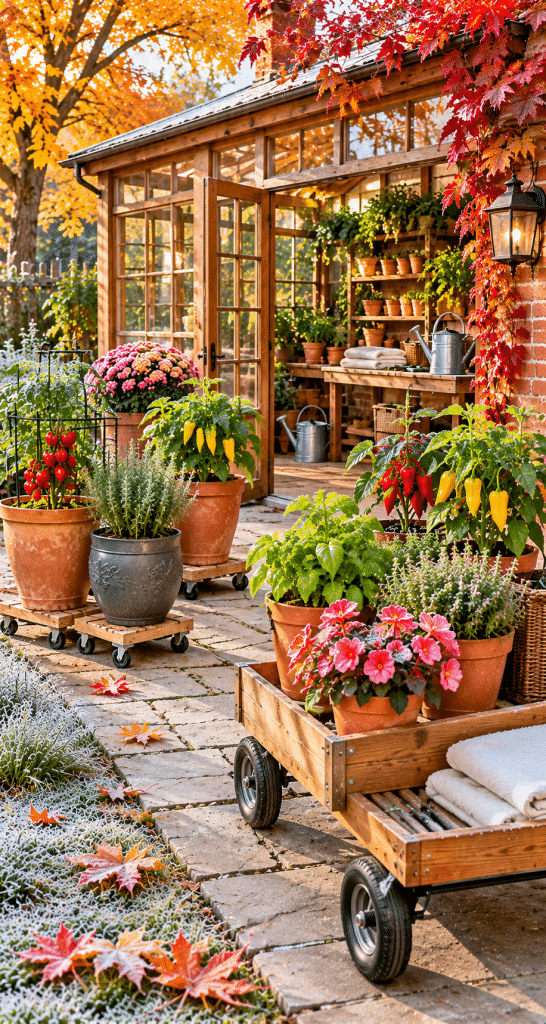
Heavy-duty plant caddies, lockable wheeled platforms, and appropriately rated garden carts can make relocation substantially easier.
Instead of lifting heavy ceramic or terracotta planters every evening, gardeners can gradually roll them into protected areas.
Several smaller herb containers can also be grouped on one sturdy movable platform.
This arrangement makes it possible to maintain an attractive outdoor garden during favorable daylight conditions while protecting vulnerable plants overnight.
Wheels should be locked or stabilized when the containers are in position, especially on sloping surfaces.
Creating a Temporary Sheltered Container Cluster
Some containers may be too large or inconvenient to relocate completely.
In these situations, grouping compatible plants within a sheltered garden area can provide practical benefits.
Placing containers close together reduces the number of exposed container surfaces. An appropriately supported protective blanket can then be installed around the collection.
Larger and more cold-tolerant plants can occupy the outer sections of the arrangement, while smaller vulnerable plants can be positioned within the protected interior.
Avoid overcrowding the foliage, blocking drainage openings, or creating conditions that prevent adequate airflow.
Container grouping and additional insulation are recognized techniques for reducing cold exposure when plants cannot be moved indoors. OSU Extension Service+1
Building an Emergency Frost Protection Storage Station
Unexpected frost warnings can create unnecessary stress when gardening supplies are scattered throughout the property.
A dedicated frost protection storage station solves this problem.
A weather-resistant cabinet, garden bench with storage, or neatly organized shelving unit can contain all the equipment required for rapid frost response.
Useful supplies include folded frost blankets, plant labels, reusable fasteners, spare garden stakes, thermometers, and protective gloves.
Keeping everything in one accessible location reduces preparation time and encourages consistent protection throughout the season.
It also prevents protective materials from being forgotten or accidentally damaged.
Designing an Attractive Mobile Autumn Garden
The mobile frost rescue concept works beautifully with contemporary container gardening aesthetics.
Matching terracotta pots, dark metal plant caddies, natural wooden shelving, and sophisticated neutral-colored planters create a harmonious garden display.
A sheltered courtyard can function as both an attractive daytime botanical arrangement and a practical nighttime protection area.
Small decorative labels and neatly organized containers add character without making the space look excessively technical.
This approach is particularly suitable for urban gardens, patios, balconies, townhouses, and homes with limited outdoor space.
🌡️ Comparing the Best 3 Fall Frost Protection Ideas
Each frost protection strategy offers different advantages depending on garden size, plant selection, local weather patterns, and available resources.
The modular frost shield is particularly suitable for established plants growing directly in garden beds.
Passive solar protection is an excellent supplementary approach for gardeners who want to take advantage of natural warmth.
The mobile rescue system provides flexibility for container gardeners and homeowners with access to protected indoor environments.
| Comparison | Modular Frost Shield | Passive Solar Protection | Mobile Plant Rescue |
|---|---|---|---|
| Best application | Vegetable and flower beds | Sheltered growing areas | Container plants |
| Main protection method | Supported insulating covers | Stored daytime warmth | Strategic relocation |
| Initial investment | Low to moderate | Low to moderate | Low to moderate |
| Installation difficulty | Easy to moderate | Moderate | Easy |
| Reusability | Excellent | Excellent | Excellent |
| Space requirements | Moderate | Moderate | Variable |
| Protection during light frost | Good | Supplementary | Excellent in suitable shelter |
| Protection during severe freezes | Limited | Limited | Depends on shelter temperature |
| Suitability for beginners | Excellent | Good | Excellent |
| Overall flexibility | Excellent | Good | Excellent |
Many gardeners achieve the best results by combining elements of all three strategies.
A productive autumn garden might use modular frost shields over vegetable rows, solar-assisted protection around selected herbs, and mobile plant platforms for sensitive decorative containers.
This combined approach ensures that protection is matched to the individual requirements of each growing area.
❄️ When Should You Start Protecting Your Garden From Fall Frost
Timing is one of the most important components of successful frost protection.
Waiting until frost is already visible on the foliage means the plants may have experienced damaging temperatures.
Gardeners should begin monitoring local overnight forecasts as autumn progresses, especially when clear skies and calm conditions are expected.
Historical first-frost dates provide a useful planning reference, but they cannot predict exactly when frost will occur in a particular backyard.
Local observations, current weather forecasts, and garden-level temperature measurements provide more actionable information.
Understanding Fall Frost Temperature Levels
| Forecast Overnight Temperature | Approximate Celsius Equivalent | Suggested Response |
|---|---|---|
| 45–50°F | 7–10°C | Monitor cold-sensitive tropical plants |
| 37–44°F | 3–7°C | Prepare protection for sensitive plants |
| 33–36°F | 1–2°C | Consider covering vulnerable plants |
| 29–32°F | -2–0°C | Implement appropriate frost protection |
| 25–28°F | -4–-2°C | Prioritize harvesting and stronger protection |
| Below 25°F | Below -4°C | Relocate sensitive plants when possible |
These temperature ranges are general planning guidelines rather than guaranteed plant survival thresholds.
Actual garden temperatures may differ from official forecasts, and prolonged cold exposure can be more damaging than a brief temperature decline.
Preparing During the Afternoon
Late afternoon is often an excellent opportunity to organize protective materials, check soil moisture, and move vulnerable containers.
Plants should receive their necessary daylight exposure before protective coverings are closed.
Installing covers before sunset helps retain warmth that would otherwise escape into the cooling nighttime environment.
Completing preparations early also avoids the difficulty of working outdoors in darkness and rapidly falling temperatures.
Managing the Garden the Following Morning
Frost protection does not end when the sun rises.
Gardeners should check outdoor temperatures before removing protective materials.
Once conditions are appropriate, covers can be opened to improve ventilation and allow plants to receive sunlight.
Transparent enclosures require particular attention because they may warm quickly in direct sunshine.
Inspect plants carefully for signs of cold injury, excessive condensation, or physical damage caused by shifting protective materials.
🕒 How to Create a Simple Fall Frost Protection Routine
Establishing a consistent routine helps transform frost protection from an emergency response into a manageable gardening habit.
A predictable routine is particularly beneficial during periods when several cold nights are followed by warmer weather.
| Time | Recommended Activity |
|---|---|
| Morning | Check temperatures and inspect plants |
| Late morning | Open or ventilate protection when appropriate |
| Early afternoon | Review the latest overnight forecast |
| Mid-afternoon | Check soil moisture and prepare supplies |
| Before sunset | Cover vulnerable beds and relocate sensitive containers |
| Following morning | Assess conditions before uncovering plants |
This routine can be adjusted according to work schedules, garden size, and local weather.
A small garden may require only a few minutes of preparation, while a larger productive backyard may benefit from several independently managed protection zones.
The key is consistency rather than complexity.
🚫 Common Fall Frost Protection Mistakes That Can Damage Your Garden
Even well-intentioned frost protection efforts can create unnecessary problems when materials are installed incorrectly or plant requirements are misunderstood.
Avoiding common mistakes can improve the effectiveness of temporary protection while maintaining healthy growing conditions.
Covering Plants Too Late in the Evening
Waiting until temperatures have already dropped significantly reduces the opportunity to retain daytime warmth.
Preparing the garden before sunset allows protective structures to begin functioning while some warmth remains available.
This becomes especially important during clear autumn evenings when exposed surfaces may cool rapidly.
Leaving Protective Structures Closed During Sunny Days
Although nighttime protection is beneficial, unnecessary daytime enclosure can create excessively warm conditions.
Transparent coverings are especially susceptible to rapid solar heating.
Opening or ventilating protective structures during suitable daytime weather helps maintain a healthier growing environment and reduces excessive condensation.
Assuming Every Plant Requires the Same Protection
A frost protection strategy designed for kale may be completely inadequate for basil.
Likewise, moving every hardy container plant indoors may create unnecessary work without providing meaningful benefits.
Understanding individual plant requirements allows gardeners to concentrate their efforts where protection is most valuable.
Using Inadequately Secured Protective Fabrics
Loose protective materials may shift during windy conditions, leaving sensitive plants exposed.
They can also rub against stems or damage delicate foliage.
Appropriate support structures, reusable clips, and secure ground anchors help maintain the intended protective arrangement.
Depending Entirely on Passive Heat During Severe Freezes
Water containers and sun-warmed masonry provide limited amounts of stored energy.
They cannot reliably maintain safe temperatures throughout every freezing event.
When a prolonged or severe freeze is expected, harvesting vulnerable crops or relocating sensitive plants may provide substantially better results.
Pruning Frost Damaged Plants Immediately
Cold-damaged foliage can look alarming, but visible injury does not always indicate that the entire plant has died.
Some plants may recover once temperatures improve, while others may reveal more extensive damage over time.
Avoid unnecessary immediate pruning until the extent of the injury becomes clearer, unless damaged tissue presents an immediate problem or the plant has specific management requirements.
🥬 Extending the Autumn Harvest With Strategic Frost Protection
One of the most rewarding benefits of fall frost protection is the opportunity to continue harvesting fresh produce beyond the first cold nights of the season.
An otherwise productive vegetable garden does not necessarily need to stop growing simply because occasional frost becomes possible.
Cool-season vegetables such as kale, spinach, and selected lettuce varieties can remain productive under favorable conditions, especially when temporary protection is available.
Tender crops such as tomatoes and peppers require greater attention because frost damage can quickly interrupt their productivity.
Prioritizing Vegetables With Valuable Remaining Harvests
Gardeners should assess which plants still contain developing produce before investing time in protection.
A tomato plant carrying numerous nearly mature fruits may justify temporary covering during a brief cold spell.
A struggling cucumber plant with little remaining productivity may not deserve the same level of effort.
This selective approach makes autumn gardening more efficient.
It also helps gardeners decide when continuing protection is worthwhile and when harvesting the remaining produce is the better option.
Protecting Autumn Salad Gardens
Autumn salad gardens are particularly well suited to temporary frost protection.
Compact leafy vegetables fit comfortably beneath low protective tunnels and individual cloches.
During appropriate weather, these structures can remain open to support healthy growth.
When colder conditions arrive, the covering can be adjusted quickly to protect the remaining harvest.
A well-managed salad garden may continue providing fresh ingredients considerably later than an unprotected growing area, depending on local climate and plant selection.
💰 Affordable Fall Frost Protection Ideas for Different Garden Sizes
An effective frost protection system does not need to involve a substantial financial investment.
Many gardeners already own materials that can be repurposed for temporary protection.
Existing garden stakes, old sheets, suitable outdoor containers, reusable clips, and sheltered household spaces can provide the foundation for an economical system.
| Garden Size | Suggested Protection Setup | Illustrative Budget |
|---|---|---|
| Small balcony | Individual covers and indoor relocation | $10–$30 |
| Small patio garden | Mobile container grouping | $20–$60 |
| One raised vegetable bed | Hoops and reusable frost fabric | $25–$75 |
| Medium backyard garden | Modular shields and thermal containers | $60–$150 |
| Large productive garden | Multiple independently protected zones | $100–$250+ |
These approximate budgets are illustrative rather than current retail quotations. Existing materials, local prices, and garden dimensions can significantly influence the actual cost.
Investing in durable, reusable components often provides better long-term value than repeatedly purchasing disposable protective materials.
Frequently Asked Questions About Fall Frost Protection Ideas
What Is the Cheapest Way to Protect Garden Plants From Fall Frost
Using existing household sheets supported by garden stakes is one of the most economical temporary methods.
The covering should extend toward the ground and be secured properly before temperatures fall.
For frequent seasonal use, reusable horticultural frost fabric may provide a more convenient alternative.
Can Plants Survive Fall Frost Without Protection
Yes, many cold-tolerant plants can survive light frost without additional protection.
Kale, spinach, carrots, and certain established hardy perennials are generally more tolerant than summer vegetables and tropical ornamentals.
However, survival depends on the plant variety, growing conditions, temperature, and duration of exposure.
Is It Better to Cover Plants or Bring Them Indoors
For plants growing directly in the ground, supported frost coverings are generally the more practical option during occasional light frost.
For highly sensitive container plants, relocation into an appropriately warm environment may provide more dependable protection.
The best method depends on the mobility and temperature requirements of each plant.
Can Water Bottles Help Protect Plants From Frost
Water-filled containers can absorb solar warmth during the day and release some of that energy as nighttime temperatures decline.
They are most useful as supplementary thermal storage beneath a suitable protective structure.
They should not be relied upon as the sole protection method during severe freezing conditions.
Should Garden Plants Be Watered Before a Frost
If the soil is dry and the plants require irrigation, watering earlier in the day may be beneficial.
Appropriately moist soil can store and release more heat than excessively dry soil.
However, unnecessary saturation should be avoided, particularly in areas with poor drainage.
Can Frost Protection Fabric Remain on Plants All Day
Certain breathable horticultural fabrics are designed to remain in place for extended periods.
Nevertheless, gardeners should consider fabric weight, sunlight transmission, daytime temperatures, and the needs of the plants.
Heavy coverings and transparent plastic structures generally require more active ventilation management. UMN Extension+1
What Is the Best Fall Frost Protection Idea for Beginners
A simple modular frost shield consisting of garden hoops, breathable frost fabric, and reusable fasteners offers an excellent starting point.
It is adaptable, relatively affordable, easy to understand, and suitable for many common vegetable and flower beds.
The system can also be expanded gradually as gardening needs change.
Can Fall Frost Protection Keep Plants Alive Throughout Winter
Temporary frost protection is primarily intended to manage occasional cold events and extend the growing season.
It is not necessarily sufficient to maintain frost-sensitive plants throughout prolonged winter conditions.
Long-term survival requires consideration of plant hardiness, regional climate, minimum temperatures, and appropriate overwintering facilities.
🌿 Final Thoughts on the Best Fall Frost Protection Ideas
The best fall frost protection ideas combine practical gardening knowledge with intelligent preparation, adaptable materials, and careful observation of changing weather conditions.
🥇 The modular overnight frost shield system provides versatile protection for established vegetables, herbs, and flowering plants while allowing easy access during favorable daytime conditions.
🥈 The passive solar heat storage system makes creative use of naturally collected warmth to supplement conventional frost protection methods and improve selected garden microclimates.
🥉 The mobile plant rescue and microclimate system provides exceptional flexibility for sensitive container plants, decorative planters, and compact urban gardens.
Each strategy addresses a different aspect of autumn frost protection, and combining them can create a more resilient and productive garden.
There is no need to surrender an attractive autumn garden simply because the first freezing night appears in the weather forecast.
With thoughtful preparation, reusable protective materials, and a flexible response to changing temperatures, gardeners can preserve beautiful flowers, protect valuable plants, enjoy additional harvests, and make the most of the final growing weeks before winter arrives.