Fall Shade Garden Ideas can completely transform overlooked outdoor spaces into breathtaking autumn retreats filled with rich foliage, delicate flowers, architectural greenery, and enchanting woodland textures. While sunny gardens often receive the most attention during fall, shaded corners offer extraordinary opportunities to create sophisticated landscapes that feel peaceful, mysterious, and beautifully connected to nature.

Imagine stepping into a quiet garden beneath towering trees, where copper-colored leaves settle gently around elegant ferns, deep burgundy foliage contrasts with silver-green plants, and delicate autumn flowers brighten the woodland floor. The combination of filtered sunlight, layered vegetation, and seasonal colors creates an atmosphere that feels like a luxurious private botanical sanctuary.
The secret to designing an extraordinary fall shade garden is understanding that autumn beauty does not depend entirely on brightly colored flowers. Instead, successful shaded landscapes combine dramatic foliage, carefully selected shade-tolerant plants, contrasting textures, seasonal blooms, and thoughtful garden composition.
Some plants develop extraordinary bronze, amber, purple, and crimson tones as temperatures cool. Others provide beautiful evergreen structure, delicate late-season flowers, or decorative foliage that remains attractive long after summer gardens begin fading.
Even challenging locations beneath mature trees or along north-facing walls can become visually impressive when the planting design responds to existing light, soil moisture, and root competition.
These three remarkable fall shade garden ideas explore different approaches to creating an inviting autumn landscape, from romantic woodland gardens to contemporary foliage retreats and enchanting seasonal garden sanctuaries.
Each concept offers a distinctive personality while emphasizing sustainable plant combinations, practical maintenance, and long-lasting seasonal interest.
🍁 Why Fall Shade Garden Ideas Can Create More Beautiful Autumn Landscapes
Shaded gardens possess a natural intimacy that sunny landscapes sometimes struggle to achieve. Overhanging branches, filtered daylight, and sheltered planting areas establish a sense of enclosure that makes an outdoor space feel like a secret garden.
During autumn, this atmosphere becomes even more captivating.
Deciduous trees gradually reveal beautiful changes in their foliage, while fallen leaves introduce warm natural colors across the ground. Evergreen ferns provide contrast against these seasonal transformations, creating visual depth without requiring elaborate decorative features.
The most successful fall shade gardens embrace these qualities instead of attempting to imitate conventional sun-loving flower borders.
Understanding the Different Types of Garden Shade
Before choosing plants, it is important to understand that shade is not a single growing condition.
Some shaded areas receive several hours of gentle morning sunlight, while others remain beneath dense tree canopies throughout the day.
These differences strongly influence plant performance.
| Shade condition | Typical characteristics | Suitable planting approach |
|---|---|---|
| Light shade | Bright conditions with limited direct sunlight | Heuchera, Japanese anemones, woodland perennials |
| Partial shade | Several hours of direct sunlight, often in the morning | Autumn cyclamen, certain hydrangeas, ferns |
| Dappled shade | Intermittent sunlight filtered through tree branches | Woodland plants, epimedium, shade-tolerant groundcovers |
| Deep shade | Very little direct sunlight | Selected ferns, evergreen foliage plants, carefully chosen groundcovers |
| Dry shade | Low light combined with limited soil moisture | Established epimedium, certain hardy ferns, autumn cyclamen |
| Moist shade | Shaded soil that remains consistently moist but drains adequately | Japanese painted ferns, moisture-loving woodland perennials |
A planting scheme that succeeds in partial shade may struggle beneath a dense evergreen canopy.
Similarly, plants that thrive in moist woodland soil may fail near large tree roots where the ground becomes extremely dry.
Understanding these conditions helps create beautiful landscapes that remain healthy with less maintenance.
Why Autumn Foliage Matters More Than Constant Flowering
Summer gardens frequently rely on flowers to provide visual excitement.
Fall shade gardens offer an opportunity to explore a more sophisticated design philosophy.
Decorative leaves become the main attraction, providing color, movement, and architectural interest even when few plants are flowering.
Heuchera varieties can display dramatic foliage in shades of caramel, burgundy, bronze, plum, and amber. Japanese painted ferns introduce delicate silver-green textures, while evergreen ferns establish a lush visual foundation.
These combinations create impressive contrasts without requiring continuous blooms.
The Royal Horticultural Society also highlights the value of combining structural plants, groundcovers, and autumn-interest species in shaded planting designs. RHS Advice
The following three garden concepts demonstrate how these principles can produce dramatically different outdoor environments.
🥇 Best 1 Fall Shade Garden Ideas With a Romantic Woodland Retreat and Enchanting Autumn Flowers
A romantic woodland retreat is one of the most captivating ways to transform a shaded garden during autumn.
This approach celebrates the natural character of forest environments by combining delicate flowers, layered greenery, textured groundcovers, and carefully arranged organic materials.
Rather than creating a rigid landscape with perfectly symmetrical planting, the woodland style embraces gentle curves, irregular plant groupings, and beautiful transitions between different foliage textures.
The result resembles a peaceful botanical hideaway where every corner offers something interesting to discover.
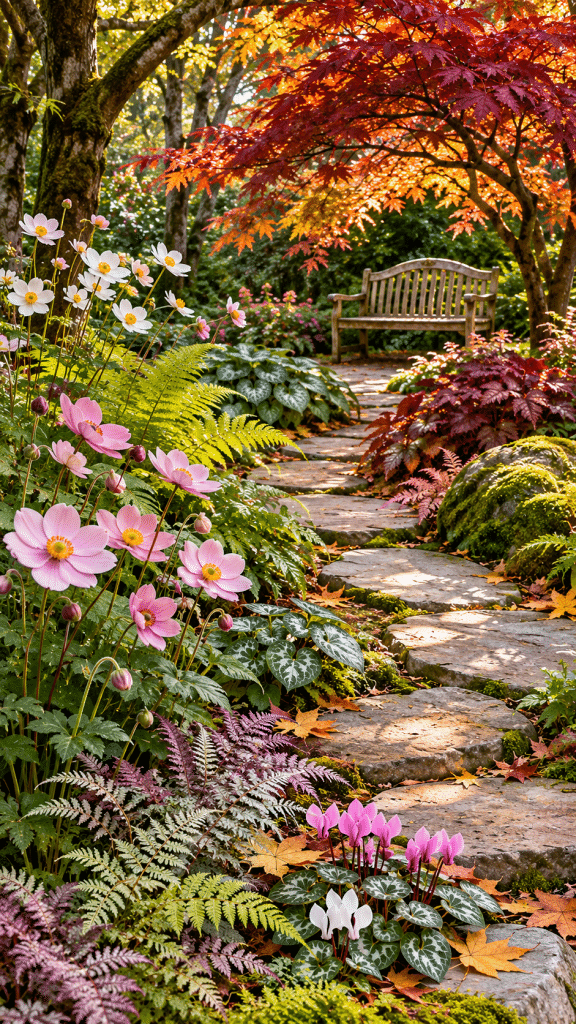
🌸 Creating a Magical Woodland Garden With Autumn Flowering Plants
The centerpiece of this design is a carefully selected collection of plants that provide autumn flowers without requiring intense sunlight.
Japanese anemones are particularly attractive for locations with suitable light and moisture.
Their elegant flowers rise above attractive foliage, creating a graceful appearance that contrasts beautifully with the surrounding greenery.
Soft white varieties provide a romantic atmosphere, while delicate pink flowers introduce subtle warmth.
Japanese anemones generally perform best in partial shade or bright, sheltered conditions rather than extremely dark locations. They also need enough moisture to support healthy flowering.
For smaller planting areas, autumn-flowering hardy cyclamen offer another delightful option.
Cyclamen hederifolium produces delicate pink or white flowers during autumn, often emerging before its patterned foliage.
These miniature flowers appear especially beautiful when planted beneath deciduous trees or among low-growing woodland plants.
The species is well suited to naturalistic planting in light shade and can gradually establish charming colonies in favorable conditions. RHS Advice+1
Combining flowers of different heights establishes a layered visual effect.
Tall Japanese anemones can occupy the background, while autumn cyclamen decorate the foreground with smaller seasonal accents.
This arrangement creates depth without overwhelming the natural woodland character.
🌿 Layering Ferns and Woodland Foliage for Extraordinary Texture
Ferns are essential components of a sophisticated woodland garden.
Their graceful fronds introduce movement and softness, making them particularly effective beneath trees and alongside irregular natural stone features.
Japanese painted ferns, especially Athyrium niponicum var. pictum, offer attractive silvery foliage with subtle purple tones.
These colors look exceptionally elegant beside deep green plants or bronze-colored foliage.
Evergreen fern varieties provide additional structure.
Christmas fern, Polystichum acrostichoides, can create attractive green clumps in suitable shaded locations, while certain Dryopteris species offer broader architectural forms.
Planting ferns in groups creates a more convincing woodland atmosphere than scattering individual specimens randomly throughout the garden.
For example, a group of three or five compatible ferns can establish a strong visual rhythm.
Smaller foliage plants can then occupy the spaces between them.
Brunnera with silver-patterned leaves offers a particularly beautiful contrast where soil conditions remain suitable.
Its heart-shaped foliage introduces a completely different leaf structure, enhancing the visual complexity of the planting composition.
The goal is to create a natural botanical tapestry with recognizable layers.
🍂 Designing a Woodland Floor With Fallen Leaves and Natural Materials
One of the greatest advantages of a fall woodland garden is that autumn provides many of its decorative materials naturally.
Fallen leaves can become part of the landscape rather than something that must immediately be removed.
A thin layer of shredded leaves can help protect exposed soil, gradually contribute organic matter, and create a beautiful woodland appearance.
However, thick mats of wet leaves should not be allowed to smother small plants or delicate evergreen foliage.
Naturalistic groundcovers also help establish a cohesive woodland floor.
Epimedium is particularly useful in many shaded planting schemes.
Its attractive foliage can provide seasonal color, while established plants may tolerate relatively dry shade.
Carefully selected sedges can introduce fine-textured foliage that contrasts with broader woodland leaves.
A restrained selection of groundcovers generally produces a more elegant result than attempting to include too many unrelated varieties.
The woodland floor should feel natural, connected, and visually peaceful.
🪵 Adding a Curved Woodland Trail and a Secret Garden Seating Area
A romantic shade garden becomes even more inviting when visitors can move through the planting areas.
A gently curving stepping-stone trail offers a beautiful way to explore the garden without disturbing delicate vegetation.
Natural stone pavers, irregular flagstones, or weathered stepping stones work particularly well.
The pathway should follow a relaxed curve rather than a rigid straight line.
This creates a sense of discovery by gradually revealing different sections of the garden.
Small woodland plants can soften the edges, making the stones appear naturally integrated into their surroundings.
At the end of the trail, a simple wooden bench can establish a peaceful destination.
Choose weather-resistant timber, reclaimed stone, or another understated natural material.
A bench beneath a deciduous tree becomes especially beautiful during autumn, when colorful foliage forms a seasonal canopy overhead.
Avoid placing heavy furniture directly over sensitive tree roots or compacting large areas of soil.
Instead, position the seating space where existing ground conditions can comfortably support regular use.
✨ Creating an Enchanting Atmosphere With Filtered Autumn Sunlight
Lighting has an enormous influence on the character of a shade garden.
During autumn, sunlight enters the landscape at a lower angle, producing beautiful patterns through the remaining tree foliage.
This filtered light can illuminate individual flowers, highlight decorative leaves, and create dramatic contrasts between bright and shaded areas.
Positioning silver-leaved plants where they catch occasional sunlight can make them appear almost luminous.
Deep burgundy foliage works beautifully nearby because darker colors create visual contrast.
Subtle outdoor lighting can extend the garden’s atmosphere into the evening.
Low-voltage garden lights may illuminate a pathway or highlight an attractive tree trunk, provided the fixtures are rated for outdoor use.
Warm lighting generally complements woodland landscapes more naturally than intense cool-white illumination.
The finished garden should feel romantic without becoming overly decorated.
Its greatest beauty comes from the relationship between plants, natural materials, and seasonal light.
🍁 The Ideal Romantic Woodland Plant Combination
A particularly appealing planting scheme includes Japanese anemones for height, autumn cyclamen for delicate flowers, Japanese painted ferns for silver-green texture, and epimedium for lower foliage coverage.
Small groups of evergreen ferns can maintain visual structure as deciduous plants enter dormancy.
This combination creates an inviting transition from late summer into autumn while offering attractive foliage beyond the flowering season.
In areas with heavier shade, prioritize the ferns and shade-adapted groundcovers, positioning flowering plants closer to brighter woodland edges.
The overall effect is a romantic retreat that feels effortlessly connected to nature.
🥈 Best 2 Fall Shade Garden Ideas With Dramatic Burgundy Foliage and a Modern Botanical Sanctuary
Not every shade garden needs to resemble a traditional woodland.
For homeowners who prefer sophisticated contemporary landscaping, a foliage-focused autumn garden offers a striking alternative.
This concept combines dramatic leaf colors, sculptural greenery, restrained planting arrangements, and elegant architectural materials.
Instead of relying on numerous flowering plants, it emphasizes strong visual contrasts between burgundy, copper, silver, and deep green foliage.
The result is a beautifully composed outdoor sanctuary that feels modern, luxurious, and exceptionally calming.
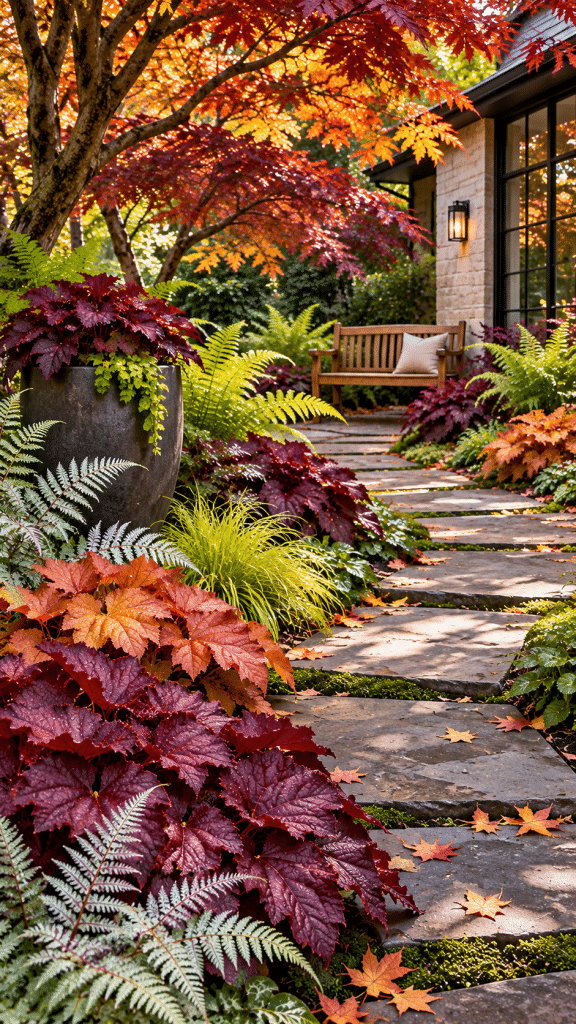
🍷 Designing a Fall Shade Garden Around Rich Burgundy and Copper Foliage
Color selection is the defining feature of this garden.
Deep burgundy leaves create dramatic focal points, especially when positioned against lighter planting materials.
Heuchera varieties are excellent candidates for this effect.
Depending on the cultivar, their leaves may display rich plum, chocolate, mahogany, amber, or caramel coloring.
Some varieties have deeply ruffled foliage that introduces additional texture.
Rather than mixing every available color, select a restrained palette.
For example, combine dark burgundy foliage with copper-toned leaves and silver-green ferns.
This creates a sophisticated appearance that feels intentional rather than chaotic.
Use darker foliage in repeated groups throughout the garden.
Repetition helps connect the planting composition and prevents individual plants from appearing visually isolated.
In brighter shade, amber or caramel foliage can introduce warmth.
In deeper shade, silver-patterned leaves and rich green textures may remain more visually distinct than very dark varieties.
🌿 Combining Heuchera With Architectural Ferns and Evergreen Structure
A successful modern shade garden needs more than color.
Architectural foliage creates the strong shapes that give the landscape its contemporary personality.
Ferns provide a useful starting point.
Upright fronds can introduce vertical emphasis, while arching varieties soften hard architectural surfaces.
Japanese holly fern, Cyrtomium falcatum, offers distinctive glossy foliage in suitable climates.
Its structured leaves contrast beautifully with the rounded forms of heuchera.
Other evergreen or semi-evergreen ferns may provide similar benefits depending on regional growing conditions.
Heuchera should generally be positioned in well-drained soil with the plant crown kept above excessive mulch buildup.
Although many varieties appreciate partial shade, their tolerance for heat, moisture, and cold can differ.
Selecting cultivars suited to the local climate is essential.
The most attractive arrangements combine several leaf forms rather than several plants with nearly identical shapes.
Try contrasting broad, rounded foliage with narrow fern fronds and fine-textured sedges.
These combinations create a sophisticated botanical composition even when flowering is minimal.
🪴 Creating Sculptural Planting Islands With Beautiful Negative Space
Modern garden design frequently uses negative space to make individual plants more visually significant.
Negative space refers to the open areas between major design features.
In a shade garden, this might include a restrained gravel surface, a simple stone walkway, or a modest open area between planting groups.
Instead of covering every available inch with foliage, organize plants into intentional clusters.
A dramatic fern can become the focal point of one planting island.
A group of burgundy heuchera can create a contrasting composition nearby.
A pale stone surface between these groups allows their colors and textures to stand out.
However, extensive gravel coverage beneath mature trees can create practical problems, particularly when combined with landscape fabric or significant soil disturbance.
Where tree roots are present, shallow organic mulch and carefully positioned stepping stones are often more appropriate.
The intention is to achieve visual simplicity without damaging existing trees.
Large containers can also create attractive focal points in shaded areas.
Matte charcoal, weathered concrete, and understated stone finishes complement dramatic foliage particularly well.
Containers should have adequate drainage and enough space for healthy root development.
🖤 Using Natural Stone and Dark Architectural Details
Hardscape materials can dramatically influence the personality of a modern autumn garden.
Dark charcoal stepping stones introduce a refined contrast against copper-colored leaves.
Weathered concrete creates a calm architectural foundation.
Pale limestone can brighten shaded areas and highlight darker plants.
The most successful contemporary designs typically rely on a limited material palette.
Using too many stone colors or decorative finishes can weaken the visual impact.
Choose one dominant material and introduce one complementary finish if necessary.
For example, dark gray stepping stones paired with warm timber seating create an elegant contrast between modern architecture and natural comfort.
Small black metal planters may provide additional structure.
However, large decorative elements should not overwhelm the plants.
The foliage remains the main attraction.
🍁 Introducing Autumn Color Without Overcrowding the Garden
A modern shade garden benefits from carefully controlled seasonal accents.
Rather than placing decorative pumpkins and colorful ornaments throughout the planting, allow selected foliage plants to provide the autumn character.
Copper and amber heuchera can offer warm tones.
Japanese painted ferns introduce sophisticated silver-green textures.
Certain deciduous shrubs provide seasonal leaf color where light conditions allow.
Compact viburnum varieties may contribute attractive autumn foliage, but their performance depends on the species, cultivar, and growing conditions.
Hydrangeas can also play a role in brighter sections of the design.
Some varieties develop attractive late-season flower colors, although many require more light than a deeply shaded location provides.
Place these flowering shrubs toward the brighter perimeter rather than directly beneath dense trees.
This gradual transition from deep shade to partial shade adds complexity without compromising the clean design.
💡 Enhancing the Modern Garden With Subtle Architectural Lighting
Contemporary shade gardens become especially atmospheric when illuminated carefully.
Instead of installing numerous bright lights, focus on a few important visual features.
An architectural fern may look beautiful when illuminated from below by a discreet garden fixture.
A sculptural container can become a subtle focal point.
Warm light reflecting against a pale stone wall may create a welcoming evening atmosphere.
Avoid directing strong lighting toward neighboring properties or creating unnecessary nighttime illumination.
Use shielded fixtures and timers where appropriate to reduce energy consumption and disturbance to wildlife.
The lighting design should reinforce the natural beauty of the garden rather than compete with it.
✨ The Ideal Modern Fall Shade Garden Planting Combination
For a refined contemporary arrangement, select two complementary heuchera colors, a structurally interesting fern, and a reliable shade-tolerant evergreen plant.
Use the darkest foliage as a focal accent.
Repeat the lighter plants to establish visual rhythm.
Introduce one sculptural container or natural stone feature to anchor the composition.
This approach works particularly well in smaller gardens, shaded courtyards, and outdoor spaces adjacent to modern architecture.
Its beauty lies in simplicity, proportion, and the extraordinary decorative potential of foliage.
🥉 Best 3 Fall Shade Garden Ideas With an Enchanted Autumn Woodland Sanctuary and Wildlife Friendly Planting
The third design transforms a shaded garden into a naturally beautiful seasonal sanctuary that supports wildlife while providing an enchanting autumn atmosphere.
This approach combines woodland planting, organic groundcovers, seasonal flowers, habitat features, and carefully managed fallen leaves.
Unlike a purely decorative landscape, the wildlife sanctuary considers the ecological functions of the garden.
It aims to provide shelter, protect soil, encourage biodiversity, and create opportunities for visitors to observe seasonal changes.
The final result feels lush and immersive without becoming unnecessarily complicated.
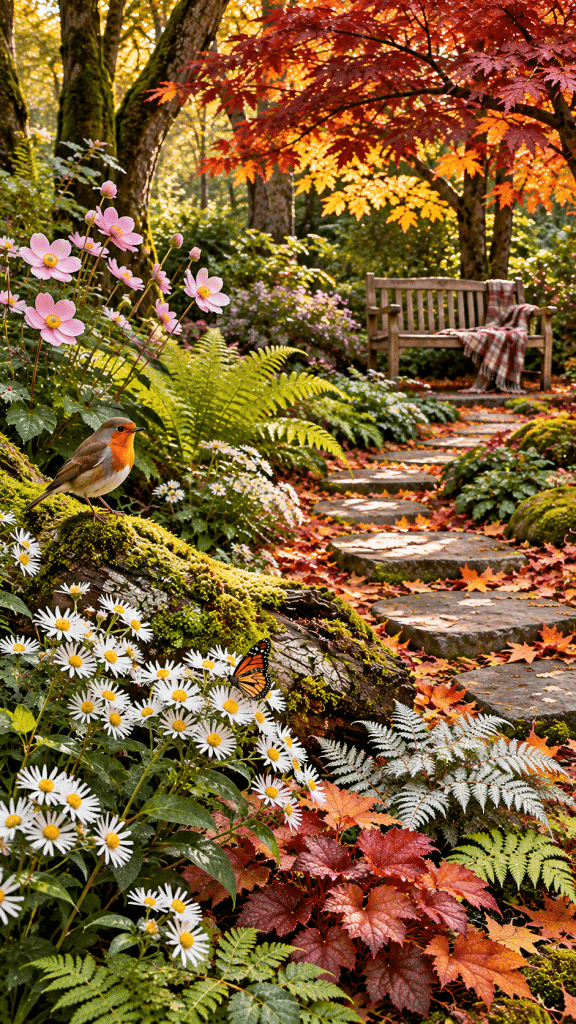
🦋 Selecting Shade Tolerant Autumn Flowers for Seasonal Wildlife Interest
Autumn is an important transition period for many garden insects.
Where temperatures remain suitable, late-flowering plants can provide valuable resources before winter.
However, many familiar fall pollinator plants, including numerous asters and goldenrods, perform best in full sunlight.
A shade garden therefore requires a more selective planting strategy.
Japanese anemones can attract visiting insects in suitable conditions.
Their late-season flowers provide delicate color and movement.
Some woodland asters, including certain North American Symphyotrichum species, can grow in partial shade.
Their light requirements vary considerably by species.
For example, white wood aster, Eurybia divaricata, is often useful in shaded woodland-style planting and can offer small, pale flowers in late summer or autumn.
It is particularly appropriate in parts of eastern North America where it is native.
When choosing plants for wildlife value, prioritize species naturally associated with the local region.
Locally native plants often have important relationships with regional insects and other wildlife.
Avoid assuming that every attractive flowering plant provides equal ecological benefits.
The Royal Horticultural Society notes that appropriately selected plants for shaded autumn borders can contribute late-season wildlife value. RHS Advice
🍄 Building a Living Woodland Floor With Natural Groundcovers
A wildlife-friendly garden begins with healthy soil.
Beneath mature trees, the ground naturally receives leaves, twigs, and other organic materials.
These materials eventually decompose, supporting soil organisms and contributing to the woodland nutrient cycle.
A carefully managed layer of fallen leaves can therefore become a valuable part of the landscape.
Instead of removing every leaf, allow suitable areas to retain a loose natural covering.
Keep heavy leaf accumulation away from vulnerable crowns and plants that require open growth conditions.
Where groundcovers are needed, choose species adapted to the actual moisture and shade conditions.
Native woodland sedges can form attractive foliage colonies.
Epimedium provides another option in ornamental plantings where it is appropriate and non-invasive.
Some evergreen ferns offer excellent year-round structure.
Combining different groundcover types helps create a more varied woodland environment.
Avoid introducing aggressively spreading species that may overwhelm neighboring vegetation or escape into nearby natural habitats.
The objective is a garden that looks abundant while remaining ecologically responsible.
🌳 Creating Natural Shelter With Layered Vegetation
Wildlife-friendly planting becomes more effective when vegetation provides a range of heights and textures.
A landscape containing only low-growing plants offers less structural diversity than one with several vegetation layers.
Begin with existing trees.
Their canopies provide shade, seasonal leaf litter, and opportunities for birds and insects.
Where space allows, add suitable understory shrubs.
These can provide additional shelter and seasonal interest.
Native shrub species should be selected according to local climate, soil conditions, and available space.
Below the shrubs, arrange clusters of ferns, woodland perennials, and groundcovers.
These layers establish a more complex landscape.
Small mammals and other wildlife may use sheltered vegetation for movement and protection.
Insects can also benefit from undisturbed natural materials and appropriately managed planting areas.
The planting should remain accessible for occasional maintenance without disturbing sensitive habitats unnecessarily.
🪵 Adding a Beautiful Woodland Log Feature
A naturally weathered log can become one of the most attractive elements in a wildlife-friendly shade garden.
Its textured bark, irregular shape, and earthy color complement the woodland environment.
As untreated wood gradually decomposes, it may provide habitat for fungi and many invertebrates.
A single substantial log can be positioned among ferns and low-growing plants.
Smaller branches may be arranged nearby to create additional natural texture.
This feature should appear intentionally integrated rather than resembling a pile of garden waste.
Choose untreated timber from a suitable local source.
Avoid importing wood that could introduce pests or diseases.
Position logs away from frequently used walkways and ensure they are stable.
In gardens where the presence of termites or other wood-associated pests is a concern, keep decomposing timber appropriately separated from buildings and vulnerable wooden structures.
A thoughtfully placed woodland log can add character while serving a practical ecological purpose.
🐦 Introducing Bird Friendly Shrubs and Seasonal Planting
Bird-friendly planting can enhance a garden’s seasonal value.
Shrubs that produce berries or provide dense shelter are especially useful when selected for the regional environment.
In brighter shade, certain viburnum species may provide decorative fruit and autumn foliage.
However, berry production usually depends on adequate flowering, suitable pollination conditions, and the plant’s light requirements.
Not every viburnum performs well in deep shade.
Other locally appropriate berry-producing shrubs may offer better results depending on the garden’s climate.
A layered planting design with shrubs, herbaceous perennials, and groundcovers can provide structural shelter as well as seasonal food opportunities.
Avoid relying solely on ornamental berries.
Native plants that support local insects may indirectly contribute important food resources for birds.
Leaving some healthy seed heads and undisturbed vegetation can also improve the garden’s ecological character.
🌙 Creating a Peaceful Autumn Sanctuary With Natural Garden Features
A wildlife-friendly shade garden should offer an enjoyable experience for people without sacrificing its natural atmosphere.
A simple seating location can provide a quiet place to observe birds, changing foliage, and seasonal activity.
A small natural stone feature may add visual interest.
A shallow wildlife water source can be useful when it is kept clean and designed with safe access and escape routes for small animals.
Avoid installing excessively bright decorative lighting.
Darkness is important for many nocturnal organisms.
If pathway lighting is necessary, use low-intensity fixtures that operate only when required.
The sanctuary should feel peaceful rather than heavily illuminated.
A restrained landscape allows visitors to appreciate natural textures, seasonal sounds, and changing light conditions.
🍂 Preserving the Wild Beauty of Autumn Without Creating a Neglected Garden
Wildlife-friendly landscaping does not mean abandoning garden maintenance.
Instead, it requires a more selective approach.
Remove invasive plants, maintain safe pathways, and monitor plant health.
Retain beneficial natural materials where they do not cause problems.
Avoid unnecessary soil disturbance.
Allow suitable perennial stems and foliage to remain through winter when they can provide habitat.
At the same time, remove diseased material when necessary to reduce the risk of recurring plant problems.
This balanced approach creates a garden that feels wonderfully natural while remaining attractive and manageable.
🌱 How to Choose the Best Plants for Fall Shade Garden Ideas
Selecting plants is often the most challenging part of designing a shaded autumn landscape.
The difficulty lies in finding species that can tolerate low light while providing attractive foliage, seasonal flowers, or reliable ground coverage.
A beautiful garden begins with plant compatibility rather than appearance alone.
The following table compares useful plants for the three featured design concepts.
Fall Shade Garden Plant Selection Guide
| Plant | Best light conditions | Autumn attraction | Best design use |
|---|---|---|---|
| Japanese anemone | Partial shade to light shade | Elegant late-season flowers | Romantic woodland retreat |
| Autumn cyclamen | Light to partial shade | Pink or white autumn flowers | Woodland ground layer |
| Heuchera | Partial shade; cultivar dependent | Burgundy, caramel, copper, or plum foliage | Modern botanical sanctuary |
| Japanese painted fern | Partial to full shade | Silver-green foliage and delicate texture | Woodland and modern gardens |
| Christmas fern | Partial to full shade | Evergreen structure | Wildlife-friendly woodland planting |
| Epimedium | Partial to full shade | Groundcover foliage and occasional autumn color | Woodland floor |
| Brunnera | Partial shade | Decorative silver-patterned foliage | Romantic foliage layering |
| White wood aster | Partial shade | Small pale late-season flowers | Native woodland wildlife garden |
| Fatsia japonica | Sheltered partial to full shade | Large architectural evergreen foliage | Contemporary shade design |
| Selected woodland sedges | Species dependent | Fine-textured foliage and ground coverage | Naturalistic wildlife sanctuary |
These recommendations describe general growing preferences rather than guarantees for every cultivar or climate.
Some plants tolerate considerable shade but flower more generously when they receive additional light.
Others may remain visually attractive in low-light conditions while growing more slowly.
Choosing the correct plant for the specific site is essential.
🍃 How to Prepare Soil for a Healthy Fall Shade Garden
Healthy soil plays a major role in the success of shaded planting.
Unfortunately, many shaded garden areas present additional challenges.
Soil beneath mature trees may be compacted, dry, and filled with competing roots.
Areas near buildings can experience very different conditions, including heavy moisture or poor drainage.
Understanding the soil before planting can prevent expensive mistakes.
Improving Soil Without Damaging Tree Roots
Under established trees, avoid deep digging or major soil replacement.
Tree roots frequently occupy the upper layers of soil, where they absorb water and nutrients.
Extensive excavation can damage these roots and weaken the trees.
Instead, use modest surface improvements when appropriate.
A thin layer of organic mulch can help moderate soil temperature and reduce evaporation.
Where additional organic matter is needed, apply it carefully without burying existing plant crowns or covering the tree’s root flare.
Keep mulch away from direct contact with tree trunks.
For heavily compacted soil, assess whether root-sensitive techniques or alternative planting locations would be more appropriate.
Healthy trees should remain a priority in any woodland-inspired garden.
Managing Moisture in Shaded Planting Areas
A common misconception is that shaded soil always remains moist.
In reality, locations beneath large trees can become extremely dry.
Tree roots compete with smaller plants for available water, while dense canopies may intercept rainfall.
This means a shaded garden may require thoughtful watering during establishment.
Newly planted ferns, perennials, and shrubs often need regular moisture while their root systems develop.
However, constantly saturated soil can damage species that require good drainage.
Check moisture beneath the surface rather than relying entirely on how the ground looks.
Water thoroughly when needed, allowing moisture to reach the active root zone.
Once plants become established, irrigation requirements may decrease depending on climate and species.
Using Leaf Mulch for a Natural Autumn Appearance
Shredded autumn leaves can be a useful organic mulch when applied appropriately.
They help create the appearance of a natural woodland floor.
As the material decomposes, it contributes organic matter to the soil.
Leaf mulch also helps reduce evaporation and limits some weed establishment.
Use a loose, moderate layer instead of piling leaves deeply around plant crowns.
In wet environments, avoid creating dense mats that prevent adequate air movement.
The ideal mulch layer protects the soil while allowing plants to grow normally.
🍁 Important Note: Fall shade garden plants must be selected according to both sunlight exposure and soil moisture. Deep shade, dry tree-root zones, and damp woodland conditions require different planting strategies. A plant described as shade tolerant will not necessarily thrive in every shaded location.
🎨 Beautiful Fall Shade Garden Color Combinations That Look Professionally Designed
Color harmony can transform even a small shaded space into a visually impressive landscape.
Because natural light is limited, the relationship between colors becomes especially important.
Dark foliage can create depth.
Silver leaves introduce brightness.
Warm autumn tones provide seasonal character.
A thoughtful color palette helps the garden look cohesive.
🍷 Burgundy and Silver for a Sophisticated Autumn Retreat
Burgundy foliage paired with silver-green leaves creates a dramatic, refined appearance.
Deep purple heuchera can serve as the darker component.
Japanese painted ferns provide a lighter contrast.
The combination is especially attractive near dark stone or weathered timber.
Small areas of green foliage prevent the design from becoming visually heavy.
This palette works beautifully in contemporary shade gardens.
🍂 Copper and Forest Green for a Warm Woodland Atmosphere
Copper-colored foliage creates warmth in shaded environments.
It looks particularly attractive beside deep green ferns and natural brown mulch.
Amber heuchera varieties may provide the primary seasonal color.
Evergreen ferns establish the darker background.
Natural timber or weathered stone can reinforce the woodland character.
This combination is ideal for romantic garden designs.
🤍 Soft White and Deep Green for an Elegant Secret Garden
White flowers can appear especially luminous against dark green foliage.
Japanese anemones offer elegant blooms in suitable partial shade.
Pale cyclamen can introduce smaller floral details.
Broad-leaved green plants and ferns provide a calm supporting background.
The resulting garden feels understated, romantic, and visually refreshing.
It is particularly effective in spaces with filtered morning sunlight.
🏡 Fall Shade Garden Ideas for Small Backyards and Narrow Side Yards
Large gardens are not necessary for creating a beautiful shaded retreat.
Small yards, narrow planting areas, and shaded corners can become impressive when every design element serves a clear purpose.
The key is restraint.
A compact garden often looks better with fewer plant varieties arranged in intentional groups.
Transforming a Narrow Shaded Side Yard
A narrow side yard can benefit from layered foliage along one edge.
Use compact ferns or low-growing heuchera to provide decorative greenery.
Where space permits, introduce taller plants toward the rear.
Maintain a clear and practical walking route.
Choose materials that complement the house rather than competing with it.
A repeated foliage palette creates visual continuity and makes the space feel more organized.
Creating a Small Shade Garden Beneath One Tree
A single mature tree can become the centerpiece of a beautiful autumn garden.
Rather than installing an elaborate flower bed directly against the trunk, preserve the tree’s root flare and use root-sensitive planting methods.
Position small shade-tolerant plants in suitable openings between existing roots.
Keep the planting arrangement loose and natural.
A restrained group of ferns and seasonal groundcovers can create an attractive composition without requiring extensive excavation.
Designing a Cozy Shaded Courtyard
A courtyard often has more controlled architectural boundaries than a woodland garden.
This makes it an excellent location for the modern foliage-focused concept.
Use decorative containers to introduce color and vertical interest.
Select plants that can tolerate the courtyard’s light conditions.
A compact seating arrangement can make the area more inviting.
Choose one focal plant or container rather than several competing decorative features.
The result can feel sophisticated even in a relatively small space.
🍁 Common Mistakes That Can Ruin Fall Shade Garden Ideas
Shade gardens can be remarkably beautiful, but several common mistakes prevent them from reaching their potential.
Understanding these problems makes the design process more efficient.
Choosing Plants That Need Too Much Sunlight
Some popular autumn flowers require extensive direct sunlight to perform well.
Planting sun-loving species in deep shade often results in weak growth and disappointing flowering.
Instead, prioritize plants naturally adapted to lower light levels.
Use brighter woodland edges for species that need additional sunlight.
Ignoring Competition From Mature Trees
Large trees absorb substantial amounts of water and nutrients.
Their roots can make surrounding soil surprisingly difficult for smaller plants.
Avoid assuming that shade automatically means ideal woodland growing conditions.
Select species according to available moisture and use careful watering during establishment.
Planting Too Many Contrasting Colors
A garden containing too many unrelated foliage colors may appear visually chaotic.
Choose a limited palette and repeat important plant groups.
A combination of burgundy, copper, green, and silver can create richness without requiring every available autumn color.
Removing Every Fallen Leaf
Excessive cleanup can remove beneficial organic material and reduce habitat opportunities.
However, leaving thick mats over vulnerable plants can also create problems.
A balanced approach preserves useful leaf litter while maintaining plant health.
Forgetting About Winter Structure
A garden designed entirely around deciduous plants may become visually empty after autumn.
Include evergreen or persistent foliage where appropriate.
Ferns, suitable shrubs, and structural groundcovers can help maintain an attractive composition beyond the fall season.
📅 Simple Fall Shade Garden Maintenance Schedule
A well-designed shade garden should become easier to maintain as the plants establish.
Seasonal care still matters, especially during autumn when moisture, temperature, and leaf accumulation change.
| Autumn period | Recommended garden care | Main benefit |
|---|---|---|
| Early fall | Assess light, soil moisture, and plant health | Identify suitable planting conditions |
| Early to mid-fall | Plant appropriate hardy perennials where climate allows | Encourage establishment before winter |
| Mid-fall | Monitor moisture and adjust mulch | Support roots and protect soil |
| Late fall | Remove diseased debris and manage excessive leaf buildup | Maintain healthy planting areas |
| Late fall | Preserve suitable stems, seed heads, and habitat materials | Support wildlife and winter structure |
| Before freezing weather | Check containers, drainage, and plant protection | Reduce avoidable winter damage |
In regions with severe winters, planting should generally occur early enough for roots to establish before the ground freezes.
In mild climates, the available planting window may be considerably longer.
Local conditions should determine the final maintenance schedule.
🌿 How to Make Fall Shade Garden Ideas Look Beautiful Beyond Autumn
A truly successful garden should not become attractive for only a few weeks.
The strongest designs provide interest across multiple seasons.
This requires combining plants with different growth cycles and visual characteristics.
Evergreen ferns can maintain greenery during colder months in appropriate climates.
Spring-flowering woodland plants can introduce fresh seasonal interest after winter.
Heuchera and other decorative foliage plants may contribute color for an extended period, depending on temperature and cultivar.
Deciduous trees create changing overhead structure as their leaves emerge, mature, and eventually fall.
In a well-planned garden, these seasonal transitions become part of the visual experience.
The romantic woodland retreat may begin with spring flowers, develop into a lush summer landscape, and eventually reveal its warm autumn character.
The contemporary botanical sanctuary can maintain a strong appearance through recurring foliage shapes and evergreen structure.
The wildlife-friendly garden can continue supporting beneficial organisms through carefully preserved natural materials and appropriate native planting.
These seasonal relationships help make the garden feel established rather than temporarily decorated.
✨ Which of the Best 3 Fall Shade Garden Ideas Is Right for Your Outdoor Space
Each of the three featured concepts offers a different interpretation of autumn beauty.
The best choice depends on the available light, garden dimensions, maintenance preferences, and desired atmosphere.
| Garden concept | Signature appearance | Ideal location | Primary attraction |
|---|---|---|---|
| 🥇 Romantic Woodland Retreat | Soft flowers, ferns, natural textures, winding trails | Dappled or partial shade beneath deciduous trees | Enchanting woodland atmosphere |
| 🥈 Modern Botanical Sanctuary | Burgundy foliage, architectural plants, elegant stone | Shaded courtyards and contemporary gardens | Sophisticated foliage contrast |
| 🥉 Autumn Wildlife Sanctuary | Natural groundcovers, woodland layers, habitat features | Established gardens with suitable trees and shrubs | Seasonal beauty and ecological value |
For homeowners who love romantic outdoor spaces, the woodland retreat offers an especially inviting atmosphere.
Its delicate flowers, arching ferns, and natural textures create the feeling of a private garden hidden within the landscape.
For those who prefer minimalist architecture, the modern botanical sanctuary provides a sophisticated approach.
Rich foliage colors and sculptural plants create dramatic visual impact without excessive decoration.
For nature enthusiasts, the autumn wildlife sanctuary offers a meaningful combination of beauty and ecological function.
Its layered vegetation and carefully managed natural materials can support a more diverse garden environment.
Although each design has a distinct personality, all three share one essential principle: successful shade gardening begins with understanding the natural conditions of the location.
🍂 Final Thoughts on Creating a Stunning Fall Shade Garden
The most beautiful autumn landscapes are not always found in sun-filled flower beds.
Sometimes, the most captivating garden spaces exist beneath trees, beside shaded buildings, or in quiet corners where filtered daylight reveals the extraordinary details of foliage and seasonal flowers.
Thoughtful Fall Shade Garden Ideas can transform these overlooked locations into elegant outdoor retreats that feel welcoming, peaceful, and deeply connected to nature.
A romantic woodland garden offers graceful flowers and enchanting natural textures.
A contemporary botanical sanctuary celebrates dramatic foliage and sophisticated architectural design.
A wildlife-friendly woodland retreat combines seasonal beauty with valuable ecological features.
Whichever approach suits the space, the most important elements remain consistent: appropriate shade-tolerant plants, healthy soil, careful moisture management, harmonious colors, and a planting composition that respects the surrounding environment.
With these principles, even a modest shaded corner can become one of the most beautiful features of an autumn garden.
The greatest secret of a remarkable fall shade garden is not adding more sunlight but discovering how much beauty can flourish in the shade.