A beautiful Fall Ornamental Grass Garden can transform an ordinary backyard into a breathtaking autumn retreat filled with golden textures, graceful movement, dramatic silhouettes, and remarkable seasonal color. While traditional fall gardens often rely on colorful flowers, pumpkins, and seasonal decorations, ornamental grasses offer something more enduring. Their delicate seed heads, flowing foliage, and naturally elegant shapes create a sophisticated outdoor atmosphere that becomes increasingly beautiful as autumn progresses.
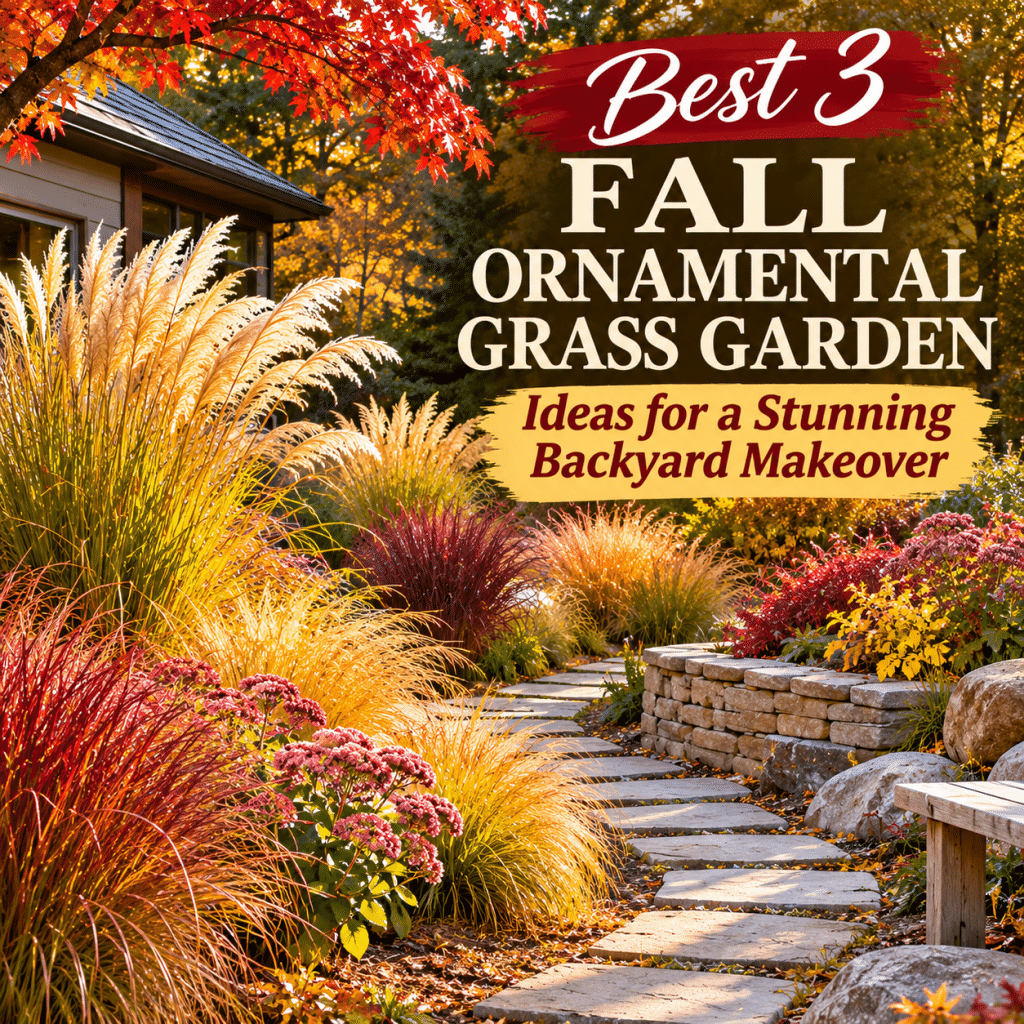
Imagine stepping outside on a crisp October morning and discovering a garden glowing with copper-colored grasses, feathery golden plumes, and soft burgundy foliage illuminated by the rising sun. Every gentle breeze creates movement, turning the landscape into a living composition of texture, light, and seasonal beauty.
🍂 The secret to an extraordinary autumn garden is not necessarily adding more flowers. Sometimes, the most impressive transformation comes from selecting ornamental grasses that bring height, contrasting colors, architectural structure, and natural movement into the landscape.
Unlike temporary seasonal decorations, many perennial ornamental grasses remain attractive long after autumn flowers have faded. Their dried stems and seed heads can continue providing striking visual interest throughout winter, making them a valuable investment for gardens designed to look beautiful across multiple seasons.
Whether you prefer the relaxed atmosphere of a natural meadow, the refined elegance of a modern architectural garden, or the romantic softness of a golden autumn sanctuary, ornamental grasses can help create a memorable outdoor space.
The following Best 3 Fall Ornamental Grass Garden ideas explore three distinctive approaches to autumn garden design, each offering its own combinations of ornamental grasses, planting arrangements, textures, colors, and decorative possibilities.
Why a Fall Ornamental Grass Garden Is One of the Most Beautiful Autumn Landscaping Choices
Ornamental grasses possess a unique ability to make an autumn landscape feel both natural and intentionally designed. Their graceful foliage introduces flowing lines that contrast beautifully with the solid forms of trees, shrubs, garden structures, and stone surfaces.
During spring and summer, many ornamental grasses create attractive green or blue-green mounds. As temperatures cool and daylight decreases, certain varieties begin developing remarkable shades of amber, copper, burgundy, orange, bronze, and golden yellow.
These seasonal transitions make ornamental grasses particularly valuable for homeowners who want a garden that changes appearance naturally throughout the year.
Beautiful Autumn Colors Without Relying on Seasonal Flowers
One of the greatest attractions of a Fall Ornamental Grass Garden is its rich seasonal color palette.
Little bluestem can transform from blue-green summer foliage into vibrant copper, orange, and reddish-purple tones. Selected switchgrass cultivars develop burgundy highlights, while prairie dropseed can create a glowing golden or orange-red appearance.
These colors are not artificially created through decoration. They develop naturally as plants respond to seasonal changes.
According to Iowa State University Extension and Outreach, ornamental grasses such as switchgrass, little bluestem, prairie dropseed, and selected Miscanthus cultivars can provide particularly attractive autumn foliage. Yard and Garden
The result is a garden filled with authentic autumn colors that blend harmoniously with fallen leaves, natural stone, wooden fences, and surrounding trees.
Elegant Movement That Makes the Garden Feel Alive
Unlike rigid shrubs or architectural garden ornaments, ornamental grasses respond beautifully to moving air.
Their fine leaves bend gently in the wind, while delicate flower heads sway above the foliage. This creates a fascinating visual effect that can make even a simple planting arrangement feel dynamic.
Tall grasses introduce sweeping vertical movement, while shorter varieties create soft waves closer to the ground.
The gentle rustling sound of dry foliage can also contribute to a peaceful autumn atmosphere.
Placing grasses where they catch morning or evening sunlight enhances their translucent seed heads and delicate outlines. This combination of light, movement, and texture is especially effective in gardens viewed from patios, terraces, or large windows.
Long Lasting Beauty From Early Fall Into Winter
Another compelling reason to grow ornamental grasses is their extended seasonal appeal.
Many traditional autumn flowers lose their decorative value after the first hard frost. Numerous ornamental grasses, however, continue displaying attractive seed heads and upright stems after their foliage has turned golden brown.
This creates continuity between autumn and winter.
In suitable locations, dormant grass clumps can capture frost, reflect low winter sunlight, and introduce elegant silhouettes into otherwise quiet landscapes.
The Royal Horticultural Society recommends retaining the attractive structure of many deciduous ornamental grasses through winter and cutting them back before new spring growth begins. RHS Advice
Best 3 Fall Ornamental Grass Garden Designs for an Unforgettable Autumn Landscape
The most successful ornamental grass gardens are designed around a clear visual concept rather than simply combining numerous grass varieties.
Each grass contributes a particular shape, height, color, or texture. When carefully arranged, these characteristics create a unified garden composition.
Three especially beautiful approaches include romantic golden meadows, modern architectural landscapes, and colorful naturalistic prairie gardens.
Each design creates a different atmosphere while celebrating the extraordinary beauty of ornamental grasses during autumn.
🥇 Best 1 Fall Ornamental Grass Garden With a Romantic Golden Meadow and Flowing Feather Plumes
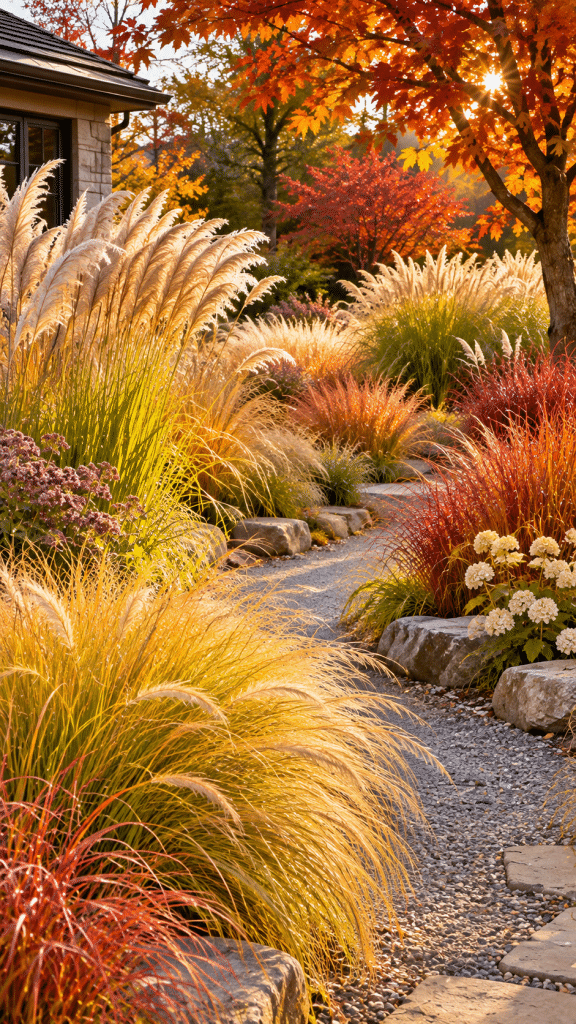
A romantic golden meadow is one of the most enchanting ways to celebrate autumn in the garden.
This design transforms an outdoor space into a soft, flowing landscape inspired by natural grasslands, peaceful countryside scenery, and the warm golden light of late autumn afternoons.
Instead of relying on rigid planting arrangements, the garden features generous groups of ornamental grasses with slightly overlapping forms.
The overall impression should feel relaxed, abundant, and naturally beautiful.
Tall golden stems rise above softly rounded grass mounds, while delicate seed heads catch the sunlight and create an almost magical atmosphere.
Create a Golden Landscape With Prairie Dropseed and Feather Reed Grass
The foundation of this garden style is a carefully balanced combination of ornamental grasses with different heights and growth habits.
Prairie dropseed (Sporobolus heterolepis) is particularly attractive because of its fine-textured foliage and graceful rounded form.
During autumn, its foliage can develop beautiful golden, orange, and reddish tones, depending on the cultivar and growing conditions.
Its delicate flower panicles form a soft haze above the leaves, creating an airy appearance that works beautifully in naturalistic gardens.
For vertical contrast, introduce feather reed grass (Calamagrostis × acutiflora ‘Karl Foerster’).
This ornamental grass produces narrow, upright stems topped with elegant flower heads that gradually develop warm, straw-colored tones.
The contrast between rounded prairie dropseed mounds and tall feather reed grass creates an appealing balance between softness and structure.
For the best visual results, plant prairie dropseed in generous clusters rather than scattering individual plants throughout the garden.
Position feather reed grass in small repeated groups behind these lower-growing masses.
This arrangement creates natural depth while maintaining a harmonious appearance.
Add Soft Copper and Champagne Colored Ornamental Grasses
A golden meadow becomes even more spectacular when it includes subtle color variations.
Instead of selecting only yellow ornamental grasses, introduce varieties that display copper, bronze, champagne, and pale brown tones during autumn.
Little bluestem (Schizachyrium scoparium) is an excellent option for adding warm copper coloration.
Its upright foliage can gradually transform into brilliant autumn shades, creating a beautiful contrast with the softer golden tones of prairie dropseed.
Certain cultivars, such as ‘Blaze’, are especially appreciated for their seasonal color.
The delicate seed heads of little bluestem also provide a distinctive silvery appearance when illuminated by low autumn sunlight.
This combination creates several layers of color within the garden.
Near the ground, fine golden foliage provides warmth. In the middle, copper-colored grasses introduce depth. Above them, pale seed heads create a luminous and delicate finish.
The resulting composition feels naturally luxurious without requiring elaborate decorative elements.
Design a Curving Garden Path Through Flowing Grass Clusters
One of the most effective ways to enjoy a romantic ornamental grass garden is to incorporate a simple pathway that allows visitors to experience the planting from different angles.
A gently curving path made from gravel, natural stone, or compacted decomposed granite works especially well.
Avoid perfectly straight lines if the goal is to create a relaxed meadow atmosphere.
Instead, allow the path to move naturally between clusters of ornamental grasses.
Position taller varieties where their foliage can frame the route without overwhelming it.
Lower grasses should define the pathway edges while leaving enough space for mature plants to spread naturally.
As visitors walk through the garden, the surrounding grasses create an immersive experience filled with movement, texture, and seasonal color.
During late afternoon, sunlight filtering through the seed heads produces a remarkable golden glow.
For additional visual interest, include one simple resting area with a wooden bench or natural stone seat.
The seating area becomes a peaceful destination within the garden rather than a dominant decorative feature.
Enhance the Romantic Atmosphere With Natural Materials
A golden meadow garden looks most beautiful when surrounding materials support its organic appearance.
Weathered timber, natural gravel, aged stone, and untreated-looking wood complement the warm color palette of autumn grasses.
A simple oak bench positioned beneath a deciduous tree can create an inviting place to enjoy the changing landscape.
Large natural stones can also provide subtle contrast against the fine foliage.
However, decorative elements should remain understated.
Too many ornaments can distract from the beauty of the grasses themselves.
The goal is to allow the plants to become the main attraction.
✨ Best design feature: A romantic combination of golden prairie dropseed, copper little bluestem, and elegant feather reed grass creates a flowing autumn meadow that glows beautifully in low afternoon sunlight.
🥈 Best 2 Fall Ornamental Grass Garden With Modern Architectural Grasses and Dramatic Autumn Silhouettes
For homeowners who prefer contemporary landscape design, ornamental grasses can create an extraordinary modern garden filled with structure, movement, and refined simplicity.
This design focuses on bold plant silhouettes, disciplined repetition, contrasting materials, and carefully controlled color combinations.
Rather than attempting to recreate a natural meadow, a modern ornamental grass garden treats each planting group as an architectural feature.
Tall vertical grasses become living sculptures, while shorter varieties provide soft texture around geometric garden elements.
The result is sophisticated, visually striking, and surprisingly easy to maintain once the plants are established.
Use Upright Switchgrass as a Living Architectural Element
Switchgrass (Panicum virgatum) is one of the most versatile ornamental grasses for contemporary landscapes.
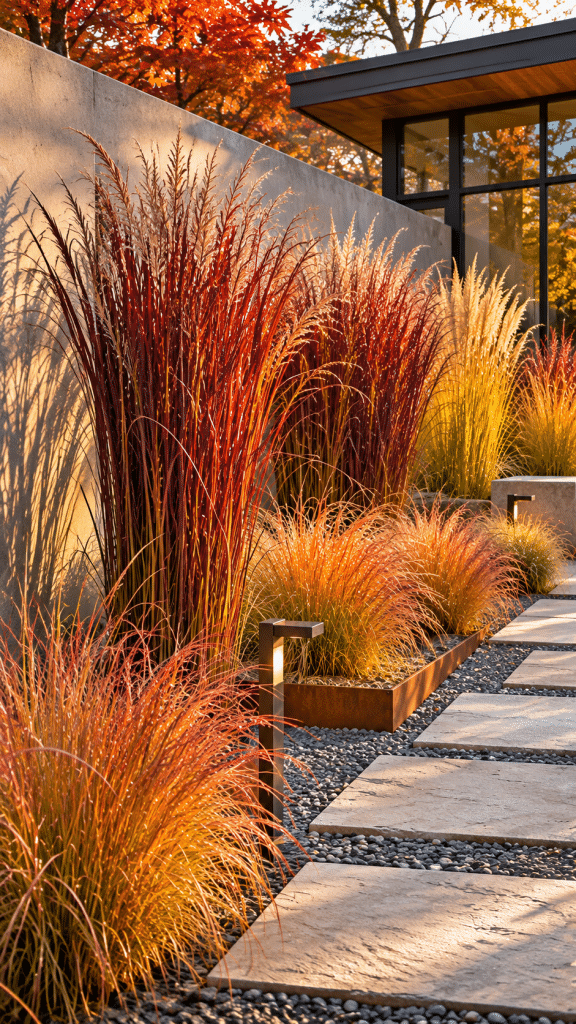
Its upright growth habit creates strong vertical lines that complement modern homes, minimalist terraces, concrete walls, and architectural garden structures.
Cultivars such as ‘Northwind’ are particularly useful when a strong upright silhouette is desired.
Other varieties, including ‘Shenandoah’, introduce attractive reddish foliage that can become increasingly noticeable during the growing season.
In autumn, many switchgrass varieties develop golden, reddish, or burgundy tones, depending on the cultivar and environmental conditions.
For a dramatic architectural effect, arrange switchgrass in repeated groups along a garden wall or behind a low seating area.
Avoid placing too many unrelated varieties next to one another.
Repetition creates a cohesive visual rhythm and allows the distinctive form of the selected grass to become more impressive.
For example, a series of three or five evenly spaced switchgrass groups can establish a strong focal composition.
The exact spacing should reflect the cultivar’s mature width rather than its appearance at the time of purchase.
Introduce Bold Contrast With Dark Gravel and Natural Stone
One of the most effective techniques for creating a modern ornamental grass garden is to contrast delicate foliage with strong, solid surfaces.
Dark gray gravel, charcoal-colored pavers, blackened steel edging, and pale architectural concrete can all highlight the natural beauty of ornamental grasses.
Warm golden foliage becomes especially striking against darker surfaces.
Similarly, burgundy switchgrass can create an elegant contrast with light-colored stone.
A particularly sophisticated arrangement uses rectangular planting areas filled with dark gravel and carefully positioned grass clumps.
The planting should remain simple enough to emphasize the shapes of the grasses.
A restrained palette of charcoal, sandstone, bronze, and muted gold creates a timeless contemporary atmosphere.
Large stone slabs can provide geometric structure, while the surrounding grasses soften their edges.
This contrast between precise architecture and natural movement is the defining characteristic of the design.
Create a Sculptural Focal Point With Little Bluestem
Although little bluestem is frequently associated with natural prairie landscapes, its distinctive upright form also makes it suitable for modern gardens.
Cultivars with strong autumn coloration can become beautiful seasonal focal points.
For example, ‘Blue Heaven’ can develop burgundy-red autumn tones, while ‘Blaze’ may display orange to reddish-purple foliage.
These colors complement minimalist materials such as concrete, dark stone, and weathered steel.
One particularly effective approach is to position a group of little bluestem against a simple architectural backdrop.
A smooth wall or dark garden screen allows the fine foliage and seed heads to stand out clearly.
When illuminated by low autumn sunlight, the grasses produce dramatic shadows and delicate patterns.
Instead of hiding this effect with additional plantings, preserve some open space around the focal group.
Negative space is an essential part of contemporary garden design.
It allows individual plant forms to appear more deliberate and sculptural.
Add Sophisticated Outdoor Lighting for Evening Interest
Modern ornamental grass gardens can become especially impressive after sunset when lighting is used carefully.
Low-voltage outdoor lighting can emphasize tall grass silhouettes, create delicate shadows, and highlight the textures of mature seed heads.
Position warm-white landscape lights near selected planting groups rather than illuminating every grass.
Soft uplighting can make tall switchgrass appear sculptural against a wall.
Side lighting may reveal the fine texture of feather reed grass or the delicate seed heads of little bluestem.
Avoid excessively bright fixtures that flatten the visual composition.
A few carefully placed lights often create a more elegant effect than numerous decorative lamps.
Choose outdoor-rated fixtures designed for the installation environment, and avoid lighting arrangements that create glare for neighbors or unnecessarily disrupt nighttime wildlife.
The combination of warm autumn grasses, simple architectural materials, and subtle lighting can turn a modern garden into a sophisticated outdoor retreat.
Keep the Planting Palette Intentional and Minimal
The greatest advantage of this contemporary design is its simplicity.
Instead of purchasing a large collection of ornamental grass varieties, select two or three complementary types.
A strong combination might include upright switchgrass, copper-colored little bluestem, and a restrained grouping of fine-textured prairie dropseed.
Each species serves a specific visual purpose.
Switchgrass establishes height and structure.
Little bluestem introduces seasonal color.
Prairie dropseed softens the lower planting areas.
The surrounding hardscape provides balance and contrast.
This disciplined approach creates a garden that feels professionally designed without becoming overly complicated.
🏡 Best design feature: Upright burgundy switchgrass, copper-toned little bluestem, charcoal gravel, and warm architectural lighting create an elegant autumn garden with a sophisticated modern identity.
🥉 Best 3 Fall Ornamental Grass Garden With Colorful Prairie Layers and a Magical Autumn Wildlife Sanctuary
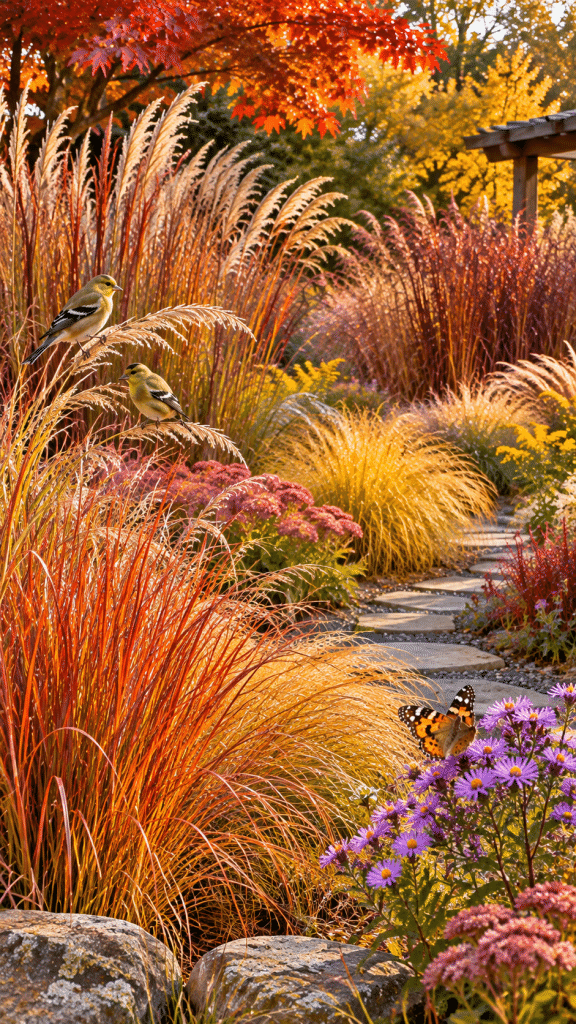
A colorful prairie-inspired garden combines seasonal beauty with ecological value.
This design celebrates the natural characteristics of ornamental grasses while creating a landscape that feels abundant, dynamic, and connected to the surrounding environment.
Instead of organizing every plant into strict geometric patterns, the garden features flowing groups of grasses arranged in overlapping layers.
Different heights, leaf colors, and seed-head textures create visual interest from early autumn through winter.
Where regionally appropriate native grasses are used, the garden can also provide useful habitat structure and resources for local wildlife.
The result is a vibrant autumn landscape that feels welcoming, natural, and full of life.
Build a Rich Autumn Palette With Little Bluestem and Big Bluestem
Little bluestem and big bluestem are two outstanding ornamental grasses for creating prairie-inspired autumn landscapes in suitable North American regions.
Little bluestem (Schizachyrium scoparium) typically forms relatively compact upright clumps with fine foliage.
Its beautiful copper, rust, and reddish autumn colors make it a natural choice for the middle and front portions of a prairie-style composition.
Big bluestem (Andropogon gerardii) grows considerably taller in favorable conditions and can create a dramatic background.
Its foliage develops warm bronze and reddish tones during autumn, while its distinctive seed heads introduce additional visual texture.
The contrast between these two grasses creates natural layering.
Little bluestem provides colorful intermediate-height clumps, while big bluestem introduces stronger vertical structure.
In larger gardens, repeated groups can create a flowing landscape inspired by native tallgrass prairies.
For smaller spaces, use big bluestem sparingly or select a more compact cultivar suited to the available area.
Add Airy Golden Seed Heads With Prairie Dropseed
Prairie dropseed is an excellent companion for taller native grasses because of its delicate texture and rounded growth habit.
Its fine leaves create soft mounds that contrast with the upright stems of little bluestem and big bluestem.
During late summer and autumn, airy flower panicles rise above the foliage and produce a light, almost cloudlike appearance.
As the foliage develops warm seasonal tones, these plants help create visual continuity across the garden.
For the most natural appearance, arrange prairie dropseed in irregular groups rather than perfectly symmetrical rows.
Groups of several plants can form soft drifts that connect taller grass clusters.
The delicate seed heads become especially attractive when illuminated from behind.
This effect creates a beautiful golden haze that makes the entire planting appear more atmospheric.
Prairie dropseed also works well near seating areas where its graceful texture can be appreciated at close range.
Use Repetition to Create a Natural Prairie Rhythm
Successful prairie-inspired gardens rarely depend on an enormous variety of plants.
Instead, they rely on repetition, variation in height, and carefully balanced groupings.
Start with one dominant grass variety that establishes the overall character of the landscape.
Then introduce a second variety with contrasting height or autumn color.
Use a third grass to connect the composition and soften transitions.
For example, a prairie-inspired planting could feature repeated little bluestem clusters, taller big bluestem accents, and lower prairie dropseed drifts.
This simple combination creates a complex visual effect without requiring an excessive number of species.
The repeated forms guide the eye naturally through the garden.
Their changing colors also create a sense of movement across the landscape, even when the air is still.
Allow sufficient spacing for the grasses to reach their mature size.
Crowded planting may initially appear lush, but it can eventually reduce air circulation and make maintenance more difficult.
Encourage Wildlife With Regionally Appropriate Native Grasses
Ornamental grasses can provide more than decorative value.
When selected appropriately for the local ecosystem, native grasses may offer shelter, nesting material, and habitat structure for birds and other beneficial wildlife.
Their seeds may also provide food for certain bird species.
Standing vegetation can help create protected areas during colder months.
However, not every ornamental grass contributes equally to wildlife habitat.
Native species adapted to local conditions are often a better ecological choice than unrelated ornamental plants introduced from distant regions.
Before planting, consider the garden’s geographic location, available sunlight, soil conditions, and local wildlife priorities.
Check whether a species is native, noninvasive, and suitable for the local growing environment.
Avoid selecting ornamental grasses solely because they appear attractive in photographs.
Some popular ornamental species can spread aggressively or become invasive in particular regions.
A thoughtfully selected native grass garden can combine excellent visual design with responsible environmental stewardship.
Create an Immersive Autumn Experience With Natural Planting Layers
The final element of a beautiful prairie-inspired garden is spatial depth.
Instead of placing all grasses at the same height, arrange them in layers that create visual movement from foreground to background.
Lower-growing grasses can form a soft foundation.
Medium-height grasses add color and density.
Tall prairie grasses establish vertical drama and frame views across the landscape.
This arrangement works particularly well when the garden is viewed from a patio, window, or outdoor seating area.
As autumn progresses, the foliage gradually changes from green and blue-green to gold, copper, bronze, and burgundy.
The garden becomes a constantly evolving composition of color and texture.
During winter, many of the dried stems continue offering visual interest.
🦋 Best design feature: A colorful combination of native little bluestem, big bluestem, and prairie dropseed creates a richly textured autumn garden with natural movement, seasonal color, and potential wildlife benefits.
Fall Ornamental Grass Garden Plant Selection Guide
Choosing the right ornamental grasses is essential for achieving an attractive, balanced, and long-lasting autumn garden.
Different grasses offer different growth habits, mature heights, colors, and growing requirements.
Some varieties are particularly valuable for upright architectural structure, while others provide colorful foliage or soft mounding shapes.
The following table compares several ornamental grasses that can contribute distinctive autumn character.
| Ornamental grass | Typical mature height | Autumn appearance | Best design application |
|---|---|---|---|
| Little Bluestem (Schizachyrium scoparium) | 2–4 feet | Copper, orange, reddish purple | Colorful prairie gardens |
| Switchgrass (Panicum virgatum) | 3–6 feet | Gold, bronze, burgundy depending on cultivar | Modern architectural gardens |
| Prairie Dropseed (Sporobolus heterolepis) | 2–3 feet including flower stems | Gold, orange, reddish tones | Romantic meadow plantings |
| Feather Reed Grass (Calamagrostis × acutiflora ‘Karl Foerster’) | 4–5 feet including flower stems | Golden-tan flower heads and foliage | Vertical accents |
| Big Bluestem (Andropogon gerardii) | 4–7 feet | Bronze, copper, reddish tones | Tall prairie backgrounds |
| Purple Moor Grass (Molinia caerulea and cultivars) | 2–6 feet depending on cultivar | Golden yellow to warm straw tones | Airy naturalistic designs |
Heights and seasonal colors are approximate and vary with cultivar, climate, soil, and growing conditions. Always check mature plant dimensions and local suitability before purchasing.
The ideal combination depends on the intended design.
A romantic meadow benefits from delicate, flowing grasses with warm golden tones.
A contemporary garden requires plants with distinctive architectural silhouettes.
A prairie-inspired landscape works best when multiple native grasses create overlapping layers of natural color and texture.
Selecting grasses according to their visual purpose helps prevent the garden from appearing random or overcrowded.
How to Plan a Beautiful Fall Ornamental Grass Garden Before Planting
An impressive ornamental grass garden begins with careful planning.
Although ornamental grasses are often described as low-maintenance plants, choosing unsuitable varieties or planting them in the wrong conditions can create unnecessary problems.
Consider the available space, sunlight, soil drainage, seasonal climate, and desired visual effect before establishing the garden.
Choose a Location That Captures Autumn Sunlight
Sunlight influences both the growth of ornamental grasses and their appearance during autumn.
Many popular grass species develop their strongest structure and seasonal coloration in sunny conditions.
Locations receiving generous direct sunlight are particularly suitable for prairie grasses such as switchgrass and little bluestem.
However, different species have different requirements, and some ornamental grasses tolerate partial shade.
For the most dramatic visual effect, think beyond basic plant health.
Consider how sunlight moves through the garden during the day.
A planting positioned where low morning or evening sunlight passes through the seed heads can appear exceptionally beautiful.
Backlighting emphasizes the fine texture of individual leaves and flowers.
This simple design consideration can make an ordinary planting look remarkably atmospheric.
Consider Mature Size Instead of Initial Plant Size
Young ornamental grasses often look small when purchased from a nursery.
However, many varieties expand considerably after several growing seasons.
A compact nursery pot may eventually develop into a substantial clump several feet wide.
Always research the mature dimensions of each cultivar before planting.
Tall grasses should not obstruct important walkways, windows, or sightlines.
Similarly, vigorous varieties need sufficient space to develop naturally.
Appropriate spacing also makes seasonal maintenance easier.
It allows air to circulate through the planting and gives individual grasses enough room to display their characteristic forms.
Prepare Soil for Healthy Root Development
Most commonly cultivated ornamental grasses perform best when their soil conditions match the requirements of the selected species.
Good drainage is especially important for varieties adapted to dry or moderately moist conditions.
However, not all ornamental grasses prefer the same environment.
Some tolerate heavy clay, while others thrive in lighter, well-drained soil.
Before planting, examine the existing soil.
Determine whether water drains quickly, remains consistently moist, or collects after heavy rainfall.
Choose plants accordingly rather than attempting to force every species into identical conditions.
Avoid applying excessive fertilizer simply to encourage faster growth.
Overfertilization can cause some ornamental grasses to develop weak, floppy stems instead of the strong structure that makes them attractive.
Healthy growth depends more on choosing an appropriate species and planting location than on frequent feeding.
The Best Time to Plant Ornamental Grasses for Autumn Beauty
Understanding the seasonal growth patterns of ornamental grasses helps improve establishment and long-term performance.
Ornamental grasses are generally categorized as cool-season or warm-season plants.
Cool-season grasses begin growing during cooler periods and may be suitable for autumn planting in appropriate climates.
Warm-season grasses typically begin active growth once temperatures rise in spring.
For these plants, spring or early summer planting often provides better establishment opportunities in regions with cold winters.
According to the Royal Horticultural Society, autumn is generally favorable for planting many cool-climate grasses, while late spring is preferred for warm-climate grasses such as Miscanthus, Panicum, and Pennisetum. RHS
This distinction is important because planting ornamental grasses too late in autumn may leave insufficient time for root establishment before the ground freezes.
A garden intended to deliver spectacular autumn colors is often best established well before the season begins.
That allows the grasses to develop strong root systems and mature foliage before their seasonal color transformation.
Fall Ornamental Grass Garden Care for Beautiful Winter Structure
One of the greatest benefits of ornamental grass gardening is the relatively modest maintenance required after plants become established.
However, thoughtful seasonal care helps preserve healthy growth and attractive appearance.
Water New Plantings Until Established
Newly planted ornamental grasses require consistent attention while their root systems develop.
Even drought-tolerant species need adequate moisture during establishment.
Water deeply when necessary, allowing the root zone to receive moisture without keeping the soil continuously saturated.
As plants mature, their irrigation needs often decrease.
However, drought tolerance varies by species and growing conditions.
Container-grown grasses typically require more frequent watering than established plants in the ground.
Avoid Cutting Back Beautiful Autumn Grass Too Early
One of the most common mistakes in ornamental grass gardening is removing attractive foliage immediately after it begins turning brown.
Many deciduous ornamental grasses are most beautiful during autumn and early winter.
Their golden stems, feathery seed heads, and natural silhouettes create seasonal structure.
Cutting everything back too early eliminates this decorative value.
For numerous deciduous varieties, late winter or early spring is an appropriate time for annual pruning.
Evergreen grasses generally require a different approach, often needing only damaged or dead foliage removed.
🌿 Important Note: Leave healthy, noninvasive deciduous ornamental grasses standing through winter when conditions allow, then cut back before new spring growth. However, dry grass foliage can become a fire hazard. In wildfire-prone locations or near vulnerable structures, follow local fire-safety guidance and prioritize defensible space over winter decoration.
RHS Advice+1
Remove Unwanted Seedlings and Monitor Plant Spread
Some ornamental grasses reproduce by self-seeding, while others spread through underground structures.
These behaviors vary considerably between species and cultivars.
Regularly inspect the garden for unwanted seedlings or expanding clumps.
Remove plants growing outside the intended planting area.
Avoid cultivating species known to be invasive in your location, even if they are popular in decorative landscapes elsewhere.
Selecting well-behaved, regionally appropriate grasses from the beginning is generally easier than controlling aggressive plants later.
How to Make a Small Fall Ornamental Grass Garden Look More Luxurious
A spectacular ornamental grass garden does not necessarily require a large backyard.
Small gardens can benefit enormously from carefully selected grass varieties.
The key is to emphasize proportion, repetition, and simplicity.
Instead of using numerous tall grasses, choose one distinctive focal variety and surround it with lower-growing companions.
For example, a compact planting might include a small group of upright little bluestem with several prairie dropseed mounds nearby.
The contrast between their growth forms introduces depth without excessive visual clutter.
In a modern courtyard, a single appropriately sized switchgrass cultivar can become a beautiful seasonal focal point against a simple wall.
The surrounding surface can remain clean and minimal.
For a softer appearance, smaller ornamental grasses can be arranged along a narrow seating area or garden edge.
Their foliage brings movement into the space without requiring large decorative structures.
Containers also offer possibilities for patios and compact gardens, provided the pots have adequate drainage and enough volume for the mature root system.
Choose compact cultivars rather than forcing large prairie grasses into undersized containers.
The objective is to make each plant feel intentional.
A thoughtfully arranged small garden often appears more elegant than a larger space filled with too many competing elements.
The Most Beautiful Autumn Color Combinations for Ornamental Grasses
Color coordination is one of the easiest ways to create a polished ornamental grass garden.
Although ornamental grasses generally have natural, harmonious colors, the overall atmosphere changes depending on which tones dominate.
A golden palette creates warmth and romance.
A copper-and-burgundy palette introduces rich seasonal drama.
A combination of pale straw tones and charcoal hardscape creates contemporary elegance.
Consider these three distinctive palettes when designing the garden.
| Autumn color palette | Suggested ornamental grasses | Overall atmosphere |
|---|---|---|
| Golden Champagne | Prairie dropseed, feather reed grass, selected purple moor grass | Romantic, luminous, peaceful |
| Copper and Burgundy | Little bluestem, reddish switchgrass cultivars, big bluestem | Rich, dramatic, naturally colorful |
| Bronze and Charcoal | Upright switchgrass, little bluestem, golden feather reed grass | Modern, architectural, sophisticated |
For a cohesive appearance, choose one dominant color family and use the remaining tones as accents.
A garden featuring mostly golden grasses may benefit from a few copper-colored plants for contrast.
Similarly, burgundy switchgrass can appear more dramatic when surrounded by softer neutral foliage.
Natural autumn light also affects color perception.
Warm evening sunlight can intensify amber and copper tones, while cooler morning light emphasizes subtle silver and pale gold textures.
Observing the garden at different times of day can reveal which combinations create the most attractive visual effect.
Common Mistakes That Can Ruin a Fall Ornamental Grass Garden
Even beautiful ornamental grasses can produce disappointing results when planted without a clear design strategy.
One common mistake is choosing varieties based entirely on photographs without considering their mature size.
Large grasses may eventually overwhelm narrow planting areas, block windows, or crowd neighboring plants.
Another mistake is mixing too many unrelated ornamental grass varieties.
Although diversity can be attractive, excessive variation in height, texture, and growth habit can make a garden feel visually disorganized.
A limited selection of complementary grasses often creates a stronger result.
Poor planting conditions can also reduce autumn beauty.
Grasses growing in unsuitable shade may develop weaker stems, limited flowering, or less impressive seasonal color.
Likewise, excessive fertilizer can encourage soft growth that collapses under the weight of mature seed heads.
Cutting grasses back immediately after their foliage turns brown is another frequent problem.
This removes the winter structure that makes many ornamental grasses especially valuable.
Finally, overlooking local invasiveness concerns can create long-term maintenance and environmental issues.
Always check whether the selected species is appropriate for the local region.
A beautiful ornamental grass garden should remain attractive and manageable as it matures, not become an uncontrolled collection of spreading plants.
Frequently Asked Questions About Fall Ornamental Grass Gardens
What ornamental grass has the most beautiful fall color?
Little bluestem is one of the most impressive ornamental grasses for autumn color.
Depending on the cultivar and growing conditions, its foliage can develop striking shades of copper, orange, burgundy, and reddish purple.
Selected switchgrass varieties are also excellent choices, particularly cultivars known for reddish autumn foliage.
Prairie dropseed provides an attractive alternative for gardeners who prefer soft golden and orange tones.
The best selection depends on local climate, available sunlight, and the desired color palette.
Do ornamental grasses stay beautiful throughout winter?
Many deciduous ornamental grasses retain attractive stems, seed heads, and dried foliage during winter.
Their silhouettes can create visual interest even after the original autumn colors have faded.
However, winter durability varies considerably by species and climate.
Heavy snow, strong winds, prolonged wet conditions, and ice accumulation can damage or flatten certain grasses.
Varieties with sturdy upright stems generally provide stronger architectural structure than delicate grasses prone to collapsing.
Can ornamental grasses grow in a small backyard?
Yes. Ornamental grasses can be highly effective in small gardens when selected according to their mature size.
Compact grasses work well in narrow planting areas, small courtyards, and appropriately sized containers.
For modern gardens, one carefully positioned upright grass can serve as a striking focal point.
Avoid overcrowding and maintain sufficient space for plants to develop their natural shape.
Should ornamental grasses be planted in fall or spring?
The ideal planting season depends on the type of grass and the local climate.
Cool-season ornamental grasses are often suitable for autumn planting in temperate regions.
Warm-season varieties generally establish more reliably when planted during spring or early summer, especially where winters are cold.
Always consider the first expected frost date and the amount of time available for root establishment.
Are ornamental grasses low maintenance?
Many ornamental grasses require relatively little maintenance after becoming established.
Their care usually involves occasional watering during drought, monitoring for unwanted spreading, and seasonal removal of dead foliage.
However, maintenance requirements vary between species.
Fast-spreading grasses, self-seeding varieties, and container-grown plants may require more attention.
Selecting suitable grasses from the beginning is the most effective way to create a manageable garden.
Which ornamental grass is best for a modern fall garden?
Upright switchgrass cultivars are excellent choices for modern gardens because of their strong vertical form.
‘Northwind’ is particularly useful where a disciplined architectural silhouette is desired.
Little bluestem can add beautiful seasonal color, while feather reed grass introduces elegant vertical seed heads.
Combining these grasses with simple stone surfaces and restrained planting arrangements creates a refined contemporary landscape.
Can a fall ornamental grass garden attract wildlife?
Yes. Regionally native grasses can contribute useful habitat for birds, insects, and other wildlife.
Some species provide seed resources, while standing grass clumps offer shelter and structural cover.
The ecological value depends on the plant species, geographic location, surrounding habitat, and garden management practices.
Native grasses suited to the local ecosystem generally provide a stronger foundation for wildlife-friendly planting than potentially invasive ornamental species.
Final Thoughts on Creating a Beautiful Fall Ornamental Grass Garden
A thoughtfully designed Fall Ornamental Grass Garden offers an extraordinary combination of seasonal color, natural movement, elegant structure, and long-lasting beauty.
Unlike gardens that depend entirely on temporary autumn decorations, ornamental grass landscapes can develop their character gradually throughout the growing season.
Their foliage becomes increasingly expressive as autumn arrives, transforming ordinary outdoor spaces into captivating compositions of gold, copper, bronze, burgundy, and soft champagne tones.
The romantic golden meadow design is particularly appealing for homeowners who love flowing forms, natural textures, and peaceful countryside inspiration.
Its combination of prairie dropseed, feather reed grass, and little bluestem creates an inviting autumn sanctuary filled with warm sunlight and graceful movement.
The modern architectural design offers a completely different atmosphere.
With upright switchgrass, dramatic foliage colors, refined hardscape materials, and carefully positioned lighting, ornamental grasses become living sculptural elements that enhance contemporary outdoor spaces.
The colorful prairie-inspired design celebrates a more natural landscape.
By combining regionally appropriate native grasses with varied heights, seasonal colors, and layered planting arrangements, it creates a beautiful environment that can also support local wildlife.
Each of these three approaches demonstrates that ornamental grasses deserve a prominent role in autumn garden design.
🍁 The most beautiful autumn gardens are not always the ones with the most flowers or decorations. Sometimes, the unforgettable landscapes are those where golden grasses dance in the wind, copper foliage catches the evening sunlight, and every changing season brings a new kind of natural beauty.
With suitable plant selection, thoughtful placement, and a cohesive design, an ornamental grass garden can become one of the most spectacular features of the backyard—captivating during fall, graceful throughout winter, and ready to begin its transformation again when spring arrives.