A narrow strip beside the house is often one of the most ignored areas of a property, yet the right side yard garden ideas can transform that forgotten space into one of the most beautiful parts of the entire landscape. Instead of treating a side yard as nothing more than a passage between the front and backyard, it can become a lush garden walkway, a productive vertical garden, or even a quiet hidden retreat surrounded by plants.
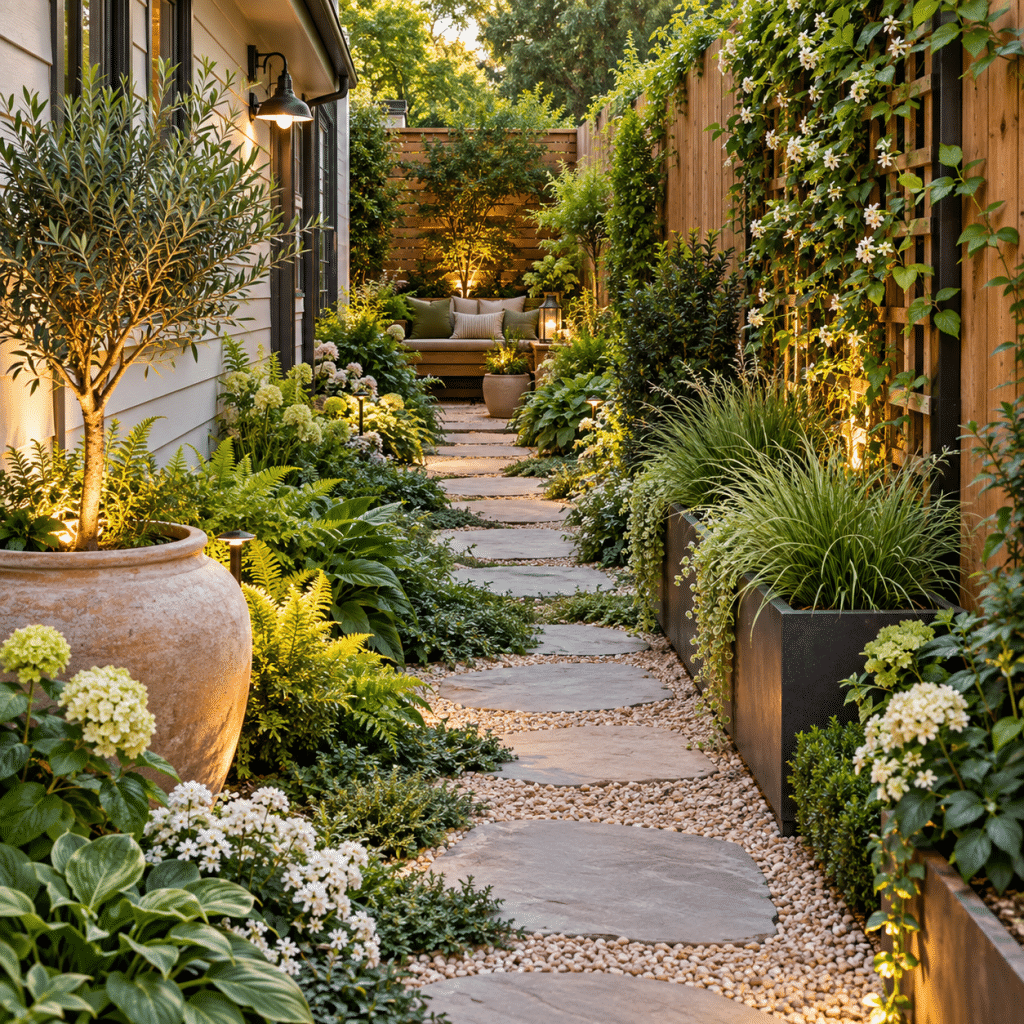
The challenge is that side yards usually come with limitations. They may be narrow, partially shaded, bordered by fences, interrupted by utility equipment, or difficult to landscape with traditional wide garden beds. Those restrictions, however, can actually encourage more creative garden design.
🌿 The best side yard gardens work with the space rather than fighting against it. They emphasize vertical surfaces, layered planting, attractive pathways, and carefully selected focal points that make the area feel intentional.
For homeowners looking for practical inspiration, these three ideas offer very different ways to rethink a side yard. Each concept can work in a modest suburban property, a cottage garden, or even a very narrow urban outdoor space.
The three strongest approaches are:
🥇 A lush layered garden pathway
🥈 A space saving vertical garden corridor
🥉 A hidden side yard garden retreat
Each design uses a different strategy, but all three help turn overlooked outdoor space into something functional, beautiful, and surprisingly memorable.
Why Side Yard Garden Ideas Are Becoming More Important
Modern homes often prioritize the backyard when it comes to landscaping. Large patios, lawns, vegetable gardens, outdoor kitchens, and entertaining areas usually receive most of the attention.
Meanwhile, the side yard is frequently left unfinished.
It may contain gravel, a narrow concrete path, trash bins, air conditioning units, hoses, or simply a strip of grass that is difficult to mow.
That is exactly why creative side yard garden ideas can make such a dramatic difference.
Because the space starts with relatively little visual interest, even a modest improvement can completely change how it feels. A simple pathway bordered by greenery, for example, can transform an awkward passage into something that resembles a small garden corridor.
There is also an important practical advantage. Side yards naturally connect different areas of the property. Improving them creates a more seamless transition between the front and backyard.
Instead of walking through a forgotten utility zone, visitors can move through a carefully designed landscape.
The side yard can also provide valuable planting space for gardeners who do not have a large backyard.
Vertical trellises, narrow raised beds, wall planters, climbing plants, compact shrubs, herbs, and shade-tolerant perennials can all thrive in areas that initially appear too limited for gardening.
Understanding the Challenges of a Side Yard Garden
Before choosing plants or decorative features, it helps to understand the conditions of the space.
Side yards behave differently from open gardens.
The walls of the house and neighboring fences can create unusual patterns of sunlight and shade. Some spaces receive only a few hours of morning sun, while others may become surprisingly hot during the afternoon because heat reflects off walls and paving.
Air circulation can also be limited.
Drainage is another important consideration. Water from roof gutters may flow directly into the side yard, while narrow boundaries can make it difficult for excess moisture to escape.
These conditions should influence the design.
A successful side yard garden usually focuses on four things:
- available sunlight
- walking space
- drainage
- vertical surfaces
Once those factors are understood, the area becomes much easier to design.
Important Note: Always maintain clear access to utility meters, drainage systems, air conditioning units, gates, and emergency pathways when designing a side yard garden. Beautiful landscaping should never block essential maintenance access.
Quick Comparison of the Best Side Yard Garden Ideas
The right concept depends on how the space will be used.
Some homeowners want a beautiful walkway. Others want to maximize planting space, while some prefer to create a private garden destination.
| Side Yard Garden Idea | Best For | Main Feature | Space Needed | Maintenance |
|---|---|---|---|---|
| 🥇 Layered Garden Pathway | Creating a beautiful transition | Path surrounded by layered plants | Narrow to medium | Moderate |
| 🥈 Vertical Garden Corridor | Extremely small side yards | Trellises and wall planting | Very narrow | Low to moderate |
| 🥉 Hidden Garden Retreat | Privacy and relaxation | Small seating nook surrounded by plants | Medium | Moderate |
All three concepts can be adapted to different garden styles, including cottage, modern, woodland, Mediterranean, rustic, and minimalist landscapes.
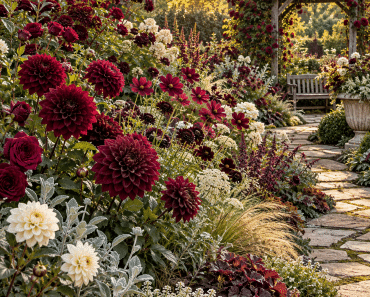
🥇 Best 1 Side Yard Garden Ideas With a Lush Layered Garden Pathway
One of the most effective ways to transform a side yard is to treat it as a garden journey rather than simply a passage.
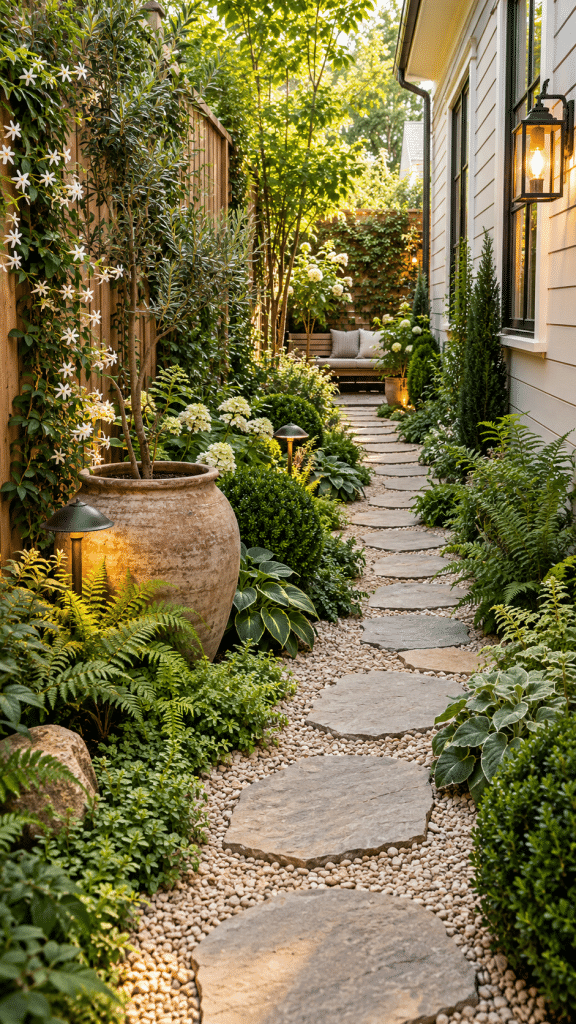
A lush layered garden pathway creates the feeling that the landscape continues naturally from the front garden toward the backyard.
Instead of placing one narrow row of plants against the fence, the design uses different plant heights to create depth.
Low plants grow near the pathway.
Medium-height plants fill the middle layer.
Taller plants or climbing vines create the background.
This simple structure makes a narrow garden feel surprisingly rich.
Build the Path First
The pathway becomes the backbone of the entire design.
Rather than installing a perfectly straight concrete walkway, consider materials that create a softer garden atmosphere.
Natural stone stepping stones can work beautifully.
Gravel is another practical option because it provides drainage while creating pleasant texture underfoot.
Brick can add a classic cottage garden character.
For modern landscapes, large rectangular concrete pavers surrounded by gravel can create a cleaner architectural appearance.
The width does not need to be enormous.
A comfortable walking path usually needs enough room for one person to move naturally without brushing against plants.
Curving the pathway slightly can also create visual interest.
Even a subtle curve makes the garden feel longer because the destination is not immediately visible.
Create Layers Along the Side Yard Garden Path
Plant layering is what makes this idea feel like a true garden instead of a decorated walkway.
Start with low-growing plants near the path.
These could include creeping thyme, sedges, compact ornamental grasses, small ferns, or flowering groundcovers depending on the climate and sunlight.
Behind them, introduce plants with more height.
Hostas, heucheras, hydrangeas, compact grasses, salvias, or shade-tolerant shrubs can create the middle layer.
The tallest layer should appear near the fence or wall.
This might include narrow evergreen shrubs, bamboo alternatives suited to the local climate, climbing vines, espalier fruit trees, or ornamental grasses.
The goal is not to fill every centimeter.
Leaving small areas of open space helps each plant remain visible.
🌱 A well-designed narrow garden should feel layered, not crowded.
Use Repetition to Make the Garden Look Larger
Repeating plants is one of the easiest ways to make a narrow landscape feel professionally designed.
Instead of planting ten completely different species, choose a few strong plants and repeat them along the pathway.
For example, three groups of ornamental grasses could appear at intervals.
The same flowering perennial might repeat between them.
A climbing vine could appear on several sections of the fence.
This rhythm visually connects the entire garden.
Repetition is especially important in narrow landscapes because too many unrelated elements can quickly make the area feel chaotic.
A limited plant palette creates calmness.
Add a Destination at the End of the Path
One clever garden design technique is to place something interesting at the end of the view.
This encourages the eye to travel through the space.
Possible focal points include:
- a large ceramic planter
- a small ornamental tree
- a garden gate
- a birdbath
- a sculptural trellis
- a simple bench
- a large fern
- a decorative container garden
The focal point does not need to be expensive.
Its purpose is simply to provide visual direction.
Without it, the side yard may still feel like a passage.
With it, the path begins to feel like a designed garden experience.
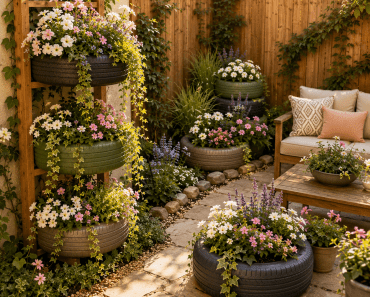
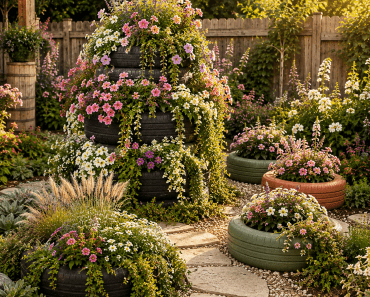
🥈 Best 2 Side Yard Garden Ideas With a Space Saving Vertical Garden Corridor
When the side yard is extremely narrow, horizontal planting space may be limited.
That does not mean gardening is impossible.
Instead, the solution is to look upward.
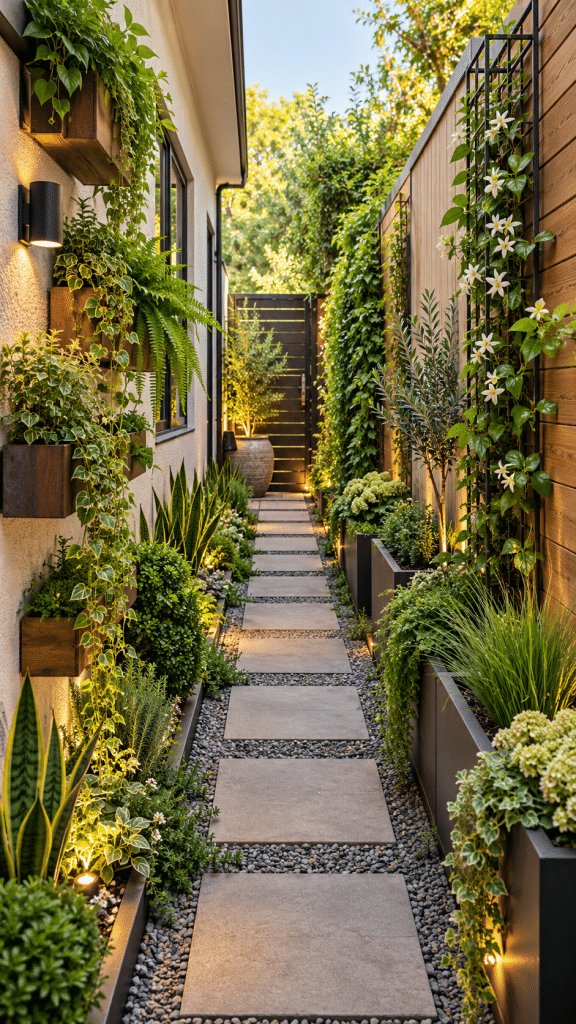
A vertical garden corridor uses fences, walls, trellises, climbing plants, hanging containers, and narrow planters to create greenery without sacrificing walking space.
This approach is especially useful for small urban homes where every square foot matters.
The basic idea is simple.
Keep the ground relatively open while moving much of the planting onto vertical surfaces.
The result can feel like a living green hallway.
Turn the Fence Into a Garden Wall
A plain wooden or metal fence often dominates the view in a narrow side yard.
Instead of hiding it, use it as part of the landscape.
Simple vertical trellises can support climbing plants.
Depending on climate and sunlight, options may include clematis, climbing roses, jasmine, honeysuckle, star jasmine, or annual flowering vines.
Gardeners interested in food production can also grow climbing vegetables.
Beans, peas, cucumbers, or compact climbing tomatoes can use vertical supports.
The important thing is to match the plant with the available sunlight.
A sun-loving vine placed in a shaded side yard will struggle.
Similarly, a shade-tolerant plant may suffer against a hot west-facing wall.
Use Narrow Raised Planters
Traditional garden beds may take up too much walking space.
Long narrow planters can solve the problem.
A planter only needs enough width to support the plants being grown.
Placing long rectangular containers along one wall creates a clean planting zone while leaving the center open.
This approach works especially well with herbs.
Imagine a narrow side yard planted with rosemary, thyme, parsley, sage, mint in containers, and edible flowers.
The space can become both decorative and useful.
For a more ornamental design, fill planters with grasses, ferns, compact shrubs, or seasonal flowers.
Matching containers can make the entire garden feel more organized.
Create a Vertical Herb Garden
A sunny side yard can become an excellent herb-growing area.
Wall-mounted planters or tiered shelves allow many herbs to grow in a very small footprint.
🌿 Basil can occupy sunny upper containers.
🌿 Parsley can grow beneath.
🌿 Thyme can trail over the edges.
🌿 Chives can add vertical texture.
🌿 Mint can remain safely contained instead of spreading through garden soil.
This type of garden is especially practical when the side yard is near the kitchen.
Fresh herbs can be harvested without walking to a distant vegetable garden.
Add Trellis Panels for Height
Trellises can also divide a long side yard into visual sections.
Instead of seeing one uninterrupted narrow corridor, visitors see several smaller garden spaces.
For example, a trellis placed halfway through the side yard can create a subtle transition.
Climbing vines growing over the structure soften the boundary.
Passing through it feels almost like moving into another garden room.
This is an especially powerful technique in long narrow properties.
Use Hanging Plants Carefully
Hanging baskets can add another planting layer, but placement matters.
They should never hang directly into the walking path.
Instead, place them against fences or walls where they provide height without becoming obstacles.
Trailing plants can look especially attractive in narrow spaces because the foliage naturally softens hard architectural surfaces.
Several small baskets are not always necessary.
One or two substantial hanging planters can create a cleaner visual effect.
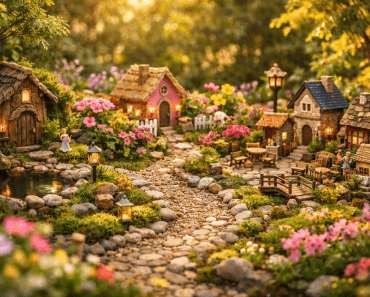
🥉 Best 3 Side Yard Garden Ideas With a Hidden Garden Retreat
A side yard does not always need to function as a corridor.
If the area is wide enough, it can become a small private destination.
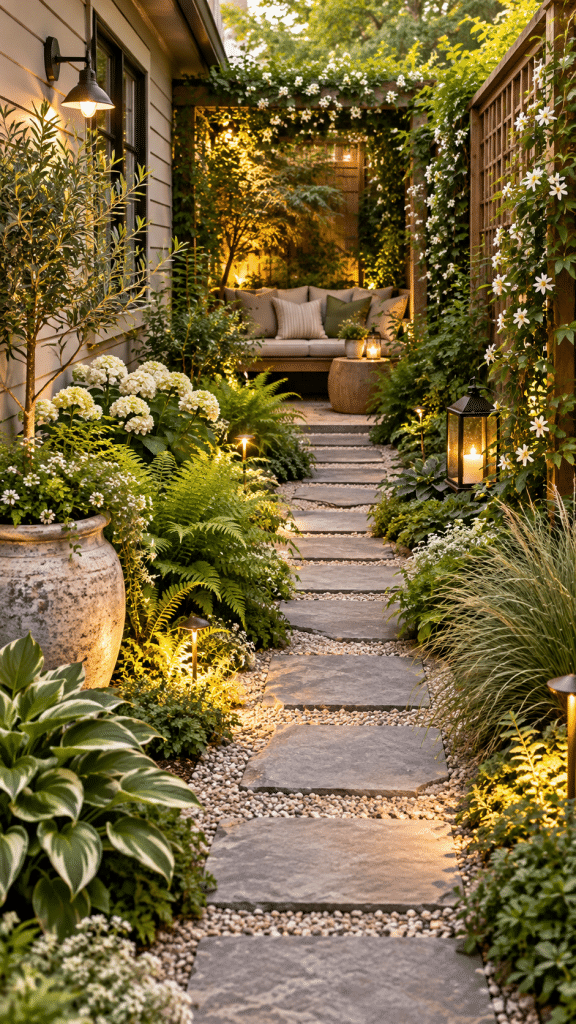
The third concept turns the side yard into a hidden garden retreat.
This design works particularly well when the space already has some natural privacy from fences, walls, or established shrubs.
Instead of emphasizing movement, the garden encourages people to stop.
A small bench, bistro chair, or reading seat becomes the centerpiece.
Plants surround the seating area and create separation from the rest of the property.
The result can feel surprisingly secluded.
Choose One Small Seating Element
Large furniture rarely works well in side yards.
A single small bench is often enough.
Another option is a compact bistro chair with a tiny side table.
The furniture should fit naturally into the space without blocking circulation.
Wood works beautifully in cottage or woodland gardens.
Dark metal can complement traditional landscapes.
Simple modern furniture fits contemporary homes.
The seating area does not need to accommodate a large group.
The charm comes from creating a place for one or two people to enjoy the garden quietly.
Surround the Retreat With Greenery
Plants create the sense of enclosure that makes the retreat feel special.
Tall plants can provide privacy.
Medium plants create softness around the seating area.
Groundcovers connect the garden visually.
In shaded side yards, ferns can be particularly effective.
Their layered leaves create a lush woodland atmosphere.
Hostas, heucheras, Japanese forest grass, and other shade-tolerant plants can complement them.
In sunny spaces, flowering perennials, ornamental grasses, lavender, and compact shrubs may be better choices.
A mix of foliage textures often creates more visual depth than flowers alone.
Introduce Fragrance
Because the seating area is small, fragrant plants can have a surprisingly strong effect.
A climbing jasmine near a bench can perfume the air.
Lavender planted beside the pathway releases fragrance when brushed lightly.
Herbs such as rosemary or thyme can also provide scent.
This creates a garden experience that goes beyond appearance.
It becomes a space that feels different from the rest of the property.
Add Soft Garden Lighting
Side yards can become dark quickly because buildings block ambient light.
Soft lighting improves both atmosphere and safety.
Low-voltage path lights can define the walkway.
Small wall lights can illuminate architectural surfaces.
Warm string lights may work in casual gardens.
A few carefully positioned solar lanterns can also provide subtle illumination.
The goal is not to make the area extremely bright.
Soft pools of light usually create a more inviting atmosphere.
✨ Lighting the plants instead of only the pathway can create beautiful shadows against fences and walls.
How to Make a Narrow Side Yard Look Wider
One of the most common concerns is that a side yard feels cramped.
Several simple design techniques can change that perception.
The first is to avoid planting tall dense vegetation on both sides of the walkway.
Doing so can create a tunnel effect.
Instead, keep one side slightly more open.
Another useful technique is using diagonal lines.
A stepping-stone pathway that shifts gently from side to side can make the garden appear wider than a perfectly straight corridor.
Plant height also matters.
Lower plants near the entrance allow the garden to feel open.
Taller plants farther away create depth.
Light-colored materials can help as well.
Pale gravel, light stone, or cream planters reflect more light into narrow spaces.
Best Plants for Side Yard Garden Ideas
Plant selection should always be based on climate and available sunlight, but several categories work especially well in narrow spaces.
Ferns
Ferns are ideal for shaded side yards.
They bring texture and movement without needing bright sunlight.
Different varieties can be combined to create a layered woodland effect.
Ornamental Grasses
Grasses provide vertical texture without requiring large amounts of space.
Their movement in the wind also brings life to narrow garden corridors.
Compact Shrubs
Small shrubs provide structure throughout the year.
Look for varieties that stay narrow naturally rather than plants that require constant pruning.
Climbing Plants
Vines are among the most efficient plants for narrow gardens.
They use vertical surfaces while occupying relatively little ground space.
Groundcovers
Groundcovers soften pathway edges and prevent bare soil from dominating the garden.
They can also reduce weed growth.
Herbs
Herbs provide both beauty and usefulness.
Many grow well in containers or narrow raised beds.
Add Containers Without Creating Clutter
Containers are useful because they allow gardeners to experiment without permanently changing the landscape.
However, narrow spaces can quickly become cluttered if too many small pots are used.
A better approach is to use fewer but larger containers.
One tall planter might hold an architectural grass.
Another could contain seasonal flowers.
A third might feature a compact shrub.
Repeating container materials also creates visual consistency.
Terracotta works beautifully in rustic gardens.
Matte black containers suit modern landscapes.
Stone or stone-look pots provide a more traditional appearance.
Side Yard Garden Ideas for Shade
Many side yards receive limited direct sunlight.
Rather than seeing this as a disadvantage, consider designing a shade garden intentionally.
Shade creates opportunities for dramatic foliage.
Plants with different leaf shapes can create rich visual contrast.
Large hosta leaves might sit beside delicate fern fronds.
Heucheras can add burgundy, caramel, lime, or silver foliage.
Japanese forest grass can introduce movement and bright color.
Moss and stone can reinforce the woodland atmosphere.
Adding a few weathered wooden elements can make the space feel peaceful and natural.
Side Yard Garden Ideas for Full Sun
Sunny side yards can support a completely different style.
Mediterranean-inspired planting works particularly well.
Lavender, rosemary, ornamental grasses, salvias, and drought-tolerant perennials can create a relaxed landscape.
Gravel paths complement this style.
Terracotta pots introduce warmth.
A small olive-like ornamental tree or another climate-appropriate narrow tree can create a focal point.
Because walls may reflect heat, plants in these locations should tolerate higher temperatures.
Mulching the soil can also help retain moisture.
Use the Side Yard as a Pollinator Corridor
A narrow garden can also serve wildlife.
Flowering plants arranged along the side yard create a small pollinator corridor.
Bees, butterflies, and other beneficial insects can move between planting areas.
Choose flowers with different blooming periods so nectar remains available across multiple seasons.
A shallow water source can also support insects and birds.
The feature should remain simple and easy to maintain.
Even a few carefully chosen flowering plants can significantly increase biodiversity compared with a completely paved side yard.
Make Drainage Part of the Design
Water management is especially important in narrow areas between buildings.
Instead of allowing rainwater to collect, the landscape can help direct and absorb it.
Permeable materials such as gravel allow water to enter the soil.
Rain-friendly planting beds can capture runoff.
Where appropriate, a dry creek style channel made from decorative stones can guide water through the garden while also becoming a visual feature.
This turns a practical requirement into part of the landscape design.
Decorative Details That Work Well in Side Yards
Because the garden is narrow, decorative elements should be chosen carefully.
Too many ornaments can overwhelm the space.
One strong feature usually has more impact than several small objects.
Good options include a wall-mounted planter, a sculptural birdbath, a decorative gate, one oversized ceramic pot, a simple garden bench, or a beautiful trellis.
Mirrors are sometimes used in garden design to create the illusion of space, but they should be positioned carefully to avoid confusing birds or reflecting harsh sunlight.
Natural materials usually integrate most successfully with the landscape.
Wood, stone, terracotta, metal, and woven textures tend to age gracefully outdoors.
Create Seasonal Interest
A side yard should remain attractive beyond one short flowering season.
Evergreen foliage provides year-round structure.
Spring bulbs can appear early in the year.
Summer perennials provide color.
Ornamental grasses add movement during late summer and fall.
Seed heads can remain through winter for texture.
Seasonal containers can also change the mood without redesigning the entire garden.
🍂 In fall, containers might feature ornamental grasses, mums, small pumpkins, and warm foliage.
🌸 In spring, bulbs and flowering branches can brighten the walkway.
☀️ Summer can emphasize lush foliage and long-blooming flowers.
❄️ During winter, evergreen branches, lanterns, and architectural plants can maintain structure.
Common Side Yard Garden Mistakes to Avoid
One of the biggest mistakes is choosing plants that eventually grow far larger than expected.
A small shrub may look perfect when first planted but become difficult to manage several years later.
Always check mature plant size.
Another mistake is making the pathway too narrow.
Plants naturally spread into walking areas, so some extra space should be allowed.
Ignoring drainage can also create problems.
Water trapped between buildings may damage plants or contribute to moisture issues around the house.
Finally, avoid filling every empty space.
Good garden design needs breathing room.
Negative space allows important plants and features to stand out.
How to Choose Between These Top 3 Side Yard Garden Ideas
Each concept solves a different landscaping problem.
Choose the lush layered garden pathway when the side yard primarily connects the front and backyard and there is enough room for planting along the edges.
Choose the vertical garden corridor when horizontal space is extremely limited and fences or walls provide opportunities for upward planting.
Choose the hidden garden retreat when the side yard is wide enough to hold a small seating area and privacy is desirable.
These approaches can also be combined.
A side yard might begin with a layered garden path, pass through a vertical trellis section, and end at a tiny seating nook.
That combination can make even a relatively small space feel like a complete garden journey.
Final Thoughts on Side Yard Garden Ideas
The best side yard garden ideas prove that a beautiful landscape does not require a huge backyard.
A narrow strip beside the house can become valuable garden space when the design responds carefully to its limitations.
🥇 A layered garden pathway turns a simple passage into a lush transition between outdoor spaces.
🥈 A vertical garden corridor uses walls and fences to maximize greenery without sacrificing valuable walking room.
🥉 A hidden garden retreat transforms an overlooked corner into a quiet destination surrounded by plants.
The most successful side yard gardens usually remain relatively simple.
A clear pathway, a limited plant palette, thoughtful vertical elements, and one or two strong focal points are often enough to completely change the character of the space.
Instead of viewing the side yard as leftover property, it can be treated as an opportunity.
With creative planting and smart use of space, even the narrowest area can become one of the most interesting parts of the garden.