A hanging tire planter can completely change the way an old tire feels in the garden. Once lifted from the ground and surrounded by flowers, trailing foliage, timber, and open air, the tire stops looking like a piece of discarded rubber and starts behaving more like a suspended garden feature.
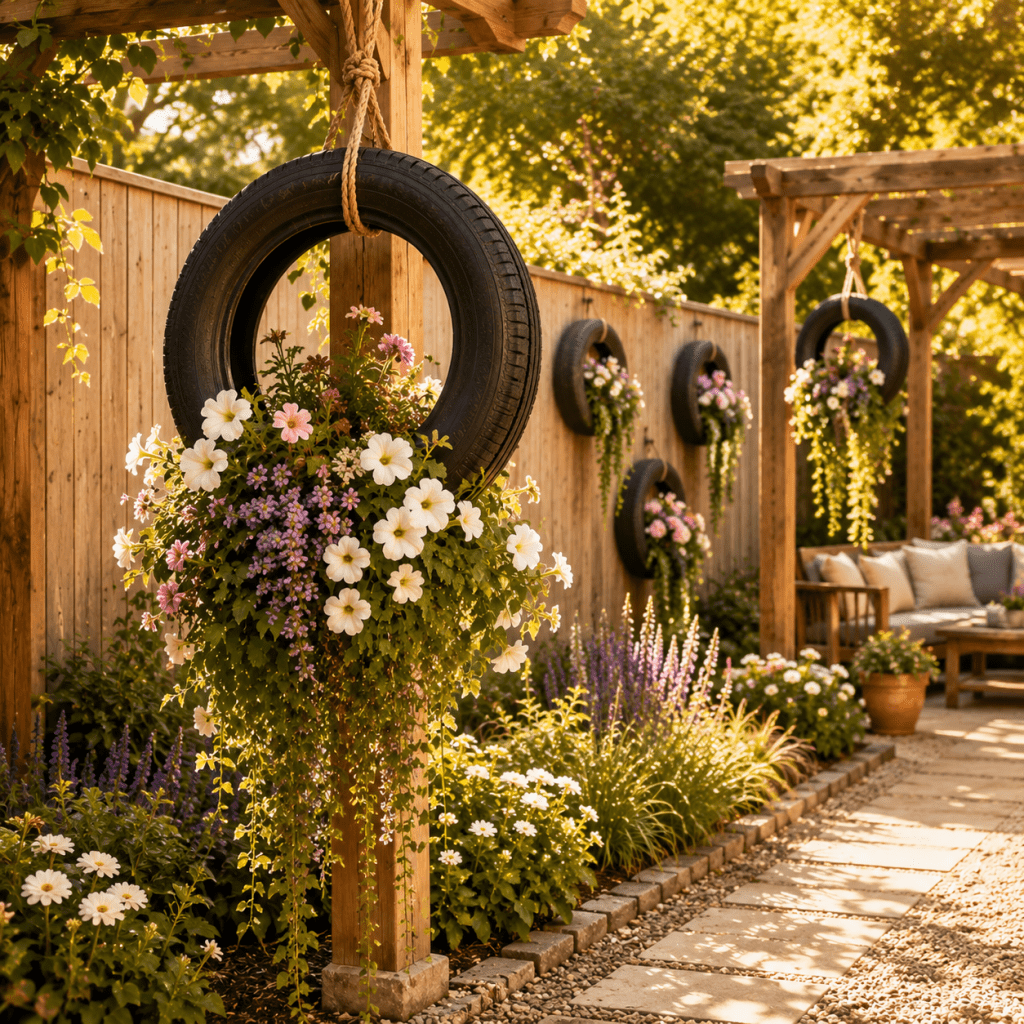
That is exactly why Hanging Tire Planter Ideas are so visually effective.
Unlike ordinary tire planters placed on the ground, hanging designs create movement and vertical interest. They can soften plain fences, decorate pergolas, fill awkward wall space, and introduce flowers without taking up valuable floor area. In a small garden, this can make a surprisingly big difference.
But the strongest hanging tire planter is not simply a tire tied to a rope.
The support system, orientation, planting style, background, height, and overall composition all matter. Some designs work best as dramatic single focal points. Others become more impressive when several tires are arranged together as a vertical display.
For this guide, the three concepts are deliberately different. The first creates an elegant suspended floral centerpiece. The second uses several tires on a fence or timber structure to form a layered living wall. The third combines a tire planter with a pergola or garden frame for a more architectural outdoor-living look.
Here are the 3 best Hanging Tire Planter Ideas for adding beautiful vertical garden style to your outdoor space.
| Rank | Hanging Tire Planter Idea | Main Visual Effect | Best For |
|---|---|---|---|
| 🥇 | Suspended Cascading Flower Tire Planter | Dramatic floating floral focal point | Patios and garden corners |
| 🥈 | Layered Hanging Tire Fence Garden | Lush vertical planting display | Fences and small backyards |
| 🥉 | Pergola Hanging Tire Garden Feature | Architectural garden styling | Outdoor living spaces |
Important Note: A hanging tire planter becomes very heavy when filled with growing medium and saturated with water. Use a support structure and hardware appropriate for the full loaded weight, protect against movement in wind, and position the planter where failure would not create a hazard. Reused tires are most straightforward for ornamental planting rather than edible crops when material history is uncertain.
🥇 Platz 1 Suspended Cascading Flower Tire Planter
The most beautiful hanging tire planter often begins with simplicity.
One tire.
One strong suspension point.
One carefully designed planting composition.
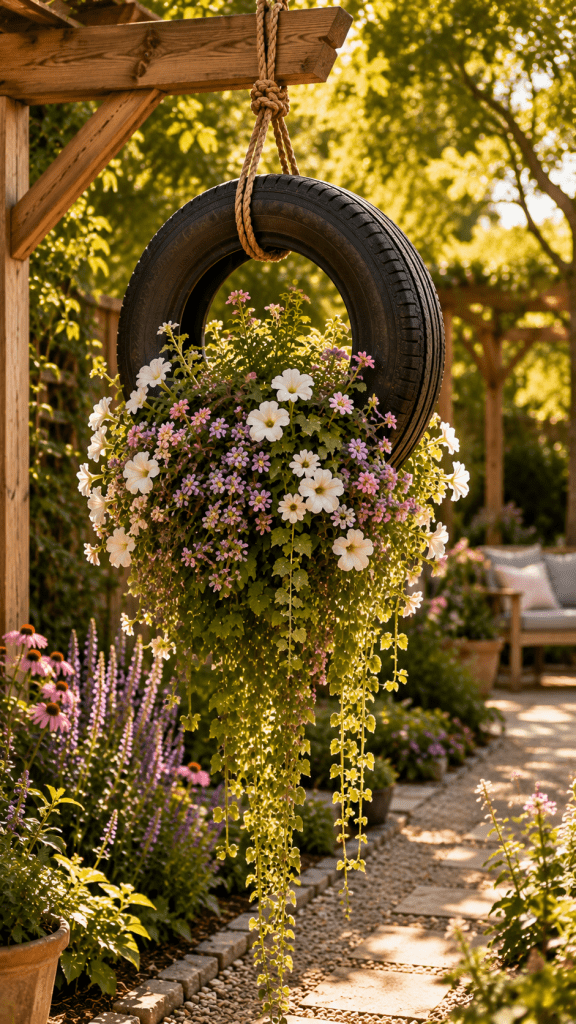
The Suspended Cascading Flower Tire Planter turns a single old tire into a floating floral focal point, with flowers and foliage spilling from the opening and partially covering the rubber.
The result can be surprisingly elegant.
Let the Tire Float Visually
The most important part of this concept is space around the planter.
If the tire is squeezed between too many objects, the suspended effect disappears.
Give it breathing room.
A beautiful location might be beneath a mature tree, beside a pergola, against a simple garden backdrop, or near the edge of a patio.
The planter should be visible from several angles.
When placed correctly, the empty space around the tire becomes part of the design.
Decide How the Tire Will Hang
The tire can be positioned in different orientations.
A vertical orientation highlights the circular shape.
This works beautifully when flowers and foliage grow from the lower interior section and spill downward.
A slightly angled orientation can create a more relaxed, informal look.
The planter may appear as though it is gently suspended in the garden rather than rigidly displayed.
A horizontal orientation creates a different effect and can support more of a bowl-like planting arrangement, but it requires a carefully engineered support system because the loaded weight must remain stable.
For visual impact, the vertical tire is often the most distinctive.
Use Cascading Plants as the Main Feature
Trailing plants are essential.
Without them, the tire can remain visually heavy.
Plants that fall downward break the circular outline and create movement.
The best composition combines several growth habits.
Use a mounding plant near the center.
Add flowering plants around it.
Then introduce trailing foliage or flowers that extend beyond the lower edge.
The cascading layer should be generous enough to soften the tire, but not so dense that the shape completely disappears.
The tire itself is still part of the design.
Add One Strong Upright Accent
A hanging planter can become too bottom-heavy if every plant trails downward.
Introduce one upright element.
This might be a flowering plant, decorative foliage, or fine ornamental grass.
It creates visual balance.
The eye first sees height near the center and then follows the cascading plants downward.
That movement makes the planter feel much more dynamic.
Keep the Tire Color Restrained
A suspended tire already attracts attention because of its unusual position.
There is often no need to add very strong paint.
Dark charcoal works beautifully with pale flowers and green foliage.
Muted sage can create a softer botanical effect.
Warm terracotta can work well in Mediterranean-inspired gardens.
Dusty blue suits cottage-style planting.
The safest rule is simple:
if the flowers are colorful, keep the tire quieter.
If the planting is mostly green and white, the tire can carry slightly more color.
Use the Rope or Chain as Part of the Aesthetic
The suspension material is not invisible.
It contributes to the visual style.
Natural rope can create a rustic or cottage-inspired look.
Dark metal chain has a more industrial appearance.
Minimal dark hardware can work in contemporary gardens.
Whatever material is used, function comes first. It must be appropriate for the actual load and outdoor conditions.
But once that requirement is met, choosing a support that complements the surrounding garden helps make the project feel complete.
Create a Beautiful Background
A hanging planter looks strongest when the background provides contrast.
Against a pale wall, a charcoal tire filled with greenery becomes dramatic.
Against a weathered timber fence, a muted cream or sage planter can feel softer.
Against dense foliage, lighter flowers can help the planter remain visible.
Think about the entire frame.
The background is almost as important as the tire itself.
Why This Idea Takes First Place
The Suspended Cascading Flower Tire Planter earns 🥇 because it produces the biggest transformation with the least visual clutter.
One tire becomes a floating garden feature.
The flowers soften the material, the suspended position creates drama, and the vertical presentation makes it feel very different from an ordinary tire planter.
🥈 Platz 2 Layered Hanging Tire Fence Garden
One hanging tire can be beautiful.
Several carefully arranged tires can transform an entire fence.
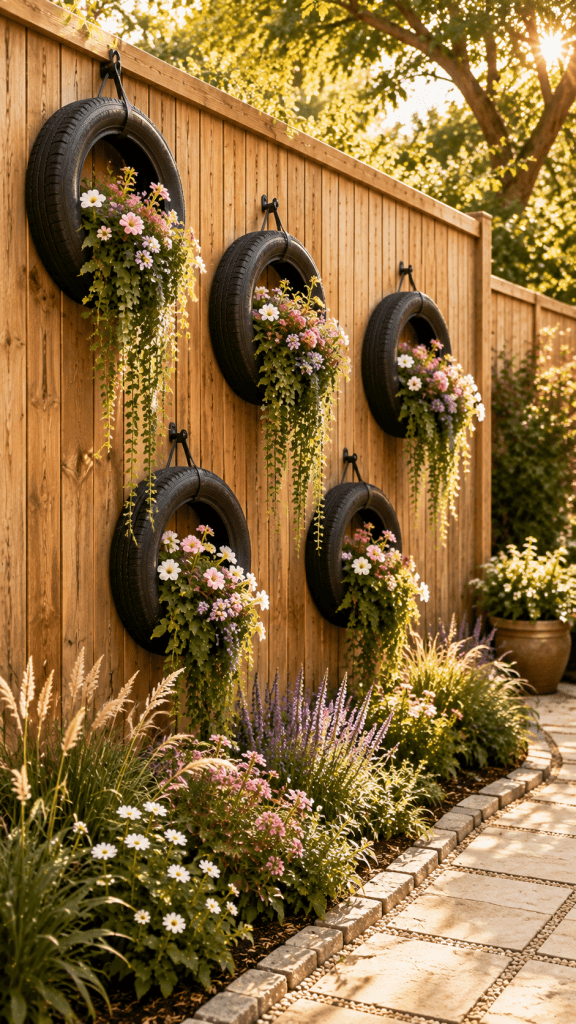
The Layered Hanging Tire Fence Garden uses multiple tire planters at different heights to create a vertical planting composition.
This is especially useful in small gardens where horizontal planting space is limited.
Instead of covering the ground, the garden climbs upward.
Treat the Fence Like a Canvas
Do not attach tires randomly.
Imagine the fence as a blank wall.
Plan the composition first.
One option is a structured grid.
This creates a clean, organized appearance.
Another option is asymmetrical placement.
One tire can sit higher.
Two can occupy the middle.
Another can sit lower and slightly off-center.
This creates more movement.
A diagonal arrangement can also work, with the planters gradually climbing from one side of the fence to the other.
Leave Negative Space
A vertical garden does not need to cover every centimeter.
In fact, too many tires can make the fence look visually heavy.
Allow the background material to remain visible.
Timber, brick, stone, or painted fencing can provide valuable visual contrast.
The empty spaces also allow trailing plants to spread without immediately colliding with one another.
Use Different Plant Forms at Different Heights
The highest tire should not necessarily contain the same planting as the lowest.
Upper planters benefit from stronger cascading plants because they are viewed from below.
Middle planters can combine mounding flowers and trailing foliage.
Lower tires can support fuller planting and more upright elements.
This creates a natural layering effect.
The planting changes as the eye moves down the fence.
Repeat One Plant Throughout the Display
Repetition is crucial.
Use one flower or foliage plant in several tires.
Perhaps every planter contains the same white trailing flower.
Or every tire includes a small amount of burgundy foliage.
This visually connects the separate planters.
Without repetition, the fence can look like a collection of unrelated containers.
Keep the Tires in One Color Family
The same principle applies to paint.
Using one color across all tires creates a more architectural appearance.
You could also use tonal variations.
For example:
deep sage + medium sage + pale sage
or:
charcoal + warm gray + stone
The flowers can then provide more variation.
A controlled tire palette keeps the overall wall from becoming chaotic.
Consider the Fence Material
The support structure is not merely decorative.
A lightweight fence may not be appropriate for several heavily loaded planters.
A purpose-built timber frame or structurally suitable wall may be necessary.
This is especially important when multiple tires are involved because total weight can become substantial.
Do not assume that a fence capable of standing outdoors is automatically designed to carry loaded planters.
Integrate the Bottom With Ground Planting
One of the easiest ways to make the vertical display feel complete is to add conventional planting beneath it.
Low flowers, ornamental grasses, or groundcover can visually connect the hanging tires with the ground.
This prevents the wall garden from looking disconnected.
Plants above and below begin to create one continuous composition.
Best Places for This Idea
The Layered Hanging Tire Fence Garden works especially well:
- in narrow side yards,
- against backyard fences,
- beside patios,
- in compact courtyards,
- behind garden seating,
- or anywhere an unattractive blank vertical surface needs improvement.
It is particularly valuable when there is little room for conventional flower beds.
Why It Takes Second Place
This idea earns 🥈 because it combines decoration with space efficiency.
Instead of using several square meters of ground, the garden occupies a vertical surface.
And because the planters sit at different heights, the display can feel much larger than the actual footprint suggests.
🥉 Platz 3 Pergola Hanging Tire Garden Feature
The third idea integrates the tire planter into garden architecture.
A Pergola Hanging Tire Garden Feature suspends one or more tire planters from a sturdy pergola, garden frame, or purpose-built overhead structure.
This creates a more polished outdoor-living look.
The planter becomes part of the architecture rather than an isolated decoration.
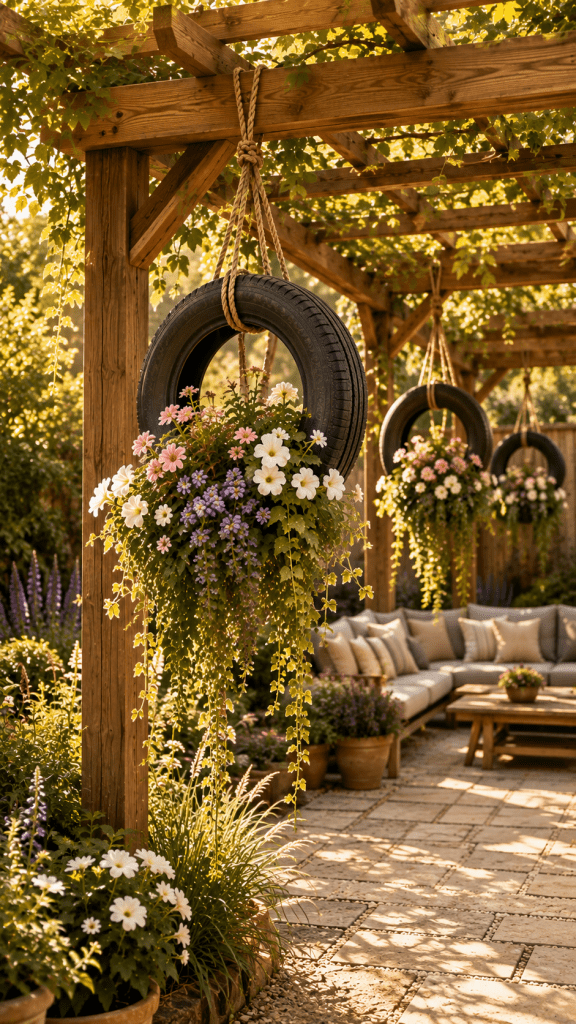
Use the Structure to Frame the Planter
A pergola naturally creates vertical and horizontal lines.
A round hanging tire introduces contrast.
That combination can be visually powerful.
Position the planter where the circular form is framed by the beams.
This creates a deliberate composition.
The tire should not simply hang wherever there happens to be space.
Consider how it looks from the patio, garden entrance, and seating area.
Use One Large Planter Instead of Many
In a refined outdoor-living space, fewer elements often work better.
One substantial hanging tire planter can create more impact than several small ones.
Fill it with abundant foliage and flowers.
Allow the plants to cascade.
The planter becomes almost like a botanical chandelier.
This can work beautifully above the edge of a patio or beside a seating zone, provided it is positioned safely away from normal circulation.
Coordinate With Outdoor Furniture
This concept becomes much stronger when the planter relates to the surrounding outdoor room.
If the furniture contains natural timber, use similar tones in the support structure.
If the cushions are cream and olive, a muted olive tire with white flowers can reinforce the palette.
If the patio uses dark metal furniture, a charcoal tire can connect with those details.
The result feels styled rather than improvised.
Introduce Other Plants Around the Pergola
Do not rely on the tire alone.
Climbing plants on the pergola can provide additional greenery.
Large conventional containers at ground level can create balance.
Flower beds nearby can repeat the colors used in the hanging planter.
These surrounding plants help the tire feel like one component of a broader garden design.
Keep the Styling Sophisticated
This concept works best when decorative elements are limited.
Avoid combining multiple bright tire colors, signs, ornaments, and unrelated accessories.
The pergola already provides architecture.
The tire provides circular form.
The flowers provide texture and color.
That is enough.
Use Warm Natural Materials
Timber is especially effective around hanging tire planters.
It softens the industrial character of the rubber.
Natural stone, limestone, gravel, linen outdoor cushions, terracotta, and restrained metal details can reinforce this effect.
The goal is to surround the recycled planter with materials that make the garden feel established and intentional.
Consider the View From Seated Height
A hanging planter beside a seating area will often be viewed while people are sitting.
That changes the ideal placement.
It should not hang so low that it blocks views or creates an obstacle.
It should also not be so high that the flowers become invisible.
Test the visual position from the actual seating area before completing the installation.
Why It Takes Third Place
The Pergola Hanging Tire Garden Feature earns 🥉 because it offers the most architectural interpretation.
It works particularly well when the garden already contains a defined outdoor-living structure.
The tire becomes part of the room rather than simply part of the flower bed.
How to Make Hanging Tire Planter Ideas Look More Beautiful
A few design decisions can dramatically improve the final result.
Use Cascading Plants Generously
Trailing growth is one of the best tools for visually softening the tire.
Let flowers and foliage extend beyond the rubber edge.
Keep the Palette Controlled
Choose two or three dominant colors rather than combining every flower color available.
Repeat Elements
If several tires are used, repeat at least one flower, foliage plant, or tire color.
Simplify the Background
A planter becomes easier to appreciate against a relatively calm fence, wall, or garden structure.
Allow Space Around the Tire
Do not crowd the composition.
Vertical gardens still need negative space.
Vertical or Horizontal Hanging Tire Planters
Both orientations can create distinctive results.
A vertical tire planter emphasizes the circular silhouette.
It also works particularly well with cascading flowers growing from the lower interior section.
A horizontal tire planter behaves more like a suspended bowl.
It can accommodate a broader planting surface but requires a support system designed to keep the loaded planter level and secure.
For visual drama, vertical is usually more recognizable.
For abundant container planting, horizontal can offer more planting area.
The correct choice depends on the structural setup and desired aesthetic.
Best Plants for Hanging Tire Planters
Hanging planters are particularly suited to plants with attractive trailing growth.
Depending on your climate and growing conditions, suitable ornamental categories may include:
- cascading flowering plants,
- compact mounding flowers,
- trailing foliage,
- small ornamental grasses,
- compact foliage plants.
Look for combinations with different textures.
Fine foliage beside larger leaves creates contrast.
Small flowers beside fuller blooms add variety.
A limited palette with varied texture usually looks more sophisticated than many colors with identical plant forms.
Sunlight Matters More in Hanging Planters
The elevated position of a hanging planter can change its exposure.
A tire attached to an open fence may receive more sun and wind than a pot sitting near the ground.
A planter beneath a pergola may receive partial shade.
One hung from a mature tree may experience changing light throughout the day.
Choose plants based on the actual conditions of the hanging location.
Also remember that containers can dry faster than in-ground beds under warm, windy conditions.
Monitor moisture appropriately for the plants and climate.
Drainage Is Essential
A hanging container should never accumulate unnecessary standing water.
Extra water adds weight and can create poor root conditions.
Use a planter configuration that allows appropriate drainage while securely containing the growing medium.
The exact setup will depend on the tire’s orientation and planting design.
Whatever method is chosen, water should have a safe route out of the planter.
Stability and Safety Come First
This matters especially with hanging tires.
An old tire may already be relatively heavy.
Add growing medium.
Add plants.
Then add water.
The final load can be far greater than the empty tire suggests.
Use hardware and structural attachment points rated appropriately for the expected load and environmental conditions.
Do not hang heavy planters from weak tree branches, decorative fence boards, or structures whose load capacity is uncertain.
And avoid positioning them directly over seating, play areas, walkways, or other locations where a falling planter could cause injury.
A beautiful garden feature must also be secure.
Should You Paint a Hanging Tire Planter
Painting can work beautifully.
A hanging tire is often more visible than one sitting in a flower bed, so color has more impact.
For elegant gardens, try:
charcoal
sage
dusty blue
warm terracotta
stone gray
muted cream
For playful gardens, stronger colors can work, but keep them coordinated with the flowers and surrounding space.
If painting, use a coating compatible with the material and exterior environment according to the manufacturer’s instructions.
Rope Chain or Hidden Hardware
Each approach creates a different look.
Natural-looking rope can feel rustic.
Dark chain can introduce an industrial character.
Minimal hardware can produce a cleaner contemporary appearance.
The aesthetic choice comes after structural suitability.
Use only attachment components appropriate for the real load and outdoor conditions.
Never choose a visually attractive suspension method that is not suitable for the actual weight.
How Many Hanging Tires Should You Use
One tire creates a focal point.
Three or more can create a vertical garden.
The correct number depends on the available wall, fence, or structure.
In a small courtyard, one dramatic planter may be enough.
Along a long fence, a carefully spaced group may look better.
Avoid filling every available vertical surface.
The arrangement needs visual breathing room.
How High Should a Hanging Tire Planter Be
There is no universal perfect height.
The planter should remain visible and accessible enough for plant care while staying clear of normal movement through the space.
Consider:
- viewing height,
- watering access,
- nearby seating,
- paths,
- children,
- pets,
- wind exposure,
- and the mature length of trailing plants.
Remember that cascading plants can eventually hang much lower than the tire itself.
Design for the mature planter, not only the newly planted one.
How to Make a Fence Tire Garden Feel Intentional
Use a simple visual system.
For example:
same tire color + different flowers
or:
different tonal tire colors + same flower
or:
same flowers + staggered heights
Choose one organizing principle.
This gives the display coherence.
Random color, random spacing, and random plants used simultaneously usually create visual noise.
Common Hanging Tire Planter Mistakes
The first mistake is choosing the location based only on appearance and ignoring structural load.
The second is placing too many tires too close together.
Another is using plants that do not trail enough to soften the circular shape.
Too many unrelated paint colors can also make the composition feel chaotic.
Poor drainage adds unnecessary weight.
And hanging the planter too low can interfere with pathways or garden seating.
Good design needs to solve all of these issues at once.
Which Hanging Tire Planter Idea Is Best
Choose the 🥇 Suspended Cascading Flower Tire Planter if you want one dramatic focal point.
It creates the clearest visual transformation and works beautifully with trailing flowers.
Choose the 🥈 Layered Hanging Tire Fence Garden if you want to maximize a vertical surface.
This is especially useful in small backyards where ground space is valuable.
Choose the 🥉 Pergola Hanging Tire Garden Feature if you want the planter to become part of a more polished outdoor-living space.
It connects recycled garden design with architecture, furniture, and surrounding landscape materials.
Final Thoughts on Hanging Tire Planter Ideas
The best Hanging Tire Planter Ideas succeed because they use vertical space in a way ordinary ground planters cannot.
The 🥇 Suspended Cascading Flower Tire Planter turns one tire into a dramatic floating floral focal point.
The 🥈 Layered Hanging Tire Fence Garden transforms an otherwise empty vertical surface into a lush wall of flowers and foliage.
And the 🥉 Pergola Hanging Tire Garden Feature integrates the recycled planter into a more architectural outdoor-living environment.
Whichever concept you choose, resist the temptation to make the tire itself do all the decorative work.
Let plants soften it.
Let the surrounding materials support it.
Leave enough negative space around the composition.
And make structural safety part of the design from the beginning.
When those elements work together, a hanging tire no longer looks like an object that simply found a new use.
It becomes a deliberate vertical garden feature.