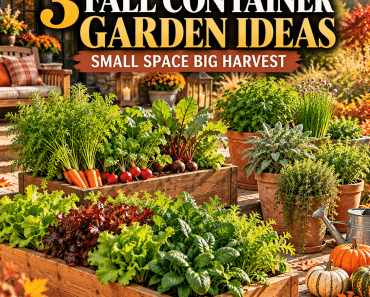
Fall Raised Bed Garden Ideas can completely change the way you experience autumn gardening, transforming ordinary backyard growing spaces into productive, beautifully organized garden beds that continue providing fresh vegetables, healthy soil, and seasonal interest long after summer has ended. While many gardeners assume their vegetable-growing season is nearly finished when temperatures begin to drop, the arrival of fall actually creates exciting opportunities to extend harvests, prepare healthier planting spaces, and establish crops that will reward your patience in the following year.
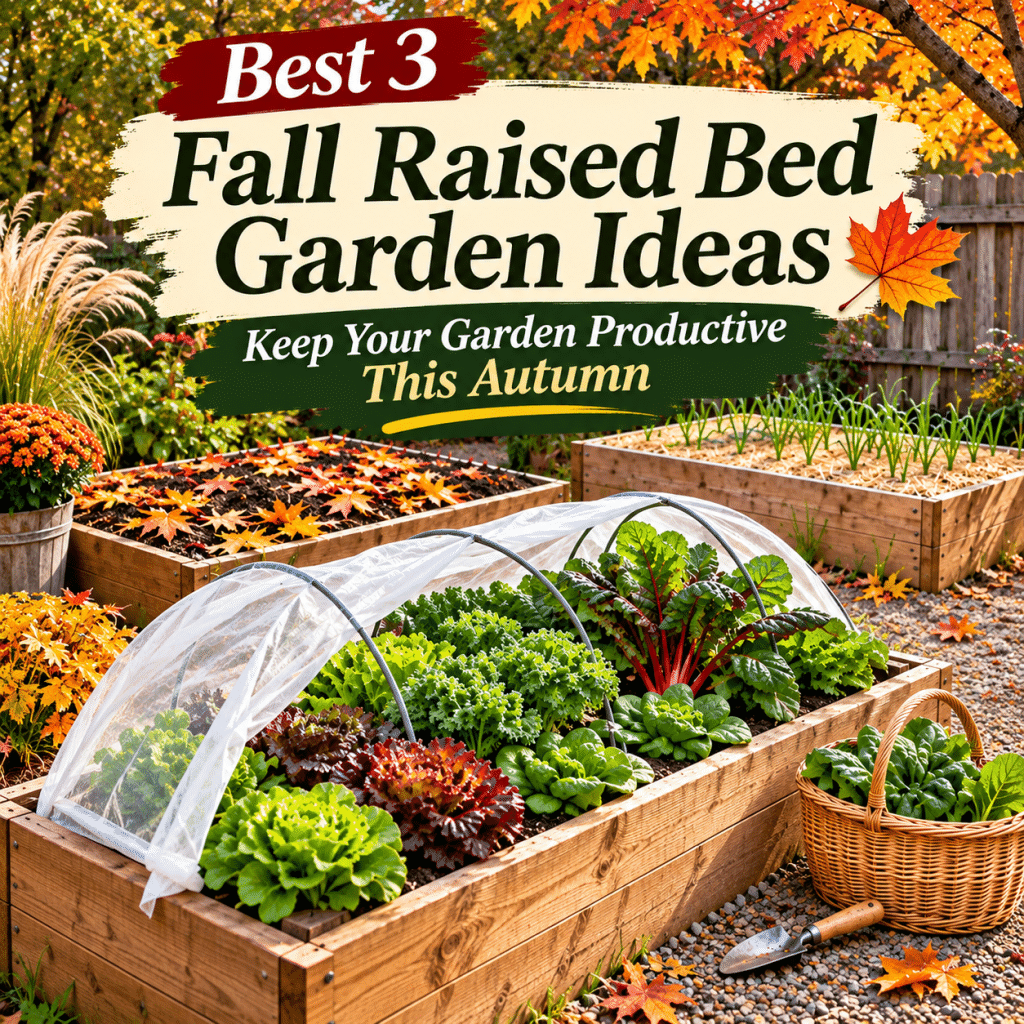
Imagine stepping into your backyard on a crisp autumn morning and discovering lush green vegetables growing beneath a protective garden tunnel. Nearby, another raised bed is covered with beautiful layers of shredded autumn leaves and rich compost, quietly developing fertile soil for spring. A third bed contains neatly planted garlic cloves and overwintering onions, beginning their underground development while the surrounding landscape settles into winter.
🍂 The secret to a successful autumn raised bed garden is not simply choosing what to plant but designing each growing space around a specific seasonal purpose.
Unlike ordinary decorative garden beds, fall raised beds can become highly functional growing systems that address several challenges associated with colder weather.
Their elevated soil provides a manageable growing environment, clearly defined planting areas, and convenient access for seasonal maintenance. With thoughtful planning, they can also accommodate removable frost protection, compost-based soil improvement, and crops that develop across more than one growing season.
However, creating a productive autumn garden requires understanding that different raised beds serve different purposes.
Some are designed to produce vegetables through the colder months.
Others are intended to restore soil fertility after an exhausting summer growing season.
Still others provide a sheltered growing environment for crops that establish in autumn and mature the following year.
These Best 3 Fall Raised Bed Garden Ideas explore three distinctive approaches that combine practical gardening techniques, attractive backyard organization, and long-term productivity.
Rather than concentrating on decorative borders or landscaping materials, each idea focuses on how the raised bed actually functions throughout autumn and beyond.
The result is a garden that works harder, requires more intentional maintenance, and offers meaningful rewards throughout the changing seasons.
Why Fall Raised Bed Garden Ideas Are Perfect for Extending Your Growing Season
Autumn presents a unique opportunity for gardeners who want to make better use of their outdoor growing spaces.
During summer, many vegetable gardens struggle with intense sunlight, high temperatures, rapidly drying soil, and vigorous weed growth.
As temperatures begin to moderate, several of these pressures may become less severe.
Cool-season vegetables such as kale, spinach, certain lettuces, and Asian greens often grow well during mild autumn weather, although successful harvests depend on local temperatures, daylight, and planting dates.
Raised beds make this seasonal transition particularly convenient because the growing areas are clearly defined and relatively easy to manage.
Instead of preparing an entire backyard vegetable plot, gardeners can concentrate on a few carefully selected beds.
One bed might continue producing edible greens.
Another could be prepared for winter with organic matter.
A third might be reserved for autumn-planted garlic.
🌱 Giving each raised bed a specific purpose can make fall gardening more organized, productive, and manageable.
Raised beds also offer practical advantages for soil management.
Because gardeners can work from surrounding pathways, the planting soil is less likely to become compacted by repeated foot traffic.
Their elevated growing surfaces can improve drainage where native soil conditions are challenging, although they may also dry out faster and experience greater temperature fluctuations than in-ground beds.
These characteristics make careful moisture management and winter protection especially important. University of Maryland Extension+1
Another advantage is flexibility.
A simple rectangular raised bed can accommodate a lightweight hoop tunnel during autumn and then return to open-air production when warmer conditions arrive.
A previously productive summer bed can become a temporary soil-building station through compost and leaf mulch.
A small dedicated planting bed can support overwintering crops without disrupting the arrangement of other vegetable beds.
🏡 The most successful raised bed gardens are designed for changing seasons rather than a single moment of peak summer growth.
Best 3 Fall Raised Bed Garden Ideas at a Glance
The following comparison highlights three distinctive approaches to autumn raised bed gardening.
| Fall Raised Bed Garden Idea | Main Purpose | Best Plants or Materials | Primary Advantage |
|---|---|---|---|
| 🥇 Protected Cool Season Harvest Bed | Extend autumn vegetable harvesting | Kale, spinach, mâche, Asian greens, frost cloth | Fresh produce during cooler weather |
| 🥈 No Dig Autumn Soil Renewal Bed | Improve soil fertility for spring | Finished compost, shredded leaves, organic mulch | Healthier soil with less disturbance |
| 🥉 Overwintering Garlic and Allium Bed | Establish crops for the following year | Garlic, suitable overwintering onion varieties, mulch | Productive use of raised beds across seasons |
Each idea offers a different advantage depending on your climate, gardening experience, available space, and seasonal priorities.
Gardeners who enjoy harvesting fresh vegetables may prefer a protected cool-season bed.
Those who want healthier spring soil may appreciate the simplicity of autumn soil renewal.
Meanwhile, gardeners interested in long-term crop planning can create a dedicated garlic and allium bed that remains productive across the winter-to-summer transition.
The following sections explain how to design, plant, maintain, and improve each approach.
🥇 Best 1 Fall Raised Bed Garden Ideas With a Protected Cool Season Harvest Tunnel
A protected cool-season harvest bed is one of the most practical ways to transform an ordinary raised vegetable garden into a productive autumn growing space.
This design uses a traditional raised bed combined with a lightweight, removable tunnel structure that helps protect carefully selected vegetables from challenging weather.
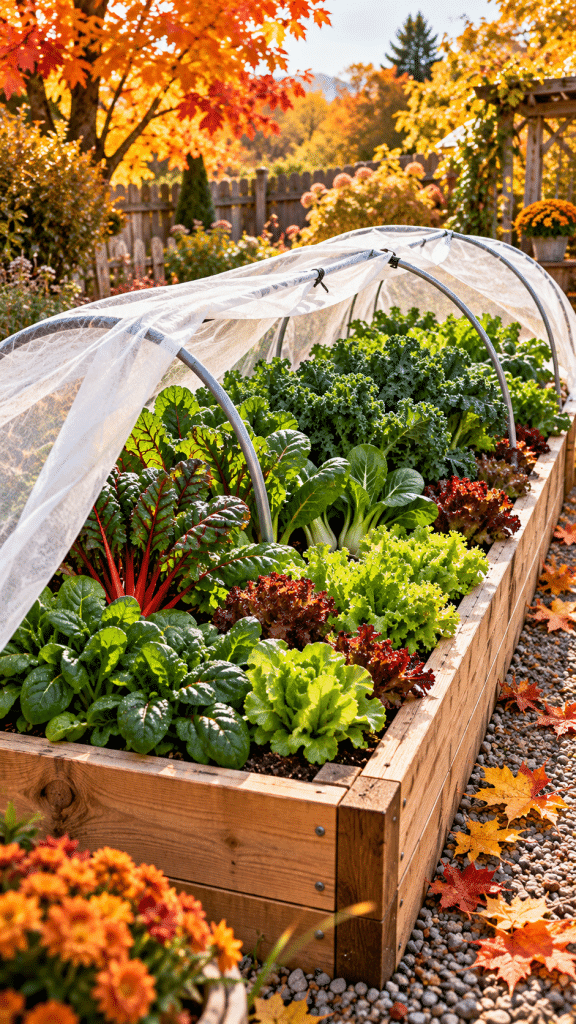
Imagine a beautifully organized rectangular garden bed filled with vigorous dark-green kale, delicate spinach leaves, and compact Asian greens.
Above the plants, several curved supports form a graceful miniature tunnel.
A translucent protective cover stretches across the hoops, creating a simple but effective growing environment.
During mild weather, the cover can be opened or removed to improve ventilation.
When colder conditions approach, the tunnel can provide additional protection against frost and wind.
🥬 A well-designed raised bed tunnel allows gardeners to make better use of autumn planting opportunities without building a permanent greenhouse.
The beauty of this approach lies in its simplicity.
The tunnel is not intended to completely recreate summer conditions.
Instead, it helps moderate environmental exposure, allowing cold-tolerant crops to survive or remain harvestable for longer in suitable climates.
Choose the Right Dimensions for a Fall Harvest Raised Bed
The first consideration is the shape and size of the raised bed.
A rectangular design is generally the easiest option because it provides convenient growing space and allows protective hoops to be installed at regular intervals.
A bed approximately four feet wide and six to eight feet long can be a useful starting point for a backyard vegetable garden.
The exact length is flexible, but the width should allow gardeners to reach the center without stepping on the soil.
If the bed is accessible from only one side, a narrower design may be more practical.
For the tunnel itself, select a support system compatible with the bed dimensions.
Flexible garden hoops, purpose-made tunnel supports, or suitable PVC arches can create the basic framework.
The supports should be securely attached and spaced closely enough to prevent excessive sagging.
In areas with strong winds or snowfall, the structure must be designed for expected weather conditions.
A simple lightweight tunnel should not be assumed capable of supporting heavy snow.
📏 A compact, accessible design often performs better than an oversized bed that becomes difficult to cover and maintain.
Plant Cold Tolerant Vegetables for a Productive Autumn Harvest
Plant selection is the most important part of creating a successful protected raised bed.
Cold-tolerant crops generally perform better in autumn than heat-loving vegetables such as tomatoes, cucumbers, and peppers.
However, cold tolerance varies considerably among species and varieties.
Some vegetables continue growing in cool weather.
Others become nearly dormant as temperatures and daylight decrease, even when they remain alive beneath protective covers.
For the most reliable results, establish crops early enough that they reach a useful size before growth slows significantly.
Excellent candidates include:
- Kale: A hardy leafy vegetable that can remain harvestable during cool weather.
- Spinach: Particularly useful for autumn sowing and, in appropriate climates, overwintering.
- Mâche: Also called corn salad, this compact green performs well in cool conditions.
- Tatsoi: A beautiful Asian green with a low-growing rosette form.
- Mizuna: A fast-growing leafy crop suitable for cut-and-come-again harvesting.
- Claytonia: Also known as miner’s lettuce, a cool-season salad green suited to mild conditions.
🥗 Combining several leafy vegetables creates a visually attractive garden while providing different textures and flavors for autumn meals.
For example, taller kale plants can occupy the northern side of a bed in the Northern Hemisphere, while smaller spinach and mâche plants grow in front.
This helps reduce shading when the lower autumn sun becomes an important factor.
Avoid planting every section too densely.
Vegetables grown under protective covers still require adequate airflow.
Overcrowding can increase moisture retention around leaves and create conditions favorable to certain fungal diseases.
Create a Simple Removable Hoop Tunnel for Frost Protection
A removable hoop tunnel is the defining feature of this garden idea.
The structure consists of several arched supports and an appropriate protective cover.
Gardeners commonly use horticultural frost cloth or lightweight row-cover fabric to protect cool-season plants.
These materials can reduce exposure to frost and wind while allowing some light and moisture to pass through.
Clear polyethylene film is another option, but it requires especially careful ventilation because temperatures beneath plastic can rise rapidly during sunny weather.
The cover should be secured along the edges to prevent it from blowing away.
At the same time, the design should allow easy access for harvesting, watering, and inspecting plants.
A practical arrangement includes a long side that can be lifted or rolled upward.
This makes it possible to harvest vegetables without completely dismantling the tunnel.
🌤️ The goal is to provide protection when necessary while avoiding excessive heat and trapped humidity.
The tunnel should be monitored regularly as outdoor conditions change.
Cold nights may require additional insulation, while sunny afternoons may require the cover to be opened.
Important Note: A low tunnel does not guarantee protection from severe freezes. Its performance depends on the cover material, construction, wind, temperature, and plant variety. Check conditions beneath the cover regularly, ventilate during warm weather, and never place an unsuitable or poorly secured structure where it could collapse under snow or strong winds.
Arrange Your Autumn Harvest Bed for Easy Maintenance
The planting arrangement should make harvesting simple.
Rather than mixing vegetables randomly, organize the growing space into clearly defined sections.
For example, one side of the bed can contain kale plants, while the center supports a row of spinach and the opposite side contains compact Asian greens.
This creates a visually balanced arrangement and makes it easier to identify which plants are ready for harvesting.
The pathway beside the bed should remain clear throughout autumn.
Fallen leaves, wet soil, and seasonal equipment can quickly make narrow garden passages inconvenient.
A stable pathway with suitable organic mulch or another appropriate surface helps maintain accessibility.
Consider placing the harvest bed near the kitchen or a frequently used backyard entrance.
This makes it easier to check the tunnel, collect vegetables, and respond to changing weather.
✨ A productive autumn vegetable bed should be convenient enough that harvesting becomes part of everyday life.
Make Your Protected Harvest Bed Work Through the Seasons
One advantage of a removable tunnel is that the bed does not need to remain enclosed year-round.
During favorable autumn conditions, vegetables can grow with minimal protection.
As colder weather approaches, the tunnel becomes increasingly useful.
In regions with relatively mild winters, established cold-hardy crops may remain available for periodic harvests.
In colder climates, the tunnel may primarily protect plants already near harvestable size rather than support significant new growth throughout winter.
When spring arrives, the structure can be removed, stored, or reused to protect new plantings.
The raised bed then becomes available for another growing cycle.
This seasonal flexibility makes the protected harvest tunnel an excellent investment for gardeners who want to use the same growing space more efficiently.
🥈 Best 2 Fall Raised Bed Garden Ideas With No Dig Soil Renewal and Natural Autumn Leaf Layers
Not every productive fall raised bed needs to contain actively growing vegetables.
Sometimes, the most valuable autumn gardening project is preparing the soil for the following spring.
A no-dig soil renewal bed uses organic materials to protect and gradually improve a raised bed after its summer crops have finished.
Instead of repeatedly digging and turning the soil, gardeners apply suitable compost and organic mulch to the surface.
Over time, earthworms, microorganisms, moisture, and natural decomposition help incorporate organic matter into the growing environment.
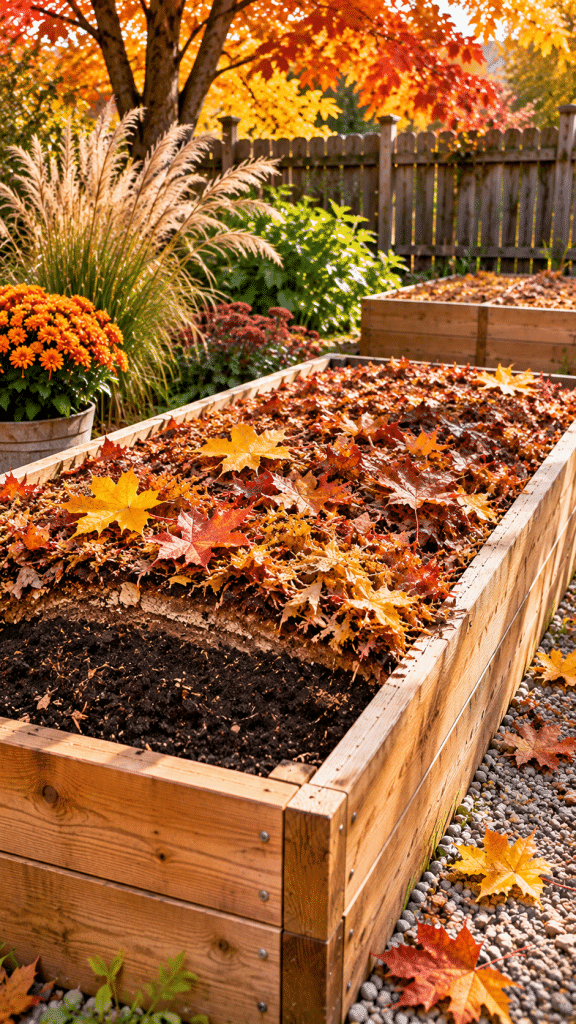
Imagine a beautifully maintained raised bed after the last summer tomatoes have been removed.
The soil is covered with a dark layer of finished compost.
Above it rests a blanket of finely shredded golden-brown leaves.
The surface is tidy, protected, and ready to endure changing autumn conditions.
🍁 A no-dig autumn raised bed turns seasonal garden cleanup into an opportunity to build healthier soil.
This approach is particularly valuable for gardeners who want a manageable gardening routine while maintaining long-term soil productivity.
Transform a Finished Summer Bed Into a Soil Building Space
The first step is to evaluate the condition of the raised bed after summer harvesting.
Remove spent annual crops that are no longer productive.
Healthy plant material can generally be composted using appropriate composting methods.
Plants affected by persistent diseases or troublesome pests may require different disposal methods to avoid spreading problems into future crops.
Next, inspect the soil.
Summer vegetable production can leave the growing medium compacted at the surface, depleted of certain nutrients, or partially exposed.
Raised bed soil may also settle over time as organic materials decompose.
Instead of automatically replacing the entire soil volume, evaluate whether additional compost or mineral soil is actually needed.
A healthy raised bed should contain a balanced growing medium with suitable drainage, water retention, and aeration.
University extension guidance supports minimizing unnecessary soil disturbance and using organic amendments appropriately to maintain soil structure. University of Maryland Extension+1
🌱 The objective is to improve existing soil rather than repeatedly starting the growing medium from scratch.
Add Finished Compost to Restore Organic Matter
Finished compost is one of the most useful materials for preparing raised beds in autumn.
It contributes organic matter and may supply nutrients, depending on its composition.
Spread a modest, even layer across the soil surface.
For many established beds, approximately half an inch to one inch of mature compost is a reasonable starting point, although soil test results and existing organic matter levels should guide the actual application.
Avoid assuming that more compost is always better.
Excessive applications, especially of manure-based compost, can contribute unnecessary nutrients and soluble salts.
If a raised bed has received substantial amounts of compost for several years, consider testing the soil before adding more.
The compost should be mature and suitable for edible gardening.
Fresh manure should not be treated as an equivalent substitute because it introduces additional food safety and nutrient-management considerations.
A carefully prepared compost layer provides an excellent foundation for the next stage of autumn soil renewal.
Use Shredded Autumn Leaves as Protective Organic Mulch
Fallen autumn leaves are among the most useful free garden materials available in many residential landscapes.
Instead of disposing of every leaf collected from the lawn, gardeners can repurpose suitable leaves as protective mulch.
Shredded leaves work particularly well because they settle more evenly and are less likely to form thick, water-resistant mats.
Spread them over the compost-covered soil.
A loose layer approximately two to four inches deep can provide seasonal surface protection, depending on the material and local conditions.
This mulch helps reduce exposed soil, limits erosion from heavy rainfall, and moderates moisture fluctuations.
As the leaves gradually decompose, they contribute organic material to the soil system.
The University of Minnesota Extension recommends autumn organic additions and mulch layers to protect raised beds and improve their condition for future planting. UMN Extension
🍂 A blanket of shredded leaves gives a resting raised bed a beautiful natural appearance while serving a practical gardening purpose.
Avoid collecting leaves from areas where contamination may be a concern.
Do not use leaves that have been heavily treated with unsuitable chemicals or mixed with roadside debris.
Also, avoid burying living perennial plant crowns beneath thick, soggy layers of organic material.
Encourage Healthy Soil Biology Without Excessive Digging
Healthy soil contains a complex community of living organisms.
Earthworms, fungi, bacteria, and other soil organisms contribute to processes involved in decomposition and nutrient cycling.
A no-dig approach aims to reduce unnecessary disruption of the soil environment.
When organic materials remain near the surface, decomposition occurs gradually.
Earthworms may move some of the resulting organic matter through the soil, while microorganisms break down plant residues.
This process does not mean that every raised bed will automatically become fertile without additional care.
Soil fertility still depends on factors such as nutrient availability, pH, drainage, crop demands, and existing soil composition.
However, keeping soil protected and adding appropriate organic matter can be valuable elements of a long-term gardening strategy.
🪱 A healthy raised bed is more than a container filled with soil; it is a living growing environment that benefits from consistent management.
Create an Attractive Autumn Soil Renewal Bed
A resting raised bed can still look organized and intentional.
Begin by leveling the compost surface without excessively compacting it.
Distribute shredded leaves evenly across the bed.
If wind is a concern, lightly moisten the leaves or use an appropriate breathable cover to help keep them in place.
Keep the edges clean so organic materials do not spill unnecessarily onto surrounding pathways.
A simple garden marker can identify the bed as a spring planting area.
For a larger vegetable garden, several resting beds can be arranged beside actively planted beds.
This creates a coordinated system in which some sections provide current harvests while others undergo seasonal preparation.
The contrast can be visually appealing.
Dark green winter vegetables stand beside warm brown leaf-covered beds, creating a garden that reflects the natural transition of the season.
Prepare the Renewed Raised Bed for Spring Planting
As winter progresses, the organic mulch may settle and partially decompose.
Before spring planting, inspect the bed.
If a thick leaf layer remains, move some of it aside to allow the soil surface to warm and provide a suitable seedbed.
Fine seeds require good contact with the growing medium and should not be sown directly into a thick layer of undecomposed leaves.
Any remaining mulch can be returned around established transplants or reused elsewhere in the garden.
Check soil moisture before working.
Excessively wet soil can compact and lose structure when disturbed.
If the raised bed needs additional nutrients, use a soil test and crop-specific recommendations rather than applying fertilizer automatically.
This simple system turns autumn garden cleanup into a productive part of the annual growing cycle.
By spring, the raised bed is better positioned to support new crops without requiring a complete rebuilding project.
🥉 Best 3 Fall Raised Bed Garden Ideas With Overwintering Garlic and a Dedicated Allium Growing Zone
An overwintering garlic bed offers a completely different approach to autumn gardening.
Instead of concentrating on immediate harvests or soil preparation alone, this design establishes a crop during fall that will mature during the following growing season.
Garlic is particularly well suited to this approach in many temperate regions.
It is commonly planted in autumn so that roots can establish before winter, with bulbs developing as growth resumes in spring.
A dedicated raised bed makes the process easier to organize.
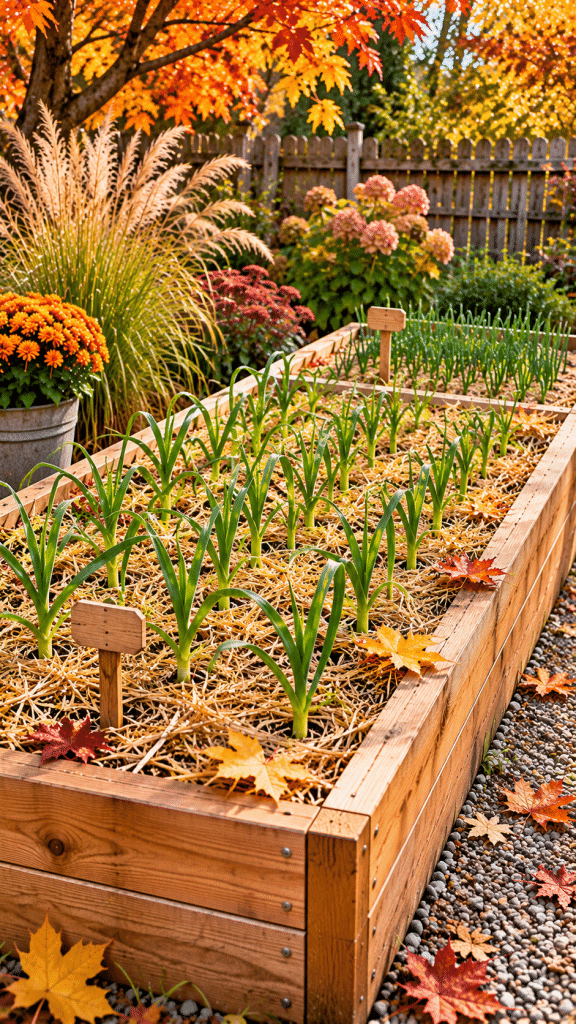
Imagine a beautifully prepared rectangular bed filled with loose, fertile soil.
Garlic cloves are planted in evenly spaced rows beneath a protective mulch layer.
Small garden markers identify different varieties.
The bed remains neat and purposeful during autumn, quietly supporting root development beneath the surface.
🧄 An overwintering garlic bed transforms an otherwise unused autumn growing space into a long-term harvest investment.
This approach is ideal for gardeners who enjoy planning ahead and want to develop a more continuous annual crop schedule.
Choose Garlic Varieties That Match Your Climate
Garlic varieties are commonly divided into two broad categories: hardneck and softneck.
Hardneck garlic often performs well in climates with colder winters and typically produces a flowering stalk known as a scape.
Softneck garlic is widely grown in milder regions and is often valued for its storage potential.
However, performance varies among individual cultivars, and local adaptation matters more than category alone.
Choose planting stock sold specifically for gardening when possible.
Certified or reputable disease-free planting material can reduce the risk of introducing persistent diseases into the growing area.
Ordinary grocery-store garlic is not always suitable for planting because its identity, health status, and storage treatment may be uncertain.
For a dedicated raised bed, consider choosing two locally appropriate varieties.
This allows gardeners to compare growth habits, harvest timing, and storage performance.
🌿 Growing well-adapted garlic is more rewarding than choosing an unusual variety that struggles in the local climate.
Plant Garlic at the Correct Autumn Timing
Planting time depends heavily on local climate.
In many temperate areas, garlic is planted during fall, often several weeks before the ground becomes consistently frozen.
The goal is to encourage root establishment without promoting excessive tender top growth before harsh winter weather.
Separate the bulbs into individual cloves shortly before planting.
Select healthy cloves and orient them with the pointed end upward.
A common planting depth is approximately two to three inches, measured from the soil surface to the top of the clove, although local growing guidance may recommend adjustments.
Space cloves approximately four to six inches apart, with enough distance between rows for mature bulb development and maintenance.
Larger cultivars may need additional space.
Firm the soil gently around each clove and water as needed to establish good soil contact.
The exact fall planting schedule should be based on regional extension advice rather than a single universal calendar date.
Design a Dedicated Garlic Raised Bed With Organized Rows
One of the greatest advantages of a dedicated garlic bed is simplicity.
Because garlic occupies the growing space for an extended period, clearly defined rows and planting zones make maintenance easier.
A compact bed can accommodate multiple rows, provided the plants have adequate spacing.
For example, a four-foot-wide bed might contain several rows arranged across its width, with the final number determined by variety size and access requirements.
Keep different cultivars grouped together and labeled.
This helps you observe differences in spring emergence, vigor, and eventual harvest dates.
Do not plant garlic too close to the bed edges if the surrounding material creates unusual heat or moisture conditions.
If the bed is exposed to strong winds, consider a sheltered but sunny location.
Garlic generally benefits from a site with good drainage and adequate sunlight during its active growing season.
An orderly layout also makes it easier to remove weeds without disturbing developing bulbs.
📐 Consistent spacing and clear labels make a garlic bed feel like a carefully managed miniature vegetable farm.
Protect Overwintering Garlic With Organic Mulch
After planting, apply a suitable organic mulch where recommended for the local climate.
Clean straw or shredded leaves can help moderate soil temperature fluctuations and reduce weed pressure.
Mulch is particularly useful in regions where repeated freezing and thawing may disturb the soil.
However, moisture conditions matter.
A thick, continuously waterlogged mulch layer can create problems in poorly drained locations.
Use an appropriate depth and monitor the bed during prolonged wet weather.
In spring, check whether young shoots are emerging successfully.
If mulch is excessively dense, move it aside enough to avoid restricting new growth.
The objective is to protect the planting area while allowing plants to develop normally.
Add Overwintering Onions Where Climate Allows
Garlic is not the only allium that can be planted during autumn.
In suitable climates, certain onion varieties can also be established for overwintering.
However, onion performance depends strongly on cultivar, temperature, and day-length requirements.
Not every onion variety is suitable for fall planting.
A gardener in a mild-winter region may have very different planting options from someone experiencing prolonged frozen conditions.
If overwintering onions are appropriate locally, allocate a separate section of the raised bed.
This allows different crops to receive suitable spacing and management.
Avoid overcrowding garlic with onions simply to fill every available space.
Both crops require sufficient resources to develop properly.
A dedicated allium bed should prioritize healthy growth rather than maximum plant density.
Plan for Harvest and the Next Growing Cycle
The rewards of autumn garlic planting become more visible during spring.
As temperatures warm, established plants resume active growth.
Hardneck varieties may produce scapes that can be removed and used in cooking.
Bulb harvest generally occurs later, when the crop reaches its appropriate maturity stage.
Harvest timing varies with variety, region, and seasonal conditions.
After lifting the bulbs, cure and store them according to appropriate garlic-handling guidance.
Once the bed is cleared, consider how it will be used for the remainder of the growing season.
Depending on harvest timing and climate, it may be suitable for a later crop, soil-building cover crop, or another carefully planned planting.
Avoid repeatedly growing garlic, onions, and related alliums in the same soil without considering crop rotation and disease history.
🌱 A dedicated autumn garlic bed is especially valuable because it encourages gardeners to think beyond one season and plan the garden as a continuous cycle.
How to Choose the Best Fall Raised Bed Garden Idea for Your Backyard
The right raised bed concept depends on what you want the garden to accomplish.
If fresh vegetables are your main priority, a protected harvest tunnel provides a practical growing system.
If the summer garden has already exhausted your time and attention, a no-dig soil renewal bed offers a simpler approach that supports future planting.
If you enjoy growing crops across multiple seasons, an overwintering garlic bed creates a clear long-term project.
These approaches do not have to compete.
In a garden with three raised beds, each can fulfill a separate role.
One bed can produce cool-season greens.
Another can rest beneath compost and shredded leaves.
The third can contain garlic planted for next year’s harvest.
This arrangement establishes a useful balance between immediate food production, soil improvement, and long-term crop planning.
For a smaller backyard with only one raised bed, the same principles can be applied across different years or growing periods.
One autumn might focus on cold-season vegetables.
The following autumn could prioritize soil restoration.
The best strategy is the one that matches your available time, climate, and realistic gardening goals.
Essential Materials for a Successful Autumn Raised Bed Garden
A productive fall raised bed garden does not require an enormous collection of specialized equipment.
The most valuable materials are those that solve specific gardening problems.
| Material | Main Function | Best Application |
|---|---|---|
| Frost cloth or horticultural row cover | Reduce frost and wind exposure | Protected harvest tunnel |
| Flexible hoops and secure fittings | Support a temporary protective structure | Protected harvest tunnel |
| Finished compost | Add suitable organic matter | Soil renewal and bed preparation |
| Shredded untreated leaves | Protect exposed soil | Soil renewal and garlic mulch |
| Clean straw | Provide seasonal soil cover | Overwintering garlic |
| Garden labels | Identify crops and varieties | Harvest beds and garlic beds |
| Soil thermometer | Monitor growing conditions | Cold-season planting decisions |
| Soil test kit or laboratory analysis | Evaluate fertility and pH | Long-term soil management |
Purchasing every item is unnecessary.
Begin with the materials needed for the specific raised bed design you select.
A simple, well-maintained garden is often more productive than an elaborate system with components that are difficult to inspect or maintain.
Common Fall Raised Bed Gardening Mistakes to Avoid
One common mistake is waiting too long to plant autumn vegetables.
As daylight decreases and temperatures fall, plant growth may slow substantially.
Even cold-hardy crops need enough time to establish before severe weather arrives.
Gardeners sometimes assume that installing a frost cover will compensate for planting weeks too late.
Protective covers can improve growing conditions, but they cannot fully replace lost daylight or guarantee rapid growth.
Another mistake is neglecting soil moisture.
Raised beds may drain efficiently, but their growing medium can also dry more quickly than surrounding ground.
Autumn rainfall does not necessarily keep every raised bed adequately moist, particularly beneath protective structures.
Check soil conditions instead of relying entirely on the weather forecast.
Overusing compost is another potential problem.
A raised bed does not require unlimited additions of rich organic material.
Nutrients should be managed according to crop needs and soil conditions.
Heavy applications of manure-rich compost may create imbalances rather than improvements.
Poor ventilation inside protective tunnels can also cause difficulties.
Excessive humidity and heat can damage plants or encourage disease.
Make ventilation part of the normal maintenance routine.
Finally, avoid leaving bare soil exposed unnecessarily after summer harvests.
Where appropriate, organic mulch, suitable cover crops, or carefully managed winter plantings can protect soil from erosion and support longer-term garden health.
How to Create a Simple Fall Raised Bed Garden Maintenance Routine
A successful autumn garden becomes much easier to manage when seasonal tasks are organized into a predictable routine.
During early fall, evaluate which summer crops have finished producing.
Remove unsuitable plant debris and decide which beds will continue growing vegetables.
Prepare any raised beds that need additional compost or soil amendments.
Plant cool-season vegetables according to your local first-frost date and the maturity requirements of the selected varieties.
As autumn progresses, begin monitoring nighttime temperatures more closely.
Install protective tunnel components before severe weather makes outdoor construction difficult.
Check cover attachments after windy conditions.
Continue inspecting soil moisture beneath protective materials.
For resting beds, maintain an even protective mulch layer and replace material that has blown away if necessary.
For garlic beds, confirm that the planting area drains properly and that mulch is not creating excessively wet conditions.
During winter, the maintenance schedule may become less demanding, but periodic inspections remain valuable.
Look for wind damage, collapsed covers, drainage problems, and signs that crops require attention.
When spring approaches, review which methods performed well.
This helps refine the design for the next gardening season.
🌿 Consistent observation is often more valuable than complicated gardening techniques.
Frequently Asked Questions About Fall Raised Bed Garden Ideas
What Is the Best Vegetable to Grow in a Fall Raised Bed?
There is no single vegetable that is best for every location.
Kale, spinach, mâche, and several Asian greens are popular cool-season choices because they tolerate conditions that are less suitable for many summer vegetables.
However, the best selection depends on the climate, planting date, available sunlight, and expected winter temperatures.
In mild climates, gardeners may have a broad selection of autumn crops.
In colder regions, the priority may be establishing hardy vegetables early enough to harvest before or during the onset of winter.
Should Raised Beds Be Covered During Fall?
Raised beds do not always need protective covers.
Cool-season plants can grow successfully without tunnels during favorable weather.
Covers become useful when frost, wind, or cold temperatures threaten sensitive or developing crops.
Empty raised beds may benefit from organic mulch to protect exposed soil.
The appropriate covering method depends on whether the bed contains living plants or is being prepared for the following season.
Can You Start a New Raised Bed Garden in Autumn?
Yes, autumn can be a good time to establish a new raised bed.
It provides an opportunity to prepare the site, install the structure, and organize the growing medium ahead of spring.
Choose a location with appropriate sunlight, drainage, and water access.
Avoid working saturated soil or creating conditions that direct excess water toward nearby buildings.
A newly constructed bed can also benefit from time for its growing medium to settle before intensive planting begins.
How Deep Should a Fall Raised Bed Be?
The ideal depth depends on the crops, the condition of the underlying soil, and whether the bed sits directly on the ground or on a hard surface.
Relatively shallow raised structures can work well when plant roots are able to grow into suitable native soil beneath them.
Beds installed over pavement generally require greater attention to total rooting depth, drainage, and growing medium volume.
Always match the bed design to the crops being grown rather than choosing a height based only on appearance.
Is It Better to Leave a Raised Bed Empty During Winter?
Leaving a raised bed unplanted is not necessarily harmful, but leaving its soil completely bare may expose it to erosion and weather-related deterioration.
A resting bed can be covered with appropriate organic mulch.
Alternatively, suitable winter cover crops or overwintering vegetables may be grown where local conditions allow.
The best approach depends on your soil management goals and future planting schedule.
Can Garlic and Leafy Vegetables Grow in the Same Raised Bed?
They can share a raised bed in some circumstances, but their growing habits and schedules must be considered carefully.
Garlic often occupies the growing space from autumn into the following summer.
Short-season leafy vegetables may be harvested earlier, but dense planting can create unwanted competition.
For beginners, separate growing sections are generally easier to manage.
How Can I Make a Small Fall Raised Bed Garden More Productive?
Begin by selecting one clear purpose for the bed.
Choose suitable crops, plan realistic planting dates, and avoid unnecessary overcrowding.
Use the growing space efficiently while preserving access for maintenance.
Consider seasonal protection only when it provides a genuine benefit.
After harvesting, prepare the soil for the next planting rather than leaving the bed neglected for months.
A small raised bed with thoughtful seasonal planning can provide considerable value.
Final Thoughts on the Best 3 Fall Raised Bed Garden Ideas
The most rewarding fall gardens are not necessarily the largest or most expensive.
They are the gardens designed to make intelligent use of changing seasonal conditions.
A carefully planned raised bed can provide fresh vegetables during cool weather, develop healthier soil while resting, or support crops that mature during the following year.
🥇 Protected Cool Season Harvest Beds are ideal for gardeners who want to continue enjoying fresh homegrown vegetables as autumn temperatures decline. Their removable tunnels add useful flexibility and can extend harvesting opportunities when properly managed.
🥈 No Dig Autumn Soil Renewal Beds provide an effective way to protect exposed growing soil while incorporating appropriate organic materials. Their simple maintenance requirements make them particularly attractive after a demanding summer season.
🥉 Overwintering Garlic and Allium Beds introduce a rewarding long-term dimension to gardening. By establishing suitable crops during autumn, gardeners can begin preparing for a productive harvest in the following growing season.
The greatest advantage comes from understanding that these ideas serve different purposes.
One emphasizes harvesting.
Another emphasizes regeneration.
The third emphasizes seasonal continuity.
Together, they demonstrate how an ordinary collection of raised garden beds can become a more thoughtful and productive growing system.
🍂 Beautiful fall raised bed gardening is about more than what your garden looks like in autumn. It is about what your garden can produce, protect, and prepare for every season that follows.
With well-chosen crops, healthy growing soil, practical protective structures, and consistent seasonal care, even a modest backyard can become an inviting garden filled with purpose.
And when spring eventually returns, the benefits of thoughtful autumn preparation become unmistakable through healthier growing spaces, established crops, and a garden ready for another rewarding year of cultivation.