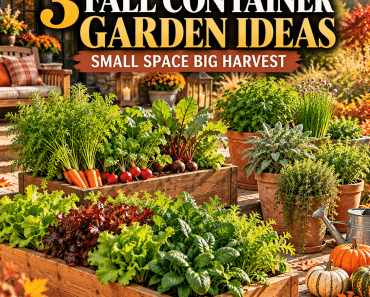
Fall Garden Bed Ideas can completely transform an ordinary backyard into a beautifully organized autumn landscape filled with architectural charm, natural textures, and inviting seasonal character. While many gardeners focus on colorful flowers and decorative pumpkins during autumn, the secret to a truly impressive garden often lies beneath those seasonal decorations. The shape, structure, edging, elevation, and arrangement of garden beds can make an outdoor space feel dramatically more sophisticated without requiring an expensive landscape renovation.

🍂 A beautifully designed fall garden bed is more than a place to grow plants. It is an architectural feature that brings structure, personality, and lasting beauty to the entire backyard.
Autumn presents a wonderful opportunity to reconsider how garden beds interact with surrounding lawns, pathways, patios, fences, and outdoor living areas. Cooler weather can make outdoor projects more comfortable, while the changing landscape reveals areas that need stronger structure, improved planting arrangements, or more intentional design.
The most attractive garden beds balance practical gardening requirements with thoughtful landscape design. Their boundaries are clearly defined, their materials complement the surrounding home, and their proportions make the space feel organized rather than overcrowded.
Some garden beds become stunning focal points through elegant raised construction. Others use curved boundaries to soften rigid backyard architecture. A third approach combines several planting levels to create visual depth and beautiful transitions between different outdoor areas.
These Best 3 Fall Garden Bed Ideas explore three distinctive structural designs that can turn even a relatively simple backyard into a sophisticated autumn retreat.
Rather than focusing on temporary flower arrangements, these ideas emphasize permanent or semi-permanent garden bed features that remain beautiful through changing seasons.
Why Fall Garden Bed Ideas Can Transform an Ordinary Backyard
A garden bed influences far more than the appearance of the plants growing inside it.
Its position determines how people move through the yard. Its boundaries shape the visual relationship between planted areas and open spaces. Its height affects drainage, accessibility, and planting opportunities. Even the materials used along its edges can establish a completely different atmosphere.
For example, a low rectangular bed framed with natural stone can introduce a clean, architectural appearance to a contemporary home.
A softly curved bed edged with weathered bricks can create a romantic cottage garden atmosphere.
Meanwhile, several raised planting sections connected by small pathways can make a compact backyard feel surprisingly spacious and professionally designed.
🏡 The strongest fall garden bed designs begin with layout and structure before considering seasonal planting.
This approach also makes future garden maintenance easier.
Clearly defined beds reduce confusion between planting areas and walking surfaces. Raised edges help contain soil and mulch. Accessible pathways make watering, planting, and weeding more convenient.
Well-planned beds can also help gardeners manage difficult soil conditions. Raised structures allow greater control over the growing medium, while carefully located ground-level beds can take advantage of existing soil and natural drainage.
However, these benefits depend on correct construction, suitable materials, and thoughtful plant placement.
A beautiful garden bed should not merely look impressive in photographs. It should also function comfortably throughout the year.
Best 3 Fall Garden Bed Ideas at a Glance
Before choosing a design, consider the available space, surrounding architecture, preferred materials, and amount of maintenance you are comfortable performing.
The following comparison highlights three different approaches to creating distinctive autumn garden beds.
| Fall Garden Bed Design | Best For | Main Materials | Design Character | Main Advantage |
|---|---|---|---|---|
| 🥇 Sculptural Natural Stone Raised Beds | Contemporary and luxury-inspired backyards | Natural stone, masonry, gravel | Architectural and sophisticated | Strong visual structure and defined planting zones |
| 🥈 Curved Brick Garden Beds | Cottage gardens and traditional homes | Clay bricks, organic mulch, natural edging | Romantic and welcoming | Softens hard landscaping and creates natural movement |
| 🥉 Tiered Timber Garden Beds | Sloped yards and compact spaces | Durable timber, drainage gravel, suitable hardware | Rustic modern and functional | Makes effective use of different elevations |
Each option offers a different way to transform unused lawn, neglected planting spaces, or awkward backyard corners.
The best design is not necessarily the largest or most expensive.
A smaller, carefully proportioned garden bed can look more impressive than an oversized structure that overwhelms the surrounding landscape.
The goal is to create a composition that feels intentional, balanced, and naturally connected to the home.
🥇 Best 1 Fall Garden Bed Ideas With Sculptural Natural Stone Raised Beds
Natural stone raised beds are among the most sophisticated choices for homeowners who want their autumn garden to feel permanent, elegant, and architecturally impressive.
Unlike temporary seasonal planting arrangements, a stone-framed garden bed becomes a defining landscape feature that can remain attractive even when its plants are dormant.
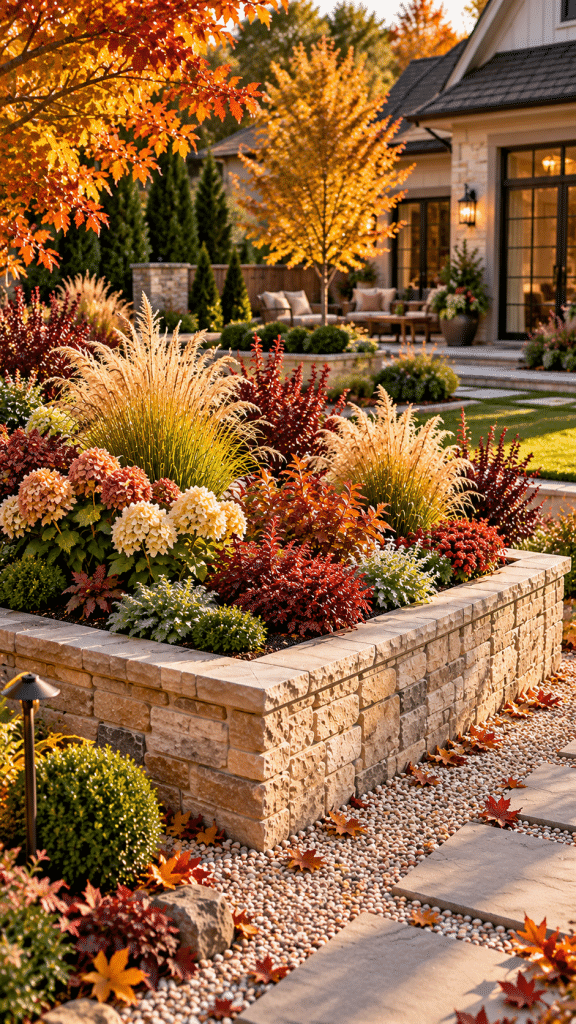
Imagine a beautiful backyard with warm beige limestone garden walls, carefully defined rectangular planting spaces, and narrow gravel pathways separating each section.
The stone surfaces have subtle natural variations, while the raised planting areas create crisp architectural lines against the softer textures of the surrounding landscape.
In autumn, fallen golden leaves and warm afternoon sunlight enhance the stone’s natural character.
✨ The result is a garden that feels like an extension of a professionally designed luxury residence rather than a collection of ordinary planting areas.
This concept works especially well in contemporary homes, modern farmhouse gardens, sophisticated courtyard landscapes, and properties with natural stone patios.
The key is to treat the raised beds as permanent design elements.
Their proportions, construction, placement, and finishes should receive as much attention as the plants growing inside them.
Design Rectangular Stone Garden Beds With Elegant Proportions
Rectangular shapes are particularly effective in natural stone garden bed design because they create a strong sense of order.
A series of identical rectangles can make the garden feel organized and visually balanced.
However, perfect repetition is not always necessary.
One larger central bed can be complemented by two narrower planting sections, creating a composition with more visual rhythm.
For example, a backyard could feature a raised bed approximately eight feet long and four feet wide, positioned parallel to a patio.
Two smaller beds could extend along nearby boundaries, repeating the same stone material while adapting their dimensions to available space.
The four-foot width is especially practical when the planting area can be reached from both sides, allowing many gardeners to work comfortably without stepping into the soil.
For beds accessible from only one side, a narrower width is generally more convenient.
📐 Beautiful proportions should always support comfortable access.
A garden bed that is too wide may look impressive initially but become frustrating when plants need pruning, watering, or seasonal maintenance.
Consider the viewing angle as well.
Beds placed near patios may look best with their longer sides parallel to the seating area. Beds positioned along a narrow side yard can appear more harmonious when their dimensions follow the direction of the walkway.
Avoid placing large rectangular beds randomly across the lawn.
Instead, align them with architectural features such as exterior walls, patio edges, fences, or existing paving patterns.
This simple design principle can create a cohesive appearance that feels considerably more expensive.
Choose Natural Stone Finishes That Complement Autumn Colors
Stone selection has an enormous influence on the finished garden.
Warm limestone creates a soft, understated appearance that blends beautifully with beige walls, natural wood, and muted autumn foliage.
Sandstone introduces additional texture and natural color variation, making it particularly suitable for rustic contemporary landscapes.
Gray granite creates a stronger contrast and can look striking beside modern architecture.
Weathered fieldstone offers a more traditional appearance, especially when the stone pieces have varied shapes and irregular surfaces.
The best choice depends on the surrounding property.
A contemporary home with white walls and black window frames may benefit from clean-lined gray stone.
A cottage-style residence with timber details may look more harmonious with warm sandstone or irregular natural stone.
🤎 For a luxurious autumn atmosphere, consider stone colors that connect naturally with bronze, taupe, rust, cream, and earthy brown.
Avoid mixing too many unrelated stone finishes in one small space.
A garden with limestone raised beds, red brick pathways, gray concrete edging, and several different gravel colors may feel visually fragmented.
Instead, select one dominant material and use a complementary secondary finish.
A restrained combination of warm stone walls and neutral gravel often produces a more sophisticated result.
Create Beautiful Gravel Pathways Between Raised Beds
The empty spaces between garden beds are just as important as the beds themselves.
Gravel pathways provide a useful visual contrast to solid stone walls while establishing convenient access for planting and maintenance.
A narrow path between two raised beds can create a beautifully ordered garden composition.
For comfortable everyday use, a pathway around three feet wide is often a useful starting point, although accessibility needs and garden equipment may require more space.
Choose angular, compactable gravel rather than highly rounded decorative pebbles when stable walking surfaces are important.
A properly prepared base helps reduce shifting, unevenness, and muddy conditions.
For an elegant appearance, select gravel colors that complement the raised bed material.
Warm beige stone looks beautiful beside pale buff gravel. Dark gray masonry can pair well with muted gray aggregate.
The overall effect should be calm and coordinated.
Pathways can also define the garden’s geometry.
Instead of creating several disconnected walking surfaces, connect the planting beds through one clear circulation pattern.
This makes the backyard feel intentional and encourages people to explore the landscape.
Add Architectural Planting Without Overcrowding the Stone Beds
A sculptural raised bed does not need an excessive number of plants to feel beautiful.
In fact, overly dense planting can conceal the stonework that makes the design distinctive.
Choose a restrained selection of plants with contrasting heights, foliage shapes, and seasonal characteristics.
Compact shrubs can establish permanent structure.
Low-growing perennials can soften the inner edges.
A few carefully positioned grasses or other upright plants can introduce movement without overwhelming the stone boundaries.
The goal is to create a balanced relationship between vegetation and construction.
Allow portions of the stone walls to remain clearly visible.
This gives the garden visual breathing room.
🌿 A simple planting scheme often looks more sophisticated when each plant has enough space to reach its mature size.
Consider the mature dimensions of every species rather than judging spacing only by the size of nursery plants.
Planting too closely may create immediate fullness, but it can lead to competition, excessive pruning, and crowded growth in later seasons.
When choosing plants for autumn installation, pay attention to local climate requirements and the expected first hard frost.
Not every plant establishes successfully when installed late in the season.
Construct Stone Raised Beds for Long Term Durability
Stone raised beds can be relatively permanent structures, so construction quality matters.
Unlike lightweight decorative borders, raised stone walls may need to resist substantial outward pressure from soil.
Their stability depends on the wall’s height, material, foundation, drainage, and construction method.
Short, properly designed retaining structures can sometimes use compatible segmental masonry systems.
Taller installations or heavy masonry walls may require engineered foundations, reinforcement, and professional construction.
Avoid assuming that loosely stacked decorative stones are suitable for every raised bed height.
Drainage is equally important.
Excess water trapped behind a masonry wall can create pressure, contribute to frost-related damage, or gradually weaken the structure.
Where appropriate, incorporate drainage aggregate, outlets, and other construction details suitable for the site.
It is also important to protect nearby building foundations.
Do not direct garden drainage toward the house or create planting beds that trap moisture against exterior walls.
Important Note: Before constructing permanent raised garden beds, assess natural drainage, soil conditions, wall height, and local frost requirements. Stone walls that retain significant soil loads may require engineered construction, while newly installed plants need sufficient time to establish before severe freezing weather.
With appropriate planning, natural stone raised beds can deliver a refined appearance that remains attractive long after the autumn season ends.
🥈 Best 2 Fall Garden Bed Ideas With Romantic Curved Brick Borders
Curved brick garden beds create a completely different atmosphere from geometric stone structures.
Where rectangular raised beds emphasize precision and architectural order, curved brick borders introduce softness, movement, and a sense of established garden character.
This design is particularly effective in traditional backyards, cottage gardens, farmhouse landscapes, and properties with older brick architecture.
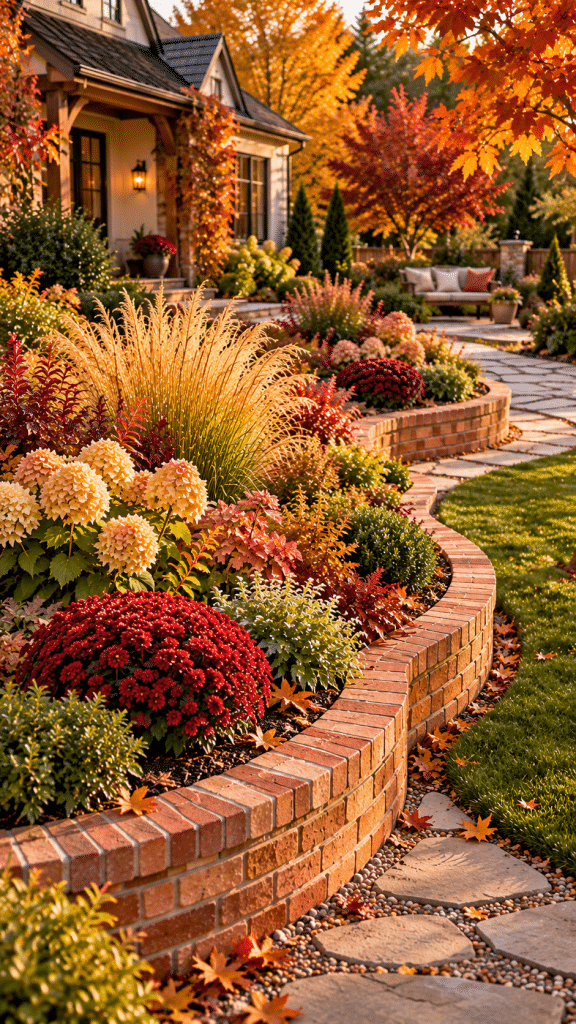
Imagine a beautiful autumn lawn surrounded by a flowing brick-edged planting bed.
The border follows a graceful curve rather than a rigid straight line.
Weathered clay bricks create a warm transition between the grass and planted area, while the bed’s organic shape guides the eye toward a quiet garden corner.
Golden leaves gather naturally near the edges, creating an inviting seasonal atmosphere.
🍁 Curved brick edging makes a garden feel relaxed and romantic while maintaining the structure needed for a polished landscape.
The most appealing version of this design is neither excessively formal nor completely irregular.
Instead, it balances gentle curves with carefully defined boundaries.
Create Flowing Garden Bed Shapes That Feel Natural
The foundation of this design is the shape of the planting area.
A beautifully curved bed should feel like a deliberate part of the landscape, not an accidental patch of soil.
Start by observing the existing lawn.
Identify areas where straight edges make the garden feel rigid or disconnected.
Corners near fences, the edges of patios, and spaces beneath established shrubs may benefit from a more organic planting boundary.
A gently curved bed can soften the transition between a rectangular patio and an open lawn.
It can also transform an awkward corner into a more attractive garden feature.
One effective method is to create a broad sweeping curve using a flexible garden hose or rope as a temporary outline.
Move the hose until the shape looks balanced from the most important viewing positions.
For many gardens, one generous curve looks better than several small, tightly alternating bends.
Excessive waves can make a bed appear visually busy and create awkward areas for mowing.
📐 Aim for gentle movement rather than complicated decoration.
The bed should be wide enough to support meaningful planting depth and accommodate mature plants.
A very narrow curved strip may look attractive immediately after construction but can become difficult to maintain as plants expand.
Where space allows, a deeper bed creates more opportunity for varied plant heights and a balanced composition.
Use Weathered Clay Bricks for Timeless Autumn Character
Traditional clay bricks are particularly attractive in fall landscapes because their natural colors connect beautifully with seasonal surroundings.
Muted terracotta, warm red, soft brown, and weathered orange all complement autumn foliage.
Reclaimed bricks can introduce additional character through subtle variations in tone and texture.
However, reclaimed materials should be evaluated for outdoor durability.
Some older bricks are not suitable for repeated exposure to freezing and thawing.
For colder climates, choose units rated for the intended landscape application.
Brick installation also requires careful attention.
Bricks laid flat can establish a broad, understated edge.
Bricks installed vertically can create a more pronounced boundary, while certain manufactured edging systems allow graceful curves with consistent joints.
The choice depends on the desired appearance and installation conditions.
For curved designs, small gaps and changes in alignment must be managed carefully.
Loose bricks placed directly on unprepared soil may shift over time.
A properly compacted foundation and suitable edge restraint can improve stability.
🧱 The most expensive-looking brick garden borders are often those with simple construction patterns and consistent alignment.
Avoid using too many decorative brick arrangements in a compact backyard.
A restrained border can make the plants and surrounding landscape appear more refined.
Connect Curved Garden Beds to Existing Backyard Features
One of the strongest advantages of curved brick borders is their ability to visually connect separate areas of the garden.
A curved bed can begin near a patio, continue along a lawn, and gradually widen toward a fence.
This creates a natural transition without requiring extensive new construction.
The shape can also guide attention toward a destination.
For example, a garden bed might curve gently around a small seating area.
Rather than creating a rigid rectangular enclosure, the planting boundary creates a soft, inviting edge.
Another possibility is to use a curved bed along the perimeter of a small backyard.
The organic shape can make a straight fence feel less visually dominant.
It also creates an opportunity to introduce planting depth without dividing the yard into too many separate spaces.
When creating the layout, consider how the lawn will be maintained.
Curves should be wide enough for convenient mowing and edging.
Very tight corners can become difficult to maintain and may require additional trimming.
A garden that looks beautiful but creates unnecessary maintenance problems is rarely a successful long-term design.
Create a Beautiful Transition Between Lawn and Garden Bed
A curved brick border is most effective when the edge between lawn and planting soil is clearly managed.
Without proper separation, grass can gradually spread into the planting bed.
Likewise, loose mulch may move onto the lawn during heavy rain or routine maintenance.
A defined brick edge helps create a visually clean boundary.
The exact edging arrangement depends on the surrounding ground levels.
Some designs use flush brick edging that allows lawnmower wheels to pass over the surface.
Others incorporate a slightly raised edge for a stronger visual statement.
Flush edging often works particularly well in traditional lawns because it creates a neat appearance while making mowing easier.
Raised edging may be more suitable where soil or mulch needs additional containment.
However, it can complicate mowing if the transition is too abrupt.
Choose the detail that best suits the garden’s maintenance requirements.
The planting surface should also be graded appropriately to avoid directing runoff onto nearby patios or building foundations.
A subtle slope may be nearly invisible, but it can make a substantial difference to how the bed performs during heavy rainfall.
Layer Natural Materials for a Sophisticated Cottage Garden Look
Although brick provides the main structure, surrounding materials determine the overall atmosphere.
Organic mulch can create a soft visual contrast against the defined brick edge.
Shredded leaves, composted leaf mulch, and suitable bark products may help protect soil and reduce weed growth.
A natural brown mulch usually complements traditional clay brick better than highly contrasting artificial-looking colors.
Avoid piling mulch directly against plant crowns, woody stems, or tree trunks.
Instead, maintain a small clear area around vulnerable plant bases.
This allows better airflow and reduces the risk of excessive moisture accumulation.
The curved bed can also incorporate carefully selected permanent features.
A simple stone birdbath, small timber bench, or understated garden ornament can create an attractive focal point.
However, these decorative elements should not dominate the design.
A single meaningful feature often feels more elegant than several unrelated accessories.
🤎 Think of the bed as a beautiful frame around a calm garden composition.
The brick edging provides structure, the planting creates softness, and the surrounding materials establish seasonal character.
Together, these elements produce a garden that feels welcoming and established.
Make Curved Brick Beds Feel Beautiful in Small Backyards
Curved garden beds are especially useful in small outdoor spaces because they can soften the appearance of rectangular boundaries.
A compact backyard often contains many straight lines.
Fences, exterior walls, patios, and narrow walkways may all follow rigid geometric patterns.
Introducing one well-positioned curved bed creates a welcome contrast.
However, the curve should not consume excessive lawn space.
In smaller gardens, consider concentrating the curved bed along one perimeter rather than surrounding the entire yard with several planting strips.
This preserves a useful central area.
Another effective approach is to make the bed gradually wider toward a corner.
The broader section can accommodate a larger structural plant, while narrower areas maintain continuity along the fence.
This creates variation without requiring a complicated shape.
The result feels intentional and spacious.
A carefully planned curved garden bed can make an ordinary backyard appear warmer, more mature, and considerably more inviting.
🥉 Best 3 Fall Garden Bed Ideas With Tiered Timber Structures and Multi Level Planting
Tiered timber garden beds are an excellent choice for homeowners who want to introduce visual depth while making practical use of limited or uneven outdoor space.
This design combines multiple planting elevations into one coordinated landscape feature.
Instead of presenting the entire garden as a flat surface, it introduces clearly defined levels that create depth and architectural interest.
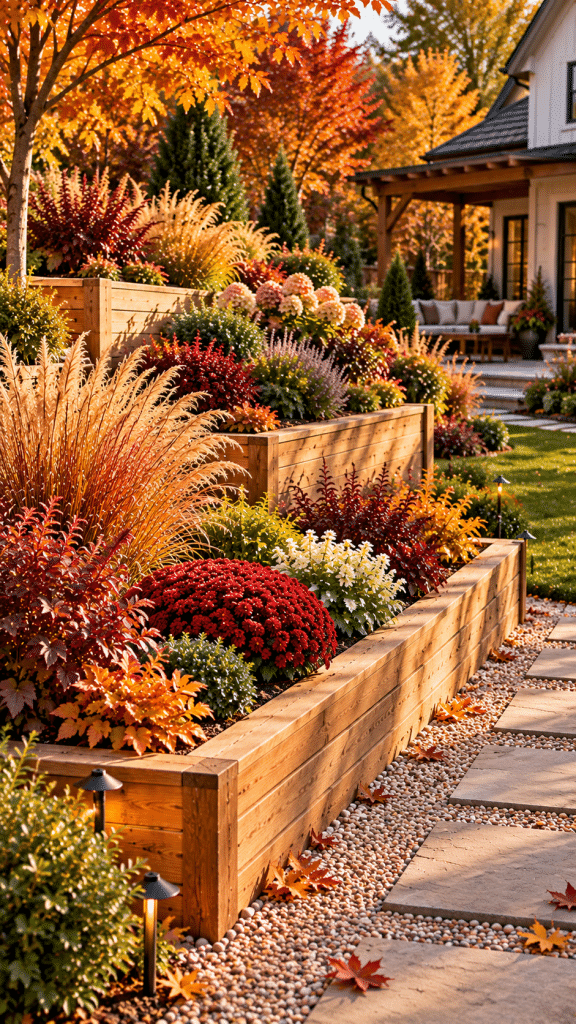
Imagine a backyard where three timber-framed planting sections rise gradually along a gentle slope.
The lowest bed sits near a gravel walkway.
A second planting level rises behind it, while a third, slightly elevated section completes the composition near the fence.
The timber has a warm natural finish that complements autumn leaves and earthy planting materials.
The result feels rustic but polished.
🌾 Tiered garden beds make planting space feel dimensional, organized, and visually interesting without requiring elaborate decoration.
This approach can work in sloping backyards, narrow side gardens, and compact outdoor spaces.
It is particularly effective when constructed with consistent materials and carefully planned proportions.
Design Multiple Garden Bed Levels for Beautiful Visual Depth
The first step is to decide how many planting levels the garden actually needs.
Three levels may create an attractive composition, but they are not necessary in every space.
A small backyard might benefit from only two elevations.
A larger sloping garden could accommodate several broader tiers.
The goal is to create a comfortable progression of heights rather than an overwhelming wall of timber.
In a relatively flat yard, individual raised beds can be constructed at different heights without creating major changes to the surrounding ground.
For example, three adjacent raised planting structures might have wall heights of approximately 12, 18, and 24 inches.
These are illustrative design dimensions rather than universal construction recommendations.
The correct dimensions depend on planting requirements, accessibility, soil loads, and structural design.
On a sloped property, tiered beds may function as retaining structures.
This creates additional engineering considerations, especially when the walls support substantial soil loads or sit near buildings.
Never assume that ordinary decorative timber boards can safely retain large amounts of earth.
For taller tiers, complex slopes, or unstable soil, professional landscape design and structural guidance may be necessary.
📐 A well-proportioned tiered garden should feel like a series of connected planting spaces rather than a steep stack of boxes.
Allow adequate room between levels for safe access.
Avoid narrow steps, unstable surfaces, or awkward corners that make gardening difficult.
Choose Durable Timber for Outdoor Raised Garden Beds
Wood introduces warmth and natural character that can be difficult to achieve with some manufactured landscape materials.
Its visible grain and earthy tones complement the atmosphere of autumn particularly well.
However, timber selection is essential because garden bed walls are repeatedly exposed to moisture, soil, and changing weather conditions.
Naturally durable species may offer better resistance to decay, although performance varies by species, grade, climate, and installation details.
Cedar is a popular option in many regions.
Other locally available durable woods may also be suitable.
Some gardeners choose pressure-treated lumber intended for ground-contact applications.
When doing so, use products approved for the intended purpose and follow the manufacturer’s guidance, particularly for edible planting areas.
Untreated wood can be an option, but its lifespan may be shorter where moisture and soil contact are constant.
Wood should not be selected based on appearance alone.
Consider its durability, sourcing, cost, available dimensions, and maintenance requirements.
For a refined rustic-modern appearance, choose boards with relatively consistent widths.
Strong horizontal lines make a tiered structure feel orderly.
Visible hardware can be used intentionally, but excessive brackets and unrelated fasteners may make the design appear unfinished.
🪵 The best timber raised beds balance natural texture with clean, carefully constructed edges.
A restrained finish often looks more expensive than a heavily decorative one.
Build Tiered Garden Beds With Proper Support and Drainage
Timber raised beds contain substantial amounts of soil, especially when filled deeply.
Wet soil can exert significant pressure on the walls.
For this reason, structural support must match the bed dimensions.
Corners require secure connections.
Long walls may need additional bracing or support posts to prevent bowing.
Fasteners should be suitable for outdoor exposure and compatible with the chosen timber treatment.
Drainage is equally important.
Beds built over naturally draining soil may allow excess water to move downward, provided the underlying ground has not been excessively compacted.
Structures installed over concrete, rock, or impermeable surfaces require special drainage planning.
On sloped sites, runoff must be carefully managed so that one level does not overwhelm the next.
Water should not become trapped behind timber walls.
Where appropriate, drainage aggregate, outlets, or professionally designed systems may be needed.
Poor drainage can damage the structure and create unsuitable growing conditions.
Additionally, beds should not be constructed in a way that directs water toward nearby foundations or neighboring properties.
A successful tiered garden requires more than attractive carpentry.
Its drainage and support systems are essential to long-term performance.
Arrange Planting Spaces to Emphasize the Different Levels
Once the timber structures are complete, the planting arrangement can strengthen their visual effect.
The most important principle is maintaining a clear relationship between plant size and bed elevation.
Plants in the uppermost bed do not necessarily need to be the tallest.
Because the bed itself is already elevated, very tall vegetation may create an unbalanced appearance.
Compact shrubs, medium-height perennials, and controlled foliage forms often work well in higher sections.
Lower beds can accommodate plants that remain visible from nearby pathways.
The arrangement should also consider sunlight.
A higher structure can cast shadows onto beds below it, especially when the garden receives low-angle autumn sunlight.
Observe how sunlight moves across the site before finalizing the planting plan.
Plants with similar moisture and exposure requirements should be grouped together where practical.
This simplifies watering and seasonal maintenance.
🌿 The goal is to make each planting level visually distinct while allowing the entire structure to read as one coordinated garden.
Avoid filling every tier with an unrelated collection of plants.
Repetition creates unity.
Similar foliage colors, recurring plant shapes, or a consistent mulch finish can connect the different levels.
Create Rustic Modern Details Without Making the Garden Look Cluttered
Tiered timber beds naturally introduce strong lines and rich material texture.
Additional decorations should therefore be chosen carefully.
A simple gravel walkway can create an attractive contrast to the warmth of the timber.
Neutral stepping stones may provide practical access while introducing a slightly more refined appearance.
A single low-voltage landscape light can emphasize the structure’s form after sunset, provided it is rated and installed for outdoor conditions.
Another attractive detail is allowing the horizontal timber boards to remain visually prominent.
Avoid covering every surface with decorative accessories.
Instead, emphasize craftsmanship.
Consistent board spacing, neatly aligned corners, well-positioned support elements, and a coordinated material palette can make the structure appear professionally designed.
The timber will naturally weather over time.
Some homeowners prefer this developing patina, while others choose appropriate exterior finishes to maintain a more consistent appearance.
Whatever finish is selected, check its suitability for the intended planting use.
A beautifully finished tiered garden should feel naturally integrated with the outdoor space.
It should not resemble several unrelated wooden planters stacked together.
Adapt Tiered Garden Beds for Narrow or Uneven Spaces
One of the greatest advantages of tiered structures is their flexibility.
A narrow side yard can contain a series of compact beds positioned along one boundary.
This arrangement leaves the opposite side available for movement.
A small sloping backyard can benefit from carefully engineered terraces that create more usable planting surfaces.
An awkward corner can be redesigned with two stepped beds that follow the existing site geometry.
However, avoid building unnecessarily high structures simply to create visual interest.
A modest elevation difference may be enough to establish a distinctive design.
Low, broad tiers generally feel more stable and easier to maintain than narrow, tall structures.
For accessibility, consider incorporating one planting surface at a comfortable working height, with appropriate knee or wheelchair clearance where needed.
A well-designed raised bed can make gardening more enjoyable by reducing the need for bending.
The exact working height should reflect the gardener’s needs.
Whether used in a narrow garden or a larger sloping backyard, tiered timber beds offer an appealing combination of architectural structure and practical functionality.
How to Choose the Right Fall Garden Bed Design for Your Backyard
Selecting the best design requires more than choosing whichever material looks most attractive.
The relationship between the garden bed and its surroundings determines whether the finished landscape feels balanced.
A modern home with large windows and minimalist paving may look particularly beautiful with geometric natural stone beds.
A traditional brick residence may benefit from curved borders that repeat the home’s existing material character.
A rustic farmhouse or property with uneven terrain may be better suited to timber structures.
However, architectural compatibility is only one consideration.
Budget, installation complexity, maintenance requirements, drainage, and available space also matter.
Natural stone construction can involve significant material and labor costs.
Brick edging may be relatively approachable for small projects, although careful preparation is still required.
Timber beds can be economical in some situations, but long-term maintenance and structural requirements should not be overlooked.
The following comparison can help clarify the decision.
| Design Consideration | Natural Stone Beds | Curved Brick Beds | Tiered Timber Beds |
|---|---|---|---|
| Architectural appearance | Strong and contemporary | Soft and traditional | Warm and structured |
| Suitable terrain | Primarily level or engineered sites | Level to gently graded sites | Level or engineered sloped sites |
| Installation complexity | Moderate to high | Low to moderate for simple edging | Moderate to high for retaining tiers |
| Typical visual effect | Luxury courtyard | Romantic cottage garden | Rustic modern landscape |
| Primary maintenance concern | Joints and drainage | Edging stability and weeds | Timber weathering and structural integrity |
| Long-term design flexibility | Relatively permanent | Moderately adaptable | Depends on construction |
No single design is suitable for every property.
The best choice is the one that improves how the garden looks and functions while respecting the practical conditions of the site.
How to Prepare the Ground Before Building Fall Garden Beds
Ground preparation is one of the most important steps in creating a durable garden bed.
It also happens to be one of the easiest stages to overlook.
A carefully selected stone, brick, or timber structure can develop problems when installed over unstable or poorly drained ground.
Before construction begins, inspect the proposed location.
Look for areas where water collects after rainfall.
Notice whether the soil feels heavily compacted or remains unusually wet.
Check the slope of the ground and observe how water moves through the property.
Identify nearby tree roots, underground utilities, irrigation lines, and drainage systems.
These existing features can influence where a bed should be built.
For planting areas established over turf, remove grass thoroughly or use a suitable site-preparation method.
Persistent weeds should be addressed before new edging or raised walls make access more difficult.
Avoid aggressive excavation near established tree roots.
Root damage can weaken trees and affect their long-term health.
Once the site is prepared, ensure the structure has a foundation or base appropriate to its materials and intended load.
The requirements for a shallow brick border are not the same as those for a raised masonry wall.
Similarly, an open-bottom timber bed has different construction needs from a terrace retaining soil on a slope.
A thoughtful foundation creates the conditions for lasting beauty.
How to Make Fall Garden Beds Look More Expensive on a Budget
An attractive garden does not necessarily require premium imported materials.
Many beautiful landscapes achieve their appeal through consistency, proportion, and thoughtful detailing.
Start by simplifying the design.
One well-constructed garden bed can make a stronger impression than several poorly coordinated features.
Choose a dominant material that complements the home.
Repeating this material throughout the landscape creates visual continuity.
For example, if the property already has a brick patio, a matching or complementary brick border can look naturally integrated.
If the house features warm wooden details, timber raised beds may establish a similarly cohesive appearance.
Material reuse can also reduce expenses.
Reclaimed bricks or suitable salvaged stone may offer character at a lower price, provided their condition and durability are appropriate.
For new construction, compare the total installation costs rather than judging materials by purchase price alone.
A cheaper product that deteriorates quickly may ultimately be more expensive.
✨ The luxury appearance comes from clean lines, consistent materials, and beautiful proportions rather than the number of decorative elements.
Pay attention to finishing details.
Straight wall lines should be straight.
Curved borders should flow smoothly.
Pathways should look intentional.
Planting surfaces should be neat without appearing excessively artificial.
Small improvements in alignment and finishing can make a remarkable difference.
Fall Garden Bed Maintenance That Protects Your Investment
Autumn garden maintenance should focus on protecting both the planting environment and the physical structure of the bed.
Begin by inspecting the edges and walls.
Look for loose bricks, shifting stones, deteriorating timber, or signs of soil movement.
Addressing minor problems early can prevent more substantial repairs.
Remove diseased plant material when appropriate, but avoid automatically clearing every healthy perennial stem or seed head.
Some standing plant material offers wildlife habitat and visual interest during colder months.
Organic mulch can help protect exposed soil and reduce erosion.
For many established beds, a layer around two to four inches deep may be appropriate depending on the mulch material, climate, and planting conditions.
Keep mulch away from vulnerable stems, crowns, and trunks.
Newly installed plants also require attention.
Cooler temperatures do not eliminate the need for water.
Check soil moisture periodically and water when conditions require it, especially before the ground freezes in colder climates.
Different plants have different requirements, so avoid treating all planting areas identically.
In snowy climates, check whether surrounding pathways could direct deicing salts into sensitive planting beds.
Salt exposure may damage plants and affect soil conditions.
For timber structures, inspect exposed joints and fasteners.
For masonry structures, watch for movement or cracking that could indicate drainage or foundation problems.
🍂 Regular maintenance helps a beautiful garden bed remain a permanent landscape asset rather than a short-lived seasonal project.
Common Fall Garden Bed Design Mistakes to Avoid
Even attractive materials can produce disappointing results when the overall design is poorly planned.
One common mistake is creating garden beds that are too narrow for the intended planting arrangement.
Plants eventually grow beyond their original nursery dimensions.
A bed that appears perfectly arranged during installation may become overcrowded in later seasons.
Another mistake is constructing raised walls without considering soil pressure and drainage.
This can lead to bowing, shifting, cracking, or other structural problems.
A third mistake involves using too many materials.
Combining several unrelated types of stone, brick, wood, metal, and decorative edging can make a small garden appear cluttered.
A limited, coordinated palette generally creates a more polished impression.
Poor access is another concern.
Beds should be designed so that gardeners can reach plants without repeatedly stepping onto cultivated soil.
Likewise, pathways should accommodate normal movement and maintenance needs.
Finally, avoid making the entire garden bed dependent on short-lived seasonal decorations.
Pumpkins, temporary ornaments, and autumn accessories can be charming, but the underlying structure should remain attractive after they are removed.
A successful garden bed has lasting architectural value.
Frequently Asked Questions About Fall Garden Bed Ideas
Are Raised Garden Beds Better Than Traditional Ground Level Beds in Fall?
Raised beds offer certain advantages, but they are not automatically better for every garden.
They can improve access and allow gardeners to manage the growing medium more directly.
In areas with difficult soil conditions, raised structures may also help create a more suitable planting environment.
However, raised soil can experience greater temperature fluctuations than surrounding ground.
This may become important during autumn and winter, particularly in colder climates.
Traditional ground-level beds can be simpler to construct and may benefit from the thermal buffering provided by surrounding soil.
The best choice depends on the site, climate, planting requirements, and gardener’s preferences.
What Is the Best Material for a Long Lasting Fall Garden Bed?
There is no single material that performs best under every condition.
Properly designed natural stone or masonry structures can be highly durable.
Clay brick edging may also last for many years when suitable products and installation techniques are used.
Timber provides warmth and flexibility but may require more maintenance as it ages.
Construction quality, drainage, and exposure conditions strongly influence longevity.
A well-installed modest structure may outperform a more expensive bed built without appropriate preparation.
Can Fall Garden Beds Be Built in a Small Backyard?
Absolutely.
Small yards can benefit significantly from defined garden beds because they create organization and visual structure.
The key is controlling scale.
A single narrow stone raised bed may be enough to establish a sophisticated focal point.
A shallow curved brick border can soften an otherwise rigid fence line.
Two compact timber beds at different heights can create useful planting space without dominating the yard.
Measure carefully and preserve sufficient room for walking, maintenance, and everyday outdoor activities.
Should Garden Beds Be Mulched During Autumn?
Mulching can provide several benefits during the autumn season.
Depending on the material and local conditions, mulch can reduce erosion, moderate soil temperature changes, suppress some weeds, and gradually contribute organic matter.
However, more mulch is not always better.
Excessive depth can interfere with water and air movement or keep plant crowns unnecessarily wet.
Choose a suitable material, apply an appropriate depth, and keep mulch clear of plant stems and tree trunks.
Is Late Autumn a Good Time to Build New Garden Beds?
Construction timing depends on the local climate, soil conditions, and type of project.
Early autumn can be a convenient period for many outdoor landscaping projects because temperatures are often more comfortable.
However, saturated ground, frozen soil, heavy rainfall, or approaching severe winter conditions can complicate construction.
For permanent walls, appropriate foundations and weather-sensitive installation requirements must be considered.
Building the structure and installing plants do not necessarily need to happen at the same time.
In colder regions, it may be practical to complete site planning or suitable structural work while postponing sensitive planting until conditions improve.
Final Thoughts on the Best 3 Fall Garden Bed Ideas
A stunning autumn backyard does not have to depend entirely on colorful flowers, elaborate decorations, or expensive seasonal landscaping.
Sometimes the most impressive transformation comes from creating better garden structure.
These Best 3 Fall Garden Bed Ideas demonstrate how thoughtful materials, carefully planned proportions, and beautiful architectural details can give an ordinary outdoor space a completely different personality.
🥇 Sculptural natural stone raised beds are an excellent choice for homeowners who appreciate refined contemporary design, clean geometric lines, and a permanent luxury-inspired appearance.
Their elegant stone surfaces, defined boundaries, and coordinated pathways can create a sophisticated garden that looks beautiful throughout multiple seasons.
🥈 Romantic curved brick garden beds offer a softer alternative.
Their gently flowing shapes and warm traditional materials can transform rigid backyard boundaries into inviting garden features filled with timeless cottage character.
🥉 Tiered timber garden beds provide a combination of visual depth and functional planting space.
Their layered construction can make awkward slopes, narrow areas, and compact yards feel organized, interesting, and thoughtfully designed.
Whichever approach best suits the property, the most important consideration is the relationship between structure and surroundings.
Choose materials that complement the architecture.
Create dimensions that allow comfortable gardening.
Respect the site’s drainage and soil conditions.
Use decorative details selectively rather than overcrowding the landscape.
🍁 A beautiful fall garden bed should look intentional even when the seasonal decorations disappear.
When the stonework, brick curves, or timber elevations are attractive on their own, autumn foliage and changing natural light become additional layers of beauty rather than the entire design.
That is what makes a garden feel genuinely sophisticated.
With thoughtful planning and careful construction, even an ordinary backyard can become an elegant outdoor landscape that feels welcoming in autumn and remains beautiful throughout the changing seasons.