A mature oak tree can be one of the most impressive features in a yard, but the ground beneath it is often surprisingly difficult to landscape. Deep shade, thirsty roots, dry soil, falling leaves, and limited planting space can make the area feel neglected even when the rest of the garden looks beautiful. The best garden under oak tree ideas work with these natural conditions instead of fighting them, transforming the space beneath the canopy into a calm, layered, and intentional part of the landscape.
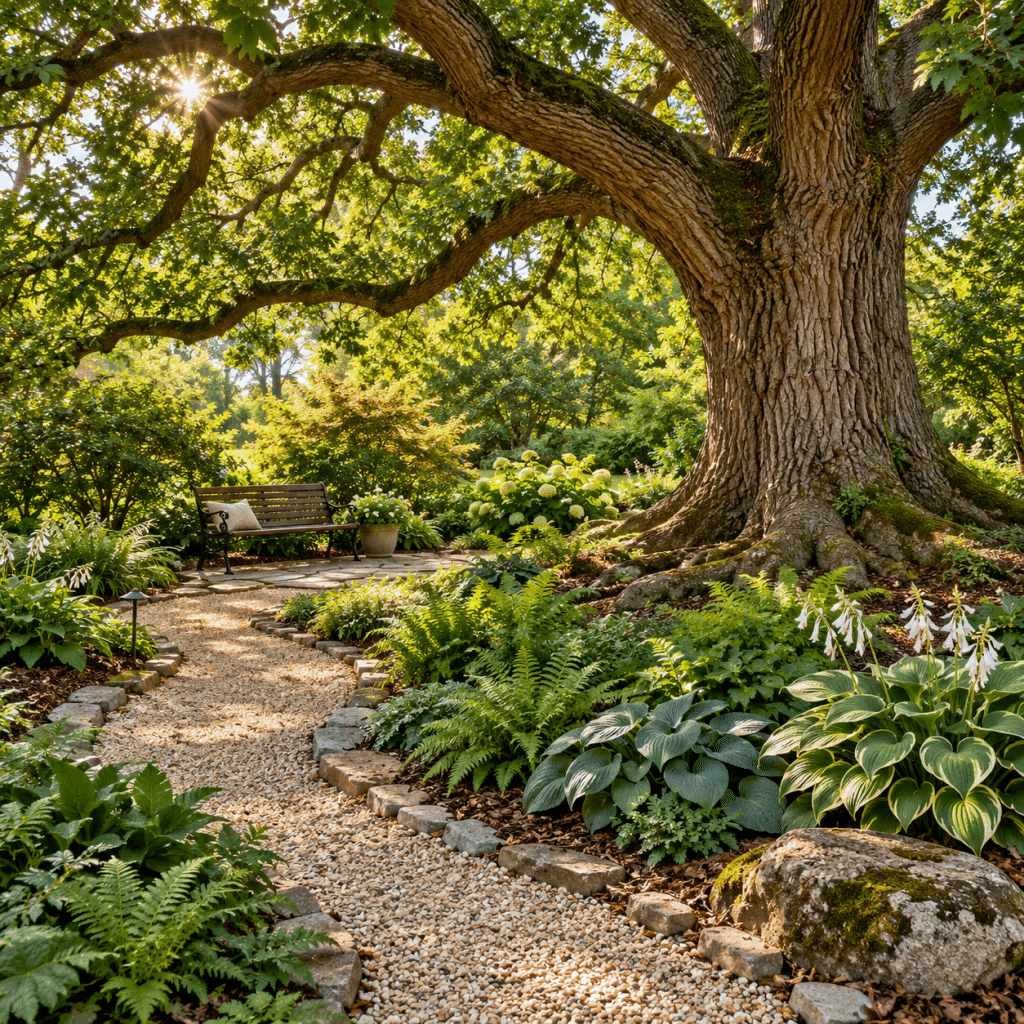
Rather than trying to force a sunny flower bed beneath a large oak, a better approach is to celebrate the character of the tree itself. Its broad canopy, textured bark, spreading branches, shifting shadows, and dramatic trunk already create an architectural focal point. The garden below only needs to support that existing beauty.
The most successful designs usually rely on restrained planting, natural materials, woodland textures, and carefully positioned features that do not overwhelm the tree. 🌿 Fern-like foliage, shade-tolerant groundcovers, stone, mulch, simple pathways, and quiet seating areas can turn an awkward patch of ground into one of the most atmospheric parts of the yard.
Below are three distinctive approaches that make the most of the space while keeping the oak tree as the visual hero.
Why Garden Under Oak Tree Ideas Need a Different Design Approach
Gardening beneath a mature oak is different from creating an ordinary flower bed. The canopy changes how sunlight reaches the ground, while the tree’s established roots compete strongly for water and nutrients. In many cases, the soil underneath may be considerably drier than surrounding garden areas even though the space looks shaded and cool.
The root system also matters. Mature trees depend on oxygen reaching the soil around their roots. Heavy digging, deep soil additions, repeated compaction, or large raised beds built directly around the trunk can create unnecessary stress.
That does not mean the area needs to stay empty. It simply means the design should be lighter, more adaptable, and more respectful of the existing tree.
A successful under-oak garden tends to include several characteristics. 🌳 It uses relatively shallow planting methods, accepts natural leaf litter, favors plants that tolerate partial or dry shade, keeps the trunk visually open, and avoids creating a crowded ornamental bed immediately against the bark.
The result is usually more elegant anyway. Instead of dozens of unrelated flowers fighting for attention, the area becomes a quiet transition between lawn, garden, and woodland.
Understanding the Conditions Beneath an Oak Tree
Before designing anything, spend time observing how the site behaves throughout the day.
Some areas may receive gentle morning sunlight. Others may experience bright filtered light through the leaves. Spaces close to the trunk may remain in heavy shade, while the outer canopy receives several hours of indirect or even direct light.
Moisture conditions can vary just as much.
Soil near the tree may dry quickly because the oak is constantly drawing moisture through its extensive roots. Meanwhile, slightly farther from the trunk, rainwater may reach the ground more easily.
These differences can guide where planting, paths, benches, and decorative elements should go.
Quick Design Comparison
| Design Idea | Best For | Main Visual Effect | Planting Intensity | Maintenance |
|---|---|---|---|---|
| 🥇 Woodland Layer Garden | Natural landscapes and large yards | Soft layered woodland atmosphere | Medium | Low to Medium |
| 🥈 Curved Shade Garden Path | Narrow or awkward areas beneath wide canopies | Strong visual movement and structure | Low to Medium | Low |
| 🥉 Quiet Oak Tree Garden Retreat | Relaxing backyard destinations | Cozy intimate outdoor room | Low | Low to Medium |
Each approach can be adapted to the size of the tree, existing lawn, available shade, and overall garden style.
Important Note: Avoid piling soil or mulch deeply against the trunk of a mature oak. Keep the root flare visible and use lightweight landscape treatments whenever possible around established roots.
🥇 Best 1 Garden Under Oak Tree Ideas With a Layered Woodland Garden
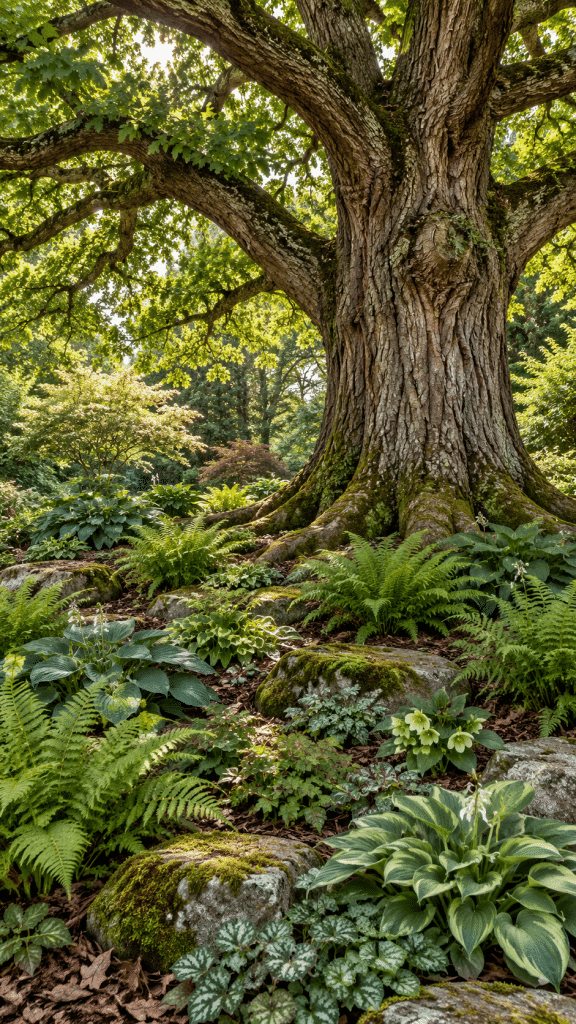
The first and most natural approach is to create a layered woodland garden beneath the oak tree.
Instead of disguising the shady conditions, this design turns them into the main attraction. The area should feel as though the oak has always been surrounded by a soft understory of foliage, woodland textures, and irregular planting groups.
This works particularly well around mature trees because the visual style does not depend on dense flowering displays. The emphasis is on leaves, shape, texture, and atmosphere.
Think of the tree canopy as the ceiling of an outdoor woodland room. Underneath it, lower plant layers gradually step down toward the ground.
Start With a Natural Mulched Floor
A woodland garden begins at ground level.
Instead of trying to maintain perfect lawn beneath the entire canopy, allow some sections to become mulched planting zones. Shredded bark, leaf mold, fine wood chips, or other organic materials can create the visual effect of a forest floor.
Use a thin, natural-looking layer rather than forming a raised mound around the trunk.
The edge does not need to be perfectly circular. In fact, a slightly irregular shape often looks much more natural.
Allow the mulched area to curve around visible roots, existing plants, rocks, and surrounding lawn. This creates an organic transition rather than a rigid landscape ring.
🍂 Fallen oak leaves can also become part of the aesthetic. Instead of removing every leaf immediately, allow some to remain between plants where appropriate. They reinforce the woodland appearance and help the garden feel connected to the tree.
Build Layers With Shade Friendly Foliage
The most beautiful woodland gardens are built from plant layers rather than one flat planting height.
Begin with low ground-level plants and gradually introduce slightly taller foliage as you move outward from the trunk.
Plants suited to the exact site will depend on climate and local conditions, but the design principle remains the same.
Low foliage can soften bare soil.
Medium-height leafy plants can create volume.
Occasional upright plants can add vertical punctuation without competing with the oak itself.
🌿 Fern-like forms are especially effective because their fine texture contrasts beautifully with the massive trunk and heavier branches above.
Broad leaves can also create an interesting counterpoint.
Instead of using many different species, repeat a smaller palette across several groups. This helps the space look intentional and calm.
For example, three or four repeated plant types usually create a stronger design than fifteen unrelated ones.
Create Small Planting Islands Instead of One Dense Bed
A common mistake beneath mature trees is trying to fill every inch of soil.
A better solution is to plant in islands.
Leave some areas open with mulch or natural leaf litter. Then create clusters where planting conditions are easiest.
One group might sit near the outer canopy where more light reaches the ground.
Another could wrap gently around a rock.
A third might appear near the beginning of a pathway.
These gaps create breathing room and reduce visual clutter.
They also make the tree’s roots and trunk feel integrated into the design rather than hidden beneath vegetation.
Add Natural Stone as a Quiet Accent
Stone works beautifully under oak trees because it introduces structure without needing constant maintenance.
Use a few large irregular stones rather than many small decorative objects.
A single mossy boulder can feel more convincing than a collection of miniature ornaments.
Stone can also visually connect the tree garden with a nearby path, patio, retaining wall, or garden border.
If the surrounding landscape already includes natural stone, repeat the same material beneath the oak to make the entire yard feel cohesive.
The goal is not to create a rock garden.
The goal is to make it feel as if the stones naturally belong beneath the tree.
Use Texture Instead of Bright Color
A woodland oak garden does not need intense color to be interesting.
Texture can do most of the work.
Combine:
- Fine fern-like leaves
- Soft groundcover
- Broad matte foliage
- Dark bark
- Gray or beige stone
- Dry leaves
- Mossy details
- Gentle ornamental grasses where conditions allow
The changing light passing through the oak canopy will create its own visual drama.
Morning sunlight may illuminate one planting island while the rest remains shaded. During the afternoon, shadows may move across stone and foliage.
This constantly changing pattern gives the garden a quiet richness that ordinary flower beds often lack.
Keep the Oak Tree as the Main Focal Point
Do not cover the base of the trunk with decorative objects.
Let the bark remain visible.
A beautiful old oak trunk is often more visually impressive than any garden ornament.
The planting should appear to frame the tree instead of hiding it.
This is especially important when the oak has dramatic branching, textured bark, or exposed surface roots.
Those details can become part of the landscape composition.
Why This Idea Works
The layered woodland approach succeeds because it respects what already exists.
Instead of transforming the area into something completely different, it amplifies the natural character of the tree.
It is especially suitable for cottage gardens, woodland landscapes, relaxed family yards, rustic homes, and properties surrounded by mature vegetation.
The final effect should feel calm, slightly wild, and timeless.
🥈 Best 2 Garden Under Oak Tree Ideas With a Curved Shade Garden Path
The second approach focuses less on planting and more on movement.
A curved garden path beneath an oak tree can turn the shaded area into a meaningful transition between different parts of the yard.
This solution is particularly effective when grass struggles to grow beneath the canopy.
Instead of repeatedly repairing thin lawn, the difficult area becomes a pathway surrounded by low-maintenance planting and mulch.
The result is both practical and highly decorative.
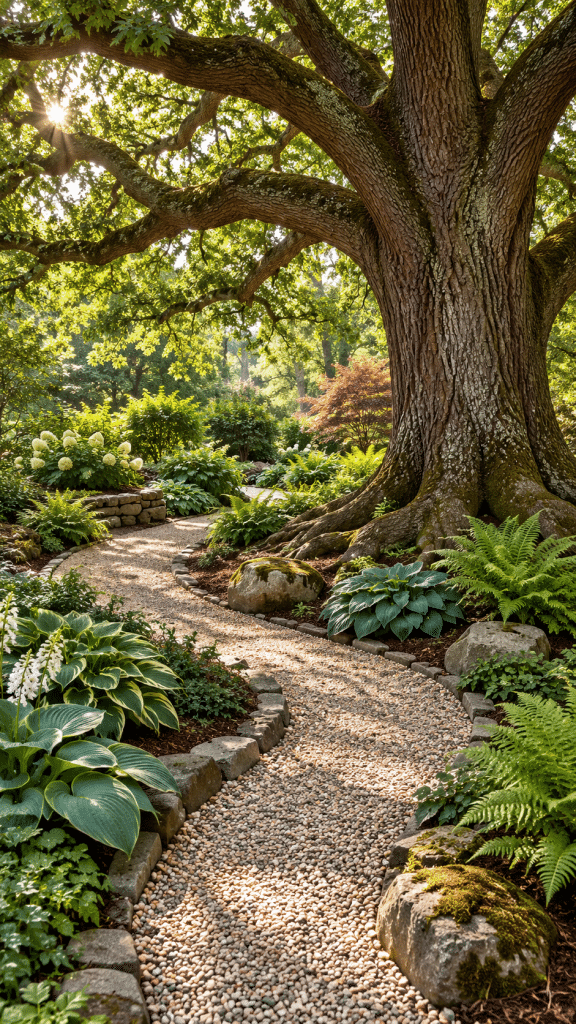
Let the Path Curve Around the Tree
Straight paths can sometimes look too rigid beneath a large natural canopy.
A gentle curve usually feels more appropriate.
Allow the route to bend around the trunk rather than heading directly toward it.
This creates a sense of discovery.
From one viewpoint, the path may disappear behind a planting group before reappearing farther into the garden.
That small visual trick can make even a modest backyard feel larger.
🌳 The tree becomes a landmark within the route rather than an obstacle blocking it.
Choose Permeable Natural Materials
The surface material should visually match the surrounding garden.
Fine gravel can create a relaxed European garden look.
Stepping stones can produce a more informal woodland feeling.
Natural stone slabs can create a refined landscape.
Wood chips can work well in rustic or heavily wooded areas.
Whichever material is used, avoid making the area feel overly engineered.
The path should appear gently integrated into the landscape.
Soft edges are particularly effective.
Rather than using a high border, allow groundcover or mulch to visually meet the pathway.
Frame the Path With Low Shade Planting
The path becomes much more attractive when it is bordered by repeated foliage.
Low planting can guide the eye through the space without blocking the view.
Use small clusters rather than continuous thick borders.
One side might contain loose drifts of foliage.
The other side could remain more open with mulch and exposed roots.
This asymmetry often feels more natural beneath large trees.
🌿 Repeating the same plant farther along the path creates rhythm.
For example, one leafy cluster near the entrance can visually echo another cluster several meters away.
That repetition helps the landscape feel professionally designed.
Use the Outer Canopy for More Color
The darkest area under the center of the tree is not always the best location for flowers.
Move brighter plants toward the perimeter of the canopy.
These zones often receive more filtered light and moisture.
By concentrating color near the outer edge, the garden gains depth.
The shaded center remains calm and green while the brighter perimeter visually pulls the eye outward.
This creates an attractive transition from woodland shade into the sunnier garden beyond.
Add One Destination at the End of the Path
Paths feel more meaningful when they lead somewhere.
The destination does not have to be elaborate.
It could be:
- A small bench
- A birdbath
- A simple garden gate
- A stone planter
- A secondary flower border
- A vegetable garden entrance
- A patio
- Another mature tree
The oak then becomes part of a garden journey.
Instead of thinking of the shaded space as an isolated landscaping problem, it becomes a connecting landscape feature.
Create an Elegant View From the House
When planning the path, consider how it looks from indoor windows.
A curved path disappearing beneath a mature oak can create a strong focal view from a kitchen, living room, or dining area.
This matters because gardens are often viewed from indoors more frequently than people realize.
A carefully positioned curve can make the outdoor landscape feel much deeper.
In autumn, fallen leaves may partially cover the pathway and create a beautiful seasonal scene.
During summer, filtered light adds moving shadows.
In winter, the trunk and branches become more visually prominent.
The path helps organize all of these seasonal changes.
Why This Idea Works
The curved path approach works because it solves a practical issue while creating a stronger garden composition.
Thin grass is no longer a problem.
Heavy shade becomes atmospheric.
Visible roots become part of the scenery.
The garden also gains direction and structure without requiring dense planting.
This makes the idea particularly useful for homeowners who want a low-maintenance under-tree landscape.
🥉 Best 3 Garden Under Oak Tree Ideas With a Quiet Garden Retreat
The third approach turns the oak tree into the anchor of a small outdoor retreat.
Large mature trees naturally create shade and enclosure, making them ideal locations for quiet seating areas.
Rather than filling the entire zone with plants, this design uses restraint.
A chair, bench, or compact seating arrangement becomes the focal point while the tree provides the architectural backdrop.
The result can feel like a hidden garden room.
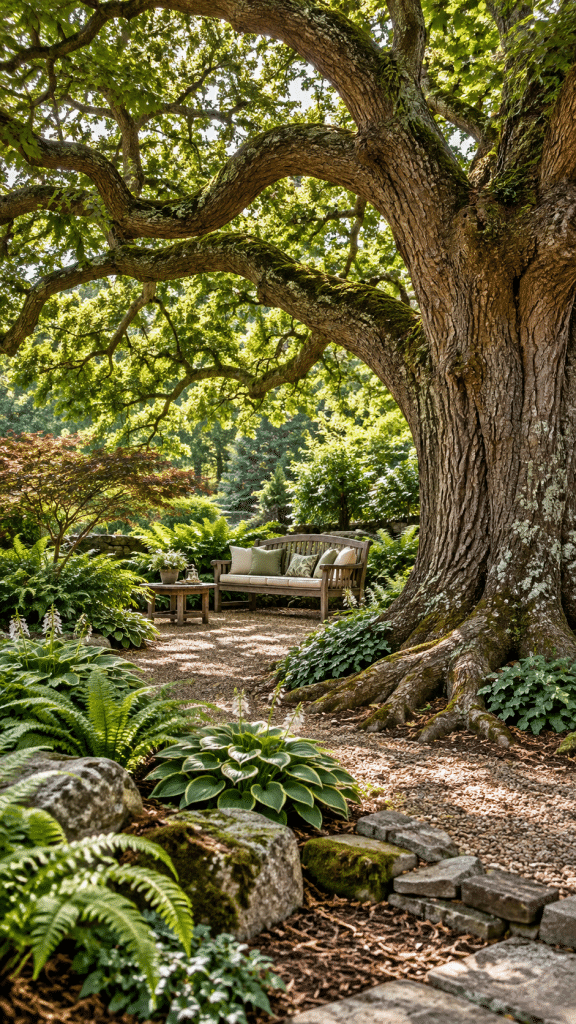
Position Seating Where the View Feels Best
Do not automatically place the bench directly against the trunk.
Instead, observe the surrounding landscape.
Which direction provides the most attractive view?
Perhaps one side overlooks a flower garden.
Another might face the house.
A different angle may look toward an open lawn, vegetable garden, pond, or distant landscape.
Positioning the seating slightly away from the trunk can often create a more comfortable composition.
The goal is to feel sheltered by the canopy without crowding the tree itself.
Choose Simple Furniture
Under a mature oak, simple furniture usually looks better than highly decorative pieces.
A wooden bench works well in woodland gardens.
A slim black metal bench can suit more formal landscapes.
A single lounge chair may be enough for a small space.
Two chairs with a tiny side table can create a conversational corner.
🪑 The furniture should visually disappear into the landscape rather than compete with the tree.
Natural wood, charcoal metal, muted stone, woven outdoor materials, and earthy neutral colors tend to work particularly well.
Bright plastic furniture may feel visually disconnected unless the overall garden is intentionally colorful.
Define the Retreat With a Ground Surface
A seating area feels more intentional when it has a subtly defined floor.
This could be a small gravel pad.
It could also be several large stepping stones surrounded by mulch.
For a very natural landscape, the seating may simply rest on compacted earth or woodland mulch.
Avoid creating a heavy raised patio immediately around major tree roots.
Instead, keep the construction lightweight and visually soft.
The transition between the seating zone and surrounding planting should feel gradual.
Surround the Retreat With Soft Planting
The planting around a garden retreat should create enclosure without making the area feel crowded.
Use slightly taller foliage behind or beside the seating.
Keep the front more open so the view remains clear.
This produces a layered effect similar to an outdoor room.
The oak canopy becomes the ceiling.
Shrubs or leafy plants become the walls.
Mulch or gravel becomes the floor.
The seating becomes the furniture.
This simple spatial concept can completely change how an overlooked corner of the garden feels.
Add Gentle Lighting Carefully
Subtle lighting can make an oak tree retreat especially beautiful in the evening.
The key is restraint.
Instead of covering the tree with bright decorative lights, use a few warm low-level fixtures around the path or seating zone.
Small lanterns can create an intimate atmosphere.
Soft downward lighting can help define the walking route.
One carefully positioned uplight may emphasize the trunk if appropriate for the site.
✨ Warm illumination often works better than cool white light because it complements bark, foliage, gravel, and timber.
The lighting should make the garden feel peaceful rather than theatrical.
Create Seasonal Interest Without Replanting Everything
One advantage of a seating-centered garden is that seasonal decoration can change without disturbing the soil around the oak.
In spring, a simple container of shade-tolerant plants can add freshness.
During summer, neutral outdoor cushions can make the retreat more comfortable.
Autumn naturally brings beautiful fallen leaves and warmer tones.
In colder months, evergreen branches, lanterns, or understated seasonal accents can maintain visual interest.
Because these elements are movable, the permanent landscape remains simple.
Why This Idea Works
The quiet retreat approach gives the shaded area a purpose.
Many awkward spaces beneath trees remain unused because homeowners assume they must become flower beds.
They do not.
Sometimes the most effective garden feature is simply a comfortable place to sit.
A mature oak already provides the drama.
The retreat only needs to help people enjoy it.
How to Choose the Best Garden Under Oak Tree Idea for Your Yard
The right design depends on how the area connects with the rest of the landscape.
If the surrounding garden is naturalistic and filled with mature trees, the layered woodland garden will probably look most harmonious.
If the oak sits between two important areas of the yard, the curved shade garden path may provide the strongest combination of function and beauty.
If the tree occupies a peaceful corner with a pleasant view, the quiet garden retreat could transform the space into a destination.
There is also no rule saying the three ideas cannot overlap.
In fact, some of the most successful landscapes combine them.
A curved path might enter beneath the oak.
Small woodland planting islands could frame the route.
The path could eventually lead to a bench positioned beneath the outer canopy.
That combination creates movement, atmosphere, and function without requiring heavy construction.
Avoid Treating the Area Like a Normal Flower Bed
One of the most important design shifts is accepting that the space beneath an oak does not need to behave like a traditional garden border.
Trying to create a constantly blooming flower bed can lead to frustration.
Sun-loving plants may become weak.
Moisture-loving plants may struggle with dry roots.
Repeated digging can become difficult.
Constant watering may also be required.
Instead, let foliage become more important than flowers.
Let bark become decoration.
Let fallen leaves contribute texture.
Let shadows become part of the composition.
Once that mindset changes, landscaping under the tree becomes much easier.
Work With Visible Roots
Exposed roots are often treated as unattractive obstacles, but beneath an old tree they can add character.
Do not try to hide every root beneath thick soil.
Instead, design around them.
A path can curve between roots.
Groundcover can soften nearby areas.
Mulch can create a consistent background.
A strategically placed stone can visually balance the composition.
🌳 Large roots often emphasize the age and strength of the tree, adding exactly the kind of natural texture that designers frequently try to recreate artificially.
Use Fewer Materials for a More Expensive Look
Too many decorative materials can make an under-tree garden feel chaotic.
A limited palette often creates a more sophisticated result.
For example:
Natural stone + dark mulch + green foliage
Or:
Fine gravel + oak bark + soft woodland plants
Or:
Weathered wood + leaf litter + shade-loving groundcover
Repeating the same materials elsewhere in the garden makes the oak area feel integrated rather than separate.
If the patio already uses beige stone, repeat that stone in the path beneath the tree.
If the garden fence is dark timber, consider using similar wood for the bench.
These small repetitions create visual unity.
Easy Garden Under Oak Tree Ideas for Small Yards
A large estate is not required to make this concept work.
Even one mature oak in a modest backyard can become an impressive focal point.
The key is scale.
Avoid trying to squeeze every possible feature beneath the canopy.
Choose one strong idea.
For example, a small curved path with three planting clusters may be enough.
Or use one bench surrounded by mulch and several low foliage groups.
A restrained design can actually make the tree appear larger and more dramatic.
In small yards, the canopy itself may already define much of the outdoor space.
Adding only a few carefully chosen elements allows the tree to remain visually dominant.
Try an Asymmetrical Layout
Small gardens often benefit from asymmetry.
Instead of creating a perfect circular bed around the trunk, extend planting farther on one side.
Place a seating area off-center.
Allow the path to curve diagonally.
Keep another side relatively open.
This can make the space feel larger because the composition does not reveal everything immediately.
It also creates a more natural relationship with the irregular branching structure of a mature tree.
Garden Under Oak Tree Ideas for a More Natural Landscape
Natural landscaping is becoming increasingly attractive because it celebrates existing site conditions rather than constantly controlling them.
An oak tree provides an ideal foundation for this approach.
Instead of creating a manicured ring beneath the canopy, allow the garden to transition gradually from cultivated to natural.
Use mulch irregularly.
Let leaves gather between plants.
Repeat native-looking foliage forms.
Use stone sparingly.
Avoid excessive edging.
🌿 The aim is not neglect.
The aim is intentional looseness.
A successful natural garden may look effortless, but its shapes, repetitions, and open spaces have still been carefully considered.
Create Repetition Across the Garden
One way to prevent the oak area from looking disconnected is to repeat plants or materials found elsewhere in the yard.
If a particular foliage plant appears near the patio, use another cluster near the oak.
If the front garden includes ornamental grasses, repeat a shade-appropriate equivalent in the backyard.
If stone edging appears elsewhere, echo the same stone beneath the tree.
These visual connections guide the eye across the landscape.
They make different garden zones feel like parts of the same overall design.
Best Plants for Garden Under Oak Tree Ideas
Plant selection depends heavily on climate, oak species, soil characteristics, rainfall, and the amount of light reaching the ground.
Rather than focusing only on a fixed plant list, begin with plant characteristics.
Look for species suited to:
🌿 Partial shade or filtered light
🍂 Dry shade where appropriate
🌱 Root competition
🌳 Woodland conditions
💧 Moderate or low supplemental irrigation once established where climate allows
Texture should also influence the choice.
Choose a combination of fine, medium, and broad foliage.
Avoid using only plants with identical leaf shapes.
A mix of textures creates depth even when most of the color palette stays green.
Think Beyond Flowers
Flowers can certainly be included, but they do not need to dominate.
Foliage often lasts much longer visually.
A flower may bloom for several weeks.
A beautifully shaped leaf can contribute to the garden for an entire growing season.
This makes foliage particularly valuable beneath mature trees where conditions may already limit flowering.
Use blossoms as accents instead of the entire design strategy.
Add Seasonal Beauty Beneath the Oak
One of the best parts of landscaping around an oak is watching the space change throughout the year.
In spring, fresh leaves create delicate filtered light.
Summer brings deep shade.
Autumn introduces fallen leaves and warmer tones.
Winter reveals branch architecture and the full shape of the trunk.
A successful garden design should look attractive during more than one season.
This is another reason stone, pathways, benches, bark, and evergreen or persistent foliage can be so valuable.
They provide structure when flowers disappear.
Let Autumn Leaves Become Part of the Design
Fallen leaves do not always need to be treated as visual clutter.
In woodland-style areas, they can create one of the most beautiful seasonal effects.
A few leaves scattered across mulch or gravel instantly make the garden feel warmer and more natural.
They also visually connect the ground to the canopy above.
Keep high-traffic paths usable, but allow surrounding planting areas to retain some seasonal character.
Final Thoughts on the Best Garden Under Oak Tree Ideas
A mature oak tree should not be viewed as a landscaping problem. It is already one of the most valuable visual features a garden can have.
The strongest garden under oak tree ideas simply give that feature the right setting.
🥇 A layered woodland garden creates a natural understory filled with soft foliage, mulch, stone, and woodland atmosphere.
🥈 A curved shade garden path transforms difficult ground into a beautiful route through the landscape.
🥉 A quiet garden retreat turns the shade beneath the canopy into an intimate outdoor destination for relaxing and enjoying the yard.
The secret is restraint.
There is no need to cover every section of soil, hide every root, or fill the canopy with decorations. Mature oaks already provide texture, scale, movement, and seasonal beauty.
A few carefully placed plants, a natural ground surface, a gently curved pathway, or one comfortable bench may be all the landscape needs.
When the design follows the tree instead of fighting it, the once-difficult shaded area can become one of the most distinctive and memorable parts of the entire garden.