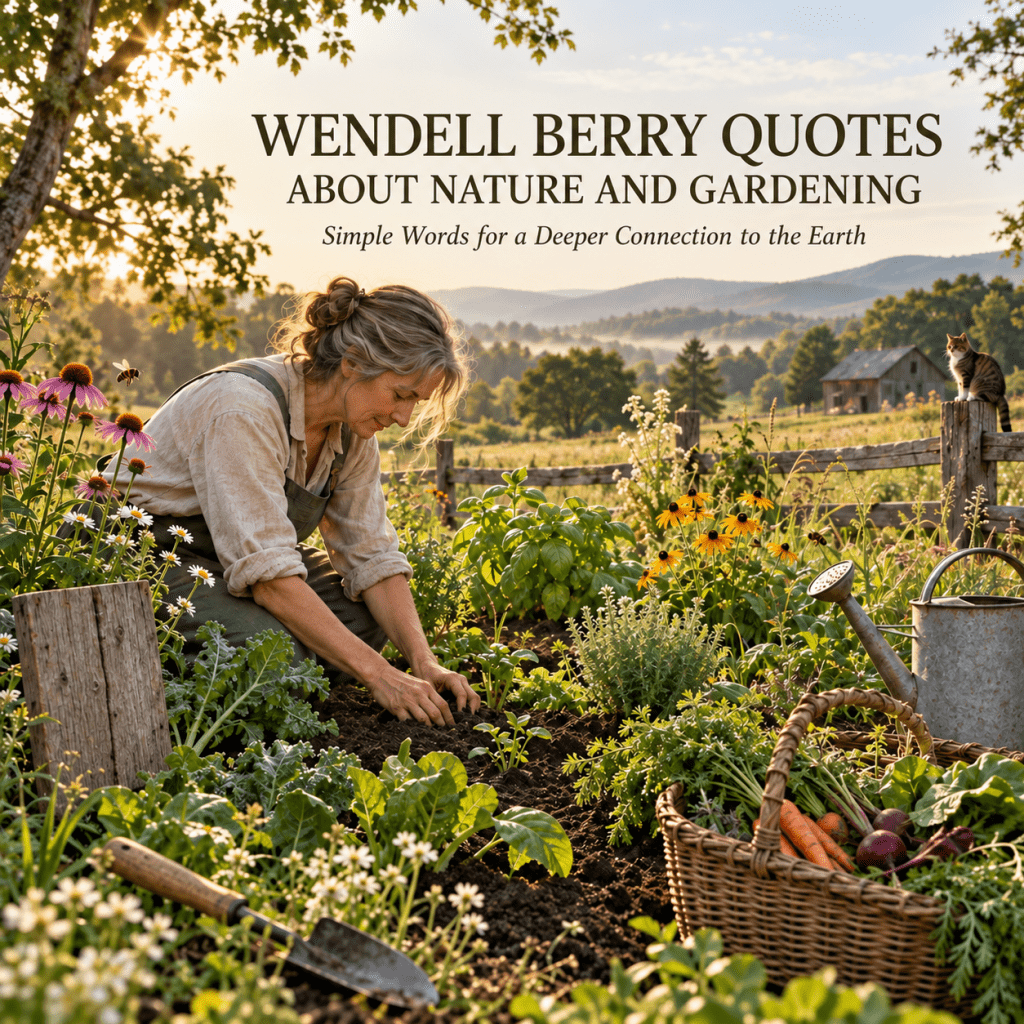
Some garden quotes are beautiful for a moment. Others quietly change the way you look at the soil beneath your feet, the vegetables growing behind your house, the birds visiting at sunrise, and even the food arriving on your dinner table. Wendell Berry Quotes About Nature and Gardening belong firmly in the second category. His words invite gardeners to see a garden not simply as decoration, but as a living relationship between people, soil, plants, animals, seasons, food, and place.
Wendell Berry spent decades writing about agriculture, nature, rural communities, food, responsibility, and the importance of belonging to a particular place. His ideas were not formed only at a writing desk. Berry was also a Kentucky farmer whose understanding of land was closely connected to practical work. The Berry Center continues to describe his legacy through advocacy for farmers, land-conserving communities, and healthy regional economies. Berry died at his home in Kentucky on August 31, 2026, but the questions running through his writing remain strikingly relevant.
For gardeners, his work offers something deeper than a collection of inspirational sayings. 🌱 It provides a philosophy of gardening based on care, attention, limits, patience, and affection.
A vegetable patch becomes more than a source of tomatoes. Compost becomes more than waste management. A native flower border becomes more than landscaping. Even sitting quietly beside a tree can become a reminder that human life is part of a much larger living world.
Among the many ideas associated with Berry, three themes stand out especially strongly for gardeners today. They concern the environmental importance of gardening, the extraordinary value of soil, and the peace humans can rediscover by paying attention to wild nature.
Why Wendell Berry Quotes About Nature and Gardening Still Matter
Modern gardening can easily become focused on appearances.
Perfect lawns, fashionable planters, expensive outdoor furniture, immaculate borders, dramatic before-and-after transformations, and social-media-ready landscapes can all be enjoyable. Yet a garden is much more than an outdoor room waiting to be styled.
It is an ecosystem.
Under every garden bed is a complicated world of roots, fungi, microorganisms, insects, minerals, moisture, and decomposing organic matter. Above it are relationships involving flowers, vegetables, birds, pollinators, weather, sunlight, human labor, and changing seasons.
Berry’s writing repeatedly encourages readers to notice those relationships.
That is one reason his ideas feel particularly meaningful to gardeners. Gardening naturally teaches something modern life often hides: everything depends on something else.
🌿 A healthy tomato plant depends on healthy soil.
🐝 A productive fruit tree may depend on pollinating insects.
🍂 Healthy soil can depend on decomposing plant material.
💧 Plant survival depends on water.
🌳 Wildlife depends on habitat.
👩🌾 And a garden depends on someone being willing to pay attention.
Berry’s ecological thinking is rooted in this kind of connectedness. The Berry Center describes its agricultural work as an effort to use nature as a standard while supporting farms, communities, and economies capable of lasting without permanently damaging the ecosystems on which they depend.
The result is a philosophy that translates surprisingly well from large farms to tiny backyard gardens.
You do not need fifty acres to practice careful stewardship.
Sometimes it begins with one raised bed.
Sometimes it begins with a compost pile.
Sometimes it begins with planting flowers for bees instead of spraying every insect that appears.
And sometimes it begins by simply observing what the land is already trying to tell you.
The Top 3 Wendell Berry Quotes About Nature and Gardening at a Glance
The following three ideas capture different sides of Berry’s relationship with land and nature.
| Rank | Wendell Berry Quote | Central Idea | Practical Garden Lesson |
|---|---|---|---|
| 🥇 Top 1 | “I can think of no better form of personal involvement in the cure of the environment than that of gardening.” | Gardening as environmental action | Improve one small piece of land through thoughtful cultivation |
| 🥈 Top 2 | “The soil is the great connector of our lives, the source and destination of all.” | Soil as the foundation of life | Feed and protect the soil instead of treating it as inert dirt |
| 🥉 Top 3 | “I come into the peace of wild things” | Nature as restoration | Leave room for wildness and spend time observing it |
Each quote points toward a slightly different question.
What can an individual actually do for the environment?
What deserves the gardener’s greatest attention?
And what can nature give back to the person who learns to notice it?
Together, these three ideas create a surprisingly complete gardening philosophy.
Important Note: Berry’s writing connects agriculture, food, community, soil, wildlife, and human responsibility. These quotations become more meaningful when treated as starting points for thoughtful stewardship rather than isolated decorative slogans.
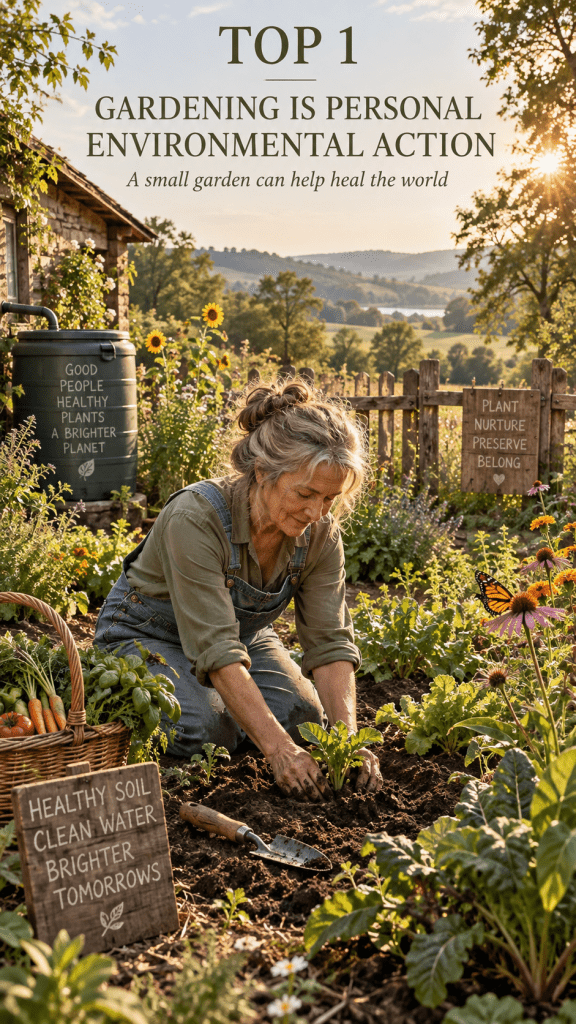
🥇 Top 1 Gardening Is Personal Environmental Action
The Wendell Berry Gardening Quote That Turns a Backyard Into Something Bigger
One of Berry’s clearest statements about gardening appears in his essay Think Little:
“I can think of no better form of personal involvement in the cure of the environment than that of gardening.”
The power of this statement comes from the phrase personal involvement.
Environmental problems are often discussed at enormous scales: climate, industrial agriculture, pollution, biodiversity decline, resource consumption, soil degradation, and disappearing habitat. The size of those problems can make individual action seem insignificant.
Berry turns the question around.
Instead of asking whether one person can fix everything, he asks what one person can responsibly do where they actually live.
Gardening becomes valuable because it brings responsibility close enough to touch.
You can touch the soil.
You can plant a seed.
You can decide whether to use pesticides.
You can compost kitchen scraps.
You can collect leaves.
You can plant flowers for pollinators.
You can grow herbs outside a kitchen window.
You can choose whether your little piece of ground becomes more alive or less alive because of your presence.
That is an extraordinarily practical environmental philosophy. 🌱
A Garden Makes Environmental Care Concrete
Environmental concern can remain abstract for years.
Gardening makes it physical.
If the soil dries out, you see it.
If earthworms appear in rich compost, you notice them.
If butterflies begin visiting a patch of nectar-rich flowers, you witness the result.
If repeated chemical treatments reduce insect activity, that too becomes visible.
A garden therefore becomes a small ecological classroom.
The gardener gradually learns that environmental health is not merely an idea. It is expressed through relationships.
Berry’s argument in Think Little goes beyond ornamental gardening. He explains that a person who grows food organically improves a small portion of the world while becoming more directly involved in feeding people and understanding food.
That observation feels particularly relevant in an age when food can appear almost magically on supermarket shelves.
Growing even one tomato plant changes the experience.
Suddenly tomatoes require soil.
They require nutrients.
They require water.
They require sunlight.
They may require pollination.
They require protection from disease.
They require time.
And they require someone to wait.
🍅 The tomato is no longer simply a product.
It becomes the visible conclusion of a biological process.
Gardening Also Changes the Gardener
One of the most interesting aspects of Berry’s gardening philosophy is that the garden does not merely improve because somebody works in it.
The gardener changes too.
Growing plants develops habits that are increasingly rare in fast-moving consumer culture.
Patience becomes unavoidable.
You cannot order a seed to germinate instantly.
Observation becomes important.
You must notice whether leaves are yellowing, whether soil is too wet, whether flowers are being pollinated, or whether a plant needs more light.
Humility becomes necessary.
Weather can destroy carefully made plans in a single afternoon.
Restraint becomes useful.
More fertilizer is not always better. More watering is not always better. More pruning is not always better.
Gardening repeatedly reminds people that successful care often requires understanding limits.
That may be one of the deepest reasons Berry connects gardening with environmental responsibility.
The garden trains the habits needed for stewardship.
How to Apply This Wendell Berry Quote in Your Own Garden
Applying Berry’s idea does not require transforming your property into a farm.
Start small.
🌱 Grow something edible, even if it is only basil, mint, lettuce, chili peppers, or tomatoes in containers.
🍂 Compost plant material when practical instead of immediately treating every fallen leaf as garbage.
🐝 Include flowering plants that provide food for pollinators.
💧 Reduce unnecessary water use by mulching and choosing plants suited to local conditions.
🌿 Avoid treating every unfamiliar insect as an enemy.
🥬 Learn where at least some of your food comes from.
The point is not perfection.
The point is participation.
A gardener becomes less detached from ecological processes because gardening requires direct involvement with them.
That is why this deserves the number-one position among Wendell Berry Quotes About Nature and Gardening.
It transforms gardening from a hobby into a form of relationship.
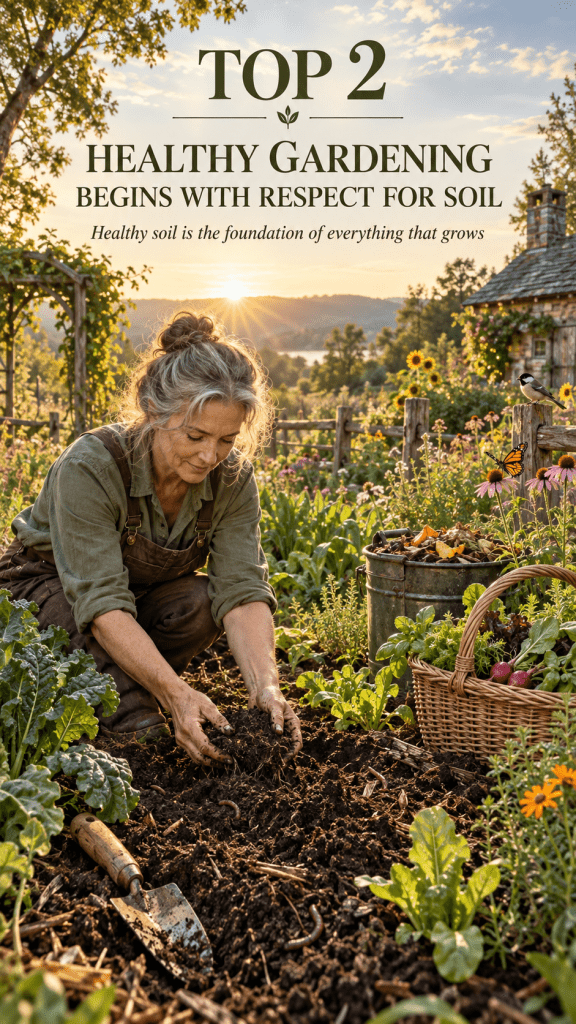
🥈 Top 2 Healthy Gardening Begins With Respect for Soil
The Wendell Berry Quote That Every Gardener Should Remember
Berry wrote:
“The soil is the great connector of our lives, the source and destination of all.”
The quotation comes from The Unsettling of America, Berry’s influential 1977 work examining agriculture, culture, land, and industrialization. The U.S. Natural Resources Conservation Service also preserves the quotation in its collection of notable statements about soil.
For gardeners, this idea is difficult to exaggerate.
Beautiful gardening begins below the surface.
Before flowers bloom, roots must grow.
Before vegetables can produce, plants must obtain nutrients and water.
Before fallen leaves disappear, organisms must break them down.
Before next season’s growth begins, much of the previous season eventually returns to the ground.
Soil appears quiet, but it is never merely empty brown material beneath plants.
It is a biological foundation.
Stop Thinking of Soil as Dirt
The words soil and dirt are frequently used interchangeably, but gardeners benefit from thinking about them differently.
Dirt sounds disposable.
Soil sounds alive.
A handful of healthy garden soil may contain an extraordinary network of biological activity. Organic matter decomposes. Fungi interact with roots. Microorganisms cycle nutrients. Invertebrates create channels and process decaying material.
Plants participate in this system rather than simply sitting on top of it.
That changes how gardening decisions look.
If soil is merely a substance holding plants upright, heavy chemical intervention might seem harmless.
If soil is a living system, every intervention raises additional questions.
What happens to microorganisms?
What happens to worms?
What happens to water movement?
What happens to soil structure?
What happens after ten years rather than after ten days?
🌎 Berry’s quote shifts attention from immediate appearance to long-term health.
The Forest Offers a Gardening Lesson
Berry’s ecological writing frequently emphasizes the importance of learning from natural systems rather than forcing land into purely industrial patterns.
An excerpt published by the National Endowment for the Humanities describes the woodland principle that ground remains protected by vegetation and that annual growth returns to the soil, decomposes, and contributes to rebuilding it.
Gardeners can see a simplified version of that process every autumn.
Trees drop leaves.
Plants die back.
Organic material settles onto the ground.
Fungi and microorganisms begin breaking it down.
Nutrients cycle.
New growth eventually appears.
Nature rarely removes every fallen leaf, sterilizes the ground, exposes bare soil, and replaces fertility from a plastic bag.
That does not mean a home garden should literally imitate a forest in every detail.
It means gardeners can learn from the principle.
Keep soil covered when practical.
Return organic matter.
Reduce unnecessary disturbance.
Protect biological activity.
Think in cycles.
Compost Is More Than Garden Waste Disposal
Few garden practices illustrate Berry’s idea better than composting.
Kitchen scraps, dry leaves, grass clippings, plant stems, and other organic materials are often classified as waste.
Composting changes the category.
What looked like waste becomes fertility.
Yesterday’s plant becomes tomorrow’s soil amendment.
🍂 The cycle becomes visible.
That is remarkably close to the worldview expressed in Berry’s writing: healthy communities and healthy agriculture depend on respecting the systems that continually connect life, death, decomposition, and renewal.
For the gardener, compost teaches an important lesson.
A good garden is not simply a place where resources are consumed.
It can also become a place where resources circulate.
Mulch Protects More Than Appearance
Mulching provides another practical example.
A layer of organic mulch can help moderate soil temperature, slow moisture loss, reduce weed competition, and gradually contribute organic material as it decomposes.
But perhaps its most important philosophical lesson is simpler:
good gardening protects the ground.
Bare soil is vulnerable.
Heavy rain can disturb it.
Strong sunlight can dry it.
Wind can move fine particles.
Repeated disturbance can weaken structure.
A thoughtful gardener therefore begins to see soil protection almost like protecting the foundation of a house.
Flowers may receive the photographs.
Soil deserves the attention.
Build the Garden From the Ground Up
A Berry-inspired approach to soil might include several simple habits.
Add compost instead of relying exclusively on synthetic fertility.
Keep living roots in the soil whenever practical.
Use mulch.
Avoid unnecessary compaction.
Reduce excessive tilling.
Grow cover crops where suitable.
Allow some organic material to decompose naturally.
Observe drainage before redesigning an entire planting bed.
And above all, learn about the specific soil you actually have.
That final point matters enormously.
Berry argued that ecological agriculture should fit the farming to the farm, emphasizing the importance of understanding the character of a particular place rather than applying one standardized method everywhere.
The same principle works beautifully in gardening.
A shady clay garden requires different choices from a sunny sandy garden.
A humid tropical garden behaves differently from a dry Mediterranean one.
A tiny urban courtyard creates different possibilities from a large rural property.
The question should not always be:
How do I force this garden to match my idea?
Sometimes the better question is:
What kind of garden naturally belongs here?
That is a very Wendell Berry question.
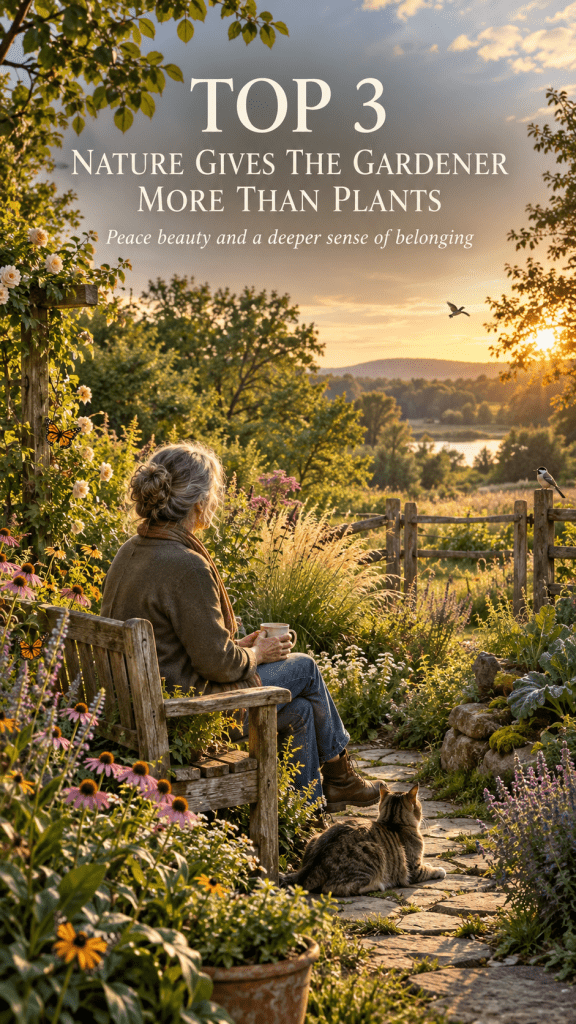
🥉 Top 3 Nature Gives the Gardener More Than Plants
The Wendell Berry Nature Quote About Finding Peace Among Wild Things
Berry’s famous poem The Peace of Wild Things contains one of his simplest and most memorable lines:
“I come into the peace of wild things.”
The poem describes turning toward wild nature during moments of fear and anxiety. Water, birds, darkness, and the surrounding natural world become a temporary refuge from human worry.
For gardeners, the idea opens an interesting possibility.
Perhaps a garden is not only something humans create.
Perhaps it can also become somewhere humans go to be restored.
That difference matters.
If the garden exists only to display our control, every fallen leaf becomes disorder.
Every insect becomes intrusion.
Every self-seeded flower becomes a mistake.
Every irregular branch becomes something to correct.
But when a garden is understood partly as habitat, the gardener can begin allowing nature to participate.
🌿 Suddenly wildness is not automatically failure.
Sometimes it is life returning.
Leave a Little Wildness in the Garden
A perfectly controlled landscape may look impressive, but ecological richness often depends on allowing some complexity.
A small patch of native flowers can feed insects.
A berry-producing shrub may feed birds.
A shallow water source may help wildlife.
Seed heads left standing can provide food and structure.
A small pile of branches in an appropriate corner may create shelter for creatures that would otherwise have nowhere to go.
This does not require abandoning design.
One of the most beautiful contemporary gardening approaches is intentional wildness.
Paths can remain clear.
Terraces can remain elegant.
Borders can have structure.
Outdoor seating can remain sophisticated.
But within that framework, plants can move, flower, seed, feed, shelter, and change.
The garden becomes less like a static photograph and more like a living conversation.
A Garden Can Become a Place for Attention
Berry’s nature writing repeatedly returns to the importance of being present in a place.
Gardening naturally encourages that habit.
Sit outside for twenty minutes without doing anything.
At first, the garden may appear still.
Then details begin emerging.
A bee moves between flowers.
A bird lands on a branch.
A spider web catches the light.
Leaves respond to wind differently depending on their shape.
An ant crosses a stone.
Clouds change the color temperature of the entire landscape.
A flower visited in the morning may look different by evening.
None of these things requires the gardener.
That realization can be surprisingly comforting.
🌳 The garden has a life beyond our plans for it.
Gardening Is Not Only About Productivity
Productive gardening is valuable.
Vegetable beds, fruit trees, herbs, berries, and edible flowers can strengthen the relationship between people and food.
Berry famously wrote that “Eating is an agricultural act.” His essay The Pleasures of Eating argues that eaters participate in agriculture because eating completes the process that begins with cultivation and production.
But gardening does not need to be productive in a narrow economic sense to matter.
A tree that produces shade matters.
A flower that feeds a bee matters.
A hedge that shelters birds matters.
A patch of grasses moving in the wind matters.
A bench beneath a tree where someone sits quietly for ten minutes can matter too.
Nature is not valuable only when it becomes a commodity.
The garden can remind us of that every day.
What These Top 3 Wendell Berry Quotes Teach Us Together
Each of these three quotations emphasizes a different relationship.
The first concerns action.
Gardening allows individuals to participate directly in environmental care.
The second concerns foundation.
Soil connects living systems and therefore deserves careful stewardship.
The third concerns attention.
Wild nature has value beyond its usefulness and can offer perspective, beauty, and peace.
Put together, they create a simple but powerful garden philosophy:
🌱 Grow something.
🍂 Care for the soil.
🐝 Make room for other life.
👀 Pay attention.
🌳 Allow some wildness.
🥕 Understand where food comes from.
💚 Care for the place you actually inhabit.
None of this requires a perfect garden.
In fact, perfection may be the wrong goal.
A better goal may be health.
How to Create a Wendell Berry Inspired Garden
Begin With What Is Already There
Before buying plants, observe the place.
Where does sunlight fall?
Where does water collect?
Which areas dry quickly?
What plants already grow successfully?
Which insects visit?
Which birds appear?
What kind of soil is present?
Berry’s approach to land repeatedly emphasizes the importance of fitting human activity to the qualities of a particular place.
That principle can save gardeners enormous amounts of frustration.
Instead of forcing shade-loving plants into intense afternoon sun, work with the light.
Instead of endlessly fighting a naturally damp corner, consider plants that appreciate moisture.
Instead of importing a completely foreign aesthetic, explore materials and plants connected to the region.
Good gardening often begins with listening.
Grow at Least One Thing You Can Eat
Even ornamental gardeners can benefit from growing something edible.
It can be tiny.
A pot of basil.
A chili plant.
A few strawberries.
Lettuce.
Tomatoes.
Rosemary.
A dwarf citrus tree.
The objective is not self-sufficiency.
The objective is connection.
Once you have waited weeks or months for food to grow, harvesting becomes different.
Waste becomes different.
Seasonality becomes different.
Freshness becomes different.
And the sentence “Eating is an agricultural act” becomes much easier to understand.
Create Habitat Alongside Beauty
A beautiful garden and a wildlife-friendly garden do not need to be opposites.
Choose flowers with long blooming periods.
Include multiple layers of vegetation.
Grow shrubs when space allows.
Provide shelter.
Plant species useful to local pollinators where appropriate.
Avoid unnecessary pesticide applications.
Allow selected seed heads to remain after flowering.
Add water safely if local conditions permit.
You can still maintain pathways, seating areas, architectural edges, and beautifully composed planting combinations.
The goal is not neglect.
The goal is generosity.
A garden can look beautiful to people while remaining useful to other species.
Let the Seasons Remain Visible
Modern landscaping sometimes attempts to hide seasonal change.
Berry’s writing points in almost the opposite direction.
Seasons matter because they reveal time.
Spring brings emergence.
Summer produces abundance.
Autumn brings harvest, seed, color, and decline.
Winter exposes structure and rest.
A garden becomes richer when those transitions are allowed to remain visible.
🍂 Leave some seed heads.
🌾 Appreciate dried grasses.
🌱 Notice emerging shoots.
🌸 Celebrate temporary flowers precisely because they are temporary.
The garden does not need to look identical twelve months of the year.
Its changing nature is part of its meaning.
Why Wendell Berry Appeals So Strongly to Gardeners
Gardening occupies a curious position in modern life.
It can be recreation, work, art, food production, environmental stewardship, exercise, therapy, design, science, and tradition all at once.
Few activities connect so many parts of life.
Berry’s writing resonates because he also resisted separating things that actually belong together.
Agriculture affects culture.
Food affects land.
Soil affects communities.
Economic choices affect landscapes.
Environmental damage eventually becomes human damage.
The Berry Center continues to apply those ideas through agricultural education and programs designed around land stewardship, economically viable farming, healthy soil, water, community, and locally rooted knowledge.
A home gardener works on a much smaller scale.
But the relationships remain.
The Deeper Meaning Behind Wendell Berry Quotes About Nature and Gardening
Perhaps the most important lesson hidden inside Wendell Berry Quotes About Nature and Gardening is that environmental responsibility does not always begin with something enormous.
It can begin with affection.
Affection for a tree.
Affection for a patch of soil.
Affection for a vegetable bed.
Affection for birds returning each morning.
Affection for a landscape you have known long enough to recognize when something has changed.
People usually protect what they have learned to love.
Gardening creates opportunities for that love to develop because it slows attention down.
A person who has watched a tree grow for twenty years does not see merely timber.
A person who has built soil season after season does not see merely dirt.
A person who has watched bees crowd around lavender does not see an insect as an abstraction.
Relationship changes perception.
Perception can change behavior.
And behavior, repeated over enough years, changes places.
Final Thoughts on the Best 3 Wendell Berry Quotes for Gardeners
The best Wendell Berry quotes do not simply make gardens sound romantic.
They make gardening feel consequential.
🥇 Gardening becomes personal environmental action.
Berry’s words remind us that improving one small piece of land is not meaningless simply because the planet is enormous.
🥈 Soil becomes the center rather than the background.
A healthy garden begins beneath our feet, where the processes supporting nearly everything visible above ground are constantly unfolding.
🥉 Wild nature becomes a companion rather than something that must always be controlled.
Birds, water, trees, insects, flowers, grasses, and seasonal changes can remind people that they belong to a world much larger than their schedules and worries.
That may be the enduring appeal of Wendell Berry Quotes About Nature and Gardening.
They encourage gardeners to stop asking only how to make a garden look better and begin asking deeper questions.
How can this soil become healthier?
What other creatures can live here?
What does this place naturally want to become?
What can be grown rather than merely purchased?
What can be returned rather than thrown away?
What deserves protection?
And perhaps most importantly:
How can a person learn to belong more carefully to the place where they live?
A great garden may begin with seeds, soil, water, and sunlight.
But according to the philosophy running through Berry’s work, something else is necessary too.
🌿 Attention.
Because when people truly pay attention to a place, gardening becomes more than decoration.
It becomes care.
And care is where stewardship begins.