Old tires are rarely the first thing that comes to mind when imagining a beautiful garden. They are heavy, dark, industrial, and usually associated with garages rather than flowers and carefully designed outdoor spaces. Yet with the right approach, Tire Garden Ideas can transform this unlikely material into something surprisingly stylish, colorful, and full of character.
The secret is not simply filling an old tire with soil and adding a few flowers. The most successful tire gardens treat each tire as a genuine landscape element. Shape, placement, planting style, color, surrounding materials, and proportion all determine whether the result looks like a creative garden feature or simply discarded tires placed among plants.
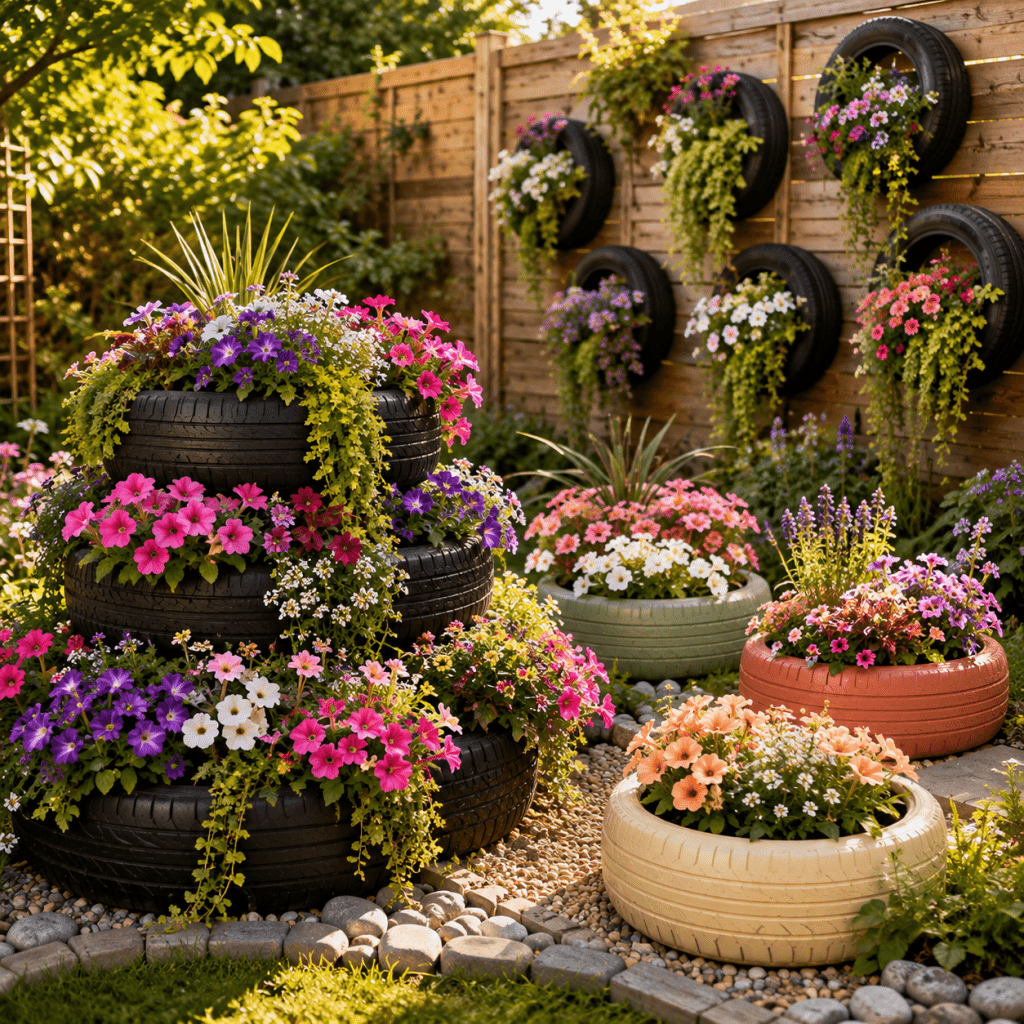
That is why the three ideas in this guide take three distinctly different approaches. One uses height and layered planting to create a sculptural focal point. Another uses carefully coordinated color to turn ordinary tires into decorative planters. The third moves the garden upward, creating a vertical planting display that works especially well where ground space is limited.
Here are the 3 best Tire Garden Ideas for giving old tires an unexpectedly beautiful second life.
| Rank | Tire Garden Idea | Best Feature | Ideal For |
|---|---|---|---|
| 🥇 | Sculptural Stacked Tire Flower Garden | Dramatic height and layered flowers | Backyard focal points |
| 🥈 | Color Coordinated Painted Tire Garden | Sophisticated use of color | Cheerful decorative gardens |
| 🥉 | Vertical Tire Garden Wall | Space-saving greenery | Fences and small gardens |
Important Note: Old tires can work wonderfully as decorative planters for ornamental plants, but be thoughtful about how they are used. For edible crops, consider purpose-made food-safe containers instead, especially when the tire’s age, condition, and previous exposure are unknown.
🥇 Platz 1 Sculptural Stacked Tire Flower Garden
The most impressive way to make an old tire look intentional is to stop treating it like an ordinary planter.
Instead, turn several tires into a piece of garden architecture.
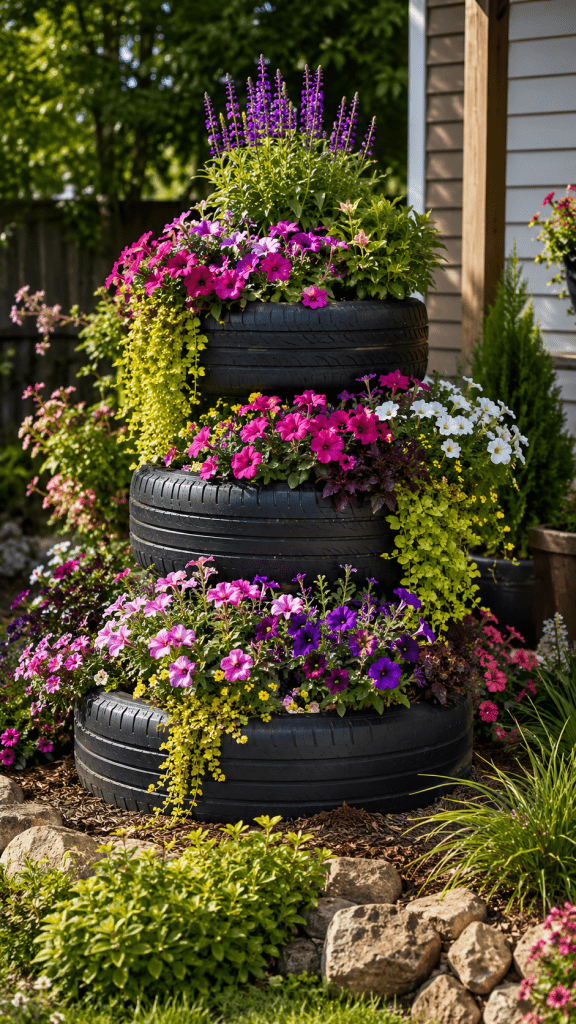
A Sculptural Stacked Tire Flower Garden uses different heights, overlapping forms, cascading plants, and carefully selected flowers to create a three-dimensional focal point. Rather than seeing individual tires scattered around the yard, the eye reads the entire arrangement as one composition.
This distinction is important.
Three tires placed randomly beside each other can easily look improvised. Three or five tires arranged at deliberately different heights can look like a designed garden feature.
Create Height Instead of a Flat Arrangement
Start with the overall silhouette.
One of the easiest compositions is a staggered pyramid. Place two or three tires at the bottom and introduce additional tires at progressively higher levels. They do not need to form a perfectly symmetrical tower.
In fact, a slightly asymmetrical arrangement often feels more natural.
You might position one tall stack toward the back, a medium-height stack slightly forward, and one individual tire at ground level. This produces a gradual transition rather than an abrupt vertical column.
Another possibility is a cascading arrangement built into a gentle slope. Tires can appear to descend through the landscape, with flowers spilling from one level toward another.
The goal is visual movement.
Your eyes should naturally travel from the highest flowers through the middle layer and finally toward the plants around the base.
Let Flowers Soften the Tire Shapes
Plant selection makes an enormous difference.
A tire has a very strong geometric shape. Its circular edge can dominate the composition if every plant remains neatly contained inside it.
Cascading flowers help break that outline.
Petunias, calibrachoa, lobelia, bacopa, nasturtiums, trailing verbena, and similar ornamental plants can spill over the edges and partially conceal the tire.
The result becomes softer and more organic.
For the uppermost tire, consider slightly taller flowering plants or ornamental foliage. Medium-height plants can occupy the center level, while trailing plants work beautifully near the edges.
Think in three planting layers:
Vertical plants → mounding plants → trailing plants
That combination creates much more depth than planting the same flower in every tire.
Keep the Color Palette Controlled
A common temptation with recycled garden projects is using every available color.
That can work for playful spaces, but if you want your Tire Garden Ideas to feel more sophisticated, restraint usually produces a stronger result.
For example, imagine dark charcoal tires filled with:
- white petunias,
- pale pink calibrachoa,
- burgundy foliage,
- soft green trailing plants.
The tire itself becomes a neutral structural element.
Alternatively, paint the tires in one muted family such as sage, dusty blue, terracotta, cream, or warm beige.
The flowers can then provide stronger color.
The important principle is repetition. If the same two or three colors appear throughout the arrangement, separate tires begin to feel connected.
Integrate the Bottom Into the Garden
The base of the arrangement is often overlooked.
A beautiful stack of planted tires can still look disconnected when it sits directly on an empty patch of ground.
Instead, blend it into its surroundings.
Low groundcovers can creep toward the tires. Gravel can define the planting zone. Mulch can visually connect the feature with nearby flower beds. Small stones, ornamental grasses, and low-growing flowers can soften the transition between rubber and landscape.
You want the tire structure to look as though the garden has grown around it.
Where This Idea Works Best
This is the strongest of the three concepts when you have enough space for a genuine focal point.
It works especially well:
- against an otherwise empty garden wall,
- beside a patio,
- at the end of a garden path,
- in a neglected backyard corner,
- near a shed,
- or within a larger ornamental flower bed.
The biggest advantage is visibility.
Even from across the yard, the combination of circular forms, varying heights, and abundant flowers creates a recognizable feature.
That earns the Sculptural Stacked Tire Flower Garden our 🥇 first place.
🥈 Platz 2 Color Coordinated Painted Tire Garden
Painting old tires can go wrong surprisingly quickly.
Random neon colors combined with unrelated flowers may create a fun craft project, but they do not necessarily create a cohesive garden.
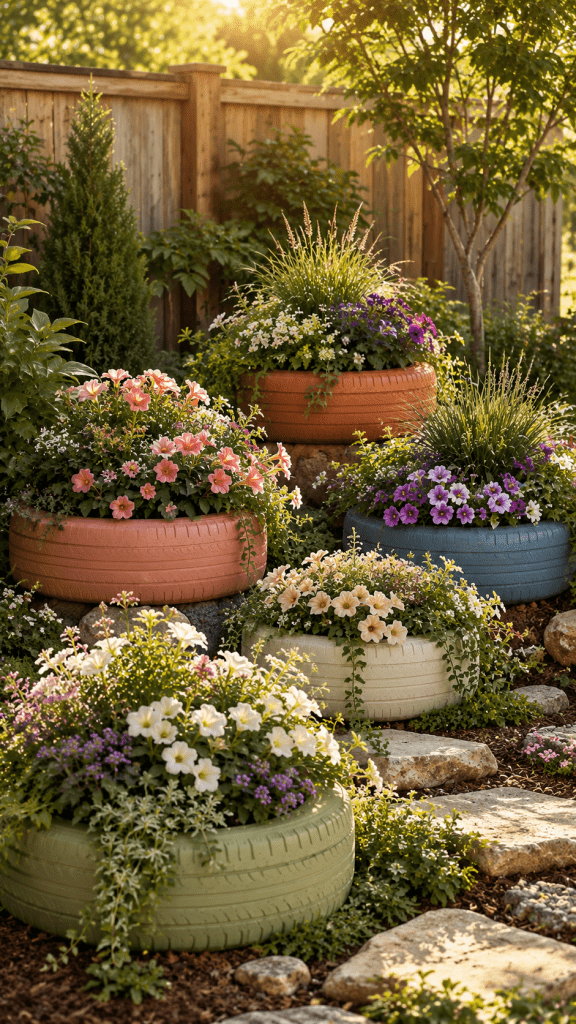
The more refined approach is a Color Coordinated Painted Tire Garden.
Instead of treating every tire as an independent decoration, select a deliberate palette and repeat it throughout the entire display.
This turns color into the organizing principle.
Start With the Garden Before Choosing Paint
Look at the colors that already exist around your outdoor space.
What color is your house?
What materials appear on your patio?
Do you have a wooden fence?
Are your existing containers terracotta, black, cream, or gray?
These surroundings should influence the tire colors.
For a warm natural garden, consider:
terracotta + muted cream + olive green
For a softer cottage-inspired look:
dusty rose + warm white + sage
For a modern outdoor space:
charcoal + stone gray + muted beige
For something cheerful but controlled:
mustard + dusty blue + soft coral
You can still use strong color. The difference is that the colors relate to one another.
Paint Does Not Need to Cover Everything
A completely painted tire creates a strong graphic object.
Sometimes that is exactly what you want.
But there are other possibilities.
You can leave portions of the original black rubber visible and paint only selected sections. You can use two-tone designs. A subtle geometric pattern can create interest without overwhelming the planting.
Another beautiful approach is tonal repetition.
Imagine three tires painted in progressively lighter shades of terracotta. When placed among green foliage, the variation feels deliberate without becoming visually chaotic.
Match the Flowers to the Containers
This is where the idea becomes much more sophisticated.
Do not choose tire color and flower color independently.
If the tire is muted blue, white and lavender flowers can create a calm composition.
If the tire is warm terracotta, soft yellow, apricot, white, and deep green plants can reinforce that warmth.
If you choose sage green tires, pale pink flowers provide a beautiful contrast while still feeling garden-appropriate.
This creates a simple visual hierarchy:
Painted tire → foliage → flowers
The container supports the plants rather than competing with them.
Create Repetition Across the Yard
One painted tire can feel like an isolated DIY project.
Several coordinated tires can become a landscape theme.
For example, place one group near the patio, another beside a path, and one final planter near the garden entrance.
Use the same paint palette across all three locations.
Suddenly the eye notices repetition.
That repetition makes the design feel intentional.
You can take this further by repeating the same flower variety or foliage plant in several tire planters. This creates visual continuity even when the containers are separated.
Avoid Overdecorating
Because a painted tire already has considerable visual presence, additional decoration should be used carefully.
You usually do not need painted flowers, multiple patterns, figurines, decorative stones, signs, and five different flower colors all in the same planter.
Choose the hero.
If the paint is bold, simplify the flowers.
If the flowers are spectacular, make the painted tire more understated.
A garden becomes more elegant when every element does not compete for attention.
Where This Idea Works Best
The Color Coordinated Painted Tire Garden is particularly effective in spaces that need personality.
Try it around:
- patios,
- children-friendly garden areas,
- plain fences,
- sheds,
- garden entrances,
- cottage gardens,
- or informal backyard seating areas.
It is also one of the easiest concepts to personalize.
A muted palette can make recycled tires surprisingly elegant, while stronger colors can produce a joyful, energetic outdoor space.
That flexibility earns it 🥈 second place.
🥉 Platz 3 Vertical Tire Garden Wall
What happens when there is almost no ground space available?
Move the garden upward.
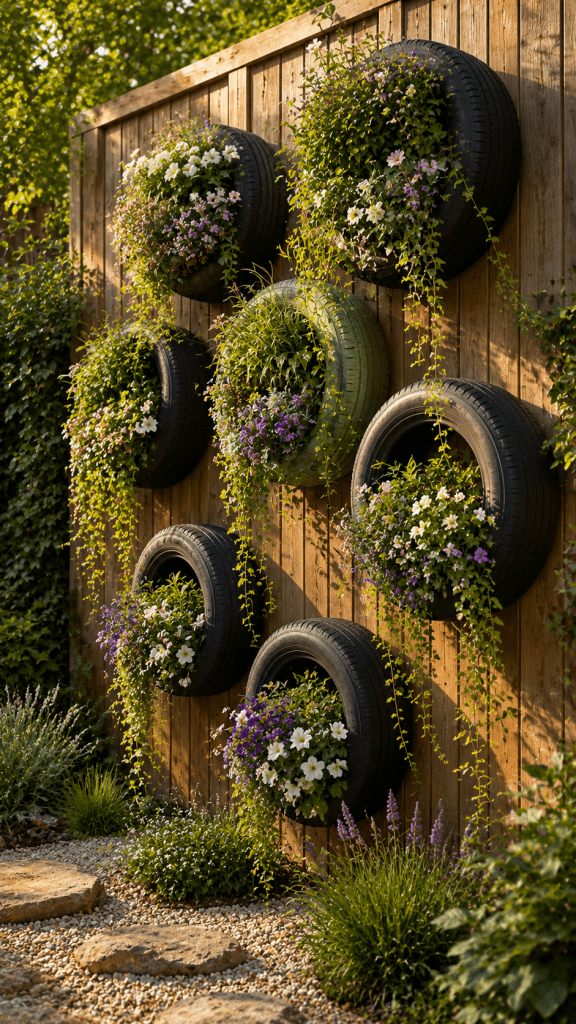
A Vertical Tire Garden Wall uses tires as elevated planting pockets positioned against a structurally suitable wall, fence, or purpose-built support system.
Of all the Tire Garden Ideas in this guide, this one creates perhaps the most dramatic before-and-after transformation.
A plain vertical surface can become covered with circular planters, foliage, flowers, and cascading greenery.
Think of the Wall as a Composition
Do not start by attaching tires randomly.
First imagine the entire wall as a blank canvas.
A symmetrical arrangement creates a clean, orderly appearance. For example, six tires could form two vertical columns.
An asymmetrical layout feels more organic.
You could position one tire high on the left, two around the middle, and another group toward the lower right. Trailing plants can visually connect these separate circles.
Another approach is diagonal movement.
Arrange the tires so they gradually climb from one side of the wall toward the other.
This can make even a relatively small installation feel dynamic.
Use Trailing Plants Generously
Vertical gardens are particularly suited to plants that cascade.
Once foliage begins spilling downward, the tire loses some of its visual heaviness.
Trailing flowers can create colorful waterfalls, while foliage plants produce a greener, calmer result.
The effect becomes especially attractive when different textures are combined.
Imagine fine trailing foliage beside broad leaves, small flowers beside dense mounding plants, and a few upright accents emerging from the center.
The wall develops depth instead of looking flat.
Create Space Between the Tires
More is not always better.
Covering every centimeter with tires can make the wall feel crowded and heavy.
Negative space is valuable.
Allow some of the fence, timber, brick, or wall material to remain visible between the planters. The background becomes part of the composition.
A warm timber fence combined with dark tires and abundant green plants, for example, can look surprisingly sophisticated.
The same applies to pale masonry walls, where dark circular forms can create strong contrast.
Consider the View From Below
Vertical planters are seen differently from ordinary containers.
When a tire is positioned higher than eye level, plants should be attractive from underneath as well as from the front.
Trailing foliage becomes especially useful here.
The plants can conceal portions of the container while creating movement below it.
Lower tires can contain fuller, more upright planting, while higher ones emphasize cascading growth.
This creates natural visual layering.
Make Structural Safety Part of the Design
A planted tire can become very heavy once soil and water are added.
That means this concept requires more than decorative thinking.
The supporting structure and attachment system must be appropriate for the total loaded weight, and the tire should remain secure in wet and windy conditions. Drainage also matters because standing water adds unnecessary weight and can create poor growing conditions.
If the existing fence is lightweight or uncertain, a purpose-built freestanding structure may be the better solution.
A beautiful vertical garden should also be a stable one.
Where This Idea Works Best
This concept is particularly valuable for:
- small backyards,
- narrow side yards,
- courtyards,
- patios,
- balconies with appropriate structural support,
- garden fences,
- and areas where floor space needs to remain open.
It can also disguise an unattractive background.
Instead of looking directly at a plain fence, you see a living display of foliage and flowers.
That combination of decoration and space efficiency earns the Vertical Tire Garden Wall 🥉 third place.
How to Make Tire Garden Ideas Look More Expensive
The difference between a beautiful recycled garden and one that looks cluttered usually comes down to editing.
Old tires already have a strong identity. You do not need to add many additional decorative elements.
Instead, concentrate on a few details.
Repeat Materials
If gravel appears around one tire arrangement, use the same gravel elsewhere.
If you choose timber as a backdrop, introduce another small timber element nearby.
If tires are painted sage green, repeat sage in another container or garden feature.
Repetition creates cohesion.
Use Fewer Better Plants
A planter does not necessarily become more attractive because it contains more plant varieties.
Two or three complementary plants can create a stronger composition than seven unrelated ones.
Pay attention to foliage as much as flowers.
Leaves provide structure even when seasonal flowers are not blooming.
Hide the DIY Details
Visible rough cuts, peeling paint, poorly prepared surfaces, messy soil edges, and improvised supports can make a project look unfinished.
Preparation matters.
Clean the tires thoroughly before decorative use. If painting them, use products appropriate for exterior conditions and compatible with the material, following the manufacturer’s preparation and application instructions.
Then keep the surrounding area equally tidy.
Give Every Tire a Purpose
This may be the most important rule.
Do not add another tire simply because one is available.
Ask what it contributes.
Does it add height?
Does it continue a color?
Does it hold a different plant texture?
Does it complete the composition?
If it contributes nothing, the garden may look better without it.
Which Tire Garden Idea Should You Choose
Choosing among these three concepts depends largely on the space you have and the effect you want.
For maximum visual impact, choose the 🥇 Sculptural Stacked Tire Flower Garden. It turns recycled materials into a genuine focal point and provides plenty of opportunities for layered planting.
For color and personalization, the 🥈 Color Coordinated Painted Tire Garden is the strongest option. It allows you to connect tire planters with the existing palette of your home and garden.
For limited space, choose the 🥉 Vertical Tire Garden Wall. It transforms an unused vertical surface while leaving valuable ground area available.
You can also combine elements from all three.
A backyard might feature a stacked arrangement as its central focal point, two coordinated painted planters near the patio, and a smaller vertical tire display along a fence.
The key is maintaining a shared visual language.
Use related colors, repeat several plants, and avoid filling every available space.
Final Thoughts on Tire Garden Ideas
Old tires are challenging materials precisely because they do not naturally look delicate or botanical. But that contrast is also what makes successful Tire Garden Ideas so interesting.
The 🥇 Sculptural Stacked Tire Flower Garden turns tires into a layered landscape feature. The 🥈 Color Coordinated Painted Tire Garden uses a controlled palette to transform industrial rubber into decorative containers. And the 🥉 Vertical Tire Garden Wall uses height and cascading plants to turn an overlooked surface into a living display.
The common principle behind all three is intention.
Instead of asking, “Where can I put this old tire?” ask, “What role should this element play in the garden?”
Give it a purpose, connect it visually with its surroundings, soften it with beautiful planting, and leave enough breathing room around the composition.
Do that successfully, and an object that once belonged on the road can become one of the most unexpected features in the garden.