Imagine stepping into your backyard and discovering a miniature world where children explore hidden pathways, conquer imaginative obstacle courses, create extraordinary outdoor masterpieces, and experience the irresistible excitement of childhood adventure. The most inspiring Backyard Play Area Ideas transform ordinary outdoor spaces into beautiful family environments that encourage creativity, movement, discovery, and unforgettable memories. Instead of filling the garden with bulky plastic toys or expensive playground equipment, thoughtfully designed play areas combine natural materials, flexible activities, attractive landscaping, and imaginative details to create something truly extraordinary.
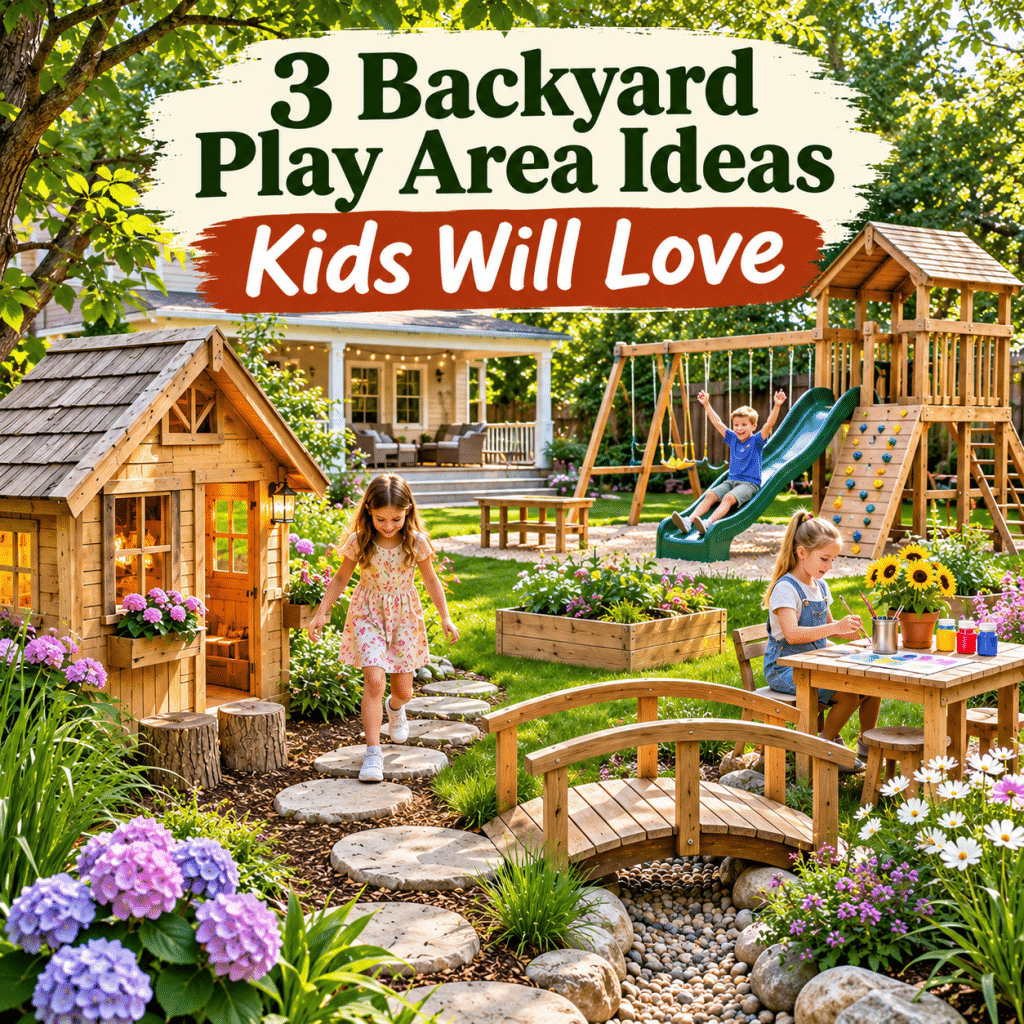
A beautiful backyard play area should offer more than a temporary distraction. It can become a meaningful extension of family life, providing opportunities for children to develop confidence, strengthen coordination, explore nature, and enjoy independent adventures within a thoughtfully supervised environment. From enchanting woodland discovery trails to architectural climbing playgrounds and creative sensory gardens, the possibilities extend far beyond traditional swings and slides.
The secret lies in creating outdoor spaces that feel exciting to children while remaining visually appealing to adults. Natural timber, stepping stones, ornamental grasses, playful pathways, comfortable seating, and carefully selected greenery can turn even a modest garden into a sophisticated family retreat.
🌿 The three best backyard play area ideas combine imaginative exploration, active adventure, and hands-on creativity to create outdoor spaces that children genuinely want to use every day.
Whether the garden is spacious, narrow, shaded, or surprisingly compact, these three remarkable approaches demonstrate how thoughtful outdoor design can transform ordinary family spaces into extraordinary childhood destinations.
Why the Best Backyard Play Area Ideas Create More Than Just a Playground
Traditional playgrounds often concentrate on individual pieces of equipment. A swing offers swinging, a slide provides sliding, and a climbing frame encourages climbing. Although these activities remain valuable, an exceptional backyard play area introduces something more engaging: a collection of connected experiences that naturally inspire children to move between different kinds of play.
One corner might encourage quiet observation, while another offers physical challenges. A small gathering space can invite imaginative storytelling, and a nearby sensory station may inspire children to experiment with water, natural textures, and everyday materials.
This variety creates opportunities for children with different interests, personalities, and developmental abilities to enjoy the same outdoor environment.
🌱 The Secret to Designing a Backyard Children Never Want to Leave
The most successful play gardens offer a balance between structure and freedom.
Children benefit from recognizable features such as pathways, climbing elements, small platforms, and activity stations. However, they also enjoy spaces where they can invent their own games without relying on complicated instructions.
A circular walking path might become a racing circuit one afternoon and an imaginary jungle expedition the next. A simple timber platform could transform into a pirate ship, a mountain lookout, or a secret headquarters depending on the day’s adventure.
Designing for this flexibility gives ordinary backyard features a remarkable advantage over single-purpose toys.
Natural materials also contribute to the atmosphere. Timber, smooth stones, durable outdoor fabrics, and layered greenery create a cohesive garden aesthetic while offering interesting visual and tactile experiences.
The goal is not to reproduce a commercial playground at home. It is to establish a welcoming outdoor environment where different kinds of childhood adventures can develop naturally.
🏡 How to Choose the Right Backyard Play Area for Your Family
Before selecting a design, consider how children actually use outdoor space.
Younger children often enjoy accessible sensory activities, simple imaginative settings, and opportunities to investigate materials through supervised play. Older children may appreciate increasingly challenging movement activities, creative construction projects, and more independent exploration.
The shape of the garden is equally important. A long, narrow backyard may be ideal for a discovery trail, while a broad rectangular lawn offers greater flexibility for an adventure circuit. A compact courtyard can become a surprisingly engaging creative garden when activities are arranged vertically and storage is carefully integrated.
The following comparison highlights the unique strengths of the three featured designs.
| Backyard Play Area Idea | Main Experience | Best Garden Type | Outstanding Feature |
|---|---|---|---|
| 🥇 Enchanted Woodland Discovery Trail | Nature exploration and imaginative play | Small to medium gardens with planting space | Secret pathways and miniature discovery destinations |
| 🥈 Modular Adventure Playground | Active movement and physical challenges | Medium to large gardens | Flexible climbing and obstacle activities |
| 🥉 Creative Sensory Maker Garden | Artistic exploration and hands-on discovery | Small gardens, courtyards, and family patios | Adaptable water, art, and nature activity stations |
Each concept offers a different interpretation of outdoor family enjoyment. The most effective choice depends on available space, children’s ages, and the kinds of play your family wants to encourage.
🥇 Best 1 Backyard Play Area Ideas With an Enchanted Woodland Discovery Trail
Best for imaginative nature exploration and beautifully landscaped family gardens
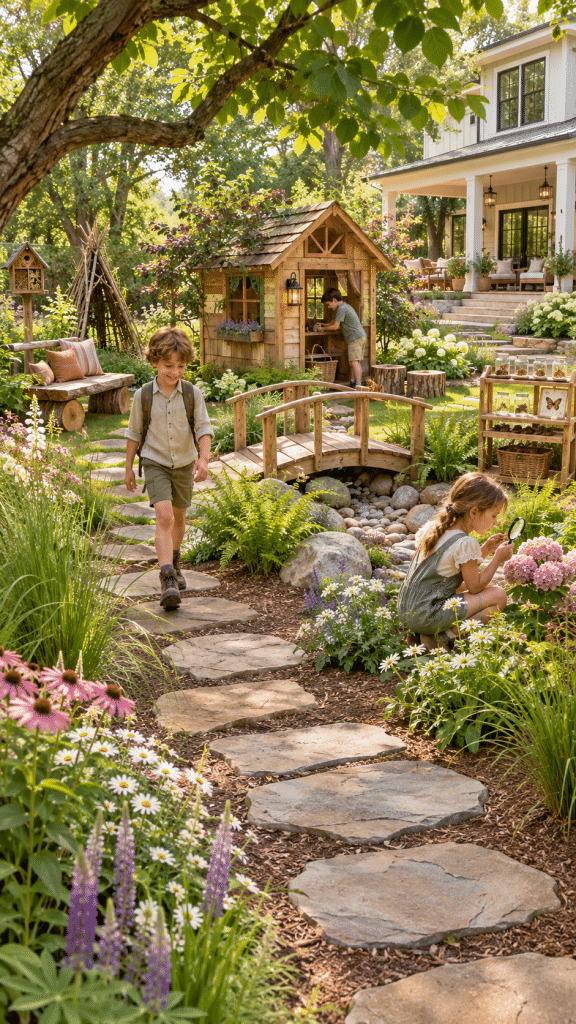
Imagine a narrow winding pathway disappearing between flowering shrubs, a miniature wooden bridge crossing a shallow dry pebble stream, and a tiny woodland hideaway surrounded by ornamental grasses. Small stepping stones lead toward an outdoor discovery station where children investigate interesting leaves, observe insects, and collect fallen natural treasures.
This enchanting garden concept transforms an ordinary backyard into a miniature landscape filled with possibilities.
Rather than concentrating every activity in a central playground, the woodland discovery trail distributes small experiences throughout the garden. Children can follow pathways, investigate hidden corners, and invent stories inspired by their surroundings.
The design feels particularly magical because the environment itself becomes the attraction.
🌿 Create a Secret Garden Pathway That Inspires Exploration
The central feature of this backyard play area is a carefully planned winding pathway.
Instead of connecting two destinations with a straight line, introduce gentle curves that reveal different areas gradually. Even a relatively short route can feel adventurous when its complete layout is not immediately visible.
Low-growing plants, ornamental grasses, and compact shrubs can define the pathway without overwhelming the garden.
Consider using firm, stable, slip-resistant paving, textured stepping surfaces, or a properly installed accessible garden path. The best material depends on local weather, drainage, and children’s mobility needs.
A narrow path bordered by lush greenery can create the impression of entering an entirely different world.
To make the route more engaging, incorporate miniature destinations along the way. These might include a small reading shelter, a nature observation bench, or a wooden marker identifying a pretend woodland landmark.
Children can invent their own names for these destinations, turning the landscape into a personal adventure map.
The pathway should remain easy for adults to supervise, with planting kept low enough to preserve visibility.
🍄 Build a Magical Woodland Hideaway With Natural Materials
A charming woodland hideaway creates a recognizable destination within the discovery trail.
A low timber playhouse, open-fronted shelter, or professionally installed child-sized garden structure can provide space for imaginative games without dominating the landscape.
Natural wood finishes work especially well because they complement surrounding vegetation.
Soft earthy colors such as sage green, warm beige, muted terracotta, and gentle brown help the structure blend into the garden.
Decorative features can introduce a sense of wonder. Painted wooden signs, oversized mushroom-inspired garden ornaments, and playful animal silhouettes make the setting feel imaginative without requiring excessive decoration.
For a more sophisticated appearance, use one consistent material palette throughout the area.
A small woodland shelter surrounded by ferns, ornamental grasses, and flowering perennials can become the visual centerpiece of the entire garden.
Inside, simple child-safe furnishings and weather-resistant cushions can support storytelling, pretend camping, and quiet observation.
Avoid enclosing the hideaway in dense vegetation. Clear sightlines, good ventilation, and easy adult access are essential.
🦋 Add Nature Discovery Stations That Change With Every Season
One of the most fascinating characteristics of a woodland play garden is its ability to evolve naturally throughout the year.
Spring brings emerging leaves and flowering plants. Summer introduces insects and lush vegetation. Autumn offers colorful fallen leaves, interesting seedpods, and changing textures. Winter reveals branches, evergreen structures, and seasonal differences in the garden.
A nature discovery station can help children notice these transformations.
Install a small weather-resistant table where children can examine fallen leaves, sketch flowers, compare safe natural objects, and record garden observations.
A simple magnifying glass designed for children, illustrated nature guides, and washable drawing materials can turn ordinary outdoor discoveries into engaging educational experiences.
Planting can also support wildlife observation.
Choose suitable local native flowers that attract pollinators, while keeping insect observation areas away from crowded seating and active play routes.
A birdwatching point with a clear view of a feeder or bird-friendly planting can provide another opportunity for quiet discovery. Feeders should be positioned and maintained according to local wildlife guidance.
Children may enjoy keeping a seasonal garden journal containing drawings of flowers, interesting weather patterns, and animals observed from a safe distance.
These activities encourage curiosity without turning outdoor play into a formal lesson.
🌼 Plant a Child Friendly Miniature Landscape
The planting scheme determines much of the woodland garden’s atmosphere.
Use a layered composition with low-growing groundcovers near pathways, medium-height plants around activity stations, and larger shrubs or small trees toward the garden boundaries.
This arrangement creates visual depth while preserving practical supervision.
Select plants according to local climate, sunlight, soil conditions, and maintenance requirements.
Non-toxic, thorn-free, and non-irritating species are particularly important around children’s activities.
Decorative grasses can introduce movement and texture, while flowering perennials provide seasonal interest.
Small shade trees may eventually create comfortable resting areas, although their mature roots, branches, and growing dimensions should be considered during planning.
The landscape should also contain open areas. A woodland theme becomes more enjoyable when dense planting alternates with small clearings where children can stop, sit, or invent games.
This balance creates an environment that feels adventurous without becoming difficult to maintain.
✨ Make the Woodland Trail Feel Magical Without Expensive Decorations
An extraordinary woodland play area does not require elaborate ornaments.
Its most memorable qualities often emerge from carefully arranged natural elements.
A small timber bridge over a dry decorative streambed can create an imaginative crossing. Smooth, securely fixed stones may define the stream’s appearance, while larger natural boulders placed outside running areas can add landscape character.
A miniature wooden direction sign might point toward the Butterfly Meadow, Secret Forest, or Explorer’s Corner.
These simple details encourage children to develop stories around the garden.
Durable outdoor decorations can be changed with the seasons, giving the space a refreshed appearance without reconstructing the main layout.
The result is a play environment that feels atmospheric, beautiful, and constantly full of possibilities.
Why this idea deserves first place: The enchanted woodland discovery trail offers an exceptional combination of imaginative play, natural beauty, seasonal discovery, and flexible landscaping. It can be adapted to different garden sizes and remains visually appealing even when children are not actively using it.
🥈 Best 2 Backyard Play Area Ideas With a Modular Adventure Playground and Exciting Obstacle Challenges
Best for energetic children who enjoy movement and physical adventure
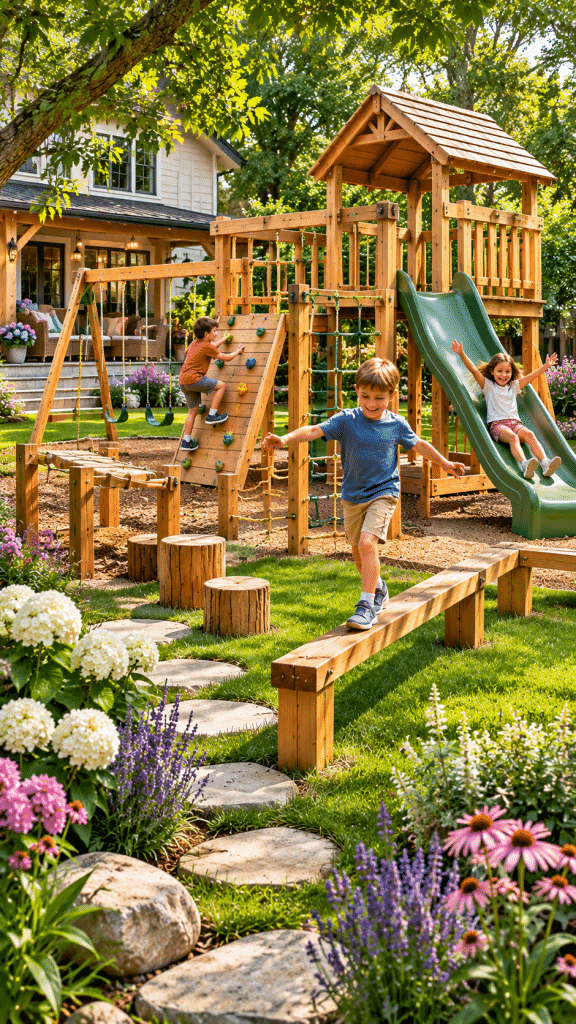
Picture a beautifully designed backyard adventure circuit featuring low balance beams, a climbing structure, carefully arranged movement stations, and an open lawn where children can invent their own challenges.
Instead of installing one enormous playground structure, this concept organizes several smaller activity features into a cohesive outdoor environment.
The modular approach creates flexibility. Families can adapt activities as children grow, rearrange appropriate portable equipment, and introduce new challenges without redesigning the entire backyard.
With thoughtful landscaping, the adventure playground can feel like a contemporary outdoor fitness garden rather than a crowded collection of toys.
🪵 Design an Architectural Adventure Circuit With Natural Timber
Natural timber provides an attractive foundation for a backyard adventure playground.
Its warm appearance complements garden planting, stone paving, and contemporary outdoor architecture.
A professionally designed timber climbing frame can become the main feature, while separate ground-level activity areas encourage different forms of movement.
For example, children might begin with a marked walking route, continue toward a low balance activity, and finish with a simple stepping challenge.
The circuit should provide enough separation between activities to prevent children from colliding.
Aesthetically, repeating timber finishes creates a unified appearance.
Choose durable materials suited to exterior conditions and use hardware appropriate for playground installations.
Commercially manufactured, age-appropriate equipment is generally preferable to improvised climbing structures, particularly when significant loads, movement, or elevated platforms are involved.
Avoid treating decorative landscape timber as automatically suitable for load-bearing play equipment.
🏃 Create a Backyard Obstacle Course That Can Change Every Weekend
The most exciting adventure playgrounds encourage children to invent new challenges.
A flexible obstacle course provides this opportunity without requiring permanent installations for every activity.
Ground-level hoops, cones, movable stepping markers, and age-appropriate balance activities can be arranged into different routes.
One day, the course might focus on careful movement and coordination. Another day, it could involve imaginative expedition tasks, such as transporting lightweight objects between stations.
A color-coded route adds another element of excitement.
Children can follow different colors to complete different activities, making the same physical space feel fresh through simple changes.
A gentle beginner route may concentrate on walking, stepping, and following directions.
A more challenging route for older children could include suitable balance and agility activities, always matched to their abilities and the equipment’s intended use.
Because many elements are portable, the playground can be adapted for different ages without permanently filling the entire garden.
This flexibility is especially valuable for families with children who have different interests or developmental needs.
🧗 Add Climbing Challenges Without Overcrowding the Garden
Climbing activities can become the centerpiece of an adventure-focused play area, but careful planning is essential.
Choose equipment designed for the intended age group and install it according to the manufacturer’s specifications.
The surrounding area needs appropriate impact-attenuating surfacing and sufficient clear space around and beneath the equipment.
The type and required depth of protective surfacing depend on the equipment’s fall height, relevant safety standards, and manufacturer guidance.
A compact climbing structure with multiple age-appropriate activities may offer more practical value than several separate installations competing for limited space.
Visual simplicity also contributes to the garden’s appearance.
Choose understated timber finishes or coordinated colors that harmonize with fences, outdoor furniture, and surrounding planting.
Avoid placing climbing equipment directly beside hard paving, walls, fences, tree trunks, or other obstacles that could increase injury risks.
⚠️ Important Note: Every backyard play area should be designed around children’s ages, abilities, and appropriate adult supervision. Follow manufacturer instructions and applicable playground safety standards for equipment installation, fall zones, anchoring, protective surfacing, and maintenance. Keep play areas away from ponds, pools, traffic, poisonous plants, sharp objects, and unsecured structures. Inspect equipment regularly and never substitute decorative grass, loose stones, or ordinary landscaping materials for certified impact-attenuating surfacing where it is required.
🌳 Incorporate Shade and Comfortable Recovery Spaces
An active adventure playground needs places where children can rest between activities.
A shaded bench or small covered seating area gives children a comfortable opportunity to pause, drink water, and enjoy quieter games.
Shade can come from appropriately positioned trees, a purpose-built pergola, or a securely installed outdoor shade structure.
The chosen solution should account for local wind, sun exposure, maintenance, and the surrounding play equipment.
Portable shade structures should not interfere with playground safety clearances.
Natural shade trees can make the entire garden feel more pleasant during warm weather, although their branches and trunks must remain outside critical equipment clearances.
A nearby drinking-water point or accessible water bottles encourage regular hydration.
Comfortable resting areas also make the adventure garden more inclusive for children who prefer alternating between energetic and quieter activities.
🎯 Build an Adventure Playground That Grows With Your Children
One of the strongest advantages of modular backyard play design is its long-term adaptability.
A family with younger children may initially emphasize simple ground-level movement activities, imaginative pathways, and accessible play stations.
As children grow, families can replace those activities with appropriately rated equipment that offers new physical challenges.
The garden layout itself does not necessarily need to change.
Maintain clear circulation routes, flexible activity spaces, and a dedicated storage location for portable equipment.
This approach prevents the backyard from becoming permanently associated with a single childhood stage.
Eventually, the same open area might support family exercise, outdoor stretching, or informal recreation.
Investing in a flexible landscape rather than a collection of temporary toys can provide better long-term usability.
🌾 Give the Adventure Playground a Beautiful Landscape Design
A modular adventure playground can be visually sophisticated.
Begin with a simple color palette featuring natural timber, warm gray, olive green, and subtle charcoal details.
Use planting along the outer boundaries to soften the appearance of play structures while keeping equipment clearances open.
Ornamental grasses, compact shrubs, and carefully positioned trees can create a pleasant garden setting.
A defined lawn or suitable play surface provides visual breathing room between activity zones.
Storage can be integrated into a weather-resistant garden cabinet or appropriately designed outdoor bench positioned outside active play areas.
The overall composition should feel organized rather than crowded.
The most attractive playgrounds do not necessarily contain the most equipment. They offer a thoughtful balance between open space, physical challenges, and attractive surroundings.
Why this idea earns second place: The modular adventure playground provides exciting opportunities for movement, adaptable physical challenges, and long-term flexibility. Its combination of coordinated equipment and landscape design makes it particularly attractive for active families who want the backyard to evolve alongside their children.
🥉 Best 3 Backyard Play Area Ideas With a Creative Sensory Maker Garden and Magical Outdoor Discovery Stations
Best for small backyards and children who enjoy creativity and hands-on activities
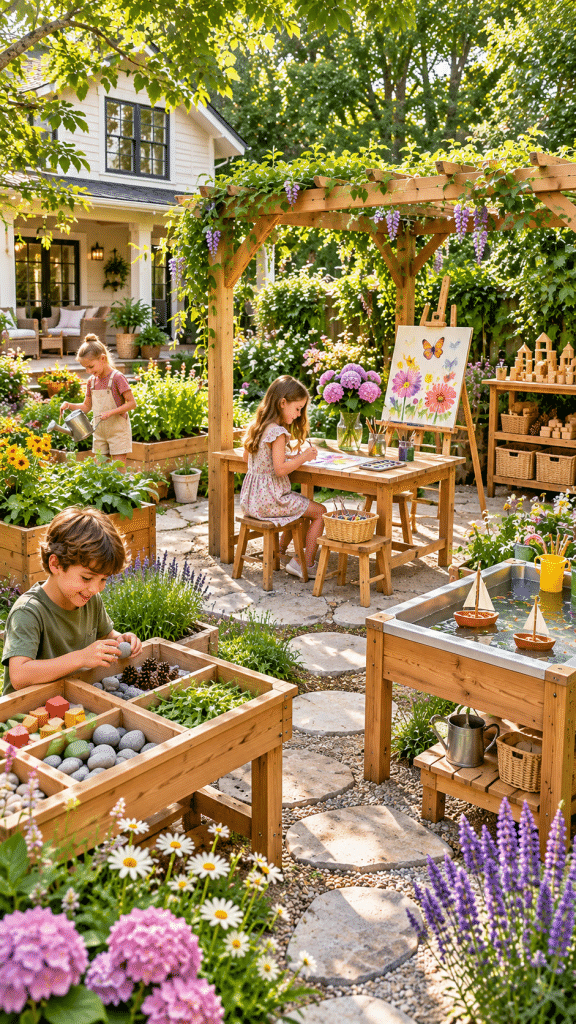
Imagine a charming outdoor creative garden with a miniature art studio, a beautifully organized sensory workbench, a shallow supervised water-play station, and a collection of adaptable nature-inspired activities.
Instead of relying on climbing equipment or expansive lawns, this concept transforms a small outdoor area into a place where children can experiment, build, design, and discover.
A creative sensory maker garden is particularly appealing because many activities can take place within a compact footprint.
Even a modest courtyard or narrow garden can accommodate an inspiring collection of outdoor workstations when the layout is carefully planned.
The key is to create a visually harmonious setting that remains flexible enough for constantly changing activities.
🎨 Create a Beautiful Outdoor Art Studio
An outdoor art studio introduces a wonderful opportunity for creative expression.
A child-height worktable, washable activity surface, and weather-resistant storage can establish a practical foundation.
Position the studio in a shaded area where children can work comfortably without excessive exposure to direct sunlight.
An outdoor easel or securely mounted drawing board offers a vertical creative surface, helping preserve limited table space.
Choose washable, non-toxic materials suitable for the children’s ages.
Children might paint landscapes inspired by the garden, create nature-themed collages, or experiment with patterns using leaves and other safe materials.
A thoughtfully designed studio can feel attractive without becoming visually complicated.
Natural wood furniture, woven-look storage containers, and a restrained palette of cream, sage, and terracotta create a warm, contemporary appearance.
Keep art supplies organized in labeled containers so children can select materials and participate in cleanup.
The studio becomes more engaging when its activities change regularly.
Seasonal colors, garden observations, and simple construction projects provide fresh inspiration while using the same basic furniture.
💧 Introduce a Supervised Water Discovery Station
Water activities can provide memorable sensory experiences, particularly in warm weather.
A child-appropriate shallow activity tray placed at a comfortable height can support simple experiments involving pouring, floating, and observing how water moves.
Children might compare which safe objects float, investigate how different containers hold water, or experiment with funnels and measuring cups.
These experiences encourage curiosity through hands-on observation.
The station does not require a large permanent water feature.
A removable activity tray is often more practical because it can be emptied, cleaned, and stored immediately after use.
This also helps keep the surrounding area uncluttered.
Use a stable work surface with a slip-resistant surrounding area and avoid placing water activities near electrical equipment.
Young children require continuous, close adult supervision around water, even when only a small amount is present.
Empty and store containers after every session to prevent unsupervised access and standing water.
A removable water station provides the appeal of sensory exploration without turning the garden into a permanent aquatic play environment.
🌻 Design a Miniature Garden Laboratory for Young Explorers
A miniature garden laboratory encourages children to observe living things and participate in simple gardening activities.
A small raised planting bed, appropriately sized watering can, and child-safe gardening tools can create an inviting introduction to plant care.
Choose plants that are suitable for the local climate and safe for children to handle.
Fast-growing edible plants, familiar herbs, and colorful flowers can be rewarding options when their identification and suitability are confirmed.
Children can observe seeds germinating, compare leaves, notice changes in plant height, and learn how sunlight and water affect growth.
A simple planting calendar can make the activity even more interesting.
For example, children may mark the date when seeds are planted and record visible changes over the following weeks.
Garden labels add a decorative element while helping children recognize different species.
The growing area should remain separate from active running or climbing zones to reduce accidental damage.
Small gardens can benefit from compact raised beds, vertical planters, or containers positioned along a sunny boundary.
This makes gardening accessible without sacrificing the main play space.
🪨 Build a Nature Inspired Sensory Exploration Table
A sensory table introduces a flexible activity zone where children can investigate colors, shapes, textures, and materials.
A sturdy child-height table with removable trays makes it easy to change activities.
One session might involve exploring damp soil with appropriate tools, while another could focus on sorting large smooth natural objects by texture or color.
For older children, carefully selected age-appropriate materials may support more elaborate creative projects.
Avoid small objects for children who may put items in their mouths, and check all natural materials for sharp edges, contamination, irritants, and choking hazards.
A sensory station should also remain easy to clean.
Removable containers, washable surfaces, and nearby storage reduce maintenance and make spontaneous activities more practical.
The visual design can remain simple.
A natural wood table surrounded by potted greenery and neatly arranged activity containers fits beautifully into a contemporary family garden.
Unlike a fixed playground feature, the table changes character whenever its materials and activities change.
🏡 Add a Miniature Outdoor Workshop for Imaginative Projects
An outdoor maker workshop offers a different type of creative play.
Instead of focusing entirely on drawing or painting, it encourages children to build and assemble imaginative objects using age-appropriate materials.
Large interlocking construction pieces, child-safe reusable components, and supervised craft projects provide opportunities to experiment with shapes and structures.
A small workbench with organized storage can establish the workshop atmosphere.
Children might design miniature pretend villages, create garden signs, assemble temporary sculptures, or construct imaginative landscapes using suitable materials.
Activities can become more sophisticated as children develop new skills.
For younger children, the focus may remain on arranging large lightweight objects.
Older children can explore increasingly detailed design challenges under appropriate supervision.
Keep actual power tools, sharp woodworking equipment, chemical adhesives, and other hazardous workshop supplies securely inaccessible.
The maker workshop should encourage creativity without introducing unnecessary risks.
🌸 Make the Sensory Garden Beautiful for Adults Too
A creative play area can integrate seamlessly into a sophisticated outdoor living environment.
The secret is to establish a coordinated visual language.
Choose furniture with similar finishes, repeat a small selection of natural materials, and avoid excessive decorative accessories.
Warm timber, muted green planters, pale stone paving, and subtle woven textures can create a beautiful foundation.
Arrange the main activity stations along the perimeter of the garden, leaving the center relatively open.
This makes a small backyard feel more spacious while keeping individual activity zones recognizable.
Vertical storage is especially useful.
Wall-mounted cabinets and secure shelving designed for outdoor use can organize supplies while remaining outside children’s climbing and fall areas.
Child-accessible materials should be stored at appropriate heights, while heavier equipment and hazardous items remain secured.
A few carefully placed plants can soften the appearance of workstations and introduce natural beauty.
The finished result should feel like a charming miniature creative studio nestled within a garden rather than a cluttered collection of children’s furniture.
Why this idea earns third place: The creative sensory maker garden offers impressive versatility in a small footprint. Its adaptable stations encourage artistic exploration, nature observation, and imaginative construction while maintaining an attractive outdoor environment.
How to Combine the Best 3 Backyard Play Area Ideas Into One Extraordinary Family Garden
Although each featured concept can function independently, larger gardens may benefit from combining selected elements.
A woodland discovery trail could connect a compact climbing area to a creative garden studio.
This arrangement creates an engaging transition between imaginative exploration, energetic movement, and quieter hands-on activities.
The challenge is to maintain clear boundaries between activities that require different levels of supervision and different safety conditions.
🌿 Create Three Connected Zones With Different Play Experiences
A garden divided into three complementary zones can provide extraordinary variety.
The first zone might feature natural pathways, observation points, and imaginative discovery destinations.
The second could provide age-appropriate physical activities with dedicated protective surfaces and clear equipment spacing.
The third might contain a shaded creative workstation, gardening containers, and removable sensory activities.
Visual connections between these areas make the garden feel cohesive.
Repeat similar planting styles, timber finishes, and landscape colors throughout the space.
Maintain clear walking routes between zones while preserving appropriate separation around climbing equipment and water activities.
A continuous route can encourage movement through the garden without forcing every activity into a single crowded area.
This approach is particularly useful for families with children who enjoy different types of play.
🌞 Use Sunlight and Shade to Organize the Backyard Naturally
Outdoor conditions should influence the placement of each activity.
A planting station may benefit from a sunny position, depending on the chosen plants.
Art activities and reading areas often work better in comfortable shade, especially during warm afternoons.
Climbing equipment requires careful consideration of sun exposure because some surfaces can become dangerously hot.
Observe the movement of sunlight across the garden before finalizing the layout.
Existing buildings, mature trees, fences, and neighboring structures may create useful areas of shade.
Where additional protection is needed, choose suitable shade solutions that do not interfere with equipment clearances or introduce attachment hazards.
A well-organized combination of sunlight and shade makes the backyard more comfortable throughout the day.
🪴 Choose Materials That Connect Every Play Zone
A unified material palette helps prevent the garden from looking fragmented.
Timber can connect a woodland shelter, adventure structure, and creative workbench.
Consistent planting containers and complementary paving finishes reinforce visual harmony.
Consider using warm natural materials paired with muted greens, soft grays, and neutral outdoor fabrics.
Durability is especially important because family gardens experience frequent movement, changing weather, and regular cleaning.
Choose surfaces that provide good drainage and appropriate slip resistance.
Materials should also be selected according to their specific function. A decorative path surface may be suitable for walking while being inappropriate beneath climbing equipment.
Practical performance should always guide the final selection.
Smart Backyard Play Area Layout Ideas for Different Garden Sizes
The best backyard transformation does not necessarily depend on having a large property.
A thoughtful layout can make a small space surprisingly functional.
Rather than copying a design intended for an expansive garden, adapt the central concept to the available dimensions.
🏡 Small Backyard Play Area Ideas for Compact Family Gardens
Compact gardens benefit from multifunctional features.
A creative workstation can include storage beneath its tabletop. A narrow discovery path can wrap around the perimeter. An appropriately designed shaded seating area may support reading, drawing, and quiet imaginative games.
Keep permanent structures to a minimum.
A visually open central area often makes the garden feel larger and provides flexibility for changing activities.
Vertical planters, compact furniture, and neatly organized storage can help preserve precious ground space.
Avoid introducing climbing equipment unless the garden can accommodate the manufacturer’s full required use zone and suitable protective surfacing.
For very small spaces, a creative sensory maker garden may provide the most practical variety.
🌳 Medium Backyard Play Area Ideas With Balanced Activity Zones
Medium-sized gardens often provide enough flexibility to introduce two complementary concepts.
For example, a woodland discovery trail can wrap around a modest open play area.
Alternatively, a compact adventure feature may coexist with a creative station and attractive perimeter planting.
Use landscaping to give each activity a recognizable identity without introducing barriers that obstruct supervision.
A small tree, cluster of shrubs, or change in paving appearance can establish visual separation.
Maintain sufficient circulation space and avoid overcrowding.
A medium garden frequently feels more inviting with fewer well-designed features than with numerous unrelated structures.
🌲 Large Backyard Play Area Ideas With Multiple Adventure Destinations
Expansive gardens offer opportunities for a more elaborate design.
A woodland trail could connect several activity destinations, with a dedicated adventure playground positioned on suitable ground and a creative studio located closer to the house.
Longer pathways can make movement between areas feel like part of the experience.
Larger gardens also provide more opportunities for planting, seasonal interest, and quiet outdoor retreat spaces.
However, additional space does not remove the need for supervision.
Children’s activities should remain within practical sightlines, and remote corners should not become difficult to monitor.
A successful large play garden feels connected and easy to navigate rather than scattered across disconnected areas.
Backyard Play Area Budget Planning for a Beautiful and Practical Transformation
Creating a remarkable play garden does not require completing every feature at once.
A phased approach allows families to establish essential infrastructure first and introduce additional activities over time.
The following table illustrates an approximate planning framework using broad budget categories rather than fixed prices, which vary considerably by region, materials, installation requirements, and equipment specifications.
| Design Element | Budget Friendly Approach | Higher Investment Approach |
|---|---|---|
| Woodland pathways | Simple durable ground-level route | Professionally installed landscaped pathway |
| Imaginative shelter | Small manufactured playhouse | Custom-designed garden shelter |
| Adventure activities | Portable age-appropriate ground-level equipment | Professionally installed climbing system |
| Creative workstations | Adapted outdoor activity table | Custom weather-resistant maker station |
| Garden planting | Small containers and young plants | Mature landscaping and professionally designed beds |
| Outdoor storage | Compact weather-resistant storage unit | Integrated built-in cabinets |
| Shade | Suitable portable or existing shade | Professionally installed shade structure |
💰 Prioritize the Features Children Will Actually Use
Before purchasing equipment, identify the activities that interest the children most.
A family whose children love drawing and building may receive more value from a well-designed creative station than an elaborate climbing structure.
Children who enjoy movement may prefer adaptable obstacle activities and dedicated open space.
Nature enthusiasts may spend hours exploring a modest discovery garden.
Prioritizing genuine interests can prevent unnecessary purchases.
It also helps families invest in durable features rather than accumulating equipment that quickly loses its appeal.
🛠️ Build the Backyard in Thoughtful Stages
A practical transformation can begin with the main landscape layout.
Establish drainage, essential pathways, suitable ground surfaces, and appropriate planting locations first.
Next, introduce the primary activity feature.
This might be a creative workstation, a woodland shelter, or a professionally installed adventure structure.
Finally, add adaptable decorative details, movable activities, and seasonal planting.
The phased approach makes it easier to evaluate how children actually use the space before committing to further permanent installations.
It also allows the garden to evolve naturally.
Beautiful Backyard Play Area Landscaping Details That Make Every Design Feel Special
Small design decisions can dramatically influence the atmosphere of a play garden.
The most memorable spaces often combine practical planning with carefully considered decorative details.
🌼 Use Layered Planting to Create Natural Wonder
Planting can turn simple outdoor activities into immersive experiences.
Low-growing flowers near observation stations, graceful ornamental grasses along pathways, and carefully positioned trees can create a sense of natural discovery.
Choose resilient plants that tolerate the conditions of an active family garden.
Avoid poisonous species, sharp thorns, irritating sap, and plants that produce hazardous fruits or seeds.
Select suitable species for the local growing conditions rather than relying entirely on decorative appearance.
A restrained planting palette often creates a more harmonious result than introducing too many unrelated varieties.
🧺 Integrate Attractive Storage Without Cluttering the Garden
Accessible storage helps children participate in caring for their outdoor environment.
Portable activity materials can be organized into clearly labeled containers.
Art supplies, garden tools, and construction pieces should have dedicated storage locations.
Weather-resistant cabinets can protect materials when they are not being used.
Position storage outside active equipment zones and secure units that could tip if climbed.
A consistent storage system makes cleanup easier while preserving the beautiful appearance of the garden.
🎨 Introduce a Playful Color Palette That Complements the Landscape
Bright colors can create an energetic atmosphere, but a sophisticated play garden does not require every surface to be vividly colored.
Natural timber, sage green, muted mustard, warm terracotta, and cream provide a softer alternative.
These shades complement plants and landscape materials while still feeling cheerful.
Colorful details can be introduced through removable accessories, activity equipment, or small painted decorative features.
This approach allows the garden’s appearance to evolve as children’s preferences change.
How to Keep Backyard Play Areas Exciting Throughout the Year
A beautifully designed play garden should remain useful beyond one season.
Seasonal changes can become part of the experience.
During spring, children might observe emerging flowers and participate in simple planting activities.
Summer can bring supervised water experiments, outdoor art sessions, and shaded nature exploration.
Autumn introduces changing leaf colors, seed observations, and creative projects inspired by fallen natural materials.
In colder months, suitable weather-resistant activities can continue when conditions are safe, surfaces are not slippery, and children are dressed appropriately.
🍂 Refresh Activities Without Redesigning the Garden
The best way to maintain interest is to change the activities rather than constantly replacing structures.
A woodland trail can feature a different nature observation theme each month.
A modular adventure area can introduce new ground-level movement challenges.
A creative maker garden can rotate between painting, gardening, and construction activities.
These changes give children fresh reasons to explore the same outdoor environment.
They also reduce the need for expensive new equipment.
🌦️ Maintain the Garden for Long Term Enjoyment
Regular maintenance preserves both appearance and usability.
Inspect playground equipment for movement, corrosion, loose hardware, splintering, and damaged components.
Check walking surfaces for slippery areas, standing water, or emerging trip hazards.
Maintain appropriate protective surfacing around equipment and follow the relevant manufacturer’s recommendations.
Trim plants that obstruct visibility or encroach on play areas.
Clean activity tables, storage units, and removable materials regularly.
Seasonal inspections are particularly useful after strong winds, heavy rainfall, or prolonged exposure to harsh weather.
A well-maintained garden remains inviting and supports safer play.
Frequently Asked Questions About Backyard Play Area Ideas
What Is the Best Backyard Play Area Idea for a Small Garden
A creative sensory maker garden is often an excellent choice for limited spaces because it offers several activities within a compact footprint.
An outdoor art table, removable sensory trays, and a small planting station can create a varied environment without requiring a large permanent playground structure.
A short nature discovery trail may also work beautifully when existing landscaping provides suitable space.
How Can a Backyard Play Area Look Beautiful Instead of Cluttered
Use a consistent material palette and limit the number of permanent structures.
Natural timber, coordinated planters, restrained colors, and organized storage help create visual harmony.
Keep clear spaces between activity zones and integrate planting around the garden’s perimeter.
An attractive family garden benefits from the same principles of balance, proportion, and thoughtful composition used in professional landscape design.
What Can Children Do in a Backyard Without a Swing Set
Children can enjoy nature exploration, gardening, outdoor art, imaginative storytelling, ground-level movement games, and supervised sensory activities.
Flexible activities are particularly valuable because they can change according to age, interests, and available space.
A backyard does not need large playground equipment to offer meaningful outdoor experiences.
How Do You Make a Backyard Play Area Suitable for Different Ages
Create flexible activity zones and select equipment according to each child’s developmental abilities.
Ground-level creative stations, accessible paths, and planting activities may support a broad range of ages when materials are appropriately selected.
More challenging physical equipment should follow manufacturer age recommendations and safety requirements.
Separate activities when different age groups need incompatible equipment or supervision.
Are Natural Backyard Play Areas Better Than Plastic Playgrounds
Natural play gardens offer advantages such as attractive landscaping, seasonal variety, and opportunities for observing the outdoor environment.
However, natural materials are not automatically safer or more suitable than manufactured playground equipment.
Both approaches can provide enjoyable experiences when properly designed and maintained.
The most effective choice depends on children’s needs, available space, maintenance expectations, and safety requirements.
How Much Space Do You Need for an Amazing Backyard Play Area
There is no universal minimum size for every type of play garden.
A compact creative station may fit within a relatively small courtyard, while a climbing structure requires a much larger area to accommodate equipment dimensions and the specified use zone.
The most important factor is selecting activities appropriate to the available space rather than attempting to fit oversized equipment into a limited garden.
Final Thoughts on the Best 3 Backyard Play Area Ideas for a Magical Family Garden
An extraordinary backyard play area is not defined by the number of toys, the size of the playground, or the cost of the landscaping. Its real value comes from the experiences it creates and the opportunities it gives children to explore, imagine, move, and discover.
The 🥇 Enchanted Woodland Discovery Trail stands out for its beautiful natural atmosphere, imaginative destinations, and ability to turn ordinary garden pathways into exciting adventures. Its combination of planting, exploration, and storytelling makes it an especially memorable option for families who appreciate nature-inspired design.
The 🥈 Modular Adventure Playground offers a more energetic approach, combining physical challenges, flexible movement activities, and contemporary outdoor aesthetics. It is particularly appealing for active children and families seeking a playground layout that can adapt over time.
The 🥉 Creative Sensory Maker Garden demonstrates that even a compact backyard can provide remarkable opportunities for discovery. Its combination of artistic workstations, supervised sensory activities, and miniature gardening experiences offers impressive versatility without requiring an expansive lawn.
The most successful Backyard Play Area Ideas share one essential quality: they make the garden feel like a place of possibility.
A winding pathway can become an enchanted forest. A carefully designed movement circuit can inspire exciting expeditions. A simple outdoor worktable can become a creative studio filled with remarkable inventions.
With attractive landscaping, flexible activity zones, suitable safety measures, and thoughtful details, an ordinary backyard can become a welcoming family paradise that grows with children’s curiosity and provides years of meaningful outdoor enjoyment.